
Key Takeaways
- Minnesota's LP credential requires a doctoral degree, while a master's caps licensure at the LPCC level.
- School psychologists in Minnesota earn a median annual wage of $83,699 according to 2025 state OEWS data.
- Most top-ranked psychology programs in Minnesota for 2026 are delivered fully online, with only one using a hybrid format.
- Net tuition across the 11 ranked schools varies widely, so comparing aid-adjusted costs is essential before enrolling.
Public versus private, online versus residential: those two contrasts define most of the practical decision-making for psychology students in Minnesota in 2026. Public institutions in the Minnesota State system charge in-state tuition starting around $10,200 per year, while private universities on this list range from roughly $25,600 to over $50,000 before aid.
Minnesota's demand for mental health professionals remains strong. The state tracks shortages in licensed clinical roles across both urban and rural counties, and master's-level counseling programs in Minnesota have expanded their online offerings in direct response. Across the 11 schools and 27 program listings evaluated here, the emphasis is on affordability and flexibility, with most programs available fully online.
The rankings cover bachelor's degrees, graduate certificates, and master's programs, with attention to tuition, net price, specializations, accreditation status, and licensure alignment. One factor shapes everything else: your degree level determines which Minnesota license you can hold. A master's qualifies you for LPCC status; the LP credential requires a doctorate. That credential ceiling is worth understanding before you choose a program.
2026 Best Psychology Programs in Minnesota: Full Rankings
Minnesota's psychology landscape in 2026 spans public universities in the Minnesota State system, faith-integrated private colleges, and nationally recognized online institutions headquartered in the Twin Cities. Across the 11 schools and 27 distinct program listings below, you will find bachelor's degrees, master's programs, doctoral tracks, and graduate certificates covering specializations from clinical counseling and forensic psychology to autism spectrum disorders and industrial-organizational psychology. Each listing is sorted by a methodology that rewards lower net price, strong financial aid availability, and meaningful outcome indicators, so affordability and access are front and center.
- Net price after financial aid
- Financial aid and Pell Grant access
- Graduation and retention outcomes
- Online or hybrid delivery options
- Program breadth and specialization depth
- NCES-IPEDS federal institutional data — nces.ed.gov
- Internal program database
- College Scorecard graduate earnings — collegescorecard.ed.gov
- Independent program research

Bemidji State University
Bemidji State University is a Minnesota State system school that extends in-state tuition to online students regardless of home state, making it one of the most budget-friendly paths to a psychology degree in the region. Its fully online BA and BS in General Psychology require no special admission criteria and emphasize practical skills, research methods, and internship opportunities. Rural Minnesota learners and working adults benefit from a format designed to eliminate campus visits entirely.
- Fully online with no on-campus requirement
- BA and BS tracks available
- Open to all admitted BSU students, no extra application
- Internship opportunities integrated into curriculum
- Flexible electives let students tailor career focus
- Prepares graduates for master's or doctoral study
General Psychology (BA/BS) — Online

Southwest Minnesota State University
Southwest Minnesota State University, another Minnesota State institution, ranks highly for affordability thanks to a low net price and competitive tuition that extends broadly to online students. Its 12-credit Graduate Certificate in Autism Spectrum Disorders is purpose-built for educators and healthcare professionals who need specialized ASD training aligned with Minnesota special-education licensure expectations. The program's compact, fully online format lets working professionals finish quickly without leaving their current roles.
- 12-credit fully online program
- Covers assessment, programming, and behavioral strategies
- Designed for educators and healthcare professionals
- Aligns with Minnesota special-education endorsement needs
- Requires only a bachelor's degree for admission
- Flexible scheduling for working adults
Graduate Certificate in Autism Spectrum Disorders — Online
Capella University
Capella University, headquartered in Minneapolis, is one of the largest online psychology program providers in the country and offers an unusually deep catalog of specializations from a single institution. Students can pursue master's degrees in clinical counseling, clinical mental health, forensic psychology, and industrial-organizational psychology, or continue to doctoral work in general, educational, or developmental psychology. The CACREP-accredited clinical mental health counseling track is structured to meet Minnesota LPCC academic requirements, while FlexPath and GuidedPath formats give self-directed learners a way to control both pace and cost.
- APA-accredited, 74 quarter credits
- Includes practicum and internship components
- No GRE or GMAT required for admission
- Online with limited in-person residencies
- Prepares students for doctoral-level study
- Focus on ethics and multicultural competence
- CACREP-accredited program
- Structured to meet Minnesota LPCC academic requirements
- Online with in-person clinical components
- Specializations available within the degree
- Bachelor's degree and 2.7 GPA required
- Scholarships and military tuition benefits offered
- Competency-based online curriculum
- Multiple specialization tracks available
- No GRE or GMAT required
- Accredited by Higher Learning Commission
- Up to 15 transfer credits accepted
- Designed for working adults seeking flexibility
- 53 total credits, fully online
- Develops forensic assessment and research skills
- Covers psychology and law, criminal behavior analysis
- No application fee
- Bachelor's degree and 2.3 GPA needed
- Scholar-practitioner faculty with field experience
- FlexPath self-paced option available
- 53 credits via GuidedPath or 27 program points via FlexPath
- Covers talent management and organizational behavior
- No entrance exam required
- Accepts up to 15 transfer credits
- One-on-one academic coaching included
- 84 quarter credits, fully online
- Three virtual residencies required
- $48,000 tuition cap for the program
- Master's degree and 3.0 GPA required
- Research-focused, not designed for licensure
- Up to 24 transfer credits accepted
- 84 quarter credits with dissertation
- Seven specialization courses in learning strategies
- Virtual residencies replace campus attendance
- Not a licensure-preparation program
- 10% military discount available
- Prepares graduates for teaching and research roles
- 80 to 84 quarter credits depending on track
- Concentrations include child/adolescent and health development
- Four residencies and dissertation required
- As few as 33 months to completion
- Up to $5,000 grant for eligible students
- Master's degree required for admission
- 180-credit fully online bachelor's program
- Aligned with BACB 6th edition standards
- Prepares students for BCBA/BCaBA certification paths
- Synchronous live group meetings included
- Up to 120 transfer credits accepted
- No-cost general education courses available
MS in Clinical Psychology, Clinical Counseling — On-Campus
MS in Clinical Mental Health Counseling — On-Campus
MS in Clinical Psychology — On-Campus
MS in Clinical Psychology, Forensic Psychology — Online
MS in Psychology, Industrial/Organizational Psychology — Online
PhD in Psychology, General Psychology — Online
PhD in Psychology, Educational Psychology — Online
PhD in Developmental Psychology — Online
BS in Psychology, Applied Behavior Analysis — Online

Minnesota State University Moorhead
Minnesota State University Moorhead pairs affordable Minnesota State system tuition with a hybrid delivery model that blends online coursework and on-campus components. Its undergraduate psychology program features 10 research labs and faculty collaboration, while the NASP/CAEP-approved School Psychology specialist program is a primary pipeline to Minnesota school psychologist licensure. MSUM's hybrid format is especially practical for upper-Midwest professionals who can attend periodic campus sessions in Moorhead.
- Hybrid format with online and on-campus elements
- Access to 10 on-campus research labs
- Faculty-led research collaboration opportunities
- Membership in Psi Chi and Psychology Club
- Emphasis on critical thinking and communication
- Strong preparation for graduate study
- NASP/CAEP-approved program
- 65 to 68 semester credits depending on track
- 1,200-hour supervised internship required
- Designed for Minnesota school psychologist licensure
- In-state tuition extended broadly
- High job placement rates in regional K-12 systems
General Psychology (BA/BS) — Hybrid
MS and Specialist in School Psychology — Hybrid

Concordia University-Saint Paul
Concordia University-Saint Paul is a private institution that consistently appears among Minnesota's best-value online psychology options thanks to competitive per-credit tuition and generous credit-transfer policies. Its fully online BA in Psychology targets adult learners with an accelerated format and year-round start dates, while the Graduate Certificate in Special Education with an ASD emphasis helps Minnesota teachers add autism-related competencies. Both programs operate entirely online, with no campus attendance required.
- Fully online, accelerated format for adults
- Covers counseling, research methods, and cognition
- Experiential learning options including internships
- Strong credit-transfer acceptance policies
- Prepares graduates for master's-level study
- No campus attendance required
- Online format designed for working educators
- Blends ASD theory with classroom practice
- Financial aid available for graduate students
- Supports Minnesota special-education endorsement goals
- Bachelor's degree required for admission
- Flexible scheduling for professionals
Psychology Major (BA, Adult Online) — Online
Special Education with Autism Spectrum Disorders Emphasis (Graduate Certificate) — Online

Saint Mary's University of Minnesota
Saint Mary's University of Minnesota stands out for a remarkably low average net price relative to its sticker tuition, reflecting substantial institutional aid. Its fully online BS in Applied Psychology accepts up to 90 transfer credits, potentially letting students finish the degree in as few as 90 total credits rather than the traditional 120. The hybrid MS in Clinical Psychology integrates Catholic faith perspectives with clinical training structured to meet Minnesota LPC/LPCC academic requirements.
- Fully online, $440 per credit
- Up to 90 transfer credits accepted
- Follows APA undergraduate guidelines
- Flexible start dates throughout the year
- Requires at least 30 prior college credits
- Emphasizes scientific reasoning and ethics
- Hybrid format, 60 credits over two years
- $650 per credit with 720 hours of clinical training
- Structured toward Minnesota LPC/LPCC licensure requirements
- Catholic faith integration in curriculum
- Start dates in September and January
- Evidence-based practice and cultural humility focus
BS in Applied Psychology — Online
MS in Clinical Psychology — Hybrid
Walden University
Walden University is a Minneapolis-based online institution offering graduate psychology programs that span forensic, educational, and developmental specializations. Its MS in Forensic Psychology can be completed in as few as 15 months, and the doctoral programs include structured Doctoral Degree Coach support to improve completion outcomes. Walden's quarter-based system, frequent scholarship offerings, and transfer-credit flexibility help manage total cost, though students should note that several PhD tracks are research-focused and do not prepare graduates for clinical licensure.
- 48 quarter credits, completable in 15 months
- Covers victimology, criminal behavior, law enforcement psych
- Capstone or field experience included
- No GRE or application fee required
- Prepares students for nonclinical forensic roles
- Scholarship and grant opportunities available
- 65 to 90 quarter credits depending on prior degree
- Dissertation and four residencies required
- $630 per quarter credit
- Not a licensure-preparation program
- Course waivers possible for master's holders
- Accredited by Higher Learning Commission
- 80 quarter credits with multiple concentration options
- Child/adolescent, health, and self-designed tracks
- As few as 33 months for master's holders
- Four residencies and dissertation required
- Up to $5,000 grant for eligible students
- Doctoral Degree Coach assigned to each student
MS in Forensic Psychology — Online
PhD in Psychology, Educational Psychology — Online
PhD in Developmental Psychology — Online

Crown College
Crown College is a faith-based private institution near the Twin Cities that offers an online Psychology/Counseling BS built around a Christian worldview. Its 8-week course format and flat online tuition are designed for working adults, and the curriculum integrates biblical perspectives on human behavior with foundational counseling skills. Crown also provides an accelerated pathway into its own graduate counseling programs, making it a practical single-institution pipeline from bachelor's to master's study.
- Fully online with 8-week course blocks
- Faith-integrated psychology and counseling curriculum
- Designed for working adults balancing career and school
- Prepares students for master's programs in counseling
- Experienced faculty who are practicing clinicians
- Accelerated master's pathway available at Crown
Psychology/Counseling (BS) — Online

University of Northwestern-St Paul
The University of Northwestern-St Paul offers a 34-credit online Psychology BS with a Health Psychology concentration, targeting adult learners who want an applied, health-focused credential without relocating. Completable in 22 to 26 months at $455 per credit, the program blends Christian perspectives with practical training in counseling techniques and behavioral health. Twin Cities-based students gain access to local practicum and volunteer networks tied to the university's professional community.
- 34-credit online program for adult learners
- $455 per credit with completion in 22 to 26 months
- Health Psychology concentration with applied focus
- Faith-infused curriculum and expert clinician faculty
- Interactive online learning environment
- Generous transfer credit acceptance
Psychology (BS), Health Psychology Concentration — Online

Hamline University
Hamline University is a well-established private university in Saint Paul that recently expanded its psychology offerings with a fully online major geared toward degree-finishers and transfer students. Small class sizes and individualized advising distinguish the experience, and Twin Cities proximity gives online learners access to local internship and graduate-school networks. Financial aid and institutional scholarships help offset the nominal private-school tuition.
- Fully online, transfer-friendly format
- Small class sizes with individualized support
- Career-focused curriculum covering brain, family, and mental health
- Financial aid and scholarships available
- Strong Twin Cities internship connections
- Prepares students for graduate study or workforce entry
Psychology Major (Online BA) — Online

University of St Thomas
The University of St Thomas rounds out the list with an online Graduate Certificate in Autism Spectrum Disorders aimed at educators who want practical strategies for supporting students with autism. Year-round start dates and no specific admission prerequisites make entry straightforward. St Thomas carries the highest graduation rate and median 10-year earnings among all schools on this list, reflecting strong institutional outcomes overall.
- Fully online with year-round start dates
- Covers history, identification, and educational strategies
- Focus on developing individualized education plans
- No specific admissions prerequisites listed
- Practical application emphasis for K-12 educators
- Flexible pacing for working professionals
Certificate in Autism Spectrum Disorders — Online
Tuition and Cost Comparison for Minnesota Psychology Schools
Sticker-price tuition can be misleading. The net price column below reflects the average annual cost after institutional and federal aid, drawn from institution-wide IPEDS and College Scorecard data rather than program-specific figures. That distinction matters: a school with a $50,000 list price may cost less out of pocket than one advertising $10,000 tuition, once grants and scholarships are factored in. Saint Mary's University of Minnesota stands out with the lowest net price on this list at $11,704, despite carrying a $45,080 sticker price. Bemidji State University and Southwest Minnesota State University also come in well under $16,000 in net price, making them strong affordable options. On the other end, Walden University posts the highest net price at $33,817, and the University of St Thomas follows at $29,155. When it comes to median debt at graduation, Capella University reports the lowest figure among these schools at $14,968, which is notable given that nearly 68% of its students receive Pell Grants, the highest share in this group and a useful signal of financial accessibility for lower-income students. Crown College (59.7% Pell recipients) and Southwest Minnesota State University (56.1%) also serve high proportions of Pell-eligible students. Estimated monthly loan payments assume a standard 10-year repayment at a 5% fixed interest rate.
| School | Tuition (In-State / Out-of-State) | Net Price (After Aid) | Median Debt at Graduation | Est. Monthly Payment (10 yr) | Pell Grant Share |
|---|---|---|---|---|---|
| Saint Mary's University of Minnesota | $45,080 | $11,704 | $21,500 | $228 | 51.1% |
| Bemidji State University | $10,237 | $15,261 | $19,750 | $210 | 50.9% |
| Southwest Minnesota State University | $10,360 | $15,291 | $20,500 | $217 | 56.1% |
| Capella University | $15,092 | $17,956 | $14,968 | $159 | 67.8% |
| Minnesota State University Moorhead | $10,428 | $17,997 | $20,000 | $212 | 46.5% |
| Concordia University, Saint Paul | $25,600 | $18,462 | $17,832 | $189 | 55.3% |
| Hamline University | $50,004 | $20,744 | $23,770 | $252 | 52.2% |
| Crown College | $31,410 | $26,672 | $22,500 | $239 | 59.7% |
| University of Northwestern, St Paul | $37,920 | $27,705 | $21,325 | $226 | 46.7% |
| University of St Thomas | $21,151 | $29,155 | $23,250 | $247 | 31.5% |
| Walden University | $10,885 | $33,817 | $20,834 | $221 | 54.7% |
Questions to Ask Yourself
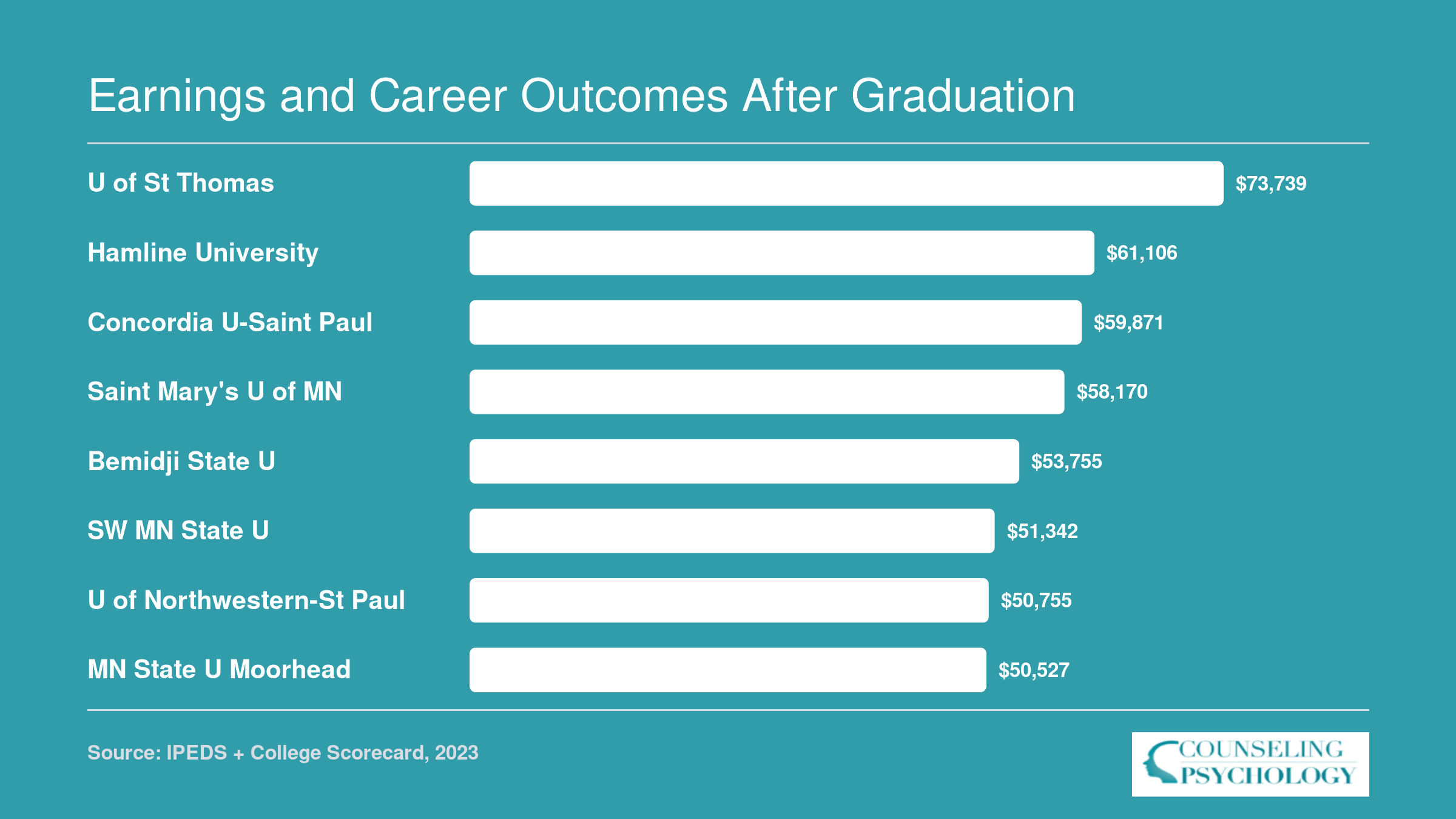
Earnings and Career Outcomes After Graduation
The chart below ranks Minnesota psychology schools by institution-level median earnings ten years after enrollment, drawn from College Scorecard data. These figures reflect all completers at each school, not a single psychology program, so they capture the overall earning trajectory of each institution's graduates. Program-level completer outcomes, such as median earnings at the one-year and four-year marks after completion, employment share among those working and not enrolled one year out, and the share earning above 150% of the federal poverty line, are not yet published for these specific psychology programs. When those metrics become available, they will offer a more precise picture of how each program's graduates fare in the job market.
What Licensed Psychologists Earn in Minnesota
School psychologists in Minnesota earn a median annual wage of $83,699, with the middle half of the workforce making between $74,006 and $99,112.1 That figure sits well above the kind of early-career numbers you see in program-level outcome data.
Bridging from Graduate Earnings to Career Wages
The earnings reported by recent graduates (covered in the previous section) capture a snapshot of new completers, often within a year or two of finishing their degree, while many are still accruing supervised hours, working at provisional licensure rates, or splitting time between part-time clinical work and other employment. The Bureau of Labor Statistics wages below reflect the broader licensed workforce: practitioners across all career stages, including senior clinicians and supervisors. Expect the BLS figures to run noticeably higher than what you might earn in your first or second year out.
School Psychologists in Minnesota
Minnesota employs roughly 1,070 school psychologists statewide.1 The full salary distribution runs from about $63,586 at the 10th percentile to $108,680 at the 90th percentile, with a mean wage of $88,296. Roughly 820 of those positions, more than three-quarters, are concentrated in the Minneapolis-St. Paul, MN-WI metropolitan area, where the median climbs slightly to $86,299. If you are considering this track, an educational psychology degree can be a strong foundation for school-based roles.
Clinical and Counseling Psychologists in the Twin Cities
For clinical and counseling psychologists, the most reliable Minnesota-specific figures come from the May 2023 OEWS estimates for the Minneapolis-St. Paul-Bloomington MSA.2 The metro reported about 1,070 clinical and counseling psychologists with a median wage of $92,998 and a mean of $100,318. The distribution is wider than for school psychologists: 10th percentile earners made $48,589, while the 90th percentile reached $146,994. That spread reflects the difference between early-career licensees in community mental health settings and established clinicians in private practice, hospital systems, or specialty roles.
Metro vs. Greater Minnesota
State-level wage data for clinical and counseling psychologists outside the Twin Cities is thinner, but the pattern in school psychology, where Minneapolis-St. Paul medians sit a few thousand dollars above the statewide figure, is consistent with what you would generally expect: metro positions tend to pay somewhat more, while rural and outstate roles may offer loan repayment incentives, lower cost of living, or shortage-area designations that change the overall financial picture.
Online vs. On-Campus Psychology Programs in Minnesota
Most psychology programs ranked in Minnesota for 2026 are delivered fully online, making them accessible to students across the state and beyond. Only one program on the list, Minnesota State University Moorhead, uses a hybrid format that blends online coursework with on-campus components. Understanding the tradeoffs between these delivery modes can help you pick the format that fits your life and career goals.
| Dimension | Fully Online | Hybrid (Online + Campus) |
|---|---|---|
| Programs on this list | Bemidji State, Southwest Minnesota State, Capella, Concordia-Saint Paul, Saint Mary's, Walden, Crown College, University of Northwestern-St Paul, Hamline, University of St Thomas | Minnesota State University Moorhead |
| Scheduling flexibility | High. Asynchronous coursework lets working professionals and students outside the Twin Cities study on their own schedule. | Moderate. Some courses or lab sessions require in-person attendance on a set schedule. |
| Typical in-state tuition range | Roughly $10,237 to $50,004, depending on the school (public universities cluster near $10,000 to $15,000; private institutions are higher) | $10,428 at MSUM, one of the most affordable options in the rankings |
| Access to research labs and practicum sites | Limited on-campus lab access; practicum or internship hours are typically arranged in the student's local community | Direct access to 10 research labs and faculty-led projects at MSUM, plus campus-based practicum coordination |
| Networking and campus life | Virtual peer interaction through discussion boards and group projects; organizations like Psi Chi may offer online chapters | In-person involvement in clubs such as Psi Chi and Psychology Club, plus opportunities to present at conferences alongside faculty |
| Student-to-faculty ratio | Ranges from 14:1 (Hamline, St Thomas) to 41:1 (Capella); large online universities tend toward higher ratios | 17:1 at MSUM, offering a balance of personal attention and class size |
| Best fit for | Working adults, career changers, students in rural Minnesota, and anyone who needs maximum schedule control | Students who want structured campus engagement alongside online convenience, especially those near Moorhead |
Psychology Specializations Available in Minnesota
The specialization you choose shapes both your day-to-day coursework and the licensure path available after graduation. Clinical and counseling psychology tracks are the most common across Minnesota schools, but a handful of programs offer distinctive concentrations you won't find everywhere. General psychology at the bachelor's level remains the broadest entry point, while master's programs branch into clinical counseling, forensic psychology, health psychology, and applied behavioral areas. Among the ranked schools, Capella University offers a Master of Science in Clinical Psychology with a Clinical Counseling specialization, and Walden University provides a dedicated MS in Forensic Psychology, a niche track that only one other large online institution in the state carries. Crown College and the University of Northwestern-St Paul stand out for faith-integrated approaches; Crown pairs counseling psychology with a biblical framework, while Northwestern offers a Health Psychology concentration. For students interested in autism-related work, both Southwest Minnesota State University and the University of St Thomas offer graduate certificates in Autism Spectrum Disorders. On the PsyD question: none of the schools in this ranked list currently offer a PsyD program. Students pursuing doctoral-level clinical training in Minnesota typically look to institutions outside this list, such as the University of Minnesota or the Minnesota School of Professional Psychology. In terms of licensure alignment, master's-level clinical counseling tracks (like Capella's) can lead toward Licensed Professional Clinical Counselor (LPCC) credentials, while a doctoral degree is required to earn the Licensed Psychologist (LP) designation in Minnesota. School psychology programs, where offered, lead to a separate Minnesota school licensure credential.
| School | Featured Specialization | Degree Level | Format | Licensure Alignment |
|---|---|---|---|---|
| Bemidji State University | General Psychology | Bachelor's | Online | Foundation for graduate study |
| Southwest Minnesota State University | Autism Spectrum Disorders | Graduate Certificate | Online | Enhances special education credentials |
| Capella University | Clinical Counseling | Master's (MS) | Online with in-person components | LPCC eligibility pathway |
| Minnesota State University Moorhead | General Psychology | Bachelor's | Hybrid | Foundation for graduate study |
| Concordia University-Saint Paul | General Psychology | Bachelor's (BA, Adult) | Online | Foundation for graduate study |
| Saint Mary's University of Minnesota | Applied Psychology | Bachelor's (BS) | Online | Foundation for graduate study |
| Walden University | Forensic Psychology | Master's (MS) | Online | Nonclinical career paths, PhD preparation |
| Crown College | Counseling Psychology | Bachelor's (BS) | Online | Foundation for counseling graduate programs |
| University of Northwestern-St Paul | Health Psychology | Bachelor's | Online | Foundation for health-related graduate study |
| Hamline University | General Psychology | Bachelor's | Online | Foundation for graduate study |
| University of St Thomas | Autism Spectrum Disorders | Graduate Certificate | Online | Enhances special education credentials |
In Minnesota, a master's degree qualifies you for licensure as a Licensed Professional Clinical Counselor (LPCC), not as a Licensed Psychologist (LP). The LP credential requires a doctoral degree. This distinction is fundamental: your degree level sets your licensure ceiling and determines which career paths remain open to you.
Accreditation and Licensure Eligibility in Minnesota
Minnesota recently aligned its psychology licensing regulations more closely with national standards, making credential portability a realistic consideration for students planning careers that might cross state lines. Understanding how accreditation connects to licensure eligibility is essential before you commit to any program.
Minnesota's Two-Tier Licensure System
The Minnesota Board of Psychology maintains distinct credential pathways based on your terminal degree level.1
For the Licensed Psychologist (LP) credential, you need a doctoral degree in psychology. The requirements include:
- Degree: Doctoral degree from an APA or CPA accredited program, or one that otherwise meets Minnesota's curriculum standards
- Supervised practice: 1,800 hours of supervised experience
- Examinations: Both the Examination for Professional Practice in Psychology (EPPP) and the Professional Responsibility Examination (PRE)
If you hold a master's degree in psychology rather than a doctorate, you cannot become a Licensed Psychologist in Minnesota. However, the Licensed Professional Clinical Counselor (LPCC) credential offers a clinical practice pathway for master's-level graduates with counseling-focused training.2 LPCC requirements include:
- Degree: Master's or doctoral degree in counseling
- Supervised practice: 4,000 hours of post-degree supervised experience
- Examinations: Either the National Counselor Examination (NCE) or the National Clinical Mental Health Counseling Examination (NCMHCE), plus the Minnesota jurisprudence exam
Note that LPCC requires a counseling degree specifically, not a general psychology master's. Students completing a master's in experimental or research-focused psychology may need additional coursework to qualify. Those interested in the LPCC route should explore online LPCC programs designed to meet these requirements from the outset.
APA-Accredited Doctoral Programs in Minnesota
For doctoral students pursuing LP licensure, three Minnesota programs currently hold APA accreditation for the 2025-2026 academic year:2
- University of Minnesota Twin Cities (Clinical Psychology PhD)
- University of St. Thomas (Counseling Psychology PsyD)
- Minnesota School of Professional Psychology at Saint Mary's University of Minnesota (Clinical Psychology PsyD)
Graduating from an APA-accredited program simplifies the licensure process because Minnesota automatically deems these programs as meeting curriculum requirements. Graduates from non-accredited programs face additional documentation burdens to prove their training meets state standards.
NASP-Approved School Psychology Programs
School psychologists follow a separate credentialing track through the Minnesota Department of Education rather than the Board of Psychology. Two programs hold National Association of School Psychologists (NASP) approval:2
- University of Minnesota Twin Cities School Psychology Program
- Minnesota State University Mankato School Psychology Program
NASP approval matters for the Nationally Certified School Psychologist (NCSP) credential and helps with license reciprocity if you relocate to another state. For a detailed breakdown of the career path, see our guide on school psychologist requirements.
Regional vs. Programmatic Accreditation
All Minnesota institutions must hold regional accreditation through the Higher Learning Commission to award recognized degrees. Regional accreditation verifies that the institution meets baseline educational standards.
Programmatic accreditation from bodies like APA or NASP evaluates specific programs against profession-specific criteria. For psychology licensure, programmatic accreditation carries the real weight. A regionally accredited school without APA-accredited psychology programs can still award legitimate degrees, but graduates may encounter licensure hurdles in Minnesota and complications when seeking credentials in other states. Our overview of counseling licensure by state can help you evaluate portability before enrolling.
What Licensure Can You Get With a Master's in Psychology in Minnesota?
A master's degree in psychology alone does not qualify you for independent licensure as a psychologist in Minnesota. The LP credential requires a doctorate.1 Master's-level graduates have a few options: pursue the LPCC if their degree meets counseling requirements, work in supervised research or applied settings that do not require independent licensure, or continue to doctoral study. Students who want clinical autonomy with a master's degree should consider counseling-specific programs designed to meet LPCC requirements from the start.
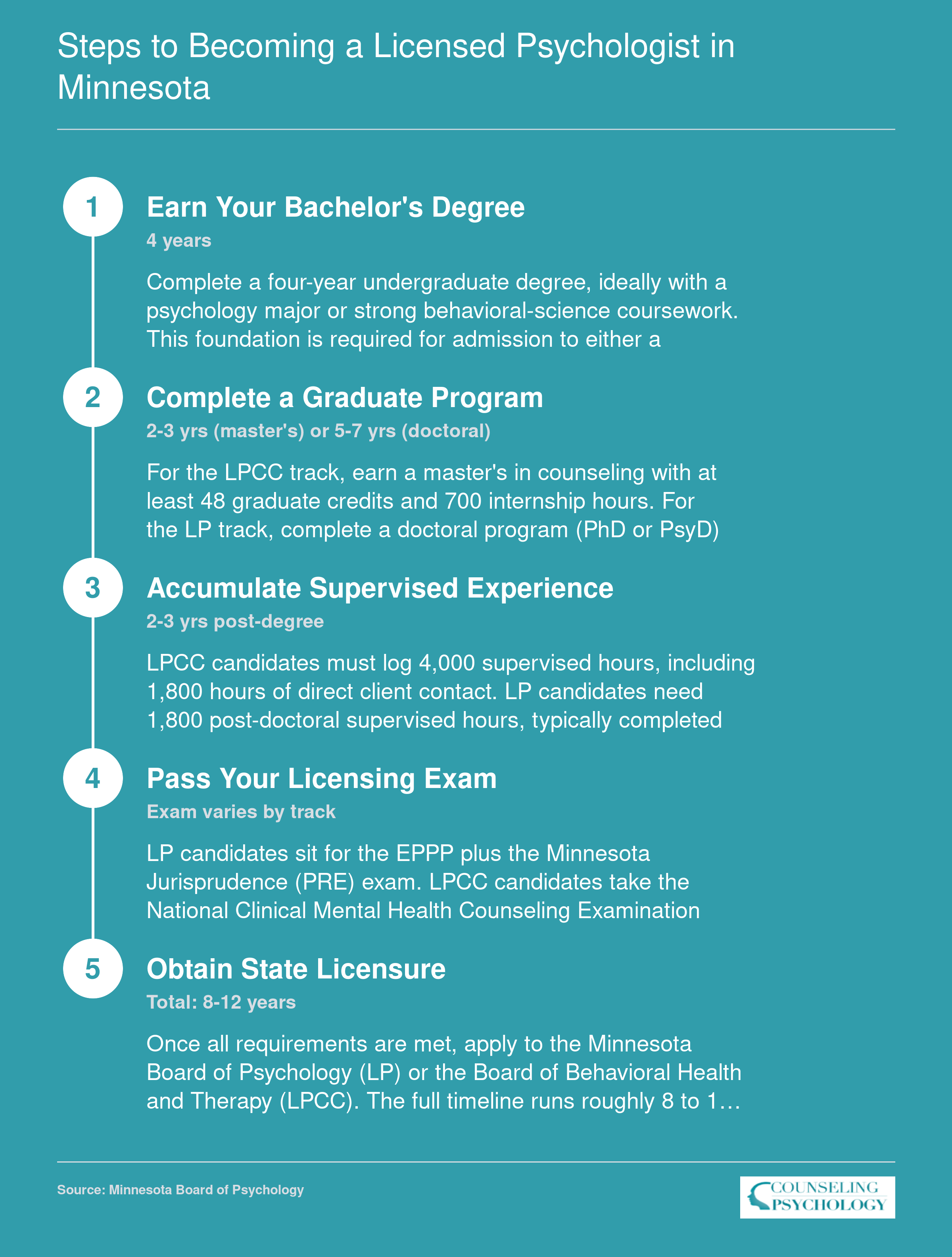
Steps to Becoming a Licensed Psychologist in Minnesota
Minnesota offers two parallel credentialing paths in psychology: the doctoral track leading to Licensed Psychologist (LP) status, and the master's-level track leading to Licensed Professional Clinical Counselor (LPCC). Both require structured education, supervised clinical experience, and a licensing exam, but the timelines and requirements differ significantly.
How to Choose the Right Psychology Program in Minnesota
Selecting the right psychology program requires balancing several factors at once: your career goal, your budget, your schedule, and how quickly you want to enter the workforce. Minnesota offers enough variety that you can find a strong match, but only if you approach the search with clear priorities.
Start With Your Career Goal, Then Work Backward
The single most important decision is matching your degree in psychology to your intended license. If you want to work as a Licensed Professional Clinical Counselor or in most counseling roles, a master's degree is your target. If your goal is to practice as a Licensed Psychologist with full diagnostic and testing privileges, you need a doctorate. This distinction shapes everything else: program length, cost, and the specific credentials you will hold at graduation.
Master's programs typically require two to three years of full-time study, while doctoral programs run four to seven years depending on the discipline. PhD programs often skew longer due to dissertation and research requirements, whereas PsyD programs may emphasize clinical training with a somewhat shorter timeline.
Compare Real Costs, Not Sticker Prices
Net price matters more than published tuition. Institutional aid, scholarships, and graduate assistantships can shift a program's true cost dramatically. Before applying, check each school's net price calculator and, where available, review program-level earnings outcomes to understand how graduates fare financially after completing their degrees. If earnings data is not yet published for a specific program, ask the admissions office what placement and salary information they track internally.
Verify Accreditation and Specialization Fit
Accreditation status determines whether your degree will count toward licensure. For doctoral programs, APA accreditation is the gold standard for clinical and counseling psychology. For counseling master's programs online, CACREP accreditation streamlines the LPCC pathway. Confirm accreditation before investing time in an application.
Specialization availability varies by school. If you have a clear focus, such as clinical psychology, school psychology, or industrial-organizational psychology, verify that the program offers dedicated coursework and supervised experience in that area.
Factor in Format and Minnesota's Job Market
Online programs offer flexibility for working students, but some specializations (clinical, school) require in-person practica regardless of coursework delivery. Hybrid models can split the difference.
Minnesota's employment outlook supports the investment. The state projects 6.5 percent growth for mental health and substance abuse social workers and 6.8 percent growth for educational, guidance, and career counselors through 2032.1 Nationally, the Bureau of Labor Statistics projects 6 percent growth for psychologists through 20342 and 17 percent growth for substance abuse and behavioral disorder counselors over the same period.3 A 2017 DEED report noted that only about half of mental health counselor vacancies were being filled, underscoring persistent demand for qualified professionals.4
With job growth outpacing many other fields, completing an accredited program that aligns with your licensure path positions you for a stable career in a state that needs more mental health practitioners.
Frequently Asked Questions About Minnesota Psychology Programs
Below are answers to the questions prospective psychology students in Minnesota ask most often. Where possible, each response ties back to data and topics covered earlier in this article.