
What you’ll learn in this article…
- Arkansas has two CSWE-accredited MSW programs: University of Arkansas and Arkansas State University, both available online.
- Title IV-E child welfare stipends can cover full tuition and living expenses in exchange for a post-graduation work commitment.
- LCSW licensure requires an MSW, passing the ASWB clinical exam, and completing supervised post-graduate clinical hours.
- Most Arkansas MSW programs no longer require the GRE, though minimum GPA thresholds still apply.
Arkansas has only two CSWE-accredited MSW programs, the University of Arkansas at Fayetteville and Arkansas State University, which together produce fewer than 150 graduates annually. Meanwhile, demand for licensed clinical social workers continues to climb, particularly in underserved rural counties where the ratio of residents to mental health providers far exceeds the national average.
The limited options simplify your search but sharpen the stakes around affordability and format. Arkansas State offers a fully online MSW that costs roughly $20,000 for residents, while the University of Arkansas program, delivered on-campus and in hybrid formats, runs closer to $28,000. Both hold full CSWE accreditation, and both feed into the same state licensure ladder, but the difference in structure, cost, and clinical placement networks can shift your timeline and your debt load.
Arkansas also maintains a Title IV-E stipend program that can cover full tuition and living expenses for students willing to commit to public child welfare after graduation. That funding is competitive and conditional, but it remains one of the few pathways to a debt-free MSW in the state. If you are also considering related helping professions, Arkansas offers strong counseling programs in Arkansas that share overlapping career outcomes.
Best MSW Programs in Arkansas: Rankings & Comparison
Arkansas offers a limited but well-structured set of MSW pathways through its flagship public university, the University of Arkansas in Fayetteville. Whether you are entering social work for the first time or hold a BSW and want to accelerate your career, the programs below provide CSWE-accredited training with flexible delivery options. Program-level earnings data is not yet available for these MSW tracks, but institution-wide median earnings ten years after enrollment sit at $58,191, a useful benchmark when weighing your investment.
- Tuition and net price
- Graduation and retention rates
- CSWE accreditation status
- Program flexibility and format
- Field placement opportunities
- Independent program research
- Internal program database
- NCES-IPEDS federal institutional data — nces.ed.gov
- College Scorecard graduate earnings — collegescorecard.ed.gov

University of Arkansas
The University of Arkansas is the only in-state public institution offering a CSWE-accredited MSW, making it the default choice for Arkansas residents seeking affordable, licensure-ready social work training. With a 70.5% graduation rate, an 86% retention rate, and multiple program tracks spanning campus, online, and part-time formats, the school accommodates a wide range of student circumstances. Its curriculum is grounded in a Multi-System Life Course perspective with a strong emphasis on social justice, poverty reduction, and evidence-based practice. Field internships, a required capstone research project, and a dual JD/MSW option round out a versatile graduate experience.
- CSWE-accredited 63-credit-hour curriculum for the regular 2-year track
- Advanced Standing 12-month option for BSW holders (39 credit hours)
- Extended 3-year part-time track for working professionals
- Field internship with focus on vulnerable populations and poverty reduction
- Capstone research project required for all graduates
- Dual JD/MSW degree option available
- Multi-System Life Course perspective integrated throughout coursework
- In-state tuition approximately $12,470 per year; out-of-state roughly $30,892
- 100% online delivery with no campus visits required
- 39 credit hours, completable in approximately one year
- Designed for students holding a CSWE-accredited BSW
- GRE not required for admission
- Year-long, 22-hour-per-week local internship placement
- Per-credit-hour cost of roughly $446
- CSWE accredited, meeting Arkansas LMSW and LCSW coursework requirements
Master of Social Work (On-Campus) — On-Campus
Master of Social Work (Online Advanced Standing) — On-Campus
Online vs. On-Campus MSW Programs in Arkansas
Arkansas has two CSWE-accredited MSW programs: the University of Arkansas and Arkansas State University. Both hold full CSWE accreditation, which means graduates of either format, online or on-campus, meet the same professional standards required for licensure. Understanding the trade-offs between delivery modes can help you pick the path that fits your life and career goals.
Pros
- Online MSW programs offer scheduling flexibility that lets working professionals keep their jobs while earning a degree.
- No relocation is required, so students across rural or underserved parts of Arkansas can access graduate social work education from home.
- Total costs can be lower online because you avoid commuting, campus housing, and many campus-based fees.
- The University of Arkansas Online Advanced Standing MSW is fully online with no required campus visits, making it a genuinely remote option.
- CSWE accreditation applies equally to online and on-campus formats, so an online MSW carries the same weight for licensure as a traditional one.
Cons
- On-campus programs typically coordinate field placements more directly, connecting students with local agency supervisors and community partners in person.
- In-person cohorts build stronger peer networks through daily interaction, group projects, and access to campus organizations and events.
- Face-to-face faculty mentorship can deepen professional relationships that lead to research opportunities and stronger recommendation letters.
- Some online learners find it harder to stay motivated without the structure and accountability of a physical classroom schedule.
- Online students arranging their own local field placements may face additional logistical steps compared to on-campus peers with established site partnerships.
Questions to Ask Yourself
Related Articles
Admissions Requirements & How to Apply to Arkansas MSW Programs
Do Arkansas MSW programs require the GRE, and what GPA do you need? The short answer: most have dropped the GRE, but a few nuances matter. Here are the specifics for the state's two primary MSW providers to help you gauge your fit and get your application ready.
GPA and Standardized Test Requirements
The University of Arkansas requires a minimum 3.0 undergraduate GPA for its standard MSW program.1 If your GPA falls between 2.75 and 2.99, you may be considered for conditional admission, but you will need to submit GRE or MAT scores as part of that review.1 For applicants with a 3.0 or higher, no test scores are required. Arkansas State University takes a different approach: it has no GRE requirement for any MSW applicant.3 The minimum GPA for its standard program is also 3.0, with conditional admission possible, while advanced standing requires a 3.2 GPA in your BSW coursework.3
Traditional vs. Advanced Standing Tracks
Both schools offer a traditional 60-credit-hour track for those without a BSW and an accelerated advanced-standing track (around 30 credits) for applicants who already hold a Bachelor of Social Work from a CSWE-accredited program. At the University of Arkansas, advanced standing is available only if you earned your BSW within the last six years.1 The advanced-standing option at Arkansas State University requires a BSW and a 3.2 GPA, and it starts in the summer ahead of the fall cohort.3 Traditional students at both schools typically begin in the fall semester.
Application Materials and Deadlines
Plan to submit: - Personal statement: Articulate your interest in social work, relevant experience, and career goals. - Resume or CV: Highlight human-services experience, paid or volunteer. - Letters of recommendation: Usually two to three, from academic or professional sources. - Transcripts: Official copies from all colleges attended.
The University of Arkansas's fall 2026 deadline is February 16, 2026.2 Its advanced-standing summer cohort typically has an earlier deadline. Arkansas State University's program starts August 19, 2026, with a rolling admissions process; apply early to secure a spot.3 Both programs admit only once per year for the traditional track.
Prerequisite Coursework
Admitted students may need to complete certain undergraduate courses before enrolling. The University of Arkansas expects a statistics course, a biology or human-science course, and a fine arts or arts course.1 Arkansas State University requires a broader set: American Government, Human Biology with Lab, Introductory Psychology, Introductory Sociology, Social Statistics, and Introduction to Social Work.3 Missing prerequisites can often be finished at a community college before the program begins. If you are weighing related graduate options alongside your MSW, you might also explore best counseling masters programs to compare curriculum structures and admissions expectations.
Selectivity and What It Means for Applicants
Program-specific admission rates are not publicly reported, but institution-wide acceptance rates offer some context. The University of Arkansas admits roughly 74% of all undergraduate applicants, a figure that reflects the university as a whole, not the MSW program. Graduate social work programs tend to be moderately selective, with a focus on fit and readiness rather than sheer numbers. Meeting minimum GPAs and submitting a strong personal statement will position you well for either Arkansas program.
What MSW Graduates Earn in Arkansas: Salary & Career Outcomes
The upfront cost of a master's in social work can feel steep, but the long-term earnings picture helps clarify whether the investment pays off. While program-level salary data for Arkansas MSW graduates is not yet published, broader financial indicators and state-specific wage data provide a clear lens on what to expect.
What the Data Shows About Earnings
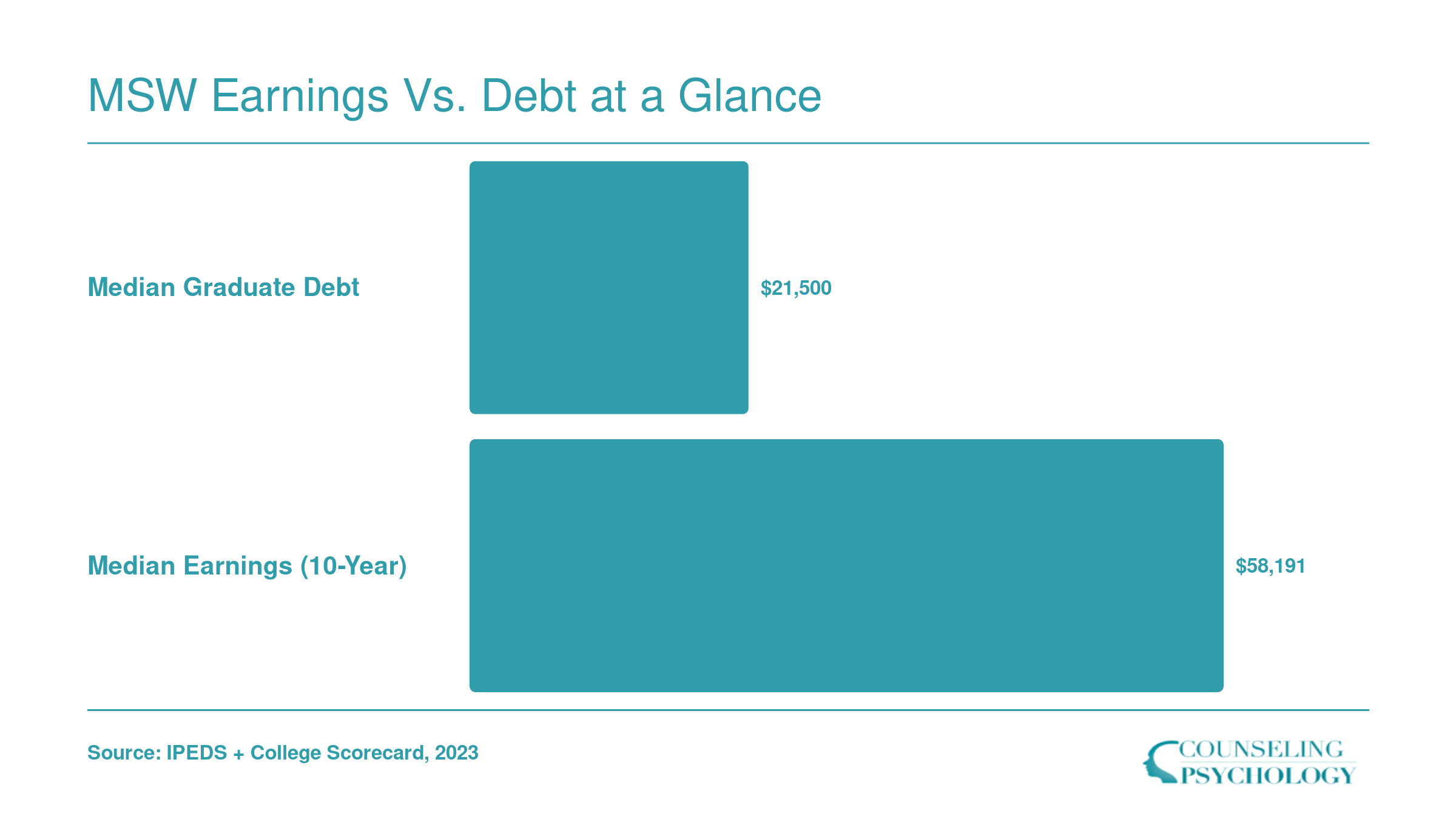
Detailed earnings figures specific to MSW completers in Arkansas are still emerging. In the meantime, institution-level outcomes offer a reliable benchmark. For example, graduates of the University of Arkansas, one of the state's flagship MSW providers, earn a median of about $58,000 per year a decade after entering the workforce. At the same time, MSW students from the university carry a median debt of $21,500. This translates to a debt-to-earnings ratio above 2.7, meaning the financial upside comfortably exceeds the borrowing burden.
These figures reflect the university's overall graduate pool, not just social workers, but they underscore a pattern: Arkansas MSW programs, when chosen carefully, can generate solid returns.
Social Work Salaries Across Arkansas
Statewide wage data from the Bureau of Labor Statistics (2024) shows how earnings vary by specialization.1 Among the three main social work categories in Arkansas, the median annual salaries are:
- Child, family, and school social workers: $42,960
- Healthcare social workers: $62,040
- Mental health and substance abuse social workers: $49,820
These statewide medians mask significant variation by metro area; social workers in larger cities like Little Rock or Fayetteville typically command higher pay than those in rural regions. The higher median for healthcare social workers, for instance, reflects the concentration of medical facilities and the specialized skills those roles demand.
Licensure and Earning Potential
In Arkansas, the Licensed Master Social Worker (LMSW) credential is the entry point for most MSW graduates. However, the Licensed Clinical Social Worker (LCSW) designation, earned after completing supervised clinical hours, often unlocks substantially higher earning potential. LCSWs can practice independently, take insurance, and pursue private practice, all of which boost income. Many agencies and hospitals also pay a premium for clinical licensure, making the extra effort a clear financial win. For those interested in how counselor salary figures compare across related helping professions, the contrast with clinical social work pay can be instructive.
Is an MSW Worth It Financially?
With a median debt of $21,500 and earnings that, even at the lower end of the BLS range, exceed $40,000 annually, the degree places graduates on a sustainable path.1 The University of Arkansas's strong debt-to-earnings ratio signals that most borrowers can manage loan payments without undue strain, especially if they target higher-paying niches like healthcare social work.
Additionally, social workers in public service roles may qualify for loan forgiveness, further improving the long-term financial calculus. Graduates drawn to substance abuse counselor degrees online or addiction-focused careers will find that the MSW pairs well with specialized certifications in that space. When weighed against the licensure ladder and the state's growing demand for mental health services, the data suggests that an Arkansas MSW is a pragmatic investment for those committed to the field.
MSW Earnings vs. Debt at a Glance
How quickly can Arkansas MSW graduates recoup their investment? The chart below compares the median graduate debt for University of Arkansas students against what graduates typically earn within ten years. Program-level first-year earnings and monthly loan payment figures are not yet available for this program, so the institution-wide graduate debt and ten-year median earnings offer the best current snapshot of the return-on-investment picture.
Arkansas Social Work Licensure: LMSW & LCSW Pathways
Licensure in Arkansas is the legal permission to practice social work in the state, issued by the Arkansas Social Work Licensing Board.1 There are two graduate-level credentials you should know: the LMSW (Licensed Master Social Worker), which lets you practice non-clinical social work after earning your degree, and the LCSW (Licensed Certified Social Worker), Arkansas's clinical license that authorizes independent therapy and diagnosis. Most graduates pursue the LMSW first, then build toward the LCSW. If you are weighing related helping professions, you may also want to explore how to become a mental health counselor.
Becoming an LMSW in Arkansas
The path is straightforward and does not require post-graduate supervised hours before you sit for the exam.2
- Earn a CSWE-accredited MSW: Any Arkansas program profiled in this article qualifies.
- Pass the ASWB Master's exam: The exam fee is $230.
- Apply to the Arkansas Social Work Licensing Board: Application fee is $100, plus a $5.50 online processing fee, and a background check is required.4
Becoming an LCSW in Arkansas
The clinical license adds supervised practice on top of your LMSW.5
- Complete 4,000 hours of supervised clinical experience over a minimum of two years.
- Receive at least 100 hours of direct clinical supervision under a board-approved supervisor, with a supervision plan filed and approved in advance.7
- Pass the ASWB Clinical exam ($260 fee), then submit the LCSW application ($100, plus the $5.50 processing fee) with a background check.
Note that Arkansas's 4,000-hour requirement is on the higher end nationally; many states require 3,000. Plan your supervision arrangement before you accept your first post-MSW job.
Renewal, CE, and Reciprocity
Arkansas licenses renew every two years. You will need 48 hours of continuing education per renewal cycle and an $80 renewal fee.4 CE topics typically include ethics and supervision hours mandated by the board, so check current rules before registering for trainings.
If you are moving in from another state, Arkansas evaluates licenses by endorsement based on substantially equivalent requirements.1 Out-of-state LCSWs generally transfer cleanly if their supervised hours and exam meet Arkansas standards.
A Note on Pass Rates
School-specific ASWB pass rates for Arkansas MSW programs are not publicly published by ASWB or the state board.8 If exam performance matters to your decision, ask each program directly for their first-time pass rate during your campus visit or admissions interview.
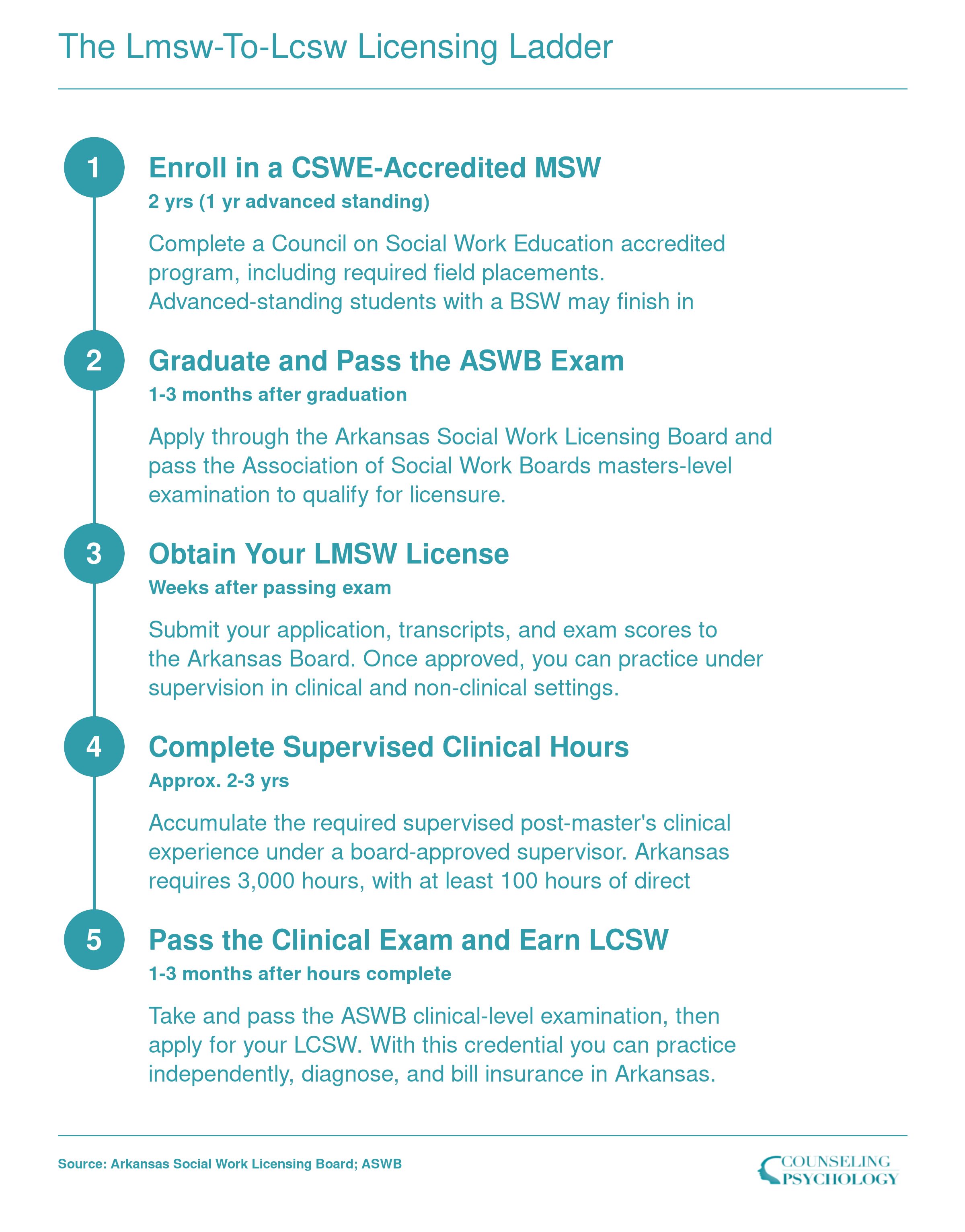
The LMSW-to-LCSW Licensing Ladder
Reaching independent clinical practice in Arkansas follows a clear sequence. Here is what the timeline looks like from your first day of graduate school through LCSW licensure.
Scholarships, Financial Aid & Loan Forgiveness for Arkansas MSW Students
Where can Arkansas MSW students actually find money that does not have to be paid back? The honest answer is that funding comes from a patchwork of state agencies, individual programs, federal repayment programs, and private foundations. There is no single statewide social work loan forgiveness program in Arkansas, so building a funding plan means stacking several smaller sources.1
Start With State and Child Welfare Funding
The Arkansas Department of Human Services administers a Title IV-E child welfare stipend program that supports MSW students who commit to working in public child welfare after graduation. Eligibility, stipend amounts, and service obligations change year to year, so check the current DHS posting before counting on it.
For broader state aid, the Arkansas Division of Higher Education runs the official Scholarship Application Management System.1 The state also maintains a general scholarship search at portal.arkansas.gov.2 Neither is social-work specific, but both surface need- and merit-based awards that MSW students can stack on top of program aid.
Program-Level and Private Scholarships
Individual schools control the largest pool of dollars most students will see. At the University of Arkansas, doctoral and master's applicants can be nominated for the Benjamin Franklin Lever Tuition Fellowship, and the UARK AcademicWorks portal lists internal awards open to graduate students.3 Call or email each MSW program's financial aid office directly: they know about departmental tuition waivers, graduate assistantships, and emergency aid that rarely show up in search results.
Outside the schools, the Arkansas Community Foundation maintains statewide scholarships for Arkansas residents.4 Bold.org also curates a running list of social work scholarships open nationally.
Federal Loan Repayment for Post-Graduation
Once you are licensed and practicing, the National Health Service Corps and HRSA loan repayment programs can cancel substantial debt for clinical social workers serving in designated Health Professional Shortage Areas. Use the HRSA HPSA Find tool to confirm your future employer's site qualifies before you accept a position, and review BLS.gov for current Arkansas social work wage and employment data to weigh repayment offers against salary.
Title IV-E child welfare stipends can cover full tuition and living expenses for Arkansas MSW students, but they require a post-graduation employment commitment in public child welfare, typically lasting two to three years. Before applying, carefully weigh whether this career path aligns with your goals, as breaking the agreement means repaying the stipend.
FAQs About MSW Programs in Arkansas
Below are answers to the questions prospective MSW students in Arkansas ask most often. Each response is drawn from current program data and state licensure requirements so you can compare options quickly.