
What you’ll learn in this article…
- Ohio has more than a dozen CSWE-accredited MSW programs, with public school tuition starting near $10,000 total.
- Multiple Ohio universities offer fully online or hybrid MSW formats, eliminating the need to relocate for your degree.
- Ohio licensure requires 900 supervised field hours plus passing the ASWB exam after completing your MSW.
- BLS data shows the national median wage for social workers was roughly $58,000, though Ohio figures may differ.
What does it actually cost to earn an MSW in Ohio, and which programs make the most financial sense? Ohio's 13 ranked, CSWE-accredited or candidacy programs range from fully online and hybrid options to traditional campus cohorts, with in-state tuition starting under $10,000 at Ohio University and climbing past $53,000 at private Case Western Reserve. The state projects strong demand for licensed social workers, with nearly 1,300 annual openings in clinical and community roles, which makes choosing a program with manageable debt and licensure-ready training a practical priority. Sorting through tuition, format, and career outcomes is essential for anyone mapping an MSW to Ohio's licensing ladder.
Best MSW Programs in Ohio: Rankings & Comparison
Ohio is home to a strong mix of public and private universities offering CSWE-accredited or candidacy-status MSW programs, many with online or hybrid delivery that lets you earn your degree without relocating. The ranking below weighs affordability heavily, factoring in net price, median graduate debt, and institution-wide outcomes so you can compare programs with a clear sense of cost and value. All graduation rates listed reflect the institution overall, not MSW-specific completion.
Details
- NCES-IPEDS federal institutional data — nces.ed.gov
- College Scorecard graduate earnings — collegescorecard.ed.gov
- Internal program database
- Independent program research

Cleveland State University
Cleveland State University's MSW program sits inside the College of Health and offers both Clinical and Advanced Generalist concentrations entirely online, with no campus visits required. Students complete field practicum in their own communities, making the program especially practical for working professionals across Ohio. An Advanced Standing pathway is available for BSW graduates from CSWE-accredited programs within the last seven years, and the school accepts applications for fall, spring, and summer starts.
- 100% online coursework with no campus residency
- Clinical and Advanced Generalist concentrations
- 900 field practicum hours completed locally
- Advanced Standing for recent BSW graduates
- 60 credit hours, full-time or part-time pace
- Three annual intakes: fall, spring, summer
- No GRE required for admission
- Certificates in Chemical Dependency, Gerontology available
Master of Social Work — Online

University of Akron
The University of Akron pairs one of the lowest in-state tuition rates in this ranking with Micro and Macro concentration tracks that prepare graduates for either direct clinical roles or administrative and policy positions. The program runs in both on-campus and fully asynchronous online formats, giving students real scheduling control. BSW holders can finish in as few as 11 months through the Advanced Standing pathway, and a built-in Cognitive Behavioral Therapy certificate adds a marketable credential.
- Micro track: advanced clinical practice focus
- Agency-based internships with field support
- No GRE required for admission
- Full-time and part-time scheduling
- CSWE-accredited program
- LICDC obtainable through elective coursework
- Macro track: leadership and policy emphasis
- Prepares community organizers and program evaluators
- 100% asynchronous online option available
- 11-month Advanced Standing for BSW graduates
- Cognitive Behavioral Therapy certificate included
- Over 100 scholarship opportunities noted
Master of Social Work (Micro Concentration) — On-Campus
Master of Social Work (Macro Concentration) — On-Campus

University of Toledo
The University of Toledo delivers its MSW through an advanced generalist model with Mental Health and Child & Family tracks. Evening and Saturday scheduling is deliberately designed for students who work during the day, and all courses are face-to-face. More than 900 hours of field work and a faculty of practicing professionals give the program a strong applied orientation.
- Mental Health track with advanced generalist core
- Evening and Saturday class schedule
- 900+ field practicum hours required
- No undergraduate social work degree needed
- CSWE-accredited program
- Access to Human Trafficking Institute research
- Child & Family concentration available
- 33-credit Advanced Standing for BSW graduates
- Full-time or part-time enrollment options
- Small class sizes with practicing-professional faculty
- 425-hour foundation plus 525-hour advanced placement
- Community agency connections for field education
Master of Social Work (Mental Health) — On-Campus
Master of Social Work (Child & Family) — On-Campus

Wright State University
Wright State University awards a Master of Arts in Social Work with an advanced generalist framework covering micro, mezzo, and macro levels. Concentrations in Children and Families or Older Adults give students a clear specialization path on campus in Dayton. The curriculum emphasizes social justice, cultural competency, and evidence-based practice, and graduates qualify directly for Ohio social work licensure.
- Children and Families concentration
- Advanced generalist professional preparation
- Accredited by CSWE
- Focus on evidence-based and ethical practice
- Prepares for Ohio licensure upon graduation
- Campus-based program in Dayton
- Older Adults concentration
- Micro, mezzo, and macro intervention training
- Cultural competence and social justice emphasis
- Leadership and policy development skills
- Student-centered learning environment
- Located at the College of Liberal Arts
Master of Arts in Social Work (Children and Families) — On-Campus
Master of Arts in Social Work (Older Adults) — On-Campus

Ohio University
Ohio University offers its MSW in campus, hybrid, and fully online formats, all centered on clinical social work with a distinctive rural-practice emphasis. The online track can be completed in as few as 24 months part-time, with field placements arranged through a network of more than 500 agencies nationwide. An Advanced Standing option reduces the credit load to 36 hours for qualified BSW holders.
- Campus, hybrid, and 100% online delivery modes
- Clinical focus with rural-environment training
- Foundation track: 62 credits; Advanced Standing: 36
- Field practicum with 500+ partner agencies
- No GRE required for admission
- Three start dates per year
- Graduate assistantships available for hybrid students
- CSWE-accredited since 2002
Master of Social Work — On-Campus

University of Cincinnati
The University of Cincinnati's MSW follows a hybrid model blending online coursework with on-campus sessions, and it offers three direct-practice specializations: Children & Families, Health & Aging, and Mental Health. Field education draws on more than 200 agency partners across the Cincinnati metro area, with students logging 14 to 17 hours per week. Multiple pacing options, including an accelerated full-time track, add flexibility.
- Children & Families specialization
- Hybrid format: online plus on-campus components
- 200+ social service agency partners for field work
- Accelerated, full-time, and part-time pacing
- CSWE-accredited program
- Transfer credits accepted with B or higher
- Health & Aging specialization
- 14 to 17 field hours per week
- Direct practice concentration core
- Eligible for Ohio social work licensure
- Hybrid delivery with flexible scheduling
- Supervised field instructor at placement site
- Mental Health specialization
- Evidence-based intervention training
- Accelerated full-time option available
- Volunteer experience may be required for admission
- On-campus coursework in Cincinnati
- Prepares for advanced clinical practice roles
Master of Social Work (Children & Families) — Hybrid
Master of Social Work (Health & Aging) — Hybrid
Master of Social Work (Mental Health) — Hybrid

Bowling Green State University
Bowling Green State University's CSWE-accredited MSW uses an empowerment and resiliency framework delivered in a hybrid format. Students choose among Gerontology, Healthcare, or Children and Families concentrations. Small cohort sizes allow close faculty mentorship, and no GRE is required. The program explicitly centers social justice, intersectionality, and environmental justice in its curriculum.
- Gerontology concentration
- Hybrid: online and in-person components
- CSWE-accredited since June 2020
- No GRE required for admission
- Empowerment approach curriculum
- One-on-one faculty attention in small cohort
- Healthcare concentration
- Advanced Standing and Regular Standing pathways
- Field education integrated throughout
- Flexible scheduling for working professionals
- Evidence-based practice focus
- Limited enrollment, early application recommended
- Children and Families concentration
- Social justice and intersectionality emphasis
- Competitive admission process, no GRE
- Hybrid delivery with campus and online sessions
- Leadership development component
- Advanced Standing option available
Master of Social Work (Gerontology) — Hybrid
Master of Social Work (Healthcare) — Hybrid
Master of Social Work (Children and Families) — Hybrid

Miami University
Miami University's hybrid MSW prepares advanced generalist practitioners through a mix of online coursework and in-person immersive sessions at its Oxford and Middletown locations. At $700 per credit hour, the program can be completed in 12 to 24 months with practicum placements at nearly 100 partner sites across Butler County, Cincinnati, and Dayton. Graduates are eligible for licensure in all 50 states.
- Hybrid format with Oxford and Middletown sites
- $700 per credit hour
- Completable in 12 to 24 months
- Nearly 100 practicum partner sites
- Advanced generalist practice with social justice focus
- Recommended 3.0 GPA for admission
- No GRE required
- Licensure eligibility in all 50 states
Master of Social Work — Hybrid

Mount Vernon Nazarene University
Mount Vernon Nazarene University delivers its MSW fully online with Behavioral Health and School Social Work concentrations, priced at $565 per credit hour. A 62-credit standard track and a 31-credit Advanced Standing track for BSW graduates keep total costs manageable. The program is currently in candidacy for CSWE accreditation, so prospective students should verify accreditation status before enrolling.
- Behavioral Health concentration
- 100% online delivery
- $565 per credit hour
- 31-credit Advanced Standing for BSW graduates
- Courses in addictions, mental health, trauma
- No application fee
- School Social Work concentration
- 62-credit standard track available
- CSWE accreditation candidacy status
- Prepares for school social worker career path
- Research methods and policy coursework included
- Admissions decision typically within one week
Master of Social Work (Behavioral Health) — Online
Master of Social Work (School Social Work) — Online

Capital University
Capital University in Columbus offers a hybrid MSW with evening and Saturday classes tailored to working adults. The two-year traditional track (59 credits) serves students without a social work background, while the one-year Advanced Standing track (36 credits) is designed for BSW graduates. Both tracks require 900 field hours. The program is pursuing CSWE accreditation, with retroactive accreditation anticipated for students who started in Fall 2025.
- Hybrid format with evening and Saturday classes
- 59-credit traditional track over two years
- 36-credit Advanced Standing track in one year
- 900 field hours required across both tracks
- No GRE required for admission
- Minimum 3.0 GPA and two professional references
- 12:1 student-to-faculty ratio
- CSWE accreditation candidacy, retroactive expected
Master of Social Work — Hybrid
Ohio MSW Program Tuition & Cost Comparison
Tuition for MSW programs in Ohio varies significantly depending on whether the school is public or private, and whether you qualify for in-state rates. The per-credit figures below reflect published rates for the 2025-2026 academic year where available; institution-level tuition figures are drawn from federal data. Because graduate tuition structures differ from undergraduate rates, always confirm MSW-specific costs directly with each program before applying.
| School | Format | Per-Credit Cost | Estimated In-State Tuition (Institutional) | Estimated Out-of-State Tuition (Institutional) | CSWE Status |
|---|---|---|---|---|---|
| University of Akron | Online / Campus | $463.50 | $10,125 | $15,885 | Accredited |
| Mount Vernon Nazarene University | Online | $565.00 | N/A (private) | N/A (private) | Pre-candidacy |
| Cleveland State University | Online / Campus | $636.70 (in-state); $637.70 (out-of-state) | $11,297 | $21,107 | Accredited |
| Miami University (Oxford, Middletown, Hamilton) | Hybrid | $700.00 | $16,751 | $37,791 | Accredited |
| Wright State University | Campus | N/A | $15,771 | $25,759 | Accredited |
| University of Toledo | Campus | N/A | $17,605 | $29,426 | Accredited |
| Ohio University | Campus / Hybrid / Online | N/A | $9,720 | $17,712 | Accredited |
| Bowling Green State University | Hybrid | N/A | $10,291 | $16,283 | Accredited |
| University of Cincinnati | Hybrid | N/A | $14,902 | $26,674 | Accredited |
| Capital University | Hybrid | N/A | N/A (private) | N/A (private) | Candidacy |
| Case Western Reserve University | Campus | N/A | N/A (private: $53,980) | N/A (private: $53,980) | Accredited |
Questions to Ask Yourself
Can you commit to campus or hybrid sessions, or do you need a fully online format?
Do you hold a BSW from a CSWE-accredited program and qualify for advanced standing?
Is your career goal clinical licensure (LISW) or macro-level work in policy, administration, or community organizing?
How much total debt are you willing to take on relative to your expected starting salary?
Online Vs. On-Campus MSW Programs in Ohio
Ohio offers a genuine range of MSW delivery formats, from fully asynchronous online programs to traditional on-campus cohorts and everything in between. The table below breaks down the practical differences so you can weigh schedule flexibility against in-person networking, concentration options, and campus requirements. All programs listed hold full CSWE accreditation unless noted otherwise.
| Feature | Fully Online (e.g., Cleveland State, Ohio University, University of Akron) | Hybrid (e.g., University of Cincinnati, Miami University, Capital University) | On-Campus (e.g., Case Western Reserve, University of Toledo, Wright State) |
|---|---|---|---|
| Class Format | Primarily or 100% asynchronous coursework; Ohio State blends synchronous and asynchronous sessions | Online coursework combined with periodic in-person immersive sessions or weekend classes | Face-to-face classes, often held evenings or Saturdays to accommodate working students |
| Campus Visits Required | No campus visits required at Cleveland State, Ohio University, or University of Akron | Yes, periodic on-site sessions (Capital University requires campus attendance; Miami University holds sessions in Oxford and Middletown) | Regular campus attendance expected throughout the program |
| Field Placement | Arranged locally in the student's community; programs coordinate with area agencies | Arranged locally; University of Cincinnati partners with 200+ agencies, Miami University with nearly 100 sites | Typically arranged through university partnerships in the surrounding metro area |
| Concentration Options | May be limited: Cleveland State offers Clinical only online; University of Akron offers both Micro and Macro; Ohio University mirrors its campus focus areas | Broad: University of Cincinnati offers Children and Families, Health and Aging, and Mental Health; Miami University follows an advanced generalist model | Widest selection: Case Western Reserve lists six pathways including School Social Work and Substance Use Disorders; Toledo offers Mental Health and Child and Family tracks |
| Typical In-State Tuition (annual, graduate level) | Roughly $9,720 to $11,297 at public institutions (Ohio University and Cleveland State) | Approximately $13,530 to $16,751 (Capital University and Miami University) | Ranges widely: about $15,771 at Wright State up to $53,980 at Case Western Reserve |
| Schedule Flexibility | Highest flexibility; asynchronous formats let students complete coursework on their own schedule | Moderate; online weeks provide flexibility, but in-person weekends or immersions require advance planning | Least flexible, though many programs offer evening and Saturday sections for working professionals |
| Networking and Campus Resources | Virtual advising and online student communities; less organic peer networking | Periodic face-to-face sessions build professional relationships while preserving some remote convenience | Full access to faculty office hours, student organizations, alumni mentorship, and campus career services |
| Best Fit For | Working professionals, students in rural areas, or anyone who needs maximum scheduling control | Students who want online convenience but value some in-person connection and hands-on learning | Full-time students, career changers seeking deep immersion, or those who prioritize the widest concentration choices |
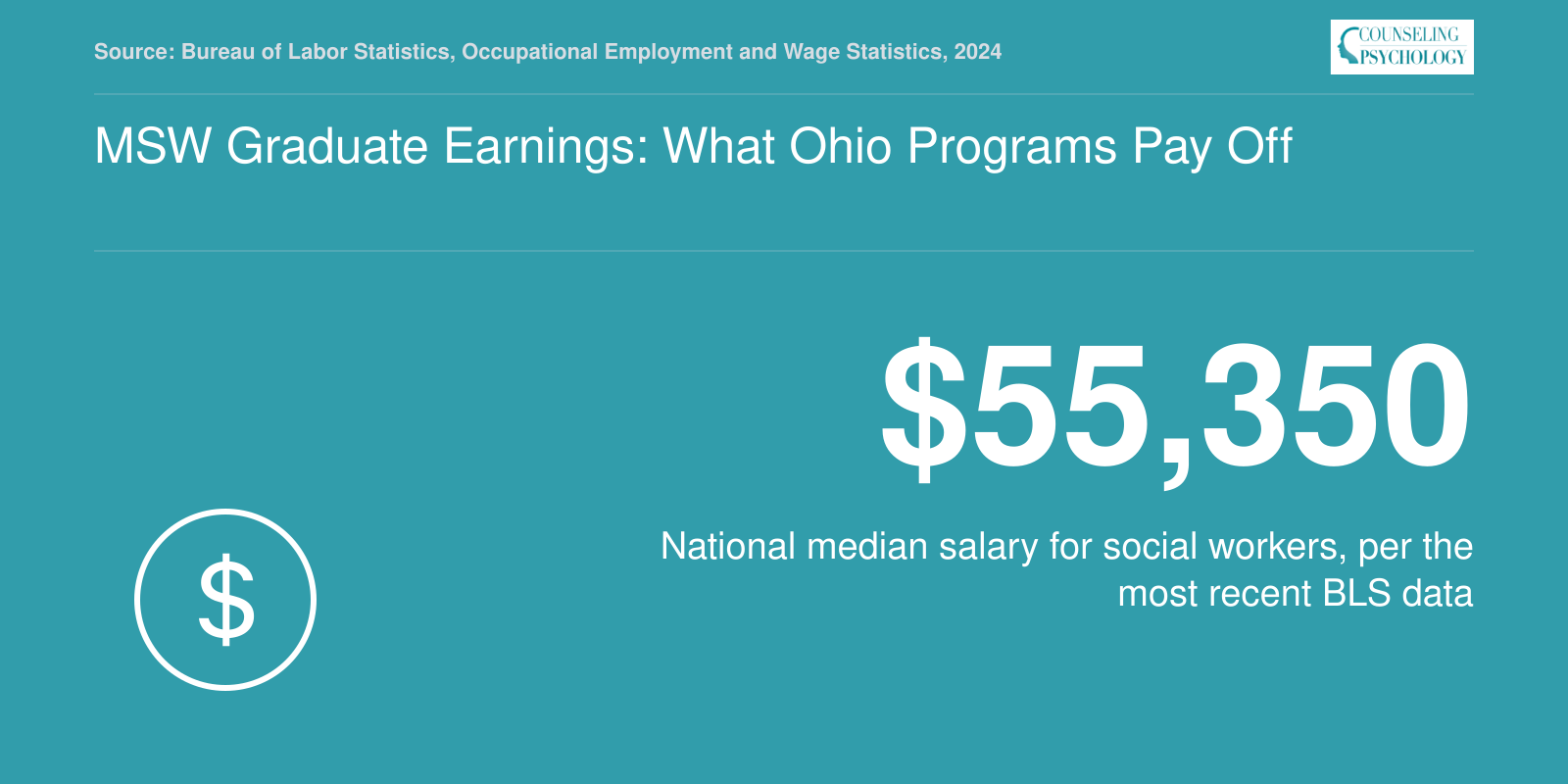
MSW Graduate Earnings: What Ohio Programs Pay Off
Program-level earnings data for Ohio MSW programs is not yet published in sufficient detail to compare individual schools side by side. Federal reporting timelines mean that many newer or recently restructured programs have not had their graduate earnings tracked long enough to appear in public datasets. As more cohorts reach the one-year and two-year post-completion milestones, clearer program-by-program comparisons will become available.
MSW Admissions Requirements in Ohio
Gaining admission to a Master of Social Work program in Ohio requires careful attention to each school's academic thresholds, application materials, and deadlines. While requirements share common themes, details like GPA minimums, testing policies, and advanced standing pathways differ across institutions. The overview below outlines what you can expect when applying to CSWE-accredited programs.
GPA and Testing Requirements
Most Ohio MSW programs set a minimum undergraduate GPA between 2.5 and 3.0, though specifics vary by school. For example, Cleveland State University requires a 2.75 cumulative GPA, while many other programs typically expect a 3.0 or higher.1 Some schools may grant conditional admission to applicants who fall slightly below the threshold but demonstrate strong professional experience or a compelling personal statement. The GRE has largely been eliminated as a requirement: the vast majority of Ohio MSW programs no longer mandate standardized test scores for admission. When in doubt, check the program's website to confirm the current testing policy.
Advanced Standing for BSW Holders
If you hold a Bachelor of Social Work (BSW) from a CSWE-accredited program, you may qualify for advanced standing, which shortens the MSW timeline significantly. Advanced standing admits can often complete the degree in one year of full-time study instead of two, as they are exempt from foundational coursework.
- Eligibility window: At Ohio State University, your BSW must have been earned within the past five years. Cleveland State University allows up to seven years from BSW completion.1
- GPA requirement: Advanced standing typically demands a higher undergraduate GPA. Cleveland State requires a 3.0 in social work courses, and similar expectations are common elsewhere.1
- Credit savings: Advanced standing can reduce the total credits needed by 30 to 50 percent, lowering both tuition costs and time to licensure.
Typical Application Components
Most applications require a personal statement, two or three letters of recommendation, and a current résumé highlighting relevant social service experience. The personal statement carries significant weight: faculty reviewers look for clear career goals, understanding of the social work profession, and alignment with the program's mission. If you are curious about how competitive graduate admissions can be across related fields, our overview of how hard it is to get into grad school for psychology offers useful context. Some programs may also request an interview, either in person or via video call, as part of the final selection process.
Deadlines and Admission Cycles
Application timelines can include priority deadlines, final deadlines, or rolling admission. Priority applications often receive first consideration for funding and field placements. Cleveland State University, for instance, sets these final deadlines: July 10 for fall start, November 21 for spring start, and April 3 for summer start.1 Other schools may use a single early-spring priority date for the following fall. Since deadlines can shift year to year, always confirm dates on the program's admissions page. Submitting a complete application well in advance of the posted deadline is strongly advised.
Specializations & Concentrations at Ohio MSW Programs
Ohio's CSWE-accredited MSW programs vary widely in their available concentrations, from broad advanced generalist models to highly specific tracks in areas like substance use or school social work. The table below maps each program's known specialization options and delivery format so you can match your career interests to the right school.
| School | Known Concentrations / Specializations | Delivery Format |
|---|---|---|
| Case Western Reserve University | Children, Youth and Families; Community Practice for Social Change; Mental Health; School Social Work; Substance Use Disorders; Aging; Individualized Path | On-campus |
| University of Cincinnati | Direct Practice (specializations in Children and Families, Health and Aging, Mental Health) | Hybrid |
| Cleveland State University | Clinical | On-campus, 100% Online |
| The Ohio State University | Aging and Health | On-campus, Fully Online |
| University of Akron | Micro Practice; Macro Practice | On-campus, 100% Online |
| University of Toledo | Advanced Generalist (Mental Health track, Child and Family track) | On-campus |
| Wright State University (Greater Miami Valley Joint MASW) | Advanced Generalist: Children and Families | On-campus |
| Ohio University | Advanced Clinical Practice (rural focus) | Hybrid, Online |
| Bowling Green State University | Advanced Practice and Leadership; Gerontology | Hybrid |
| Mount Vernon Nazarene University | Behavioral Health (includes Clinical Social Work in Addictions, Mental Health, Trauma-Informed Practice) | Online |
| Capital University | Advanced Social Work Practice (micro and macro areas, behavioral health and addiction services) | Hybrid |
| Miami University | Advanced Generalist | Hybrid |
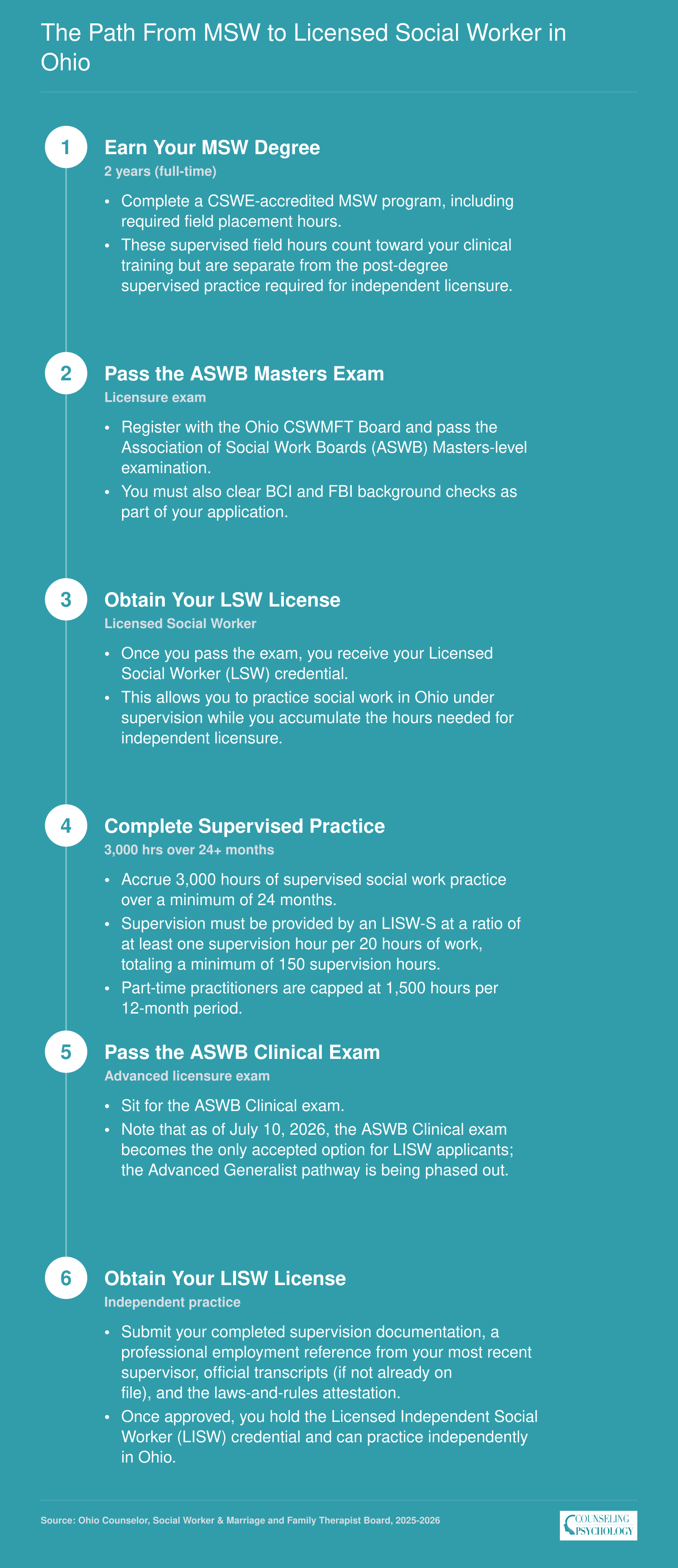
The Path From MSW to Licensed Social Worker in Ohio
Ohio's credentialing ladder is straightforward but demands planning. Most CSWE-accredited MSW programs in Ohio already require 900 field hours, which gives you a strong clinical foundation before you ever sit for a licensing exam. Here is how the progression works under current Ohio CSWMFT Board rules.
Career Outcomes & Salary for Ohio MSW Graduates
Choosing between a $10,000 public-university MSW and a $54,000 private-school program is partly a values question, but it is also a math problem. What matters is whether the salary you earn after graduation justifies the debt you carry getting there.
What Program-Level Earnings Data Shows
Program-specific earnings figures for Ohio MSW graduates are not yet reported across the programs reviewed here. That absence does not mean outcomes are poor; graduate-level social work programs at this degree tier frequently do not yet appear in federal outcome databases, or their cohort sizes fall below the reporting threshold. Until that data becomes available, the most honest approach is to interpret salary expectations through statewide occupational data and national benchmarks rather than school-specific numbers.
Ohio Salary Benchmarks by Specialty
The Bureau of Labor Statistics reports a 2024 statewide median annual wage of $48,050 for all social workers in Ohio.2 That figure covers a wide range of roles and experience levels, so it is best treated as a floor rather than a ceiling. For context, the national median across all social worker occupations was $61,330 in 2024, meaning Ohio wages currently run below the U.S. average.3 The gap matters when you are projecting a return on tuition investment.
Within Ohio, the specialty you pursue shapes your earning trajectory considerably:
- Clinical and licensed clinical social workers: Roles requiring licensure (LISW or LISW-S in Ohio) tend to command higher pay, particularly in private practice, hospital settings, and community mental health centers.
- Child, family, and school social workers: These roles are broadly available across the state but often sit at the lower end of the wage scale, particularly in county agencies and school districts.
- Healthcare social workers: Hospital and healthcare-system positions tend to pay above the statewide median, especially in larger metro markets.
For a broader wage reference, BLS data also shows a 2023 median of $63,770 for the Social Workers, All Other category in Ohio, which captures roles outside the standard specialty buckets and often reflects more credentialed or senior positions.1 If you are weighing related helping professions, Ohio also has strong demand for masters in counseling graduates working in clinical mental health and school settings.
Geographic Variation Across Ohio Metros
Where you work within Ohio matters as much as what specialty you choose. Columbus, Cleveland, and Cincinnati each have distinct labor markets for social workers. Urban centers generally offer more positions in healthcare systems, behavioral health networks, and large nonprofit organizations, which tend to pay above rural or suburban agency roles. If you are weighing a lower-cost program in a smaller market against a pricier school in a major metro, factor in whether you plan to relocate after graduation or practice close to where you study.
How Debt Shapes the Return on Investment
Among the Ohio MSW programs with reported institutional data, median graduate debt figures range from roughly $21,000 to $27,000. At $24,000 in federal debt, a standard 10-year repayment plan at current rates produces a monthly payment in the neighborhood of $250 to $270. Against a starting salary near the statewide median, that is manageable but not trivial, particularly for graduates entering county-agency or school-based roles.
The debt-to-earnings picture becomes more strained when tuition runs high and the target role falls at the lower end of the wage scale. A program costing $54,000 in tuition paired with a $40,000 starting salary in a child welfare position is a meaningfully different financial situation than a $10,000 in-state program paired with the same job. Checking the salary-by-specialty breakdown for your intended role before committing to a program is worth the time.
Job Growth Context
The broader employment picture for social work remains strong. National projections covering 2016 through 2026 show expected growth of 16 percent for all social workers, with healthcare social workers projected at 20 percent and mental health and substance abuse social workers at 19 percent.4 The BLS also projects roughly 74,000 annual job openings nationally for social workers through 2034.3 Ohio's aging population, persistent behavioral health workforce shortages, and expansion of integrated care models all point to sustained demand, particularly for credentialed clinicians in metro and rural healthcare settings alike.
Financial Aid & Scholarships for Ohio MSW Students
Where should an Ohio MSW student actually look for funding beyond the standard federal loan package? The answer is layered: federal aid, state aid, school-based awards, professional association scholarships, and post-graduation loan forgiveness all play different roles. The most efficient path is to research each tier directly from its authoritative source rather than relying on aggregator sites.
Start with Federal and State Government Sources
File the FAFSA first. Federal Direct Unsubsidized and Grad PLUS loans are the baseline for most MSW students. After graduation, two federal programs deserve close attention: Public Service Loan Forgiveness (PSLF), which discharges remaining federal loan balances after 120 qualifying payments while working for a government or qualifying nonprofit employer, and the National Health Service Corps (NHSC) Loan Repayment Program, which is open to licensed clinical social workers serving in designated shortage areas. Both are documented at studentaid.gov and nhsc.hrsa.gov respectively.
For state-level aid, the Ohio Department of Higher Education maintains a current list of grants and scholarships available to Ohio residents.1 Ohio's Title IV-E child welfare stipend program is another route worth researching directly through participating schools, since it can cover tuition in exchange for a public child welfare service commitment after graduation.
Check School Financial Aid Pages Directly
Each Ohio MSW program publishes its own scholarship inventory. Ohio University, for example, lists the Dr. Betty Hartford Endowment Scholarship for incoming and second-year MSW students with financial need (with preference for gerontology or research focus), along with child welfare incentive awards in the $5,000 to $10,000 range.2 Ohio State, Cincinnati, Case Western Reserve, and Cleveland State each publish their own merit awards, graduate assistantships, and departmental fellowships on their college of social work pages.3 Bookmark these pages and check deadlines early in your application cycle.
Professional Associations
The NASW Foundation administers several national scholarships relevant to MSW students, including the Consuelo W. Gosnell Memorial Scholarship (for students committed to serving American Indian/Alaska Native and Hispanic/Latino populations or working in public/nonprofit agencies), the Verne LaMarr Lyons Memorial Scholarship (health and mental health practice in African American communities), the Lawanna Renee Barron Scholarship (at-risk children and youth), and the Neysa Fanwick Memorial Scholarship (public service and social justice).4 The NASW Ohio Chapter also offers a Student Membership Scholarship that covers the cost of student membership, a small but useful entry point into the professional network.5 If you are also weighing related clinical paths in the state, exploring MFT programs in Ohio can help you compare funding options across disciplines.
For occupational salary data that helps you weigh debt against expected earnings, the U.S. Bureau of Labor Statistics (bls.gov) is the authoritative reference.
Frequently Asked Questions About Ohio MSW Programs
Choosing the right MSW program means sorting through tuition rates, accreditation details, and licensing rules that vary by state. Below are the questions Ohio applicants ask most often, answered with current program data and state requirements.
- What is the most affordable online MSW program in Ohio?
- Among CSWE-accredited options, the University of Akron stands out with in-state graduate tuition around $10,125 for its MSW program, which is offered in a fully online asynchronous format. Cleveland State University follows closely at roughly $11,297 in-state. Miami University's hybrid MSW charges about $700 per credit hour. Always confirm current rates directly with each school, as fees change annually.
- Which Ohio universities offer CSWE-accredited MSW programs?
- Ohio has a strong selection. CSWE-accredited MSW programs are available at the University of Akron, Cleveland State University, Miami University, Wright State University, and several others including Ohio State University, the University of Cincinnati, and Case Western Reserve University. CSWE accreditation is essential because Ohio's licensing board requires graduation from an accredited program before you can sit for the LSW exam.
- Can I complete an MSW fully online from an Ohio university?
- Yes. The University of Akron offers 100% online asynchronous MSW classes, and Cleveland State University provides a fully online option as well. Miami University uses a hybrid model that combines online coursework with periodic in-person immersive sessions. Keep in mind that every program still requires supervised field placements completed in your local community, so some in-person commitment is unavoidable.
- How long does it take to earn an MSW in Ohio, including advanced standing options?
- A traditional full-time MSW typically takes two years (60 credits). Part-time tracks extend to three or four years. If you hold a BSW from a CSWE-accredited program, advanced standing can cut the timeline significantly. The University of Akron's advanced standing track, for example, can be completed in as few as 11 months. Miami University advertises a 12 to 24 month completion window depending on your background.
- What are the licensure requirements for social workers in Ohio?
- Ohio issues the Licensed Social Worker (LSW) credential to MSW graduates who pass the Association of Social Work Boards (ASWB) master's-level exam. No post-degree supervised experience is required for the LSW. For the independent-practice credential (LISW), you need at least two years of post-master's supervised clinical experience and a passing score on the ASWB clinical exam.
- Do Ohio MSW programs require the GRE?
- Most Ohio MSW programs have dropped the GRE requirement. The University of Akron explicitly does not require it, and many others, including Cleveland State University, have followed suit. A few programs may still list it as optional or accept it for students with lower GPAs. Check each school's current admissions page to confirm, but the overall trend in Ohio is GRE-optional or GRE-free.
- What is the difference between an LSW and LISW in Ohio?
- The LSW (Licensed Social Worker) is the entry-level license you earn after completing your MSW and passing the ASWB master's exam. An LSW must practice under supervision. The LISW (Licensed Independent Social Worker) requires an additional two years of supervised clinical experience plus passing the ASWB clinical exam. The LISW allows independent practice, private-practice billing, and clinical supervision of other social workers.
More Cswe-Accredited MSW Programs in Ohio
Beyond the programs featured in our top rankings, Ohio offers additional CSWE-accredited MSW programs that may align with different priorities. The following schools provide diverse formats and specializations worth exploring.
Southwest Ohio
- Master of Social Work
- Master of Social Work
Northeast Ohio
- Master of Social Work (MSW) (Children, Youth and Families)
- Master of Social Work (MSW) (Mental Health)
- Master of Social Work (MSW) (Substance Use Disorders and Recovery)