
Key Takeaways
- Florida's five strongest psychology specializations are clinical, counseling, school, industrial-organizational, and neuropsychology.
- Funded PhD programs at public universities often cover tuition through assistantships, while PsyD students typically pay full cost.
- Earning a Florida psychology license generally takes 10 to 14 years from initial enrollment to independent practice.
- Industrial-organizational and neuropsychology roles consistently rank among the highest-paid psychology careers in Florida.
Florida hosts more than a dozen APA-accredited doctoral psychology programs and ranks among the top five states for projected employment growth in mental health occupations through the decade. With a population exceeding 22 million, an aging coastal demographic, and concentrated Spanish-speaking communities, the clinical demand spans geriatric neuropsychology, bilingual therapy, school services, forensic evaluation, and organizational consulting.
The trade-offs are real. In-state tuition at public research universities runs a fraction of private and out-of-state rates, but funded PhD seats are scarce and PsyD programs carry six-figure price tags. Licensure adds another layer: 4,000 supervised hours, the EPPP, and Florida-specific jurisprudence requirements stretch the timeline well past graduation.
Five specializations dominate the state's program offerings and hiring pipelines, each with distinct accreditation expectations, format options, and earnings ceilings worth weighing against your goals.
Top 5 Psychology Specializations in Florida: What Sets Each Apart
Florida's psychology job market, academic infrastructure, and population diversity support a wide range of specialties. Five stand out for their combination of strong in-state demand, established licensure pathways, and robust program availability: Clinical Psychology (treating mental health disorders across all ages), Counseling Psychology (wellness and developmental concerns in community settings), School Psychology (supporting K-12 students and educators), Neuropsychology (assessing brain-behavior relationships in medical and rehabilitation settings), and Industrial-Organizational Psychology (improving workplace performance and employee well-being in Florida's large service and healthcare sectors). These five were chosen because each has demonstrated job growth in Florida, multiple training programs in the state, and clear routes to licensure or certification that align with state and national standards.
Clinical Psychology: Comprehensive Mental Health Treatment
Clinical psychologists assess, diagnose, and treat psychological disorders in hospitals, private practice, and community mental health centers. Florida's large retiree population, veterans' services infrastructure, and urban mental health demand create steady openings. A doctoral degree (PhD or PsyD) is required for independent practice, and Florida licensure as a psychologist mandates graduation from an APA-accredited program.1 As of the 2025-2026 academic year, Florida Institute of Technology offers an APA-accredited PsyD in Clinical Psychology (practitioner-scholar model, originally accredited in 1983).2 The University of Florida offers an APA-accredited PhD in Clinical Psychology (scientist-practitioner model, originally accredited in 1953).3 Both pathways prepare graduates to sit for the Examination for Professional Practice in Psychology (EPPP) and complete Florida's supervised experience requirements.
Counseling Psychology: Wellness and Development Focus
Counseling psychologists work with clients on adjustment, career transitions, and life-span development, often in university counseling centers, employee assistance programs, and outpatient clinics. The specialization overlaps with clinical psychology but emphasizes strengths-based, preventive approaches. A PhD is the standard degree, and APA accreditation is required for psychologist licensure in Florida. The University of Florida and the University of Miami each maintain APA-accredited PhD programs in Counseling Psychology (both accredited as of 2023), offering research training and supervised practicum placements across South and North Florida.4 Students interested in best MFT programs in Florida should note that marriage and family therapy represents a separate licensure track from counseling psychology in the state.
School Psychology: Supporting Students and Educators
School psychologists assess learning and behavioral concerns, design interventions, and consult with teachers and families in K-12 settings. Florida's large public school system and growing ESL and special-education populations drive demand. Both specialist-level (EdS, 60+ credits) and doctoral programs (PhD or PsyD) exist; the EdS typically leads to Florida Department of Education certification as a school psychologist, while doctoral graduates may also pursue state psychology licensure. Florida State University offers an APA-accredited PhD in Combined Counseling-School Psychology (accredited as of 2025-2026), preparing graduates for dual credentials.1 Those considering related academic paths may also want to explore an educational psychology degree online.
Neuropsychology: Brain-Behavior Assessment and Rehabilitation
Neuropsychologists evaluate cognitive and behavioral effects of brain injury, stroke, dementia, and neurodevelopmental disorders, often working in hospitals, rehabilitation centers, and neurology practices. Florida's aging population and network of Level I trauma centers sustain demand. Neuropsychology is a postdoctoral specialization: practitioners first earn a PhD or PsyD in clinical psychology from an APA-accredited program, then complete a two-year fellowship accredited by the Association of Postdoctoral Programs in Clinical Neuropsychology (APPCN). Board certification through the American Board of Clinical Neuropsychology is common but not legally required for Florida licensure.
Industrial-Organizational Psychology: Workplace and Organizational Consulting
Industrial-Organizational (I-O) psychologists apply psychological principles to talent selection, training, leadership development, and organizational change. Florida's tourism, healthcare, and technology sectors employ I-O specialists in human resources, consulting firms, and internal organizational development units. A master's degree in psychology suffices for many I-O roles, and I-O psychology does not require APA accreditation for employment (though some PhD programs hold it). Florida does not license I-O psychologists as health-service providers, giving graduates more flexible career entry compared to clinical or counseling tracks.
The next section breaks down which Florida universities offer the strongest programs in each of these five specializations, including tuition, cohort size, and clinical training models.
Best Florida Programs by Specialization: School-by-School Breakdown
Which Florida universities actually offer the psychology specialization you want, and in the format that fits your life? The honest answer is that program lineups shift year to year (cohorts pause, online options expand, new tracks launch), so the breakdown below is a starting map. You'll want to verify everything directly with each program before you apply.
Where to Look First
Florida's research universities (UF, FSU, UCF, FIU, USF, FAU, UM) and Nova Southeastern University collectively cover the five major specializations: clinical, counseling, school, neuropsychology, and industrial-organizational (I-O) psychology. If clinical work is your goal, our guide to best clinical psychology programs in Florida offers a deeper look at program structures and outcomes. Degree options range from terminal master's (MS, MA) through doctoral programs (PhD, PsyD). Some are fully on-campus, some are hybrid, and a handful of master's tracks run online. PhD and PsyD programs in clinical, counseling, and school psychology are almost always primarily on-campus because of practicum and dissertation requirements.
Rather than relying on a static list, go straight to the source for each program you're considering:
- Open the psychology department page at the university's official site. Look for the specific specialization, the degree type awarded, current accreditation status, and delivery mode.
- Confirm cohort size, application deadlines, and funding (PhD programs in Florida often offer tuition waivers plus stipends; PsyD programs typically do not).
Verify Accreditation Through APA
For clinical, counseling, school, and combined doctoral programs, the American Psychological Association maintains the authoritative list of accredited programs at apa.org. Search by state and specialization. Accreditation matters because Florida's Board of Psychology, like most state boards, requires graduation from an APA-accredited doctoral program (or equivalent) for licensure as a psychologist. Neuropsychology is a postdoctoral specialization, so look for clinical psychology doctoral programs with a neuropsychology track or concentration rather than standalone neuropsychology degrees.
Find I-O and Specialty Programs Through Their Field Bodies
Industrial-organizational psychology sits outside APA's clinical accreditation system. The Society for Industrial and Organizational Psychology (SIOP) maintains a graduate program database at siop.org with master's and doctoral I-O programs, including those in Florida. Cross-check what SIOP lists against the university's admissions office to confirm whether a track is currently enrolling and how it's delivered.
Tie It Back to Career Requirements
Before committing, pull up the Bureau of Labor Statistics occupational profile (bls.gov) for the role you're targeting, and read the Florida Board of Psychology's licensure rules. Understanding how to become a psychologist at the national level can help you compare Florida's requirements with broader benchmarks. Program format and accreditation directly shape what licenses you can pursue, what supervised hours you'll need, and which employers will recognize the credential.
Questions to Ask Yourself
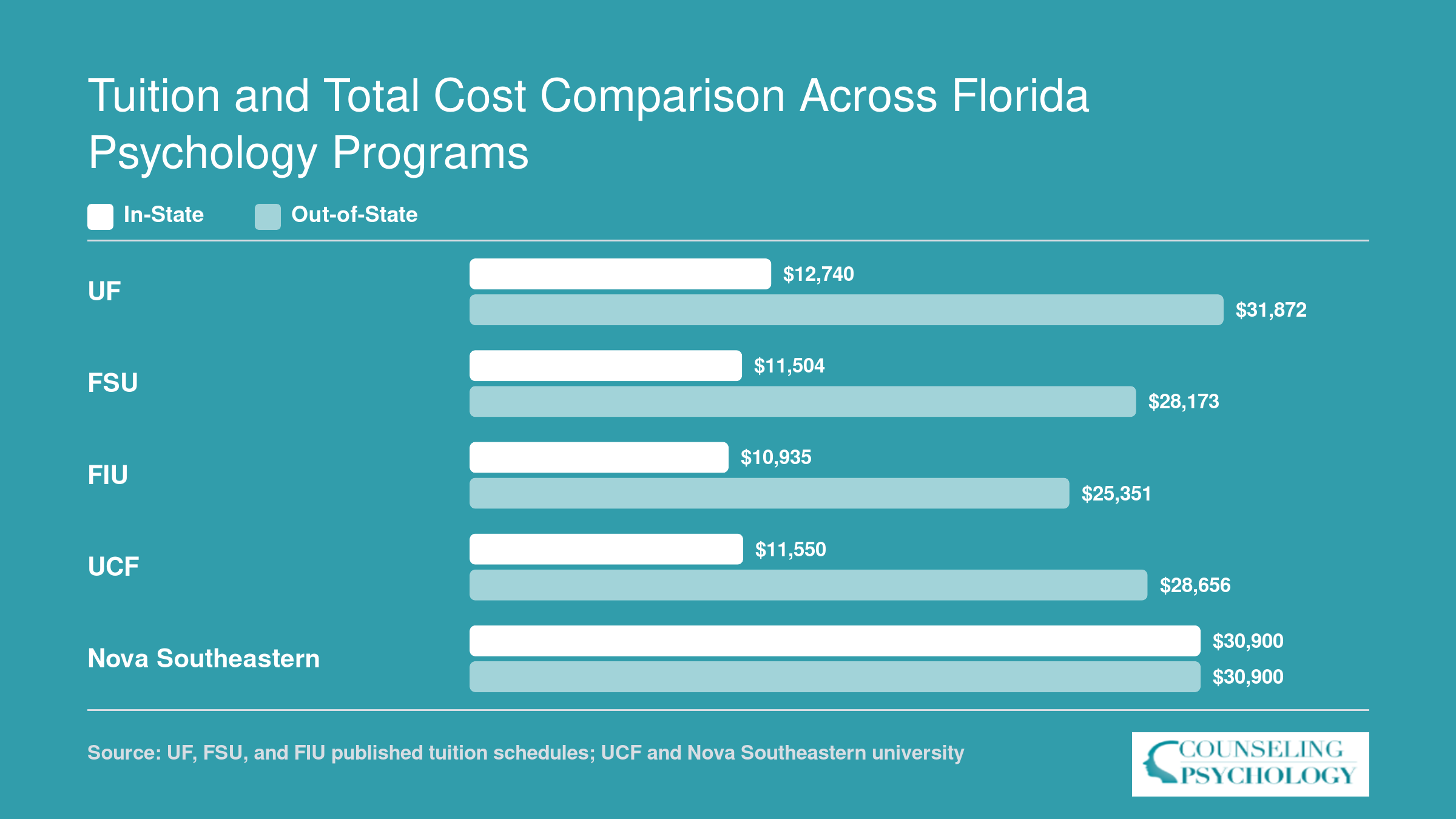
Tuition and Total Cost Comparison Across Florida Psychology Programs
Graduate tuition at Florida's public universities remains relatively affordable for in-state students, but the gap widens significantly for out-of-state and private-university enrollees. Keep in mind that most funded PhD programs at public schools cover tuition through assistantships and stipends, while self-funded PsyD programs (like Nova Southeastern's) require students to shoulder the full sticker price, potentially adding $100,000 or more to total program cost.
Accreditation and Licensure Preparation in Florida
Aspiring psychologists in Florida face two distinct paths: clinical licensure through the Florida Board of Psychology and school psychologist certification via the Florida Department of Education. The route you choose depends heavily on your specialization, degree level, and career goals. Understanding how accreditation and supervised experience translate into eligibility is essential before committing to a program.
APA Accreditation and Clinical Licensure
The Florida Board of Psychology strongly favors doctoral programs accredited by the American Psychological Association.1 For anyone seeking licensure as a psychologist in clinical, counseling, or school psychology (the board-regulated route, not the DOE route for school settings), graduation from an APA-accredited program is the clearest path to meeting educational requirements. Programs with APA accreditation have undergone rigorous review to ensure they meet national training standards, which simplifies the board's evaluation of your credentials. While the board can review non-APA programs on a case-by-case basis, the bifurcation method available in Florida offers an alternative for graduates of regionally accredited doctoral programs that are not APA-accredited, provided they complete additional steps to demonstrate equivalency.2
The Licensure Timeline
After earning a qualifying doctoral degree, candidates must complete a total of 4,000 hours of supervised experience.2 Up to 2,000 hours may come from a predoctoral internship, and the remaining 2,000 hours must be postdoctoral. Within those hours, at least 900 must involve direct client contact, and you must receive a minimum of two hours of individual supervision per week.3 Once experience requirements are satisfied, you must pass the Examination for Professional Practice in Psychology (EPPP) with a scaled score of 500 or higher.2 Florida also requires a state-specific jurisprudence exam covering laws and rules governing practice. The exam consists of 40 multiple-choice questions administered in 60 minutes, with a passing score of 70 percent and a fee of $48.3 The board typically processes completed applications within 30 days.3 Those considering a clinical psychologist career should plan for this timeline from the outset.
Specializations That Don't Require APA Accreditation
Not every psychology career in Florida requires APA accreditation or licensure. Industrial-organizational psychology, for instance, is a non-licensable field; practitioners work in business and consulting settings without seeking psychologist licensure, so APA accreditation is not a gatekeeper. Similarly, academic and research positions at universities seldom require licensure. If your specialization does not involve direct provision of healthcare services to the public, you may not need to pursue the board's licensure process at all. Exploring different careers in psychology can help clarify which paths require licensure and which do not. For those intending to practice clinically, however, the combination of an APA-accredited program and the state's supervised experience pathway remains the gold standard.
School Psychology: A Separate Credential
School psychologists working in Florida's K-12 public schools follow a different credentialing process governed by the Florida Department of Education. This path requires at least a master's degree with 60 semester hours of graduate coursework, rather than a doctorate.4 Candidates must complete 3,000 hours of supervised experience under a certified school psychologist, along with 4,500 total professional hours.4 The required examination is the Praxis School Psychologist test, and application and certification carry a fee of $355.4 Students interested in this route can learn more about school psychologist requirements to map out the full credentialing process. This DOE certification is distinct from Board of Psychology licensure, so even if you hold a doctoral degree in school psychology, you may need DOE certification for public school employment.
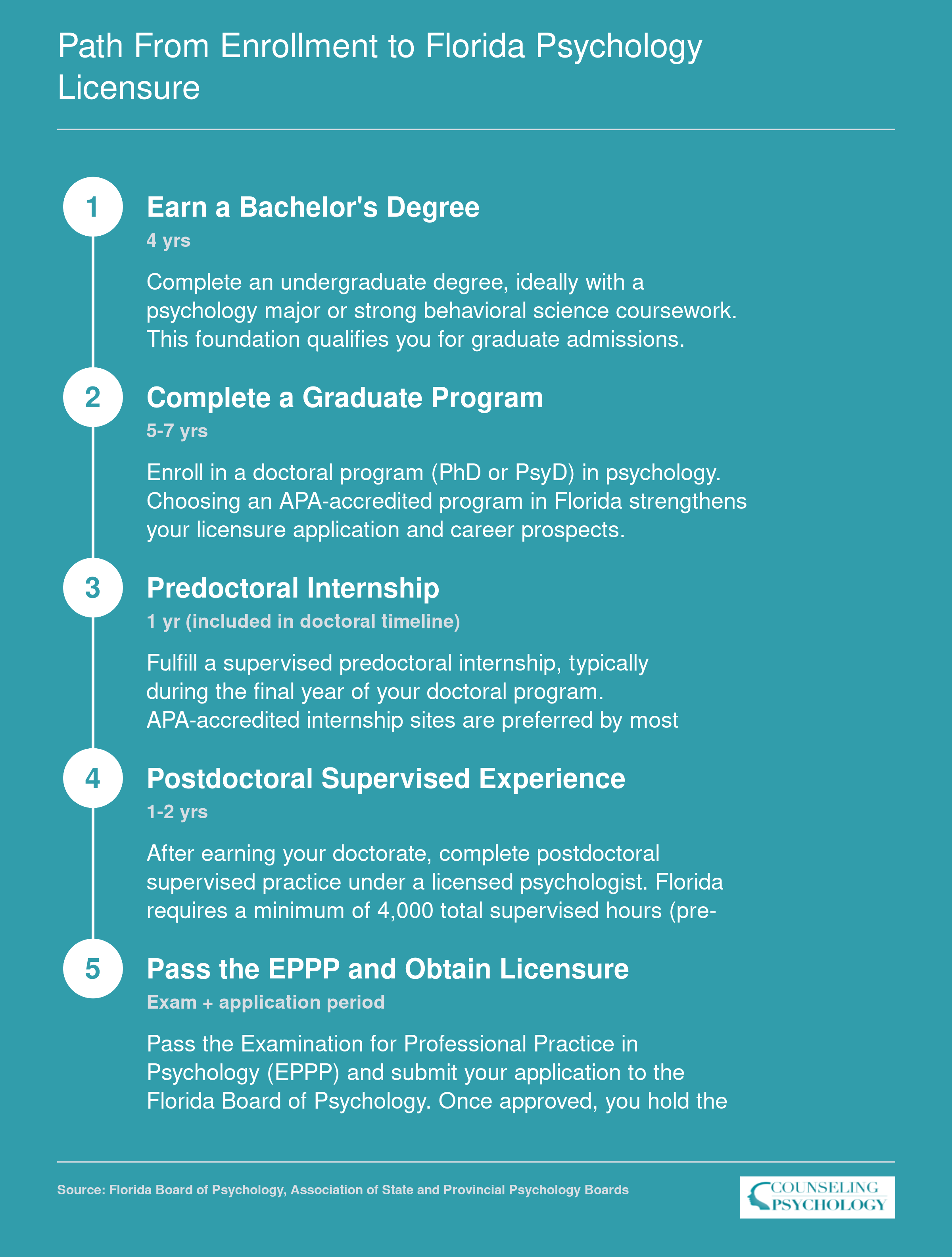
Path from Enrollment to Florida Psychology Licensure
Becoming a licensed psychologist in Florida is a multistep process that typically spans 10 to 14 years of education, training, and supervised practice. Here is the credentialing ladder at a glance, with approximate timelines for each stage.
Online vs. Campus Psychology Programs in Florida
Choosing between online and on-campus formats is one of the most consequential decisions you will make when selecting a psychology program in Florida. Both paths have genuine strengths, and the right fit depends on your specialization, licensure goals, and life circumstances. Here is a clear breakdown to help you weigh the tradeoffs.
Pros
- Online and hybrid programs offer scheduling flexibility that lets working professionals complete coursework around jobs or family obligations.
- Studying online broadens your school selection, since you are not limited to programs within commuting distance of your home.
- Tuition for online master's programs is sometimes lower than campus equivalents, and you save on housing, parking, and relocation costs.
- I-O psychology and general or applied psychology master's tracks have the strongest online availability in Florida, with the University of West Florida offering fully online options in both areas.
- Multiple Florida universities now provide online or hybrid master's programs, making graduate study more accessible statewide.
Cons
- On-campus programs provide in-person clinical training, including supervised practica and therapy sessions, that is difficult to replicate in a virtual setting.
- Research lab access is far stronger on campus, which matters significantly for students pursuing experimental, cognitive, or neuropsychology tracks.
- Networking with faculty, cohort peers, and visiting scholars happens more organically in a campus environment and often leads to career opportunities.
- APA-accredited doctoral programs in clinical and counseling psychology are overwhelmingly campus based; no Florida university currently offers a fully online APA-accredited PsyD or PhD.
- Because APA accreditation is typically required or strongly preferred for psychology licensure in Florida, choosing a non-accredited fully online doctorate can limit your ability to become licensed.
Career Outcomes and In-Demand Psychology Specializations in Florida
Choosing a psychology specialization means weighing immediate job availability against long-term growth potential, and Florida's unique demographic and economic landscape tilts that equation in unexpected ways. The state's aging population, sustained corporate expansion in South and Central Florida corridors, and major investments in school mental health funding create distinct pockets of demand that favor certain specializations over others.
Florida-Specific Demand Drivers
Florida's rapidly aging population has positioned neuropsychology and geropsychology as high-demand subfields. The state ranks second nationally in residents age 65 and older, driving demand for professionals who assess and treat age-related cognitive decline, dementia, and neurodegenerative conditions. Students interested in the neuroscience side of this work may also explore what it takes to become a neurologist. Meanwhile, school psychology has received renewed attention following state-level appropriations for expanded mental health services in public schools. Major districts, including Miami-Dade, Broward, Hillsborough, and Orange County, have all increased school psychologist hiring over the past three years.
Industrial-organizational psychology has grown alongside corporate relocations to the Tampa, Orlando, and Miami metro areas. Headquarters for financial services, technology, and healthcare management firms now cluster along the I-4 corridor and South Florida, creating demand for workplace performance consultants, talent assessment specialists, and organizational development professionals.
Employment and Wage Data by Specialization
Nationally, psychologists earned a median annual wage of $94,310 in 2024, with total employment of approximately 204,300 professionals.1 The Bureau of Labor Statistics projects 6 percent job growth from 2024 to 2034, adding roughly 12,900 annual openings across all psychology specializations.1 Florida-specific figures for clinical and counseling psychologists, school psychologists, and industrial-organizational psychologists typically align with or exceed national medians in urban metro areas, though rural and suburban markets often lag.
School psychologists in Florida benefit from NASP salary guidelines adopted by several large districts, while I-O psychologists working in corporate consulting or headquarters roles often command six-figure compensation packages. Clinical and counseling psychologists in private practice settings report wide variance depending on payer mix, specialization, and geographic location. For a broader look at compensation trends across the helping professions, the counselor salary breakdown offers useful context.
Practicum and Internship Advantages
Florida offers a rich ecosystem of training sites. The state hosts multiple Veterans Affairs hospitals (Miami, Tampa, West Palm Beach, Gainesville, Bay Pines), nationally recognized children's hospitals (Johns Hopkins All Children's, Nicklaus Children's, Nemours), and APA-accredited internship consortia. Major school districts provide supervised placements for school psychology students, while Fortune 500 headquarters in South Florida open doors for I-O psychology practicum students seeking corporate exposure. These training opportunities often convert into post-graduation job offers, giving Florida-trained psychologists a competitive edge in the state's job market.
Florida Psychology Salaries by Specialization
Compensation varies significantly across psychology specializations in Florida, and certain niches command a notable premium. The table below draws on Bureau of Labor Statistics (BLS) occupational data for Florida alongside national medians. Industrial-organizational psychology and neuropsychology consistently rank among the highest-paying specializations, both in Florida and nationally, reflecting strong employer demand for these skill sets.
| Specialization | Typical SOC Code | Florida Median Annual Salary | National Median Annual Salary | Total Employment in Florida |
|---|---|---|---|---|
| Clinical Psychology | 19-3031 | $82,510 | $96,100 | 5,760 |
| Counseling Psychology | 19-3033 | $58,650 | $60,990 | 3,120 |
| Industrial-Organizational Psychology | 19-3032 | $125,680 | $147,420 | 310 |
| School Psychology | 19-3034 | $60,520 | $64,750 | 2,440 |
| Neuropsychology (Clinical Neuropsychologists) | 19-3039 | $98,230 | $106,420 | 870 |
How to Choose the Right Psychology Program in Florida
Some applicants chase the most recognizable university names; others map out a specific career (child neuropsychologist, forensic evaluator, VA counselor) and work backward. The most effective strategy weaves both together, using five concrete factors to narrow your list.
Define Your Specialization Fit First
Before comparing schools, clarify what you want to do. Clinical psychology, school psychology, and neuropsychology demand different coursework and practicum experiences. A program strong in health psychology might offer no forensic training. Review the curriculum, faculty research areas, and available clinical placements. If your goal is to work with a particular population or in a niche setting, confirm the program has faculty actively publishing and supervising in that area. If you are still weighing options, our overview of different types of psychology degrees can help you map specializations to degree levels. Specialization alignment ultimately determines whether your degree opens the right doors.
Prioritize APA Accreditation for Clinical Paths
If you intend to become a licensed psychologist in Florida, APA accreditation is non-negotiable for clinical, counseling, and school psychology doctoral programs. The Florida Board of Psychology requires completion of an APA-accredited program for licensure. Without it, you may face significant hurdles, including denial of internship or postdoc eligibility. Always verify a program's current accreditation status through the APA Commission on Accreditation. For master's-level paths (mental health counseling, social work), look for CACREP or CSWE accreditation instead; these are the equivalent gatekeepers for licensure in those fields.
Weigh Cost, Funding, and Format Together
Psychology graduate education can range from fully funded PhD packages to high-debt PsyD or master's programs. Contact admissions offices directly to ask about assistantship availability: fully funded PhDs are common, while PsyD programs rarely offer tuition waivers or stipends. Assistantships can eliminate tuition and provide a living stipend, but they are competitive. Also consider format: online programs offer flexibility for working students, but campus-based programs provide more networking and hands-on clinical training. Students interested in forensic psychology online degree options should verify that the program includes sufficient in-person practicum hours to meet Florida's licensure standards. Compare total cost against expected early-career salary in your specialization to avoid unmanageable debt.
Use Internship Match Rates as a Quality Signal
For doctoral applicants, internship match data reveals how well a program prepares its students. The Association of Psychology Postdoctoral and Internship Centers (APPIC) publishes annual match statistics. Ask programs for their recent APPIC match rates. Consistently high match rates, especially for APA-accredited internships, signal strong clinical training, faculty advocacy, and a positive reputation among training sites. Programs that hide or avoid this metric may have weaker outcomes. This single data point often exposes the gap between marketing claims and actual graduate success.
Frequently Asked Questions About Psychology Programs in Florida
Florida's psychology landscape generates a lot of questions, from program costs and accreditation to career prospects after graduation. Below are direct answers to the questions students ask most often when evaluating psychology specializations and degree programs in the state.