
What you’ll learn in this article…
- Dallas-area Christian counseling master's programs range from CACREP-accredited licensure tracks to non-licensed ministry degrees.
- Texas LPC licensure requires a 60-credit qualifying degree plus 18 to 30 months of post-degree supervised practice.
- Institution-wide average net prices vary widely, so comparing aid packages and per-credit costs is essential before committing.
- Denominational fit, practicum hour requirements, and faith integration models differ significantly across DFW programs.
The Dallas-Fort Worth metro holds one of the highest concentrations of Christian universities in the United States, which means applicants have real choices rather than a single obvious option. That density also creates genuine complexity: programs in this region range from fully clinical, CACREP-adjacent tracks designed to qualify graduates for the Texas LPC exam, to ministry-focused degrees built around biblical exposition and pastoral care with no licensure pathway at all.
The distinction matters practically. Texas requires a qualifying 48-to-60-credit-hour master's degree, two years of supervised post-degree experience, and passage of a national licensing exam before a graduate can practice independently as a licensed professional counselor. A ministry-track degree, regardless of its academic rigor, does not satisfy those requirements. Students exploring the broader landscape of faith-rooted programs, including accredited biblical counseling degree online options, will find the same licensure-versus-ministry divide nationwide.
Tuition across Dallas-area programs runs from roughly $7,200 to over $25,000 in total program costs, and program-level earnings data is not yet available for most of these degrees, making cost-benefit comparisons harder than they should be. What is clear is that the credential you earn determines the career you can build.
Top Master's in Christian Counseling Programs Near Dallas
The Dallas-Fort Worth region is home to several faith-rooted graduate programs in Christian counseling, but they differ sharply in purpose. Some prepare you for Texas LPC licensure while others equip you for non-licensed ministry roles in churches and parachurch organizations. Below, we profile four programs sorted by overall institutional strength and program relevance, noting which track each one follows so you can zero in on the right fit.
- Accreditation and licensure alignment
- Institutional graduation and retention rates
- Net price and affordability
- Program format and flexibility
- Faith integration and career focus
- Internal program database
- NCES-IPEDS federal institutional data — nces.ed.gov
- Independent program research
- College Scorecard graduate earnings — collegescorecard.ed.gov

Dallas Baptist University
Dallas Baptist University anchors its counseling offerings with a CACREP-accredited, 60-credit M.A. in Professional Counseling that meets Texas LPC requirements, giving the broader campus a clinical training culture that few faith-based competitors can match. Alongside that licensure track sits a 36-hour M.A. in Christian Counseling, a hybrid, non-licensure program built for ministry contexts. DBU's Baptist affiliation and deep ties to DFW-area churches, including a unique residency partnership with Sky Ranch Christian Camps, make it especially practical for students already living and serving in North Texas.
- 36-credit, non-licensure program focused on ministry settings
- Hybrid format blends online coursework with on-campus sessions
- Integrates biblical principles with psychological theory
- Sky Ranch residency pathway pairs degree with camp ministry
- Evening and weekend scheduling designed for working professionals
- Experienced faculty with real-world ministry backgrounds
- Prepares graduates for church, denominational, and parachurch roles
Master of Arts in Christian Counseling — Hybrid

Houston Christian University
Houston Christian University's 66-credit M.A. in Christian Counseling is structured to align with Texas LPC Board requirements, making it one of the few explicitly faith-centered programs in the state that positions graduates for licensed clinical practice. The program is not CACREP-accredited, so students should verify reciprocity before planning to practice outside Texas. With a scholar-practitioner faculty, diverse urban clinical placements, and growing online course availability, HCU can serve Dallas-area students willing to complete in-person clinical components in Houston.
- 66-credit curriculum aligned with Texas LPC Board requirements
- Three-year completion plan with both campus and online courses
- Emphasis on spiritual formation alongside clinical competency
- Covers trauma-informed care, substance abuse, and ethics
- Supervised internships in Houston-area clinical settings
- Scholar-practitioner faculty integrating Christian worldview
- Scholarships available based on need and academic promise
Master of Arts in Christian Counseling — On-Campus

Amberton University
Amberton University in Garland offers one of the most affordable options in the Dallas suburbs. Its M.S. in Family Studies with a Christian Counseling Specialization is a 36-credit, fully online or hybrid program designed for working adults already embedded in North Texas churches and family ministries. The degree is not a licensure track; it targets family life education, lay counseling, and ministry leadership roles rather than clinical practice. Institution-wide graduation and retention data are not reported through standard federal sources, so prospective students should request outcome information directly from the university.
- 36 credits at roughly $325 per credit hour
- 100% online or hybrid delivery from Garland campus
- Interdisciplinary curriculum covering counseling, ethics, and research
- Geared toward family life education and church-based ministry
- Non-licensure program suited for lay counseling roles
- Requires students to be at least 21 and typically working
- Small 12:1 student-to-faculty ratio supports individual attention
MS Family Studies, Christian Counseling Specialization — Online

Dallas Theological Seminary
Dallas Theological Seminary brings heavyweight biblical and theological training to its counseling programs, offering both an M.A. in Counseling Ministries (66 hours) and an M.A. in Biblical Counseling. Neither program is designed for Texas LPC licensure; both emphasize nonclinical, church-based counseling with substantial coursework in Bible exposition and systematic theology. DTS delivers courses from its Dallas campus, several extension sites, and an online platform with required real-time participation, giving North Texas students multiple scheduling options. Students must affirm DTS's doctrinal statement, so theological alignment is a genuine admissions factor.
- 66-hour nonclinical program blending psychology with biblical training
- Available in Dallas, Houston, other extension sites, and online
- 22 hours of Bible exposition plus 18 hours of systematic theology
- Cultural competency and recovery strategies woven into curriculum
- Logos Bible Software provided to all counseling students
- Financial aid and scholarships available for qualifying students
- Campus-based program focused on biblical counseling methodology
- Integrates theology and counseling for faith-based career preparation
- Prepares graduates for congregational and parachurch counseling roles
- Requires a bachelor's degree and alignment with DTS doctrinal statement
- Strong emphasis on Scripture-driven counseling practice
- Ideal for students prioritizing text-centered pastoral care
Master of Arts in Counseling Ministries — On-Campus
Master of Arts in Biblical Counseling — On-Campus
Licensure-Track vs. Ministry-Focused Programs: How to Choose
The real decision most Dallas-area applicants face is not which Christian counseling program feels most spiritually aligned, but whether they want a credential that lets them practice independently. That choice shapes everything: the program you apply to, the cost you accept, and the career options you gain.
What Licensure-Track Programs Require
In Texas, earning a Licensed Professional Counselor (LPC) credential requires graduating from an accredited program of at least 60 graduate credit hours, completing a minimum of 300 supervised practicum hours during your degree, passing the Texas Jurisprudence Exam plus either the NCE or NCMHCE, and logging 3,000 post-degree supervised hours before receiving a full license. These thresholds come directly from the Texas Behavioral Health Executive Council (BHEC) and apply to anyone seeking licensure in the state.2
Programs designed to meet these standards are typically aligned with CACREP accreditation (the Council for Accreditation of Counseling and Related Educational Programs). A CACREP-accredited degree signals to state licensing boards that your curriculum, faculty qualifications, and practicum structure already meet or exceed the benchmarks. For students who want to open a private practice, work in a community mental health agency, or bill insurance, this path is not optional; it is the foundation. Those exploring licensed professional counselor online programs will find the same 60-hour, clinically oriented structure regardless of delivery format.
What Ministry-Focused Degrees Offer Instead
Ministry-focused Christian counseling degrees, often structured as Master of Arts programs through seminaries or Bible colleges, typically run 36 to 48 credit hours. They prioritize theology, pastoral care, and spiritual formation over clinical diagnosis and evidence-based treatment modalities. Graduates are well-prepared for roles in church counseling centers, campus ministry, chaplaincy, and coaching, settings where licensure is not required. Students drawn to this track may also want to explore pastoral counseling degree options to compare curriculum depth and career outcomes.
The tradeoff is real: these programs are often shorter and less expensive, but they do not qualify graduates to practice as licensed counselors without further coursework.
Can a Ministry Degree Lead to Licensure Later?
Texas BHEC does allow applicants from non-CACREP programs to pursue LPC licensure by completing deficiency coursework in areas where their degree falls short. In practice, this means identifying which required content areas your transcript does not cover and taking additional courses, sometimes a significant number, before you qualify to sit for exams. For graduates of a 36-credit ministry program, the gap between what they have and what Texas requires can translate to a year or more of additional study and real added cost.
If licensure is even a possibility you want to keep open, the more efficient path is choosing a 60-plus-hour CACREP-aligned program from the start rather than retrofitting a ministry degree later.
Matching the Program to Your Actual Goals
A straightforward way to self-select:
- Clinical practice or private practice: You need a licensure-track, CACREP-accredited program with the full 60-credit-hour structure and supervised practicum built in.
- Church ministry, chaplaincy, or pastoral care: A ministry-focused MA may be exactly the right fit, and the shorter timeline can be an advantage.
- Uncertain or dual goals: Err toward the licensure track. Holding an LPC does not prevent you from doing ministry work; lacking one does prevent you from accepting clinical clients or working in regulated settings.
Faith integration matters in both tracks, but the structural differences between them are significant enough that choosing the wrong one can mean years of remediation. Clarify your career target before you apply.
Questions to Ask Yourself
Cost Comparison and Financial Aid for Dallas-Area Programs
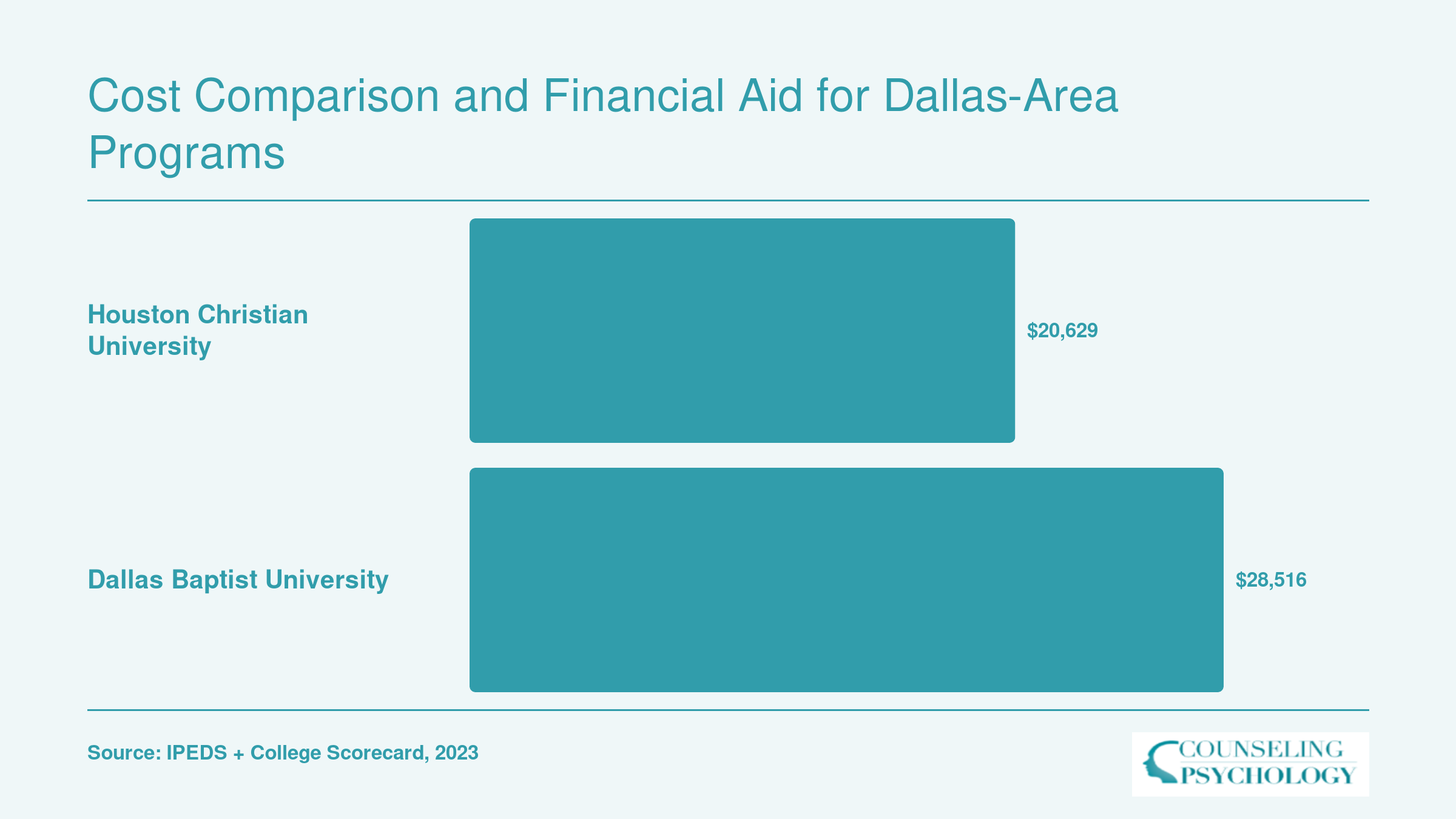
The figures below reflect institution-wide average net prices after financial aid, drawn from federal data. Actual graduate tuition for a Christian counseling master's will differ depending on credit hours, program format, and any merit or denominational aid you receive. Common funding sources for these programs include church-based tuition discounts (such as the Sky Ranch partnership with DBU, which covers a substantial portion of tuition), denominational scholarships like the Southern Baptist Theological Seminary's Excellence in Biblical Counseling Scholarship, employer tuition assistance for ministry staff, NBCC Foundation fellowships, and federal graduate loans.
Career Outcomes and Earnings After Graduation
Career outcomes for Christian counseling master's graduates depend heavily on which path you choose: a licensure-track degree that leads to LPC credentials and clinical practice, or a ministry-focused degree that prepares you for pastoral counseling, church-based care, or chaplaincy. The earnings, employment timelines, and roles look meaningfully different across those two tracks, so any single "average" figure hides a lot of variation.
What the Dallas-Fort Worth Job Market Pays
The clearest benchmark comes from the Bureau of Labor Statistics. In the Dallas-Fort Worth-Arlington metro, mental health counselors (SOC 21-1014) held about 970 jobs in May 2023, with a mean annual wage of $50,880 and a mean hourly wage of $24.46.1 That figure reflects fully licensed counselors working in clinical settings, not new graduates or LPC-Associates earning a supervised-practice wage. Early-career pay in DFW typically sits below the metro mean, while experienced counselors in private practice or specialized settings often earn well above it. Ministry-track graduates working in church staff roles, lay-counseling ministries, or nonprofit pastoral care generally fall outside this BLS category and earn on a different scale tied to congregation size and denomination. Students weighing a ministry path may want to explore masters in biblical counseling programs, which typically orient curricula around vocational ministry rather than clinical licensure.
Program-Level Earnings and Employment Data
Here is where readers deserve straight talk: program-specific earnings and employment outcomes for the Dallas Baptist University and Houston Christian University Christian counseling master's programs are not currently published in the federal outcomes data. That means we cannot reliably quote one-year or four-year median earnings for completers of these specific programs, the share working one year after graduation, or the share earning above 150% of the federal poverty line. When that data becomes available, it will give a much sharper picture than occupation-wide BLS figures.
What we can say: institution-wide early-career earnings for graduates of both schools (across all programs, ten years after entry) sit in the mid-$50,000s, which is consistent with the DFW counselor market for those who pursue licensure.
Thinking About Return on Investment
Median graduate debt runs roughly $21,000 to $23,000 at these two institutions. Against a realistic early-career LPC-Associate salary of $42,000 to $50,000 in DFW (climbing past the metro mean once fully licensed), the debt load is manageable but not trivial. The ROI math improves substantially for licensure-track graduates who complete supervision and move into independent practice. For ministry-track graduates, the financial return is harder to quantify because the work itself is structured around vocational calling rather than market wages, something worth weighing honestly before you enroll.
Related Articles
Curriculum, Practicum Hours, and Faith Integration
Balancing rigorous clinical training with deep spiritual formation is the defining challenge of a Christian counseling master's program. Both elements shape whether you graduate ready for state licensure and equipped to counsel from a biblical worldview. The curriculum in a licensure-track Christian counseling MA typically weaves together three strands: core clinical courses, theological study, and integration seminars that bridge the two.
Core Clinical and Theological Coursework
Expect the same foundational clinical sequence found in any CACREP-aligned program: psychopathology, human development, assessment, group counseling, and professional ethics. Layered on top are Bible and theology requirements, often drawn from the institution's seminary or divinity school, covering Old and New Testament, systematic theology, and hermeneutics. The distinctive piece is the integration seminar, a course dedicated to examining where psychological theory and Christian doctrine intersect or diverge, and how to apply that synthesis in the therapy room. Some programs also require a spiritual disciplines or formation course. Students who want to explore additional credentials in this space may consider a graduate certificate in biblical counseling to complement their master's work.
Practicum and Internship Hours
For licensure-track students, the supervised clinical experience is non-negotiable. CACREP standards mandate a 100-hour practicum followed by a 600-hour internship, totaling at least 700 hours of direct client contact and supervision. These hours are built into the master's program and must be completed at approved sites under an LPC-S or equivalent supervisor. Ministry-focused or non-licensure tracks may have a reduced fieldwork requirement, often substituting a ministry practicum or a capstone project in a church setting, so confirm the hour totals with each program if you are weighing both paths.
Faith-Integrated Practicum Sites in DFW
The Dallas-Fort Worth area offers a strong network of Christian counseling centers that accept master's interns, though most do not advertise openings publicly.1 Church-based clinics such as the Oak Cliff Bible Fellowship Counseling Center1 and First Baptist Dallas's Pathways Christian Counseling Center2 provide explicitly Christ-centered and biblically based environments. Parachurch options include Harmony Counseling (part of Harmony CDC), which operates extended hours3, and White Rock Therapy, where Christian counseling is offered and supervision is provided.4 Other sites like Thrive Counseling Services5 and Total Life Counseling6 integrate faith throughout their work. LifeStance Health, a larger network, has DFW offices that make faith-based Christian counseling available and occasionally accept master's-level interns.7 Because formal internship listings are rare, the best strategy is to contact these centers directly and ask whether they host interns and if an LPC-S or LMFT-S is on staff to provide supervision.1 Most church-based counseling centers in Texas regularly use interns, so persistence often yields a placement.
Spiritual Formation and Mentorship
Beyond coursework and clinical hours, Christian counseling programs prioritize the student's personal faith development. This often takes the form of chapel attendance requirements, adherence to an institutional faith statement, and intentional mentorship from faculty members who are both licensed clinicians and committed believers. Some programs assign a spiritual director or require reflective journals alongside clinical case notes. For those drawn to the pastoral side of the vocation, an online master's in pastoral counseling can offer an alternative pathway that emphasizes ministry over clinical licensure. The goal across all these programs is not just to train skilled therapists but to nurture counselors whose personal character and spiritual depth anchor their professional practice.
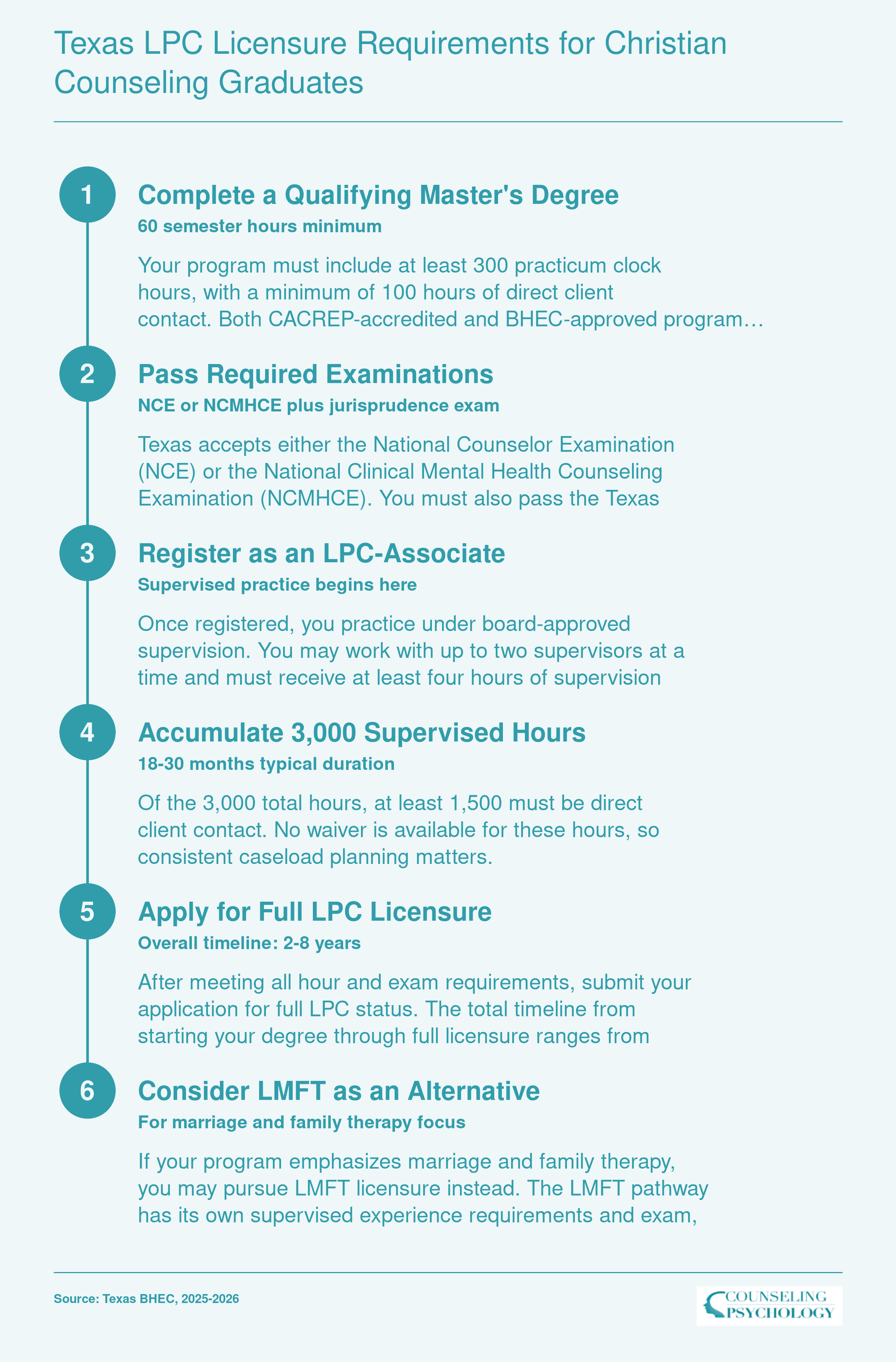
Texas LPC Licensure Requirements for Christian Counseling Graduates
Graduating from a qualifying Christian counseling program is just the starting line. Texas requires several post-degree milestones before you hold a full LPC, and the timeline typically spans 18 to 30 months of supervised practice after you finish your master's. Programs with a marriage and family therapy emphasis may also qualify graduates for LMFT licensure, which follows a separate credentialing track through the Texas BHEC.
Admissions Requirements and Application Tips
Applying to a master's in Christian counseling is not a one-size-fits-all process. Each program sets its own thresholds, and those details shift more often than any aggregated source can track. The most reliable move is to go directly to the official admissions page of each school you are considering.
What to Look For on Each Program's Admissions Page
Most Dallas-area programs, including those at Dallas Baptist University and Dallas Theological Seminary, publish their admissions criteria online, but the specifics vary and do change. When you visit those pages, check for:
- GPA minimums: Many programs require a 3.0 undergraduate GPA, though some accept lower GPAs with additional materials.
- GRE requirements: Some programs waive the GRE outright, others require it only for applicants below a certain GPA threshold, and a few still require it universally.
- Faith or doctrinal statements: Christian counseling programs commonly ask applicants to articulate their personal faith, and some require agreement with a specific statement of faith tied to the institution's denomination or theological tradition.
- Pastoral or spiritual references: Beyond the standard academic or professional letters of recommendation, many programs request one or more references from a pastor, ministry leader, or spiritual mentor.
- Prerequisite coursework: Some programs expect foundational coursework in psychology, statistics, or theology before enrollment, while others build those foundations into the program itself.
When the Website Leaves Gaps
Admissions pages do not always answer every question. If you cannot find clear information on waivers, transfer credit policies, or whether a prerequisite can be satisfied after conditional admission, call or email the admissions office directly. Admissions staff are accustomed to these questions and can clarify faster than any third-party source.
If you are weighing a faith-integrated path against a clinical track, exploring spiritual counseling certification requirements can help you understand the broader landscape. Reviewing general education and licensure expectations across counseling occupations can also clarify why programs structure their admissions criteria the way they do.
Build Your Network Before You Apply
Joining the American Association of Christian Counselors (AACC) before you even submit an application is a strategic move. Student membership gives you access to a community of practitioners and graduate students who have firsthand experience with many of the programs you are evaluating. Conversations with current students or recent alumni often surface practical details, such as how intensive the doctrinal requirements feel in practice or which prerequisites trip applicants up, that no admissions brochure will mention.
Christian counseling programs around Dallas span a real theological spectrum, from nondenominational evangelical to Southern Baptist confessional to broadly interdenominational. Before you apply, pull up each school's statement of faith and community covenant. Doctrinal fit shapes your classroom experience, your clinical supervision, and the populations you'll feel called to serve, often more than a ranking ever will.
Frequently Asked Questions About Christian Counseling Programs Near Dallas
Choosing a Christian counseling program involves navigating accreditation standards, licensure pathways, costs, and career possibilities. Below are answers to the questions prospective students in the Dallas area ask most often.