
Key Takeaways
- CSWE accredited accelerated online BSW programs can be completed in as few as 18 to 24 months with transfer credits.
- Every program requires a minimum of 400 supervised field placement hours, often the biggest scheduling variable for online students.
- Stacking an accelerated BSW with an advanced standing MSW can compress the path to clinical licensure by several years.
- BLS projects strong national job growth for social workers, though entry level BSW salaries remain modest across most settings.
The Bureau of Labor Statistics projects employment for social workers will grow 7% through 2033, faster than the average across all occupations, with roughly 67,300 openings expected each year. Accelerated online BSW programs respond to that demand by compressing the traditional four-year path into 18 to 36 months for transfer-ready students.
The tradeoff is real. Faster completion means denser coursework, tighter field placement timelines, and less margin for working students juggling 400 required practicum hours. Tuition across the 29 CSWE-accredited programs ranked here ranges widely, and completion windows vary based on transfer credit policies, term length, and whether a school runs six-, eight-, or fifteen-week sessions.
For candidates already eyeing advanced standing MSW admission, the BSW credential is less a destination than a 12-month head start on clinical licensure.
Best Accelerated Online BSW Programs in 2026
The programs below were evaluated using a composite of net price, institution-wide graduation rate, and median earnings reported through the College Scorecard. This approach balances affordability, completion momentum, and long-term return on investment. Because program-level earnings data are not yet available for most of these BSW tracks, the 10-year median earnings figures reflect institution-wide outcomes, giving you a broad ROI snapshot rather than a social-work-specific salary figure. Graduation rates are also institution-wide per federal reporting conventions. Where acceleration claims could be independently verified, those programs received additional weight in positioning.
- Net price after financial aid
- Institution-wide graduation rate
- Scorecard median earnings
- Verified accelerated completion timeline
- Program accreditation status
- Independent program research
- Internal program database
- College Scorecard graduate earnings — collegescorecard.ed.gov
- NCES-IPEDS federal institutional data — nces.ed.gov

University of Illinois Urbana-Champaign
The University of Illinois Urbana-Champaign pairs a nationally top-ranked School of Social Work with an online BSW structured as a roughly two-year degree-completion pathway for transfer students. CSWE-accredited and designed to feed directly into advanced-standing MSW admission, the program blends asynchronous coursework with supervised field education. At an institution-wide graduation rate of 85.1% and a 10-year median earnings figure of $81,054, UIUC offers a strong long-term payoff despite a higher sticker price than many public peers.
- CSWE-accredited with a top-ten national ranking
- Approximately two-year completion for transfer students
- Online format with hands-on field education component
- Pathway to advanced standing in MSW programs
- Generalist practice focus spanning policy and direct service
- In-state tuition around $18,267; net price $14,355
- Campus and online modalities available
Bachelor of Social Work — Online

University of Utah
The University of Utah stands out for one of the shortest verified timelines on this list: an online BSW professional sequence of roughly 48 credits completable in about 1.5 to 2 years. Its curriculum centers social justice, diversity, and direct practice with individuals, families, and communities. Students can also pursue a Child Welfare concentration, a niche that pairs well with state-level child protective services demand. The 10-year median earnings for Utah graduates reach $67,170, and fieldwork is woven into the program to ensure hands-on readiness.
- 48-credit professional sequence, completable in 1.5 to 2 years
- Available Child Welfare concentration
- Online format with required field education
- Approximately $537 per credit for the professional portion
- In-state tuition around $9,620; net price $16,200
- CSWE-accredited with social justice emphasis
- Financial aid and scholarships available
Bachelor of Social Work — Online

University of North Carolina at Charlotte
UNC Charlotte delivers a CSWE-accredited online BSW that functions as a 60-credit, two-year degree-completion program, with in-state per-credit pricing starting near $189. That combination of speed, accreditation, and affordability earned it a spot among nationally recognized fast BSW programs. An in-person practicum requirement builds real-world competence, and the 69% institution-wide graduation rate reflects a large, diverse student body. Ten-year median earnings sit at $57,289.
- Two-year, 60-credit degree-completion model
- In-state rate approximately $189 per credit hour
- Out-of-state rate approximately $864 per credit hour
- CSWE-accredited with generalist practice focus
- Mandatory in-person practicum for field experience
- 2.5 GPA and prerequisite courses required for admission
- Net price $15,435 after aid
Bachelor of Social Work — Online

University of South Florida
The University of South Florida offers a CSWE-accredited BSW in a hybrid format that blends online coursework with a 460-hour field placement. The lock-step cohort structure keeps students on a predictable timeline, and the 41-credit professional sequence is among the more compact on this list. A net price of $9,812 makes USF one of the most affordable entries here, while a 10-year median earnings figure of $57,743 underscores solid post-graduation value. Distance learning and field lab fees apply on top of base tuition.
- CSWE-accredited hybrid program
- 41-credit professional sequence in lock-step cohort
- 460-hour supervised field placement required
- In-state tuition approximately $6,410; net price $9,812
- Distance learning fee applies for online students
- Background check and vaccinations may be required
- Generalist practice preparation for diverse settings
Social Work B.S.W. — Hybrid

The University of Tennessee-Knoxville
UT Knoxville built its online BSSW specifically for transfer students who bring 60 credit hours and an associate degree, making it a natural fit for community college graduates looking to finish quickly. The curriculum mirrors the on-campus version and includes real-time and asynchronous sessions plus field placements under professional supervision. Elective options in trauma and forensic social work let students tailor their training. The program reports a 95% employment rate after graduation, and institution-wide 10-year median earnings reach $60,249.
- CSWE-accredited online program for transfer students
- Mirrors on-campus curriculum in rigor and content
- Electives available in trauma and forensic social work
- 95% post-graduation employment rate reported
- Real-time and asynchronous online learning
- Field placements with professional supervision
- In-state tuition around $13,812; net price $18,976
Bachelor of Science in Social Work — Online

California State University-Chico
CSU Chico provides a hybrid BSW that combines on-campus instruction with online flexibility, grounded in practical skills and broad curriculum coverage. Its 92.7% admission rate makes it one of the most accessible programs on this list, and the net price of $14,480 is competitive within the California State University system. Graduates report 10-year median earnings of $64,172. Financial aid options are available, and the program is suited to students who benefit from some face-to-face interaction alongside digital coursework.
- Hybrid format blending online and on-campus learning
- Emphasis on practical skills and theoretical knowledge
- Net price $14,480; in-state tuition around $8,472
- Financial aid available to eligible students
- Diverse curriculum covering multiple social work domains
- Accessible admission with a 92.7% acceptance rate
Bachelor of Social Work — Hybrid

The University of Texas at Arlington
UT Arlington's hybrid BSW is CSWE-accredited and includes 120 total credit hours with an 18-hour field internship. The program's strong transfer credit policies and evening class options add genuine flexibility for working adults, and minors in Substance Use Treatment, Diversity Studies, or Social Welfare and Social Justice let students specialize early. A net price of $13,951 keeps costs reasonable for a large Texas research university, while 10-year median earnings of $63,199 reflect broad career utility. Advanced-standing pathways into the MSW program shorten the road to graduate licensure.
- CSWE-accredited hybrid program, 120 total credit hours
- 18-hour field internship in the local community
- Available minors: Substance Use, Diversity, Social Justice
- Evening and part-time class options for working students
- Transfer credit accepted; advanced MSW standing available
- In-state tuition around $11,950; net price $13,951
- Over 50 experienced faculty members
Bachelor of Social Work — Hybrid

University of Missouri
The University of Missouri offers its BSW both online and on campus, with students selecting a modality when they apply to the professional phase. The program prepares graduates for direct human service roles across healthcare, schools, and criminal justice settings, and it also positions them for graduate study. Mizzou's 74.9% graduation rate and 93% retention rate signal strong institutional support, though a net price of $20,268 places it at the higher end of this list. Ten-year median earnings for graduates are $63,403.
- Online and on-campus modalities available
- Application required to enter professional phase
- Modality choice is fixed upon admission
- Prepares for direct service, policy, and graduate study
- In-state tuition around $14,837; net price $20,268
- 93% first-year retention rate institution-wide
- Career paths span healthcare, schools, criminal justice
Bachelor of Social Work — Online

Appalachian State University
Appalachian State's CSWE-accredited BSW is offered both online and on its Boone, NC campus, with a curriculum rooted in social justice, human rights, and the American Social Welfare System. A 16:1 student-to-faculty ratio is the smallest in this ranking, pointing to more individualized attention. The program prepares students for entry-level positions in mental health, schools, and human services, and it also serves as a strong foundation for MSW study. Ten-year median earnings of $51,836 are the lowest in this set, reflecting the rural Appalachian market many graduates initially serve.
- Fully CSWE-accredited, online and on-campus options
- 16:1 student-to-faculty ratio, smallest on this list
- Curriculum covers social justice and human rights
- Prepares for careers in mental health and schools
- In-state tuition approximately $7,579; net price $16,836
- Strong pipeline to graduate social work programs
- Suitable for students at various life stages
Bachelor of Social Work — Online

University of Hawaii at Manoa
UH Manoa's online BSW is designed to reach students across Hawaii's island geography, combining asynchronous coursework with field education arranged locally. The program prepares graduates specifically for licensure as Licensed Bachelor Social Workers in Hawaii, making it a clear choice for anyone planning to practice in the state. Flexible part-time and full-time schedules accommodate working professionals, and a 15:1 student-to-faculty ratio ensures close faculty engagement. Ten-year median earnings for the institution are $57,624.
- Asynchronous online courses with local field education
- Prepares students for Hawaii LBSW licensure
- Part-time and full-time scheduling options
- 15:1 student-to-faculty ratio
- Completion of General Education Core required for entry
- In-state tuition around $12,186; net price $15,664
- Taught by experienced social work faculty
Bachelor of Social Work — Online
How Fast Can You Finish an Online BSW?
The fastest online BSW programs allow you to earn your bachelor's degree in social work in as little as 18 to 24 months if you enter with maximum transfer credits and maintain full-time enrollment. Most accelerated programs accept 60 to 90 semester credits from prior coursework, leaving roughly 30 to 60 credits to complete in the major. Your actual timeline depends on how many credits you bring in, how many courses you take per term, and whether the program runs year-round or follows a traditional academic calendar.
What to Look for on University Websites
When researching accelerated BSW programs, check individual university sites for these key details:
- Eight-week term structures: Many accelerated programs divide the academic year into five or six eight-week sessions instead of two semesters, letting you complete more courses in a calendar year.
- Year-round enrollment: Programs that offer fall, spring, and summer terms without breaks enable you to maintain continuous momentum and finish faster.
- Maximum transfer credit policies: Look for clear statements on how many credits the program accepts from community colleges, prior bachelor's degrees, or military training. Most CSWE-accredited programs cap transfers at 60 to 90 credits, but policies vary.
- Prior learning assessments: Some schools award credit for documented professional experience or portfolio review, potentially shaving months off your degree.
Verify Accreditation and State Requirements
Before committing to any timeline, consult the Council on Social Work Education (CSWE.org) to confirm that your program holds full accreditation. Only CSWE-accredited BSW programs satisfy the educational prerequisite for advanced-standing MSW admission and meet most state licensing boards' requirements. The National Association of Social Workers (NASW.org) offers additional professional guidance on credential standards and career pathways.
The U.S. Bureau of Labor Statistics (BLS.gov) publishes occupational outlooks and typical education requirements for social workers, which can help you understand how your degree fits into broader workforce expectations. While BLS does not certify individual programs, it provides useful context on what employers and licensing boards expect.
Contact Admissions Directly
Admissions offices can answer questions that websites leave unclear. Ask about:
- Exact transfer-credit limits for your prior coursework
- Whether the program offers competency-based credit or challenge exams
- Typical completion timelines for students entering with an associate degree or partial bachelor's credits
- Field placement scheduling, which can extend your timeline if local opportunities are limited
Direct conversations often reveal accelerated pathways not advertised prominently online, especially for working adults or military-connected students.
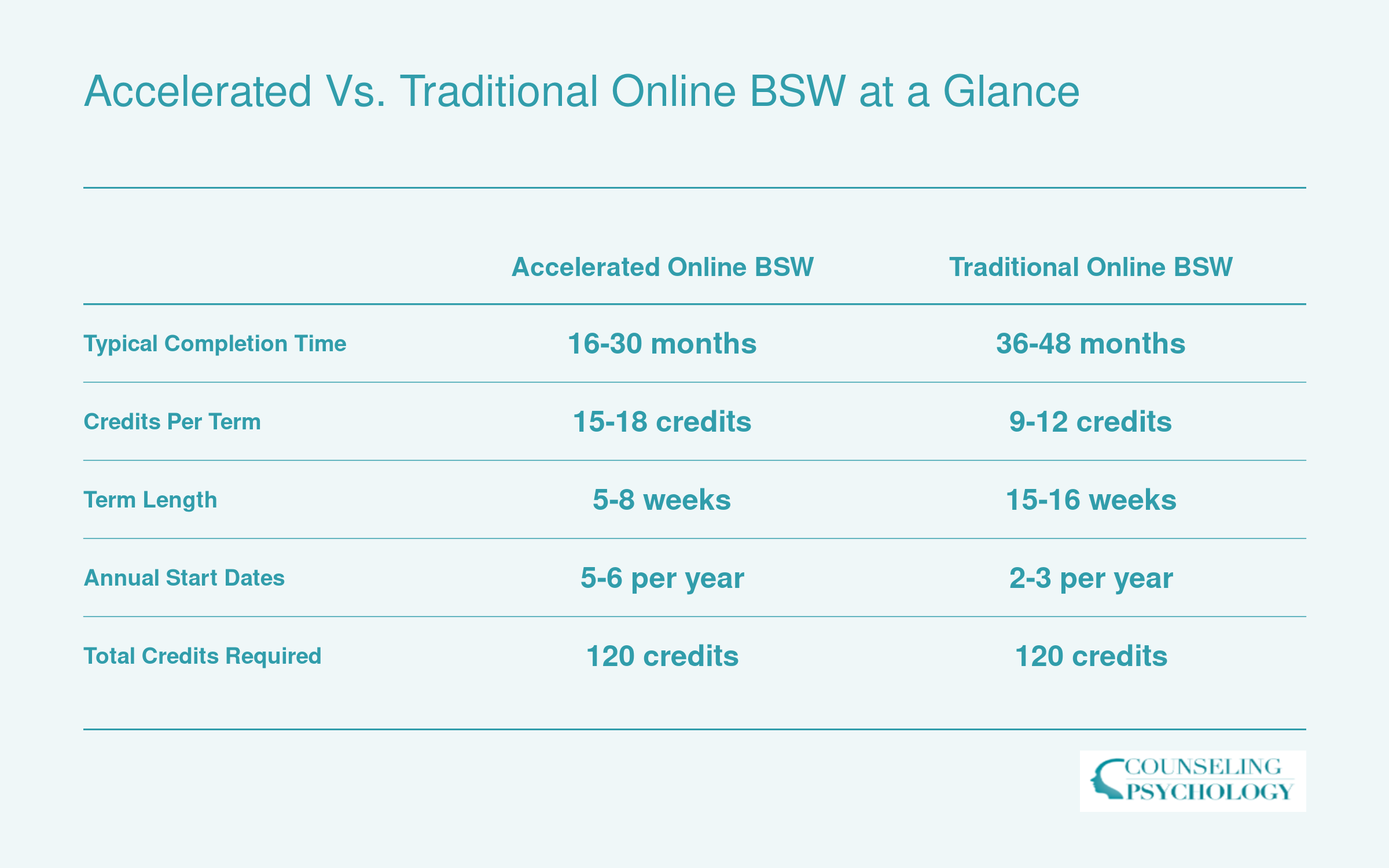
Accelerated vs. Traditional Online BSW at a Glance
The same degree, two very different timelines. This side-by-side breakdown shows exactly where accelerated programs compress the path so you can weigh pace against workload before you commit.
What Makes an Accelerated BSW Program Different?
Does "accelerated" mean you are skipping material or earning a lesser degree? Not at all. The distinction is entirely about how the coursework is delivered, not what you learn.
Same Credits, Compressed Calendar
An accelerated online BSW requires the same total credit hours as a traditional program, typically 120 semester credits. The difference is structural. Instead of spreading those credits across eight 16-week semesters with summers off, accelerated programs compress the calendar by using shorter terms, higher per-term credit loads, and year-round scheduling. The result: you cover identical content in less elapsed time.
Most accelerated formats use one or more of these strategies:
- Shorter terms: Seven- or eight-week blocks replace traditional 16-week semesters, effectively doubling the number of terms per year.
- Higher credit loads: Students often carry 15 to 18 credits per term instead of the 12 to 15 credits typical of a standard pace.
- No summer break: Year-round enrollment eliminates the three- to four-month gap that stretches a traditional program to four full years.
- Multiple start dates: Many programs offer six or more entry points per year, so you are never waiting months to begin.
What the Workload Actually Feels Like
Compressing a 16-week course into seven or eight weeks means roughly double the weekly reading, assignments, and discussion posts. Expect to spend 20 to 30 hours per week on coursework if you are taking a full accelerated load. That pace is manageable for disciplined learners, but it leaves little room for procrastination. Missing a single week in an eight-week term is the equivalent of missing two weeks in a traditional semester.
Field placement hours add another layer. Programs still require the same number of supervised practicum hours mandated for all BSW students, so you will need to carve out time for in-person fieldwork alongside your compressed coursework.
Rigor Stays the Same
Every accredited BSW program, whether traditional or accelerated, must meet the standards set by the Council on Social Work Education (CSWE). Those standards govern curriculum content, competency benchmarks, field education requirements, and faculty qualifications. An accelerated timeline does not reduce what CSWE expects. Admissions committees for MSW programs and state licensing boards evaluate your degree the same way regardless of how quickly you earned it. If you later pursue graduate study, the same compressed-calendar philosophy applies to programs like accelerated online masters in counseling degrees.
The bottom line: accelerated programs reward speed and intensity, but they do not cut corners. You finish faster because you study more frequently, not because you study less.
Questions to Ask Yourself
Accreditation and Licensure: What to Verify Before Enrolling
A program that is regionally accredited at the institutional level and one that holds Council on Social Work Education (CSWE) accreditation at the program level may look similar in a brochure, but they lead to very different professional outcomes. Choosing the wrong one can lock you out of licensure and advanced-standing MSW admission before your career even starts.
Why CSWE Accreditation Is Non-Negotiable
CSWE accreditation is granted to individual social work programs, not to entire universities.1 A school can hold legitimate regional or national institutional accreditation and still lack CSWE recognition for its BSW. That distinction matters because every U.S. state licensing board requires graduation from a CSWE-accredited program (or one in candidacy) as a prerequisite for social work licensure. It is also the gatekeeper for advanced-standing MSW programs, which let you complete a master's degree in about one year instead of two.
CSWE assigns one of several statuses: Accredited, Conditional, Candidacy, or Pre-Candidacy.1 As of 2026, programs at schools like Eastern Kentucky University, the University of Tennessee-Knoxville, Georgia State University, Arizona State University, UMass Global, Cal Poly Humboldt, Indiana Wesleyan University, and the University of North Dakota all hold full CSWE accreditation for their online BSW tracks.23 Charter Oak State College's online BSW, by contrast, is currently in candidacy and under review. Candidacy students can generally still pursue licensure, but it is wise to confirm with your state board before enrolling.
CSWE accreditation covers all delivery methods within an approved program, so an online cohort at an accredited school carries the same credential as its on-campus counterpart.1
BSW-Level Licensure Basics
Most states and the District of Columbia offer a bachelor's-level social work credential. Common titles include LBSW, LSW, and LSWA.2 States that grant these credentials include Texas, Alabama, Arizona, Michigan, Minnesota, Missouri, Kansas, Nebraska, New Mexico, North Dakota, Oklahoma, South Carolina, Tennessee, and D.C., among others.
The licensing pathway typically involves three elements:
- ASWB Bachelors Exam: The national standardized exam administered by the Association of Social Work Boards. Passing it is a requirement in the large majority of licensing states.3
- Supervised field hours: CSWE requires a minimum of 400 hours of supervised field education at the BSW level. Some programs set the bar higher; the University of Alabama's online BSW, for instance, requires 450 hours.2
- State application: Each state board sets its own fees, background-check procedures, and any additional supervised-practice requirements beyond the field placement embedded in your degree.
Check State Authorization Before You Commit
Here is a detail that catches many online students off guard: a CSWE-accredited program based in one state may not be authorized to operate in another. State-authorization agreements govern whether an online program can legally enroll students, place them in field sites, or qualify them for licensure in a given jurisdiction. Before you enroll, contact the licensing board in the state where you plan to practice and confirm that the specific program you are considering meets its requirements. You can verify a program's current status through the CSWE directory of accredited programs. Most program websites list the states where they are approved to offer instruction, but those lists change, and the licensing board's confirmation is the only one that counts.
Taking 20 minutes to verify CSWE accreditation status and state authorization can save you years of frustration and thousands of dollars in tuition spent on a degree that does not open the doors you need.
Cost Comparison: Most Affordable Accelerated Online BSW Programs
Sticker price alone never tells the full story. The net price figures below represent institution-wide averages after financial aid, not a guaranteed quote for any individual student; your actual cost will depend on your aid package, residency status, and transfer credits. That said, accelerated timelines can meaningfully lower total expense even when per-term tuition looks comparable to a traditional program. Fewer semesters mean fewer rounds of living expenses, fees, and opportunity cost, and entering the workforce sooner translates to earlier earnings. When evaluating these programs, weigh net price alongside median graduate debt to gauge what students actually pay out of pocket.
| School | State | Tuition (In-State) | Tuition (Out-of-State) | Avg. Net Price After Aid | Median Graduate Debt |
|---|---|---|---|---|---|
| University of Maine at Presque Isle | ME | $9,402 | $14,862 | $7,035 | $16,000 |
| Northern Kentucky University | KY | $11,088 | $21,912 | $8,191 | $23,000 |
| Portland State University | OR | $11,118 | $29,136 | $9,552 | $20,500 |
| University of South Florida | FL | $6,410 | $17,324 | $9,812 | $17,988 |
| Western Kentucky University | KY | $11,652 | $27,000 | $10,990 | $22,095 |
| Wayne State University | MI | $16,159 | $34,650 | $12,766 | $21,250 |
| The University of Texas at Arlington | TX | $11,950 | $29,582 | $13,951 | $17,527 |
| University of Illinois Urbana-Champaign | IL | $18,267 | $40,096 | $14,355 | $19,500 |
| California State University, Chico | CA | $8,472 | $21,072 | $14,480 | $16,552 |
| Ball State University | IN | $11,082 | $29,630 | $14,940 | $23,250 |
Online Field Placement Requirements by Program
Virtual coursework versus in-person fieldwork: every CSWE-accredited BSW program, online or otherwise, mandates a minimum of 400 supervised field placement hours completed at an approved agency. This requirement exists regardless of how you take your classes, making placement logistics one of the most critical factors in choosing an accelerated online program.
The 400-Hour Baseline and Beyond
The Council on Social Work Education sets 400 hours as the floor, not the ceiling. Several programs exceed this minimum substantially. The University of Maine at Presque Isle requires 700 hours of field experience, nearly double the standard threshold.2 The University of Alabama mandates 450 hours, structured at roughly 16 hours per week during your field semester.2 West Virginia University sticks closer to the baseline at 400 hours but adds a separate 50-hour human services experience earlier in the curriculum.3
These differences matter for timeline planning. A program requiring 700 hours will take longer to complete than one requiring 400, even if both advertise accelerated formats. Calculate backward from your target graduation date to understand how many weekly field hours you can realistically commit.
How Online Programs Coordinate Local Placements
Most online BSW programs follow a similar model: the university's field education office works with you to identify and vet agencies in your area. You propose potential sites, the school confirms they meet CSWE standards, and a field supervisor at the agency agrees to mentor you. Some programs maintain pre-established networks with agencies in major metropolitan areas, which can streamline the process if you live near a large city.
West Virginia University offers flexibility by allowing employer-based placements, meaning working professionals at qualifying human services organizations may complete field hours through their current job.3 This arrangement requires university approval but can eliminate the logistical challenge of finding a separate placement site.
On-Campus Requirements and Geographic Restrictions
Not every online program is fully remote. The University of Alabama requires a one-day on-campus orientation, a modest but still necessary travel commitment.2 Other programs may require periodic campus visits for intensive workshops or field education seminars. West Virginia University and the University of Maine at Presque Isle do not require campus immersions, making them more accessible if travel presents a barrier.3
Some programs restrict enrollment based on state placement partnerships. If a university cannot verify agencies or provide supervision infrastructure in your state, you may not be eligible to enroll. Always confirm placement support in your specific geographic area before submitting an application.
Why This Factor Is Make-or-Break
You can complete coursework from anywhere with an internet connection, but fieldwork requires a physical presence at a local agency. If your program lacks placement partnerships in your region, you may face delays finding an approved site, extending your timeline and negating any acceleration benefits. Rural students and those in states with fewer participating agencies face the steepest challenges.
Before applying, contact each program's field education coordinator directly. Ask whether they have existing relationships with agencies in your area, how long the placement matching process typically takes, and whether they have successfully placed students in your state before. A program with a strong national placement network will give you a concrete timeline; one without may offer vague assurances that should prompt further questions.
Field placement logistics, not coursework, cause most delays in online BSW programs. If you live in a rural area or a state with fewer partner agencies, confirm placement support and local supervision options before you enroll. Programs vary widely in how much help they offer finding sites, especially across state lines.
Who Should Choose an Accelerated Online BSW, and Who Should Think Twice
An accelerated online BSW promises speed, but it also compresses the learning curve, demanding intense focus and resilience. The tradeoff is clear: you can enter the field faster, but you must weigh that timeline against your tolerance for pressure, the program's support systems, and the quality of your training.
Verify Program Outcomes and Accreditation
- Completion rates: Check university websites for program-specific graduation and retention data. Look for CSWE accreditation status and any published outcomes reports.
- Attrition data: Contact admissions advisors directly and ask for recent attrition rates for the accelerated track. Schools that are transparent about these numbers signal confidence in their support structures.
Map Your Career Path with Reliable Data
- Employment projections: The Bureau of Labor Statistics (BLS.gov) offers occupation-level forecasts for social workers, showing faster-than-average growth. Use this to confirm that your fast-track investment aligns with real demand.
- Typical education pathways: BLS also outlines common entry-level education requirements, helping you verify that a BSW is sufficient for the roles you want.
Cross-Check Student Experiences
- Student reviews: Platforms like GradReports and College Confidential provide unfiltered perspectives on program difficulty, instructor responsiveness, and workload. However, always verify critical claims against official sources or by speaking with current students if possible.
A fast degree is only as valuable as the preparation it delivers. If you thrive under structure and have a clear career target, the accelerated path can be a smart shortcut. If you need more time to absorb complex material or balance heavy outside commitments, a traditional pace may protect your long-term success. For students who ultimately decide they want to pivot toward clinical or therapeutic roles, exploring online clinical mental health counseling programs at the graduate level is a natural next step after earning a BSW.
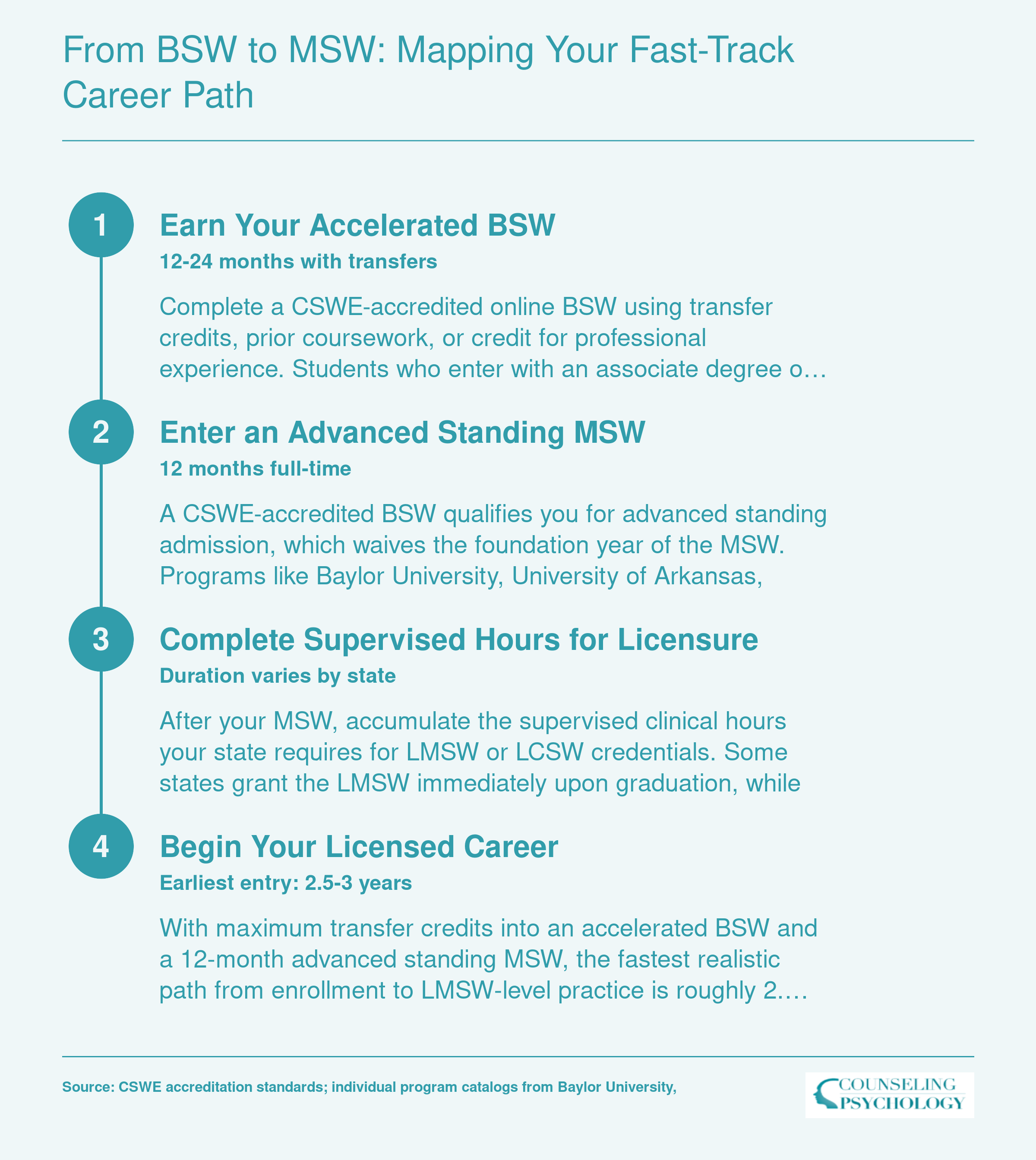
From BSW to MSW: Mapping Your Fast-Track Career Path
With the right planning, you can move from your first BSW course to a licensed clinical role far faster than most people expect. The key is stacking an accelerated online BSW with an advanced standing MSW, which cuts the graduate program from two years down to one. Here is the sequence, along with realistic timelines at each stage.
Social Work Career Outlook and Earnings After Your BSW
Understanding the realistic earnings potential and career outlook for BSW graduates is essential before committing to an accelerated program. While social work offers meaningful career opportunities with steady growth projections, it is not a path to exceptionally high salaries at the bachelor's level. Here is what the data shows about what you can actually expect to earn.
National Wage Context: What Social Workers Actually Make
According to the Bureau of Labor Statistics (2024), the national median annual wage for social workers across all specialties is $61,330.1 Entry-level social workers (10th percentile) earn approximately $41,580, while experienced professionals in the 90th percentile reach about $99,500. These figures vary considerably by specialty: healthcare social workers earn a median of $65,580, mental health and substance abuse social workers earn $59,200, and child, family, and school social workers earn $58,570.1
The highest-earning graduates in our data come from programs like the University of Illinois Urbana-Champaign, where median ten-year post-completion earnings reach $81,054. The University of Utah follows at $67,170, and California State University-Chico at $64,172. However, it is important to note that these figures reflect career earnings a decade after graduation and often include workers who have pursued advanced degrees or moved into specialized or supervisory roles.
Can You Make $200,000 as a Social Worker?
This is a common question, and the honest answer is: extremely rarely, especially with only a BSW. Earning six figures in social work typically requires an MSW, clinical licensure (LCSW or equivalent), significant specialization, and often leadership or administrative responsibilities. Some clinical social workers in private practice or high-cost metropolitan areas may approach or exceed $100,000 after years of experience, but $200,000 is far outside the typical range for the profession. Social work attracts professionals motivated by service and impact rather than salary maximization.
The BSW as an Entry Credential
Your bachelor's degree opens the door to entry-level generalist social work positions in schools, nonprofits, child welfare agencies, hospitals, and community organizations. Job growth is steady, with the BLS projecting 6% growth for all social workers between 2024 and 2034, with mental health and substance abuse social workers seeing the fastest growth at 10.6%.2 However, career advancement and substantially higher earnings typically require an MSW and clinical licensure. Many BSW graduates use their degree as a stepping stone to advanced standing in MSW programs, shaving a year off graduate school and positioning themselves for clinical roles that offer greater autonomy and earning potential. Students weighing a related helping-profession path may also want to explore whether a bachelor's degree in counseling psychology is worth it.
Realistic Expectations and Career Planning
If you are entering an accelerated BSW program, plan for starting salaries in the $40,000 to $50,000 range in most regions, with potential to reach the national median of around $60,000 within a few years. Geographic location matters significantly: social workers in states with higher costs of living and robust social services infrastructure typically earn more. Long-term earning growth will depend on whether you pursue graduate education, obtain clinical licensure, and move into specialized practice areas or leadership roles.
Frequently Asked Questions About Accelerated Online BSW Programs
Prospective students tend to ask the same core questions before committing to an accelerated online BSW. The answers below draw on current program data, accreditation standards, and Bureau of Labor Statistics figures to give you a realistic picture of what to expect.
More Accredited Online BSW Programs to Consider
If the programs in the top 10 didn't quite fit your needs, this directory of additional CSWE-accredited online BSW programs can help you find a better match. Each entry includes the school name, location, format, and net price so you can compare options more easily.
- Bachelor of Arts in Social Work
- Bachelor of Social Work
- Bachelor of Social Work
- Bachelor of Social Work
- Bachelor of Social Work
- Social Work & Human Development and Family Science
- Bachelor of Social Work
- Bachelor of Social Work
- Bachelor of Science in Social Work
- Bachelor of Social Work
- Bachelor of Social Work
- Bachelor of Social Work Online
- Online Social Work, BSW
- Social Work Comprehensive
- Social Work, B.S.W.
- Social Work, B.S.W. (Forensic Social Work)
- Social Work, B.S.W. (Gerontology: Dynamics of Aging)