
What you’ll learn in this article…
- Eight affordable school counseling programs near Topeka range widely in net price and median graduate debt.
- Kansas requires a KSDE-approved master's degree, not just any counseling credential, for school counselor licensure.
- Kansas school counselors earn a state median annual wage around $51,000, with top earners exceeding $72,000.
- Federal aid, state grants, and district tuition reimbursement can cut actual out-of-pocket costs significantly below sticker price.
Kansas employs roughly 2,980 school and career counselors, and districts across the state, including USD 501 in Topeka, regularly post openings for licensed PreK-12 counselors. The catch: KSDE requires a specific graduate credential, and program net prices across the eight Kansas options near Topeka run from about $12,500 a year at Fort Hays State to north of $22,500 at private institutions like the University of Saint Mary.
That spread matters because most candidates carry $19,000 to $22,000 in graduate debt at completion, and starting school counselor salaries in Kansas sit well below the national median. Where you enroll, and how you stack aid against tuition, shapes the math for years after licensure. If you are still exploring the broader profession, understanding how to become a counselor can help you decide whether school counseling is the right specialization before you commit to a program.
Best Affordable School Counseling Programs Near Topeka, Kansas
These eight Kansas institutions each offer a pathway into school counseling, school psychology, or a related credential, and every one is reachable from Topeka either online or within a reasonable drive. The ranking weights net price and financial aid data most heavily, then layers in graduation outcomes and program-level strengths so that cost-conscious students can compare options with confidence. Program-level median earnings are not yet published for any of these school counseling tracks, so institution-wide figures are used where relevant.
- Net price and in-state tuition
- Financial aid and Pell share
- Institutional graduation rate
- Program accreditation status
- Online or hybrid accessibility
- NCES-IPEDS federal institutional data — nces.ed.gov
- College Scorecard graduate earnings — collegescorecard.ed.gov
- Internal program database
- Independent program research

Fort Hays State University
Fort Hays State University pairs some of the lowest in-state tuition in Kansas with a CACREP-accredited school counseling master's that runs 60 credit hours in a hybrid format. The university enrolls a large share of Pell Grant recipients and maintains a median graduate debt of $21,000, which helps explain its position at the top of this affordability ranking. Faculty emphasize evidence-based counseling practices and supervised field placements across diverse educational settings.
- CACREP-accredited 60-credit-hour master's program
- Hybrid delivery blends online coursework with campus sessions
- Meets Kansas State Department of Education licensure requirements
- Practicum and internship placements built into the curriculum
- Covers counseling theories, developmental issues, and advocacy
- No separate teaching license required for admission
M.S. in Counseling, School Counseling — Hybrid

Pittsburg State University
Pittsburg State University delivers its school counseling master's entirely online, removing the roughly three-hour drive from Topeka and keeping costs competitive for Kansas residents. The 48-credit-hour program does not require a GRE for applicants holding a 3.0 GPA or higher, and students choose among thesis, research problem, or coursework tracks. Schools offering this program have a graduation rate of 56.6%, and institution-wide median graduate debt sits at about $18,969.
- 48-credit-hour fully online master's degree
- No GRE required with a 3.0 or higher GPA
- Thesis, research problem, or coursework track options
- Prepares graduates for PRAXIS II exam
- Open to candidates from non-education backgrounds with added coursework
- Strong regional reputation in psychology and counseling education
- Affordable in-state tuition with flexible pacing
School Counseling (Master's) — Online

Wichita State University
Wichita State University's 18-credit graduate certificate is designed specifically for licensed clinical mental health counselors who want to add school counselor credentials without completing a full second master's degree. The hybrid format and compact course load make it a practical fit for counseling professionals already practicing in the Topeka area. Schools offering this program have a graduation rate of 51%, and the institution reports a median graduate debt near $20,500.
- 18-credit-hour hybrid graduate certificate
- Designed for professionals holding a counseling master's degree
- Requires 3.25 minimum graduate GPA for admission
- Meets KSDE school counselor licensing requirements
- Internship and practicum experiences included
- Allows local field placements near the student's community
- Focused coursework in school counseling foundations and advocacy
Clinical Mental Health Counselor to School Counselor Graduate Certificate — Hybrid

Emporia State University
Emporia State University sits roughly an hour from Topeka and has deep ties to Kansas K-12 districts, which simplifies practicum and internship logistics for capital-area students. The fully online, CACREP-accredited M.S. in School Counseling runs 60 credit hours at a published rate of $355 per credit, and leads to dual licensure as both a school counselor and an LPC in Kansas. Schools offering this program have a graduation rate of 56.1%, and targeted scholarships for ESU school counseling students can further reduce out-of-pocket costs.
- CACREP-accredited, 60-credit-hour online program
- $355 per credit hour published tuition rate
- Leads to dual licensure: school counselor and LPC in Kansas
- No teaching license required for admission
- Mix of synchronous and asynchronous class sessions
- Program-specific scholarships available for Kansas students
- Faculty with direct K-12 school counseling experience
- Strong KSDE standards alignment for easier local placements
Master of Science in School Counseling — Online

Kansas State University
Kansas State University's hybrid master's program boasts a reported 100% Praxis exam pass rate and quick employment outcomes for recent graduates. K-State also offers a unique Certificate in Counseling Military Connected Students and Families, which can be completed alongside the degree. Scholarships and assistantships help offset the higher net price, and the institution posts a 71.1% graduation rate, one of the strongest in this group.
- CACREP-accredited hybrid master's program
- Reported 100% Praxis exam pass rate among graduates
- Certificate in Counseling Military Connected Students available
- Scholarships and graduate assistantships offered
- No teaching license required for entry
- Part-time and full-time scheduling options
- Professional development through conference participation
- Strong Kansas district placement network
Master's in School Counseling — Hybrid

Ottawa University-Online
Ottawa University's online M.A. in Education with a school counseling focus uses eight-week accelerated terms, letting students move through the curriculum at a steady pace while working full time. The program meets both Kansas and Arizona licensure requirements, a useful feature for graduates who may relocate. Practicum experiences can be arranged in the student's home district, making the program workable for Topeka-area candidates without regular trips to the Overland Park campus.
- Fully online with eight-week accelerated terms
- Meets Kansas and Arizona school counselor licensure requirements
- CAEP-accredited education program
- Multicultural counseling and trauma-informed care emphasis
- Local practicum placements arranged in home district
- Comprehensive K-12 school counseling curriculum
- Ethics and professional practices coursework included
Master of Arts in Education, School Counseling — Online

University of Saint Mary
The University of Saint Mary offers a 48-credit hybrid master's in school counseling that can be completed in about two and a half years. At a published rate of $410 per credit hour, the program welcomes applicants from both teaching and non-teaching backgrounds and does not require the GRE. The Overland Park campus is about an hour from Topeka, and flexible scheduling with online, on-ground, and remote course options keeps commuting manageable. Schools offering this program have a graduation rate of 47.8% and an 11-to-1 student-to-faculty ratio.
- 48-credit hybrid program completable in roughly 2.5 years
- $410 per credit hour published tuition
- No GRE required for admission
- KSDE-accredited and aligned with Kansas licensure
- Rolling admissions with January and August start dates
- Open to both teaching and non-teaching backgrounds
- Online, on-ground, and remote course options available
- Small class sizes with an 11-to-1 student-faculty ratio
Master's in School Counseling — Hybrid

University of Kansas
The University of Kansas offers a doctoral-level path through its Ph.D. in School Psychology, a research-intensive program requiring 121 to 123 credit hours, a dissertation, and a full-year internship. This is not a typical entry-level school counseling degree; it targets students aiming for advanced practice or research roles in health service psychology within educational settings. Schools offering this program have a 68.8% graduation rate, and internship placements frequently occur in Kansas public school districts, including those near Topeka.
- Research-focused doctoral program in health service psychology
- 121 to 123 credit hours required
- Full-year, full-time internship component
- GRE scores required for admission
- On-campus delivery at the Lawrence campus
- Dissertation and original research required
- Prepares graduates for Kansas school psychologist licensure
Ph.D. in School Psychology — On-Campus
How to Become a Licensed School Counselor in Kansas
The biggest misconception about becoming a school counselor in Kansas is that any graduate-level counseling program will qualify you for licensure. In reality, the Kansas State Department of Education (KSDE) mandates a very specific educational path, and choosing the wrong program can add years of extra coursework or even render you ineligible.1 Here's exactly what you need to do, step by step.
Degree Requirements: Master's or Ed.S., Not a Certificate
A graduate certificate in school counseling will not meet Kansas licensure standards on its own. KSDE requires a full graduate degree, either a master's (M.Ed.) or an education specialist (Ed.S.) in school counseling.1 These programs must include at least 60 credit hours of coursework covering topics like child development, ethics, assessment, and counseling techniques.2 A typical graduate certificate is only 12 to 24 credits and lacks the supervised clinical components and depth that KSDE demands. If you already hold a master's in a related field, you may be able to apply some credits, but you will still need to complete a state-approved school counseling program to earn the endorsement.
Programs like Wichita State University's School Counseling M.Ed. track and Kansas State University's Ed.S. in School Counseling are designed to align with KSDE requirements.3 Both build in the required supervised experiences and prepare you for the licensure exam. Always confirm that your program is approved by KSDE before enrolling.
Supervised Field Experience and the Topeka Connection
All candidates must complete a supervised internship or practicum totaling at least 75 hours as part of their degree program.2 This hands-on training is typically arranged by your university, often through partnerships with local school districts. In the Topeka area, districts like Topeka Public Schools, Shawnee Heights, and Seaman frequently host counseling interns, giving you direct experience in diverse K-12 settings. These placements are embedded in your coursework, so you won't need to find them independently. They also help you build professional connections that can lead to job offers after licensure.
Praxis Exam and Application Steps
Once you finish your program, you must pass the Praxis Professional School Counselor (5421) exam.2 KSDE also requires a minimum graduate GPA of 3.25.3 If your GPA falls short, you may need to retake courses or provide additional evidence of competency. You apply for licensure online through your KSDE licensure account, submitting official transcripts, proof of program completion, Praxis scores, and a completed background check.1 There is no separate application fee beyond the background check cost. For those without a teaching background, the Parallel Pathways Program offers an alternative route to meet any teaching experience prerequisites.1
If you have completed at least 50% of your program, you may qualify for a provisional license, which allows you to work as a school counselor under supervision while you finish the remaining credits.3 This can accelerate your entry into the field, especially if you need income while studying.
How Fast Can You Become a School Counselor?
For full-time students, a 60-credit master's program usually takes 2 to 2.5 years, including summer terms. Part-time students often finish in 3 to 4 years. An Ed.S. program may add another year if pursued after a master's. The supervised internship is integrated into the curriculum, so there's no lengthy post-degree residency. After graduation, factor in a few months to schedule and pass the Praxis exam and for KSDE to process your application. Realistically, you can expect to hold a standard school counselor license in Kansas within 3 to 4 years of starting a part-time program, or as quickly as 2 years if you attend full-time.
Later, to upgrade to a professional license, KSDE requires either one year of accredited school counseling experience or eight semester hours of recent graduate credit.3 This step is optional but may be required by some employers for long-term employment.
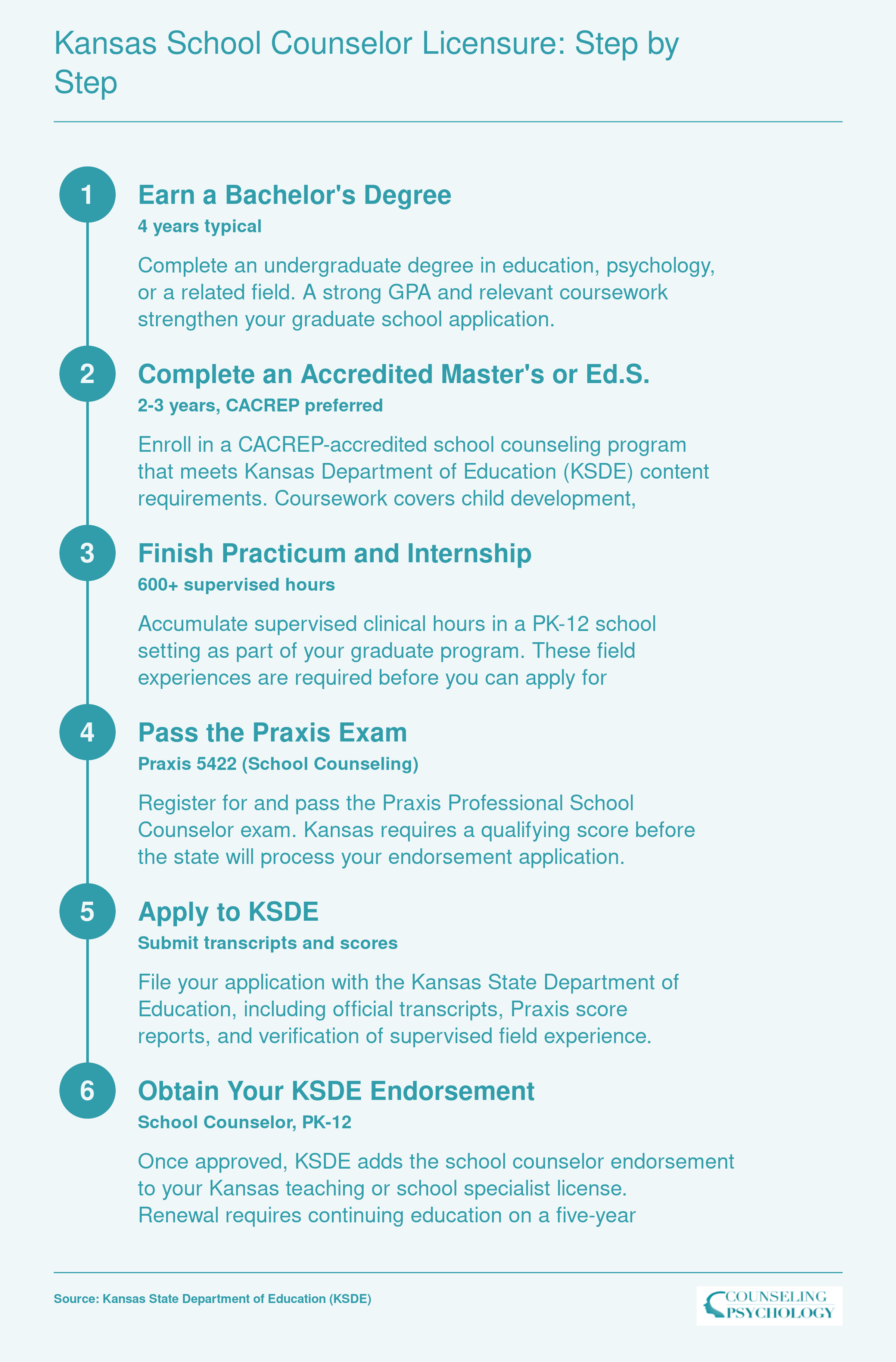
Kansas School Counselor Licensure: Step by Step
Earning your Kansas school counselor credential is a structured process that typically spans five to six stages. The graduate portion alone takes roughly 2-3 years, so planning ahead helps you stay on track and minimize costs.
Comparing Total Program Costs: Kansas School Counseling Degrees
Sticker price only tells part of the story. The table below lines up annual in-state tuition, out-of-state tuition, average net price after aid, median graduate debt at graduation, and the degree level for each school counseling program near Topeka. Net price figures reflect institution-wide averages reported to IPEDS, so your actual cost will depend on financial aid, residency status, and how many credit hours the program requires. Use these numbers as a starting point, then request a personalized cost estimate from each school's financial aid office.
| School | Degree Level | Annual In-State Tuition | Annual Out-of-State Tuition | Avg. Net Price | Median Graduate Debt | Program Format |
|---|---|---|---|---|---|---|
| Fort Hays State University | Master's (M.S., 60 hrs) | $4,949 | $12,745 | $12,569 | $21,000 | Hybrid |
| Wichita State University | Graduate Certificate (18 hrs) | $7,986 | $16,873 | $13,194 | $20,500 | Hybrid |
| Emporia State University | Master's (M.S., 60 hrs) | $8,843 | $19,154 | $16,261 | $19,500 | Online |
| University of Saint Mary | Master's (48 hrs) | $9,073 | $9,073 | $22,519 | $22,018 | Hybrid |
| Pittsburg State University | Master's (48 hrs) | $9,470 | $20,302 | $15,784 | $18,969 | Online |
| University of Kansas | Doctorate (Ph.D., 121+ hrs) | $11,971 | $27,146 | $18,059 | $21,000 | On Campus |
| Kansas State University | Master's (Hybrid) | $12,089 | $25,824 | $19,406 | $21,250 | Hybrid |
Questions to Ask Yourself
Online vs. On-Campus School Counseling Programs for Topeka Students
Topeka students weighing school counseling programs will find a mix of delivery formats across Kansas institutions. The right fit depends on your schedule, budget, and how you plan to build professional relationships in the districts where you want to work. Here is a practical look at the tradeoffs.
Pros
- Online programs from Emporia State, Pittsburg State, and Ottawa University let working professionals complete coursework on their own schedule without relocating.
- Online and hybrid tuition can run lower overall because you eliminate commuting, parking, and campus housing costs, especially important for budget-conscious students.
- Studying online opens the door to competitively priced out-of-state options while you remain rooted in the Topeka area for practicum placements.
- Hybrid formats at Fort Hays State, Kansas State, Wichita State, and University of Saint Mary blend online flexibility with periodic on-campus intensives for hands-on skill building.
- On-campus or hybrid students gain easier access to face-to-face faculty mentoring, cohort connections, and networking events that often lead to job referrals in Kansas districts.
- In-person attendance simplifies coordination with Topeka-area practicum sites, including USD 501 Topeka Public Schools, which partners with Washburn University and KSDE on field placement pipelines.
- The University of Kansas doctoral program in school psychology operates fully on campus, suiting students who want immersive research training with direct faculty supervision.
Cons
- Even fully online students must complete practicum and internship hours at a local school site, so you still need to arrange supervised placements in the Topeka area yourself.
- USD 501 does host practicum students, but its established partnerships (such as the TCALC Teacher Apprenticeship Program) focus on teacher candidates, so school counseling placements may require extra coordination with your program.
- On-campus programs at universities farther from Topeka, like Pittsburg State or Fort Hays State, mean significant travel unless you choose their online or hybrid tracks instead.
- Online learners can miss informal hallway conversations with classmates and faculty that often spark professional opportunities in nearby school districts.
- Hybrid schedules still require periodic travel to campus locations in Hays, Manhattan, Leavenworth, or Wichita, which adds time and expense for Topeka-based students.
Scholarships, Grants, and Employer Tuition Benefits for Kansas School Counseling Students
The real question isn't sticker price. It's what you actually pay after aid stacks up against the salary you'll earn coming out. Published tuition at Kansas public universities looks intimidating until you factor in federal aid, state programs, district reimbursement, and institutional scholarships that most school counseling students layer together.
Start with the average net price
Federal data shows what students at each Kansas school in our ranking actually pay on average after grants and scholarships. Fort Hays State posts the lowest average net price at roughly $12,600 per year, with Wichita State around $13,200 and Pittsburg State near $15,800. Emporia State sits at about $16,300, Kansas State at $19,400, and the University of Kansas at $18,100. Among private options, University of Saint Mary's average net price runs about $22,500. These figures bundle undergraduate and graduate aid together, so treat them as a starting baseline rather than a precise graduate quote, then layer the aid below on top.
State and federal programs to know
- Kansas Teacher Service Scholarship: Administered by the Kansas Board of Regents, this service-obligation award has included school counseling among eligible fields in some award cycles.1 Recipients agree to teach (or counsel, when counseling is named) in Kansas after graduation. It applies at Emporia State, Washburn, Pittsburg State, and Fort Hays State, among others. Check the current year's eligible-fields list before counting on it, because the qualifying shortage areas shift annually.
- TEACH Grant: Up to $4,000 per year for graduate students preparing to serve in high-need fields at low-income schools. School counseling eligibility depends on whether your state and program classify the role as a TEACH-eligible discipline, so confirm with your financial aid office before enrolling.
- NBCC Foundation Scholarships: The Military Scholarship and Rural Scholarship are open to master's counseling students committed to serving those populations.2 Kansas has substantial rural acreage, which makes the Rural award especially worth a look for students planning to practice outside the Wichita, Topeka, and Kansas City corridors.
Institutional scholarships at Kansas programs
- Kansas State University: The College of Education funds multiple named scholarships for school counseling graduate students, including the Riegel Family Scholarship in School Counseling (for Ed.S. students, October 1 deadline, requires a letter of recommendation and resume) and the Katharine Foster School Counseling Graduate Student Support Fund.3
- Emporia State University: The school counseling program's published highlights note scholarships available to enrolled students; the counselor education department is the right first contact.
- Kansas State assistantships: Graduate assistantships are advertised alongside the master's program and can offset tuition substantially for students who can commit to on-campus or hybrid work hours.
District tuition reimbursement
If you're already working in a Kansas school district as a paraprofessional, classified staff member, or licensed teacher, ask your HR office about tuition reimbursement before you apply anywhere. Many Kansas districts reimburse a per-credit amount (often $200 to $500 per credit hour, capped annually) for coursework leading to an endorsement the district needs, and school counseling routinely qualifies. Reimbursement is typically paid after you complete the course with a B or better, so plan cash flow accordingly.
How much does a school counseling degree actually cost?
For a Kansas resident at a public university, a realistic out-of-pocket range after typical federal aid and one or two institutional scholarships lands between $18,000 and $35,000 total for a 48- to 60-credit-hour master's. Students who land the Kansas Teacher Service Scholarship, a TEACH Grant, or meaningful district reimbursement can push that figure below $15,000. Private programs like University of Saint Mary cost more on paper but discount aggressively, so request a personalized award letter before ruling any school in or out. If you're also weighing options beyond Kansas, comparing counseling programs in neighboring Nebraska can help you benchmark value across state lines.
What School Counselors Earn in Kansas: Salary and Job Outlook
Kansas employed roughly 2,980 educational, guidance, and career counselors and advisors as of the most recent BLS data available for the state. The figures below reflect Kansas-specific wages, not national medians. Understanding where you fall on this pay scale can help you weigh total program cost against long-term earning potential when comparing affordable school counseling programs near Topeka.
| Wage Percentile | Annual Salary (Kansas) |
|---|---|
| 25th Percentile | $48,860 |
| Median (50th Percentile) | $58,430 |
| Mean (Average) | $58,950 |
| 75th Percentile | $67,640 |
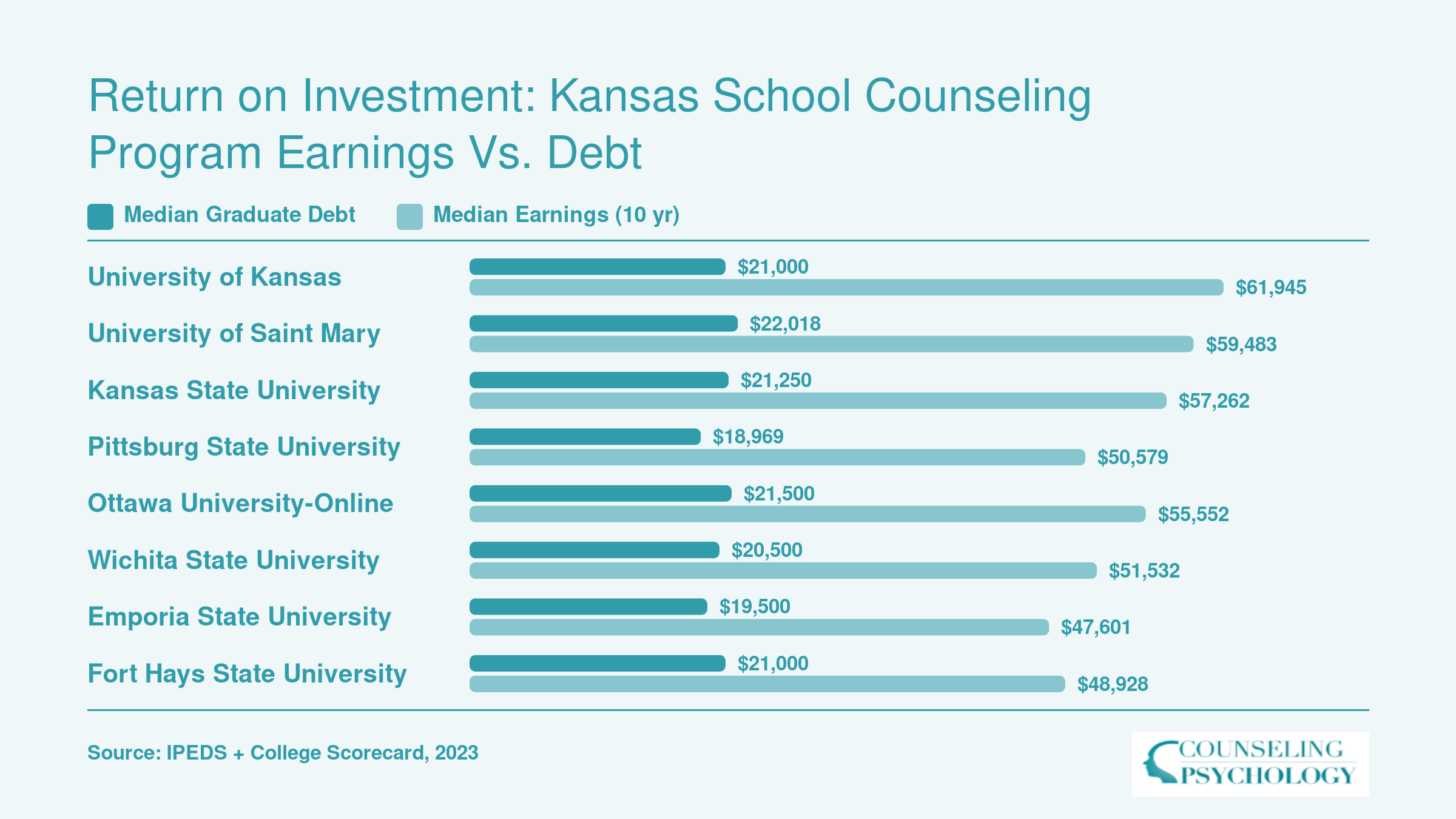
Return on Investment: Kansas School Counseling Program Earnings vs. Debt
Program-level earnings data for these school counseling programs is not yet published in federal reporting, so the chart below compares each institution's median graduate debt against its institution-wide median earnings at ten years post-entry. These figures offer a useful baseline, though individual outcomes in school counseling will vary. For context, the BLS reports that school counselors in Kansas earn a median salary that can serve as a practical ceiling for the occupation in-state.
The American School Counselor Association recommends that school counselors dedicate at least 80 percent of their time to direct and indirect student services, things like individual counseling, group sessions, academic advising, and consultation with teachers and families. The remaining 20 percent or less should go to administrative duties such as scheduling and testing coordination. If you are drawn to counseling for the human connection, this ratio is reassuring, but it is worth confirming with prospective employers that they actually follow it.
Frequently Asked Questions About School Counseling Programs in Kansas
Choosing a school counseling program is a major investment of time and money. Below are answers to the questions prospective students near Topeka ask most often, grounded in current licensure rules, labor market data, and program cost information.