
What you’ll learn in this article…
- Missouri offers I-O psychology master's programs at UMSL, Maryville University, and Missouri S&T across online, hybrid, and on-campus formats.
- Annual in-state tuition ranges from roughly $8,000 to over $14,000, and net prices vary significantly after institutional aid.
- The BLS reports a national median salary of $147,420 for industrial-organizational psychologists, with Missouri's median tracking competitively.
- PhD graduates typically command higher salaries and research roles, while master's holders enter consulting, HR analytics, and talent management faster.
Industrial-organizational psychology has shifted from a coastal academic niche to a core business function, and Missouri's St. Louis and Kansas City metro areas now sustain consistent demand for I-O practitioners in corporate, healthcare, and government sectors. The state's response is a deliberately concentrated graduate pipeline: just three master's programs, each offering a different mix of online and hybrid delivery.
For students evaluating an industrial-organizational psychology degree in Missouri, the decision is less about choosing from a crowded field than about matching a program's format, cost, and likely return to a specific career plan. Institutional data suggests that master's-level alumni from these programs can command salaries above $80,000, making the in-state value proposition worth a hard look against the total debt load.
Best Industrial-Organizational Psychology Programs in Missouri: Our Rankings
Missouri offers a small but strong set of I-O psychology programs spanning online, hybrid, and on-campus formats at the master's and doctoral levels. Each school below brings a distinct value proposition, whether that is stackable credentials, a nationally recognized full-time cohort, or a flexible online path that can be completed in two years. Institution-wide graduation rates and College Scorecard financial data are included to give you an at-a-glance picture, though program-level earnings and debt figures are not yet available for these specific I-O programs.
- Net price and debt burden
- Institution-wide graduation rate
- Program format and flexibility
- Degree levels offered
- Career-relevant curriculum strength
- College Scorecard graduate earnings — collegescorecard.ed.gov
- NCES-IPEDS federal institutional data — nces.ed.gov
- Independent program research
- Internal program database

Missouri University of Science and Technology
Missouri S&T pairs a fully online Master of Science in I-O Psychology with an on-campus PhD in Applied Psychology, making it the only Missouri school on this list where you can pursue both degree levels in the discipline. The university's emphasis on STEM rigor carries into the psychology department, where a scientist-practitioner model, stackable graduate certificates in Applied Workplace Psychology and Human Factors Psychology, and thesis or non-thesis options give students multiple ways to tailor the degree. An institution-wide median of $82,957 in earnings ten years after enrollment (College Scorecard) and a median graduate debt of $23,250 point to solid return on investment, while a 64.4% institution-wide graduation rate signals a demanding academic culture.
- Fully online format suits working professionals across Missouri and the Midwest
- Scientist-practitioner training model with statistics and research methods core
- Thesis and non-thesis tracks available
- Stackable certificates in Applied Workplace Psychology and Human Factors Psychology
- Prepares graduates for consulting, business, education, or doctoral study
- Admission requires meeting specific GPA standards
- Net price of $16,298 (IPEDS) with median graduate debt of $23,250
- On-campus doctoral program requiring 72 graduate credits
- Concentration in Applied Social/Industrial-Organizational Psychology
- Bachelor's or master's in psychology preferred for admission
- Tailored coursework plus faculty-mentored research opportunities
- Focus on employee engagement, organizational structures, and workplace dynamics
- Designed to prepare graduates for competitive starting salaries in the field
Master of Science in Industrial-Organizational Psychology — Online
PhD in Applied Psychology, Applied Social/Industrial-Organizational Concentration — On-Campus

Missouri State University
Missouri State's Master of Science in Psychology with an I-O concentration is delivered in a hybrid format that blends online coursework with in-person components in Springfield. The department markets this program as one of the strongest I-O master's options nationally, and it functions as both a terminal professional degree and a springboard into doctoral study. Small class sizes and direct faculty research mentorship are core selling points. At a net price of $17,613 and a median graduate debt of $21,992, costs are moderate, though note that this is a full-time, in-residence program, so relocation may be necessary for students outside the Springfield area. The institution-wide graduation rate is 57.9%.
- Hybrid format combining online and in-person instruction
- Full-time, in-residence requirement means students complete the degree on a focused timeline
- Small class sizes with personalized faculty mentorship
- Flexible elective courses allow specialization within I-O topics
- Dual purpose: terminal applied degree or pipeline to PhD programs
- Financial aid options available; net price $17,613 (IPEDS)
- Median graduate debt of $21,992 with institution-wide earnings of $49,827 at ten years
- Faculty with diverse research specialties across organizational psychology
Master of Science in Psychology, Industrial/Organizational Concentration — Hybrid

Southeast Missouri State University
Southeast Missouri State University's Master of Arts in I-O Psychology is a fully online, 42-credit program that can be completed in roughly two years, making it the most flexible option on this list for working professionals who cannot relocate. Students choose between an internship track and a research track, so the degree accommodates both career advancers and future doctoral candidates. The net price of $15,882 is the lowest among ranked Missouri I-O programs, and a flat tuition rate of $7,702 for in-state and out-of-state students alike removes a common cost barrier for regional learners. The institution-wide graduation rate stands at 57.9%, with a median graduate debt of $21,500.
- Fully online program with no campus residency required
- 42 total credit hours with a two-year projected completion timeline
- Choose between an internship track or a research track
- Flat tuition rate for in-state and out-of-state students ($7,702)
- Lowest net price among ranked Missouri I-O programs at $15,882
- Covers performance appraisal, work motivation, and organizational development
- Prepares graduates for careers in HR, talent management, and consulting
- 3.0 undergraduate GPA preferred for admission
Master of Arts in Industrial/Organizational Psychology — Online
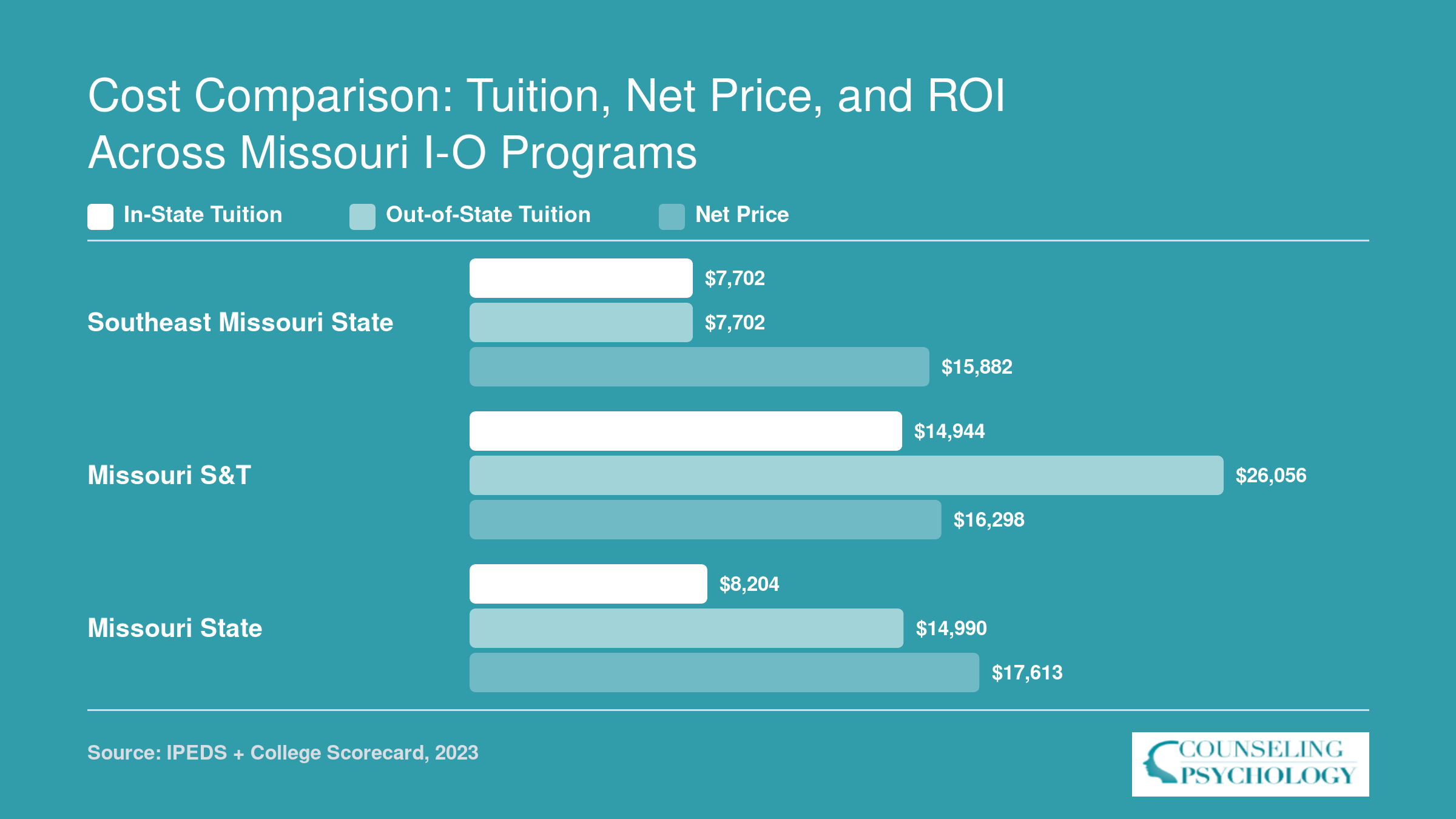
Cost Comparison: Tuition, Net Price, and ROI Across Missouri I-O Programs
Sticker price tells only part of the story. The figures below compare annual in-state tuition, out-of-state tuition, and institution-wide average net price (after grants and scholarships) for each ranked Missouri I-O psychology program. Keep in mind that net price reflects a campus-wide average for undergraduates and may not match what a graduate student actually pays. Program-level earnings data is not yet available for these programs, but institution-wide ROI ratios range from roughly 2.0 to 3.6, suggesting graduates generally earn well above their total educational costs over time.
What Missouri I-O Graduates Earn vs. What They Owe
The financial bet on an I-O psychology degree comes down to two numbers: what you earn after graduation, and what you owe when you walk across the stage. Program-level earnings data specific to Missouri I-O master's cohorts (the one-year and four-year post-completion benchmarks College Scorecard publishes for many graduate programs) has not yet been released for these three programs. That gap is common for smaller, newer, or lower-enrollment graduate programs, where federal reporting thresholds suppress figures to protect student privacy.
What we can show is institution-wide outcomes for graduates ten years after entering each school, paired with median debt at completion. Those numbers give you a realistic floor for the kind of long-run earnings trajectory each campus produces. For a broader look at how these programs compare nationally, see our ranking of industrial organizational psychology master's programs.
Earnings and Debt at a Glance
- Missouri S&T (Rolla): Median earnings ten years out land around $82,957, with median graduate debt of roughly $23,250. That earnings figure is unusually strong, reflecting the school's STEM-heavy graduate mix, and the debt load is moderate for a master's-producing institution.
- Missouri State (Springfield): Ten-year median earnings sit near $49,827, with median debt around $21,992. Lower sticker price, lower long-run earnings, a more typical liberal-arts master's profile.
- Southeast Missouri State (Cape Girardeau): Ten-year median earnings of about $44,030 against median debt near $21,500. The lowest debt of the three, but also the lowest earnings benchmark.
Running the Mental Math
On a standard 10-year federal repayment plan at current graduate PLUS rates, $22,000 to $23,000 in debt translates to roughly $230 to $260 per month. Against an entry-level Missouri I-O salary in the $55,000 to $70,000 range (consistent with state BLS figures for I-O-adjacent HR and training roles), that monthly payment runs about 4 to 6 percent of gross income, well under the 8 to 10 percent threshold financial planners flag as burdensome.
Is It a Good Bet?
Compared to psychology degrees broadly, which often saddle graduates with $30,000-plus in debt against $40,000 starting salaries, these three Missouri programs land on the favorable side of the debt-to-earnings ledger. Program-specific share-above-poverty and one-year employment metrics are not reported for these cohorts yet, so the institutional earnings figures and your own outreach to program directors remain the best signal until Scorecard fills in the gaps.
Online vs. On-Campus vs. Hybrid: Missouri I-O Program Formats Explained
Missouri's three I-O psychology master's programs each take a different approach to delivery, so your day-to-day experience as a student will vary significantly depending on which you choose. If you are searching for an online industrial organizational psychology option in Missouri, two programs currently deliver coursework entirely online, while a third blends in-person and remote learning. Below is a side-by-side look at how each format compares across the dimensions that matter most to working professionals and full-time students alike.
| Dimension | Southeast Missouri State University (Fully Online) | Missouri S&T (On-Campus and Online) | Missouri State University (Hybrid) |
|---|---|---|---|
| Delivery Format | 100% online M.A. in I-O Psychology | M.S. in I-O Psychology offered both on campus in Rolla and online | M.S. in Psychology with I-O concentration, hybrid format combining online and in-person sessions in Springfield |
| Schedule Flexibility | High. Asynchronous coursework designed for students who work full time or live outside Missouri | High for online track; on-campus students follow a more traditional semester schedule | Moderate. Some coursework is remote, but periodic campus attendance is expected |
| Networking and Faculty Access | Virtual interaction with faculty and cohort peers; 20:1 student-to-faculty ratio institution-wide | On-campus students benefit from face-to-face mentoring and lab access; 17:1 student-to-faculty ratio | Blend of in-person relationship building during on-site sessions and virtual collaboration; 21:1 student-to-faculty ratio |
| Practicum and Applied Experience | Internship and research tracks available; students arrange placements in their local area | Scientist-practitioner model with research opportunities on campus; online students coordinate local practicum sites | Research opportunities with faculty; elective flexibility supports applied project work |
| In-State Tuition (Annual, Undergraduate Institution-Level) | Approximately $7,702 (same rate for in-state and out-of-state students) | Approximately $14,944 in-state | Approximately $8,204 in-state |
| Best Fit For | Working professionals, career changers, or students outside the state seeking a fully remote option at the lowest tuition | Students who want the choice between a traditional campus experience and the convenience of online learning, with a strong research orientation | Students near Springfield who value some face-to-face interaction but still need scheduling flexibility |
Questions to Ask Yourself
What You Study in a Missouri I-O Psychology Program
Industrial-organizational psychology is the scientific study of human behavior at work: how people are hired, trained, motivated, evaluated, and organized into teams. A graduate I-O curriculum in Missouri translates that focus into a structured sequence of coursework, research training, and applied experience grounded in the scientist-practitioner model, where students learn to both generate research and apply it inside real organizations.
Core Coursework Areas
The APA Guidelines for Education and Training in Industrial-Organizational Psychology (2016) outline the knowledge domains that responsible programs should cover, and Missouri programs broadly map to them:1
- Industrial/personnel topics: job analysis, personnel selection, performance management, training and development, and compensation systems.
- Organizational topics: leadership, motivation, work attitudes, teams, organizational development, and workplace culture.
- Methodological and analytic foundations: research methods, statistics, psychometrics, and measurement theory.
- Contextual and cross-cutting issues: ethics, diversity and inclusion, and the legal and global context of work.
Expect roughly half of your credits to sit in statistics, measurement, and research design. Programs like Missouri S&T's M.S. in I-O Psychology structure their sequence to be consistent with the APA master's-level guidelines, and Saint Louis University's doctoral I-O/OB program is listed in the SIOP graduate program database. Students drawn to the broader application of psychology in workplace and organizational settings may also want to explore industrial organizational psychology degree online options for comparison.
Thesis, Applied, and Capstone Tracks
At the master's level, the APA guidelines recognize three culminating options: an empirical thesis, an applied project, or a comprehensive exam.1 Missouri S&T explicitly offers both a thesis track and a non-thesis/applied track, letting students choose between a research-heavy path (useful if a PhD or research role is the goal) and an applied path geared toward consulting or in-house HR analytics work. Doctoral students, including those at SLU, complete an independent dissertation rather than choosing among lighter options. Those considering a career that blends research with hands-on organizational work might review what it takes to become an applied psychologist.
Practicum and Applied Experience
Under current guidance, supervised applied experience is encouraged but not strictly required at the master's level, and strongly encouraged at the doctoral level.1 In practice, Missouri students typically pursue a practicum or internship with a local employer, consulting firm, or government agency, often during the second year. SIOP's "How to Choose a Graduate Training Program" resource is worth consulting when you compare how each Missouri program structures these applied hours and what kinds of host sites students have used recently.
Admissions Requirements and Competitiveness
Missouri's I-O psychology master's programs vary in selectivity and prerequisites. The table below summarizes the key admissions requirements for the 2025-2026 cycle. Note that institutional admission rates reflect overall undergraduate selectivity, not graduate program acceptance rates specifically, so treat them as a general indicator of each school's competitiveness.
| School | Degree Offered | Minimum GPA | GRE Policy | Prerequisites | Application Deadline | Institutional Admission Rate |
|---|---|---|---|---|---|---|
| Missouri S&T | M.S. in Industrial-Organizational Psychology | 3.0 (3.5 GPA preferred for priority admission) | Optional | Social science research methods; data analysis or statistics | Rolling (Fall and Spring starts) | 72.6% |
| Missouri State University | M.S. in Psychology (I-O Concentration) | 3.25 | Contact program for current policy | Psychology coursework including statistics and research methods | February 15 (Fall start only) | 90.5% |
| Southeast Missouri State University | M.A. in Industrial/Organizational Psychology | 3.0 preferred | Contact program for current policy | Varies; check with the department | Contact program for current deadline | 73.5% |
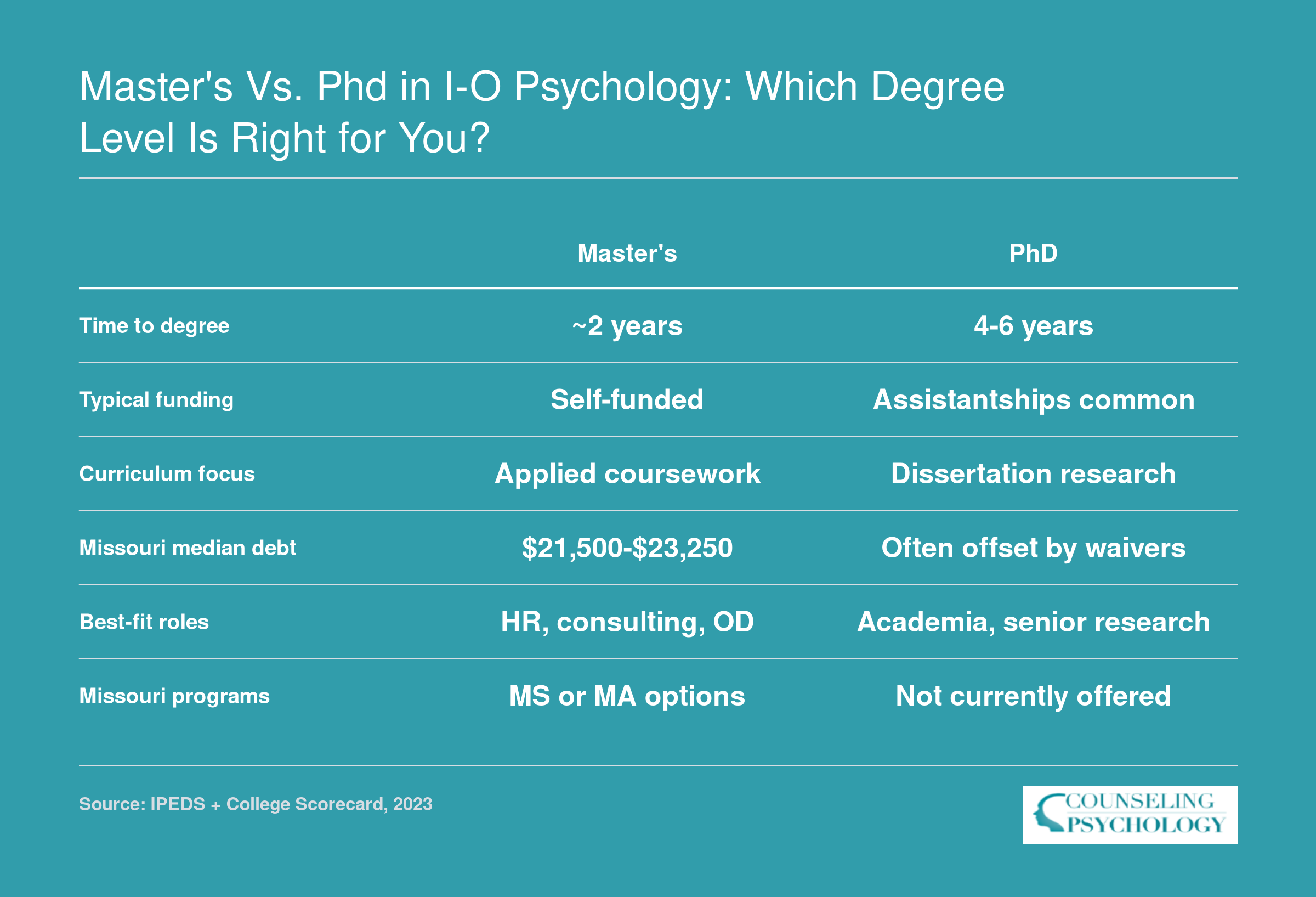
Master's vs. PhD in I-O Psychology: Which Degree Level Is Right for You?
Choosing between a master's and a doctoral degree in industrial-organizational psychology shapes your timeline, your wallet, and the roles you can pursue. Missouri's I-O master's programs typically run about two years and are largely self-funded, while PhD tracks take four to six years but often include assistantships and tuition waivers. Use the comparison below to see which path aligns with your career goals.
Career Outcomes and Salaries for I-O Graduates in Missouri
The central question for most prospective I-O psychology students is whether the degree investment will translate into meaningful career opportunities and competitive compensation. In Missouri, that calculation involves weighing limited local wage data against strong national trends and a diverse regional economy.
What the Data Tells Us About I-O Salaries
Nationally, industrial-organizational psychologists command impressive compensation. According to the Bureau of Labor Statistics, the national median annual wage for I-O psychologists was $147,420 in 2023.1 The wage range spans considerably based on experience and sector: the 10th percentile earned $45,860, while the 90th percentile reached $219,810.1 The national mean annual wage stood at $154,380.1
Missouri-specific wage data for I-O psychologists is not reported by the BLS, nor are figures available for the St. Louis or Kansas City metro areas.4 This gap reflects the relatively small national employment base of roughly 1,030 I-O psychologists tracked by BLS surveys rather than weak demand in the state.1 Many I-O professionals work under related job titles such as human resources manager, organizational development specialist, or management consultant, which may not appear in I-O-specific counts.
Program-level earnings data for Missouri I-O graduates in their first or fourth year after completion are not yet published in federal outcome databases. As a practical benchmark, national figures suggest that master's-level I-O graduates typically enter the workforce earning between $50,000 and $75,000, with salaries climbing substantially as they accumulate experience and move into senior consulting or leadership roles.
Who Hires I-O Talent in Missouri
Missouri's economy offers diverse landing spots for I-O graduates. Major healthcare systems such as BJC HealthCare, Mercy, and SSM Health employ organizational development specialists to improve workforce engagement and reduce turnover. Defense contractors with significant Missouri operations, including Boeing and Leidos, rely on I-O expertise for workforce analytics and training design. Financial services firms headquartered in St. Louis and Kansas City seek talent for selection systems and leadership development. Corporate headquarters for companies like Cerner, Express Scripts, and Emerson Electric also recruit I-O professionals for roles spanning talent management, employee experience, and organizational strategy. For a deeper look at what the day-to-day work involves, our guide on how to become an industrial organizational psychologist covers typical responsibilities and career trajectories.
What Can You Do With an I-O Degree in Missouri?
Graduates pursue a range of career paths:
- Human resources leadership: Designing selection processes, performance management systems, and succession planning programs.
- Organizational development consulting: Working internally or with consulting firms to diagnose culture issues and implement change initiatives.
- Talent analytics: Leveraging data to guide hiring decisions, predict turnover, and measure training effectiveness.
- Training and development: Creating and evaluating employee learning programs.
What About the Highest-Paid I-O Psychologists?
The highest earners in this field typically hold doctoral degrees and serve as senior consultants, chief human resources officers, or partners at major consulting firms. Nationally, the top 10% earn above $219,810.1 In Missouri, reaching this tier often means building expertise in high-demand areas like executive assessment, mergers and acquisitions integration, or advanced people analytics.
Job Growth Outlook
The BLS projects 6% growth for psychologists overall from 2024 to 20342, and I-O psychology carries a Bright Outlook designation from O*NET, indicating favorable hiring prospects.3 Missouri's mix of corporate headquarters, healthcare systems, and government agencies positions the state well for continued I-O demand. While the local market is smaller than coastal hubs, remote and hybrid consulting work has expanded geographic flexibility for Missouri-based graduates.
Missouri's industrial-organizational psychologists earn a median salary that outpaces many neighboring states, and the St. Louis and Kansas City metro areas host dense clusters of Fortune 500 headquarters, healthcare systems, and federal agencies that consistently hire I-O talent. Completing your degree in state positions you to build professional connections where the jobs already are.
Frequently Asked Questions About I-O Psychology in Missouri
Choosing an I-O psychology program raises practical questions about cost, format, timeline, and career payoff. Below are answers to the questions prospective students ask most often, grounded in the latest available data for Missouri programs.