
What you’ll learn in this article…
- Top I-O Ph.D. programs admit only 5 to 15 percent of applicants, so strong research experience is essential.
- Fully funded programs near Chicago typically offer annual stipends between $20,000 and $30,000 for assistantship work.
- I-O psychologists rank among the highest-paid in the broader psychology field after completing a doctorate.
- Most I-O roles in Illinois do not require state licensure, though using the title psychologist does.
Campus-based Ph.D. programs require relocating and stepping away from the workforce; fully online I-O doctoral degrees let you earn the credential while staying embedded in the Chicago business landscape that employs I-O psychologists. The metro area houses over 35 Fortune 500 headquarters and a dense network of management consultancies, providing a living laboratory for research on leadership assessment, team dynamics, and organizational change. An online Ph.D. in organizational psychology removes geography as a barrier, giving working professionals direct access to rigorous training without uprooting their careers. The payoff: Ph.D.-level I-O practitioners command premium salaries in a market where corporations increasingly treat workforce analytics as a core competitive function.
Best Fully Online Ph.D. Programs in I-O Psychology: Rankings
The programs below are ranked using a composite quality score that factors in completion outcomes, graduate earnings, student debt levels, and net price, all evaluated specifically for fully online delivery. Because these are 100% online doctorates, Chicago-area professionals can pursue any of them without relocating, though proximity to a program's home institution can still offer networking and practicum advantages. Program-level earnings data is not yet available for these I-O psychology doctorates, so institution-wide figures from the College Scorecard are used where they exist.
- Completion and graduation outcomes
- Graduate earnings after enrollment
- Median student debt at graduation
- Net price and tuition affordability
- Program structure and credit requirements
- Internal program database
- Independent program research
- College Scorecard graduate earnings — collegescorecard.ed.gov
- NCES-IPEDS federal institutional data — nces.ed.gov

Regent University
Regent University pairs its I-O concentration with a broader Counseling and Psychological Studies doctorate, giving graduates a distinctive clinical-inflected lens on workplace psychology. With a 51-credit curriculum, 150 hours of required field experience, and a net price of roughly $19,923, Regent delivers one of the more affordable online doctoral pathways on this list. The institution-wide graduation rate sits at about 56.9% (not program-specific), and the median earnings figure for all Regent graduates is approximately $44,498 ten years after enrollment.
- 51 total credit hours in a fully online format
- 150 hours of supervised field experience required
- Integrates clinical counseling foundations with I-O psychology
- Christian worldview woven into curriculum and research
- Prepares graduates for consulting, research, or faculty roles
- Tuition listed at $17,869 per year (same in-state and out-of-state)
- Median graduate debt of approximately $24,534 institution-wide
- Selective admissions with a 38.1% acceptance rate
Ph.D. in Counseling & Psychological Studies, Industrial-Organizational Concentration — Online

Liberty University
Liberty University's Ph.D. in Psychology with an Industrial/Organizational specialization is built around 60 credit hours delivered in flexible eight-week course blocks. No standardized test scores are required for admission, and students may transfer up to 50% of their credits, potentially shortening time to degree. The listed doctoral tuition is $595 per credit hour, with a net price around $29,357 and an institution-wide graduation rate of roughly 65.3%. Median earnings for Liberty graduates overall stand near $44,813 ten years after enrollment.
- 60 credit hours with 8-week accelerated course terms
- No GRE or other standardized test required for admission
- Up to 50% of credits may transfer from prior graduate work
- Doctoral tuition at $595 per credit hour
- Biblical perspective integrated throughout the curriculum
- Fully online delivery with no on-campus residency requirement
- Institution-wide graduation rate of approximately 65.3%
- Career paths include organizational consulting and academia
Ph.D. in Psychology, Industrial/Organizational Psychology — Online

The Chicago School at Los Angeles
The Chicago School's Ph.D. in Business Psychology with an Industrial and Organizational Track blends psychological science with business strategy across a three-to-five-year timeline. Despite the Los Angeles campus designation, the program is available online and benefits from The Chicago School's strong brand recognition in Chicagoland I-O circles. Tuition is listed at $35,328 per year, and the institution-wide median earnings figure of roughly $56,899 at ten years is the highest among programs on this list. Net price data is not currently published for this institution.
- Accepts both post-bachelor's and post-master's applicants
- Program spans approximately 3 to 5 years
- Two required campus residencies supplement online coursework
- Comprehensive competency exam plus dissertation required
- 11-to-1 student-faculty ratio supports mentorship
- Institution carries strong name recognition in Chicago's I-O market
- Median graduate debt of approximately $20,000 institution-wide
- Research-driven curriculum with professional development focus
Ph.D. in Business Psychology, Industrial and Organizational Track — Online

Keiser University-Ft Lauderdale
Keiser University's fully online PhD in Industrial/Organizational Psychology is structured around 60 credit hours delivered in short eight-week terms, making it a practical option for professionals balancing full-time work. No GRE is required, and the program accepts applicants with either a bachelor's or master's degree. Tuition runs about $36,230 per year with a net price near $30,498, and the institution-wide graduation rate is approximately 61%. Median earnings for Keiser graduates overall are around $39,696 at the ten-year mark.
- 60 credit hours in a fully online, flexible format
- Eight-week course terms allow accelerated pacing
- No GRE or standardized test required for admission
- Two entry paths: post-bachelor's or post-master's
- Doctoral residencies included as part of the program
- 14-to-1 student-faculty ratio at the institution level
- Financial aid available; median graduate debt near $26,125
- Graduates pursue careers in HR consulting, research, and academia
PhD in Industrial/Organizational Psychology — Online

Adler University
Adler University is the only Chicago-headquartered institution on this list, offering a fully online 66-credit Ph.D. in Industrial and Organizational Psychology anchored by a social justice mission. A required 200-hour Social Justice Practicum can often be completed locally, giving Chicago-area students a built-in avenue for community-engaged projects with area organizations. Tuition is listed at $47,179 per year, and a master's degree with at least a 3.0 GPA is required for admission. Institutional earnings, graduation rate, and net price figures are not currently published for Adler.
- 66-credit fully online doctoral curriculum
- 200-hour Social Justice Practicum, completable locally in Chicago
- Social justice framework distinguishes the program nationally
- Master's degree with minimum 3.0 GPA required for entry
- 1-to-1 student-faculty ratio listed at the institutional level
- Prepares graduates for HR, consulting, academia, and nonprofit roles
- Chicago-based institution with strong local community partnerships
- Career paths span organizational leadership and policy advocacy
Doctor of Philosophy in Industrial and Organizational Psychology — Online
Why Pursue an I-O Psychology Ph.D. in the Chicago Area?
Industrial-organizational psychology has shifted decisively from a niche academic specialty into a field that corporations, hospitals, and government agencies treat as a core operational function. Chicago sits at the center of that shift in the Midwest, making it one of the most strategically advantageous places in the country to build an I-O career.
A Concentrated Employer Base
Few metro areas pack as many major employers into one labor market as Chicago does. Boeing, McDonald's, Abbott, and Caterpillar all maintain significant headquarters or operational footprints in the region, and each runs talent management, organizational development, and workforce analytics functions that I-O psychologists directly support. Layer on top of that the major consulting offices, including McKinsey, BCG, and Deloitte, all of which staff industrial-organizational practitioners for client-facing and internal work, and the pipeline from doctoral training to career placement becomes shorter and more navigable than in smaller markets.
For doctoral students, that density matters not just at graduation but throughout the program. Research partnerships, dissertation data access, practicum placements, and professional references are all easier to cultivate when your city is already full of potential collaborators.
Online Enrollment, Local Roots
Fully online I-O psychology Ph.D. programs allow students to stay embedded in the Chicago job market while completing their degrees. The degree may be earned remotely, but the networking, site visits, and applied project work can remain local. That combination of flexible enrollment plus a rich regional employer base is one of the clearest practical arguments for pursuing an online doctorate while living in or near Chicago. Students exploring earlier-stage options may also want to review best industrial organizational psychology programs in Illinois before committing to a doctoral track.
Illinois has also seen growing demand for workplace psychologists across healthcare systems, technology companies, and state and municipal government agencies, sectors that increasingly rely on data-driven approaches to hiring, retention, and organizational design.
Professional Community and Conference Access
The Society for Industrial and Organizational Psychology (SIOP), the field's primary professional body, is U.S.-based, and Chicago regularly serves as a host city for major I-O conferences and regional networking events. For doctoral students building a professional identity, proximity to that infrastructure (workshops, invited speakers, and informal peer networks) accelerates career development in ways that are harder to replicate from more isolated locations.
Questions to Ask Yourself
Admissions Requirements for I-O Psychology Ph.D. Programs
Gaining admission to an industrial-organizational psychology doctoral program is competitive, and requirements vary by institution. While national data on acceptance rates is limited, reported figures suggest that top I-O Ph.D. programs admit only 5 to 15 percent of applicants. In the Chicago area, programs typically seek candidates with strong academic records, research experience, and a clear commitment to the field. If you are wondering how hard it is to get into grad school for psychology, the numbers below help illustrate the challenge.
GPA and Academic Background
- Minimum GPA: Most programs set a floor of 3.0 to 3.5, though admitted students often exceed these baselines. Illinois Tech requires a 3.2, while DePaul recommends a 3.5 for competitive consideration.23 The Chicago School lists a 3.0 minimum.4
- Degree prerequisites: A bachelor's degree in psychology or a closely related field is standard. Some applicants hold a master's, which can strengthen an application but is not always required. Research methods coursework and statistics are often expected.
The GRE Question
GRE policies are in flux nationally. Some Chicago-area programs still require the exam, while others have moved to test-optional or no-GRE admissions:
- GRE required: Illinois Tech mandates the GRE with a recommended combined verbal and quantitative score of 302.2 DePaul also requires GRE scores, though no minimum is published.3
- No GRE required: The Chicago School and Adler University do not require GRE scores.45 This trend mirrors a broader shift in graduate psychology admissions post-2020.
Because requirements can change, always confirm the latest policy on the program's website before applying.
Cohort Sizes and Selectivity
I-O Ph.D. programs typically enroll small cohorts to ensure close mentorship and research opportunities. DePaul, for example, admits just three students per year.3 Nationally, most I-O Ph.D. cohorts range from three to eight students. These small numbers contribute to acceptance rates often reported in the 5 to 15 percent range, making the process highly selective. Strong fit with faculty research interests is often just as important as grades and test scores. For those exploring broader options, a national list of industrial organizational psychology Ph.D. programs can help you compare selectivity across institutions.
Application Components
Beyond transcripts and test scores, a complete application generally includes:
- Letters of recommendation: Usually three, from professors or supervisors who can speak to your research potential.
- Personal statement: An essay outlining your research interests, career goals, and reasons for pursuing a Ph.D. in I-O psychology.
- Writing sample: Some programs ask for an academic paper or thesis chapter to assess research and communication skills.
- Application deadlines: Dates vary. Illinois Tech's is February 15, while DePaul's for the 2026 cycle is December 15, 2026.23 Late applications are rarely accepted.
Because admissions specifics are not pulled from a single internal dataset, the information here reflects published program guidelines. Always visit each program's admissions page for the most current details.
Funding, Tuition & Cost of Living: What an I-O Ph.D. Near Chicago Really Costs
Fully funded I-O Ph.D. programs typically cover tuition and provide annual stipends in the $20,000 to $30,000 range in exchange for teaching or research assistantship work, but the specifics vary widely between Chicago-area options like the Illinois Institute of Technology and DePaul University, and between residential and online formats. Before you apply, you need a clear picture of three numbers: what the program covers, what you'll pay out of pocket, and what it actually costs to live in or near the city.
Where to Find Real Funding Numbers
Program websites are the authoritative source, but the information is often scattered. On each school's site, look for pages labeled Funding, Graduate Assistantships, Tuition & Aid, or Financial Support. Pay attention to whether funding is guaranteed for a fixed number of years (commonly four or five), whether it's contingent on satisfactory progress, and whether health insurance is included. Online I-O Ph.D. programs frequently do not offer assistantships at all, which means full tuition is on you, so confirm this directly rather than assuming parity with residential tracks. If you are weighing a master's degree against a doctorate, our guide to affordable industrial organizational psychology masters Chicago programs breaks down costs for that credential level.
If the website is vague, email the program coordinator or director of graduate studies. Better yet, ask to be connected with a current student. Students will tell you whether the stipend actually covers rent, whether summer funding exists, and how many cohort members rely on outside loans.
Chicago Cost of Living Reality Check
The Bureau of Labor Statistics publishes Consumer Expenditure Survey data and metro-area cost indexes that are useful for building a graduate budget. As of 2026, rent in neighborhoods near IIT (Bronzeville, Bridgeport) and DePaul (Lincoln Park, Logan Square) ranges roughly from $1,200 for a studio to $1,800+ for a one-bedroom. Add transit, groceries, and health expenses, and a $25,000 stipend leaves little margin. Many students take a roommate or commute from less expensive areas.
Outside Funding to Investigate
- SIOP resources: The Society for Industrial and Organizational Psychology lists scholarships, dissertation grants, and small-research awards specifically for I-O students.
- APA and APF grants: The American Psychological Foundation funds early-career and dissertation research across psychology subfields.
- Employer tuition benefits: If you're working full time and considering an online Ph.D., check whether your employer reimburses graduate study tied to organizational development or HR functions.
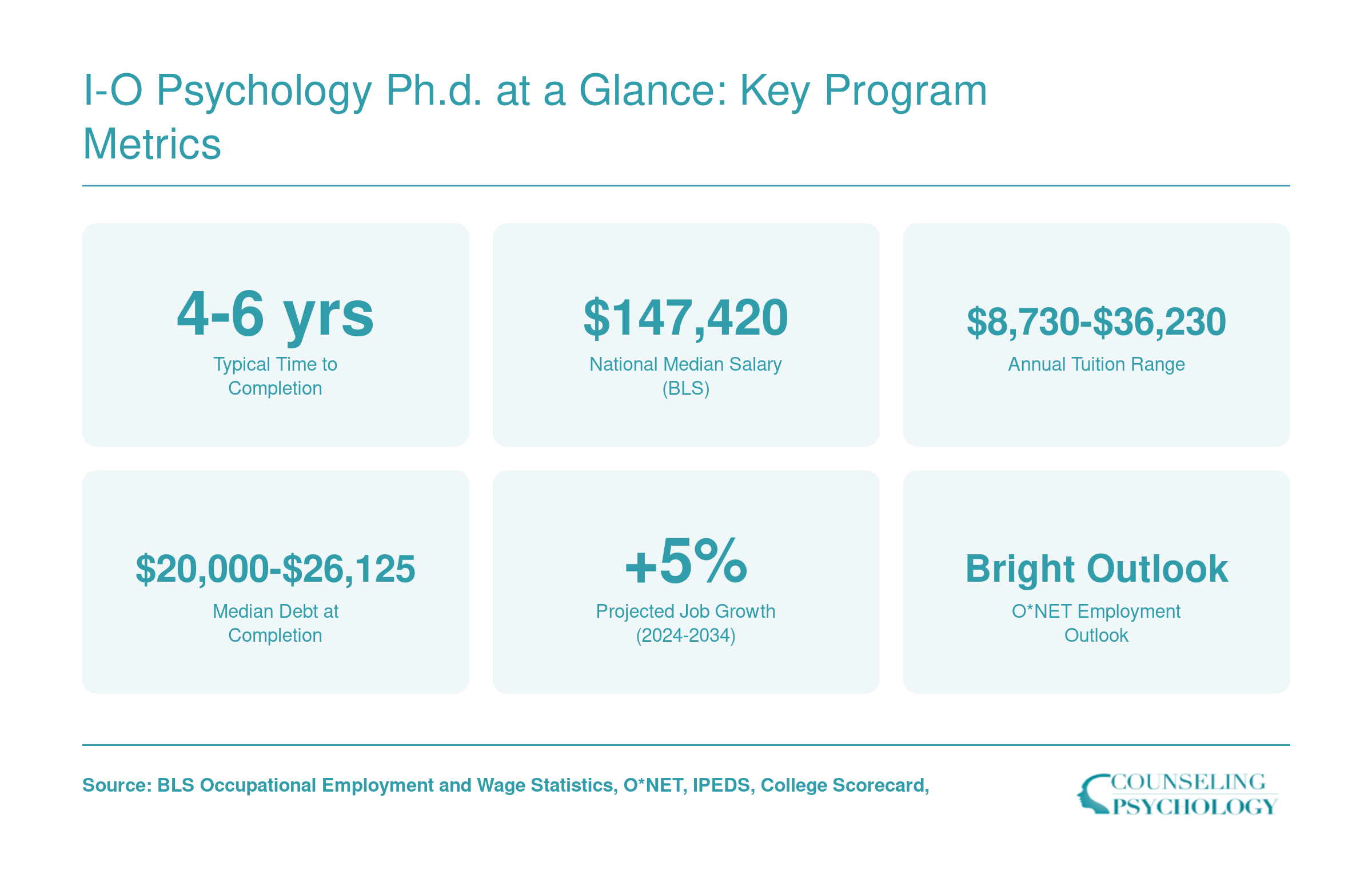
I-O Psychology Ph.D. at a Glance: Key Program Metrics
Before committing to a doctoral program, it helps to see the big-picture numbers side by side. The snapshot below combines federal labor data with tuition and debt figures reported by the online programs ranked on counselingpsychology.org, giving you a quick reference point for planning your timeline, budget, and earning potential.
Curriculum, Research Focus & Training Milestones
The biggest curriculum decision in I-O doctoral training isn't a course you'll pick. It's a philosophical fork in the road that most applicants underestimate until they're a year in. Programs split sharply between research-oriented training (preparing you for academic publishing and faculty roles) and applied/practitioner training (preparing you for consulting, internal HR analytics, and organizational interventions). The coursework looks similar on paper. The dissertations, internships, and faculty mentoring relationships look very different in practice.
Research vs. Applied Orientation
Research-heavy programs front-load methodology, advanced statistics, structural equation modeling, and meta-analysis, with the expectation that you'll publish multiple peer-reviewed papers before graduating. Applied programs preserve those methods courses but layer in supervised consulting practica, client-facing field placements, and case-based capstones. Many strong programs claim a scientist-practitioner model that blends both, but the proportions vary widely, so ask faculty directly about recent graduate placements before you commit.
The Typical Doctoral Arc
Most full-time I-O Ph.D. students follow a recognizable five-to-seven-year arc:
- Years 1-2: Core coursework and lab rotations, plus a master's-level research project at many programs.
- Year 3: Comprehensive (qualifying) exams and dissertation proposal development.
- Years 4-5: Data collection, analysis, and writing, often alongside a supervised internship or applied project.
- Year 5+: Dissertation defense and the job market.
Part-time and online students typically add two to three years to that timeline.
Core Coursework and SIOP Alignment
Expect a recognizable core: psychometrics, personnel selection, organizational behavior, statistics and research methods, job analysis, training and development, leadership, and performance management. SIOP's Guidelines for Education and Training in I-O Psychology, last revised in 2016 and still the field's reference point heading into 2026, lay out 24 competency areas covering everything from consultation skills to organizational theory.1 Programs map their curricula against those guidelines because, importantly, the APA does not accredit I-O psychology doctoral programs. There is no specialty accreditation body. Quality evaluation rests on regional institutional accreditation, SIOP alignment, faculty research output, and graduate placement records.
Online and Hybrid Considerations
Fully online I-O Ph.D. programs structure milestones differently. Residencies, summer intensives, or week-long campus visits often substitute for the in-person lab culture, and applied practica are typically arranged at or near your workplace. Confirm how each program handles dissertation supervision and data collection logistics before enrolling, because that's where remote students most often stall.
The research-versus-applied decision shapes every aspect of your doctoral experience, from dissertation expectations to career placement. Students aiming for tenure-track faculty roles need a research-intensive program, while those targeting corporate or consulting careers benefit most from programs offering applied training, practicum placements, and industry partnerships. Clarify your goal before you apply.
Career Outcomes & Salary Potential After an I-O Ph.D.
An I-O psychology Ph.D. opens the door to some of the highest-paying roles in the broader psychology field, and the salary data backs that up. Whether you land in corporate talent strategy, consulting, government, or academia, the earning trajectory for doctoral-level I-O psychologists is steep and well-documented.
National Salary Benchmarks
According to the Bureau of Labor Statistics (May 2023 data for SOC 19-3032), the national median annual wage for industrial-organizational psychologists was $147,420.1 The full wage spectrum is striking:
- 10th percentile: $45,860 (often reflects early-career or part-time roles)
- 25th percentile: $90,100
- 75th percentile: $219,410
- 90th percentile: $219,810
These figures place I-O psychology among the highest-compensated psychology subfields in the country. The national mean annual wage sits at $154,380.1 Note that BLS-reported employment for this specific occupation code is relatively small (roughly 1,030 jobs classified strictly as "industrial-organizational psychologist"), because many Ph.D. holders work under broader titles such as talent analytics director, organizational development consultant, or human capital strategist. The actual pool of professionals doing I-O work is substantially larger than the BLS category suggests.
Chicago-area-specific BLS wage data for this occupation code is not consistently published due to the small sample size. If you are benchmarking local compensation, salaries in the Chicago-Naperville-Elgin metro tend to track close to or above the national median given the density of Fortune 500 headquarters and major consulting firms in the region.
Program-Level Earnings: What Graduates Actually Report
Granular, program-level earnings data (such as median income one or four years after completion) is not yet available for the online I-O psychology Ph.D. programs ranked in this guide. That gap matters. Without it, prospective students should lean on BLS occupation-level data and employer surveys rather than assuming any single program guarantees a specific salary outcome.
Top Career Pathways
I-O Ph.D. holders fan out across several high-demand sectors. For a broader look at the steps required to enter the field, see our guide on how to become an industrial organizational psychologist.
- Corporate HR and talent management: Leading workforce analytics, employee selection systems, and organizational design at Fortune 500 firms.
- Management consulting: Firms like McKinsey, Deloitte, and Korn Ferry actively recruit I-O psychologists for leadership assessment and change management engagements.
- Academic faculty: Tenure-track positions at research universities, though competition is stiff and these roles often pay less than industry.
- Government: Agencies such as OPM and the Department of Defense hire I-O psychologists for personnel research, test development, and policy evaluation.
- Independent consulting: Experienced practitioners build private practices advising organizations on selection, training, and organizational health.
Is the Ph.D. Worth the Investment?
The return-on-investment question deserves honest framing. Median graduate debt at the institutions in this guide ranges from roughly $20,000 to $26,000, while the national median salary for the occupation exceeds $147,000. Even without program-specific earnings data, that debt-to-income ratio is favorable compared to most doctoral fields in psychology. BLS projects at least 5% job growth for I-O psychologists through 2034, and O*NET classifies the field as a Bright Outlook occupation.2 When you factor in the breadth of titles I-O graduates actually hold, the real demand is considerably wider than that single projection implies.
Students who want to test the waters before committing to a doctorate may also consider i/o psychology master's programs as an entry point. Regardless of degree level, I-O psychology consistently ranks among the fastest-growing and best-compensated psychology subfields, and a doctorate remains the clearest path to senior-level roles in both research and practice. The Chicago metro, with its concentration of corporate headquarters and consulting offices, is a particularly strong launching pad.
Licensure & Career Pathways in Illinois
Most I-O psychologists in Illinois practice without state licensure. Corporate consulting, talent analytics, HR research, and organizational development roles fall outside the regulatory scope that governs health-service psychology. The key tradeoff: forgoing licensure means you cannot use the title "psychologist" in a clinical or public-facing context, but it leaves you free to work in the exempt settings where the majority of I-O careers unfold.
Illinois Licensure: Clinical vs. I-O Pathways
Illinois issues two psychologist licenses through the Illinois Department of Financial and Professional Regulation (IDFPR): Clinical Psychologist and Prescribing Psychologist.1 Neither category is specific to industrial-organizational psychology. The state does not maintain a dedicated I-O psychology license, and the clinical pathway expects training in health-service delivery. If your doctoral program emphasized organizational research, selection systems, and workplace interventions rather than clinical assessment or psychotherapy, the application becomes more complicated.
Clinical licensure in Illinois requires a doctoral degree that is "psychological in nature" and either APA-accredited or NRHSPP-approved.3 The Clinical Psychologists Licensing and Disciplinary Board will review I-O degrees on a case-by-case basis, looking for coverage of seven core content areas: social, biological, and cognitive-affective bases of behavior, individual differences, treatment modalities, assessment, and scientific ethics.3 If your coursework covered these domains and you can document supervised clinical experience (3,500 total hours, including a 1,750-hour internship and 1,750-hour postdoctoral placement), you may qualify.4 The supervised experience must be clinical, school, or counseling in nature, and at least 30 semester hours or 350 face-to-face hours must occur within a concentrated residency window. After completing supervised hours, you sit for the EPPP.
When Licensure Matters, and When It Doesn't
For the overwhelming majority of I-O roles (talent acquisition scientist, people analytics lead, organizational effectiveness consultant, DEI metrics researcher), licensure adds little. Employers care about methodological rigor, experience with workplace data, and the ability to translate findings into business outcomes. You can hold the title "Industrial-Organizational Psychologist" in these settings without a state credential. Those interested in understanding how these roles compare to other careers in psychology will find that I-O stands out for its emphasis on business applications over clinical practice.
Licensure becomes essential if you plan to offer clinical services (psychotherapy, diagnostic assessment), use the title "Licensed Psychologist," or work in settings that require a state credential, such as some schools, government agencies, or hybrid consulting roles that blend I-O and clinical work. If you trained exclusively in I-O methods and skipped clinical practica, obtaining Illinois licensure will require years of supervised clinical hours, effectively a second training track.
Portability and Interstate Practice
Licensure rules vary widely. Some states recognize I-O psychology more explicitly; others mirror Illinois's clinical focus. If you anticipate moving or working across state lines, review the target state's requirements early. The Association of State and Provincial Psychology Boards maintains a mobility agreement (ASPPB Mobility Program) that streamlines license transfers among participating jurisdictions, but you still need an initial license that qualifies. Illinois participation means a clinical license here can ease entry elsewhere, but only if you meet the clinical training threshold in the first place. For anyone exploring the broader question of how to become a psychologist, understanding these state-level nuances is a critical early step.
FAQs About I-O Psychology Ph.D. Programs Near Chicago
Choosing a doctoral program is a major decision, and prospective I-O psychology students near Chicago tend to ask many of the same questions. Below are straightforward answers to the ones that come up most often.