
What you’ll learn in this article…
- Texas A&M tops the 2026 rankings with the highest ROI ratio among the ten best psychology programs in Texas.
- A master's degree qualifies you for LPC licensure in Texas, while the psychologist title requires a doctorate.
- BLS projects 18% national growth for mental health counselors from 2022 to 2032, well above the average for all occupations.
- Online and on-campus psychology programs in Texas lead to the same degrees and licensure eligibility.
Public universities dominate Texas psychology education, but the differences in cost and format are stark. Our 2026 rankings reward schools that combine genuinely low net prices, as little as $1,300 per year after aid at Texas A&M-Central Texas, with online or hybrid delivery that fits working adults. Eight of the ten programs offer fully online or hybrid tracks, and each holds regional accreditation necessary for state licensure.
The real dividing line for Texas psychology students is not prestige. It is whether a program's debt load aligns with the licensing timeline and salary expectations in a state where LPCs and psychologists face months of supervised practice before full independence.
Best Psychology Programs in Texas: 2026 Rankings
Texas is home to dozens of public universities offering psychology degrees, but not all of them pair affordability with genuine online or hybrid flexibility. The ten programs below earned their spots by combining low net prices, flexible delivery, and program depth across bachelor's, master's, and graduate certificate levels. Graduation rates listed are institution-wide figures reported to the federal government; they do not reflect psychology-specific completion and should be weighed alongside other factors like cost, format, and career alignment.
- Net price and affordability
- Online and hybrid availability
- Institutional graduation and retention
- Graduate debt levels
- Program breadth and concentrations
- NCES-IPEDS federal institutional data — nces.ed.gov
- College Scorecard graduate earnings — collegescorecard.ed.gov
- Internal program database
- Independent program research

Texas A&M University-Central Texas
Texas A&M University-Central Texas in Killeen operates as an upper-division and graduate institution, meaning most undergraduates transfer in after completing community college coursework, a structure that can dramatically lower total degree costs. Its psychology offerings span a hybrid B.S. and multiple fully online master's tracks, including concentrations in experimental psychology, I/O psychology, educational psychology, and institutional research, plus a hybrid Specialist in School Psychology that prepares candidates for LSSP licensure. Located near Fort Cavazos, the campus provides extensive support for military-affiliated students and working adults, and its average net price of roughly $1,300 is the lowest on this list by a wide margin.
- Hybrid format blending online and on-campus courses
- 120 credit hours with research opportunities
- Curriculum covers clinical, developmental, and theoretical psychology
- Annual student research symposium for hands-on experience
- Upper-division entry keeps total degree costs low
- Designed for transfer students from Texas community colleges
- Fully online, 36-credit-hour master's program
- Concentrations in experimental, I/O, educational, and institutional research
- Thesis requirement develops advanced research skills
- Multiple start dates each year (fall, spring, summer)
- Prepares graduates for doctoral study or applied careers
- Strong emphasis on data analysis and professional writing
- 63 to 69 credit hours with hybrid delivery
- Prepares candidates for LSSP credential in Texas
- Two-semester supervised internship included
- Curriculum aligned with NASP standards
- Web-enhanced coursework for scheduling flexibility
- Covers empirically based assessment and intervention
Bachelor of Science in Psychology — On-Campus
Master of Science in Applied Psychology — Online
Specialist in School Psychology — Hybrid

University of North Texas at Dallas
The University of North Texas at Dallas brings a CACREP-accredited Master of Science in Clinical Mental Health Counseling to the Dallas-Fort Worth metroplex, directly serving one of the state's highest-need urban areas for mental health professionals. The 60-hour hybrid program is taught by licensed practitioners and is explicitly designed to meet Texas licensure requirements, making the path from classroom to practice relatively seamless. With a net price around $6,420 and a strong Pell-recipient population, UNTD is built around accessibility for students who might otherwise be priced out of graduate counseling education.
- CACREP-accredited 60-credit-hour program
- Hybrid delivery combines online and face-to-face sessions
- Curriculum aligned with Texas LPC licensure requirements
- Faculty composed of experienced licensed professionals
- Prepares graduates for work in clinics, agencies, and private practice
- Strong urban practicum network across Dallas-Fort Worth
- Designed to accommodate working professionals' schedules
Master of Science in Clinical Mental Health Counseling — Hybrid

University of Houston
The University of Houston is a Carnegie R1 research institution whose psychology-related graduate offerings include a hybrid Master of Education with an Applied Behavior Analysis concentration, preparing students for Board Certified Behavior Analyst (BCBA) credentials. Situated in one of the nation's largest metro areas, UH students tap into an extensive network of school districts, hospitals, and autism-services agencies for supervised fieldwork. Institution-wide median earnings reach approximately $62,377 at ten years post-enrollment, a useful benchmark even though program-level earnings data is not yet available for this track.
- Hybrid format with online and on-campus components
- Coursework aligned with BACB certification standards
- GRE waiver available for qualifying applicants
- Emphasis on ethical guidelines and data-driven decisions
- Fieldwork leverages Houston-area schools and clinics
- Covers intervention design, implementation, and evaluation
- Prepares graduates for roles in education, healthcare, and consulting
- Strong focus on professional collaboration skills
Master of Education in Special Populations, Applied Behavior Analysis — Hybrid

University of Houston-Downtown
University of Houston-Downtown offers a fully online B.S. in Psychology that is one of the more affordable bachelor's options in the Houston system, with a net price near $10,542. The curriculum spans human development, abnormal psychology, and clinical studies while building core research and analytical skills applicable across counseling, education, market research, and human services. Ten-year median earnings for UHD graduates sit around $53,551 institution-wide, reflecting the practical, workforce-oriented education the campus provides to a largely first-generation student body.
- Fully online or face-to-face completion options
- Covers human development, clinical studies, and abnormal psychology
- Builds research, analysis, and presentation skills
- Prepares for entry-level roles or graduate study
- Affordable urban public university in downtown Houston
- Strong community and employer connections in the Houston area
Bachelor of Science in Psychology — On-Campus

University of Houston-Victoria
University of Houston-Victoria stands out for its niche Master of Arts in Forensic Psychology, a 66-credit-hour hybrid program that trains students to work with forensic populations and prepares them for either Licensed Professional Counselor (LPC) or Licensed Psychological Associate (LPA) credentials in Texas. UHV also houses a Specialist in School Psychology aligned with NASP standards and an online M.Ed. in Applied Behavior Analysis, giving students three distinct graduate pathways from a single regional campus. Coursework is offered at both the Victoria and Katy locations, extending reach across South-Central Texas and the Greater Houston suburbs.
- 66 credit hours with hybrid delivery at Victoria and Katy
- Two concentration tracks: Professional Counselor and Psychological Associate
- Prepares for LPC or LPA licensure in Texas
- Practicum placements with strong hire-back rates
- Prerequisites include statistics, research methods, and abnormal psychology
- Faculty interview required for admission
- Fall-only cohort start
- 63 credit hours with hybrid evening classes
- Prepares candidates for LSSP credential
- Full-time internship embedded in the program
- Curriculum aligned with NASP professional standards
- Three-year expected completion timeline
- Supports empirically based intervention training
- Fully online format for working professionals
- Focus on supporting individuals with disabilities
- Designed for educators and behavior-support staff
- Flexible scheduling around full-time employment
Master of Arts in Forensic Psychology — Hybrid
Specialist in School Psychology — Hybrid
Master of Education in Applied Behavior Analysis — Online

University of Houston-Clear Lake
University of Houston-Clear Lake delivers a STEM-designated Master of Arts in Industrial/Organizational Psychology through a hybrid evening model at its Pearland campus, making it a practical choice for Houston-area professionals who want to keep working while earning a graduate degree. The I/O focus, with its emphasis on hiring practices, training systems, and employee well-being, maps directly onto the city's corporate, energy, and aerospace sectors. Institution-wide, UHCL graduates report median earnings of roughly $59,004 at ten years, and the 15:1 student-faculty ratio supports more individualized mentorship than many larger Texas universities.
- STEM-designated graduate program
- Hybrid evening classes designed for working professionals
- Applies behavioral science to workplace performance
- GRE optional for the current admissions cycle
- Requires 12 hours of relevant undergraduate coursework
- Prepares for careers in HR, consulting, and org development
- Foundation for doctoral study in I/O psychology
- Classes held at the Pearland campus location
Master of Arts in Industrial/Organizational Psychology — Hybrid

The University of Texas at Tyler
The University of Texas at Tyler offers a fully online Master of Arts in School Counseling that can be completed in 24 months at an estimated total program cost of about $13,044, well below many competing Texas graduate programs. The 48-credit-hour curriculum is tightly aligned with Texas Education Agency and American School Counselor Association standards, and graduates have posted a 99% pass rate on the TExES certification exam. Because the required internship must be completed within Texas, the program functions as a direct pipeline into K-12 counselor positions across the state.
- Fully online 48-credit-hour program
- 24-month completion timeline
- 99% TExES certification exam pass rate
- Total estimated program cost around $13,044
- Synchronous and asynchronous course options
- Cohort model with summer entry
- Internship must be completed within Texas
- Aligned with TEA and ASCA guidelines
Master of Arts in School Counseling — Online

The University of Texas Permian Basin
The University of Texas Permian Basin provides a 100% online Bachelor of Arts in Psychology built for flexibility: courses run in accelerated eight-week terms, SAT/ACT scores are optional, and students can transfer up to 90 credits from community colleges or other institutions. The curriculum covers clinical, developmental, forensic, and health psychology tracks, giving undergraduates early exposure to several specialization areas before they commit to graduate study. With a net price around $12,723 and recognition on national affordability lists, UTPB is a strong value play for Texas residents finishing a degree while employed.
- Fully online with accelerated 8-week terms
- Accepts up to 90 transfer credits
- SAT/ACT not required for most applicants
- Focus areas include clinical, forensic, and health psychology
- 120 total credits with research methods emphasis
- Competitive tuition recognized in national affordability rankings
- Transfer-friendly for Texas community college students
- Prepares graduates for entry-level roles or graduate programs
Bachelor of Arts in Psychology — Online

East Texas A&M University
East Texas A&M University (formerly Texas A&M University-Commerce) pairs one of the lowest resident tuition rates in the state, starting around $3,669 per semester for graduate work, with hybrid psychology programs that serve a large swath of Northeast Texas and the Dallas exurbs. The M.S. in Psychology offers both thesis and non-thesis options across 36 to 66 credit hours, while the Specialist in School Psychology program prepares students for LSSP certification through a three-year, 66-hour hybrid curriculum that includes practicum and internship components. Multiple campus locations make in-person course requirements more manageable for students outside the Commerce area.
- Hybrid delivery with online and face-to-face courses
- 36 to 66 credit hours depending on track
- Thesis and non-thesis pathways available
- Texas resident tuition starting at $3,669 per semester
- Research-focused curriculum with practical training
- Prepares for counseling, organizational, or doctoral careers
- 1 to 3 year flexible completion timeline
- 66 credit hours over a 3-year hybrid program
- Prepares candidates for LSSP certification in Texas
- Practicum and internship embedded in the curriculum
- Multiple campus locations for in-person requirements
- Fall-semester entry with cohort model
- No foreign language requirement
- Affordable resident tuition compared to Texas averages
Master of Science in Psychology, General Psychology — Hybrid
Specialist in School Psychology — Hybrid

University of North Texas
The University of North Texas in Denton rounds out the list with a fully online Graduate Academic Certificate in Applied Behavior Analysis, a 24-credit-hour program designed for professionals who already hold a master's degree and want BACB-aligned coursework for BCBA eligibility. Courses are available every semester, allowing students to fit the certificate around full-time work in schools, clinics, or community agencies. At roughly $11,100 in Texas-resident tuition, the certificate is a cost-efficient credential add-on, and institution-wide ten-year median earnings for UNT graduates reach about $57,010.
- Fully online, 24-credit-hour program
- Courses offered every semester for scheduling flexibility
- Meets BACB coursework standards for BCBA eligibility
- Specialized training for Autism Spectrum Disorders
- Covers assessment, intervention, and ethical practice
- Requires a master's degree for admission
- Texas resident tuition approximately $11,100
- Evidence-based intervention strategy focus
Graduate Academic Certificate in Applied Behavior Analysis — Online
How We Ranked Texas Psychology Programs
Transparency in college rankings is still the exception rather than the rule. A quick scan of competing "best psychology programs in Texas" lists reveals that most provide little or no detail about the criteria behind their selections. We take a different approach.
Data Sources We Rely On
Our rankings draw from two primary federal datasets: the U.S. Department of Education's College Scorecard (both institution-level and program-level outcomes where available) and the Integrated Postsecondary Education Data System (IPEDS) for tuition and enrollment figures. These are the same datasets colleges themselves report to, which makes them consistent and auditable. One important caveat: graduation rates pulled from these sources reflect the institution as a whole, not the psychology department specifically. Program-level completion data simply is not published at that granularity for most schools.
What Carries the Most Weight
Because this list focuses on affordable and accessible options, financial metrics sit at the center of the ranking formula.
- Net price after aid: We use the average net price students actually pay once grants and scholarships are factored in, not the published sticker price. This figure varies by income bracket and individual aid packages, so your personal cost may differ.
- Financial aid availability: The share of students receiving institutional or federal aid signals how aggressively a school works to lower the barrier to entry.
- Online or hybrid delivery: To qualify for consideration, a program must offer at least some coursework online or in a hybrid format, reflecting the reality that many Texas psychology students balance school with work or family obligations.
What "Affordable" Actually Means
When we label a program affordable, we are referring to the average net price after all aid is applied. This is a useful benchmark, but it is not a guarantee. Students with higher family incomes, those enrolling part-time, or out-of-state learners may see different totals. Always request a personalized net price estimate directly from the school's financial aid office before committing.
Why This Matters
Methodology transparency is a cornerstone of trustworthy guidance. By showing you exactly what we measured and where the data came from, we make it possible for you to weigh our conclusions against your own priorities, whether that is rock-bottom tuition, program reputation, or something else entirely. Students exploring a bachelor's degree in psychology can use these same principles to evaluate any ranking list they encounter.
Texas Psychology Degree Costs and ROI
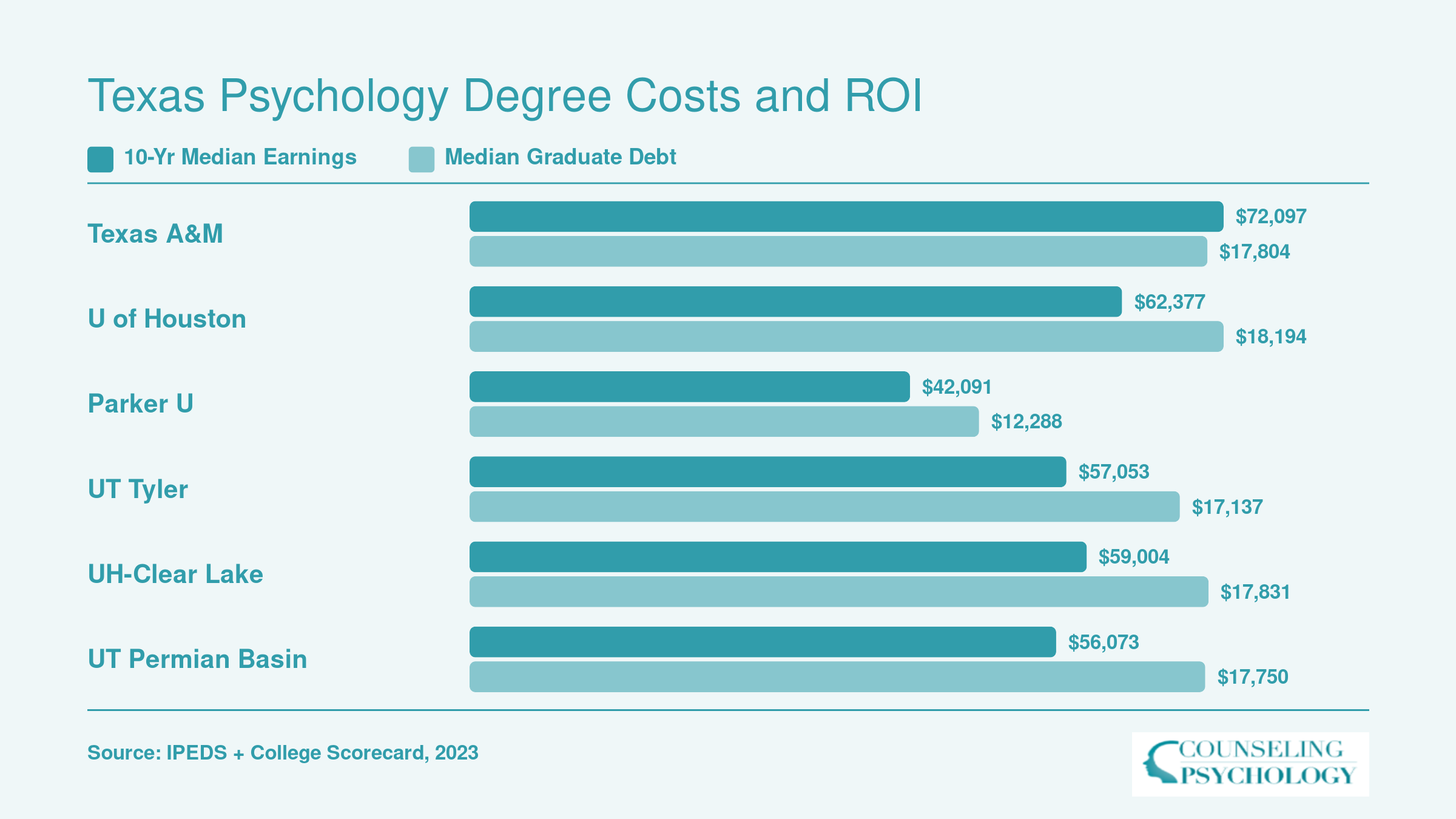
The ROI ratio, calculated as ten-year median earnings divided by median graduate debt, is one of the clearest ways to gauge whether a psychology program's price tag pays off. Among the top-ranked Texas programs, Texas A&M leads with an ROI ratio above 4.0, meaning graduates earn roughly four dollars for every dollar of debt they carry. Program-level earnings by year after completion are not yet available for these schools, so the chart below uses institution-wide median earnings ten years after enrollment alongside median debt. For context, monthly payments on a standard ten-year repayment plan range from roughly $128 (Parker University, $12,288 median debt) to about $190 (University of Houston, $18,194 median debt).
What Psychology Graduates Earn Vs. What They Owe
The gap between what you pay and what you earn after graduation varies dramatically across Texas psychology programs. The table below uses institution-level data from the College Scorecard and IPEDS, sorted by median earnings ten years after enrollment. Program-specific early-career earnings are not yet available for most of these schools, so we rely on the institution-wide figures to approximate return on investment. For broader career context, BLS data shows that clinical and counseling psychologists earn a national median of $96,100 per year (with a Texas mean of roughly $82,420), while industrial-organizational psychologists command a national median of $117,580. These occupation-level benchmarks suggest that graduate-degree holders in specialized psychology tracks can expect earnings well above the institutional medians shown here, which reflect all graduates across every major.
| School | Net Price | Median Graduate Debt | Median Earnings (10 yr) | ROI Ratio |
|---|---|---|---|---|
| Texas A&M University, College Station | $21,315 | $17,804 | $72,097 | 4.05 |
| Texas Tech University | $19,070 | $21,500 | $62,454 | 2.90 |
| University of Houston | $14,276 | $18,194 | $62,377 | 3.43 |
| University of Houston, Clear Lake | $15,563 | $17,831 | $59,004 | 3.31 |
| Saint Edward's University | $25,578 | $24,803 | $58,826 | 2.37 |
| LeTourneau University | $28,185 | $26,000 | $57,103 | 2.20 |
| UT Tyler | $13,323 | $17,137 | $57,053 | 3.33 |
| University of North Texas | $15,649 | $19,250 | $57,010 | 2.96 |
| Texas State University | $16,805 | $21,000 | $56,906 | 2.71 |
| Dallas Baptist University | $28,516 | $21,591 | $56,807 | 2.63 |
Related Articles
Online Vs. On-Campus Psychology Programs in Texas
Texas is a large state, and where you live can shape which program format makes the most sense. Both online and on-campus psychology programs can lead to the same degrees and licensure eligibility, but each format comes with distinct trade-offs. Several ranked programs on this list offer a hybrid or "both" format, blending online coursework with periodic on-campus intensives, which can serve as a practical middle ground.
Pros
- Online programs offer scheduling flexibility that lets working professionals in Texas complete coursework around existing jobs and family obligations.
- Tuition and total cost tend to be lower for online students, who avoid commuting, relocation, and many campus fees.
- Students in rural parts of Texas, far from metro university campuses, can access accredited programs without uprooting their lives.
- Hybrid formats at several ranked schools combine online lecture content with structured in-person residencies for clinical skill building.
- On-campus students benefit from direct, face-to-face faculty mentorship and spontaneous collaboration that can deepen learning.
- In-person programs in Houston, Dallas, San Antonio, and Austin integrate practicum and internship placements within local clinical networks.
- Campus-based cohorts build peer relationships in shared Texas metro settings, creating professional networks that often last an entire career.
Cons
- Online students pursuing licensure tracks such as LPC or LMFT must still complete supervised clinical hours at a local site, which requires arranging practicum placements independently.
- Fully online learners may have fewer organic networking opportunities with classmates and local clinical supervisors compared to on-campus peers.
- On-campus programs typically carry higher total costs once you factor in housing, transportation, and campus-specific fees.
- Rigid class schedules in on-campus formats can be difficult to manage for students who work full time or live outside major metro areas.
- Hybrid programs require occasional travel to campus, which may be costly or inconvenient for students in West Texas or the Panhandle region.
Questions to Ask Yourself
Psychology Licensure Requirements in Texas
A master's degree opens the door to counseling and therapy licensure in Texas, while a doctorate is required to use the title "psychologist." That single distinction shapes which programs from the rankings above match your goals, since the degree you choose locks in the licensure tracks available to you.
The Two Regulators You'll Deal With
Texas splits oversight between two bodies. The Texas State Board of Examiners of Psychologists (TSBEP) regulates the Licensed Psychologist (LP) and Licensed Psychological Associate (LPA) credentials.1 The Texas Behavioral Health Executive Council (BHEC) administers the Licensed Professional Counselor (LPC) and Licensed Marriage and Family Therapist (LMFT) licenses through its member boards. Application materials, fees, and rule updates for the counseling tracks flow through BHEC; doctoral and master's-in-psychology applicants apply to TSBEP.
Master's-Level Tracks: LPA, LPC, and LMFT
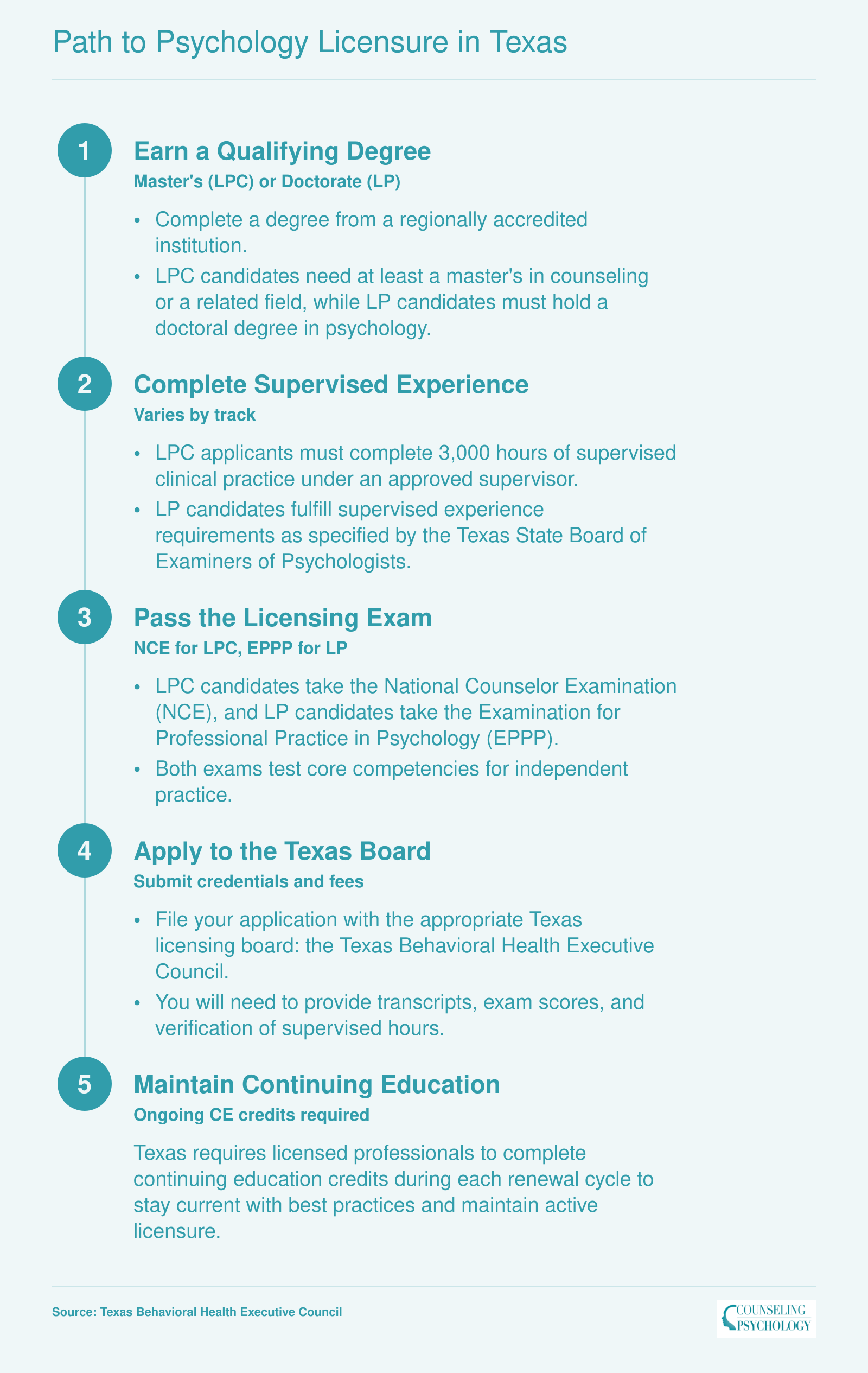
The LPA requires a master's in psychology with at least 60 semester hours, including 6 semester hours of practicum (capped at 12 within the degree). After graduation, candidates complete 3,000 hours of supervised experience and pass both the Examination for Professional Practice in Psychology (EPPP) and the Texas Jurisprudence Examination.
LPC and LMFT applicants pursue counseling degrees, then complete supervised post-degree hours under a BHEC-approved supervisor before sitting for their respective national exams (the National Counselor Examination or National Clinical Mental Health Counseling Examination for LPCs, and the AMFTRB exam for LMFTs). Texas rules require coursework in ethics, and certain tracks expect content in psychopharmacology, assessment, and cultural competence, so verify your program's curriculum against current BHEC rules before enrolling. For a broader look at counseling licensure requirements across the country, comparing state-by-state standards can help you plan for mobility after graduation.
Doctoral Track: Licensed Psychologist
The LP requires a doctoral degree (PhD or PsyD) from an APA-accredited or equivalent program, a 1,750-hour predoctoral internship, and 1,750 hours of postdoctoral supervised experience. Candidates pass the EPPP and the Texas Jurisprudence Examination. Holders of the Certificate of Professional Qualification (CPQ) are exempt from all requirements except the jurisprudence exam, and out-of-state psychologists with five years of practice or 3,000 documented supervised hours can have the supervised-experience requirement waived. Students exploring the full range of careers in psychology should note that doctoral licensure unlocks independent practice, forensic work, and academic positions that master's-level credentials do not.
Why Accreditation Matters
For licensure eligibility, the accreditor on your transcript matters as much as the degree itself. APA accreditation is the expected standard for doctoral psychology programs heading toward LP licensure. For counseling master's programs, CACREP accreditation streamlines the LPC pathway, and COAMFTE accreditation does the same for LMFT candidates. Choosing an unaccredited program can mean extra coursework, delayed eligibility, or a denied application.
Path to Psychology Licensure in Texas
Texas offers two primary licensure tracks for psychology professionals. The Licensed Psychologist (LP) path requires a doctoral degree and passing the EPPP, while the Licensed Professional Counselor (LPC) path requires a master's degree and passing the NCE. Both routes follow the same general credentialing ladder outlined below.
Psychology Specializations Available in Texas
Choosing a Texas psychology program is less about picking the "best" school and more about matching a specialization to the career you actually want, because the wrong concentration can add years of unlicensed coursework or lock you out of the credential you need. The ranked programs in this guide cluster around five practical tracks, and each one carries different licensure consequences in Texas.
Clinical vs. Counseling Psychology
The distinction matters more than the names suggest. Clinical-track programs lean toward psychopathology, assessment, and diagnosis, often preparing graduates to work with more acute presentations. Counseling-track programs emphasize wellness, prevention, and developmental adjustment, with a strong vocational and identity-formation lens. In Texas, both routes commonly funnel master's degree in psychology graduates toward LPC (Licensed Professional Counselor) eligibility when the program is CACREP-aligned; the doctoral psychologist license is a separate, longer path.
Clinical mental health counseling tracks appear at the University of North Texas at Dallas (CACREP-accredited, 60 credit hours), Lamar University (online, 60 credits, LPC-prep), Midwestern State University (CACREP, with in-person intensives starting Fall 2026), Lubbock Christian University, and Sul Ross State University. Counseling psychology framing shows up at Lamar and Midwestern as well. Students weighing the counseling route specifically may also want to compare counseling programs in Texas for a broader view of CACREP-aligned options.
School Psychology and the LSSP Path
If you want to work in Texas public schools, you need the Licensed Specialist in School Psychology (LSSP) credential, which is a master's or Ed.S.-level path, not a doctorate. Texas Tech's Educational Psychology M.Ed. with a School Psychology concentration leads directly to LSSP licensure. Stephen F. Austin offers a 63-hour NASP-recognized master's in School Psychology, and Tarleton State runs a Specialist in School Psychology program focused on rural and underserved communities with dual LSSP and NCSP credentialing. UT Tyler's online M.A. in School Counseling Psychology is a related option for school-based work.
I/O, Forensic, and Applied Behavior Analysis
Industrial-organizational psychology is the non-licensure path with the strongest corporate ROI. The University of Houston-Clear Lake offers a STEM-designated I/O Psychology M.A. with evening classes built for working professionals heading into HR, talent analytics, and consulting roles. Those exploring shorter credentials in the field can look into an industrial organizational psychology certificate as a lower-commitment entry point.
Forensic psychology is available through UH-Victoria's 66-credit M.A. in Forensic Psychology. Applied Behavior Analysis, which leads to BCBA certification rather than psychologist licensure, is offered at the University of Houston, UNT, Texas A&M College Station, and Saint Edward's University. Sports and performance psychology rounds out the list at Texas A&M-Kingsville and Parker University.
How to Choose a Psychology Program in Texas
What separates a Texas psychology program that will launch your career from one that will leave you scrambling for clinical hours? Mostly: the depth of training partnerships, the flexibility of the curriculum, and whether the credential lines up with Texas licensure rules. Here's how to investigate each program before you commit.
Dig Into Clinical Training Partnerships
Practicum and internship placements are where you actually become a psychologist, so treat them as a primary selection criterion, not an afterthought. Visit each program's official website and look for pages titled "clinical training," "field placements," or "externship sites." These pages usually name the affiliated hospitals, community clinics, and school districts where students have rotated.
If the website is vague, go to the source. Email or call the graduate coordinator or director of clinical training and ask directly: Which sites are currently active? How many students placed at MD Anderson, Texas Children's, the Michael E. DeBakey VA, or large districts like Houston ISD and Austin ISD last year? Coordinators field these questions constantly and can tell you which partnerships are robust versus which appear on a list but rarely host trainees.
Look for Accelerated and Dual-Degree Options
If you want to compress the timeline, search the university's catalog and psychology department site for phrases like "accelerated master's," "combined bachelor's/master's," "4+1," or "5-year program." These pathways are usually buried under "academic programs," "special opportunities," or "undergraduate research." Not every Texas school offers one, and eligibility often requires applying during the junior year with a minimum GPA, so confirm the rules early.
Verify Accreditation and Licensure Alignment
For doctoral training, only an APA-accredited program will keep all licensure doors open. This is especially true for online clinical psychology programs, where accreditation status varies widely. The APA maintains a public list of accredited clinical, counseling, and school psychology programs at apa.org. Cross-check anything you're considering against that list before paying an application fee.
For licensure logistics, the Texas State Board of Examiners of Psychologists publishes the supervised experience hours, exam sequence, and jurisprudence requirements you'll need to satisfy after graduation. Reading those rules now, while you're still choosing a program, helps you spot whether a degree's coursework and practicum hours will actually qualify you to sit for the EPPP in Texas without backfilling credits later.
The U.S. Bureau of Labor Statistics projects employment of substance abuse, behavioral disorder, and mental health counselors to grow 18% nationally from 2022 to 2032, far faster than the average for all occupations. Texas, with its large and expanding population, is expected to be a major driver of that demand.
Frequently Asked Questions About Texas Psychology Programs
Choosing the right psychology program means sorting through tuition costs, licensure rules, and format options. Below are answers to the questions prospective students ask most often about pursuing a psychology degree in Texas.
More Texas Psychology Programs to Consider
Beyond our top 10, Texas offers many other excellent psychology programs worth exploring. Here are additional schools with strong offerings, organized by region.
Greater Houston
- Master of Arts in Psychology
- Master of Arts in Clinical Mental Health Counseling (marriage and couples, families, grief, sexual addiction counseling)
Southeast Texas
- Master of Education in Clinical Mental Health Counseling
Austin Area
- Bachelor of Arts in Psychology
- Master of Education in Applied Behavior Analysis
South Texas
- M.S. in Kinesiology (Performance Psychology)
Brazos Valley
- Applied Behavior Analysis Certificate
- Master of Education in Educational Psychology (Developmental Sciences)
- Master of Education in Educational Psychology (School Counseling)
- Applied Behavior Analysis Certificate (Autism Spectrum Disorder)
North Texas
- Clinical Mental Health
DFW Metroplex
- Psychology (General Psychology)
- Master of Arts in Professional Counseling
East Texas
- Bachelor of Science in Psychology
- Master of Arts in Applied Behavior Analysis
- Master of Arts in Counseling - Clinical Mental Health Counseling Program
- Master of Arts in Counseling - Clinical Mental Health Counseling Program (Marriage and Family Therapy)
- Master of Arts in Counseling - Clinical Mental Health Counseling Program (Play Therapy)
- Master of Arts in School Psychology
- School Psychology, M.A.
- Master of Arts in Psychology
West Texas
- Educational Psychology M.Ed. (School Psychology)
- Educational Psychology M.Ed.
- Master of Education in Special Education (Applied Behavior Analysis)
- Graduate Certificate in Autism
- Master of Science in Clinical Mental Health Counseling
- Bachelor of Science in Psychology
- Applied Psychology M.S.