Key Takeaways
- Massachusetts hosts at least seven ABAI-accredited or BACB-approved ABA master's programs within the greater Boston metro area.
- BCBA exam pass rates for Massachusetts programs ranged widely in 2024, making published data a critical comparison tool.
- Greater Boston's concentration of hospitals, schools, and clinics gives ABA students access to unusually diverse practicum placements.
- Massachusetts ranks among the higher-paying states for behavior analysts, though BLS data relies on proxy occupational categories.
Eleven accredited ABA master's programs operate within commuting distance of Boston, spanning formats from fully online to traditional on-campus cohorts and offering tuition that ranges from under $9,000 to over $28,000 per year. This concentration of training options gives Massachusetts students unusual flexibility to match program structure to work schedules, budget constraints, and clinical interests, but the same abundance complicates comparison.
The core decision points are delivery format, ABAI accreditation status, and access to supervised fieldwork hours. Programs at UMass Lowell, Salem State, and Northeastern offer hybrid models that blend online coursework with periodic campus sessions, while Simmons and Assumption run traditional evening cohorts designed for working professionals. Regis, Bay Path, and Endicott operate fully online, a format that maximizes scheduling flexibility but requires students to independently secure fieldwork sites and supervisors. BCBA exam pass rates vary widely across these programs, from the high-90s down to the low-70s, and those differences correlate closely with program structure, faculty mentorship models, and thesis or capstone rigor.
Massachusetts also requires state licensure as a Licensed Applied Behavior Analyst (LABA) to practice independently, a credential that adds ethics coursework and jurisprudence exam requirements beyond the national BCBA certification. Most programs align their curricula with both BACB and state-specific requirements, but graduates should verify that their fieldwork hours meet Massachusetts supervision standards before sitting for the exam.
Best ABA Master's Programs Near Boston: Rankings and Comparison
Massachusetts is home to one of the densest clusters of ABA master's programs in the country, giving prospective BCBAs a wide range of formats, price points, and specialization options. The programs below span the greater Boston metro area and beyond, with tuition ranging from under $9,000 to more than $28,000 per year and formats that include fully online, hybrid, and traditional on-campus delivery. Institution-wide graduation rates are included for context, but keep in mind these figures reflect each university's overall undergraduate population, not the specific ABA master's cohort.
- Program accreditation and BCBA alignment
- Graduate tuition and debt levels
- Delivery format and scheduling flexibility
- Institutional graduation and retention rates
- Fieldwork partnerships and exam preparation
- Independent program research
- NCES-IPEDS federal institutional data — nces.ed.gov
- College Scorecard graduate earnings — collegescorecard.ed.gov
- Internal program database

Simmons University
Simmons University, located in Boston's Longwood Medical Area, has built an internationally recognized reputation in behavior analysis. The campus-based MS in Behavior Analysis is ABAI-accredited and reported an 89% first-attempt BCBA exam pass rate in 2023, while an online pathway gives remote learners a separate route to the same credential. With a 9:1 student-to-faculty ratio and median graduate debt of roughly $24,840, Simmons balances selectivity and outcomes well for students who want deep faculty interaction in a city setting.
- ABAI-accredited with 89% first-attempt BCBA pass rate (2023)
- Campus-based option with part-time evening classes
- Online pathway also available; no GRE required
- 40-credit curriculum includes thesis or research project
- Scholarships of $10,000 to $20,000 for qualified applicants
- Graduate tuition approximately $28,561 per year
- Strong faculty mentorship in ethical ABA practice
Master of Science in Behavior Analysis — On-Campus

University of Massachusetts-Lowell
UMass Lowell's MS in Applied Behavior Analysis and Autism Studies is a 39-credit hybrid program that blends online coursework with on-campus intensives, making it practical for working professionals across eastern Massachusetts. It is STEM-designated and offers concentrations in both Applied Behavior Analysis and Autism Studies, with no GRE requirement. In-state graduate tuition of roughly $16,434 keeps costs well below many private alternatives, and the university's median graduate debt sits at about $23,704.
- 39-credit hybrid program; STEM-designated degree
- No GRE required for admission
- In-state tuition around $16,434; out-of-state around $29,118
- Part-time and full-time scheduling with evening classes
- Prepares students for BCBA certification exam
- Supervised fieldwork at affiliated practicum sites
- Research opportunities with diverse, active faculty
- Same 39-credit hybrid structure as the ABA track
- Specializes in autism spectrum assessment and intervention
- Capstone or thesis option available
- Cultural responsiveness and DEIB principles integrated
- Financial aid and scholarships available
- Late afternoon and evening course scheduling
- Faculty expertise spans applied and translational research
Master of Science in Applied Behavior Analysis and Autism Studies, ABA Concentration — Hybrid
Master of Science in Applied Behavior Analysis and Autism Studies, Autism Studies Concentration — Hybrid

Western New England University
Western New England University's campus-based MS in Applied Behavior Analysis reported a 97% BCBA examination pass rate in 2022, one of the strongest outcomes among Massachusetts programs. The curriculum is closely tied to a partnership with the New England Center for Children (NECC), giving students hands-on clinical exposure during their supervised fieldwork hours. Graduate tuition is approximately $18,210 per year, with median graduate debt around $25,500 and institution-wide median earnings of $73,157 ten years after entry.
- 97% BCBA exam pass rate reported in 2022
- Campus-based program with 11-week terms
- Partnership with NECC for supervised fieldwork
- Meets all BACB coursework and experience requirements
- Faculty mentorship and thesis research included
- Minimum 3.0 undergraduate GPA for admission
- Focus on autism, developmental disabilities, and ethics
Master of Science in Applied Behavior Analysis — On-Campus

Assumption University
Assumption University in Worcester offers a 43-credit MA in Applied Behavior Analysis recognized as a Tier 2A program by ABAI. Small class sizes and up to 2,000 fieldwork hours give students intensive clinical preparation. Graduate tuition is approximately $15,470 per year, and the institution posts a 75.2% overall graduation rate, one of the higher marks among schools on this list.
- 43-credit curriculum recognized as ABAI Tier 2A
- Up to 2,000 supervised fieldwork hours
- Capstone project or research thesis option
- Small, in-person classes with experienced faculty
- Meets BCBA exam and Massachusetts licensure requirements
- Graduate tuition approximately $15,470 per year
- Emphasis on evidence-based assessment and intervention
Master of Arts in Applied Behavior Analysis — On-Campus

Westfield State University
Westfield State University delivers one of the most affordable ABA master's options in the state, with graduate tuition around $8,676 per year. The 48-credit MA in Applied Behavior Analysis is campus-based, with evening and late afternoon classes designed around the schedules of working professionals. Students complete a four-term practicum series and can choose between a comprehensive exam or thesis to finish the degree.
- 48-credit campus-based program
- Graduate tuition approximately $8,676 per year
- Evening and late afternoon class schedule
- Four-term practicum series included
- Prepares students for BCBA certification exam
- Comprehensive exam or thesis option
- Focus on autism, developmental disabilities, and ethics
Applied Behavior Analysis, M.A. — On-Campus

Regis College
Regis College in Weston offers a fully online 39-credit MS in Applied Behavior Analysis that can be completed in about 20 months. The program requires no GRE, runs on flexible eight-week course cycles, and guarantees a field experience placement. With a 9:1 student-to-faculty ratio and multiple tuition discount options, Regis is designed for professionals who need a streamlined online path to BCBA eligibility.
- Fully online, 39-credit program
- Completable in approximately 20 months
- No GRE required for admission
- Guaranteed field experience placement
- Flexible eight-week course cycles
- Small, interactive class sizes (9:1 ratio)
- Multiple tuition discounts available
- Meets BCBA exam eligibility requirements
Master of Science in Applied Behavior Analysis — Online

Salem State University
Salem State University's hybrid MS in Behavior Analysis is ABAI-accredited and structured around a 39-credit curriculum that students can complete in as few as two years. The program emphasizes research training, including operant laboratory experience under faculty guidance. In-state graduate tuition of roughly $9,360 makes Salem State one of the lowest-cost accredited options in the region, and median graduate debt is about $25,000.
- Hybrid format; ABAI-accredited program
- 39-credit curriculum; completable in two years
- In-state tuition approximately $9,360 per year
- Individualized study plans for each student
- Operant laboratory and applied research opportunities
- Master's project or thesis required
- Meets BACB certification and MA licensure requirements
Master of Science in Behavior Analysis — Hybrid

Bay Path University
Bay Path University offers a fully online 48-credit MS in Applied Behavior Analysis from its Longmeadow campus. The program meets BACB certification coursework and supervision requirements and includes both supervised fieldwork and an applied capstone project. With an 8:1 student-to-faculty ratio and graduate tuition around $15,162 per year, Bay Path targets educators and clinicians who want to add ABA credentials without relocating.
- Fully online, 48-credit program
- Meets BACB certification coursework requirements
- Supervised fieldwork and applied capstone project
- Graduate tuition approximately $15,162 per year
- 8:1 student-to-faculty ratio
- Focus on ethical practice, assessment, and intervention
- Designed for working educators and clinicians
Master of Science in Applied Behavior Analysis — Online

Endicott College
Endicott College in Beverly offers a 40-credit online MS in Applied Behavior Analysis with six available concentrations, including Autism, Organizational Behavior Management, and Childhood Clinical Disorders. At $682 per credit hour, the program can be finished in about 27 months with rolling admissions and three annual start dates. No GRE is required, and students receive a free BCBA exam prep course as part of their enrollment.
- 40-credit online program at $682 per credit
- Completable in approximately 27 months
- Six concentration options including Autism and OBM
- No GRE required; rolling admissions
- Free BCBA exam preparation course included
- Three annual start dates for flexibility
- Online or hybrid format available
- Specialized focus on autism spectrum disorders
- Same 40-credit, online structure
- Practical skills emphasis alongside ethical training
- BCBA exam eligibility upon completion
- Rolling admissions with three annual starts
- One-time $1,000 program fee
Master of Science in Applied Behavior Analysis — Online
Master of Science in Applied Behavior Analysis, Autism Concentration — Online

Northeastern University
Northeastern University's Bouvé College of Health Sciences has offered ABA instruction for more than 45 years, and its online MS in Applied Behavior Analysis draws on that deep institutional expertise. Classes cap at 19 students, and the program includes a comprehensive exam preparation course. Northeastern's institution-wide median earnings of $92,538 ten years after entry are the highest on this list, though that figure reflects all graduates, not ABA students specifically.
- Online program with 45+ years of ABA instruction
- Classes capped at 19 students
- Comprehensive BCBA exam preparation course included
- No GRE required; minimum 3.0 GPA
- Meets BACB coursework requirements
- Optional supervised fieldwork through coursework or workplace
- Graduate tuition approximately $26,020 per year
Master of Science in Applied Behavior Analysis — Hybrid

Cambridge College
Cambridge College in Boston offers a hybrid Master of Education in Autism/Applied Behavior Analysis built around a 38-credit, six-term curriculum. The program specifically targets professionals with field experience who want BCBA exam eligibility and a concentration in autism. Graduate tuition is roughly $11,763 per year, and median graduate debt is about $21,791, the lowest figure among programs on this list. Note that the institution-wide graduation rate of 11.1% reflects Cambridge College's nontraditional student body rather than ABA program outcomes.
- 38-credit hybrid program across six terms
- Autism concentration with BCBA exam prep
- Graduate tuition approximately $11,763 per year
- Lowest median graduate debt on this list ($21,791)
- Bachelor's degree and field experience required
- Covers behavior assessment, ethics, and ASD interventions
- Designed for Massachusetts licensure eligibility
Master of Education in Autism/Applied Behavior Analysis — Hybrid
What to Look for in a Massachusetts ABA Master's Program
The applied behavior analysis field is in a transitional moment as the BACB shifts from course-sequence verification toward degree-program accreditation for BCBA eligibility. For students starting a Massachusetts program now, picking a track that aligns with current and future standards is essential.
BCBA Eligibility: Accreditation vs. Verified Course Sequences
- ABAI Accreditation and Recognition: Full ABAI accreditation means an entire master's program has been reviewed for quality, not just isolated courses.1 ABAI recognition similarly qualifies a program for BCBA Pathway 1, which the BACB identifies as the most future-proof route. After 2031, only programs meeting the Pathway 1 standard (ABAI-accredited or ABAI-recognized) will maintain a direct pipeline to certification.2
- Verified Course Sequence (VCS) Sunset: The long-standing VCS system stopped accepting new programs on January 1, 2025, and fully sunsets on December 31, 2025.2 Current students enrolled in a VCS should verify that their coursework will still be accepted under the transition rules, but anyone applying now should prioritize programs with ABAI-level recognition rather than a standalone VCS.
- Pathway 2 and the Attestation Shift: Pathway 2 remains available until the end of 2031, allowing a master's from a regionally accredited institution plus BACB-standard coursework and a faculty attestation.2 Starting in January 2026, attestation requires a designated full-time BCBA-certified faculty member as the Pathway 2 Program Contact.3 If you are considering a non-ABAI program, confirm who serves in that role and whether the department is prepared to support the attestation process. Banking on Pathway 2 carries risk because the program must actively maintain compliance through your entire enrollment window.
Regional Accreditation and Massachusetts Licensure
Beyond BCBA certification, anyone practicing in the Commonwealth must meet the state Board of Registration of Allied Mental Health and Human Services Professions requirements for Licensed Applied Behavior Analyst (LABA). For broader context on BCBA certification requirements, it helps to understand how national credentialing dovetails with state-level licensure.
- Regional Accreditation: Most Boston-area universities hold institutional accreditation from the New England Commission of Higher Education (NECHE). This is not a substitute for ABAI recognition, but it is a baseline that affects financial aid eligibility and graduate school transfer. Double-check that any program you consider holds regional accreditation from NECHE or another federally recognized accreditor.
- Licensure Alignment: Massachusetts regulations specify the coursework, degree level, and supervised experience needed for LABA licensure. A program may be ABAI-accredited yet still require supplements for state licensure. Ask program advisors directly whether the required coursework and fieldwork placements satisfy the Board's current regulations, and whether they actively track licensure outcomes for alumni in Massachusetts.
Supervised Fieldwork: Embedded or Self-Arranged
The structure of supervised fieldwork hours can make a sharp difference in your timeline and stress level. If you are still comparing applied behavior analysis masters programs nationally, fieldwork models are one of the most important differentiators.
- Program-Embedded Placement: Some programs build supervised hours into the curriculum, providing cohort-matched sites in the greater Boston area. This removes the guesswork of finding a BCBA supervisor and streamlines the verification of hours for both the BACB and state licensure.
- Independent Arrangement: Other programs leave fieldwork entirely in your hands. While this offers flexibility to work at a current employer or a preferred clinic, it demands early coordination with a qualified supervisor and more paperwork. Confirm whether the program offers any placement assistance, such as a vetted list of sites, or simply requires you to file your own experience documentation.
Before committing, request a copy of the program's fieldwork handbook and ask specifically about the average time students need to complete the 2,000 supervised hours required for BCBA certification in Massachusetts. Also compare the degree's total cost against the fieldwork support structure: a program that shoulders the placement burden may justify a higher tuition through a faster path to credentialing.
Questions to Ask Yourself
BCBA Exam Pass Rates and Graduate Outcomes for Massachusetts Programs
The BCBA exam is notoriously difficult, and pass rates are one of the clearest signals of how well a program prepares students for certification. The Behavior Analyst Certification Board publishes pass-rate data annually, and the 2024 figures reveal meaningful differences among Massachusetts programs.1
How Massachusetts Programs Stacked Up in 2024
Nationally, 54% of first-time BCBA candidates passed the exam in 2024. Retake candidates fared considerably worse, with a national pass rate of just 25%.2 Against that backdrop, several Massachusetts programs outperformed the national average by a significant margin:
- Bay Path University (M.S. in ABA): 79% first-time pass rate
- Cambridge College at Bay Path University (Behavior Analyst): 74% first-time pass rate
- Assumption University (M.A. in ABA): 67% first-time pass rate
- UMass Lowell (M.S. in ABA and Autism Studies): 64% first-time pass rate
- UMass Lowell (Graduate Certificate in ABA): 50% first-time pass rate, matching the national average
- UMass Global (ABA Graduate Certificate): 21% first-time pass rate, well below the national figure
Note that the BACB excludes programs with fewer than six exam candidates from its published data, so some smaller programs in the region do not appear in the 2024 report.3 A program's absence from the list does not necessarily indicate poor performance.
What Graduate Earnings Data Shows
Program-level earnings data from the federal College Scorecard is not yet available for most ABA master's programs at Massachusetts institutions. Because that data is not reported at this time, it would be misleading to cite specific graduate salary figures tied to individual programs here. For a broader view of what ABA practitioners earn in Massachusetts, the salary section later in this article covers occupational wage data in more detail.
Using Pass Rates as One Tool, Not the Only One
Pass rates fluctuate from year to year depending on cohort size, curriculum updates, and the BACB's own exam revisions. A program with a strong 2024 rate might look different in 2025 or 2026 if a small cohort had an unusually strong or weak sitting. Conversely, a program currently below the national average may have recently updated its curriculum in ways the data has not yet captured. Students exploring online applied behavior analysis programs at the national level can use the same pass-rate approach to evaluate options beyond Massachusetts.
Treat pass rates as a meaningful data point rather than a definitive verdict. Combine them with what you learn about practicum quality, faculty credentials, and licensure support when comparing your options.
Related Articles
ABA Practicum and Fieldwork Sites in the Greater Boston Area
Greater Boston offers one of the densest concentrations of ABA practicum sites in the country, giving master's students a real advantage when it comes to accumulating fieldwork hours and gaining exposure to diverse clinical populations.
Where Students Train: Major Clinical Partners
Several organizations in the region have long-standing relationships with local ABA programs and regularly host practicum students:
- May Institute: One of the most recognized names in applied behavior analysis nationally, May Institute operates across Massachusetts and provides placements in residential, school, clinic, and community settings serving individuals with autism and other developmental disabilities.
- New England Center for Children (NECC): NECC runs a day and residential school in Southborough and is itself home to a BACB-verified course sequence, meaning students may complete coursework and fieldwork under one roof.
- Melmark New England: Located in Andover, Melmark offers residential and day programs for children and adults with autism and intellectual disabilities, giving students exposure to skill-acquisition and behavior-reduction programming across the lifespan.
- Boston Public Schools: District partnerships place students in classroom and consultation roles, working alongside special education teams on IEP-driven behavior plans.
- Baker Center for Children and Families: This outpatient behavioral health organization serves children and adolescents with emotional, behavioral, and developmental disorders and offers volunteer, practicum, internship, and fellowship tracks.1
- Bierman Autism Centers: With locations in Bedford, Danvers, Needham, and Quincy, Bierman runs center-based early intervention clinics for children aged 18 months to 9 years diagnosed with autism and Down syndrome.2
- Boston Medical Center Autism Program: BMC partners with New England ABA to deliver parent training in everyday ABA strategies, and students may gain supervised hours in home and community-based service delivery through that collaboration.3
- MENTOR South Bay / Sevita: This organization offers paid therapeutic internships specifically designed for graduate students, which can help offset tuition costs while logging hours.4
Types of Settings and What Each Teaches You
The variety of practicum environments around Boston is worth paying attention to, because each one builds a different skill set:
- Early intervention clinics (like Bierman) emphasize play-based teaching, caregiver coaching, and rapid skill acquisition for very young learners.
- School-based placements develop your ability to consult with teachers, write behavior intervention plans within IEP frameworks, and manage group contingencies.
- Clinic-based programs typically offer structured discrete-trial and naturalistic teaching environments with close supervisor proximity, making them a strong fit for students early in their fieldwork.
- Residential settings (May Institute, Melmark, NECC) expose students to 24-hour programming, crisis management, and interdisciplinary team collaboration, often with adolescent or adult populations.
Students who sample more than one setting type during their program tend to feel better prepared for the range of cases they will encounter after certification. Those interested in eventually pursuing advanced credentials may also want to explore ABA doctoral programs online.
Meeting BACB Fieldwork Hour Requirements
The Behavior Analyst Certification Board requires either 2,000 hours of supervised fieldwork or 1,500 hours under the concentrated supervision model before you can sit for the BCBA exam. The sheer number of approved sites in eastern Massachusetts means students rarely need to commute long distances or compete for a single placement slot. That said, site density does not guarantee a spot. Some programs arrange placements on your behalf, while others expect you to secure your own. UMass Boston, for example, embeds fieldwork into a dedicated practicum course (ABA 698, Applied Behavior Analysis for Special Populations Practicum), whereas Simmons University requires 90 hours across 8 practicum credits.56 Students who prefer a shorter credential path might also consider a graduate certificate in applied behavior analysis.
Before committing to any program, ask admissions directly: are practicum placements guaranteed, or is the process competitive? Find out whether the program maintains formal affiliation agreements with specific sites and whether supervisors at those sites hold BCBA credentials that satisfy BACB supervision standards. The answer can make the difference between finishing on time and scrambling for hours in your final semester.
Online vs On-Campus ABA Programs for Massachusetts Students
Massachusetts ABA master's programs span three delivery formats: fully online, traditional on-campus, and hybrid (a blend of online coursework with in-person components). Each format meets BACB coursework requirements, but day-to-day logistics differ significantly. One critical detail that catches some applicants off guard: every format requires supervised fieldwork hours at a local practicum site. Living in or near the Greater Boston area gives you access to one of the densest networks of ABA providers and autism service agencies in the country, which is a concrete advantage regardless of whether your classes are online or in a lecture hall.
| Dimension | Online Programs | On-Campus Programs | Hybrid Programs |
|---|---|---|---|
| Massachusetts Programs in This Category | Regis College, Bay Path University, Endicott College | Simmons University, Assumption University, Westfield State University, Western New England University | UMass Lowell, Salem State University, Northeastern University, Cambridge College |
| Schedule Flexibility | Highest flexibility; asynchronous coursework lets you study around a full-time job or family obligations | Least flexible, though several (Simmons, Westfield State) schedule evening classes to accommodate working students | Moderate flexibility; most coursework is online, with periodic on-campus intensives or lab sessions |
| Graduate Tuition (range across listed programs) | Approximately $15,162 to $17,910 per year | Approximately $8,676 to $28,561 per year | Approximately $9,360 to $26,020 per year |
| Practicum and Fieldwork | You must independently secure a local supervised placement; proximity to Boston clinics and agencies is a real advantage | Programs often have established partnerships with nearby practicum sites and may place students directly | Typically includes coordinated fieldwork arrangements, sometimes blending on-site supervision with remote coursework |
| Peer Networking and Faculty Access | Virtual discussion boards and group projects; smaller class sizes at schools like Bay Path (8:1 student-to-faculty ratio) help offset distance | Strongest in-person peer cohort; Simmons and Regis College both maintain a 9:1 student-to-faculty ratio | Mix of in-person cohort weekends and online collaboration; UMass Lowell has a 17:1 ratio, while Cambridge College holds 12:1 |
| Typical Completion Timeline | 20 to 27 months (Regis College targets 20 months; Endicott College targets 27 months) | 2 to 3 years, depending on full-time or part-time enrollment | 2 years is common; Salem State and Cambridge College both offer two-year completion paths |
| Best Fit For | Working professionals, career changers, or students outside the immediate Boston metro who still want a Massachusetts credential | Students who thrive with structured schedules, want built-in practicum placement support, and value face-to-face mentorship | Students seeking a middle ground: some in-person interaction and practicum coordination without a fully rigid class schedule |
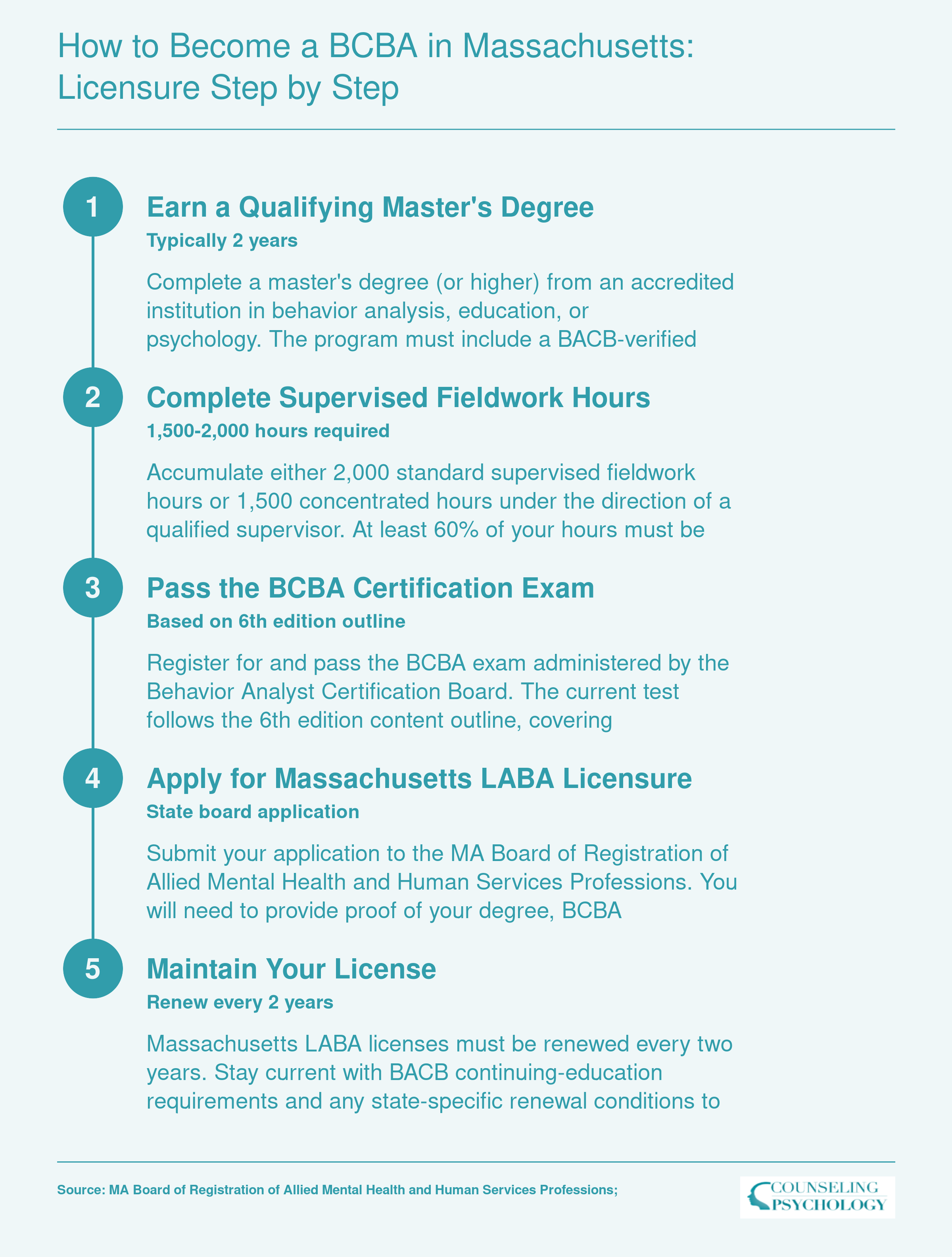
How to Become a BCBA in Massachusetts: Licensure Step by Step
Earning your Licensed Applied Behavior Analyst (LABA) credential in Massachusetts involves a clear sequence of academic, clinical, and regulatory milestones. The Massachusetts Board of Registration of Allied Mental Health and Human Services Professions oversees the process under 262 CMR 10.00. Here is the path from enrollment to licensed practice.
The demand for Board Certified Behavior Analysts continues to surge nationally, with the field projected to grow 28 percent according to 2025 data from the Behavior Analyst Certification Board. This growth rate far outpaces most healthcare occupations, reflecting the expanding recognition of applied behavior analysis in autism services, schools, and clinical settings across Massachusetts and beyond.
ABA Career Outlook and Salaries in Massachusetts
Massachusetts consistently ranks among the higher-paying states for professionals in behavior analysis and related psychology roles. The BLS does not yet publish a dedicated occupational category for Board Certified Behavior Analysts, so the closest proxy categories are shown below. Because many BCBAs are classified under broader psychology or management codes depending on their work setting, reviewing multiple categories gives a more realistic picture of the earning spectrum. Note that these figures reflect Massachusetts statewide data, not national medians.
| Occupation (BLS Category) | Total Employment in MA | 10th Percentile | 25th Percentile | Median | 75th Percentile | 90th Percentile | Annual Mean |
|---|---|---|---|---|---|---|---|
| Psychologists, All Other (19-3039) | 510 | Not reported | $79,680 | $128,180 | $153,300 | Not reported | $123,810 |
| Clinical and Counseling Psychologists (19-3033) | 3,470 | Not reported | $73,670 | $87,060 | $132,840 | Not reported | $102,440 |
| Psychology Teachers, Postsecondary (25-1066) | 1,780 | Not reported | $62,600 | $80,300 | $106,120 | Not reported | $97,240 |
| Managers, All Other (11-9199) | 10,670 | Not reported | $135,060 | $172,380 | $217,880 | Not reported | $185,060 |
Frequently Asked Questions About ABA Programs Near Boston
Choosing the right ABA master's program involves weighing cost, format, accreditation, and career outcomes. Below are answers to the questions prospective students ask most often when exploring programs in and around the Boston metro area.