
Key Takeaways
- Michigan's CADC requires a bachelor's degree plus 270 addiction education hours, while the CAADC demands a master's plus 360 hours.
- Graduate certificates cost significantly less than full master's degrees but cap career advancement at entry and mid level roles.
- Online, hybrid, and on campus formats are all available across Michigan programs, each with distinct practicum logistics.
- The BLS projects roughly 22 percent national job growth for substance abuse counselors through 2032, and Michigan's market reflects similar demand.
Michigan has one of the highest rates of substance use disorder treatment need in the Midwest, yet demand for credentialed addiction counselors continues to outpace supply in both urban centers like Detroit and Grand Rapids and in rural counties with limited behavioral health infrastructure. That gap translates directly into hiring pressure and, for prepared candidates, genuine job security.
This guide focuses on graduate certificate programs in addictions counseling specifically, because that credential tier sits at a meaningful crossroads: accessible enough to complete in under a year for working adults, yet substantive enough to satisfy much of the education-hour requirement Michigan's MCBAP sets for the CADC. Cost, program outcomes, and credential alignment are all examined program by program.
The practical tension here is real. A graduate certificate costs far less than a full master's in addiction counseling and gets most candidates credentialed faster, but it closes off the CAADC and independent clinical licensure unless the student eventually returns for the master's. That ceiling matters, and it matters most before enrollment, not after.
2026 Best Addiction Counseling Programs in Michigan
Michigan offers a small but well-differentiated set of graduate addiction counseling programs, ranging from full master's degrees to targeted certificates that align directly with state credentialing. The programs below were evaluated on institutional outcomes, cost, program depth, and alignment with CADC and CAADC requirements. Whether you are launching a new career or adding an addiction specialty to an existing counseling license, each option serves a distinct student profile.
- Graduate earnings and debt outcomes
- Tuition, net price, and affordability
- Program depth and credit requirements
- Credential and licensure alignment
- Format flexibility and accessibility
- College Scorecard graduate earnings — collegescorecard.ed.gov
- NCES-IPEDS federal institutional data — nces.ed.gov
- Independent program research
- Internal program database

University of Detroit Mercy
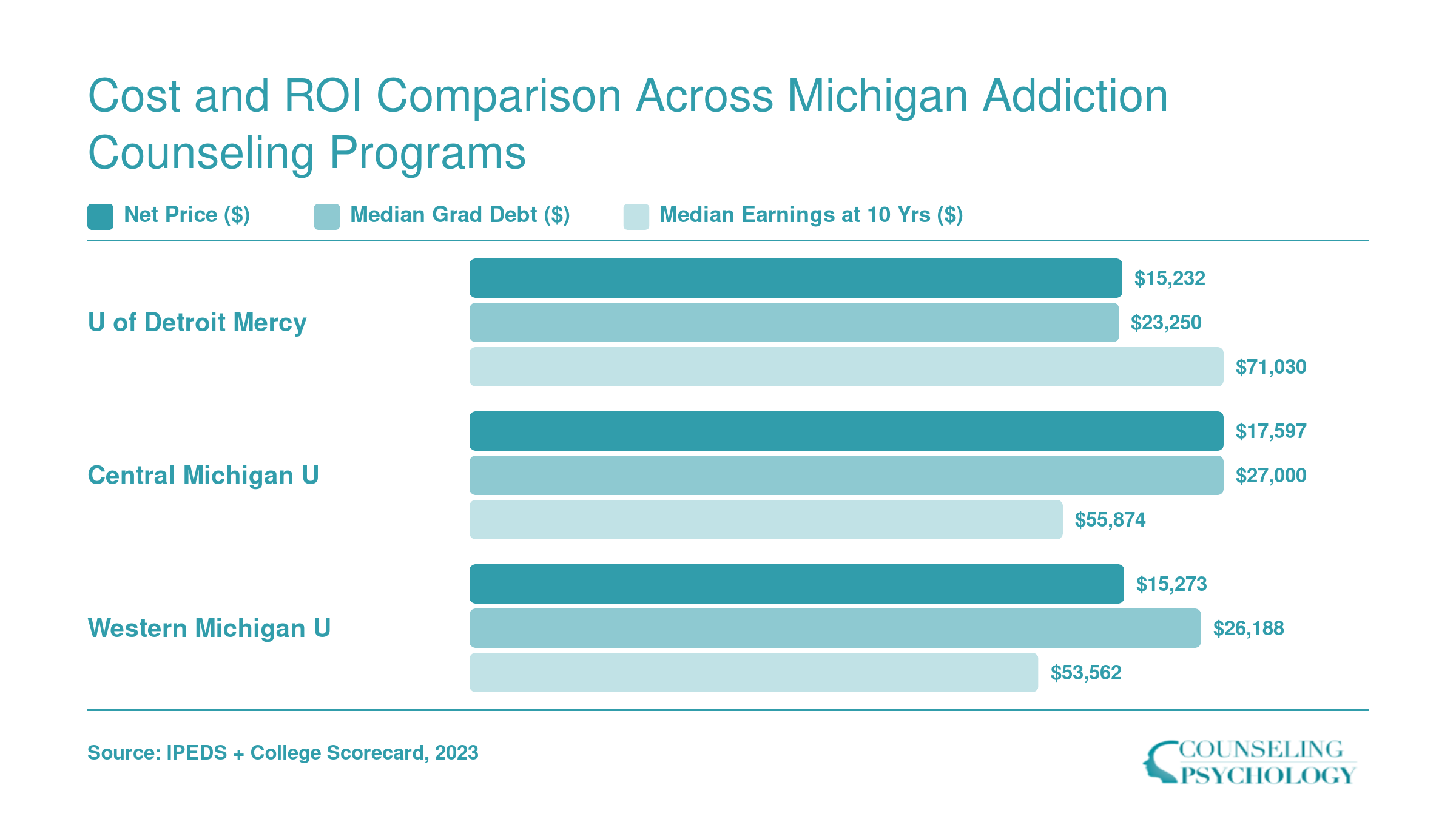
University of Detroit Mercy houses a nationally recognized Master of Arts in Addiction Counseling, one of the most comprehensive programs of its kind in the state. The 60-credit curriculum pairs deep theoretical grounding with clinical training at a no-cost counseling clinic, and the program reports a 100% job placement rate for graduates. With a 12:1 student-to-faculty ratio and all faculty holding terminal degrees, Detroit Mercy delivers an intensive, mentorship-driven experience. The institution-wide graduation rate stands at 67.2%, and the median debt at graduation is $23,250, while institution-wide median earnings ten years after enrollment reach $71,030.
- 60-credit, three-year campus-based program in Detroit
- Reports 100% job placement rate for graduates
- Hands-on training at an on-site no-cost counseling clinic
- 10:1 student-to-faculty ratio within the program
- All faculty hold terminal degrees in the field
- Prepares graduates for professional licensure eligibility
- No entrance exam required for admission
Master of Arts in Addiction Counseling — On-Campus

Western Michigan University
Western Michigan University runs what it describes as the first university-based training clinic in Michigan serving both the criminal justice population and individuals who use substances. WMU's addiction studies unit offers two distinct graduate certificates through a hybrid format that blends online coursework with weekend sessions on the Kalamazoo campus, making it accessible for working adults across the state. The institution-wide graduation rate is 57.6%, the average net price is $15,273, and institution-wide median earnings ten years out are $53,562. Program-level earnings and debt figures are not yet available for these certificates.
- 18-credit hybrid graduate certificate for post-bachelor's students
- Designed to meet Michigan CADC educational requirements
- Covers substance use, co-occurring disorders, cultural humility
- Includes a field practicum or capstone project option
- Financial aid eligible with no entrance exam required
- Weekend classes on the Kalamazoo campus plus online coursework
- 9-credit hybrid program for graduate students or post-master's professionals
- Targets CAADC credentialing requirements in Michigan
- Coursework in substance use, social justice, and addiction services
- Combines online learning with weekend campus sessions
- No entrance exam required for enrollment
- Flexible scheduling suited to career advancement goals
Clinical Addiction Certificate — Hybrid
Addiction Specialization Certificate — Hybrid

Central Michigan University
Central Michigan University offers a CACREP-accredited Master's in Counseling with a dedicated Addiction Counseling concentration, delivered in a hybrid format from its Mount Pleasant campus. The 60-credit curriculum includes mandatory practicums and internships, and students have access to CMU's Center for Community Counseling for supervised clinical hours. Faculty members are licensed counselors, which keeps instruction tightly connected to current practice. The institution-wide graduation rate is 58.7%, the average net price is $17,597, and institution-wide median earnings ten years after enrollment are $55,874. Program-level earnings data is not yet reported for this concentration.
- CACREP-accredited 60-credit hybrid master's program
- Concentration specifically in addiction prevention and care
- Mandatory practicum and internship for hands-on experience
- Access to CMU's Center for Community Counseling
- Faculty are active licensed counselors in the field
- Part-time and full-time study tracks available
- Priority application deadlines apply for admission
Master's in Counseling, Addiction Counseling Concentration — Hybrid
Graduate Certificate vs. Master's Degree in Addiction Counseling
Choosing between a graduate certificate and a master's degree comes down to one practical question: where do you want your career ceiling to be? Both credentials open doors in Michigan's addiction counseling field, but they open different doors at different speeds and costs.
Graduate Certificates: Faster Entry, Focused Scope
A post-bachelor's graduate certificate in addiction counseling typically runs about 18 credits and can be completed in 8 to 12 months.1 That speed is the main draw. If you already hold a bachelor's degree and want to move into direct substance abuse work without a multi-year commitment, this path gets you to the Michigan Certification Board for Addiction Professionals (MCBAP) education requirements for the Certified Alcohol and Drug Counselor (CADC) credential in roughly a year.2
For working professionals making a lateral career move, or for people already employed in human services who want to formalize their addiction-specific training, the graduate certificate fits into a busy life in ways a full master's program often cannot.
There is also a shorter post-master's certificate track, typically around 9 credits and 4 to 8 months, designed for clinicians who already hold a master's degree and want to add addiction specialization.1 That shorter path targets the Certified Advanced Alcohol and Drug Counselor (CAADC) credential rather than the entry-level CADC.
Master's Degrees: Clinical Independence and Longer-Term Upward Mobility
A master's degree in addiction counseling runs approximately 60 credits over 24 to 36 months.3 The longer commitment comes with substantially more career range. A master's degree satisfies the education requirements for the CAADC, which is MCBAP's advanced credential, and it also positions graduates to pursue independent clinical licensure in Michigan (such as the LLPC or LPC pathway).2 That matters if you want to open a private practice, supervise other counselors, or eventually pursue counseling doctoral programs.
The cost difference is real and worth planning around. Certificate programs cost a fraction of a full master's, though tuition varies widely by institution. For a broader look at program options beyond Michigan, you can compare online addiction counseling degrees nationwide.
Which Path Fits Your Situation
- Career-changers and working adults: A post-bachelor's certificate offers a practical, affordable entry point toward CADC certification without derailing your current employment.
- Those targeting clinical independence: A master's degree is the necessary foundation for CAADC eligibility, licensure as a professional counselor, and any supervisory or private-practice role.
- Credentialed clinicians adding a specialty: A post-master's certificate bridges the gap efficiently if you already have graduate training but need structured addiction coursework for CAADC.
Western Michigan University and similar Michigan institutions offer both certificate and master's tracks, so it is worth comparing program structures side by side before committing to either route.
In Michigan, the CADC (Certified Alcohol and Drug Counselor) requires a bachelor's degree plus 270 hours of addiction-specific education, while the CAADC (Certified Advanced Alcohol and Drug Counselor) requires a master's degree plus 360 hours. This single distinction often determines whether a graduate certificate suffices or a full master's program is the better fit for your career goals.
How Michigan Programs Align with CADC and CAADC Requirements
How do you know whether a Michigan addiction counseling program will satisfy the education hours required for state certification? The answer lies in understanding how the Michigan Certification Board for Addiction Professionals (MCBAP) structures its two primary credentials and how each program's degree level translates into education-hour reductions.
MCBAP Education Hour Requirements by Degree Level
MCBAP awards two distinct credentials: the Certified Alcohol and Drug Counselor (CADC) and the Certified Advanced Alcohol and Drug Counselor (CAADC).1 Both require education hours distributed across the twelve International Certification & Reciprocity Consortium (IC&RC) domains, with a minimum of 10 hours per domain.
For the CADC, total required education hours depend on your prior degree. Candidates with a high school diploma or GED need 300 hours; an associate's degree reduces that to 250 hours; a bachelor's brings it down to 200 hours; and a master's degree requires only 100 hours.1 All CADC pathways also demand 6,000 hours of supervised work experience and passage of the IC&RC Alcohol and Drug Counselor exam.
The CAADC, by contrast, requires a master's degree or higher in an MCBAP-approved discipline (such as counseling, social work, or psychology). CAADC candidates must complete 186 total education hours in addiction-specific content, including at least 10 hours per IC&RC domain, plus 6 hours of ethics.2 The supervised experience requirement is 2,000 hours, and candidates must pass the IC&RC Advanced Alcohol and Drug Counselor exam.1 For a broader look at the profession and how these credentials fit into career development, see our guide on how to become a substance abuse counselor.
Mapping Ranked Programs to Credential Pathways
University of Detroit Mercy's Master of Arts in Addiction Counseling is a 60-credit master's program that directly supports the CAADC pathway. As a master's-level program, graduates will meet the degree requirement for the CAADC and benefit from the lower 100-hour education minimum for domain-specific training embedded in the curriculum. The program is designed to prepare clinicians for professional licensure and certification in Michigan.
Central Michigan University's Master's in Counseling with an Addiction Counseling concentration is also a 60-credit master's program. CACREP-accredited and offering hybrid delivery, it aligns with the CAADC pathway for graduates holding a master's degree in a qualifying discipline. The addiction-focused curriculum, combined with required practicum and internship hours, positions students to accumulate supervised experience while completing their degree.
Western Michigan University offers two certificate programs. The 18-credit Clinical Addiction Certificate is a post-bachelor's graduate certificate explicitly marketed as meeting Michigan's educational requirements for CADC credentialing. It includes field practicum or capstone options and is financial-aid eligible. The 9-credit Addiction Specialization Certificate targets dual-enrolled graduate students or post-master's professionals pursuing CAADC credentialing. Both certificates are hybrid, blending online coursework with weekend sessions in Kalamazoo.
MCBAP Approved Education Providers and Additional Options
MCBAP maintains a roster of approved education providers, but as of 2026 the board has not published a comprehensive public list accessible for verification. Students should confirm directly with MCBAP whether their chosen program appears on any current approved-provider roster or whether courses are pre-approved for domain credit.
Beyond the ranked programs, prospective students should be aware that Western Michigan University's Clinical Addiction Certificate and the University of Detroit Mercy addiction specialization are mentioned in the field, though their current active status and MCBAP approval could not be independently verified from MCBAP sources as of this writing.1 Contacting the universities directly and checking with MCBAP ensures you receive up-to-date information on program approval and credentialing alignment.
Renewal and Ongoing Requirements
Once certified, CADC holders must complete 40 continuing education hours per renewal cycle, while CAADC holders must complete 60 hours.3 Keeping track of these requirements from the outset helps you select a program that not only meets initial credential standards but also connects you to ongoing professional development resources.
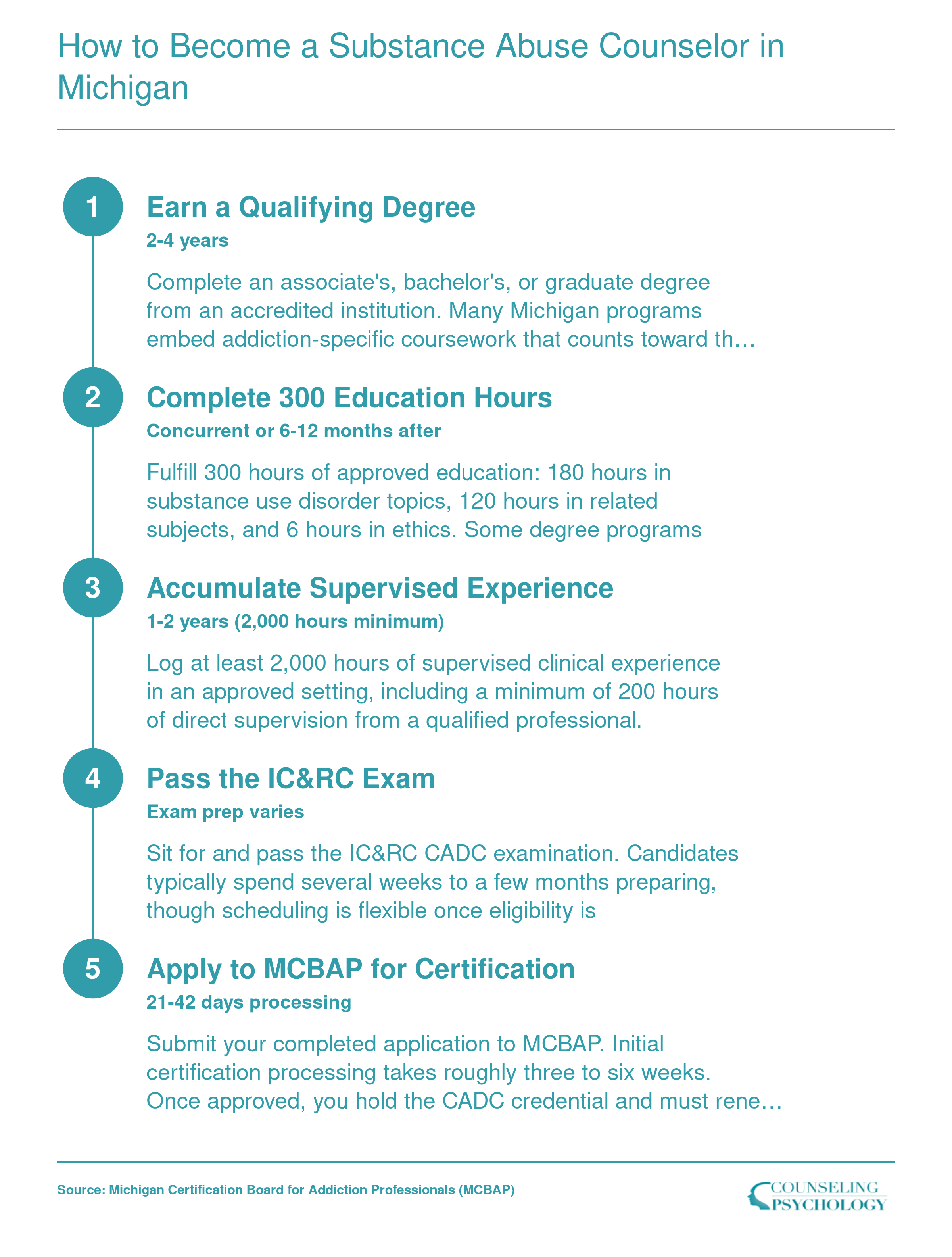
How to Become a Substance Abuse Counselor in Michigan
Earning your CADC credential in Michigan follows a structured path overseen by the Michigan Certification Board for Addiction Professionals (MCBAP). Most candidates complete the full process in roughly three to six years, depending on whether they pursue education full-time and how quickly they accumulate supervised hours.
Cost and ROI Comparison Across Michigan Addiction Counseling Programs
Understanding what you will actually pay, how much debt you may carry, and what graduates earn long-term helps you weigh the true return on your investment. The comparison below uses institution-level net price, median graduate debt, and median earnings ten years after enrollment. Program-level earnings data for these addiction counseling programs are not yet available, so the figures reflect each university's overall graduate outcomes.
Online, Hybrid, and On-Campus Format Options in Michigan
Program format refers to how and where you take your classes: fully online (all coursework delivered through a learning management system), hybrid (a mix of online lessons with periodic in-person or weekend sessions), or on-campus (classes meet at a physical location on a set schedule). Among the ranked Michigan programs, you'll find all three models represented.
Format Breakdown of Ranked Michigan Programs
- University of Detroit Mercy (Master of Arts in Addiction Counseling): Campus-based, three-year, 60-credit program in Detroit. Best suited to students who can commit to in-person attendance and who want to take advantage of training at the school's no-cost counseling clinic.
- Western Michigan University (Clinical Addiction Certificate): Hybrid 18-credit certificate combining online coursework with weekend classes in Kalamazoo.1 Explicitly designed for adult learners and post-bachelor's professionals working toward CADC credentialing.
- Central Michigan University (Master's in Counseling, Addiction Counseling concentration): CACREP-accredited 60-credit hybrid program blending online coursework with on-campus sessions in Mount Pleasant. Offers part-time and full-time study tracks.
What Online and Hybrid Formats Actually Get You
If you're working full-time or shifting careers, hybrid and online-heavy programs make it possible to keep a paycheck while you study. Asynchronous coursework lets you do readings and assignments around your shift schedule, and weekend intensives (as WMU and CMU use) concentrate face-to-face contact into manageable blocks. Students who eventually want to pursue advanced credentials may also consider online LPCC programs to build on their foundation.
One thing the format doesn't change: practicum and fieldwork are in-person. Michigan addiction counseling graduate certificates that lead to CADC or CAADC eligibility require supervised clinical hours in a licensed substance use disorder program, no matter how the coursework is delivered.2 Expect to arrange a local placement and complete hours on-site.
Career-Changer Admission Tips
If you're coming from a non-counseling background, lean into what you do bring. Relevant work experience in peer recovery roles, social services, healthcare, or education often strengthens an application. Several programs accept students from varied undergraduate majors, and some offer bridge or foundation coursework to fill prerequisite gaps. Contact admissions directly to ask about prerequisite flexibility and whether prior coursework or professional certifications can be applied toward requirements.
Questions to Ask Yourself
Michigan Addiction Counseling Job Market and Salary Outlook
Entry-level positions at community nonprofits and senior roles within large health systems represent two very different salary realities for addiction counselors in Michigan, yet both ends of the spectrum reflect a labor market that is actively expanding.
What Michigan Counselors Earn
According to BLS data for 2024, substance abuse, behavioral disorder, and mental health counselors in Michigan earned a mean annual wage of roughly $59,530.1 Workers at the 10th percentile (often those new to the field or in lower-cost rural settings) brought in about $37,200, while those at the 90th percentile earned approximately $89,170.1 That upper range typically corresponds to supervisory roles, specialized certifications such as the CAADC, or positions within hospital systems and corrections.
For geographic context, the most recent national median for the same occupational group was $53,710.2 Michigan's mean wage sits above that national median figure, though direct year-to-year comparisons should be made cautiously because the national and state data reflect slightly different reporting periods. The state's 90th-percentile wage of $89,170 also outpaces the national 90th percentile of $82,710, suggesting that experienced counselors in Michigan can command a meaningful premium. For a broader look at compensation across specialties and education levels, see our counselor salary breakdown.
Demand Drivers in Michigan
Nationally, BLS projects 17 percent employment growth for this occupation group from 2024 to 2034, translating to roughly 81,000 new positions and about 48,300 annual openings when retirements and turnover are factored in.3 Michigan's demand is likely to track at or above that pace. The state has been one of the hardest hit by the opioid crisis, and ongoing state behavioral health funding initiatives, including Medicaid expansion and targeted opioid response grants, continue to fuel hiring.
Where Michigan Counselors Work
The employer landscape in Michigan is diverse, and understanding it helps you target your job search effectively:
- Community mental health centers: These are among the largest employers statewide, particularly outside metro Detroit and Grand Rapids.
- Health systems: Organizations like Corewell Health, Henry Ford Health, and the University of Michigan Health network hire addiction counselors into integrated care teams.
- Corrections and criminal justice: The Michigan Department of Corrections and county-level diversion programs employ counselors focused on substance use treatment within the justice system.
- Nonprofit treatment facilities: Residential and outpatient providers such as Dawn Farm, Sacred Heart Rehabilitation Center, and similar organizations offer clinical roles that often satisfy supervised-experience requirements for CADC or CAADC credentialing.
If you are evaluating programs partly on career return, weigh these salary benchmarks against tuition costs. The cost and ROI comparison elsewhere in this article can help you run those numbers side by side.
Frequently Asked Questions
Prospective addiction counselors in Michigan tend to ask similar questions about credentials, therapies, and career prospects. Below are clear, practical answers grounded in current regulatory and labor market realities.