What you’ll learn in this article…
- North Carolina has four APA-accredited doctoral clinical psychology programs, each with distinct training models and specialization options.
- In-state doctoral tuition at UNC-system schools generally stays below $9,000 per year, making funded seats especially competitive.
- The EPPP and a supervised postdoctoral year are required before earning full licensure as a clinical psychologist in North Carolina.
- BLS projects roughly 6 percent national growth for psychologists through 2034, keeping job prospects steady for NC graduates.
Four APA-accredited doctoral programs in clinical psychology operate in North Carolina, offering both PhD and PsyD degrees, while several CACREP-accredited master's programs prepare clinical mental health counselors. Doctoral cohorts are small, with some programs admitting as few as six to eight students each year. For in-state students at public universities, annual tuition often stays under $9,000, and competitive programs may include full tuition waivers or stipends up to $20,000. The financial calculus shifts sharply if you pursue a PsyD or master's at a private college, where debt loads can exceed expected early-career salaries. The gap between program cost and long-term earning potential remains the central variable in choosing a North Carolina clinical psychology path.
Best Clinical Psychology Programs in North Carolina for 2026
North Carolina offers a surprisingly diverse landscape of clinical psychology graduate programs, spanning APA-accredited doctoral degrees at public universities to fully online master's programs at smaller private colleges. Tuition for in-state doctoral students at UNC-system schools generally falls below $9,000 per year before fees, while private institutions range from roughly $11,800 to nearly $48,000. Program-level earnings data are not yet available for most of these programs, so we encourage applicants to weigh factors like accreditation status, funding packages, practicum depth, and alignment with NC licensure requirements when comparing options.
- Accreditation and licensure alignment
- Clinical training depth and practicum quality
- Funding and net cost
- Graduate outcomes and career placement
- Faculty mentoring and cohort size
- Independent program research
- Internal program database
- NCES-IPEDS federal institutional data — nces.ed.gov
- College Scorecard graduate earnings — collegescorecard.ed.gov

Appalachian State University
Appalachian State University built its Psy.D. program from the ground up to address behavioral health workforce shortages across rural Western North Carolina and the broader Appalachian region. With cohorts of just six to eight students, an APA-accredited curriculum, and a three-year supervised practicum rooted in community mental health centers, FQHCs, and school-based clinics serving underserved NC counties, the program produces practice-ready clinicians with unusually deep rural training. Graduate stipends help offset costs, and the on-campus Psychology Clinic doubles as a low-cost mental health resource for Boone-area residents. Schools offering this program report an institution-wide graduation rate of 74.5%.
- APA-accredited program with rural and underserved population focus
- Cohort size of 6 to 8 students admitted each year
- Three-year supervised practicum across Western NC sites
- Graduate stipend available to offset tuition costs
- Individual faculty mentoring from 9 core faculty members
- Evidence-based practice training with practitioner-scholar model
- On-campus Psychology Clinic serves local community
- Prepares graduates for North Carolina psychologist licensure
Doctor of Psychology (Psy.D.) in Clinical Psychology — On-Campus

University of North Carolina at Charlotte
UNC Charlotte's APA-accredited Ph.D. in Clinical Health Psychology trains scientist-practitioners through a biopsychosocial lens, with deep ties to Charlotte's major hospital networks including Atrium Health and Novant Health. Students tackle health disparities prevalent across North Carolina, from chronic illness to cardiovascular disease, through diverse clinical practicums embedded in the state's largest metro area. The program reports a 100% internship match rate, and many graduates take positions within NC hospitals and academic medical centers. The school's institution-wide graduation rate stands at 69%.
- APA-accredited scientist-practitioner training model
- 100% internship match rate reported by the program
- Practicum sites across Charlotte-area hospital systems
- Interdisciplinary focus on health disparities in NC populations
- 94 total credit hours with five-year training sequence
- Diverse research areas including behavioral medicine
- Prepares graduates for NC clinical psychologist licensure
Ph.D. in Clinical Health Psychology — On-Campus

University of North Carolina at Greensboro
UNC Greensboro's APA-accredited Ph.D. in Clinical Psychology is one of the strongest funded options in the state, offering full tuition waivers and competitive stipends that dramatically reduce the financial burden of doctoral training. The five-year scientist-practitioner program places students across Piedmont Triad community clinics, public schools, and medical centers, with an emphasis on culturally competent care for diverse NC populations. Over a third of graduates work in hospitals and medical centers, while another third enter community mental health or private practice. The institution-wide graduation rate is 56.3%.
- APA-accredited with full tuition waiver available
- No GRE score required for admission
- Scientist-practitioner model over five years plus internship
- Running Start summer research program for incoming students
- Community-engaged clinical work across Guilford County
- DREAM Camp experience serving local NC youth
- Diverse career placement in hospitals, clinics, and academia
- Strong emphasis on culturally responsive practice in NC
Ph.D. in Clinical Psychology — On-Campus

University of North Carolina Wilmington
UNCW's Ph.D. in General Clinical Psychology offers rigorous scientist-practitioner training in a coastal setting, with practicum sites that span community mental health, VA clinics, forensic settings, and regional hospitals across Southeastern North Carolina. Proximity to military installations like Camp Lejeune gives students exposure to military-connected populations, a growing need in the state. The 94-credit program emphasizes empirically supported interventions and leads to NC psychologist licensure eligibility. Schools offering this program have an institution-wide graduation rate of 70.6% and one of the highest retention rates on this list at 88%.
- APA-accredited scientist-practitioner doctoral program
- 94 total credit hours across a five-year sequence
- Clinical training in coastal and military-connected NC communities
- Practicum placements in hospitals, VA, and forensic settings
- Emphasis on empirically supported clinical interventions
- Prepares graduates for North Carolina psychologist licensure
- Advanced research and dissertation requirements
- Strong retention rate of 88% at the institutional level
Ph.D. in General Clinical Psychology — On-Campus

Western Carolina University
Western Carolina University stands out for offering both a Psy.D. and an M.A. in clinical psychology, giving students a rare choice of entry points at the same mountain campus. The APA-accredited Psy.D. in Health Service Psychology combines clinical and school psychology competencies, and its practicum network reaches across Jackson, Swain, and Macon counties. Students receive $20,000 annually in teaching assistantship support, and the GRE is waived for applicants with a 3.7 or higher GPA. The M.A. feeds directly into doctoral pipelines within the UNC system. The institution-wide graduation rate is 60.3%.
- APA-accredited combined clinical-school concentration
- Three-year full-time campus program
- $20,000 per year financial support via teaching assistantship
- GRE not required for applicants with 3.7+ GPA
- McKee Psychological Services Center for in-house training
- Rural and underserved population service emphasis
- Meets North Carolina psychologist licensure requirements
- 50 semester-hour campus-based program
- Cognitive-behavioral interventions focus in coursework
- Practicum placements across Western NC agencies
- Research project required for completion
- Serves as feeder to NC doctoral programs
- Adult-focused psychological assessment training
Doctor of Psychology (Psy.D.) in Health Service Psychology — On-Campus
Master of Arts in Psychology, Clinical Concentration — On-Campus

North Carolina A & T State University
North Carolina A&T State University offers a 60-credit, CACREP-accredited master's in Mental Health Counseling with a clinical concentration, one of the most affordable graduate clinical training options in the state with in-state tuition around $8,368. As an HBCU, the program centers cultural competence and community-focused practice, preparing graduates for NC Licensed Clinical Mental Health Counselor (LCMHC) licensure. Field placements frequently involve Guilford County agencies that serve racially diverse and underserved populations. The institution-wide graduation rate is 57.2%.
- CACREP-accredited 60-credit-hour clinical program
- Aligned with NC LCMHC licensure requirements
- Specialized coursework in trauma theory and addiction counseling
- Family counseling focus within the clinical track
- Emphasizes cultural competence for diverse NC communities
- Field placements in Guilford County and surrounding areas
- Fall admission only with competitive selection
- Affordable in-state tuition at an HBCU institution
Mental Health Counseling, Clinical Concentration (M.S.) — On-Campus

North Carolina Central University
North Carolina Central University's M.A. in Psychology with a clinical concentration is designed to prepare students for licensure-eligible roles as psychological associates in North Carolina or as competitive doctoral applicants. Located in Durham's Research Triangle, NCCU draws on its HBCU mission to train clinicians who can address mental health disparities in NC communities of color. The thesis-required program takes two to three years, and placements are often secured through Triangle-area agencies and health organizations. The institution-wide graduation rate is 41.7%.
- Prepares for NC psychological associate licensure pathway
- Thesis requirement builds strong research competencies
- No GRE required for admission
- Two to three year completion timeline
- Fall admission only with focused cohort model
- Practicum opportunities across Durham and the Triangle
- Culturally responsive clinical training at an HBCU
- Pipeline to NC doctoral programs and applied positions
Psychology, Clinical Concentration (M.A.) — On-Campus

University of Mount Olive
The University of Mount Olive offers a 100% online Master of Science in Counseling with a Clinical Mental Health Counseling concentration, making it one of the most accessible options for working professionals across North Carolina who cannot relocate for graduate school. CACREP-accredited and completable in two years, the program requires no GRE and no prior psychology background. Students arrange practicum and internship placements in their own NC communities, and coursework is aligned with North Carolina LCMHC licensure requirements. The institution-wide graduation rate is 51.8%.
- CACREP-accredited and 100% online format
- No GRE or psychology background required for admission
- 60-credit program completable in two years
- Practicum arranged in students' home NC communities
- Field-experienced instructors with small class sizes
- Aligned with North Carolina LCMHC licensure standards
- Flexible scheduling for working adults
Master of Science in Counseling: Clinical Mental Health Counseling — Online

Montreat College
Montreat College's CACREP-accredited M.A. in Clinical Mental Health Counseling blends online coursework with two required face-to-face residencies, offering a faith-integrated approach to counselor training rooted in this small Christian college's mountain setting. The 60-credit program reports 100% pass rates on the Counselor Preparation Comprehensive Examination, a strong indicator of licensure readiness. Practicum sites are commonly arranged at NC agencies, hospitals, and church-based counseling centers. Schools offering this program have an institution-wide graduation rate of 50.3%, and the intimate 11:1 student-faculty ratio supports close mentoring.
- CACREP-accredited 60-credit online program
- Two required in-person residency experiences
- 100% CPCE pass rates reported
- No GRE required for admission
- NC LCMHC licensure preparation included
- Faith-integrated counseling curriculum
- Multiple financial aid options available
- 11:1 student-faculty ratio for close mentoring
Master of Arts in Clinical Mental Health Counseling — Online

Methodist University
Methodist University's fully online M.S. in Clinical Mental Health Counseling is built for accessibility, charging $545 per credit hour with no GRE requirement and accepting bachelor's degrees from any discipline. Located in Fayetteville near Fort Liberty, the program is well positioned for military-connected students and working adults across North Carolina. Two required internships ensure hands-on clinical experience, and coursework maps to NC LCMHC licensure content domains. The 11:1 student-faculty ratio keeps class interactions personal despite the online format. The institution-wide graduation rate is 43.5%.
- 100% online format with 60 credit hours
- $545 per credit hour with no GRE required
- Accepts bachelor's degrees from any discipline
- Two required internships at NC clinical sites
- Aligned with CACREP standards for licensure preparation
- Completable in approximately two years
- 11:1 student-faculty ratio for personalized support
- Strong fit for military-affiliated students near Fort Liberty
Master of Science in Clinical Mental Health Counseling — Online
How We Ranked These Clinical Psychology Programs
Choosing where to invest five to seven years of doctoral training means weighing program quality against financial reality, and those two priorities rarely point in the same direction.
The rankings on this page are built from quantifiable data rather than reputation surveys, so you can see exactly what each number reflects. If you are still exploring program options nationally, our overview of clinical psychology doctorate programs provides broader context before you narrow your search to North Carolina.
What the Model Measures
Four core dimensions drive the scoring:
- Tuition affordability: We account for both in-state and out-of-state rates, adjusted by degree level. A funded PhD program and a self-pay PsyD carry very different price tags, and the model treats them accordingly.
- Post-completion earnings: Where the U.S. Department of Education's College Scorecard publishes program-level salary data, we use it. This gives a more targeted picture than institution-wide averages, though not every program has reportable figures yet.
- Graduation rates: These come from IPEDS and reflect institution-wide completion, not the clinical psychology program alone. It is the best standardized proxy available, but keep in mind that a university's overall rate may differ from its doctoral program's retention.
- Debt outcomes: Program-level borrowing data from the College Scorecard rounds out the financial picture, capturing what graduates actually owe rather than just what tuition sticker prices suggest.
Where APA Accreditation Fits
APA accreditation status is flagged for every program in the list because it directly affects licensure eligibility in North Carolina and most other states. That said, accreditation was verified separately and is not baked into the quantitative scoring formula. A program that holds APA accreditation did not receive bonus points for it; it simply meets a threshold that, for most readers, is non-negotiable.
Sorting to Match Your Priorities
No single ranking order works for everyone. A student with full funding cares less about tuition and more about earnings trajectory, while a career-changer financing a PsyD with loans needs to scrutinize debt-to-income ratios. The table lets you re-sort by cost, median early-career earnings, or overall return on investment so the list reshuffles around whatever matters most to you. Treat the default order as a starting point, not a verdict.
APA-Accredited Clinical Psychology Programs in North Carolina
Which clinical psychology programs in North Carolina hold APA accreditation, and why does it matter for your career? North Carolina currently offers four APA-accredited doctoral clinical psychology programs, each with distinct features and accreditation timelines that shape your training pathway and professional opportunities.1
Current APA-Accredited Programs in NC
As of 2026, the American Psychological Association Commission on Accreditation recognizes four doctoral programs in North Carolina:
- University of North Carolina at Chapel Hill Clinical Psychology PhD: Full accreditation. The flagship program offers a traditional scientist-practitioner PhD with a long-standing reputation and full accreditation status.1
- UNC Charlotte Clinical Health Psychology PhD: Full accreditation since 2012. This program emphasizes health psychology applications within a clinical framework, blending behavioral medicine and traditional clinical training.2
- East Carolina University Health Psychology PhD (Clinical Health Concentration): Full accreditation. ECU's program focuses specifically on the intersection of clinical practice and health psychology, preparing graduates for integrated healthcare settings.3
- Appalachian State University Clinical Psychology PsyD: Accredited on contingency as of 2024. This newly accredited program achieved initial accreditation in 2024 but carries a contingent status, meaning it must meet specific benchmarks to achieve full accreditation.4
Why APA Accreditation Matters
APA accreditation is not optional if you plan to practice independently as a clinical psychologist. The designation directly impacts three critical career milestones:
- Internship eligibility: Most APA-accredited internships require applicants to come from APA-accredited doctoral programs. Non-accredited programs severely limit your match options during the APPIC process.
- Licensure requirements: While North Carolina's psychology board does not mandate APA accreditation for licensure, many states do. If you plan to pursue licensure in multiple states or relocate after graduation, non-accredited training can disqualify you from licensure in states with stricter requirements.
- Federal employment: Federal positions in the Veterans Health Administration, military hospitals, and other government settings require APA-accredited training for clinical psychologist roles.
Understanding Contingent Accreditation
Appalachian State's contingent status reflects the program's recent accreditation.4 Contingent accreditation is not probationary or punitive; it is a standard first stage for newly accredited programs. The program must demonstrate compliance with APA standards over time to transition to full accreditation. Students in contingent programs remain eligible for APA-accredited internships and most licensure pathways, but applicants should verify the program's current status before applying, as timelines for achieving full accreditation vary.
Questions to Ask Yourself
PhD vs. PsyD vs. Master's: Choosing the Right Clinical Psychology Degree
Three degree paths exist in clinical psychology, and choosing among them shapes nearly every practical detail of your career: how long you train, how much you spend, what you can legally do after graduation, and where you can work. Understanding the full landscape of degrees in psychology is a useful starting point before narrowing your focus.
The Doctoral Degrees: PhD and PsyD
Both the PhD and the PsyD lead to independent licensure as a clinical psychologist in North Carolina. That distinction matters enormously. Only doctoral-level practitioners can obtain full independent licensure through the NC Psychology Board; master's-level graduates follow a different, more limited pathway (more on that below).
The differences between the two doctoral degrees come down to emphasis and economics:12
- Training focus: PhD programs are research-intensive, training graduates for academic positions, research careers, and clinical practice. PsyD programs concentrate on clinical practice and are designed for students whose primary goal is direct patient care.
- Duration: PhD programs typically run five to seven years; PsyD programs generally take four to six years.
- Funding: Full funding through tuition waivers and stipends is standard in PhD programs, making the out-of-pocket cost far lower despite the longer timeline. Full funding in PsyD programs is uncommon, and students often finance a substantial portion of their education independently.
- Admission: PhD programs admit roughly five to ten percent of applicants, reflecting the intensity of their research training requirements. PsyD programs admit closer to forty percent, making them more accessible for qualified applicants who are not pursuing a research career.
- Career outcomes: PhD graduates move into academic faculty roles, research positions, and clinical practice. PsyD graduates concentrate overwhelmingly in clinical and applied settings.
Neither degree is inherently superior. The right choice depends on whether you want to generate research or deliver care, and on how much debt you are willing to carry into your career.
The Master's Path: LPA Status in North Carolina
A master's degree in psychology (MA or MS) does not lead to licensure as a psychologist in North Carolina, but it is not a dead end. The NC Psychology Board offers the Licensed Psychological Associate (LPA) credential for qualified master's-level practitioners. LPAs can provide psychological services under defined conditions, often within supervision arrangements or in settings where independent doctoral-level oversight is available.
This distinction is frequently overlooked. A master's degree can represent a meaningful credential and a real clinical career in NC, particularly for practitioners who want to enter the field more quickly or at lower cost than a doctoral program requires. It is, however, a different license with different scope than the full Licensed Psychologist credential.
Matching the Degree to Your Goals
A few questions help clarify the decision:
- Do you want to conduct research or teach at the university level? The PhD is the standard entry point.
- Is direct patient care your primary goal, and are you willing to fund your own training? A PsyD may get you to practice more directly.
- Do you want to enter clinical work sooner, with a shorter training period and lower total cost, accepting a more limited scope of practice? A master's degree with LPA licensure is a legitimate option NC offers that many neighboring states do not.
Cost and funding availability make a real difference over a career. A PhD stipend over six years versus six years of PsyD loans produces a financial gap that compounds well past graduation.
Cost, Funding, and ROI of NC Clinical Psychology Programs
What will a North Carolina clinical psychology degree actually cost you, and what can you realistically earn after licensure? The honest answer depends on the degree type, your funding package, and where in the state you practice.
Tuition Ranges and How to Read Them
Published tuition on program websites is a starting point, not a final number. For doctoral programs in NC, in-state PhD students at public universities (UNC Chapel Hill, NC State, UNC Greensboro, ECU) generally pay markedly less per credit than out-of-state students, while private PsyD programs tend to carry the highest sticker price. Masters in counseling programs in North Carolina fall in between on the cost spectrum.
When you compare programs, pull these numbers directly from the graduate school's tuition page and the department's funding page side by side. The sticker tuition matters far less than the net cost after assistantships.
Funding That Actually Offsets the Bill
Fully funded PhD programs typically cover tuition and provide a stipend in exchange for teaching or research work. Look specifically for:
- Graduate assistantships: Research or teaching positions that waive tuition and pay a stipend, common in PhD tracks.
- Fellowships: Merit or diversity awards that supplement or replace assistantship pay.
- Internship stipends: The APA-accredited internship year (required for licensure-track doctorates) is paid, though amounts vary widely.
- Practicum and externship pay: Less common, but some advanced clinical placements offer modest compensation.
PsyD and master's students should ask directly about partial tuition remission, departmental scholarships, and whether clinical placements are paid or unpaid.
Calculating ROI
The Bureau of Labor Statistics reports a national median wage of $96,100 for clinical and counseling psychologists (SOC 19-3033, May 2023), with the middle range running roughly $48,820 to $168,870.1 North Carolina state-level wages for this occupation are published in the BLS OEWS state tables but were not included in the data snippet here, so check the current NC figure directly on bls.gov before modeling your numbers. For a rough ROI calculation, divide your expected total debt by the gap between your projected NC salary and what you would earn without the degree, then factor in the five to seven years a doctorate typically requires.
Geography Inside the State
Raleigh, Charlotte, and Durham concentrate the highest-paying clinical positions in NC, but rent and overall cost of living in those metros runs well above rural counties in the western mountains or eastern coastal plain. The BLS metro area wage tables let you see local medians directly. The NC Psychological Association also publishes periodic member salary information that captures private-practice income, which OEWS tends to understate.
How to Become a Clinical Psychologist in North Carolina
Doctoral-level licensure versus master's-level practice: these are two distinct routes into clinical psychology work in North Carolina, and the requirements, scope of practice, and career ceiling differ considerably. Understanding each pathway before you enroll can save years of misaligned effort. For a broader look at the profession, our guide on how to become a clinical psychologist covers the national landscape.
The Licensed Psychologist (LP) Pathway
North Carolina's Psychology Board requires the following sequence to earn the Licensed Psychologist credential:1
- Earn a doctoral degree. Complete a PhD, PsyD, or EdD in psychology from a program accredited by the APA or CPA. The program must include at least 60 semester hours of graduate coursework and span a minimum of three academic years in residence.
- Complete a predoctoral internship. Your internship counts toward the state's supervised experience total, up to a maximum of 1,500 hours. APA-accredited or APPIC-listed internships are the standard expectation.
- Accrue postdoctoral supervised hours. After graduation, you need at least 1,500 hours of postdoctoral supervised practice. Combined with the predoctoral internship, the state requires a minimum of 3,000 total supervised hours across both phases. Supervision must include at least two hours per week of individual oversight, and at least 25% of your time should involve direct client service. A formal supervision contract is required.
- Pass the EPPP. The Examination for Professional Practice in Psychology requires a scaled score of 500 or higher. If you do not pass, you can retake it after a 60-day waiting period, with up to four attempts allowed in any 12-month window.
- Pass the jurisprudence exam. North Carolina also requires a separate exam covering state laws and professional ethics. You need a score of at least 78% to pass.
- Apply to the NC Psychology Board. Submit your application along with the $100 application fee, a $38 background check fee, the $200 jurisprudence exam fee, and a $50 EPPP administrative fee.
The Licensed Psychological Associate (LPA) Alternative
Master's-level graduates who are not pursuing a doctorate still have a path into clinical work. The Licensed Psychological Associate credential requires a master's degree in psychology with at least 45 semester hours of graduate coursework and 500 hours of supervised experience completed during the program.1 LPA candidates must pass the EPPP at a lower threshold (a scaled score of 440) and also pass the same jurisprudence exam at 78%.
The key distinction: LPAs must practice under the ongoing supervision of a Licensed Psychologist even after obtaining their license. This means your scope of practice and professional autonomy will always be more limited than a doctoral-level LP. For students who want independent practice, the doctoral route remains essential.
Timeline Expectations
Most candidates spend four to seven years in a doctoral program (including the predoctoral internship year), followed by one to two years of postdoctoral supervised practice. From the day you begin a doctoral program, reaching full LP licensure in North Carolina typically takes six to nine years. The general steps involved in becoming a psychologist mirror this progression in most states, though specific requirements vary. The LPA path is shorter, generally two to three years of graduate study plus the supervised hours, but the tradeoff in autonomy is significant.
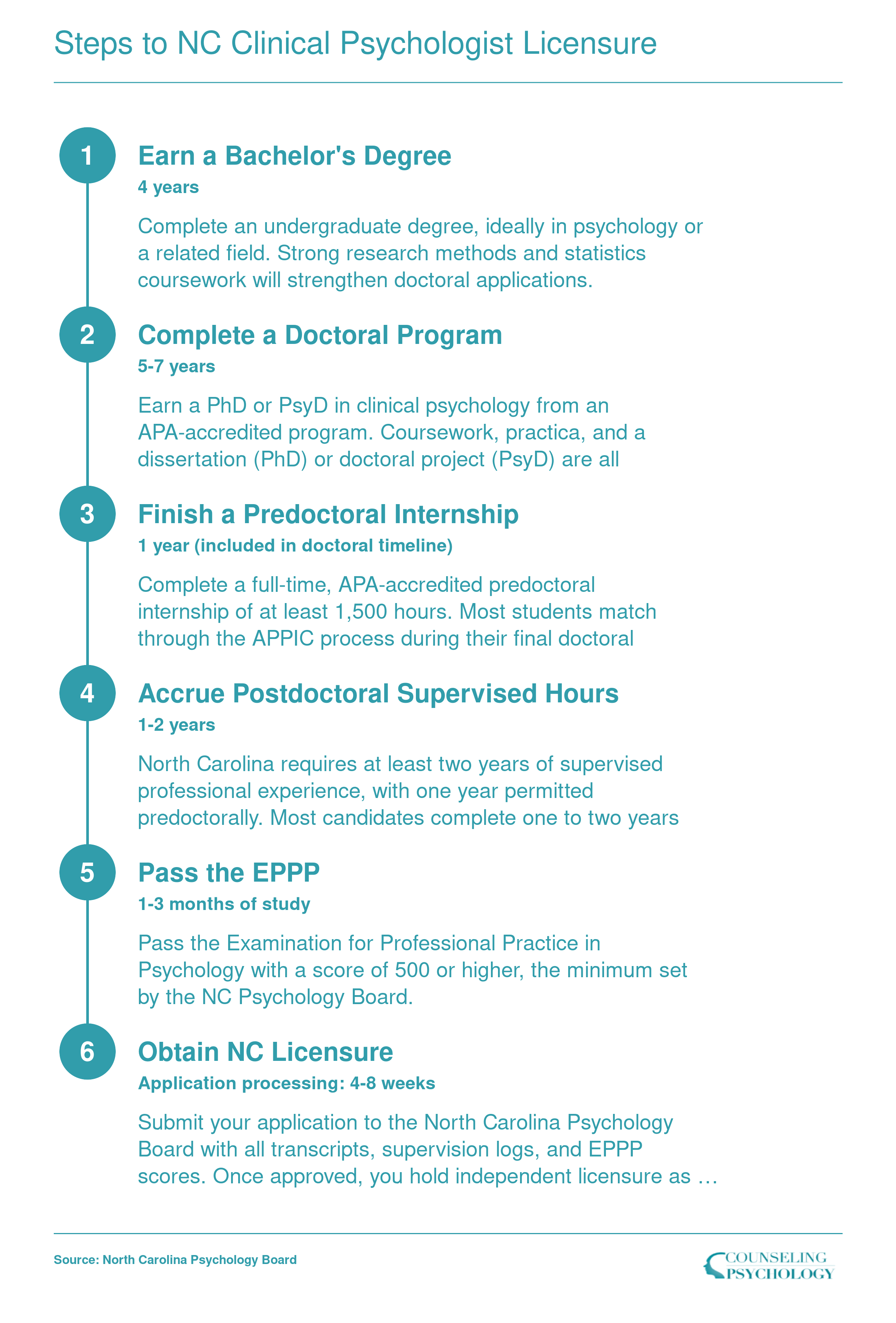
Steps to NC Clinical Psychologist Licensure
Becoming a licensed clinical psychologist in North Carolina is a multi-year commitment that moves through distinct academic, training, and examination stages. Here is the typical sequence and approximate timeline for each step.
EPPP Pass Rates and Internship Match Rates at NC Programs
Choosing a doctoral program means weighing the academic experience against the practical outcome metrics that will shape your career: EPPP pass rates and internship match rates. These numbers reveal how well a program prepares students for licensure and for securing accredited clinical placements, two hurdles that directly affect your ability to practice.
Understanding the EPPP
The Examination for Professional Practice in Psychology (EPPP) is the national licensing exam required for psychologist licensure in all 50 states.3 A program's first-time pass rate on this rigorous test serves as a key benchmark of its curriculum quality. Nationally, PhD programs in clinical psychology report first-time pass rates in the 90 to 95 percent range, while PsyD programs tend to fall between 80 and 85 percent.2 These averages provide a useful baseline when assessing any school's performance.
EPPP Performance at NC Public Programs
Among North Carolina's public doctoral programs, UNC-Chapel Hill and UNC-Greensboro have published historical EPPP pass rates for their clinical psychology PhD cohorts. From 2012 to 2016, UNC-Chapel Hill reported a 90.19 percent pass rate, and UNC-Greensboro achieved 96.77 percent.1 Both figures sit comfortably within or above the national PhD benchmark, and Greensboro's rate is notably strong. Keep in mind that these numbers reflect a period now a decade past, so confirm current data directly with each program. Other North Carolina institutions, such as East Carolina University or Duke University, may not publicly disclose EPPP outcomes, making it essential to ask about recent cohorts during your application process.
Internship Match Rates and Clinical Training
The APPIC internship match rate shows how successfully a program places its students into accredited predoctoral internships, which are required for licensure. High match rates signal robust clinical training, strong faculty mentorship, and effective preparation for the competitive matching process. While specific match statistics for North Carolina programs are not always centrally reported, APA-accredited programs typically publish these figures on their websites. If you are exploring clinical psychology phd programs nationally, look for match rates consistently at or above the national average, which generally exceeds 90 percent for PhD programs. Lower or declining match rates can indicate gaps in clinical preparation or applicant support.
Together, these outcome metrics provide a clear lens on program effectiveness. When evaluating North Carolina clinical psychology programs, prioritize those that transparently report both their EPPP first-time pass rates and APPIC internship match statistics. This transparency signals a commitment to student success that extends well beyond the classroom.
Clinical Specializations Available at NC Programs
Which North Carolina doctoral programs actually let you specialize in child psychology, neuropsychology, or forensic work, and which only offer a generalist track? The answer matters more than most applicants realize, because a program without your specialty area means cobbling together practicum hours from outside placements or switching focus mid-degree.
Formal Concentration Tracks
Based on publicly listed concentrations, two of the state's flagship clinical PhD programs offer structured child-focused training:
- Duke University: Child Clinical Concentration, listed among graduate programs with pediatric psychology training by the Society of Pediatric Psychology.1
- UNC-Chapel Hill: Child/Family Track, also listed by the Society of Pediatric Psychology.1
Beyond these two formal child tracks, most NC doctoral programs describe their specialization opportunities as emerging through faculty mentorship, lab placement, and practicum site selection rather than as named concentrations on the transcript. That distinction matters: a faculty-driven specialization depends on which professors are accepting students the year you apply.
Specialization Matrix: What to Verify Directly
Because concentration offerings shift year to year as faculty come and go, treat the following as a checklist to confirm with each program's director of clinical training before applying:
- Child and adolescent / pediatric: Confirmed at Duke and UNC-Chapel Hill. Verify current status at ECU, UNC-Charlotte, and Campbell.
- Health psychology: Verify directly. Often tied to AHEC partnerships and medical center placements.
- Neuropsychology: Typically requires specific faculty, an assessment-heavy practicum sequence, and a postdoc. Ask which faculty currently supervise neuropsych dissertations.
- Forensic psychology: Rarely a named track at the doctoral level in NC. Most students build forensic experience through Central Regional Hospital or court-clinic practicums.
- Substance use: Often integrated into general clinical training rather than offered as a stand-alone concentration.
- Geropsychology: The thinnest area in NC. Applicants with this interest should ask pointed questions about faculty research and VA practicum availability.
Why This Is a Differentiator
If your interest is pediatric psychology, the existence of formal child tracks at Duke and UNC-Chapel Hill is a real advantage: structured coursework, dedicated practicum rotations, and a peer cohort with the same focus. For specializations without a formal track anywhere in NC, you are choosing a faculty mentor more than a program, and the question to ask on interview day is whether that mentor is taking students and has funding. Students drawn to neuropsychology, for example, should review our guide on how to become a neuropsychologist to understand the full postdoctoral timeline before committing to a program that lacks dedicated assessment training.
Clinical psychology remains one of the most competitive fields in graduate education, yet job prospects are solid: the Bureau of Labor Statistics projects 6 percent growth for psychologists nationally through 2034, roughly on pace with the average for all occupations. Competition for doctoral program seats and APA-accredited internships continues to exceed available slots, making early preparation and strong research experience critical for applicants.
Frequently Asked Questions About Clinical Psychology Programs in NC
Choosing a clinical psychology program involves questions about accreditation, cost, timelines, and career paths. Below are answers to the most common questions prospective students ask about pursuing clinical psychology in North Carolina.