
Key Takeaways
- Three Minneapolis-area master's programs were ranked using CACREP accreditation, cost, clinical depth, and verified outcome data.
- Minnesota's LADC and LPCC licensure tracks have distinct education, exam, and supervised experience requirements that shape program choice.
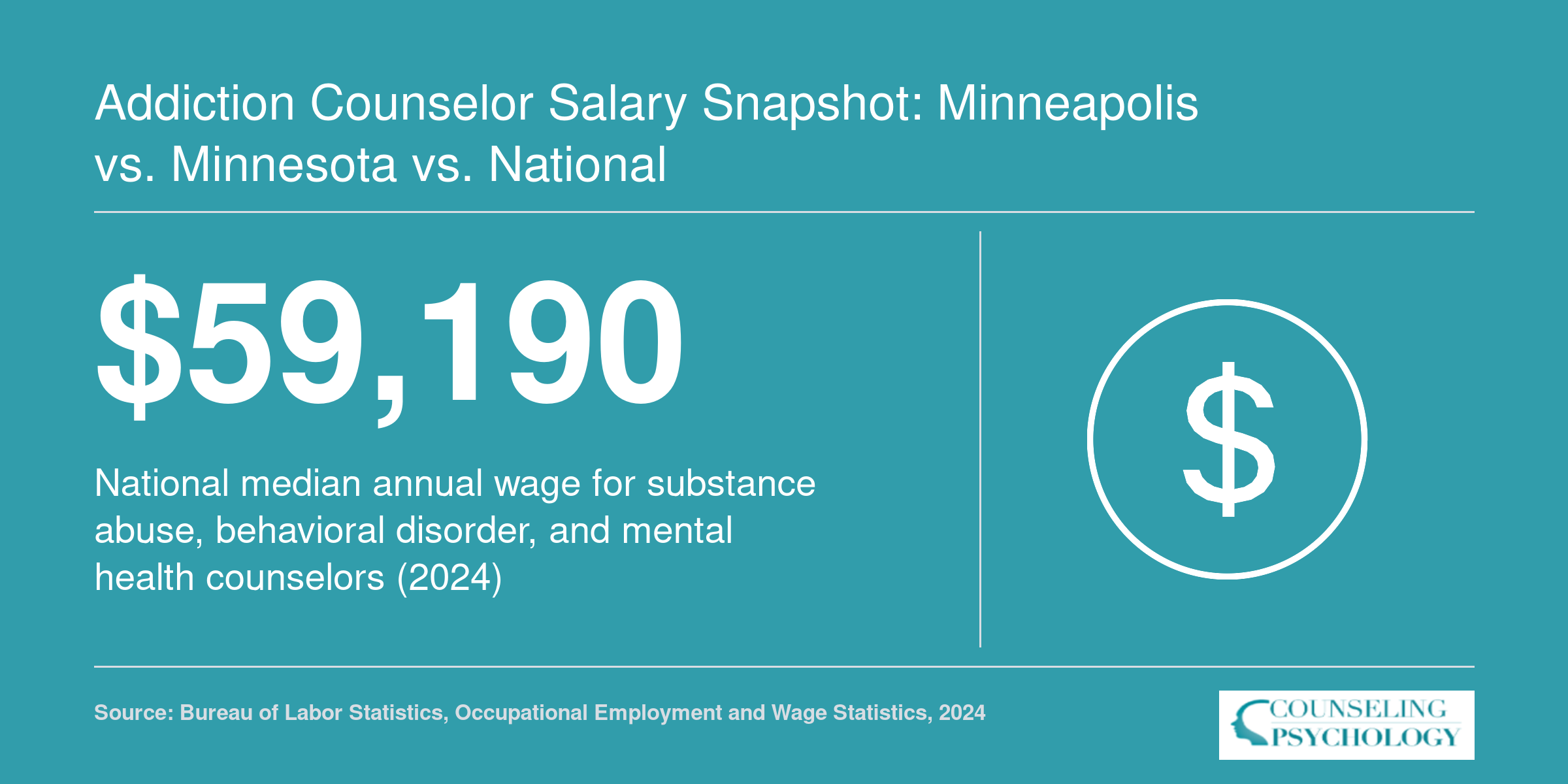
- The national median wage for substance abuse and mental health counselors is $59,190 according to BLS data.
- Clinical placement networks near Hazelden Betty Ford and other Twin Cities facilities give local programs a measurable practicum advantage.
Minnesota's behavioral health workforce shortage has pushed addiction counseling into one of the state's highest-demand credential areas, and the Twin Cities anchor the region's graduate training infrastructure. Three counseling programs in Minnesota within commuting distance of Minneapolis prepare students for LADC or LPCC licensure: University of Minnesota-Twin Cities, Metropolitan State University, and Minnesota State University Moorhead's hybrid option.
Tuition ranges from roughly $11,300 to $33,000 depending on residency and program length, with credit requirements spanning 30 to 60 hours. Accreditation status, clinical placement networks, and licensure alignment differ meaningfully across these options. Employers increasingly favor candidates from CACREP-accredited programs, a factor that affects both hiring prospects and interstate credential portability.
Best Master's in Addiction Counseling Programs Near Minneapolis
Minneapolis and the broader Twin Cities region offer a small but focused set of graduate programs built around addiction counseling, each with a different mix of cost, format, and clinical depth. The three programs below were evaluated on institutional outcomes, affordability after aid, and alignment with Minnesota licensure requirements. Program-level earnings data is not yet available for these specific degrees, so we include institution-wide median earnings as a broader reference point. Details on CACREP accreditation status and licensure pathway alignment appear in dedicated sections further down the page.
- Institutional graduation and retention rates
- Affordability after financial aid
- Licensure pathway alignment
- Program format and flexibility
- Clinical training requirements
- Internal program database
- NCES-IPEDS federal institutional data — nces.ed.gov
- College Scorecard graduate earnings — collegescorecard.ed.gov
- Independent program research

University of Minnesota-Twin Cities
The University of Minnesota's Master of Professional Studies in Addictions Counseling is a 30-credit graduate program housed in one of the state's flagship research institutions. With an institution-wide graduation rate of 85.3% and a 17:1 student-to-faculty ratio, U of M delivers strong academic infrastructure alongside 880 hours of supervised clinical experience. In-state tuition runs approximately $22,017 per year, while out-of-state students pay roughly $33,249, though the institution-wide average net price after aid drops to about $16,778. Median earnings for all graduates 10 years after enrollment sit around $69,020, providing a useful (if broad) baseline for return on investment.
- 30-credit curriculum with traditional and accelerated pathways
- Completion timeline ranges from 1.75 to 3 years
- Tuition set at approximately $850 per credit
- 880 supervised clinical internship hours required
- No GRE required for admission
- Minimum 3.0 undergraduate GPA for eligibility
- Evidence-based counseling methods across biological and social domains
- Experienced, diverse faculty with active research portfolios
Master of Professional Studies in Addictions Counseling — On-Campus

Metropolitan State University
Metropolitan State University in Saint Paul offers a 60-credit Co-occurring Disorders Recovery Counseling master's degree that trains students to work at the intersection of substance use and mental health treatment. The program positions graduates as change agents equipped with trauma-informed, culturally responsive clinical skills. Tuition is the same for in-state and out-of-state students at roughly $11,323 per year, and the institution-wide average net price after aid is approximately $16,863. The university's overall 10-year median earnings figure is about $64,705, and median graduate debt comes in around $17,100.
- 60-credit program covering addiction and mental health co-treatment
- Full-time students can expect to finish in about 3 years
- Part-time scheduling option available for working professionals
- Prepares graduates for both LADC and LPCC licensure tracks
- Culturally responsive and trauma-informed curriculum emphasis
- Practicum and applied research components included
- Person-centered, evidence-based clinical training model
- Minimum 3.0 GPA preferred, ideally in health or social sciences
Co-occurring Disorders Recovery Counseling (MS) — On-Campus

Minnesota State University Moorhead
Minnesota State University Moorhead's MS in Counseling with an Addiction Counseling emphasis is a 60-credit hybrid program that blends face-to-face and online coursework. Located roughly 230 miles northwest of Minneapolis, MSUM serves students across the state through its flexible delivery format. Tuition is uniform for residents and non-residents at about $11,902 annually, though the institution-wide average net price after aid is approximately $17,997. The university's overall graduation rate is 57.3%, and institution-wide median earnings 10 years out reach roughly $50,527.
- 60-credit program with hybrid online and in-person delivery
- Core counseling curriculum shared across multiple emphasis areas
- Designed to prepare students for state licensure in addiction counseling
- Certificate-to-master's pathway for existing addiction counseling certificate holders
- Student-to-faculty ratio of 17:1 across the institution
- Uniform tuition for in-state and out-of-state students
- Focus on practical skills development for community-based settings
MS in Counseling, Addiction Counseling Emphasis — Hybrid
How We Ranked These Addiction Counseling Programs
Transparent methodology versus no methodology at all: that gap separates useful program rankings from lists that are really just alphabetical directories dressed up with star icons. Most competing sites publish a ranked list with no explanation of how schools got there. This guide does things differently.
What the Numbers Measure
The quantitative side of the ranking draws on federal College Scorecard data for each institution. Four weighted factors drive the formula:
- Tuition and net price: Institution-level average net price after grants and scholarships, because sticker price alone misleads prospective students.
- Graduation rates: Completion rates as reported at the institution level. Because federal data does not break these figures down by individual graduate program, the numbers reflect the whole school, not the counseling department specifically. That limitation is worth knowing.
- Program-level earnings outcomes: Median earnings for graduates of each program, drawn from Scorecard data where available. This is the closest the data gets to field-specific results.
- Debt at graduation: Median federal loan balances for completers, which signals how well each institution's aid packages hold down long-term financial risk.
No ranking formula perfectly captures what any single student will experience, and institution-wide averages smooth over real variation across departments. Treat the scores as a starting point, not a verdict.
What We Weighed Qualitatively
Some factors matter enormously to career outcomes but resist clean numerical scoring. CACREP accreditation status, alignment with Minnesota LADC and LPCC licensure requirements, and the depth of each program's clinical placement network all shaped how programs were evaluated, but none of these entered the formula as a numeric weight. They are discussed in the program profiles so you can apply your own judgment. Students weighing broader options, such as clinical mental health counseling online programs, will find that CACREP accreditation carries similar weight across specializations.
Accreditation in particular is not a minor footnote. In Minnesota, the counselor license you can pursue after graduation depends partly on whether your program holds specific accreditation. A cheaper program that leaves you ineligible for the license you need is not actually a bargain.
Why the Methodology Transparency Matters
Publishing the criteria openly lets you stress-test the ranking against your own priorities. If you are a working clinician who cannot relocate and cost is the dominant factor, weight net price more heavily yourself. If you already hold an LADC and are building toward LPCC, accreditation alignment jumps to the top of your personal list. The methodology is a framework, not a final answer.
CACREP Accreditation and Why It Matters in Minnesota
CACREP accreditation is a quality seal awarded by the Council for Accreditation of Counseling and Related Educational Programs, the only specialized accrediting body recognized across the counseling profession nationwide. It tells you that a graduate program meets rigorous standards for curriculum, clinical training, faculty qualifications, and student outcomes. In Minnesota, that seal carries real weight when you sit down to pursue licensure.
How CACREP Status Affects LPCC Licensure in Minnesota
Minnesota's Board of Behavioral Health and Therapy uses CACREP accreditation as a benchmark when evaluating whether a graduate degree meets the academic requirements for Licensed Professional Clinical Counselor (LPCC) status. Graduates of CACREP-accredited programs typically have a clearer path to exam eligibility, specifically for the National Clinical Mental Health Counseling Examination (NCMHCE), and their coursework is presumed to satisfy the board's content-area requirements. If your program is not CACREP-accredited, you may need to submit detailed syllabi and course descriptions for individual review, a process that can add weeks or months to your licensure timeline. The same applies to supervised-experience hours: CACREP-aligned programs structure practicum and internship sequences that map directly to what the board expects, reducing the chance of having to log additional clinical hours after graduation.
Current CACREP Status of Minneapolis-Area Programs
Here is where each ranked program stands as of 2026:
- Hazelden Betty Ford Graduate School: CACREP-accredited in Addiction Counseling (M.A.), with accreditation running through March 2032.1 This is the only program in the Minneapolis area holding CACREP accreditation specifically in the Addiction Counseling specialty.
- University of Minnesota: CACREP-accredited in Clinical Mental Health Counseling (M.A.), with accreditation valid through October 2032.2 While this program does not carry a separate Addiction Counseling specialty accreditation, its CACREP status still satisfies the academic requirements for LPCC licensure.
- Saint Mary's University of Minnesota: Not currently listed in the CACREP directory.2
- Metropolitan State University: Not currently listed in the CACREP directory.2
So to directly answer the question many prospective students ask: yes, there are CACREP-accredited programs near Minneapolis that prepare you for addiction counseling programs in Minnesota, though only Hazelden Betty Ford holds that specific specialty designation.
What Happens If You Choose a Non-CACREP Program
Attending a program without CACREP accreditation does not make licensure impossible in Minnesota, but it does introduce friction. You will likely face a more detailed transcript review and may need to demonstrate course-by-course equivalency. The bigger concern surfaces if you ever relocate. Many states grant streamlined or automatic counseling licensure reciprocity to CACREP graduates, while applicants from non-accredited programs can encounter additional coursework mandates, extra supervised hours, or outright denials depending on the destination state's rules. If there is any chance you will practice outside Minnesota during your career, starting with a CACREP-accredited program removes a significant barrier to portability.
Questions to Ask Yourself
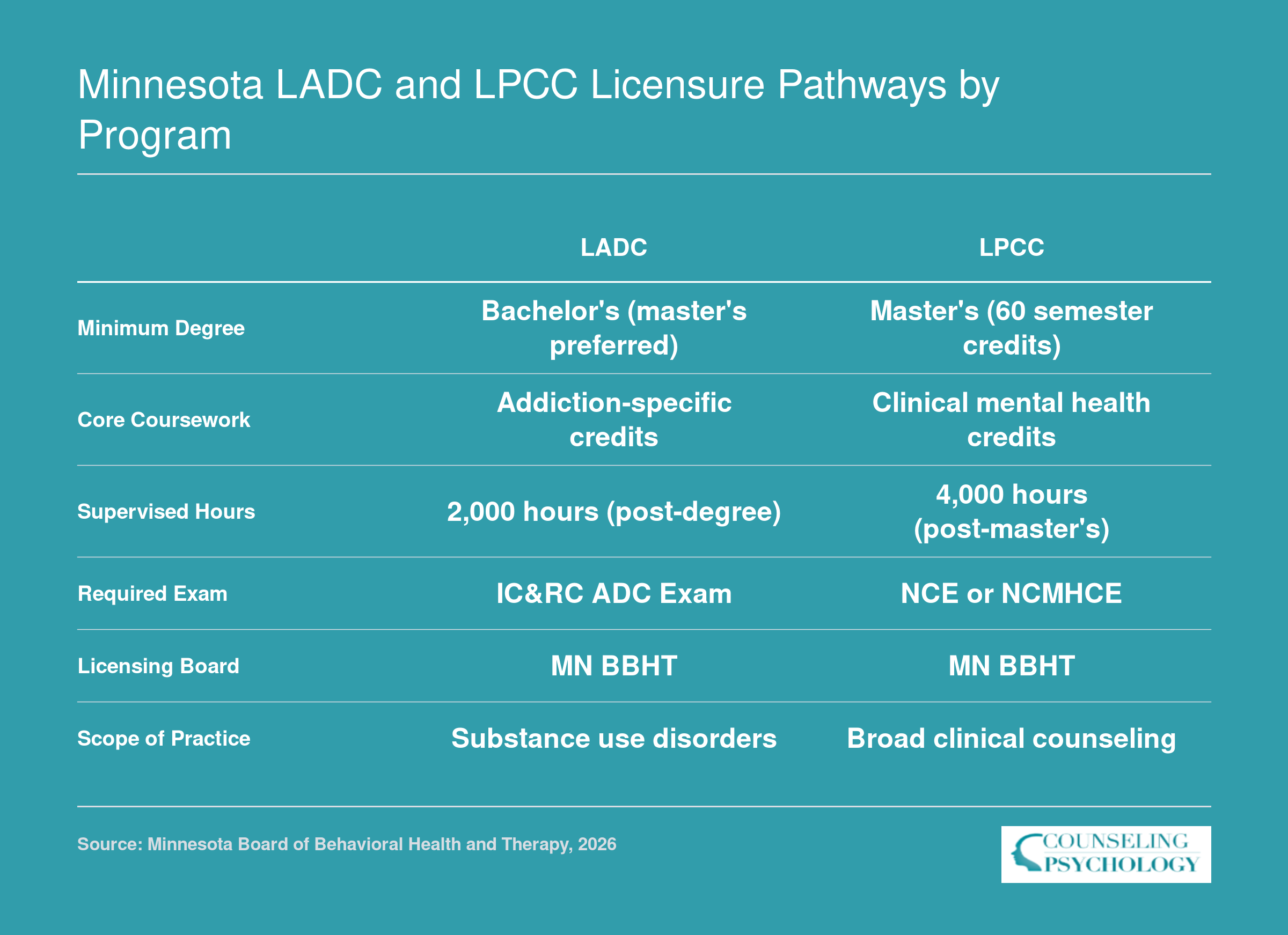
Minnesota LADC and LPCC Licensure Pathways by Program
Minnesota offers two primary licensure tracks for addiction and mental health counselors: the Licensed Alcohol and Drug Counselor (LADC) credential and the Licensed Professional Clinical Counselor (LPCC). Each pathway has distinct education, supervised experience, and exam requirements set by the Minnesota Board of Behavioral Health and Therapy. Always verify current requirements directly with the Board, as rulemaking updates through 2026 may adjust specific thresholds.
Program-by-Program Cost and Financial Aid Comparison
Tuition varies significantly across the Minneapolis-area addiction counseling master's programs featured in this guide. The table below compares published tuition rates, institutional net price, and median graduate debt at the institutional level. Program-level earnings and debt data are not yet available for these specific programs, so the figures shown reflect institution-wide medians from College Scorecard. Note that Hazelden Betty Ford Graduate School is a private, specialized institution; its tuition is a flat per-credit rate with no in-state/out-of-state distinction, while the three public universities listed use standard state tuition schedules. Financial aid highlights: Hazelden Betty Ford offers tuition discounts through partner organizations and supports employer tuition reimbursement arrangements. Metropolitan State University serves a high proportion of Pell Grant recipients (roughly 68%), suggesting strong need-based aid packaging. The University of Minnesota Twin Cities provides graduate assistantships across many departments, and its net price after aid is the lowest on this list. Minnesota State University Moorhead charges the same tuition to in-state and out-of-state students, a meaningful advantage for students relocating from neighboring states.
| School | Program | Credits | Published Tuition (In-State) | Published Tuition (Out-of-State) | Estimated Total Program Cost | Average Net Price (Institution-Wide) | Median Graduate Debt (Institution-Wide) |
|---|---|---|---|---|---|---|---|
| Hazelden Betty Ford Graduate School | M.A. in Counseling: Addiction Counseling (Hybrid/Online) | 60 | $849/credit ($50,940 total) | $849/credit ($50,940 total) | $54,345 (tuition plus estimated fees and supplies) | N/A | N/A |
| University of Minnesota Twin Cities | M.P.S. in Addictions Counseling (On-Campus) | 30 | $22,017/yr | $33,249/yr | Approx. $25,500 (30 credits at $850/credit) | $16,778 | $19,500 |
| Metropolitan State University | Co-Occurring Disorders Recovery Counseling (On-Campus) | 60 | $11,323/yr | $11,323/yr | Varies by enrollment pace (full-time: approx. 3 years) | $16,863 | $17,100 |
| Minnesota State University Moorhead | M.S. in Counseling, Addiction Counseling (Hybrid) | 60 | $11,902/yr | $11,902/yr | Varies by enrollment pace | $17,997 | $20,000 |
Online, Hybrid, and On-Campus Options Compared
Delivery format shapes everything from your weekly schedule to the professional relationships you build during graduate school. Among the ranked programs near Minneapolis, you will find on-campus, hybrid, and (starting fall 2026) fully online tracks, each with distinct trade-offs worth weighing against your life circumstances and career goals.
Pros
- Hybrid and online formats let working professionals keep clinical jobs while earning a degree, a real advantage for students already in the field.
- The University of Minnesota launches a fully online addictions counseling track in fall 2026 with asynchronous and remote synchronous options, requiring no campus visits for coursework.
- Minnesota State University Moorhead delivers its addiction counseling concentration in a hybrid format, making it accessible to students outside the Twin Cities metro.
- On-campus programs at the University of Minnesota (hybrid track, Saint Paul campus) and Metropolitan State University build direct relationships with Twin Cities treatment agencies, strengthening clinical placement options.
- Face-to-face cohort models foster organic mentorship with faculty and peer accountability that many students find harder to replicate in virtual settings.
- On-campus and hybrid students can tap into Minneapolis and Saint Paul networking events, conferences, and supervision groups that online learners must seek out independently.
Cons
- Even fully online students must complete substantial supervised hours (880 at the University of Minnesota, for example), which means arranging local practicum placements wherever you live.
- Hybrid programs like Hazelden Betty Ford's require ongoing evening and weekend in-person attendance, so students commuting from rural Minnesota face real travel burdens.
- On-campus schedules at Metropolitan State and the University of Minnesota hybrid track are less forgiving for students who work full-time or have family caregiving responsibilities.
- Commuting, parking, and related costs in the Twin Cities can add meaningfully to total program expense for on-campus students, especially over a two- to three-year program.
- Online learners may miss the informal connections with local treatment centers and alumni networks that campus-based students develop through daily proximity.
Career Outcomes and Earnings for Minneapolis-Area Graduates
Early-career wages versus long-term earning potential represent two very different ways to evaluate a master's in addiction counseling, and both matter when you are weighing the cost of a graduate degree against realistic salary expectations in the Twin Cities market.
What Program-Level Earnings Data Shows
Program-specific earnings figures for the three ranked programs are not yet available through federal reporting channels. That gap is common for newer or specialized graduate programs, and it makes occupational wage data from state and federal sources the more reliable benchmark for now.
At the institution level, graduates across all programs at the University of Minnesota-Twin Cities report a median annual wage of roughly $69,000 about ten years after enrollment, which reflects the full range of UMN graduate programs rather than addiction counseling specifically. Metropolitan State University graduates report approximately $64,700 over a similar horizon, and Minnesota State University Moorhead graduates report around $50,500. These institution-wide figures are useful for framing expectations but should not be read as addiction counseling salary projections on their own.
Occupational Wages in Minnesota and the Twin Cities
The Bureau of Labor Statistics provides a cleaner picture for the specific occupation you are training for. According to the most recent BLS data, substance abuse, behavioral disorder, and mental health counselors (SOC 21-1018) earn a median annual wage of $61,380 in the Minneapolis-St. Paul-Bloomington metro area.1 That is modestly above the Minnesota statewide median of $59,550 and the national median of $59,190, which reflects the higher cost of living and stronger employer density in the Twin Cities.2
To put those figures in context: a graduate carrying around $19,500 in debt (roughly the median for UMN graduates across programs) at a standard 10-year repayment rate would face monthly payments in the range of $200 to $220, which is manageable against a $61,000 starting salary. Metropolitan State's lower tuition results in median debt closer to $17,100, making the payback math even more favorable. MSUM graduates tend to carry slightly higher debt near $20,000, though their lower sticker tuition suggests that figure reflects aid differences rather than program cost alone.
Employers and Job Growth
The Twin Cities addiction treatment sector is anchored by well-known employers. Hazelden Betty Ford operates a major residential and outpatient campus in the metro and is one of the most recognized training sites in the country. Fairview Health Services and Hennepin Healthcare both run substantial behavioral health programs with ongoing hiring needs. Community-based programs funded through the Minnesota Department of Human Services expand that network considerably, particularly for graduates interested in serving low-income or underserved populations.
On the growth side, Minnesota DEED projects an 18 percent increase in employment for this occupation through 2032, well above average for all occupations.1 Nationally, the Bureau of Labor Statistics projects 17 percent growth through 2034.2 Both figures signal that demand for credentialed addiction counselors is not a short-term trend. For Minneapolis-area graduates who complete licensure requirements, the combination of a hiring-friendly market and above-national wages makes the investment case reasonably strong. Those interested in related behavioral health paths in the state may also want to explore MFT programs in Minnesota.
Addiction Counselor Salary Snapshot: Minneapolis vs. Minnesota vs. National
BLS data confirms a national median annual wage of $59,190 for substance abuse, behavioral disorder, and mental health counselors. State and metro-level medians for Minnesota and the Minneapolis-St. Paul-Bloomington MSA are not currently published in the research available for this section, so we are reporting only the verified national figure here. Counselors who hold an LPCC credential in addition to (or instead of) an LADC typically command higher salaries, because the LPCC scope of practice covers a broader range of clinical mental health services.
Minneapolis is home to a dense network of addiction treatment centers, including Hazelden Betty Ford's flagship campus in Center City, which gives local programs a practicum edge that online-only programs elsewhere cannot match. Before enrolling, ask admissions staff for their clinical placement site lists and whether they offer guaranteed placement.
Frequently Asked Questions About Addiction Counseling Master's Programs in Minneapolis
Below are answers to the questions prospective students ask most often about addiction counseling graduate programs in the Minneapolis area. Where possible, answers draw on program data and licensure details discussed earlier in this guide. Because admissions criteria and program structures can change, always verify details directly with each school before applying.