
What you’ll learn in this article…
- Virginia offers six I-O psychology programs ranging from fully funded doctoral tracks to fully online master's degrees.
- Virginia Tech's PhD program stands out for research depth, while George Mason and Radford serve working professionals.
- The national median salary for I-O psychologists exceeds $150,000 according to BLS, though Virginia-specific figures are not currently published.
- Northern Virginia's proximity to federal agencies and defense contractors creates one of the country's densest I-O job markets.
Virginia sits at an unusual intersection for industrial-organizational psychology: the Northern Virginia to Richmond corridor concentrates federal agencies, defense contractors, and management consulting firms in a way few states can match, creating direct demand for practitioners trained in personnel selection, organizational development, and applied research. That proximity shapes not just hiring but also how programs design their curricula.
The six programs covered here span master's and doctoral levels, campus and online formats, and a tuition range running from roughly $8,700 to over $40,000 per year depending on residency and institution type. Whether you are exploring industrial organizational psychology phd programs or a two-year applied master's, the career trajectories those paths open are meaningfully different, and that choice is the central tension for most applicants.
Program-level earnings data are not yet available for these programs, so institution-wide figures are the closest available proxy. What is clear from enrollment patterns and employer demand is that I-O psychology credentials tied to Virginia's federal and defense ecosystem carry real labor-market value, particularly at the doctoral level.
Ranked: Best I-O Psychology Programs in Virginia for 2026
Virginia offers a surprisingly diverse landscape for industrial-organizational psychology training, from research-intensive doctoral programs near the D.C. corridor to fully online master's degrees designed for working professionals. The six programs below span public flagships and private universities, each with distinct strengths in curriculum design, regional employer access, and delivery flexibility. Program-level earnings data from the College Scorecard are not yet available for these I-O concentrations, so we reference institution-wide median earnings at 10 years post-entry as a general benchmark. Graduation rates cited are also school-wide figures, not specific to any single program.
- Graduate program depth and breadth
- Regional employer access
- Tuition and net price affordability
- Institutional graduation and retention
- Delivery format flexibility
- NCES-IPEDS federal institutional data — nces.ed.gov
- College Scorecard graduate earnings — collegescorecard.ed.gov
- Independent program research
- Internal program database

George Mason University
George Mason University sits at the heart of Northern Virginia's government and consulting corridor, giving I-O students direct access to federal agencies, defense contractors, and D.C.-area corporations. The university fields three distinct I-O offerings: a campus-based MA, a fully online Master of Professional Studies, and a PhD, all supported by faculty whose research spans personnel selection, teams, leadership, and work-family dynamics. With an institution-wide median earnings figure of $76,343 at ten years and a 67.8% school-wide graduation rate, Mason pairs strong regional labor-market positioning with flexible degree pathways.
- 30 to 32 total credit hours on campus in Fairfax
- Proximity to Washington D.C. federal and private employers
- Advanced statistical methods and research design training
- Practicum options for hands-on organizational consulting
- Flexible elective selection tailored to career goals
- Professional development emphasis alongside coursework
- Fully online, asynchronous format for working professionals
- 30 total credit hours at roughly $815 per credit hour
- 8 required core courses plus 2 elective selections
- Part-time pacing designed for career continuation
- Applied workplace psychology focus over pure research
- No relocation required for Virginia or out-of-state students
- Campus-based doctoral training in Fairfax, Virginia
- Emphasis on organizational behavior and leadership research
- Faculty-student coauthorship culture across multiple labs
- Aligns with UN Global Compact ethics principles
- Covers personnel selection, diversity, and team dynamics
- Prepares graduates for academic and consulting careers
Master of Arts in Psychology, Industrial/Organizational Psychology Concentration — On-Campus
Master of Professional Studies in Applied Industrial and Organizational Psychology — Online
Industrial/Organizational Psychology, PhD — On-Campus

Virginia Polytechnic Institute and State University
Virginia Tech's I-O psychology program is housed within one of the state's most selective public research universities, boasting the highest institution-wide graduation rate on this list at 86.2% and median earnings of $81,698 at ten years. The doctoral program follows SIOP professional guidelines and uniquely blends behavior analysis with traditional I-O coursework, producing graduates equipped for data-intensive roles in government, tech, and large corporate settings. In-state tuition runs $18,564 annually, and the program has graduated 138 students as of 2024, maintaining a strong alumni network across Virginia and beyond.
- Follows Society for Industrial and Organizational Psychology guidelines
- Combines behavior analysis with I-O psychology curriculum
- 138 program graduates as of 2024 across career sectors
- Scientist-practitioner model with doctoral-level research training
- GRE scores have been optional in recent admissions cycles
- In-state tuition of $18,564 at a flagship public university
- Prepares students for both teaching and applied research careers
Industrial/Organizational Psychology, Master's and PhD — On-Campus

Radford University
Radford University offers a practice-oriented master's program in I-O psychology that reports 100% career placement within three months of graduation, a standout metric for any graduate program. The curriculum uses an Educational Consulting Firm Model, meaning students work with real organizational clients throughout their studies. Located in Southwest Virginia, Radford provides an affordable public-university option with in-state tuition of $13,762 and no GRE requirement, making it especially accessible for Virginia residents pivoting into the I-O field.
- Two tracks available: thesis-based MA or terminal practice-focused MS
- Reports 100% career placement within three months of graduation
- No GRE required with a median accepted GPA of 3.0
- Real-world client projects via Educational Consulting Firm Model
- Covers job analysis, employment law, and personnel selection
- Post-graduation salaries reported above $70,000
- Two-year program length designed for efficient completion
Industrial/Organizational Psychology, MA and MS — On-Campus

Old Dominion University
Old Dominion University's PhD in Industrial/Organizational Psychology uses a scientist-practitioner model with particular depth in organizational change, team processes, and workplace diversity. Situated in Norfolk at the center of the Hampton Roads military and defense hub, the program draws on partnerships with naval installations, defense contractors, and logistics firms for applied research. ODU's 13:1 student-faculty ratio supports close mentorship, and in-state tuition is the lowest among public options on this list at $15,390.
- Scientist-practitioner doctoral model on campus in Norfolk
- Strong psychometrics emphasis with 18 mandated specialty credits
- Research collaborations with Hampton Roads military and defense orgs
- Dedicated focus on organizational change and team processes
- Workplace diversity and inclusion as a formal research area
- Faculty research labs available for hands-on student participation
- Supportive, open learning environment with small cohort sizes
Industrial/Organizational Psychology, PhD — On-Campus

Liberty University
Liberty University provides the broadest range of I-O degree levels in Virginia: a campus-based MS, a fully online MA, and a fully online PhD, all integrating a Christian worldview with standard I-O coursework. The online programs use 8-week course blocks with no set login times, and the PhD allows transfer of up to 50% of credits, making Liberty a distinctive choice for working professionals or ministry-oriented practitioners. The university's net price runs $29,357 for the institution overall, and school-wide median earnings reach $44,813 at ten years.
- 36 total credit hours completed on campus in Lynchburg
- Leadership and organizational effectiveness coursework
- Research design training with Christian perspective integration
- Maximum 5-year completion timeline allowed
- Minimum 3.0 GPA required with no grades below B-
- Prepares students for HR, consulting, and organizational roles
- 100% online with no set login times and 8-week terms
- 36 total credit hours at $565 per credit hour
- Transfer up to 50% of credits from prior graduate work
- No standardized testing required for admission
- Practical workplace psychology focus with advanced research methods
- Christian worldview woven into organizational behavior curriculum
- Fully online doctoral program with 60 total credit hours
- 8-week course format designed for working professionals
- Doctoral tuition at $595 per credit hour
- Up to 50% of credits transferable from other programs
- No standardized test scores required for admission
- Prepares for careers in consulting, academia, and organizational leadership
Psychology (M.S.), Industrial/Organizational Psychology, Campus — On-Campus
Master of Arts in Applied Psychology, Industrial/Organizational Psychology, Online — On-Campus
Ph.D. in Psychology, Industrial/Organizational Psychology, Online — On-Campus

Regent University
Regent University in Virginia Beach offers an online MS and an online PhD with an I-O concentration, both built around a Christian worldview and designed for professionals balancing work and study. The MS program spans 39-plus credit hours with no thesis requirement, while the PhD includes 150 hours of structured field experience in workplace or organizational settings. Net price for the institution sits at $19,923, and the program's Virginia Beach location provides proximity to Hampton Roads employers for students who want to supplement online learning with local networking.
- Fully online master's program with 39-plus credit hours
- No thesis requirement for degree completion
- Christian worldview perspective integrated into coursework
- Supports preparation for doctoral study or direct career entry
- Award-winning faculty with HR and research expertise
- Career paths in human resources, consulting, and organizational research
- Online doctoral program totaling 51 credit hours
- 150 hours of required field experience in organizational settings
- Christian worldview integration throughout the curriculum
- Workplace psychology focus with applied research training
- Designed for professionals seeking advanced leadership roles
M.S. in Psychology, Industrial-Organizational Psychology — Online
Ph.D. in Counseling and Psychological Studies, Industrial-Organizational Concentration — Online
Virginia I-O Program Comparison Table
The table below puts all six Virginia I-O psychology programs side by side on the metrics that matter most: degree level, tuition, delivery format, and institution-wide median earnings ten years after enrollment. Note that program-level earnings data are not yet available for these programs, so the median earnings column reflects each school's overall institutional figure rather than I-O graduates specifically. When weighing cost against outcomes, remember that in-state tuition at public universities can be roughly half the out-of-state rate, while private institutions charge a flat rate regardless of residency.
| School | Degree Level | Format | In-State Tuition | Out-of-State Tuition | Net Price | Median Earnings (10-Year, Institution-Wide) |
|---|---|---|---|---|---|---|
| Virginia Tech | Master's | Campus | $18,564 | $35,092 | $24,953 | $81,698 |
| George Mason University | Master's (M.A., I-O concentration) | Campus | $17,964 | $40,308 | $17,915 | $76,343 |
| Old Dominion University | Doctorate (Ph.D.) | Campus | $15,390 | $36,174 | $14,638 | $54,914 |
| Radford University | Master's | Campus | $13,762 | $23,525 | $14,578 | $53,739 |
| Regent University | Master's (M.S.) | Online | $17,869 | $17,869 | $19,923 | $44,498 |
| Liberty University | Master's (M.S., I-O concentration) | Campus | $8,730 | $8,730 | $29,357 | $44,813 |
Why Study Industrial-Organizational Psychology in Virginia?
Industrial-organizational (I-O) psychology applies the science of human behavior to workplaces: how people are hired, trained, led, measured, and retained. Virginia happens to be one of the densest concentrations of that work in the country, which is why the state matters to anyone weighing where to study and become an industrial organizational psychologist.
A Federal and Defense Hiring Engine
Northern Virginia is, in practical terms, an extension of the federal labor market. The U.S. Office of Personnel Management, the Department of Defense, the CIA, NGA, DHS, the VA, and NASA Langley all hire I-O psychologists for personnel selection, assessment design, leadership development, and workforce analytics. Ring those agencies with the defense contractors that serve them (Booz Allen Hamilton, Leidos, SAIC, and Deloitte among the largest) and you get a steady pipeline of applied I-O roles that simply does not exist in most states. Management consulting firms with strong public-sector practices, including PwC, KPMG, EY, Accenture, Guidehouse, BCG, and McKinsey, add another tier of demand for talent-strategy and organizational-effectiveness work.
Richmond's Corporate Sector
Richmond is the second center of gravity. Capital One, Dominion Energy, Altria, Genworth, Markel, and the health systems VCU Health, HCA, and Bon Secours all run internal talent management, organizational development, and people-analytics functions. Graduates who do not want a security clearance or a long commute on I-66 often land here, in roles closer to traditional corporate I-O practice. Some of that assessment-design work overlaps with what a personnel psychologist does in public-sector settings.
A Strong Labor Market for the Field
The numbers back up the geography. Virginia ranks second in the country for I-O psychologist employment and third for wages, with a state mean annual wage of about $108,700.1 It sits alongside California, Texas, Ohio, and Pennsylvania as one of the top employment states for the occupation.1
Professional Community
The DC-Virginia metro also carries one of the highest concentrations of SIOP (Society for Industrial and Organizational Psychology) members in the country. Local meetups, federal-sector I-O working groups, and university-hosted colloquia at Virginia Tech, George Mason, Old Dominion, and Radford give students access to practitioners well before they graduate.2 That kind of network is what turns a degree into a job offer, whether you pursue a program in Virginia or explore I/O psychology master's programs nationwide.
Related Articles
Questions to Ask Yourself
Career Outcomes and I-O Psychology Salary in Virginia
Career outcomes after completing an industrial-organizational psychology program in Virginia encompass where you work, what you earn, and how quickly you advance. Understanding the salary landscape and employment options helps you weigh the return on your educational investment and plan your post-graduate trajectory.
National Salary Data for Industrial-Organizational Psychologists
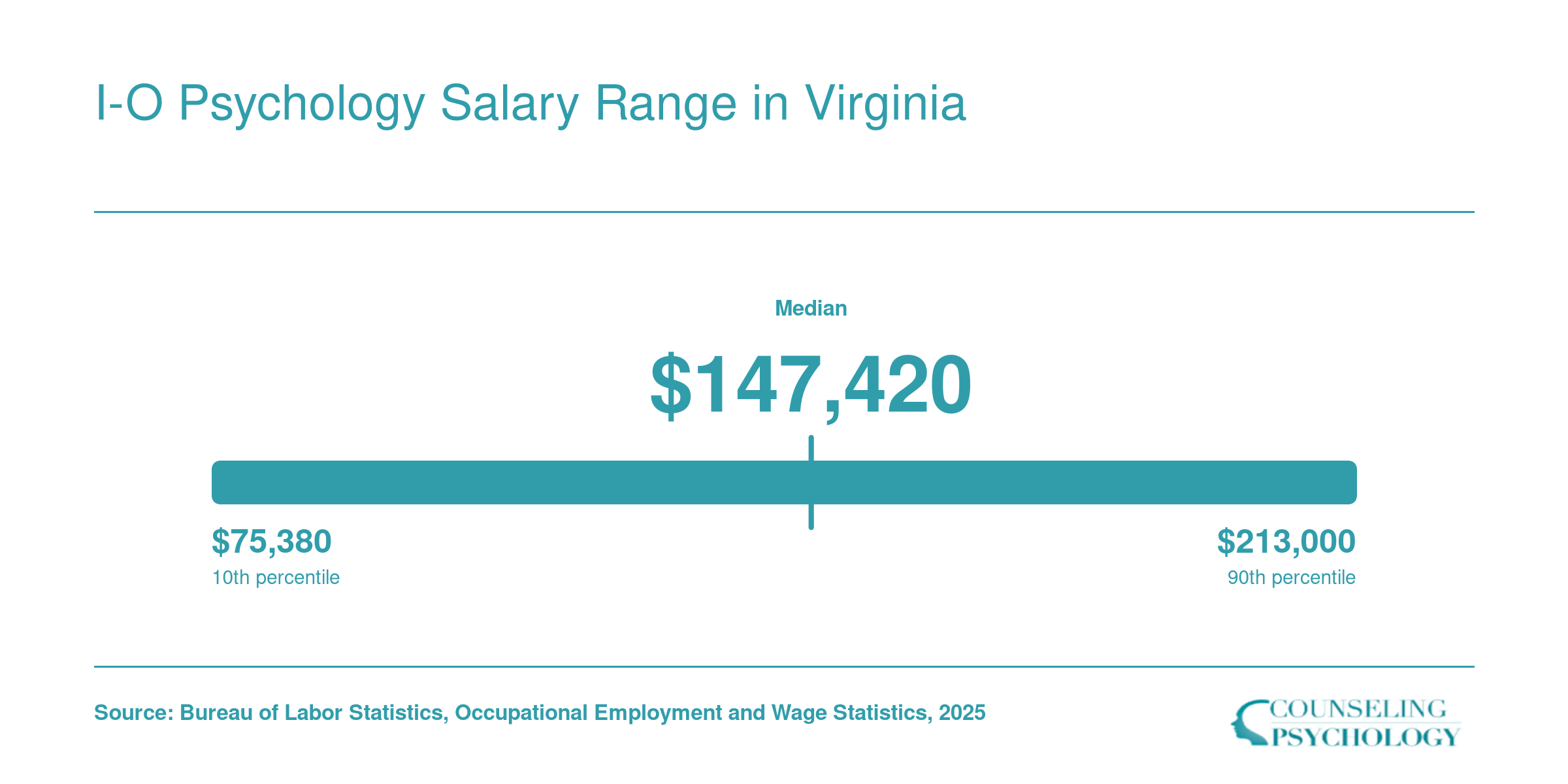
Because state-specific wage data for industrial-organizational psychologists in Virginia is not published by the Bureau of Labor Statistics, the national picture provides the most reliable benchmark. According to May 2023 BLS data, the median annual wage for industrial-organizational psychologists nationwide stands at $147,420, with the 10th percentile at $45,860 and the 90th percentile reaching $219,810.1 The 25th percentile earns approximately $90,100, while the 75th percentile reaches $219,410. Nationally, just over 1,030 industrial-organizational psychologists hold these roles, reflecting the field's specialized nature.1
For Virginia-based practitioners, wages typically align with or exceed national medians in major metropolitan areas, particularly the Washington-Arlington-Alexandria metro, where federal agencies, defense contractors, and consulting firms maintain strong demand. The BLS does not report metro-level data for industrial-organizational psychologists in Virginia's individual cities, so you will need to supplement federal statistics with local employer research.
Finding Virginia-Specific Salary Information
To refine your salary expectations for Virginia, visit the BLS Occupational Employment and Wage Statistics page and filter by state and metro area for SOC code 19-3032. While statewide and metro breakdowns remain unavailable as of 2023, you can compare neighboring states and review broader organizational psychologist categories for context.
University career services at George Mason and Virginia Tech often publish alumni salary surveys and maintain employer databases with Virginia-specific compensation figures. If you are still exploring online industrial organizational psychology programs, these alumni networks can offer valuable perspective on how different degree formats translate into Virginia-market salaries. Reach out to program coordinators or alumni relations offices for access to internal reports, which can highlight starting salaries, industry placements, and regional trends.
Professional Association Resources
The Society for Industrial and Organizational Psychology publishes periodic salary surveys and industry reports that segment data by region, sector, and experience level. Membership gives you access to networking directories, mentorship programs, and webinars where practitioners share compensation negotiations and career-path strategies. The Virginia Psychological Association offers additional local networking, continuing-education workshops, and job boards tailored to the Commonwealth's employment landscape. Both organizations serve as bridges between academic training and professional practice, helping you benchmark offers and identify high-value career moves.
I-O Psychology Salary Range in Virginia
Virginia-specific wage percentiles for industrial-organizational psychologists (SOC 19-3032) are not published by BLS for the current reporting cycle, so exact state figures are unavailable. The percentiles below reflect the most recent national distribution reported by BLS. Virginia salaries may differ based on local demand, employer type, and proximity to the D.C. metro area. The national median is included at the 50th percentile as a baseline reference point.
Admissions, Tuition, and Funding for Virginia I-O Programs
Applying to a fully funded doctoral program versus a self-funded master's program represents fundamentally different admission strategies. Doctoral applicants compete for a handful of slots with guaranteed stipends, while master's candidates often face higher admit rates but shoulder tuition themselves. Virginia's I-O psychology landscape includes both models, and understanding admissions criteria, cohort size, and funding mechanisms is essential before you submit your application.
Admissions Requirements and GRE Policies
Virginia Tech's PhD in Psychology with a concentration in Industrial-Organizational Psychology maintains a 3.0 minimum GPA, reviewed holistically, and made the GRE optional beginning with the 2026-2027 cycle.1 The December 1 application deadline for Fall 2026 entry is firm, with no rolling admission, and the program admits only a limited number of new students each year, reflecting its competitive, research-intensive design.2 Master's programs at George Mason, Old Dominion, and Radford follow different timelines and GRE policies; for instance, Radford advertises no GRE requirement and a median accepted GPA of 3.0, signaling a more practice-oriented admissions philosophy. Master's cohorts tend to be larger, accommodating professional students balancing work and coursework.
All programs expect strong letters of recommendation (typically three) and a clear, well-crafted statement of purpose. Doctoral applications should emphasize research interests aligned with faculty specializations, while master's applicants benefit from articulating career goals in consulting, HR leadership, or organizational development.
Tuition and Cost Structures
In-state tuition at Virginia Tech's graduate level runs $18,564 per year; out-of-state students pay $35,092. George Mason charges $17,964 in-state and $40,308 out-of-state. Old Dominion's in-state rate is $15,390 (out-of-state $36,174), and Radford's is $13,762 (out-of-state $23,525). Private options like Liberty and Regent charge uniform tuition regardless of residency ($8,730 and $17,869 per year, respectively) but lack the comprehensive assistantship infrastructure typical of public institutions.
Graduate Assistantships and Funding
Virginia Tech guarantees funding for all admitted PhD students in good standing, comprising a stipend and tuition waiver; however, students remain responsible for fees.1 This funding model, rooted in apprenticeship and teaching or research assistantship duties, is standard for doctoral I-O programs but rare for terminal master's degrees. If you are weighing a master's path, our overview of industrial organizational psychology graduate programs can help you compare funding norms across schools nationwide. George Mason and Old Dominion offer competitive graduate assistantships to select master's students, covering partial or full tuition plus a modest stipend, though these positions are not guaranteed and require separate application review. Radford's master's program highlights strong career placement but does not advertise routine assistantship availability for incoming students.
Prospective doctoral applicants should clarify funding duration (typically four to five years) and summer support during faculty consultations. Master's students should budget for the full cost of attendance unless an assistantship is secured before enrollment.
Online, Hybrid, and Campus I-O Program Options in Virginia
Virginia's I-O psychology programs span a range of delivery formats, from fully online master's degrees to traditional on-campus doctoral training. The format you choose should reflect your professional situation: campus programs give you direct access to research labs, faculty mentorship, and structured cohort experiences, while online options let working professionals advance without relocating. Here is how the ranked programs break down by delivery mode, flexibility, and research access.
| Program | Delivery Format | Degree Level | Asynchronous or Weekend Options | Research Lab and Practicum Access |
|---|---|---|---|---|
| Virginia Tech, PhD in Psychology (I-O Concentration) | On Campus | Doctoral | No; traditional weekday scheduling | Full access to faculty research labs and practicum placements |
| George Mason, MA in Psychology (I-O Track) | On Campus | Master's | No; standard on-campus schedule | Research and practicum options available on campus |
| George Mason, MPS in Applied I-O Psychology | Fully Online | Master's (30 credits) | Yes; asynchronous coursework with optional live synchronous sessions | Limited; designed for practitioners rather than lab-based research |
| Old Dominion University, PhD in I-O Psychology | On Campus | Doctoral (48 credits) | No; traditional weekday scheduling | Faculty research labs available; scientist-practitioner model |
| Radford University, MA/MS in I-O Psychology | On Campus | Master's | No; campus-based schedule | Real-world client projects and collaborative lab environment |
| Regent University, MS in Psychology (I-O) | Online | Master's (39+ credits) | Yes; online coursework supports flexible scheduling | Limited on-site lab access; program emphasizes applied career preparation |
| Liberty University, MS in Psychology (I-O) | On Campus | Master's (36 credits) | No; campus-based schedule | Research design training included; campus resources available |
A PhD from Virginia Tech positions you for research, academic, or senior consulting roles. An applied master's from George Mason or Radford gets you into the workforce in two years. Choose based on where you want to be in five years, not just admissions odds or prestige.
How to Choose the Right I-O Psychology Program in Virginia
What distinguishes a high-quality I-O psychology program from one that isn't aligned with your career goals in organizational consulting or human resources? The answer often depends on the program's training model, its alignment with industry standards, and how well it prepares you for the credentials that employers in Virginia actually value.
Assess the Research-Applied Balance
I-O psychology programs fall on a continuum from research-intensive to applied-focused. Doctoral programs, especially those housed in research universities, often emphasize theory, measurement, and statistical methods, preparing graduates for academic or high-level research positions. Master's-level offerings, by contrast, frequently lean toward practical skills like talent management, employee selection, and organizational development. Before enrolling, ask whether the curriculum includes applied projects, internships, or corporate partnerships, and check the faculty's background to see if they combine academic expertise with real-world consulting experience. Graduates from applied programs often move directly into HR analytics, change management, or internal consulting roles, while those from research-heavy programs may need to pursue additional credentials or doctoral study for the jobs they want.
Look for SIOP Guidelines Alignment
The Society for Industrial and Organizational Psychology (SIOP) publishes recommended training guidelines for master's and doctoral degrees. These are not mandates, but programs that follow the SIOP model generally cover the core competency areas employers expect: data analysis, personnel psychology, organizational psychology, and ethical practice. When comparing schools, review course sequences to confirm they address these domains. A curriculum that skips foundational quantitative methods or offers only superficial coverage of legal issues in employment may leave you underprepared for certification exams or licensure applications. If you're still weighing specialization options, exploring different types of psychology degrees can help clarify how I-O fits within the broader discipline.
Pursue the Right Credentials for Virginia
Virginia's licensure landscape matters. The Applied Psychologist license, which includes industrial-organizational psychology as a recognized specialty, requires a doctoral degree, at least three years of graduate study, 1,500 hours of supervised experience, passage of the EPPP, and a minimum of 18 semester hours in the specialty area.2 Master's-only graduates cannot obtain this license; their career paths lead instead to non-licensed roles in business, government, or consulting. If you plan to work in HR-adjacent positions, earning the SHRM-SCP (Society for Human Resource Management Senior Certified Professional) designation can demonstrate competence without licensure. For doctoral students, selecting a program with a structured path to supervised experience and licensure exam preparation is critical if you intend to offer independent consulting or clinical-level services in Virginia.
Weigh APA Accreditation for Doctoral Paths
A common point of confusion is APA accreditation. The APA only accredits doctoral programs in health service psychology, which does not cover I-O psychology itself. Therefore, an I-O doctoral program will not hold APA accreditation. However, if you aim to combine I-O with broader psychological practice or to qualify for other specialized certifications, studying within a psychology department that has an accredited clinical or counseling program can signal overall departmental quality. For most careers in psychology, the stronger differentiator is a program's adherence to SIOP guidelines and its alumni network in the consulting, tech, or government sectors that hire in Virginia.
Frequently Asked Questions About I-O Psychology Programs in Virginia
Choosing the right industrial-organizational psychology program involves sorting through details on salary, format, program length, and career prospects. Below are answers to the most common questions students ask about I-O psychology programs in Virginia.