What you’ll learn in this article…
- Kansas ranks three standout addiction counseling programs for 2026, including fully online options from Ottawa and Washburn.
- The state offers three licensure tiers (LAC, LMAC, LCAC), each requiring progressively more education and supervised hours.
- Kansas addiction counselors earn a median salary of $57,760, ranging up to $80,720 at the 90th percentile.
- No Kansas university currently offers a standalone graduate certificate specifically in addiction counseling.
Kansas regulates addiction counseling through a three-tier licensure structure (LAC, LMAC, LCAC) administered by the Behavioral Sciences Regulatory Board, which means the degree you choose directly determines which credential you can pursue and which clinical functions you can perform.
The state's addiction counselors earn a median of $57,760, with experienced practitioners reaching into the $80,000 range, while demand continues to climb alongside Kansas behavioral health workforce shortages flagged by HRSA. Program options are narrower than in larger states: a handful of bachelor's and master's degrees, plus undergraduate certificate pathways, with no standalone graduate certificates currently offered by Kansas universities.
That scarcity reshapes the decision, since most applicants weigh format and cost against which BSRB tier they actually need.
Best Addiction Counseling Programs in Kansas: 2026 Rankings
Kansas offers a small but focused set of addiction counseling degree programs spanning bachelor's through master's levels, with options for fully online, hybrid, and on-campus study. The programs below were evaluated on institutional outcomes, cost, program relevance to Kansas licensure, and delivery flexibility. Program-level earnings data is not yet available for these specific addiction counseling tracks, so institution-wide median earnings and debt figures are included for context. Graduation rates shown are institution-wide and should not be read as specific to any single program.
- Kansas licensure alignment
- Tuition and median graduate debt
- Accreditation and program recognition
- Delivery format and flexibility
- Institutional graduation and retention rates
- NCES-IPEDS federal institutional data — nces.ed.gov
- College Scorecard graduate earnings — collegescorecard.ed.gov
- Internal program database
- Independent program research

Washburn University
Washburn University in Topeka delivers a fully online Master of Arts in Family and Human Services with a dedicated Addiction Counseling concentration, explicitly designed to meet Kansas LMAC educational requirements through the Behavioral Sciences Regulatory Board. Faculty bring direct field experience in Kansas addiction and human services settings, and fieldwork is arranged in each student's own community under Kansas-based supervision standards. With a graduate distance education rate that is the same for all students regardless of residency, Washburn eliminates the nonresident tuition penalty and keeps costs competitive. The institution-wide graduation rate stands at 53%, and median graduate debt is $18,127.
- Fully online format with full-time or part-time pacing options
- Curriculum aligned with Kansas BSRB requirements for LMAC
- No standardized test scores required for admission
- Fieldwork completed in your own community setting
- Holistic approach integrating wellness, diversity, and trauma
- Graduate Certificate in Trauma and Recovery available by adding two courses
- In-state tuition: $10,787; out-of-state: $20,467 (same graduate distance rate)
- Welcomes students from diverse academic backgrounds
Master of Arts in Family and Human Services, Addiction Counseling — Online

Emporia State University
Emporia State University's CACREP-accredited Clinical Counseling program offers a distinct Addictions Counseling concentration delivered in a hybrid format that blends online coursework with periodic on-campus sessions in Emporia. Recognized in Kansas-focused counseling roundups as a strong in-state option for advanced addiction licensure pathways, the program covers psychopharmacology, co-occurring disorders treatment, and clinical skills at an in-state tuition of $8,843. The institution reports a 56.1% graduation rate (institution-wide), a 16:1 student-to-faculty ratio, and median graduate debt of $19,500.
- Hybrid delivery: online coursework plus on-campus intensives in Emporia
- CACREP-accredited clinical counseling program
- Dedicated Addictions Counseling concentration track
- Covers psychopharmacology and co-occurring disorders
- In-state tuition: $8,843; out-of-state: $19,154
- Scholarships available for eligible graduate students
- Low 16:1 student-to-faculty ratio for personalized mentorship
- Prepares graduates for professional counseling roles in addiction treatment
Clinical Counseling, Addictions Counseling Concentration — Hybrid

Ottawa University-Online
Ottawa University's online campus in Overland Park provides both a Bachelor of Science and a Master of Science in Addiction Counseling, giving students a clear undergraduate-to-graduate pipeline within a single institution. The MS program is CAADE-accredited and designed to prepare graduates for the LASAC credential, while the BS covers substance use disorders, cultural competence, and chemical dependency through flexible eight-week terms. The university reports a 7:1 student-to-faculty ratio, median graduate debt of $21,500, and institution-wide median earnings of $55,552 at ten years post-enrollment. The institution-wide graduation rate is 42.9%.
- Fully online with accelerated eight-week terms
- Covers substance use disorders, co-occurring conditions, and cultural competence
- Includes practicum for hands-on clinical experience
- Accredited by The Higher Learning Commission
- Tuition: $13,296 (same rate regardless of residency)
- Prepares students for entry-level substance abuse counselor roles
- Fully online graduate program
- CAADE-accredited curriculum
- Prepares graduates for LASAC credential
- Covers ethics, treatment planning, and clinical practice
- Designed to meet most state licensure academic requirements
- Tuition: $13,296 (same rate regardless of residency)
Bachelor of Science in Addiction Counseling — Online
Master of Science in Addiction Counseling — Online

Ottawa University-Ottawa
Ottawa University's main campus in Ottawa, Kansas, offers the same BS and MS in Addiction Counseling available through its online division, but with on-campus resources and a traditional small-college environment at a 12:1 student-to-faculty ratio. The undergraduate listed tuition is $35,880, though the average net price after aid is approximately $27,963. Median graduate debt is $21,500 and institution-wide median earnings reach $55,552 at ten years. The institution-wide graduation rate is 27.9%, which prospective students should weigh carefully, and the campus format is best suited for those who prefer in-person interaction and local practicum placements in eastern Kansas.
- Accelerated online format also accessible through on-campus enrollment
- Coursework in substance use disorders and cultural competence
- Practicum experiences for applied, hands-on learning
- Flexible application dates throughout the year
- Listed tuition: $35,880; average net price after aid: ~$27,963
- Admission requires a high school diploma or equivalent
- Online program format available through the Ottawa campus
- CAADE-accredited graduate curriculum
- Covers ethics, treatment planning, and clinical methods
- Prepares for LASAC credential across multiple states
- Designed for broad, multi-state licensure alignment
- Median graduate debt: $21,500 (institution-wide)
Bachelor of Science in Addiction Counseling — Online
Master of Science in Addiction Counseling — Online
Graduate Certificates in Addiction Counseling: Kansas Options
Many aspiring addiction counselors assume a graduate certificate is the most direct postgraduate path, but in Kansas the training landscape is notably different. Unlike states where universities offer standalone graduate certificates in addiction counseling, Kansas institutions have not developed that specific credential. The in-state addiction counseling education ecosystem instead revolves around embedded coursework within master's programs and a prominent undergraduate option that serves as the primary entry point to licensure.
Kansas Graduate Certificates: What's Available
A review of the major public universities shows a clear pattern. Wichita State, the University of Kansas, Emporia State, Fort Hays State, and Pittsburg State do not offer a standalone graduate certificate in addiction counseling. While several of these schools have robust graduate programs in counseling, psychology, or social work, none has chosen to package the addiction-focused curriculum as a separate certificate for post-baccalaureate students. This means that someone with a bachelor's degree in an unrelated field cannot simply enroll in a 12 to 18 credit graduate certificate program to meet the educational requirements for advanced licensure. Instead, the typical route involves either completing a full master's degree with substantial addiction coursework or starting with the undergraduate certificate pathway that already satisfies core knowledge domains. Students interested in browsing online addiction counseling degrees at the national level will find graduate certificates are more common outside Kansas.
Undergraduate Certificate Pathway: Washburn University
The sole dedicated addiction counseling certificate program in the state is the Addiction Counseling Certificate at Washburn University.2 It is an undergraduate credential requiring 33 credit hours of study. The curriculum covers essential topics such as counseling theories, ethics, psychopharmacology, and treatment planning, aligning with the educational requirements for the Licensed Addiction Counselor (LAC) credential.
- Format: The certificate can be completed online, on campus in Topeka, or through a hybrid blend, giving students the flexibility to fit coursework around existing work and family commitments.
- Cost: Tuition is billed at the standard undergraduate online rate, making it a cost-effective first step for career changers and community college transfers.
- Admission: As an undergraduate program, it requires a high school diploma or equivalent; no prior counseling experience is necessary.
Because the LAC license in Kansas requires only a bachelor's degree plus approved addiction curriculum, this certificate supplies exactly that foundation. Graduates can sit for the licensing exam and begin supervised practice without immediately pursuing a master's degree.
Stackable Credential: From Certificate to Master's
One of the certificate's most valuable features is how it can function as a stackable credential. The addiction coursework counts as undergraduate credits that may transfer into a related bachelor's program at Washburn or another institution, and from there into a master's program in counseling, social work, or addiction studies. A student who earns the certificate, gains licensure as an LAC, and works in the field for a few years can later return to pursue a master's degree and the Licensed Clinical Addiction Counselor (LCAC) designation. The prior certificate work often reduces the total graduate coursework burden, particularly if the master's program accepts some of the credits as prerequisites or electives. This scaffolded approach is especially attractive for career changers or those who want to test the profession before committing to a full graduate program.
Time to Completion and Costs
- Timeline: The 33-credit certificate typically takes 3 to 4 semesters of full-time study, roughly 1 to 1.5 years. Part-time students may take up to 3 years, but the program flexibility allows for accelerated or self-paced scheduling.
- Tuition: As an undergraduate program, the total cost is significantly lower than a graduate certificate or a full master's degree. For in-state students, undergraduate online tuition at Washburn is generally under $400 per credit hour, placing the total certificate cost in the $12,000 to $14,000 range before fees and books. This compares favorably to graduate-level certificates in neighboring states, which often run $500 to $900 per credit.
- Hidden value: Because the certificate leads directly to LAC eligibility, graduates can begin earning in the field while pursuing further education, offsetting the cost of any subsequent master's degree.
The absence of graduate-level certificates in Kansas should not discourage prospective counselors. The undergraduate certificate at Washburn offers a pragmatic, licensure-aligned path that can be built upon over time, answering the state's workforce needs and the student's career goals in one practical package.
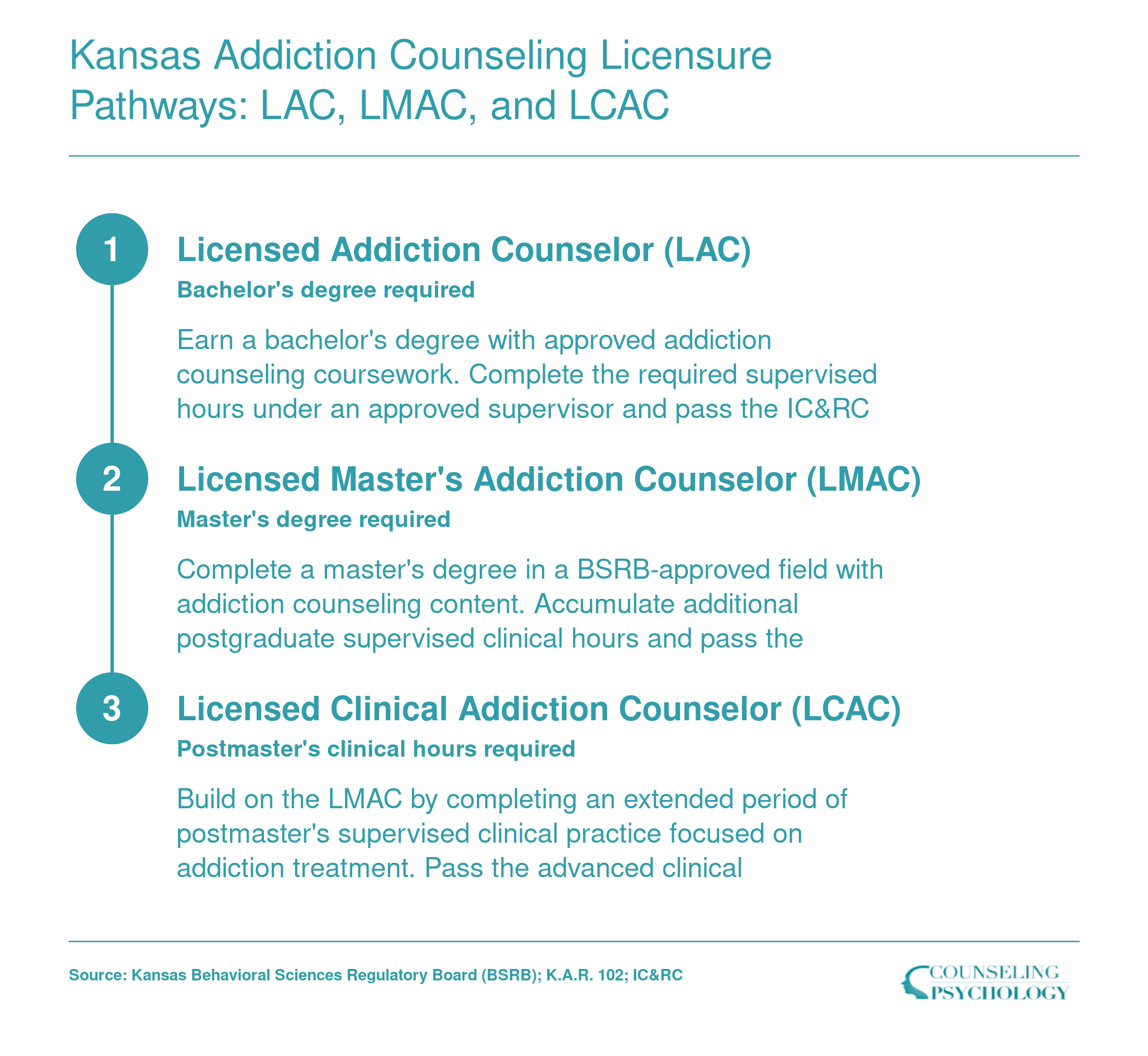
Kansas Addiction Counseling Licensure Pathways: LAC, LMAC, and LCAC
Kansas offers three tiers of addiction counseling licensure through the Behavioral Sciences Regulatory Board (BSRB). Each level builds on the previous one, requiring progressively more education, supervised clinical hours, and advanced examinations. For the most current requirements, consult the BSRB website directly, review Kansas Administrative Regulations (K.A.R. 102), and confirm exam details with the International Certification & Reciprocity Consortium (IC&RC).
Questions to Ask Yourself
Tuition and Cost Comparison Across Kansas Addiction Counseling Programs
The table below compares published tuition rates, average net price, and median graduate debt for the three ranked addiction counseling programs in Kansas. Net price figures reflect an institution-wide average after grants and scholarships and are drawn from federal data; your actual cost will depend on factors like financial aid packages, residency status, enrollment intensity, and program-specific fees. Program-level debt and monthly repayment estimates are not yet published for these programs, so we have included the institution-wide median graduate debt as a reference point.
| School | Degree Level | In-State Tuition | Out-of-State Tuition | Avg. Net Price | Median Graduate Debt |
|---|---|---|---|---|---|
| Washburn University | Master's (MA in Family & Human Services, Addiction Counseling) | $10,787 | $20,467 | $15,280 | $18,127 |
| Emporia State University | Master's (Clinical Counseling, Addictions Counseling) | $8,843 | $19,154 | $16,261 | $19,500 |
| Ottawa University | Bachelor's (BS in Addiction Counseling) | $35,880 | $35,880 | $27,963 | $21,500 |
Online vs. On-Campus: Format Options by School
Kansas addiction counseling programs split across fully online and hybrid formats, so matching the right delivery model to your schedule and learning style matters. Among the ranked programs, Ottawa University and Washburn University both offer fully online options, while Emporia State University uses a hybrid model that blends online coursework with periodic on-campus sessions. Understanding the tradeoffs of each format will help you land in a program that fits your life and your career goals.
Pros
- Online programs let working professionals keep their jobs and income while completing coursework on flexible schedules, including Washburn's full-time or part-time tracks.
- Fully online formats open up program selection beyond Kansas borders, useful if you live far from Emporia, Topeka, or other campus hubs.
- Hybrid models like Emporia State's CACREP-accredited clinical counseling program pair online convenience with periodic face-to-face training and built-in practicum site connections.
- On-campus or hybrid students benefit from direct faculty mentorship, stronger peer cohort bonds, and structured supervision training that mirrors real clinical settings.
- In-person components at schools like Emporia State often come with embedded practicum placements, reducing the burden of arranging your own fieldwork site.
Cons
- Even fully online students must complete clinical practicum hours locally, so you will need to identify and secure a supervised placement in your own community.
- Online learners may miss informal networking opportunities, peer study groups, and spontaneous faculty interactions that on-campus cohorts take for granted.
- On-campus and hybrid programs impose geographic and scheduling constraints that can be difficult for students juggling full-time employment or family obligations.
- Total cost of attendance for on-campus students can run higher once you factor in commuting, parking, and the opportunity cost of a less flexible class schedule.
- Online formats generally offer less real-time supervision training, a skill that Kansas licensure boards expect you to develop before earning your LAC or LCAC credential.
Career Outcomes and Salary Expectations for Kansas Addiction Counselors
A bachelor's-level credential and a master's degree can both open doors in addiction counseling, but the long-term earnings gap between the two paths is worth weighing before you commit. Understanding what Kansas graduates actually take home, and how those figures compare to national benchmarks, helps you set realistic expectations and plan your investment wisely.
What Kansas Graduates Earn
Program-level earnings data for the addiction counseling programs ranked on this page are not yet available through federal reporting. That means we cannot point to a verified one-year or four-year median salary tied to a specific Kansas program. What we do know is that institutional-level median earnings ten years after enrollment offer a rough proxy: Ottawa University graduates report a median of roughly $55,550, Washburn University graduates land near $49,770, and Emporia State University graduates come in around $47,600. These figures cover all programs at each school, not just addiction counseling, so treat them as directional rather than definitive.
BLS Salary Data for the Occupation
The Bureau of Labor Statistics groups addiction counselors under the broader category of Substance Abuse, Behavioral Disorder, and Mental Health Counselors (SOC 21-1018). Nationally, the 2023 median annual wage for this occupation was $53,710.1 The full range is wide:
- 10th percentile: $36,700
- 25th percentile: $44,600
- 75th percentile: $70,130
- 90th percentile: $89,920
Kansas-specific wage data from BLS has not been separately verified for this guide, so readers should consult the latest BLS state occupational wage tables or the Kansas Department of Labor for metro-level breakdowns in areas like Wichita, the Kansas City metro (Kansas side), Topeka, and Lawrence. Salaries in metro areas typically run higher than in rural parts of the state, though cost-of-living differences can narrow the practical gap. For a deeper look at how degree level influences pay across the profession, our counselor salary guide breaks the numbers down further.
Workforce Demand
Nationally, BLS projects 17 percent job growth for this occupation between 2024 and 2034, well above the average for all occupations, with an estimated 48,300 openings annually across the country.2 Kansas mirrors much of this trend. Expanded Medicaid behavioral-health coverage, ongoing opioid-response funding, and community mental health center staffing needs continue to drive demand across the state. Employers in both metro and rural Kansas regularly report difficulty filling licensed addiction counselor positions.
Credential Level Matters
The contrast between certificate or bachelor's holders and master's-level clinicians shows up clearly in both hiring priority and pay. Entry-level positions at community treatment centers may accept a bachelor's degree, but supervisory roles, private-practice eligibility, and higher-tier licensure (such as the LCAC) typically require a master's. Nationally, counselors holding graduate degrees tend to cluster in the upper wage quartiles, and Kansas licensing rules reinforce this pattern by tying clinical independence to advanced credentials. If your goal is long-term earning power and career flexibility, the master's track at a school like Washburn or Emporia State positions you for those upper-tier roles, while a bachelor's from Ottawa can serve as a cost-effective entry point as you gain supervised hours and decide whether to continue your education. Exploring the full range of counseling careers can also help you identify which specializations align with your professional goals.
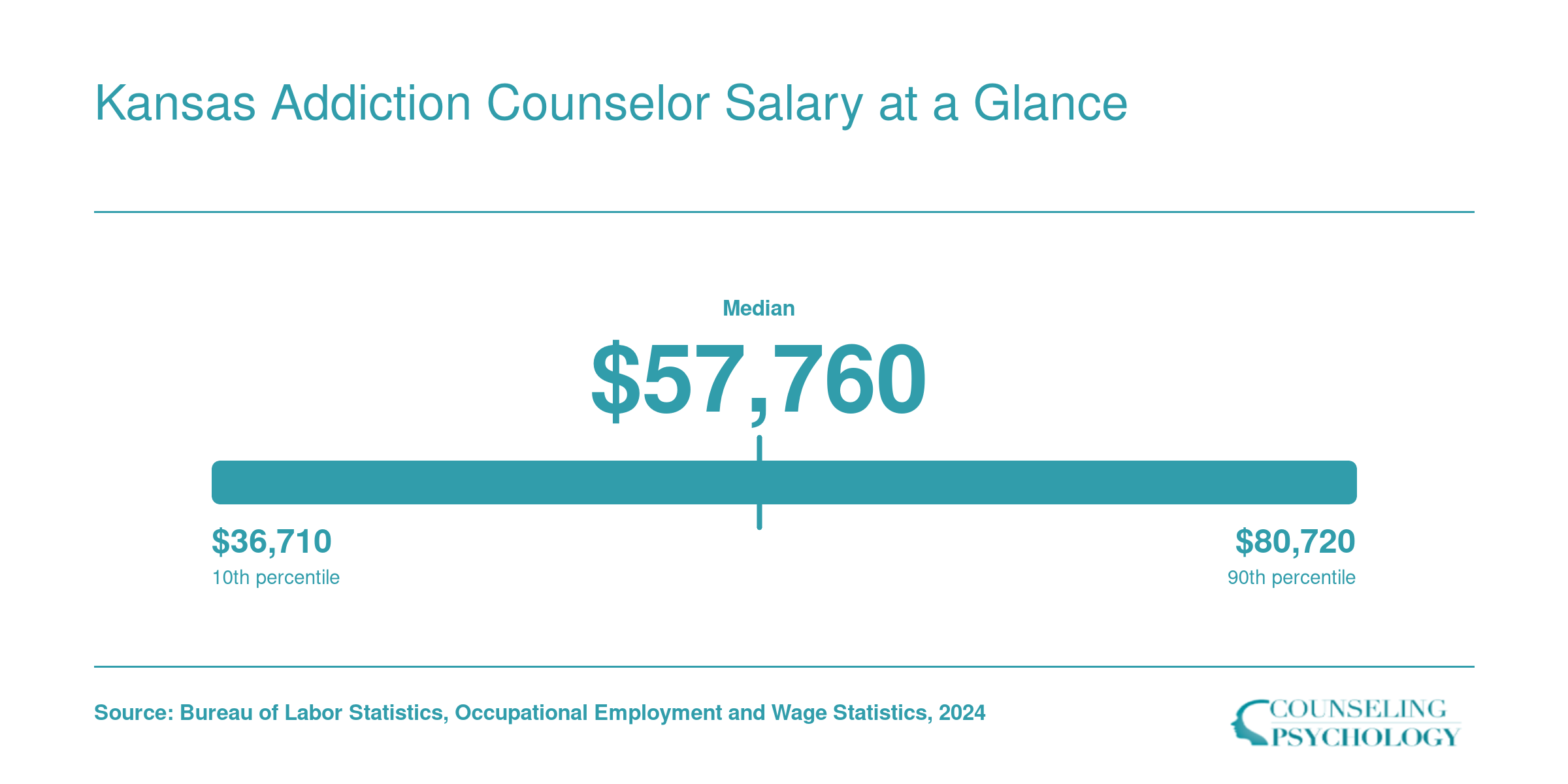
Kansas Addiction Counselor Salary at a Glance
Kansas addiction counselors earn a median of $57,760, slightly below the national median of $59,190 for substance abuse, behavioral disorder, and mental health counselors. The full salary spread ranges from $36,710 at the 10th percentile to $80,720 at the 90th, reflecting how experience, credentials, and practice setting shape earning potential.
How to Choose the Right Addiction Counseling Program in Kansas
Choosing between a low-cost certificate that opens the door to immediate licensure and a comprehensive master's degree that unlocks supervisory roles and clinical autonomy forces applicants to weigh near-term employment against long-term career flexibility. Kansas offers both pathways, but the right choice depends on your license goals, geographic constraints, and whether you can afford to invest two years in graduate study before entering the field.
Prioritize CACREP Accreditation or NAADAC-Aligned Curricula
Accreditation signals that a program meets nationally recognized standards for counselor education, which matters for two reasons: licensure portability and employer preference. CACREP-accredited programs like Emporia State University's M.S. in Clinical Counseling, Wichita State University's M.Ed. in Counseling, and Kansas State University's M.S. in Counseling ensure that graduates can pursue licensure in other states if they relocate, since many state boards grant streamlined approval for CACREP degrees.1 Emporia and Wichita both offer addiction-specific concentrations within their CACREP frameworks.23 Kansas City Kansas Community College, while not CACREP-accredited, holds NAADAC Approved Educational Provider status and aligns its associate degree and certificate programs with the Kansas Board of Social and Rehabilitation Services (BSRB) requirements for the Licensed Addiction Counselor (LAC) credential.4 If you plan to remain in Kansas and target the LAC license, NAADAC alignment may suffice. If you envision a clinical or supervisory career path requiring the LMAC or LCAC license, a CACREP master's degree is the safer investment. Students interested in exploring clinical mental health counseling online programs will find that many of these same accreditation principles apply across specializations.
Evaluate Clinical Placement Support
Practicum and internship placements are non-negotiable components of every Kansas counseling license, yet programs differ sharply in the support they provide. Emporia State and Wichita State maintain partnerships with treatment centers, community mental health agencies, and hospitals across Kansas, and their field coordinators typically arrange or pre-approve sites for students. Kansas City Kansas Community College requires students to complete 300 hours of supervised practicum for the LAC, but students in rural counties often must identify their own sites, a challenge in areas where addiction treatment providers are sparse. Online students face the same hurdle: verify whether the program assigns a field coordinator who will help secure placements in your region, or whether you shoulder that burden alone. Rural applicants should ask admissions offices to name recent placement sites within 50 miles of their zip code before enrolling.
Consider Stackable Pathways and Credential Laddering
None of the Kansas programs reviewed offer formal stackable pathways in which a graduate certificate automatically applies toward a master's degree at the same institution. Kansas City Kansas Community College's two addiction counseling certificates (Certificate A and Certificate B) satisfy the LAC educational requirement but do not transfer as block credit into a master's program.4 If you begin with a certificate or associate degree, you will need to apply separately to a master's program and may receive only partial credit for prior coursework. Students who anticipate pursuing the LMAC or LCAC should weigh whether starting directly in a 60-credit master's program like Emporia's Clinical Addictions Counseling track is more efficient than completing a 15-credit certificate first.2
Match Program to License Goal
Kansas offers three tiers of addiction counselor licensure: LAC (bachelor's or associate degree plus specific coursework), LMAC (master's degree plus 4,000 supervised hours), and LCAC (master's plus 6,000 hours). Verify that your chosen program's curriculum maps to the BSRB coursework requirements for your target license. Kansas City Kansas Community College's A.S. and certificates align precisely with LAC standards.4 Emporia State's 60-credit M.S. in Clinical Counseling with the Clinical Addictions Counseling concentration covers the LMAC and LCAC coursework requirements and qualifies graduates to sit for the National Certified Addiction Counselor (NCAC) exam.2 Wichita State's Addiction Counseling Emphasis within the M.Ed. similarly prepares graduates for LMAC or LCAC pathways.3 Kansas State's M.S. in Counseling does not offer an addiction specialization, which may require students to complete supplemental coursework or electives to meet BSRB addiction-specific requirements.1 Cohort size and faculty-to-student ratio also matter: smaller cohorts at Emporia and Wichita typically mean more access to faculty advisors who can help tailor elective choices to your license plan, while larger programs may offer more scheduling flexibility but less individualized guidance.
Frequently Asked Questions About Addiction Counseling Programs in Kansas
Prospective addiction counseling students in Kansas often have questions about licensure tiers, degree requirements, and earning potential. The answers below draw on current Kansas Behavioral Sciences Regulatory Board (BSRB) rules and the latest available salary data to help you plan your path with confidence.