
What you’ll learn in this article…
- HHS is investigating the APA for alleged antisemitic discrimination after a 2025 Brandeis Center complaint.
- Allegations include APA listserv messages glorifying Hamas and treating Zionism as a mental illness.
- The probe could jeopardize the APA's federal funding and its authority to accredit psychology programs.
- Practitioners should verify state CE requirements and consider alternative credentialing options to stay compliant.
The American Psychological Association, long the gatekeeper for psychology licensure and continuing education, now faces a federal civil rights investigation that could ripple through every state licensing board. The probe was announced June 17, 2026, by the U.S. Department of Health and Human Services in response to a complaint from the Louis D. Brandeis Center.
The complaint, filed in August 2025, alleges violations of Title VI and Section 1557, claiming the 172,000-member organization tolerated antisemitic harassment and dismissed Jewish members' reports. For the thousands of psychologists, counselors, and social workers who rely on APA-accredited programs and CE credits, the investigation introduces immediate counseling licensure vs. non-licensure degree uncertainty.
Even before any formal findings, the probe places a question mark over the neutrality of the standards that front-line clinicians trust.
What Is the HHS Investigation Into the APA?
The U.S. Department of Health and Human Services has launched a formal civil rights investigation into the American Psychological Association, marking one of the most serious institutional challenges the 172,000-member organization has faced in its history. The probe, announced publicly on June 17, 2026, originates from a complaint filed nearly a year earlier by the Louis D. Brandeis Center for Human Rights Under Law, a nonprofit legal advocacy group. At stake is not only the APA's reputation but its access to millions of dollars in federal funding tied to compliance with anti-discrimination statutes.
The Complaint That Triggered the Inquiry
The Brandeis Center submitted its detailed complaint to the HHS Office for Civil Rights (OCR) on August 8, 2025, alleging that the APA had fostered a hostile environment for Jewish members and promoted antisemitic ideology in violation of Title VI of the Civil Rights Act of 1964 and Section 1557 of the Affordable Care Act.1 According to the Center's litigation staff attorney, Rebecca Harris, the APA has "become one of the worst purveyors of antisemitism and extremist ideology in healthcare." The complaint points to a pattern of behavior including statements made at APA conferences, online listserv messages that glorify Hamas or call for Israel's destruction, and the promotion of therapeutic frameworks that treat Zionism as a mental illness.
Why a Title VI Investigation Matters
Title VI prohibits discrimination on the basis of race, color, or national origin in programs receiving federal financial assistance. Section 1557 extends similar protections within health programs. Because the APA receives millions of dollars annually in federal grants and contracts, funding that supports accreditation, continuing education, research, and public health initiatives, a finding of noncompliance could lead to suspension or termination of that support. For clinicians who rely on psychology graduate program accreditation requirements and APA-approved standards to fulfill licensure obligations, the stakes extend well beyond the association's finances. The investigation's scope is therefore not merely symbolic; it carries direct operational and financial consequences for the association and its members.
The Role of the HHS Office for Civil Rights
HHS OCR is the enforcement arm that investigates complaints of discrimination in federally funded health and human services programs. Once a complaint is filed, OCR evaluates whether it meets jurisdictional requirements and, if so, initiates an investigation. The process involves gathering evidence from both the complainant and the institution, reviewing policies and practices, and determining whether federal civil rights laws have been violated. The investigation into the APA is being conducted under that standard administrative framework, with potential outcomes ranging from voluntary compliance agreements to enforcement actions.
Key Allegations Against the APA
Professional associations often walk a tightrope: they encourage robust debate on societal issues while safeguarding members from discrimination. The complaint filed against the American Psychological Association alleges that the organization tipped from permissible advocacy into conduct that systematically excluded and harassed Jewish psychologists, violating federal civil rights protections. Here are the central allegations that the HHS is now investigating.1
The "Decolonizing Therapy" Framework
The complaint specifically targets APA-promoted programming around "Decolonizing Therapy," an approach that challenges Western-centric assumptions in mental health treatment. While proponents argue it addresses historical power imbalances, critics say it can pathologize political identities. According to the Brandeis Center, APA resources and presentations have treated Zionism, the belief in a Jewish homeland, as a mental illness or pathological attachment. The allegation is that this framing crosses from clinical critique into discriminatory stereotyping, potentially impacting how therapists view Jewish clients or students who support Israel. For practitioners who depend on APA-approved continuing education, the accusation raises concerns about whether political advocacy is compromising professional standards.
Conduct at APA Conferences
The complaint highlights two conference-related incidents. First, APA-sponsored events allegedly portrayed the October 7 attacks as strikes on military targets rather than acts of terrorism, a characterization that many Jewish members found minimizing and hostile. Second, a Jewish therapist reported being verbally harassed at an APA conference. The person alleged to have harassed her was not removed from the event, and the complaint states that the same individual is scheduled to speak at a future APA gathering. These events, the Brandeis Center argues, show that the APA failed to enforce its own anti-harassment policies equitably.1
Listserv Messages and Online Environment
The complaint also cites numerous messages posted on official APA listservs that allegedly glorified Hamas, called for boycotts of Israel, compared Gaza to the Warsaw ghetto, and prayed for Israel's destruction.1 The Brandeis Center contends that these communications created a hostile digital environment for Jewish members, who saw their professional association's platforms used to promote antisemitic tropes. While professional listservs can be spaces for vigorous discussion, the allegation is that the APA allowed this rhetoric to go unchecked, leaving Jewish psychologists feeling unsafe in their own professional community.
Institutional Dismissal of Concerns
Perhaps most troubling for practitioners is the pattern of dismissal alleged. Jewish members who reported these incidents describe facing "open hostility" and say their complaints were "dismissed, downplayed, or ignored" by APA leadership.1 The complaint suggests that rather than addressing the content or protecting the targets, the APA's response reinforced the hostile climate. This institutional pattern, if substantiated, could indicate systemic bias rather than isolated incidents, a distinction that will be central to the HHS investigation and any potential consequences for the association.
Collectively, these allegations paint a picture of an organization where political advocacy may have crossed into discrimination. The HHS review will determine whether the conduct outlined constitutes a Title VI violation or other civil rights breach. For practitioners evaluating educational requirements for psychology careers, the credibility of any certifying body matters deeply. Mental health professionals can assess the described behaviors against their own ethical codes and consider how they would expect their own professional bodies to handle similar complaints.
This is believed to be one of the first HHS Office for Civil Rights investigations into a major mental health professional association for alleged ethnic discrimination. For practitioners, this creates uncharted territory: the very organization responsible for their professional standards and continuing education accreditation is now under federal review.
How HHS OCR Investigations Work
For mental health professionals, an HHS Office for Civil Rights investigation stirs immediate concern, yet the procedural reality is far more measured than the headline suggests. The opening of an investigation signals that a complaint has crossed a procedural threshold, not that any violation has occurred. Understanding the step-by-step process can help practitioners separate early-stage noise from substantive developments.
Filing the Complaint and Jurisdictional Review
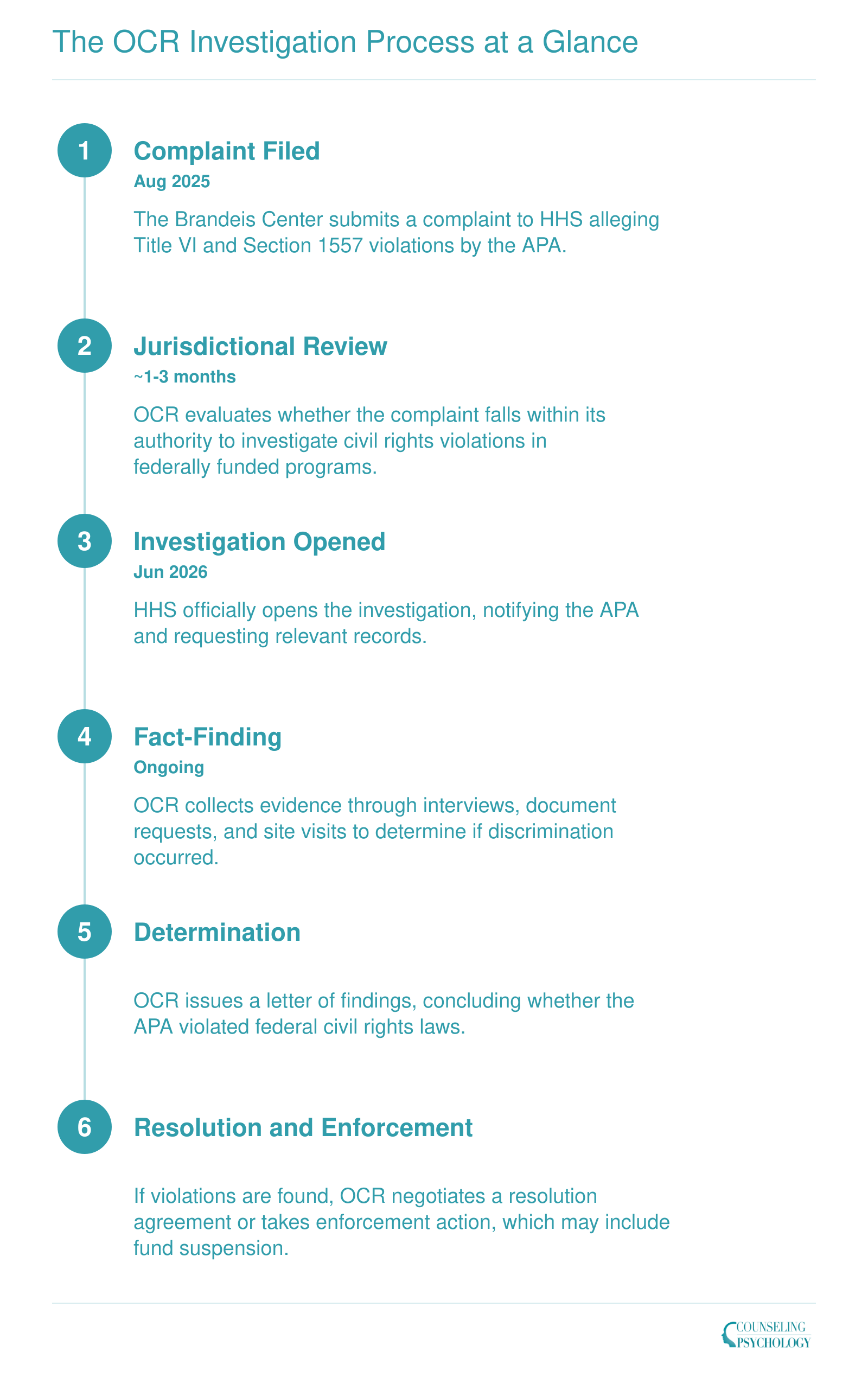
A civil rights complaint to HHS OCR must be filed within 180 days of the alleged discriminatory act, though that window may be extended for good cause.1 Complaints need to include basic elements: who was involved, what happened, when and where the alleged conduct took place. Once filed, OCR conducts a jurisdictional review to confirm the complaint falls under its authority, such as Title VI or Section 1557 of the Affordable Care Act. If the complaint meets those criteria, OCR opens an investigation and sends notification letters to both the complainant and the respondent, in this case the APA.1
Fact-Finding and Data Requests
Once an investigation is opened, OCR engages in a fact-finding phase. This can include requests for documents, data, and written responses from both parties. Site visits are allowed under OCR procedures, and OCR may also provide technical assistance to help the entity understand its compliance obligations.1 The standard of proof is a preponderance of the evidence, meaning OCR must find it more likely than not that a violation occurred. Throughout this stage, both sides have opportunities to present evidence and arguments.
Timeline and Resolution Options
Typical Title VI investigations can take many months, and complex cases often extend beyond a year. There is no fixed timeline, and much depends on the responsiveness of the parties and the volume of material to review. At the conclusion, OCR issues a letter of findings.2 If no violation is found, the case is dismissed. If a violation is identified, the preferred path is a Voluntary Resolution Agreement, where the entity agrees to take specific corrective actions, such as policy changes, training, or monitoring.2 If the entity refuses to cooperate, OCR can escalate to enforcement actions, including the termination of federal funds, though that step is rare and subject to administrative hearings.2
Confidentiality During the Process
OCR investigations are confidential while they are ongoing. Beyond the initial notification that a complaint has been accepted for investigation, parties are generally expected not to disclose details. This means public updates will be limited, and practitioners should be cautious about drawing conclusions from piecemeal information. Past OCR decisions, like those involving disability rights complaints, illustrate that the full factual record only becomes clear once a final determination is released.
- Preponderance of evidence: OCR must find it more likely than not that discrimination occurred.
- Voluntary resolution: The primary tool OCR uses to remedy violations without litigation.
- Federal fund termination: A last-resort enforcement mechanism if an entity refuses to comply.
- Monitoring: OCR typically monitors compliance with resolution agreements for a set period.2
The OCR Investigation Process at a Glance
The HHS Office for Civil Rights follows a structured multi-step process when investigating civil rights complaints against federally funded entities like the APA. Here is how it works.
Potential Consequences if Violations Are Found
If HHS finds that the APA violated Title VI or Section 1557, the consequences could shake the organization's operations and its central role in professional psychology. The range of possible outcomes spans from negotiated corrective action to the loss of federal dollars, and each carries distinct implications for practitioners who depend on APA standards.
The Range of Possible Outcomes
The HHS Office for Civil Rights (OCR) typically resolves investigations through one of several paths. At the lower end, a voluntary resolution agreement means the APA would admit no liability but commit to implementing specific reforms, such as revising its policies, providing staff training, and submitting to monitoring for a period that can stretch across multiple years.1 If OCR finds a violation and the APA does not voluntarily comply, the agency can escalate to a formal finding of discrimination and impose conditions on federal funding, including suspension or termination of financial assistance.2 In particularly severe cases, OCR can refer matters to the Department of Justice for further enforcement.
How Past OCR Actions Set a Pattern
Recent activity by HHS OCR offers concrete examples of what a resolution might look like. In 2026, OCR issued Dear Colleague guidance to medical schools directing them to eliminate race-based criteria in admissions, scholarships, fellowships, and training programs.3 That guidance led to active investigations into workforce training programs and medical education institutions where race-based practices were alleged.4 In one ongoing probe, OCR is examining a legal scholarship program's eligibility criteria, selection process, and promotional materials for potential Title VI violations.5 While these cases involve universities and training pipelines rather than a membership organization, the enforcement approach is consistent: OCR identifies a discriminatory practice, negotiates a corrective action plan, and monitors compliance over years. Resolution agreements typically require the entity to cancel memberships with race-restricted groups, audit programs, and publicly report steps taken.1
The Federal Funding Lever
The APA receives millions of dollars in federal financial assistance each year, which gives HHS significant leverage under Title VI. The statute allows the department to suspend or terminate funding to any recipient found to be discriminating on the basis of race, color, or national origin.2 Because the APA operates as both a professional society and a gatekeeper for accreditation and continuing education, losing direct federal grants, even temporarily, would be destabilizing. Even if funding is not cut off, the conditions attached to a resolution agreement often create substantial administrative burdens and can alter how the organization conducts its core business.
Organizational vs. Downstream Consequences
It is important to distinguish between consequences that land on the APA as an institution and those that trickle down to members. At the organizational level, a resolution might require the APA to restructure governance around diversity, equity, and inclusion initiatives, retrain leaders and convention staff, and adopt new complaint procedures. For practitioners, the ripple effects could include revisions to accreditation standards for graduate programs, changes to the content of approved continuing education courses, and even a temporary suspension of APA's ability to sponsor certain federal training grants. Licensed psychologists who rely on APA-approved CE for licensure renewal would need to stay alert for any modifications to the approved-provider system. Similarly, counseling, social work, and MFT professionals who engage with APA resources should be aware that the association's advocacy and standard-setting functions may shift as a result of an enforcement action.
The Investigation's Own Weight
Even without a formal finding of discrimination, an OCR investigation can prompt voluntary reforms. The publicity surrounding the allegation has already thrust the APA into a national conversation about antisemitism and ideological bias in healthcare organizations. Reputational damage alone may spur governance changes, new listening sessions, or early policy revisions designed to head off a harsher outcome. For mental health professionals, this means the landscape is already moving: the standards and ethical guidance you rely on could evolve in the near term, not just when a final resolution is announced.
Questions to Ask Yourself
What This Means for Practicing Psychologists and Counselors
The HHS investigation places a cloud of uncertainty over APA's accreditation and continuing education approval processes, directly impacting the licensure and professional development of practicing psychologists and counselors. While no immediate changes have been announced, professionals should understand how a potential adverse finding could alter the landscape of credentialing and training.
Licensing Board Requirements and APA Accreditation
State licensing boards are the gatekeepers for professional practice, and many align their requirements with APA-accredited programs.1 In states like Georgia, Hawaii, Massachusetts, Oklahoma, Pennsylvania, Tennessee, and Texas, graduation from an APA-accredited doctoral program is mandatory for psychologist licensure.1 If the U.S. Department of Education were to suspend or revoke APA's recognition as an accrediting body, one possible consequence of a Title VI violation, these state boards would need to decide whether to amend regulations, accept graduates from alternative accreditors, or grant waivers. As of now, no state board has publicly commented on the investigation, but the situation demands that practitioners monitor board websites and contact them directly for any guidance. Understanding psychology licensure requirements by state is a practical first step for any clinician tracking how this situation develops.
Alternative Accreditation Paths for Doctoral Programs and Internships
For doctoral programs in psychology, the Psychological Clinical Science Accreditation System (PCSAS) offers an alternative model focused on clinical science training. PCSAS is recognized by the Council for Higher Education Accreditation (CHEA) but has not yet gained wide adoption by state boards. Students in programs accredited by both APA and PCSAS face no immediate risk, but those in newer PCSAS-only programs should confirm acceptance with their intended state board. For internships, APA accreditation is the standard, and few alternatives exist. The Valley Health Psychology Internship Program, for instance, holds APA accreditation on contingency through 2026,2 and any disruption to APA's authority could delay full accreditation for such programs. By contrast, Virginia State University's Clinical Health Psychology PhD Program recently secured a 10-year APA accreditation effective November 2025, with its next review not until 2035,3 illustrating how program-level accreditation timelines vary considerably. Counseling and social work programs are generally accredited by CACREP and CSWE, respectively, and are not directly in the scope of this investigation.4
Continuing Education and State Board Alternatives
Many psychologists and counselors depend on APA-approved continuing education (CE) sponsors to meet renewal requirements. If APA's CE sponsorship program were to lose federal recognition, state boards would likely need to identify alternative CE providers. Practitioners should proactively ask their state board whether they accept CE from non-APA sources such as the American Counseling Association, National Association of Social Workers, or state psychological associations. Document all communication and regularly review board updates, as emergency regulations could be adopted quickly.
Staying Informed as the Situation Unfolds
Given the lack of formal board statements, the most reliable sources of information will be official state licensing board websites, the APA's own communications, and the U.S. Department of Education's database of recognized accrediting agencies. Professional association forums, including APA's member communities, state psychological associations, and listservs, may surface early discussions and informal guidance. Additionally, the Bureau of Labor Statistics (BLS.gov) can direct practitioners to state licensing board contacts. The investigation is a developing matter, so vigilance and direct inquiry are essential.
Implications for Counseling, Social Work, and MFT Professionals
As mental health disciplines grow more integrated, no single professional association operates in isolation.
The APA's Reach Across Disciplines
The American Psychological Association's influence extends well beyond its 172,000 members. Counselors, social workers, and marriage and family therapists routinely intersect with APA guidelines. The Diagnostic and Statistical Manual of Mental Disorders (DSM), published by the APA, serves as the primary diagnostic framework across mental health fields. CACREP and CSWE-accredited programs often require foundational coursework in psychological theories and assessment methods grounded in APA literature. Even where independent bodies like the National Association of Social Workers (NASW) or the American Association for Marriage and Family Therapy (AAMFT) set distinct ethical codes, they frequently reference APA research standards and evidence-based practice models.
When Research Credibility Is at Stake
If the APA's institutional credibility is undermined by findings of systemic discrimination, the ripple effects reach into clinical training and practice everywhere. APA-published journals and clinical guidelines form the backbone of continuing education for many licensed professionals. A federal determination that the APA fostered a hostile environment could lead practitioners across disciplines to question the objectivity of research that informs treatment protocols for anxiety, trauma, and cross-cultural care. Social workers and MFTs who rely on APA-endorsed assessment tools or integrated health models may face increased scrutiny from clients and supervisors about the foundations of their clinical decisions. These concerns connect directly to a cultural mistrust in mental health therapy that already complicates access to care for many communities.
Independent Accreditation, Overlapping Ethics
Although CACREP, CSWE, and COAMFTE maintain separate accreditation processes, their ethical frameworks share common roots with the APA's Ethical Principles of Psychologists and Code of Conduct. A precedent where federal sanctions target a major mental health association for Title VI violations could embolden complaints against other professional bodies. Counseling and social work programs that have incorporated APA style guidelines into student handbooks or cite APA position statements on diversity may need to reevaluate those references if the investigation reveals institutional failures. This isn't about guilt by association, but about the practical reality that standards-setting bodies model behavior for the entire field.
The Broader Concern: Ideological Capture
The core issue raised by the HHS investigation is whether ideological capture can compromise clinical training quality. If any major association allows political biases to shape continuing education content, the risk extends to clinicians who may receive skewed instruction on culturally sensitive care. Counselors and social workers bound by their own ethics codes to provide competent, non-discriminatory services cannot afford to import unexamined biases from compromised training sources. The situation underscores the need for all mental health professions to maintain transparent, evidence-based educational standards that withstand external scrutiny. This pressure arrives alongside a broader mental health workforce shortage that makes the integrity of professional training even more consequential.
APA's Response and the Broader Professional Debate
On June 19, 2026, just two days after the HHS investigation was announced, APA leadership sent a member update acknowledging the federal probe.1 The communication, sent via email and posted to the association's website, stated that the APA would cooperate fully with the investigation while reiterating the organization's opposition to antisemitism. Notably, no formal press release was issued at that time, a departure from the APA's usual practice for major external inquiries.2
Internal Actions Before the Investigation
Even before the Brandeis Center filed its complaint in August 2025, the APA had begun addressing concerns about antisemitism within the organization. In June 2025, the Board of Directors committed to a series of listening sessions with Jewish members and stakeholders.1 By February 2026, the board adopted a formal resolution on antisemitism, explicitly denouncing anti-Jewish bias and outlining steps to ensure inclusive environments at APA events and in all publications.3 A task force was subsequently established to review policies, conference programming, and listserv guidelines, though its full findings have not yet been released.
The Professional Debate
Reactions within psychology, counseling, and social work circles reflect a deep divide. Supporters of the APA's recent direction, including its 2021 apology to people of color and expanded social justice initiatives, view the organization's advocacy as a necessary ethical stance. They argue that criticizing Israeli government policies or discussing decolonization in mental health is within the bounds of professional discourse and free expression.
Critics, including many Jewish members who spoke to the Brandeis Center, contend that the line between scholarly critique and antisemitic harassment has been crossed.4 Reports of attendees being targeted at conferences, listserv messages glorifying violence, and a perceived reluctance by leadership to intervene have fueled concerns that the association has become an ideological echo chamber rather than a professional home for all psychologists.
As of July 2026, no other major mental health professional bodies, such as the American Counseling Association or the National Association of Social Workers, have issued public statements about the APA investigation. The silence is notable, given that many licensed professional counselors and social workers also rely on APA resources for continuing education and ethical guidance. For now, the outcome of the federal probe remains uncertain, and the professional community watches closely.
What Should Mental Health Professionals Do Now?
In a rapidly evolving investigation, staying informed and proactive protects your practice and professional standing. The following steps can help you navigate the uncertainty without overreacting.
Verify Your Continuing Education Requirements
State licensing boards set continuing education (CE) rules independently, and many already accept credits from approved providers beyond the APA. Review your board's website to confirm which CE sponsors are recognized. Common alternatives include: - NBCC: The National Board for Certified Counselors approves CE for counselors and often for social workers and marriage and family therapists. - State-specific boards: Many state psychology and social work licensure requirements boards maintain their own lists of approved sponsors, which can include universities, hospitals, and specialty organizations. - Specialty organizations: Groups like the Association for Behavioral and Cognitive Therapies (ABCT) and the American Counseling Association (ACA) offer CE that may satisfy state requirements.
Do not abruptly abandon APA-approved courses that are already planned if your state still accepts them. Instead, confirm that you have enough flexibility to meet renewal deadlines in case APA's CE status changes. Document your CE activities and keep receipts, as boards may ask for proof if standards shift.
Stay Informed Through Official Channels
Bookmark and check the HHS Office for Civil Rights (OCR) announcement page and the APA's governance updates. State licensing boards often post regulatory alerts when a national CE sponsor faces a compliance action. Subscribing to newsletters from your state professional association and the APA's member communications will give you timely, factual updates. Students in APA-accredited programs should follow their program director's guidance; accreditation changes require a lengthy process with teach-out protections, so an abrupt loss of accreditation is unlikely.
Engage With Professional Ethics Processes
If you have witnessed or experienced ideological bias in CE programming or association governance, use established ethics and grievance channels. The APA has an ethics complaint process for members, and many state associations have similar mechanisms. Document incidents clearly, focusing on professional standards and specific conduct, and submit them through the proper avenues. This preserves a record and contributes to systemic accountability without relying on public controversy.
Consider the Role of Advocacy in Professional Standards
The investigation invites a broader reflection on the balance between advocacy and clinical science within professional bodies. Ask yourself how your professional associations align with your ethical obligations to provide scientifically grounded, culturally competent multicultural counseling care. Encourage your organizations to prioritize evidence-based education and transparent governance. By participating in association meetings, voting in elections, and voicing concerns through official channels, you help shape standards that protect both client welfare and professional integrity.
Frequently Asked Questions About the HHS APA Investigation
This investigation has raised urgent questions for psychologists, counselors, and social workers. Below are clear, factual answers grounded in the latest 2026 developments.