
What you’ll learn in this article…
- Virginia's Telemental Health Initiative delivered over 7,300 telehealth appointments to 570 uninsured patients in 2025.
- Eight states including Arizona and New York permanently adopted pandemic-era telehealth flexibilities for counselors.
- Interstate licensure compacts are emerging to allow counselors to practice telehealth across state lines.
- The BLS projects 48,300 new mental health counselor jobs by 2034, a 17% growth rate.
Can mental health counselors practice telehealth across state lines now that pandemic flexibilities have been made permanent? In over two dozen states, the answer is yes, but the rules differ dramatically from one jurisdiction to the next. Workforce shortages, interstate compacts like the Counseling Compact, and state-level policy permanence are reshaping where and how counselors can work. What this means in practice is still evolving. Virginia's Telemental Health Initiative shows that supervised telehealth can simultaneously expand access, address the behavioral health workforce shortage, and provide clinical hours for post-graduate counselors, yet licensure portability barriers and reimbursement complexities remain real hurdles for counselors entering remote practice.
What Is Telemental Health Counseling and Why Is It Expanding?
Telemental health counseling has reshaped how Americans access mental health care, but the shift raises critical questions about long-term effectiveness, professional standards, and equitable access. What began as a crisis stopgap has become a permanent service model, with implications for everyone from pre-licensed volunteers to seasoned private practitioners.
Defining Telemental Health Counseling
Telemental health counseling is the delivery of psychotherapy, assessment, and related clinical services via secure videoconferencing, phone, or asynchronous messaging. It mirrors in-person treatment in scope, covering diagnoses like anxiety, depression, trauma, and substance use, but removes geographic barriers. Licensed professional counselors, clinical social workers, marriage and family therapists, and psychologists all practice under their state's scope-of-practice rules, often with additional telehealth-specific consent and privacy requirements.
From Crisis Response to Permanent Fixture
Before the pandemic, less than 1% of behavioral health outpatient visits happened virtually.1 By 2025, that figure had jumped to 40% for youth mental health encounters alone.2 Across all ages, 26.3 million U.S. adults accessed virtual mental health services in 2024,3 representing a substantial share of the 14% of adults who received any counseling that year.4 Nationwide, behavioral health conditions accounted for 67% of all telehealth encounters in 2024, far outpacing primary care, a pattern reinforced by insurer reports showing mental health visits remain the top telehealth claim category.5 The American Hospital Association confirmed that behavioral health outpatient visits hit 66.4 million nationally in 2024, with telehealth as a primary access point.5 Even facility readiness has caught up: 88.1% of mental health care facilities reported telehealth capability as early as September 2022.6
Why Expansion Continues
Clinical necessity and policy together drive this growth. The mental health workforce shortage is especially acute in rural counties, where over 30% face provider shortages. Telehealth bridges that gap, with Colorado data showing mental health conditions represented 58% of all telehealth visits in 2023, and utilization rates holding at 35 services per 1,000 people per month, a remarkably steady demand since 2020.7 State-level licensure compacts and emergency waivers that were initially temporary are now being codified, expanding practice across state lines. Understanding how insurance changes affect mental health counselors is equally important as agencies and private practices embed virtual care into their long-term service portfolios.
Key State Telehealth Policy Changes Counselors Should Know
By mid-2026, at least eight states, including Arizona, Colorado, Delaware, Illinois, Maine, Massachusetts, New York, and Oregon, have permanently adopted the telehealth flexibilities first introduced during the COVID-19 pandemic.1 These changes directly affect how licensed mental health counselors can deliver and bill for remote services.
Permanent Flexibilities and Payment Parity
Each of these states has enacted legislation or regulatory updates that make telehealth a permanent option for behavioral health providers. This means counselors are no longer operating under temporary waivers that could expire. Just as important, payment parity laws require private insurers to reimburse telehealth visits at the same rate as in-person sessions. Arizona, Colorado, and Oregon all have payment parity on the books, removing financial disincentives for offering virtual care.1 Illinois carries robust parity protections as well, and Massachusetts and New York have enacted strong coverage requirements of their own.
Audio-Only Sessions and Consent Requirements
Telehealth is not limited to video platforms. All eight states permanently allow audio-only sessions for behavioral health, a critical flexibility for clients who lack reliable internet or prefer phone contact.1 Counseling practices can use phone calls as a fully covered treatment modality. Informed consent processes have also been streamlined. Rather than mandating a separate written consent before each session, states like New York, Maine, and Massachusetts accept verbal consent documented in the clinical record. Delaware and Arizona require minimal documentation, integrating telehealth consent into standard intake paperwork. This reduces administrative burden and makes it easier for counselors to start seeing clients remotely.
What This Means for Your Career
For mental health counselors, these policy shifts open up several practice pathways. You can now launch a telehealth-only private practice in a licensure-friendly state and bill insurers with confidence. You can work for an agency that serves clients across a wide geographic area. The permanent status also signals to employers that remote services are a stable, long-term part of mental healthcare delivery, which supports job creation. Counselors licensed in states with these provisions are well-positioned to meet growing demand, especially from rural mental health services gap communities. As more states consider similar legislation, staying informed about your own state's status will be essential for maximizing career opportunities. Tracking insurance changes affecting mental health counselors in 2026 alongside telehealth policy is equally important, since reimbursement rules and parity enforcement continue to evolve.
The Virginia Telemental Health Initiative: A Workforce Model Worth Watching
A First-in-the-Nation Model
The Virginia Telemental Health Initiative (VTMHI) stands out as a pioneering effort that combines free telehealth services with structured workforce development. Launched as a pilot in 2022 and expanded to full scale in 2024, the program serves uninsured and underinsured residents through a network of 31 free clinics. According to Public Health Watch, the initiative is the first of its kind nationally, offering a replicable template for other states seeking to address mental health access shortages while building the next generation of licensed providers.1
By the Numbers: Growth and Reach
In 2025 alone, VTMHI scheduled more than 7,300 appointments, connecting over 570 patients with 61 post-graduate volunteer counselors.1 These counselors work under clinical supervision, providing telemental health services as they complete the hours required for licensure. The initiative not only delivers care to vulnerable populations but also creates a pipeline of experience for early-career professionals. Anxiety and depression emerged as the top diagnoses in 2025, reflecting the widespread need for accessible mental health support.
Bilingual Demand and Cultural Competence
One of the most striking features of VTMHI is the demographic it serves. Approximately 80% of referred patients are bilingual, underscoring the urgent demand for culturally responsive, multilingual counseling.1 This statistic highlights an overlooked gap in the mental health workforce: many communities, particularly immigrant and rural populations, need providers who can communicate in their preferred language. Counselors who have pursued multicultural counselor training will find telehealth opens doors to serving diverse clients who might otherwise go without care.
Workforce Development Through Supervised Practice
The initiative employs a "grow your own" workforce strategy. Post-graduate counselors volunteer their time, receive clinical supervision, and accumulate the direct client hours needed for licensure requirements. This model addresses a common barrier for new graduates: the "experience gap" where full licensure requires work experience that is often hard to obtain before being licensed. By embedding supervision into the service delivery framework, VTMHI ensures quality care while smoothing the path to independent practice. Other states grappling with behavioral health workforce shortages may look to this model as a cost-effective way to train and retain mental health professionals.
Bridging Rural Mental Health Gaps
Virginia's mental health landscape is marked by stark geographic disparities. More than 30% of the state's counties face a shortage of mental health workers, and three-quarters of those underserved counties are rural.1 Telehealth bypasses the barriers of distance, transportation, and clinic availability, allowing counselors to reach clients in regions where in-person services are scarce. The VTMHI demonstrates that with adequate funding, a statewide telehealth network, and a commitment to supervised training, it is possible to expand access meaningfully even in the most remote communities.
The Virginia Telemental Health Initiative is more than a single-state success story; it is a proof of concept for innovative policy and workforce planning. For mental health counselors, it signals that state-level telehealth expansions are creating new career pathways, especially for those who are bilingual, culturally competent, and willing to work in underserved areas. As telehealth legislation evolves across the country, models like VTMHI will likely influence how states invest in both access and professional development.
For pre-licensed counselors, Virginia's Telemental Health Initiative proves that supervised telehealth can simultaneously address workforce shortages, expand access to care, and provide the clinical hours needed for licensure. This model could be a blueprint for other states to train counselors while meeting community needs. It exemplifies how telehealth expansions create career pathways for new counselors while serving rural and underserved populations.
Licensure Portability and Interstate Compacts for Telehealth Counselors
The rapid expansion of telehealth has outpaced the patchwork of state licensure laws, leaving many counselors uncertain about when they can legally serve a client across state lines.
The Licensure Barrier to Telehealth Expansion
A mental health counselor licensed in Illinois cannot legally provide teletherapy to a client who is physically located in Wisconsin unless they hold a separate Wisconsin license or are covered by a legal mechanism like a compact. This is the fundamental barrier that has slowed remote practice growth even as demand for virtual services surges. State licensure boards regulate practice based on where the client sits at the moment of the session, not where the counselor's office is. For counselors looking to serve clients in multiple states, the traditional solution was to pursue additional state licenses, a costly and time-consuming process that often takes months. Without some form of interstate recognition, the promise of telehealth remains geographically limited.
The Counseling Compact: What It Is and How It Works
The Counseling Compact is a legally binding agreement among states that creates a pathway for licensed professional counselors to practice in multiple member states without obtaining a new license in each one.1 As of mid-2026, 39 to 40 jurisdictions have enacted legislation to join the compact, though only six states have fully operationalized the system: Arizona, Minnesota, Ohio, Louisiana, Georgia, and Indiana.1
Once a state becomes operational, counselors from other member states can apply for a "privilege to practice" in that state. This privilege is not a full license but a time-limited authorization that allows a counselor to deliver services in person or via telehealth to clients located in that state.2 To qualify, a counselor must hold a current, unencumbered license in their home state, have completed at least 60 graduate semester hours, and passed a nationally recognized exam such as the NCE or NCMHCE.3 The compact charges an administrative fee of $30 per privilege request, plus initial and renewal privilege fees of $55 each.4 Individual member states may add a fee ranging from $0 to $264, so the total cost can vary.3 Once issued, the privilege is linked to the counselor's home state license: if the home license lapses or is disciplined, all compact privileges are affected.
The compact explicitly covers telehealth services, meaning counselors can use the privilege to see clients remotely in any operational state.2 Counselors interested in using the compact should check the Counseling Compact Commission website for the latest list of operational states and application instructions, as more states are expected to go live in the coming months.
How the Counseling Compact Differs from Other Compacts
Mental health providers sometimes confuse the Counseling Compact with similar mechanisms for psychologists (PSYPACT) and social workers (the Social Work Compact). These are separate agreements with different eligibility rules and member states. PSYPACT, for example, has been operational longer and covers doctoral-level psychologists, while the Social Work Compact addresses licensure portability for social workers and is still in early stages. The Counseling Compact is specifically designed for licensed professional counselors and follows its own timeline for enactment and operation. For master's-level counselors, this is the primary vehicle for cross-state telehealth practice.
Who Benefits Most from Counseling Compact Telehealth Provisions
The compact is particularly valuable for counselors in private practice who want to maintain client relationships when a client moves temporarily or relocates to another compact state. Telehealth platform employees, who may be matched with clients from anywhere in the country, also benefit because the compact streamlines the verification process. Military spouse counselors, who frequently relocate due to military orders, stand to gain the most: the compact allows them to continue practicing in a new state without restarting the full licensure process. These groups can leverage the compact to grow their client base and maintain continuity of care.
Limits of the Compact: What It Doesn't Solve
Despite its promise, the compact does not eliminate all barriers. It only applies to states that have both enacted and operationalized the legislation, so counselors in non-member states cannot use it. Even within member states, a privilege to practice is not universal: it covers the specific state requested and must be obtained for each additional state where the counselor wants to serve clients. The compact also does not override state-specific scope-of-practice rules; for instance, if a state requires separate authorization for telehealth assessments not covered by the compact, counselors must comply with that state's additional regulations. Finally, the compact does not address reimbursement parity or other business aspects of telehealth, so counselors must still navigate insurance panels and billing rules state by state.
Related Articles
How to Become a Telehealth Counselor: Training, Certifications, and Technology
Marshall University offers a free Telebehavioral Health Microcredential, featuring 10 clinical hours and virtual on-demand coursework, approved for the Board Certified-TeleMental Health Provider (BC-TMH).1 This no-cost pathway illustrates the expanding options for counselors to build telehealth competencies on top of their foundational education.
Baseline Path: Licensure First, Then Telehealth Modality
Telehealth is a modality, not a separate profession. The baseline remains a master's degree in clinical mental health counseling online programs, marriage and family therapy, social work, or a related field, followed by state licensure (LPC, LCPC, LMHC, LCSW, LMFT). Once licensed, counselors integrate telehealth-specific training to practice remotely. This training covers legal, ethical, and clinical competencies unique to digital service delivery, not a replacement for clinical skills.
Telehealth-Specific Credentials and Training Programs
Several formal credentials signal advanced telehealth competence. The Board Certified-TeleMental Health Provider (BC-TMH), issued by the Center for Credentialing and Education (CCE), requires a qualifying behavioral health license and completion of approved training.2 Costs and exact requirements may shift annually, but the credential demonstrates commitment to best practices in virtual care.
University and continuing-education options now abound. Key programs include:
- Marshall University Telebehavioral Health Microcredential: Free, asynchronous, 10 clinical hours, BC-TMH-approved, funded by a U.S. Department of Labor grant.1
- USC Telebehavioral Health Practice Graduate Certificate: 12-credit program (approx. $25,644 total) available on-campus or online, providing in-depth graduate-level instruction.3
- Telehealth Certification Institute TeleMental Health Training Program: 15.5 clinical hours, priced at $545 (promotional rate), focusing on legal and ethical issues.4
- Harborview TeleBehavioral Health 101: A series that satisfies Washington State's telehealth training requirement, often taken for foundational knowledge.5
- ACHC Telehealth Certification: A 36-month organizational certification; individual clinicians may find it less relevant, but it signals facility-level compliance.6
The BC-TMH remains the most portable, nationally recognized individual credential. Counselors should verify that their chosen program is BC-TMH-approved if they seek that designation.
Technology Competencies and HIPAA-Compliant Platforms
Clinical competence in telehealth requires more than a webcam. Practitioners must be proficient with HIPAA-compliant videoconferencing tools such as Doxy.me, SimplePractice, or Zoom for Healthcare. Technical readiness includes a reliable computer, HD camera, good lighting, secure broadband, and a private, soundproofed space that protects client confidentiality. Digital literacy extends to troubleshooting connection issues, using screen-sharing for psychoeducation, and maintaining electronic records securely. Many states now mandate specific telehealth training hours as part of licensure renewal, underscoring technology competence as an essential clinical skill. For a broader look at where these tools are taking the field, technology trends in counseling offer useful context.
Telehealth for Pre-Licensed Counselors: State-by-State Oversight
Most states allow pre-licensed counselors to provide telehealth under approved supervision, but rules vary widely.7 Some states require the supervisor to hold a full license and be physically present in the jurisdiction, while others allow remote supervision. The Virginia Telemental Health Initiative demonstrates one model: post-graduate volunteers working toward licensure deliver free telehealth to uninsured patients through free clinics, supervised by licensed clinicians. This approach addresses workforce shortages while giving pre-licensed counselors critical telehealth clinical hours for psychology students. Aspiring telehealth counselors must check their state board's specific rules on supervised telepractice before launching virtual services.
Questions to Ask Yourself
What Telehealth Counselors Earn: Salary Data and Compensation Models
Telehealth counselor compensation varies widely based on employment arrangement, clinical hours, licensure status, and the platform or setting where services are delivered. Grasping the landscape of pay structures is the first step toward building a sustainable remote practice.
W-2 Employment vs. 1099 Contracting
Most telehealth platforms engage counselors either as W-2 employees or as 1099 independent contractors. W-2 positions typically offer steady hourly wages or salaries, along with benefits such as health insurance, retirement contributions, and client referrals managed by the employer. In contrast, 1099 arrangements give counselors more autonomy over their schedules and caseloads but shift the burden of taxes, insurance, and benefit sourcing onto the individual. Newer counselors often prefer W-2 roles for stability and supervised experience, while experienced clinicians may opt for contracting to maximize flexibility and earning potential.
Per-Session Rates and Platform Pay Models
Many online therapy platforms compensate counselors on a per-session basis rather than a direct hourly wage. Payment structures may include flat fees per completed 45- or 60-minute session, with some platforms offering higher rates for specialized modalities or couples work. Compensation can also vary based on the payer source: self-pay clients, counselor reimbursement rate trends 2026, or employee assistance program contracts. Counselors should carefully review platform agreements to understand how cancellations, no-shows, and administrative time are handled, as these policies directly impact take-home income.
Comparing Telehealth Income to Agency and Private Practice Rates
When evaluating telehealth opportunities, it is critical to benchmark platform compensation against local agency salaries and psychologist salary data as a broader reference point. A counselor's geographic location, area of specialization, and client population all influence market rates. While some platforms offer competitive reimbursement that rivals brick-and-mortar clinics, others may pay less than what a counselor could earn independently. Factoring in overhead costs, such as office rent, billing support, and technology for a private practice, can help clarify the true financial trade-offs.
Where to Find Reliable Salary Data
Counselors seeking current earnings benchmarks should consult multiple sources. The U.S. Bureau of Labor Statistics publishes median wage data for mental health and substance abuse counselors and breaks it down by state and metropolitan area. Professional organizations like the American Counseling Association and the American Mental Health Counselors Association periodically release member salary surveys that capture telehealth-specific trends. Reviewing active job postings on LinkedIn, Indeed, and Glassdoor can reveal current per-session rates and contractor versus employee classifications. Finally, connecting with colleagues through professional networks and state counseling boards offers firsthand insights into local compensation norms and negotiation strategies.
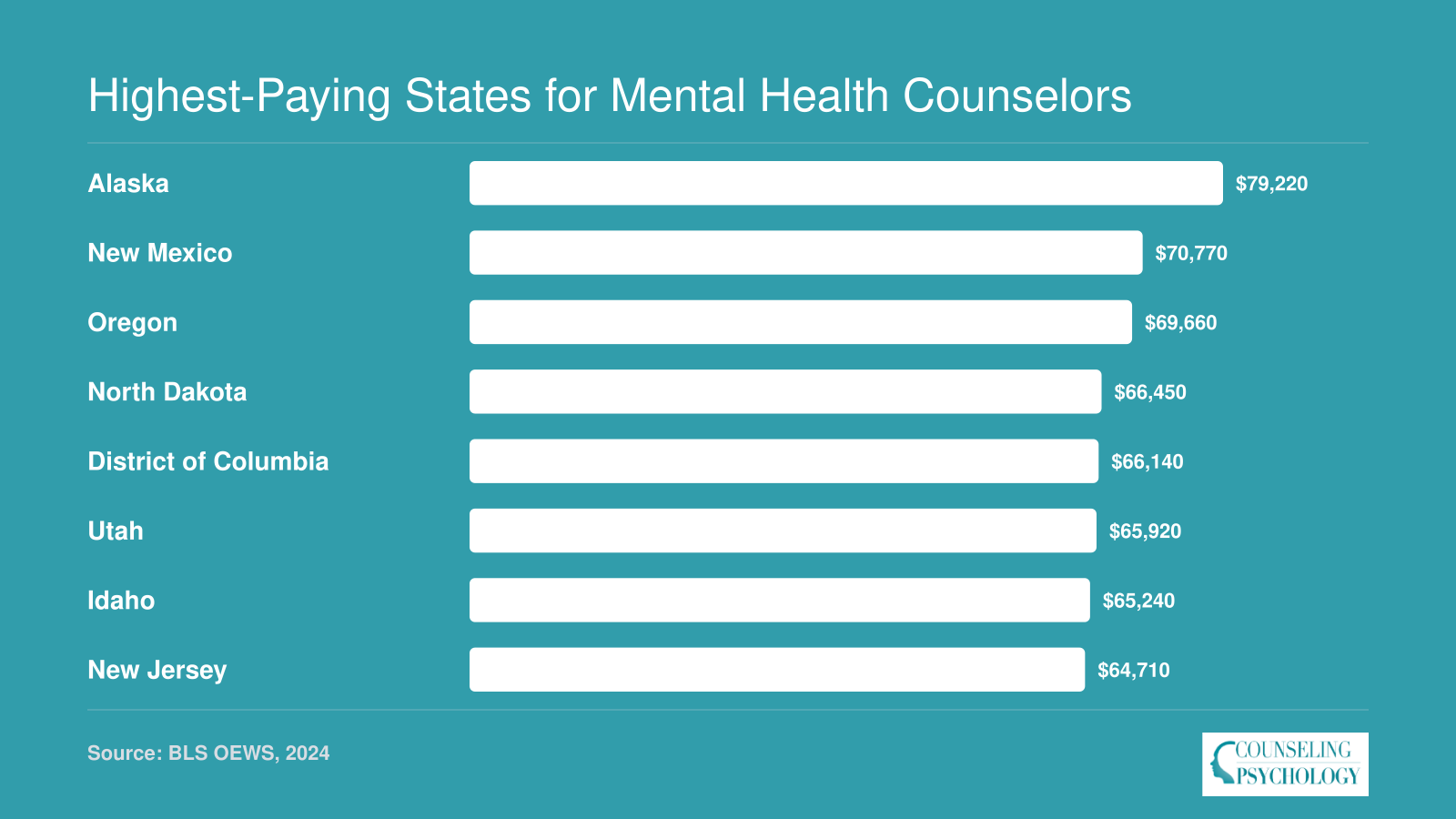
Highest-Paying States for Mental Health Counselors
The figures below represent median annual salaries for the broader occupation of substance abuse, behavioral disorder, and mental health counselors according to the Bureau of Labor Statistics. Telehealth-specific compensation can differ based on employment model, whether through a teletherapy platform, private practice, or agency setting.
Telehealth Vs. In-Person Counseling Careers: Pros, Cons, and Key Differences
Telehealth counseling has rapidly become a viable career path alongside traditional in-person practice, each with distinct advantages and trade-offs. While studies generally show comparable clinical outcomes for treating anxiety and depression, telehealth counselors often manage larger caseloads due to reduced commute and transition time, though this can increase burnout risk if not carefully managed.
Pros
- Telehealth provides geographic flexibility, allowing counselors to work from anywhere and serve clients across state lines where permitted by licensure compacts.
- Lower overhead costs without the need for physical office space can increase take-home pay, especially in private practice.
- Access to a wider client pool enables specialization in niche populations that may be geographically dispersed, such as LGBTQ+ youth or bilingual communities.
- The ability to set flexible hours often improves work-life balance and reduces commuting stress.
Cons
- Screen fatigue is a real risk, as back-to-back video sessions can drain energy faster than in-person interactions and contribute to burnout.
- Managing crisis situations remotely is more difficult without the ability to physically intervene or read subtle body language cues.
- Certain therapeutic modalities, such as play therapy or somatic techniques, are challenging to adapt effectively to a virtual format.
- Working from home can lead to professional isolation, missing the informal support and collaboration of a shared office environment.
- Technology barriers may exclude clients with limited internet access, low digital literacy, or severe mental health symptoms that require in-person care.
The Bureau of Labor Statistics projects a 17% growth in jobs for substance abuse, behavioral disorder, and mental health counselors from 2024 to 2034, much faster than the average for all occupations. This translates to about 48,300 new job openings each year, signaling strong demand for remote and in-person providers alike.
How to Capitalize on Telehealth Expansion: Career Strategies for Counselors
How can counselors actually build a career around the new telehealth opportunities cropping up across the country? The answer lies in a mix of deliberate specialty selection, business model choice, and geographic strategy. Here's a practical roadmap.
Private Practice vs. Platform-Based Models
The first decision is how to structure your telehealth work. Each path carries distinct trade-offs.
- Private practice: You set your own rates, typically ranging from $80 to $150 per session depending on licensure and market, but you're responsible for marketing, credentialing, insurance billing, and scheduling. Tools like SimplePractice or TherapyNotes streamline admin, while Alma and Headway help with insurance paneling in exchange for a per-claim fee. This route offers higher per-session revenue and full clinical autonomy, but building a caseload can take 6-12 months.
- Platform-based work: Companies like BetterHelp, Talkspace, and Cerebral provide instant client flow and handle billing, but they pay significantly less, often a flat rate per hour or per text interaction. BetterHelp, for example, pays counselors based on total client hours via a tiered model, averaging roughly $30-$50 per hour. The trade-off is lower control over client assignment, session frequency, and treatment modality. These platforms work well for supplementary income or while building a private practice, but rarely sustain a full-time private-practice income on their own.
Many successful telehealth counselors use a hybrid approach: part-time platform work for steady referrals while growing a private pay or insurance-based private practice on the side.
High-Demand Telehealth Specialties
Generalist telehealth counseling is crowded. To stand out, focus on a counseling specialty where demand is surging and provider shortages are acute.
- Anxiety and depression: These remain the most common presenting concerns, accounting for roughly two-thirds of telehealth visits in many programs. Specialized training in CBT, ACT, or EMDR delivered online can set you apart.
- Perinatal mental health: The postpartum period is a high-risk window for depression and anxiety. Telehealth eliminates transportation and childcare barriers, making it especially attractive for new parents.
- Bilingual counseling: In the Virginia Telemental Health Initiative, about 80% of patients referred for services are bilingual. Spanish-speaking counselors are urgently needed, but other languages like Mandarin, Arabic, and Vietnamese also represent significant unmet needs. Even conversational proficiency, paired with cultural humility training, can open doors.
- LGBTQ+ affirming care: Many rural or conservative areas lack affirming providers. Telehealth allows clients to connect with specialized counselors regardless of geography, and platforms like the National Queer and Trans Therapists of Color Network actively seek virtual providers.
- Remote worker support: With the rise of distributed teams, counselors who understand the isolation and burnout unique to remote work find a ready audience. Marketing directly to tech companies or coworker support groups can generate a steady stream of clients.
Navigating Rural and Urban Markets
Your location strategy shapes everything from reimbursement to regulatory ease.
- Rural-focused telehealth: Programs like the Virginia Telemental Health Initiative pair supervised postgraduate volunteers with free clinics in underserved counties. Counselors willing to serve Health Professional Shortage Areas (HPSAs) may qualify for federal loan repayment through the NHSC (up to $50,000 for a two-year commitment) or state-level incentives. These positions often come with administrative support and clinical supervision, lowering the barrier to entry. Telehealth also enables counselors to serve multiple rural counties from a single home base. The rural mental health workforce shortage makes these roles especially accessible for early-career clinicians who are willing to work in high-need communities.
- Urban and suburban markets: Competition is stiffer, but client volume and willingness to pay out-of-pocket are higher. Success often depends on a strong niche, strategic partnerships with local primary care offices, or in-network status with major insurers. Urban counselors may also find opportunities contracting with employee assistance programs (EAPs) or tech startups that offer mental health benefits. Understanding how insurance changes affect counselor reimbursement rates can be decisive when choosing whether to go in-network or focus on private-pay clients.
Action Steps for Pre-Licensed Counselors
You don't need to wait for full licensure to start building your telehealth career. These steps can position you ahead of the curve.
- Seek supervised telehealth training experiences: Some practicum and internship sites now offer remote clinical hours under supervision. If yours doesn't, ask if you can pilot a telehealth component using HIPAA-compliant tools. Mastery of videoconferencing, digital safety planning, and virtual rapport-building is now a core clinical skill.
- Pursue BC-TMH certification early: The Center for Credentialing & Education offers the Board Certified-Telemental Health Provider credential. While not universally required, it signals competence to employers and payers and can be earned while still under supervision. The exam covers legal, ethical, and technology standards specific to remote practice.
- Target states with Counseling Compact membership and telehealth-friendly supervision rules: The Compact allows counselors to practice across member states without getting a new license. Research which states count supervised telehealth hours toward full licensure and allow virtual supervision. States like Florida, Texas, and North Carolina have relatively clear telehealth supervision policies.
- Document everything with a telehealth lens: Keep a log of your telehealth-specific competencies: screen-based assessment, crisis management via video, and adapting evidence-based protocols for the digital space. These details strengthen your resume for telehealth-only roles that are now proliferating on job boards like Indeed and state workforce portals.
Frequently Asked Questions About Telehealth Counseling Careers
With rapidly evolving state policies, telehealth has created new career pathways for mental health counselors. Below are answers to some of the most common questions about providing telemental health services today.