
What you’ll learn in this article…
- Frontiers in Psychology 2026 study found nature-based walk-and-talk produced the strongest outcomes.
- Screen clients for confidentiality, physical ability, and preferences before offering outdoor sessions.
- Outdoor practice requires informed consent, preplanned routes, insurance coverage, and weather documentation.
Therapy is moving outdoors with enough momentum that the format is now attracting empirical scrutiny, part of broader trends in counseling and psychotherapy. A study published August 13, 2026, in Frontiers in Psychology measured psychological and physiological responses across a fixed sequence of indoor, urban, and nature-based walk-and-talk sessions.1 Nature-based settings showed the strongest benefits on key outcomes.
That finding arrives as more counselors weigh walk-and-talk as a complement to office-based care. The clinical appeal is clear: movement, less direct eye contact, and easier rapport. But the format also raises immediate questions about confidentiality, route safety, and client screening.
The practical tension is no longer whether the evidence exists, but how to translate it into sessions that remain ethical, safe, and clinically sound outside a controlled office.
What Is Walk-And-Talk Therapy? Defining the Modality
Walk-and-talk therapy is a distinct clinical format, not simply a casual walk outdoors, and it deserves to be defined separately from broader nature-based interventions.
A working definition
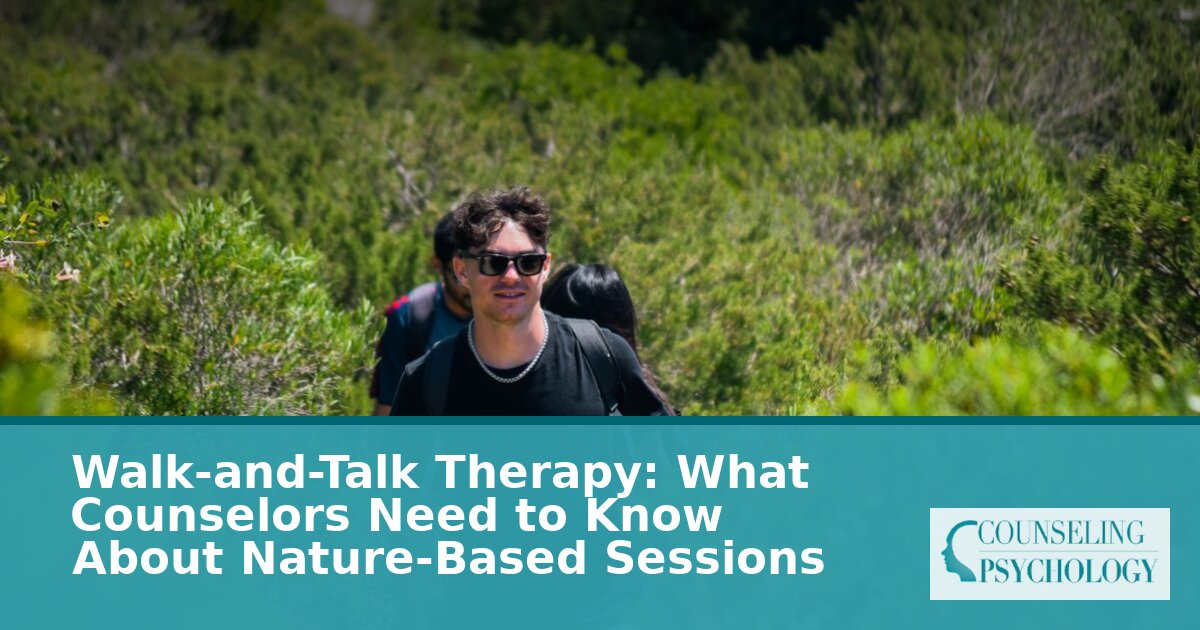
Walk-and-talk therapy is a structured counseling or psychotherapy session in which the clinician and client conduct the therapeutic conversation while walking together, usually outdoors. It sits within the wider family of ecotherapy and outdoor therapy, but it is narrower: the defining element is the moving, side-by-side conversation rather than gardening, animal-assisted work, wilderness immersion, or stationary outdoor sessions. Broader ecotherapy may include horticultural therapy, animal-assisted interventions such as equine assisted therapy, or conservation activities; walk-and-talk specifically uses locomotion as the therapeutic medium. In practice, this means walk-and-talk is a session modality, not a separate theoretical orientation.
What a session looks like
A typical session follows the same clinical frame as an indoor appointment: agreed time, length, goals, and confidentiality limits. The difference is physical orientation. Instead of sitting face-to-face across a room, client and counselor walk next to each other, which can reduce the intensity of sustained direct eye contact. Many practitioners find this side-by-side position lowers defensiveness and makes it easier for clients to pause, reflect, or raise difficult material while the shared forward movement provides a subtle rhythm. Routes are usually chosen in advance for privacy, safety, and client mobility, but the clinical agenda remains the same as an office session.
Why setting matters
The physical environment is not a backdrop. In a 2026 Frontiers in Psychology study, researchers used a fixed sequence of indoor, urban walk-and-talk, and nature-based sessions to measure psychological and physiological responses.1 The design treats setting as an active ingredient rather than an incidental convenience. For counselors, that means the choice between an office, a city sidewalk, and a park path can influence therapeutic presence, client regulation, and rapport, and should be planned rather than left to chance. This distinction matters for documentation and training: outdoor work is not simply a change of scenery; it changes the interpersonal and sensory conditions of treatment.
The Evidence for Walk-And-Talk and Nature-Based Sessions
A therapist can sit across from a client in a quiet office, or walk beside that client through city streets and wooded paths. The setting may matter more than counselors assume, and a 2026 study in Frontiers in Psychology offers a controlled look at how a fixed sequence of indoor, urban, and nature-based walk-and-talk sessions shapes psychological and physiological response.
What the 2026 study adds
In an open-access study published in Frontiers in Psychology on August 13, 2026, researchers moved participants through three conditions in a fixed order: indoor, urban walk-and-talk, and nature walk-and-talk. The nature setting produced the largest positive shift. The aggregate change score was 0.16 for indoor sessions, 0.26 for urban sessions, and 1.05 for nature sessions. The same study reported the largest increase in vigor and the largest decrease in dejection in nature, while negative affect decreased least in the urban setting. The authors did not report depression or distress effect sizes in these analyses, so the value here is directional rather than a precise clinical benchmark.
Where direct comparisons are stronger
A 2025 pilot study of men with low mood remains the clearest head-to-head for walk-and-talk versus indoor therapy. Depression outcomes were essentially equal, with a negligible effect size of d = -0.02. However, overall psychological distress favored walk-and-talk with a small-to-medium effect of d = -0.45 to -0.5, driven mainly by stress (d = -0.66 to -0.7) and anxiety (d = -0.43 to -0.4). In contrast, indoor therapy showed an advantage for masculine-type depression, with d = 0.6 on symptoms such as substance use and aggression. This pattern suggests the format may shift certain forms of distress more than it shifts core depression.
Why the picture is still preliminary
The direct pilot included only 37 participants, a short follow-up, favorable weather, and a quiet campus, and it could not separate walking, being outdoors, exposure to nature, or the side-by-side posture. Broader walking literature supports exercise-based mood benefits, but those studies are not psychotherapy format comparisons. A systematic review of walking and depression found walking interventions reduced depression with an overall effect of SMD -0.86, dropping to -0.69 after excluding low-quality studies, and a 2024 meta-analysis of walking and depressive and anxiety symptoms reported SMD -0.591 for depressive symptoms with no clear indoor versus outdoor advantage. For now, nature walk-and-talk is a promising adjunct rather than a proven replacement for indoor work.
Walk-and-talk therapy isn't a wellness fad. The August 2026 Frontiers in Psychology study recorded measurable psychological and physiological responses across indoor, urban, and nature-based sessions, with nature-based sessions showing the strongest benefits on key outcomes. That's clinical evidence, not just preference.
Client Suitability, Contraindications, and Accessibility Adaptations
Choosing walk-and-talk involves a clear tradeoff: the format can feel less formal and more engaging, but it also reduces control over privacy, physical exertion, and environmental stimulation. The screening question is not simply "Can this client walk?" but "Is this client likely to benefit from movement and nature exposure without losing safety or focus?" A pre-session assessment should cover presenting problems, goals, exercise and health risks, route fit, and outdoor-specific concerns before scheduling the first outdoor meeting.1
Green Flags for Outdoor Sessions
Clients most likely to benefit include those with: - Mild to moderate depression, anxiety, grief, or life transition concerns - Adequate walking ability and medical stability2 - An expressed interest in movement, nature, or a less face-to-face format
Contraindications and Cautions
Walk-and-talk may not be appropriate as the primary format when safety or reality testing is compromised. Screen carefully for: - Acute suicide risk or severe crisis requiring a controlled indoor setting3 - Active psychosis or uncontrolled mania, which can strain boundaries and judgment outdoors - Severe dissociation, flashbacks, or destabilizing environmental triggers - Severe substance misuse affecting safety or participation - High fall risk, uncontrolled cardiovascular or other medical conditions, or inability to walk unassisted
Unsafe weather is a practical contraindication; modify, delay, or move indoors.7
Accessibility Adaptations
Adaptations should follow the client's needs, including cultural competence in therapy, not the therapist's preferred route. - Mobility: Use even, paved, wheelchair-accessible routes with benches and rest points; reduce distance or pace as needed.4 - Trauma: Choose lower-stimulation routes, screen for location triggers, and discuss exposure to others in advance.5 - Social anxiety: A quieter route and clear session structure can help; discuss how to handle passing strangers.6 - Agoraphobia: Consider case-by-case screening and gradual exposure; some clients may need indoor work first.5 - Sensory issues: Prefer low-noise, low-crowd, low-stimulation settings that match the client's comfort.5 - Weather sensitivity: Establish a rescheduling or indoor fallback policy for heat, cold, rain, or wind.7
Finally, the 2026 study suggests individual differences may moderate benefit: personality traits and environmental identity were examined in relation to setting-specific changes. That means screening should include not just symptoms and mobility, but the client's relationship to nature and preferred level of outdoor exposure.
Confidentiality, Ethical Boundaries, and Risk Management Outdoors
How do you maintain confidentiality when a therapy session takes place on a public trail? The answer is not to assume privacy exists, but to plan for its limits before the first outdoor session.2
Informed consent: state the limits before the walk
Outdoor informed consent should name the setting as nonprivate and explain specific privacy risks: who might enter, overhear, or recognize the client.3 It should also cover what happens in emergencies, mandated reporting, or imminent risk, and how you will handle interruptions from weather, terrain, technology, or safety concerns. If you plan to record, use trail cameras, rely on telehealth backup, share location, or text, get explicit consent3 and document client understanding and agreement.2 Have the client initial the specific risks if possible, and revisit the agreement if the route or setting changes. This is not a one-time formality.
Handling chance encounters with acquaintances
Agree in advance on a neutral script for running into someone the client knows.2 The plan should make clear you will not reveal the counseling relationship, move discussion of clinical issues away from public areas,3 and follow the client's lead if they want to acknowledge or ignore the person. This keeps the client in control and reduces disclosure risk.
Dual relationships and boundary risks in community settings
Walking in shared spaces increases the chance of overlapping roles. Screen in advance for potential multiple relationships, avoid creating new dual roles, and reassess boundaries if roles shift.2 If a multiple relationship begins to impair objectivity or create exploitation risk, refer or relocate sessions.2 Across the ACA, APA Code of Ethics, NASW, and AAMFT ethical codes, the core expectations are similar: protect confidentiality, obtain informed consent in understandable language, discuss limits early, and avoid dual relationships that create conflicts of interest or exploitation.1 The ACA's current code prohibits sexual or romantic relationships with current clients, and therapist license revocation is a possible consequence when boundaries fail; other codes require avoiding multiple relationships that could impair judgment.2
Emergency planning before the first session
Write a plan covering severe weather, injury, lost client, panic, suicidal crisis, violence risk, and medical evacuation.2 Include exact location and route, cell coverage, emergency contacts, and permission for limited disclosure in an emergency, plus check-in procedures and interruption definitions. Document all of this before you walk.2
In walk-and-talk therapy, the counselor's first duty is not the setting; it is protecting client confidentiality, safety, and consent at every step.
Practical Logistics: Routes, Weather, Safety, and Documentation
Two counselors may both offer walk-and-talk sessions. One picks a scenic loop on the day of the session and improvises. The other pre-walks a short, low-traffic route, confirms cell service, and plans two seated stopping points. The second approach rarely leaves the client waiting awkwardly while the therapist re-reads a map.
Choosing a Route That Supports the Work
Route selection should balance privacy with practicality. Aim for low-traffic paths, shorter loops, and planned pause points rather than a single long trail. Pre-familiarize yourself with terrain, landmarks that mark session boundaries, emergency access, and whether your phone has service along the route. If containment matters for the client, a familiar route or repeated "sit spot" can support the work better than novelty. Reassess conditions in real time: if crowding, mud, or a fallen branch changes the path, be ready to shorten or move indoors rather than force the original plan.
Weather Plans and Pause Signals
Plan for more than temperature. Check heat index, humidity, shade, breeze, and water access before confirming an outdoor session. Many clinicians treat a heat index near 90°F (32°C), icy surfaces below freezing, or a local air quality alert as triggers to move inside. On warm days, prefer early morning or late afternoon, slow the pace, and reapply sunscreen every 2 hours when in direct sun.1 Agree ahead of time on a pause signal and physical boundaries for public encounters. If a stranger approaches, a simple "we'll pause here and pick up in a moment" can protect confidentiality without making the interruption feel like a failure.
Documenting What Changed and Why
After the session, record the route, weather conditions, any encounters or interruptions, and any deviations from the planned path. Note changes to pacing, location, or modality, and how the client responded. This protects the clinical record and helps you spot patterns, such as routes that repeatedly trigger fatigue or discomfort. It also creates a clear trail of safety decisions if you ever need to justify moving a session indoors or ending early.
Walk-And-Talk Vs. Indoor Therapy: A Format Comparison
Walk-and-talk and indoor therapy are best understood as complementary formats rather than direct substitutes. A 2025 randomised pilot trial with men experiencing low mood found similar depression improvement overall, while outdoor walking showed small-to-medium advantages on distress, stress, and anxiety; a 2026 practice-based sequential setting study found more favorable psychological and physiological changes in nature-based walk-and-talk for some clients. The table below compares the formats across the dimensions clinicians most often weigh before moving a session outside.
| Dimension | Walk-and-Talk Therapy | Indoor Therapy |
|---|---|---|
| Effectiveness for mood symptoms | In a 2025 randomised pilot trial for men with low mood, depression improvement was similar to indoor therapy (between-group effect size d = -0.02), with small-to-medium advantages on overall psychological distress (d = -0.45), stress (d = -0.66), and anxiety (d = -0.43). | In the same trial, indoor therapy produced similar depression change and showed greater improvement on male-type depression (d = 0.60). |
| Short-term psychological and physiological response | In a 2026 practice-based sequential setting study, nature walk-and-talk showed a mean psychological outcome change of 1.05, urban walk-and-talk 0.26, and indoor 0.16; systolic and diastolic blood pressure decreased slightly during both walk-and-talk sessions, while heart rate decreased least in nature. | In the same study, indoor sessions were associated with increased systolic and diastolic blood pressure and the greatest decrease in heart rate; mean psychological outcome change was 0.16. |
| Therapeutic alliance and client experience | Qualitative and meta-synthesis findings describe relaxation, freedom of movement, enhanced reflection, and reduced stress; clients viewed walk-and-talk as a viable alternative that may reduce engagement barriers. | Conventional seated sessions offer a familiar, controlled environment, but available comparative research does not yet provide direct alliance measures between the two formats. |
| Engagement, retention, and acceptability | Feasibility and qualitative studies report high acceptability, particularly for clients who would not consider indoor counselling or during pandemic conditions; comparative dropout rates are not yet published. | Standard clinic-based delivery has established practice patterns, but comparative dropout rates against walk-and-talk are not yet published. |
| Privacy and confidentiality | Outdoor public or semi-public routes require proactive confidentiality planning; organisational stakeholders identify confidentiality and risk as key challenges compared with indoor settings. | A private clinical room provides stronger baseline control over confidentiality and environmental distractions. |
| Practical suitability and barriers | Feasible and acceptable, but weather is identified as the greatest barrier; route planning, safety, and documentation add operational steps. | Predictable indoor environments reduce weather and route concerns, though they may limit physical movement and accessibility for some clients. |
Before offering walk-and-talk sessions, confirm your state licensure and liability insurance cover outdoor practice. Keep documentation as thorough as your indoor notes, and add route details and current weather conditions to each session record.
Related Articles
Training, Supervision, Insurance, and Practice Integration
Training for walk-and-talk therapy is not one credential but a patchwork of introductory workshops, continuing professional development courses, and specialty certifications for therapists, all built for licensed practitioners. Some options are formal, others are explicitly short introductions with no accreditation. The common threshold is qualified or licensed clinician status.
Choosing training and certification
- A 2-day CPCAB-accredited outdoor therapy course accepts qualified counselors or trainees; an online version exists for qualified counselors.1
- A 2.5-hour live workshop for qualified therapists is introductory professional development and is not accredited.2
- A 3-hour on-demand ecotherapy training offers a CPD certificate.3
- A video course called Walk and Talks is marketed to independently licensed psychotherapists and counselors and offers certification.4
- Run Walk Talk® Level 1 is a formal certification for licensed clinicians, with 27 continuing education hours approved by the California Board of Behavioral Sciences for LMFTs, LCSWs, LPCCs, and LEPs. It includes a reduced-cost track for pre-licensed clinicians and students.5
Supervision and documentation
There is no field-wide supervision standard for outdoor sessions. Run Walk Talk® includes monthly group consultation for one year, which in 2026 can provide up to 12 CE hours, but that is program-specific.5 Because no universal documentation standard exists, consider keeping a written log of date, setting, client issue, route, and any consultation notes. Check your state board before counting outdoor session hours toward licensure, because what counts as supervision hours varies by state.
Insurance, billing, and practice integration
Liability coverage is not standardized. A Portland Hiking Therapy workshop covers consent, billing, screening, liability, and ecopsychology basics, but it does not establish universal rules.6 Call your malpractice insurer and ask specifically whether coverage applies to outdoor, mobile, or off-site sessions. Billing has no dedicated walk-and-talk code set or payer guidance identified in 2026; use the same diagnostic and service codes you would for outpatient psychotherapy and verify with each payer.
Integration checklist: - Confirm you meet your state's qualified or licensed clinician threshold. - Complete a recognized training or certification. - Get written confirmation from your insurer about outdoor coverage. - Update consent, screening, and emergency plans for outdoor settings. - Start with a familiar, low-traffic route and build up to longer sessions. - Keep a log of location, weather, route, and duration for each session. - Join a consultation group or obtain supervision for initial cases.