
What you’ll learn in this article…
- Annual in-state tuition across the 15 ranked programs ranges from roughly $7,700 to over $23,000.
- BLS data ranks I/O psychology among the highest-paying psychology specialties at the master's level.
- Most programs now accept GRE-optional applicants, though a strong academic profile still matters.
- Online and hybrid formats dominate the 2026 landscape, giving working professionals flexible scheduling options.
Industrial-organizational psychology has earned recognition as one of the fastest-growing specialties in applied psychology, fueled by demand for evidence-based workforce strategies in talent management, employee assessment, and organizational development. The Bureau of Labor Statistics projects 5 percent employment growth for industrial-organizational psychologists through 2033, a rate that outpaces many clinical and counseling tracks. Unlike licensure-bound clinical roles, I/O psychology graduates enter a market shaped less by credential barriers and more by applied research skill, statistical fluency, and the ability to translate behavioral science into workplace interventions.
The programs ranked below reflect the dominance of online and hybrid delivery in this niche. Tuition among the top ten ranges from under $8,000 to more than $23,000 per year at public institutions, with program length typically falling between 36 and 48 credits. The affordability filter applied to these rankings prioritizes net price and debt outcomes over institutional prestige, making this list particularly useful for working professionals unwilling to leave full-time employment or relocate for a degree.
Most of these programs follow the scientist-practitioner model endorsed by the Society for Industrial and Organizational Psychology (SIOP), blending coursework in research methods, psychometrics, and personnel psychology with applied internships or capstone projects. That balance positions graduates for roles in human resources, organizational consulting, and applied research, but it also means the degree functions better as a terminal credential or a springboard to a PhD than as a pathway to independent clinical practice.
Best Online Master's in Industrial Organizational Psychology Programs
The I/O psychology master's programs below represent a strong cross-section of what is available online and in hybrid formats in 2026. Each program was evaluated with an emphasis on affordability, drawing from federal tuition and financial aid data alongside program-specific research. Whether you are a working professional looking for weekend cohorts or need a fully asynchronous schedule, this list covers a range of formats, price points, and regional employer pipelines to help you find the right fit.
- Net price and financial aid weight
- Institution-wide graduation outcomes
- Program format and flexibility
- Graduate debt levels
- Ten-year median earnings context
- NCES-IPEDS federal institutional data — nces.ed.gov
- College Scorecard graduate earnings — collegescorecard.ed.gov
- Independent program research
- Internal program database

University of Georgia
The University of Georgia pairs the research strength of a flagship public institution with a practitioner-driven I/O master's delivered on weekends at its Gwinnett Campus, just outside Atlanta. Metro Atlanta employer connections give students direct access to internships and applied projects with major regional organizations. With an institution-wide graduation rate near 90% and a ten-year median earnings figure of $68,726 across all graduates, UGA offers strong institutional credibility at a net price of $13,936.
- Two-year hybrid program on the Gwinnett Campus
- Weekend class sessions designed for working professionals
- Practitioner-focused curriculum in analytics and leadership
- Applied projects with Atlanta-metro employers
- Emphasis on workforce management and organizational strategy
- Strong UGA alumni network across the Southeast
Professional Master's Program in Industrial-Organizational Psychology — Hybrid

Austin Peay State University
Austin Peay State University delivers a fully online, 34-credit M.S. in I/O Psychology that follows SIOP guidelines and can typically be finished in two years. The program's e-Rate tuition option extends reduced pricing to qualifying out-of-state online students, and the university's proximity to Fort Campbell means robust support for military-connected learners. At a net price of $9,735, APSU is one of the most budget-friendly options on this list.
- 100% online with 15-week semesters
- 34 credit hours, completable in about two years
- Scientist-practitioner model grounded in SIOP guidelines
- Average class size of 11 students
- e-Rate tuition discount for qualifying online students
- Military and veteran support services available
- Applied projects with Middle Tennessee employers
Master of Science in Industrial-Organizational Psychology — Online

University of Houston-Clear Lake
The University of Houston-Clear Lake offers a STEM-designated M.A. in I/O Psychology that blends evening classes at its Pearland campus with online electives. Houston's dense concentration of energy, healthcare, and consulting firms creates a rich internship and placement pipeline. International students benefit from extended OPT eligibility through the STEM designation, and the GRE is currently optional. The institution-wide ten-year median earnings figure sits at $59,004.
- STEM-designated hybrid program
- Evening classes at the Pearland campus
- GRE optional for the current admissions cycle
- Strong ties to Houston-area corporations and consulting firms
- Extended OPT eligibility for international students
- 12 hours of prerequisite coursework required
- Fall-only cohort admission
- Prepares graduates for HR, consulting, or doctoral study
Industrial/Organizational Psychology M.A. — Hybrid

Purdue University Global
Purdue University Global's fully online M.S. in Psychology with an I/O concentration is built for working adults who need maximum scheduling flexibility. Students can choose between practicum and non-practicum tracks, as well as thesis or capstone options, making the program adaptable to different career goals. Military tuition reductions further lower the already competitive net price of $7,770, the lowest on this list.
- Fully online with asynchronous coursework
- 60 to 75 total quarter credits
- Four concentration options within the M.S.
- Practicum and non-practicum tracks available
- Thesis and capstone completion pathways
- Significant tuition reductions for military families
- Covers organizational leadership and workplace motivation
Master of Science in Psychology, Industrial/Organizational Concentration — Online

Louisiana Tech University
Louisiana Tech University offers a fully online I/O Psychology master's rooted in a scientific, evidence-based approach to workplace behavior. Coursework spans employment law, leadership development, and training strategy, with applied projects often connected to Louisiana businesses and Gulf South organizations. At a net price of $11,864 and an institution-wide ten-year median earnings figure of $52,279, the program delivers solid regional value.
- Fully online delivery
- Covers employment law, training, and leadership
- Research methods and statistics emphasis
- Applied projects with Louisiana and Gulf South employers
- Prepares graduates as I/O practitioners or for doctoral study
- Evidence-based curriculum focused on organizational effectiveness
Industrial-Organizational Psychology Master's — Online

University of North Carolina at Charlotte
UNC Charlotte situates its M.A. in I/O Psychology in the heart of one of the country's fastest-growing banking and corporate hubs. Evening and weekend classes in uptown Charlotte accommodate full-time professionals, while faculty connections to local SHRM chapters and Fortune 500 headquarters create direct networking channels. The institution reports a 69% graduation rate and ten-year median earnings of $57,289 across all graduates.
- Evening and weekend hybrid format in uptown Charlotte
- Cohort-based fall admission
- Nationally recognized scientist-practitioner model
- Five foundational program elements aligned with professional guidelines
- Strong partnerships with Charlotte-area banks and corporations
- Faculty engagement with regional SHRM and HR networks
- Applied focus on leadership, talent management, and analytics
Psychology: Industrial/Organizational (MA) — Hybrid

Southeast Missouri State University
Southeast Missouri State University offers a 42-credit, fully online M.A. in I/O Psychology completable in roughly two years. Students choose between internship and research tracks, giving flexibility to those who want hands-on organizational experience or a thesis pathway. The program draws many students from Missouri and nearby Midwestern states, with applied projects often tied to regional employers.
- Fully online graduate degree
- 42 total credit hours over approximately two years
- Internship and research track options
- Covers performance appraisal, motivation, and organizational development
- Designed for HR, consulting, and talent management careers
- Partnerships with Midwestern businesses and organizations
Master of Arts in Industrial/Organizational Psychology — Online

George Mason University
George Mason University's Master of Professional Studies in Applied I/O Psychology is a 30-credit, fully online program positioned squarely for the Washington, D.C., Northern Virginia, and Maryland professional market. Graduates frequently enter roles with federal agencies, government contractors, and consulting firms in the region. At $815 per credit hour and with institution-wide ten-year median earnings of $76,343, the program balances cost against strong earning potential in a high-demand metro area.
- 100% online with asynchronous courses
- 30 credit hours at $815 per credit hour
- Eight required core courses plus two electives
- Applied capstone projects tied to regional employers
- Targets D.C.-area federal agencies and consulting firms
- Requires 3.0 GPA and research methods background
- Part-time friendly for working professionals
Master of Professional Studies in Applied Industrial and Organizational Psychology — Online

Baker College
Baker College delivers a 36-credit, fully online M.S. in I/O Psychology with an accelerated option that lets motivated students finish faster than the standard two-year timeline. A 9-to-1 student-faculty ratio, among the smallest in this ranking, means closer mentorship and more individualized feedback. Based in Michigan, the program prepares graduates for organizational effectiveness roles in Midwestern businesses and beyond.
- 100% online master's degree
- 36 total credit hours
- Standard two-year or accelerated completion
- 9-to-1 student-faculty ratio
- Covers leadership psychology and group dynamics
- Emphasis on real-world application in organizational settings
Master of Science in Industrial-Organizational Psychology — Online

Albizu University-Miami
Albizu University in Miami brings a distinctive multicultural and bilingual perspective to its 48-credit M.S. in I/O Psychology. Faculty are active I/O practitioners, and coursework integrates cultural competence relevant to South Florida's diverse, Latinx, and Caribbean-connected business environment. With a 12-to-1 student-faculty ratio and the lowest median graduate debt on this list ($5,500 institution-wide), Albizu is worth a close look for students planning careers in multicultural organizational settings.
- Fully online, 48-credit program
- Small 12-to-1 student-faculty ratio
- Taught by active I/O practitioners
- Bilingual and multicultural workplace psychology emphasis
- Applied research opportunities
- Strong ties to South Florida and Caribbean organizations
- Prepares graduates for HR, selection, and organizational development roles
Master of Science in Industrial/Organizational Psychology — Online
What Is a Master's in I/O Psychology?
Industrial-organizational psychology sits at a crossroads that surprises many prospective students: it is rigorous social science, but its primary arena is the workplace rather than the clinic. Understanding that distinction matters before you commit to a program.
How I/O Psychology Differs from Related Fields
I/O psychology applies psychological principles to workplace behavior, organizational effectiveness, and the human side of business decisions. It is not the same as general organizational psychology, which tends to focus more broadly on organizational systems and management theory with less grounding in empirical research methods. More importantly, it is not clinical or counseling psychology. I/O psychologists do not assess or treat mental health conditions, and the credential does not lead to a clinical license.1 If your goal involves therapy or diagnosing clients, a different graduate track, such as a master's degree in psychology with a clinical focus, is the right path.
What the Curriculum Covers
Most master's programs build a foundation across a consistent set of domains:
- Workplace behavior and motivation: Why people perform, disengage, or lead the way they do
- Talent management: Selection systems, performance appraisal, and workforce planning
- Organizational development: Change management, culture, and team dynamics
- Research methods and data analytics: Survey design, statistical analysis, and increasingly, people analytics using real organizational data
Programs typically run 30 to 45 credits and take roughly two years to complete full-time, though timelines vary considerably. Walden University's online program, for example, is structured around 48 quarter credits and can be completed in as little as 10 to 15 months.3 Salem State's 42-credit program requires 300 hours of supervised internship experience4, while UMBC's 30-credit professional program culminates in a capstone project.5 IUPUI offers a 30-credit option with part-time enrollment available6, and West Chester University lands at 39 to 42 credits depending on track.7
Applied vs. Research Tracks
Most programs offer two orientations. Applied or professional tracks prepare graduates to move directly into consulting, human resources, talent acquisition, or organizational effectiveness roles. Graduates in these tracks often pursue careers in psychology that sit squarely within corporate and nonprofit settings. Research or thesis tracks are designed for students considering doctoral programs, emphasizing methodology, original inquiry, and academic writing. The track you choose shapes not just your coursework but your career trajectory, so it is worth thinking through early.
Licensure at the Master's Level
One practical advantage of I/O psychology over clinical fields: licensure is not required for the vast majority of roles. Master's graduates work in corporate settings, consulting firms, government agencies, and nonprofits without holding a state license. A doctoral degree opens additional doors, including some faculty positions and more senior research roles, but the master's credential is genuinely employable on its own terms.
I/O Psychology Master's Tuition and Cost Comparison
The table below ranks all 15 programs from lowest to highest annual graduate tuition (in-state rate). Tuition figures reflect degree-level graduate rates reported to IPEDS, not undergraduate sticker prices. Annual costs range from roughly $7,700 at Southeast Missouri State University to just over $20,100 at Western Michigan University. Keep in mind that the net price shown is an institution-level average based on all students receiving aid; your actual cost will depend on program length, financial aid package, and residency status. Median graduate debt is reported at the institutional level via the College Scorecard and covers all graduate completers, not just I/O psychology students specifically.
| School | State | In-State Tuition | Out-of-State Tuition | Avg. Net Price | Median Graduate Debt |
|---|---|---|---|---|---|
| Southeast Missouri State University | MO | $7,702 | $7,702 | $15,882 | $21,500 |
| Louisiana Tech University | LA | $7,995 | $12,726 | $11,864 | $22,135 |
| University of North Carolina at Charlotte | NC | $8,037 | $23,072 | $15,435 | $21,500 |
| Missouri State University | MO | $8,204 | $14,990 | $17,613 | $21,992 |
| University of Houston-Clear Lake | TX | $9,762 | $19,194 | $15,563 | $17,831 |
| Purdue University Global | IN | $10,211 | $11,241 | $7,770 | $26,078 |
| Austin Peay State University | TN | $10,518 | $15,702 | $9,735 | $20,547 |
| Indiana Wesleyan University (National and Global) | IN | $10,926 | $10,926 | $16,898 | $24,250 |
| University of Georgia | GA | $11,002 | $29,774 | $13,936 | $18,500 |
| Baker College | MI | $11,250 | $11,250 | $13,157 | $25,000 |
| Wesleyan College | GA | $11,573 | $11,573 | $12,724 | $24,094 |
| Missouri University of Science and Technology | MO | $14,944 | $26,056 | $16,298 | $23,250 |
| University of Phoenix (Arizona) | AZ | $15,208 | $15,208 | $13,520 | $31,553 |
| Saint Peter's University | NJ | $16,035 | $16,035 | $12,199 | $20,500 |
| Western Michigan University | MI | $20,103 | $29,681 | $15,273 | $26,188 |
Questions to Ask Yourself
Online Vs. On-Campus I/O Psychology Master's Programs
Choosing between an online and on-campus I/O psychology master's program is less about prestige than it once was. Most of the ranked programs on this page use online or hybrid delivery, reflecting a broader shift across the field toward flexible formats. The real question is which modality best fits your career stage, learning style, and professional goals.
Pros
- Online programs offer schedule flexibility that lets working professionals earn a degree without leaving their current role or relocating.
- Studying online opens a wider pool of regionally accredited programs, so you can choose based on curriculum fit rather than geography.
- Effective cost is often lower online because you avoid relocation expenses, campus fees, and lost income from reduced work hours.
- On-campus students gain stronger faculty mentoring relationships, with more spontaneous access to advisors and research labs.
- Research and teaching assistantships, which can offset tuition and build your CV, are far more common in on-campus cohorts.
- In-person cohorts tend to foster richer peer networks and collaborative projects that mirror real workplace team dynamics.
Cons
- Online students have fewer organic networking opportunities and must be more intentional about building professional relationships through conferences and SIOP events.
- A small minority of hiring managers still show negative bias toward online degrees, particularly those from for-profit or low-rigor institutions.
- Online programs may offer limited practicum or applied consulting placements compared to campus programs with established local employer partnerships.
- On-campus programs impose geographic constraints that can limit your options, especially if you live outside a major metro area.
- Total cost of attendance for on-campus programs is typically higher once you factor in housing, commuting, and reduced work flexibility.
- Rigid class schedules on campus make it harder to maintain full-time employment, which can be a dealbreaker for mid-career professionals.
- Some online programs lack robust quantitative methods and statistics training if the curriculum is poorly designed, so vetting SIOP guideline alignment matters.
Career Outcomes and Salary After an I/O Psychology Master's
The salary question cuts two ways for I/O psychology graduates: the BLS occupational category for this field shows some of the highest median wages among all psychology specialties, but what you actually earn in the first few years depends heavily on the job title you land, the sector you enter, and how much applied experience you bring to the table.
What the BLS Data Shows
According to the Bureau of Labor Statistics, the national median annual wage for Industrial-Organizational Psychologists (SOC 19-3032) was $147,420 in 2023, with a national mean of $169,890.1 The spread across earners is wide. The 10th percentile sits at $45,860, the 25th percentile at $90,100, and the 75th percentile reaches $219,410. The 90th-percentile figure of $219,810 reflects that top earners are clustered near a ceiling for this occupational classification. These are national figures, not state-specific medians, and they cover the full occupation rather than just master's-level practitioners. The BLS projects about 6 percent job growth through 2032 for this occupation, which is roughly in line with average growth across professions.2
Job Titles Master's Graduates Actually Pursue
Most I/O master's graduates do not enter the workforce with the formal title of industrial organizational psychologist. In practice, they move into roles that draw on the same skill set under different names:
- HR analytics manager: Typical ranges run from roughly $80,000 to $130,000 depending on company size and location.
- Talent development specialist: Often starts in the $60,000 to $85,000 range, with senior levels climbing higher.
- Organizational development consultant: Compensation varies widely, from about $75,000 in-house to well over $120,000 at larger consulting firms.
- People operations lead: Common in tech and mid-size companies, often ranging from $90,000 to $130,000.
- Compensation analyst: Typically falls between $65,000 and $95,000 at entry-to-mid level.
These figures are general market estimates. Actual compensation depends on geography, employer type, and years of experience.
Highest-Paid Paths in the Field
For those asking where I/O psychology pays most, three sectors stand out. Management consulting firms pay a premium for practitioners who can frame organizational problems in business terms and deliver measurable results. Technology companies recruiting for people analytics roles, especially those applying machine learning to workforce data, routinely offer total compensation that exceeds what the occupational median would suggest. Senior organizational development leadership in large enterprises, where practitioners drive culture change and workforce strategy at scale, also commands salaries at the upper end of the distribution. Professionals with a background in applied psychology careers often find these high-compensation paths especially accessible.
A Note on Program-Level Earnings Data
For the programs featured in this article, program-level graduate earnings data from federal sources are not yet available or have not been reported. That means direct comparisons between specific programs based on post-completion earnings are not possible at this time. The BLS occupation-level data above gives the clearest publicly available picture of where this field sits nationally, but individual outcomes will vary based on program focus, location, internship quality, and the industries graduates target after completing their degrees.
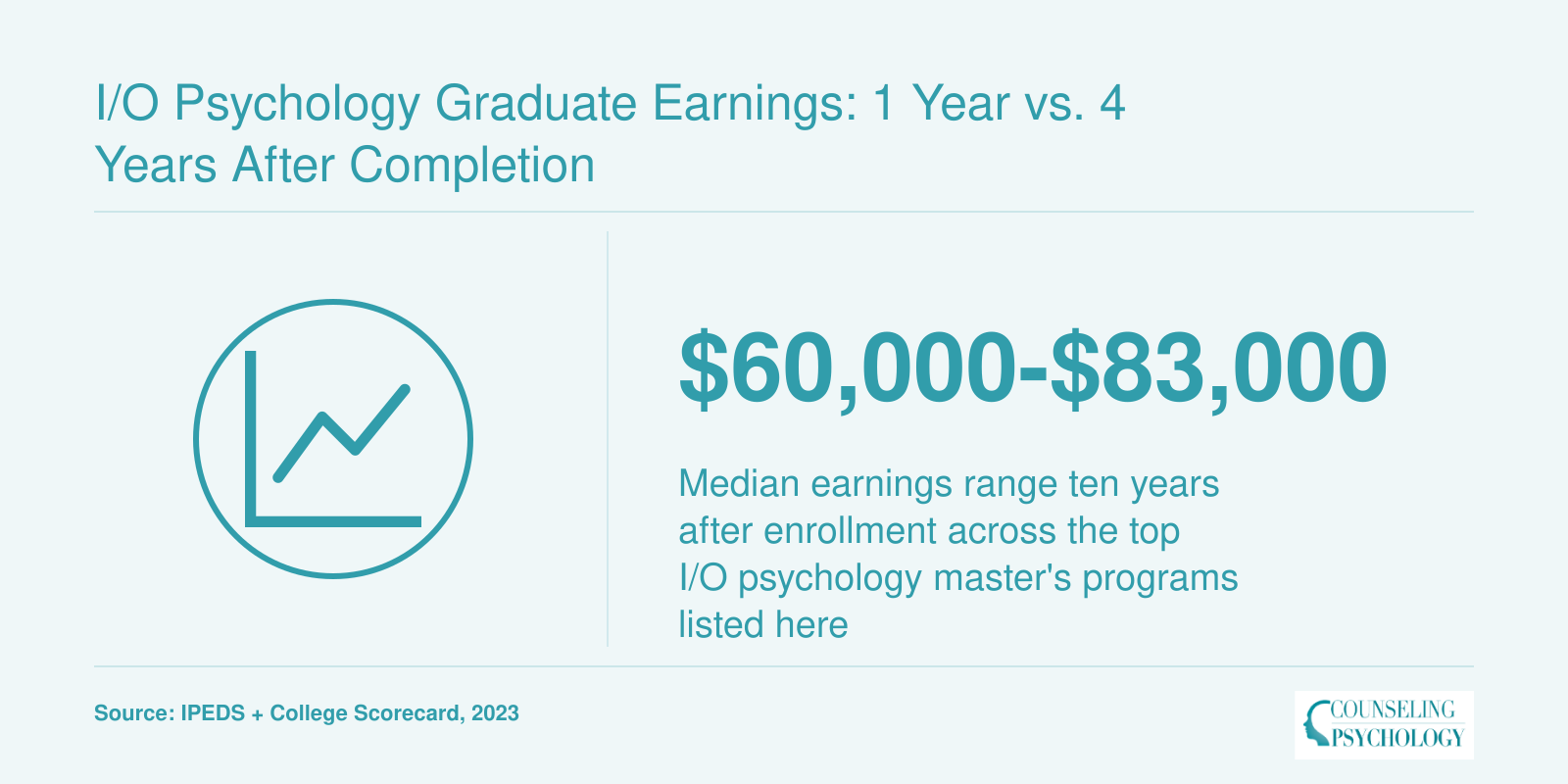
I/O Psychology Graduate Earnings: 1 Year Vs. 4 Years After Completion
Program-level earnings data at the one-year and four-year marks after completion are not yet published for these I/O psychology master's programs. Without verified figures for both time horizons, a side-by-side salary trajectory comparison would be misleading. What we can report is the institution-level median earnings ten years after enrollment, which gives a useful long-range benchmark across these schools.
Admissions Requirements and How to Get Into I/O Psychology Programs
Two paths diverge for I/O psychology master's applicants in 2026: submit a GRE score or seek a waiver. The trend toward GRE-optional admissions has reshaped the landscape, yet your academic profile, letters, and statement of purpose remain constant pillars.
Do You Need a GRE for I/O Psychology Master's Programs?
As of the 2025, 2026 admissions cycle, many I/O psychology programs have adopted GRE-optional or waiver policies. Rice University's MIOP lists the GRE as optional.1 Montclair State University waives the GRE for applicants with a 3.3 undergraduate GPA or higher, and for those who already hold a master's degree.2 St. Mary's University allows applicants to request a waiver by submitting a compelling letter explaining why the GRE is not necessary to demonstrate readiness.3
This shift reflects a broader movement in graduate education to reduce barriers and evaluate candidates more holistically. That said, not every program has eliminated the GRE requirement, and some still review scores when submitted. If you have strong quantitative scores, submitting them can strengthen your application even when optional.
Minimum GPA and Academic Prerequisites
Most I/O psychology master's programs require a minimum undergraduate GPA of 3.0, though competitive applicants typically present GPAs of 3.3 to 3.5 or higher. Montclair State, for example, sets a 3.3 floor for GRE-optional consideration.2 Keep in mind that published admissions rates reflect institution-wide figures, not program-specific selectivity, so GPA thresholds offer a more reliable benchmark for your candidacy.
Programs expect foundational coursework in psychology, statistics, and research methods. Montclair requires 12 prerequisite credits.2 Even if your bachelor's degree is not in psychology, you can often satisfy these prerequisites through post-baccalaureate courses or community college enrollment before applying.
Letters of Recommendation and Statement of Purpose
Plan to secure two to three letters of recommendation from professors or supervisors who can speak to your analytical abilities, interpersonal skills, and potential for workplace research or consulting. Montclair asks for two letters; other programs may request three.2
Your statement of purpose should clearly articulate why you are pursuing I/O psychology and how the program aligns with your career goals. Tailor each statement to the program's focus. If a program emphasizes applied consulting work, highlight relevant internships or HR experience. If the curriculum leans toward research and data analytics, discuss your statistics coursework, research assistant roles, or independent projects. Graduates of I/O programs often pursue roles as a personnel psychologist, so framing your goals around specific career outcomes can make your statement more compelling.
Applicant Profile Tips to Strengthen Your Application
- Quantitative coursework: Take statistics, psychometrics, or data analysis courses to demonstrate readiness for I/O psychology's research-heavy curriculum. Many programs assess your quantitative preparation closely.
- Relevant experience: Volunteer as a research assistant in a psychology lab, complete an HR internship, or pursue Society for Human Resource Management (SHRM) certification or student membership to show practical interest in workplace issues.
- Tailor your materials: Applied programs value consulting and organizational projects; research-oriented programs prioritize thesis work and lab experience. Adjust your statement of purpose, resume, and letter-writer selection accordingly for each application.
Strong preparation in these areas can offset a modest GPA or the absence of a GRE score, positioning you as a well-rounded candidate ready for graduate-level work in I/O psychology.
Is a Master's in I/O Psychology Worth It?
Does an I/O psychology master's degree pay for itself, and how quickly?
For most graduates, the answer is yes. But the specifics depend on program cost, how much debt you take on, and the career path you pursue after graduation.
The Financial Case
Tuition across the programs profiled on counselingpsychology.org ranges roughly from $11,000 to $40,000 for a full degree, depending on the school and residency status. Many graduates finish with modest debt relative to other master's fields, and the earning potential climbs meaningfully within just a few years of completing the degree.
Program-level earnings data for many I/O psychology master's programs has not yet been widely published, which makes apples-to-apples comparisons difficult. That said, institutional-level median earnings ten years after enrollment at top-ranked programs in our list range from roughly $42,000 to $83,000, suggesting solid long-term income trajectories. Programs like Albizu University-Miami and George Mason University stand out for favorable ratios of earnings to graduate debt at the institutional level.
Job Growth and Demand
The Bureau of Labor Statistics projects I/O psychology to be one of the fastest-growing occupations in the country, with demand driven by organizations investing more heavily in talent analytics, employee engagement, and evidence-based management practices. That growth translates into a labor market that, on the whole, is more welcoming to master's-level professionals than many other psychology subfields.
Master's vs. Doctoral Pathway
A master's degree is sufficient for the majority of corporate and consulting I/O roles, including positions in talent management, organizational development, people analytics, and HR strategy. If your goal is to work inside organizations or as an external consultant, a master's provides the applied training and credential you need to be competitive.
A PhD becomes necessary if you want to pursue tenure-track faculty positions or certain senior research scientist roles where publishing original research is a core expectation. Some organizations also prefer doctoral candidates for director-level positions in assessment or research divisions, though this varies by employer. Candidates interested in the testing and measurement side of the field may also want to explore psychometrician requirements before committing to a doctoral track.
Realistic Limitations
Entry-level I/O positions can be competitive, particularly in desirable metro areas. Joining professional organizations like the Society for Industrial and Organizational Psychology (SIOP) can help. Master's graduates qualify for SIOP Associate membership, which provides access to job boards, discounted conference registration, and resources like the SIOP-CARMA research methods webcast series.123 Building a professional network early, ideally during your program, makes a meaningful difference in landing that first role.
It is also worth noting that some senior positions still favor doctoral-level candidates, so master's holders occasionally encounter a ceiling in research-heavy tracks. For the vast majority of applied career paths, though, the combination of strong projected job growth, manageable debt loads, and competitive salaries makes this degree a compelling investment.
A master's in I/O psychology delivers strong return on investment: median graduate debt remains modest compared to four-year post-degree earnings, the Bureau of Labor Statistics forecasts robust job growth in the field, and online formats let working professionals earn credentials without pausing their careers. That said, prospective students must align their program track (applied versus research-focused) with their intended career path before enrolling to maximize outcomes and avoid costly missteps.
Frequently Asked Questions About I/O Psychology Master's Programs
Prospective students routinely have the same handful of questions before committing to an I/O psychology master's program. The answers below draw on current program data, federal earnings figures, and industry norms so you can evaluate your options with confidence.
Additional I/O Psychology Master's Programs to Consider
If the programs above didn't quite match your preferences, here are additional I/O psychology master's programs worth exploring. These schools offer unique formats, concentrations, and price points that may better align with your personal and professional goals.
- Master of Science in Psychology (Industrial/Organizational)
- MA in Psychology (Industrial/Organizational)
- Master of Science in Industrial-Organizational Psychology
- Master of Arts in Industrial Organizational Behavior Management
- Master of Science in Industrial-Organizational Psychology
- Master of Industrial-Organizational Psychology
- Master of Applied Industrial/Organizational Psychology
- Master's in Industrial-Organizational Psychology
- Industrial and Organizational Psychology, M.S.
- Master of Arts in Industrial and Organizational Psychology (Coaching and Consulting)
- Master of Arts in Industrial and Organizational Psychology (Human Resource Management)
- Master of Arts in Industrial and Organizational Psychology (Occupational Health Psychology)
- MS in Psychology, Industrial/Organizational Psychology
- Master of Industrial Organizational Psychology
- M.S. in Psychology – Industrial-Organizational Psychology
- M.A. Industrial and Organizational Psychology (Human Resources)
- M.A. Industrial and Organizational Psychology
- M.A. Industrial and Organizational Psychology