
What you’ll learn in this article…
- CACREP accreditation is required or strongly preferred for LPCC licensure in most U.S. states.
- LPCC, LPC, and LMHC titles all stem from the same core master's in clinical mental health counseling.
- The BLS reports a national median salary of $53,710 for substance abuse, behavioral, and mental health counselors.
- From enrollment to independent LPCC practice, the full timeline typically spans four to six years.
A master's in clinical mental health counseling is the standard entry point for becoming a Licensed Professional Clinical Counselor, a credential that authorizes independent diagnosis and treatment of mental health disorders in most states that issue it. BLS projections show substance abuse, behavioral disorder, and mental health counselor employment growing 19% through 2033, well above the national average. Online programs have made this 60-credit, CACREP-accredited pathway far more accessible to working professionals, but the real challenge is choosing one that aligns with your target state's licensure rules, fieldwork requirements, and long-term earning potential.
The ranked programs below are ordered by a quality composite, not tuition or completion speed alone. Credential distinctions across states (LPCC, LPC, LMHC) still trip up applicants, and picking the wrong program can cost a year or more in remedial coursework.
Best Online Master's in Licensed Professional Clinical Counseling Programs
The programs below are ordered by a quality composite that weighs institution-wide graduation rates, post-graduation earnings outcomes, and affordability signals such as net price after aid. No single metric determines placement. Program-level earnings data is not yet published for these programs, so return-on-investment indicators draw on institution-wide figures. Net price figures reflect an approximate average after financial aid and are not guaranteed for every student.
- Institution-wide graduation rate
- Graduate earnings outcomes
- Net price after financial aid
- CACREP accreditation status
- Clinical field-hour requirements
- College Scorecard graduate earnings — collegescorecard.ed.gov
- NCES-IPEDS federal institutional data — nces.ed.gov
- Independent program research
- Internal program database

Commonwealth University of Pennsylvania
Commonwealth University of Pennsylvania delivers a fully online, CACREP-accredited Master's in Clinical Mental Health Counseling built around small 25-student cohorts and a 60-credit curriculum that requires no campus visits. Graduates report a 100% employment rate and a 92% pass rate on the national counseling exam, underscoring strong licensure preparation. With in-state tuition of roughly $12,140 and an approximate average net price of $15,699 after aid, it ranks among the most affordable options on this list.
- 60-credit CACREP-accredited program, 100% online delivery
- No GRE required; up to 12 transfer credits accepted
- 100-hour practicum plus 600-hour local internship
- Small cohorts capped at 25 students for personalized advising
- 92% national counseling exam pass rate
- Concentrations in Military Veterans and Children/Adolescents
- Multiple start dates with synchronous and asynchronous options
Master's in Clinical Mental Health Counseling — Online

Marquette University
Marquette University pairs Jesuit educational values with a rigorous, CACREP-accredited 60-credit Master of Science completable in just 21 months. Three distinct concentrations in addiction, child and adolescent, and clinical rehabilitation counseling let students tailor the degree to a specific population. The program reports a 91% job placement rate within 120 days of graduation, and the institution-wide graduation rate of 83.2% is the highest in this ranking.
- CACREP-accredited, completable in 21 months
- On-campus and online delivery options available
- Three concentrations: Addiction, Child/Adolescent, Clinical Rehab
- 91% job placement rate within 120 days of completion
- GRE submission is optional; 3.0 GPA minimum required
- Tuition approximately $1,045 per credit hour
- Interview required as part of the admissions process
Master of Science in Clinical Mental Health Counseling — Online

North Carolina State University at Raleigh
NC State's Master of Education in Clinical Mental Health Counseling offers both a fully online and a hybrid pathway, each grounded in a scientist-practitioner model with CACREP accreditation. The three-year, part-time cohort format is designed for working professionals, and students complete 700 hours of supervised field placement. In-state tuition starts near $12,101, and the institution-wide graduation rate of 84.8% reflects NC State's strong academic support infrastructure.
- CACREP-accredited with online and hybrid format options
- Three-year part-time cohort model for working adults
- 700 hours of supervised field placement required
- No GRE or MAT entrance exam needed
- Multicultural counseling and evidence-based practice emphasis
- Prepares graduates for NC Licensed Clinical MHC Associate credential
- In-state tuition approximately $12,101 per year
Master of Education in Clinical Mental Health Counseling — Online

Miami University
Miami University's hybrid Master of Education in Counselor Education centers on a Clinical Mental Health Counseling concentration, with additional School Counseling and Dual Track options that broaden career versatility. Students complete 700 to 1,300 field placement hours depending on track, all at a flat rate of $700 per credit hour. The program aligns with CACREP standards and is primarily oriented toward Ohio residents, making it a strong regional choice.
- 60-credit hybrid program at $700 per credit hour
- 700 supervised field placement hours in clinical settings
- Culturally responsive counseling techniques emphasized
- Synchronous and asynchronous online coursework
- 2.75 minimum undergraduate GPA for admission
- Prepares graduates for LPC licensure in Ohio
- 60 to 66 credit hours covering both specializations
- 700 to 1,300 field hours across school and clinical sites
- CACREP standards alignment throughout curriculum
- Designed for Ohio residents seeking dual credentials
- Hybrid format combines online learning with onsite sessions
- Career flexibility across K-12 and community agency settings
Counselor Education, Master of Education: Clinical Mental Health Counseling — Hybrid
Counselor Education, Master of Education: Dual Track, Clinical Mental Health and School Counseling — Hybrid

Wichita State University
Wichita State University offers one of the most affordable paths to LPC licensure through its hybrid M.Ed. in Counseling with a Clinical Mental Health Counseling track. In-state tuition of approximately $7,986 and an average net price near $13,194 after aid make WSU especially accessible. The 60-credit, CACREP-accredited curriculum includes concentrations in addiction counseling and sports counseling, which are uncommon specializations at this price point.
- 60-credit CACREP-accredited hybrid program
- Concentrations available in Addiction and Sports Counseling
- Prepares students for Kansas LPC licensure and certification
- In-state tuition approximately $7,986 per year
- 3.00 GPA required for last 60 undergraduate credit hours
- Clinical internship integrated into the curriculum
- Coursework spans addiction, career, family, and play therapy
M.Ed. in Counseling, Clinical Mental Health Counseling Track — Hybrid
What Is an LPCC Degree and Who Is It For?
The LPCC credential is a master's-level clinical license that grants independent authority to assess, diagnose, and treat mental health disorders, making it one of the most versatile practice credentials a counselor can hold.
What the LPCC License Actually Authorizes
At its core, the Licensed Professional Clinical Counselor license is a statutory authorization to practice clinical mental health counseling without supervision.1 That means you can open a private practice, bill insurance, and provide psychotherapy to clients presenting with diagnosable conditions, all under your own license. The explicit scope covers assessment, diagnosis, and treatment of mental disorders, which distinguishes the LPCC from some other counseling credentials that carry more restricted or ambiguous practice authority.
Same Degree, Different State Titles
Here is where many prospective students get confused: the underlying degree is nearly always a Master of Science or Master of Arts in Clinical Mental Health Counseling, but the license title you earn after graduation depends entirely on the state where you practice. The core education and supervised hours requirements are comparable across states; only the nameplate changes.
A quick reference by state:
- LPCC: California, Ohio (alongside LPC), New Mexico, and Minnesota use this title2
- LPC: Texas and the majority of states use Licensed Professional Counselor3
- LMHC: Florida and New York use Licensed Mental Health Counselor, a title that carries explicit mental-health-specific scope4
- LCPC: Illinois, Kansas, Maine, Maryland, Montana, North Dakota, and Idaho (alongside LPC) use Licensed Clinical Professional Counselor, which carries explicit statutory authority to diagnose and treat1
- Clinical Professional Counselor: Wyoming uses its own distinct title
One practical note: the standard LPC designation, used in many states, may not fully cover independent diagnosis and treatment without an additional clinical upgrade or endorsement, depending on state law.1 If autonomous clinical practice is your goal, confirming the scope of the specific credential in your target state before enrolling is essential.
Who Should Pursue This Path
The LPCC track is a strong fit for several types of candidates. Career changers who hold a bachelor's degree in any field and want a terminal practice credential find it accessible without prior graduate training. Social workers and educators pivoting toward clinical counseling often pursue it to gain formal diagnostic authority they do not hold under their current licenses. It also appeals to anyone who wants the flexibility to practice across settings, from community mental health counselor roles to private practice, under a single portable credential. For a broader look at what licensed professional counselor pathways involve, reviewing your target state's specific requirements early is well worth the effort.
LMHC vs LPCC vs LPC: What's the Difference?
The landscape of professional counselor licensure continues to shift as more states adopt uniform titles and standards, but the foundational master's in clinical mental health counseling remains the common denominator. Confusion among the acronyms LMHC, LPCC, and LPC is understandable because, in practice, they all represent the same clinical preparation and scope of practice.1 The variation is almost entirely a matter of what each state legislature decided to call the credential.
The Common Ground: One Degree, Many Titles
No matter which acronym appears on a license, the underlying education is a CACREP-accredited master's in clinical mental health counseling (or a board-approved equivalent). All three credentials allow the holder to independently diagnose and treat mental and emotional disorders using counseling methods. The supervised post-degree experience and exam requirements are similar, though not identical, across states. The key takeaway is that the credential title is a state-level naming convention, not a different qualification.
Breaking Down the Credentials
- LPC (Licensed Professional Counselor): Used in over 20 states including Texas, Ohio, Georgia, Colorado, and Pennsylvania. LPCs can provide professional counseling services, including mental health diagnosis and treatment, in a variety of settings.1
- LPCC (Licensed Professional Clinical Counselor): Found in California, Minnesota, New Mexico, Kentucky, and Ohio (as an upgraded credential). The "clinical" designation explicitly emphasizes the mental health focus, but the actual scope mirrors the LPC and LMHC.1
- LMHC (Licensed Mental Health Counselor): Adopted by New York, Florida, Indiana, Washington, Massachusetts, and Hawaii. The title itself signals the mental health emphasis, though the practice rights are generally identical to LPC and LPCC.1
Exam Requirements: NCE vs NCMHCE
Which exam you take depends on state board preferences, not the credential title. Many LPC-regulated states accept either the National Counselor Examination (NCE) or the National Clinical Mental Health Counseling Examination (NCMHCE), while LPCC and LMHC states almost always require the NCMHCE. For example, California LPCCs and New York LMHCs must pass the NCMHCE, whereas Texas LPCs can choose either exam. Always check your state's specific rule before registering for a test.
Supervised Hours and Scope of Practice
All three credentials require extensive supervised post-graduate clinical experience, typically 3,000 hours for LPC and LPCC and 2,000 to 3,000 for LMHC, depending on the state.1 The scope of practice (independent diagnosis and treatment of mental disorders) is consistent across states, though LPCC and LMHC statutes sometimes spell out the mental health focus more explicitly. In practice, employers, insurance panels, and clients treat these credentials as functionally equivalent, allowing counselors to work in private practice, community mental health settings, hospitals, and telehealth environments. If you want to learn more about what the day-to-day looks like across these roles, our overview of careers in counseling covers paths, salaries, and steps to get started.
Questions to Ask Yourself
LPCC Licensure Requirements by State
Licensure requirements for the Licensed Professional Clinical Counselor credential vary significantly from state to state. If you are pursuing your degree online, understanding these differences before you enroll is critical, because the program you choose must align with the rules of the state where you plan to practice. Most states that use the LPCC title require graduates to hold a degree from a CACREP-accredited program or one that meets equivalent standards. This single factor should guide your program search more than almost any other consideration.
State-by-State LPCC Requirements at a Glance
The table below covers states that use the LPCC designation. Requirements can change, so always verify directly with your state licensing board before making enrollment decisions.
- California: 60 semester credit hours; 280 practicum/internship hours; 3,000 post-degree supervised experience hours; NCMHCE exam required; accepts fully online degrees.1
- Ohio: 60 semester credit hours; 600 practicum/internship hours; 3,000 post-degree supervised hours (minimum 2 years); NCMHCE exam required; accepts fully online degrees from CACREP-accredited programs.
- Minnesota: 48 semester credit hours (though 60 is strongly recommended for portability); 700 practicum/internship hours; 4,000 post-degree supervised hours; NCE or NCMHCE exam accepted; accepts fully online degrees from CACREP-accredited programs.
- New Mexico: 48 semester credit hours; 600 practicum/internship hours; 3,000 post-degree supervised hours; NCE exam required; accepts fully online degrees.
- Kentucky: 60 semester credit hours; 600 practicum/internship hours; 4,000 post-degree supervised hours; NCE or NCMHCE exam accepted; accepts fully online degrees from CACREP-accredited programs.
States With Stricter or Unique Requirements
California stands out for its additional coursework mandates. Beyond the 60-credit-hour minimum, the state requires specific graduate-level courses in California law and professional ethics, crisis and trauma counseling, and human sexuality.3 Applicants who earned their degrees out of state must document that their programs covered these topics or complete the coursework separately before licensure.4 California also imposes specific practicum hour minimums that differ from many other states, making it essential to confirm your online program's clinical requirements map to California's rules.
Minnesota and Kentucky both require 4,000 hours of post-degree supervised experience, which is notably higher than the 3,000 hours required in California, Ohio, and New Mexico. That difference can add a year or more to your timeline before you hold an independent license.
Why CACREP Accreditation Matters for Online Students
Nearly every LPCC-title state either requires or strongly prefers a degree from a CACREP-accredited program. For online students, this is especially important for two reasons. First, a CACREP-accredited degree is the clearest path to meeting coursework requirements across state lines, which matters if you might relocate after graduation. Second, some state boards scrutinize non-CACREP programs more closely, potentially requiring transcript-level course-by-course evaluations that can delay your application by months.
When comparing online programs, filtering for CACREP accreditation should be your first step. A program that lacks this credential may still produce excellent clinicians, but it can create unnecessary licensing complications, particularly in states like Ohio and Kentucky that explicitly tie their approval processes to CACREP standards. For a broader look at the steps involved in earning your credential, our guide on how to become a licensed mental health counselor covers the general pathway in detail.
A Note on Exam Requirements
States split roughly between the National Counselor Examination (NCE) and the National Clinical Mental Health Counseling Examination (NCMHCE), and a few accept either. California and Ohio both require the NCMHCE, which focuses on clinical assessment and treatment planning.3 States like New Mexico require the NCE, which is broader in scope. Some programs prepare students for both exams, but if you already know where you will practice, confirm which exam your state mandates and choose a program with a curriculum aligned to it.
Planning your education around these requirements from the start saves time, money, and frustration. Licensure is the finish line that makes the degree worthwhile, so let the rules of your target state shape every decision along the way.
What to Look for in an Online LPCC Program
The 2024 CACREP standards consolidation, which folded in the Council on Rehabilitation Education (CORE) programs, reflects a broader push for unified clinical training benchmarks.1 When evaluating online licensed professional clinical counselor degrees, you need to scrutinize accreditation, fieldwork logistics, and program structure against these updated expectations.
Accreditation: Why CACREP Is Essential
CACREP accreditation is the baseline most state licensing boards require or strongly prefer for LPCC eligibility.2 A program that holds CACREP's 2024 Clinical Mental Health Counseling specialty accreditation aligns with the nationally recognized curriculum and clinical training standards that directly map to licensure requirements.1 The 2024 standards update also integrated rehabilitation counseling tracks, so you may see former CORE-accredited programs now under the CACREP umbrella. Without this credential, you risk completing a degree that does not satisfy your state board's educational prerequisites, forcing costly additional coursework or even a second master's.
Practicum and Internship Hour Breakdown
CACREP mandates a minimum of 100 practicum hours and 600 internship hours, for a combined 700 hours of supervised field experience.3 These are not optional; they are built into the credit load of a standard 60-semester-credit master's.3 Online programs handle clinical placements the same way as on-campus ones: you arrange a site local to you, under a qualified site supervisor, and the program verifies that the setting and supervision meet CACREP's requirements. Some schools maintain a network of pre-approved sites, while others expect you to do the legwork. Confirm how the program supports placement before you enroll, especially if you live in a rural area or a state with fewer counseling agencies.
Fully Online vs. Hybrid: What the Labels Actually Mean
Fully online in LPCC programs means coursework is delivered asynchronously or via live virtual classes, but it never eliminates in-person clinical hours. You will still complete your practicum and internship face-to-face at a local facility. Hybrid programs add another layer: they may require short on-campus residencies, weekend intensives, or in-person skills labs. These can be valuable for hands-on practice and group supervision, but they add travel costs and time away from work. Always read the fine print: if a program advertises itself as online, ask whether you must visit campus at any point.
Field Placement Support Can Make or Break Your Timeline
Securing a qualifying clinical site is one of the biggest logistical hurdles for online students. Programs that employ dedicated placement coordinators, maintain a database of approved sites, or offer placement guarantee arrangements reduce the risk of delays that can push graduation back by a semester or more. If you are responsible for finding your own site, start early and confirm that the program will vet the supervisor's credentials and the site's activities before you begin accruing hours. Without active support, students report losing months while navigating site requirements alone.
Credit Requirements and Realistic Completion Timelines
Licensure-eligible LPCC master's programs typically require 60 semester credits, a non-negotiable figure rooted in CACREP standards.3 Most part-time students finish in about three years, though accelerated cohorts can compress the work into two years by offering year-round courses and heavier fall-spring loads. Do not mistake a fast pace for a shortcut: every program still must deliver the same clock hours of clinical training. Students interested in advancing beyond the master's level may eventually explore online doctorate in counseling programs. Consider whether you can sustain a full-time graduate load alongside work and personal obligations, and factor in the intensive internship phase that demands 15 to 20 hours per week at your site during the final semesters.
How to Become a Licensed Professional Clinical Counselor Online
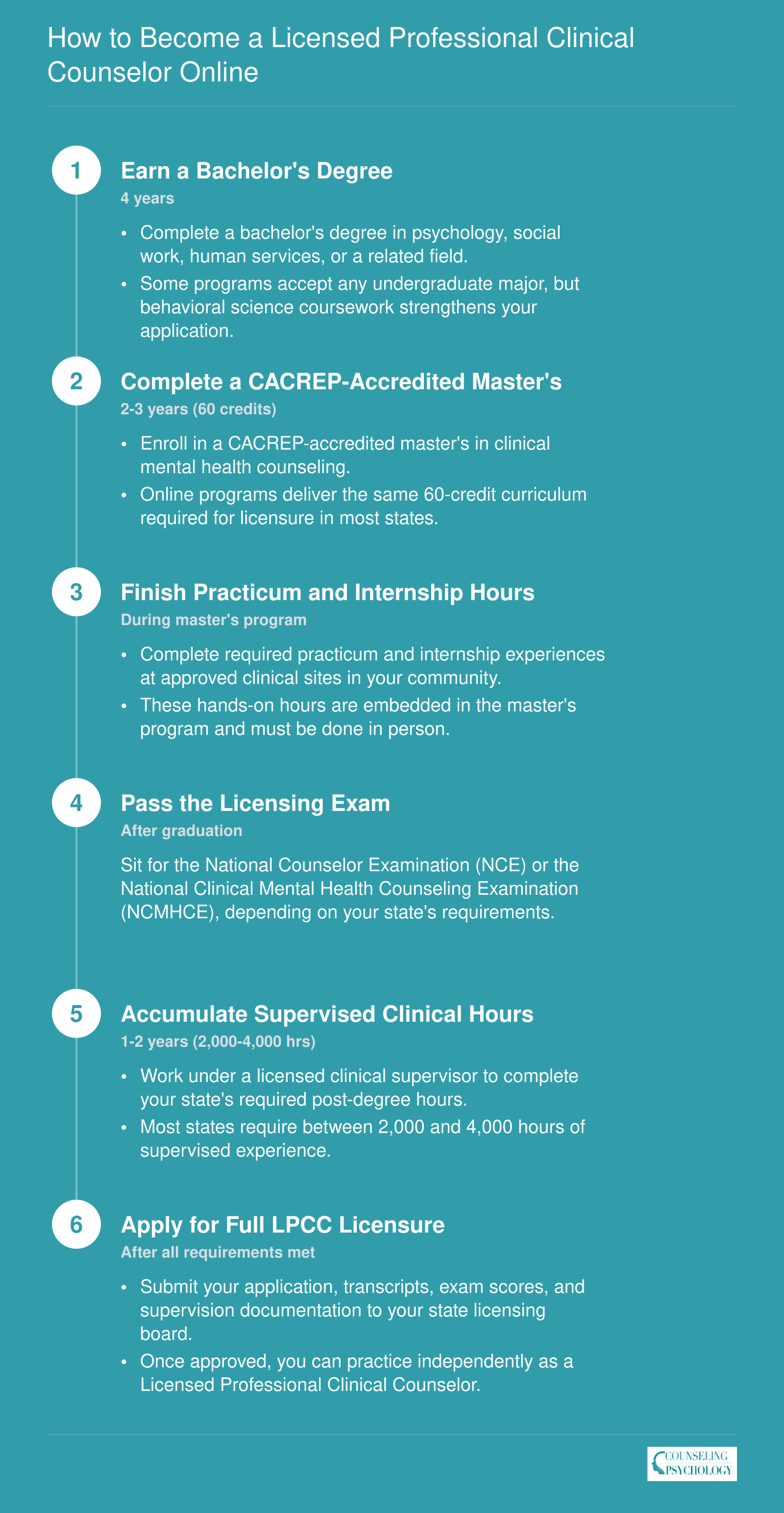
The path from first-semester undergrad to independent LPCC practice typically spans 4-6 years. While steps 1 through 3 can be completed through online programs, the licensing exam, supervised clinical hours, and final licensure application happen in clinical settings regardless of how you earned your degree.
Admissions Requirements and How to Get In
The tension most applicants face here is between programs that signal selectivity through high bars (3.5 GPA, GRE scores, prerequisite stacks) and programs that prioritize access for working adults and career changers. Both can lead to the same license. Knowing which side of that line a program sits on saves time and application fees.
GPA, GRE, and Prerequisites
Most CACREP-accredited online counseling programs set a minimum undergraduate GPA between 2.5 and 3.0 on a 4.0 scale.1 Capella University, for example, requires a 2.5 minimum for its MS in Clinical Mental Health Counseling, which sits on the more accessible end.2 Programs at more selective institutions often want a 3.0 or higher, and some weigh the last 60 credits more heavily than the cumulative number.
The GRE has largely disappeared from this space. Capella, Walden, Northwestern, and The Chicago School all list the GRE as not required for their online counseling master's programs in 2026.2 George Washington University still lists it as preferred but not required.3 If a program does ask for scores, it is increasingly the exception. For a broader look at admissions competitiveness, see our guide on how hard it is to get into grad school for psychology.
Prerequisite coursework varies. Many programs expect introductory psychology, statistics, and abnormal psychology on the transcript. Others, including Capella, accept a bachelor's in any major without specific prerequisites.2
Application Components
Expect to submit a personal statement or statement of purpose (George Washington asks for 500 to 750 words), two to three letters of recommendation, a current resume, and official transcripts.3 Because the work involves direct clinical contact, a background check is standard before practicum placement, and disclosure of past convictions during the application is common.
Look for application fee waivers (George Washington and Capella both list a $0 fee in 2026), rolling admissions, and multiple start dates per year.3 These features matter more than they sound: they let you align the program with your current job and licensing timeline.
Career Changers
If your bachelor's is in business, education, or anything outside psychology, you are still a strong candidate at most programs. Plan for one extra semester if prerequisite courses are required, and use the personal statement to connect your prior work to clinical counseling clearly. Admissions readers want to see thoughtful motivation, not a psychology pedigree. If you are also weighing a broader psychology track, compare online master's in psychology programs to see how the admissions landscape differs.
Most states require or strongly prefer that LPCC candidates graduate from a CACREP-accredited counseling program. Choosing a program without this accreditation can prevent you from qualifying for licensure entirely, or force you to complete additional coursework after graduation. Before you enroll, verify that the program holds current CACREP accreditation to protect your path to licensure.
Career Outcomes and Earning Potential After an LPCC Program
Agency employment versus independent practice: the path you choose after graduation will shape your earnings more than almost any other factor. Understanding the full earnings picture before you enroll helps you weigh tuition costs against realistic career trajectories.
What Program-Level Earnings Data Shows
For the programs featured in this guide, program-level earnings data from federal sources are not yet available for these specific clinical mental health counseling tracks. That is not unusual for graduate counseling programs, where post-completion outcomes reporting lags behind undergraduate data. What is available are institution-level figures. Graduates from Marquette University, for example, report a median early-career earnings figure in the upper $70,000s across all graduate completers, while NC State University graduates report figures in the upper $60,000s. These are institution-wide figures, not counseling-specific, so treat them as context rather than a precise forecast for your counseling career.
BLS Data: The Broader Earnings Landscape
The Bureau of Labor Statistics tracks substance abuse, behavioral disorder, and mental health counselors as a combined occupational group. According to the most recent BLS data, the national median annual wage for this group is $59,190 (2024).1 That figure represents the midpoint across all work settings and experience levels nationwide.
The wage distribution reveals real variation:2
- Bottom 10%: approximately $36,700 per year
- Bottom 25%: approximately $44,600 per year
- Top 25%: approximately $70,130 per year
- Top 10%: approximately $89,920 per year
The highest-paying industry for this occupational group is business, professional, and similar organizations, where mean wages reach around $94,050 annually.2 Government and hospital settings also tend to pay above the broader median.
Job growth projections are unusually strong. The BLS projects 17% growth for this occupation from 2024 to 2034, with roughly 48,300 job openings expected each year over that period.1 That growth rate is well above the average for all occupations, driven by expanding mental health awareness and workforce shortages in clinical settings. For those interested in the substance abuse treatment side of the field, how to become a substance abuse counselor is another pathway worth exploring.
Licensure and the Earnings Ceiling
Pre-licensure roles, where you are accumulating supervised hours as an associate or intern, typically pay less than fully licensed positions. Once you earn independent LPCC status, you gain access to a broader range of employment options and, critically, the ability to open or join a private practice. Private practice LPCCs can earn substantially more than agency-employed counterparts, particularly as they build a client base and take on insurance panels or self-pay clients. If you are still mapping out the overall steps involved, our guide on how to become a counselor covers the full licensure pathway.
Weighing Investment Against Return
Graduate debt at completion varies significantly across the ranked programs. Public university programs in this guide, such as NC State, Wichita State, and Commonwealth University of Pennsylvania, carry lower price tags and correspondingly lower typical debt at graduation, with figures ranging from roughly $20,000 to $26,000 for those programs based on institutional data. Marquette, as a private university, carries higher tuition but also offers institutional aid that can reduce out-of-pocket costs meaningfully.
Set against a career that starts near the national median and has a realistic ceiling well above $90,000 for experienced independent practitioners, even mid-range graduate debt loads represent a manageable investment for most graduates who move through licensure efficiently and enter a growing field.
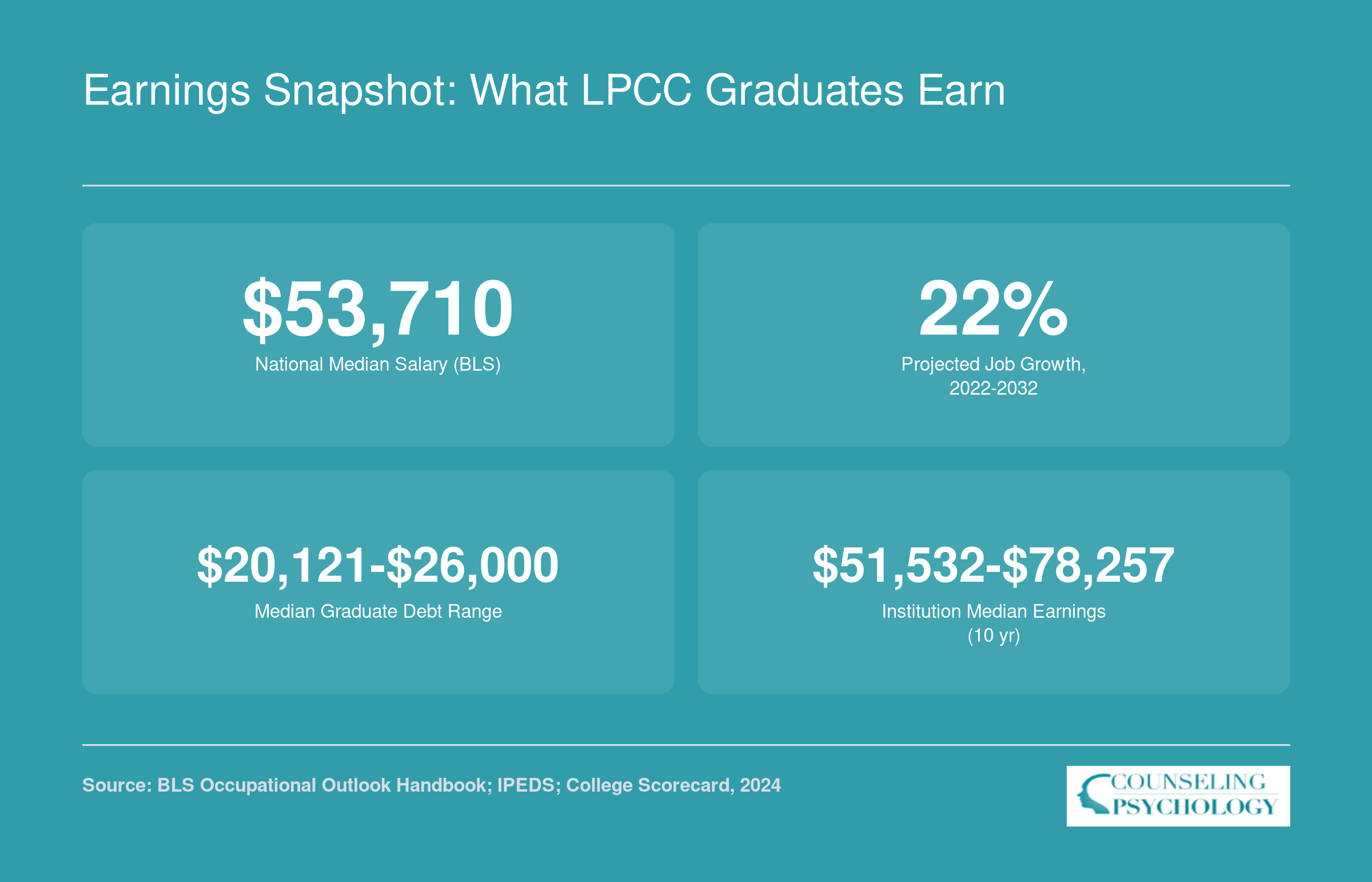
Earnings Snapshot: What LPCC Graduates Earn
Program-level earnings data for these clinical mental health counseling master's programs are not yet available from federal reporting. However, institution-wide outcomes and national labor market projections offer a useful starting point. The BLS reports a national median salary of $53,710 for substance abuse, behavioral disorder, and mental health counselors, with 22% projected job growth from 2022 to 2032. Median graduate debt across the programs reviewed here ranges from roughly $20,000 to $26,000.
Frequently Asked Questions About Online LPCC Programs
Choosing an online master's program in clinical counseling raises practical questions about licensure, cost, and format. Below are concise answers to the questions prospective students ask most often.