
What you’ll learn in this article…
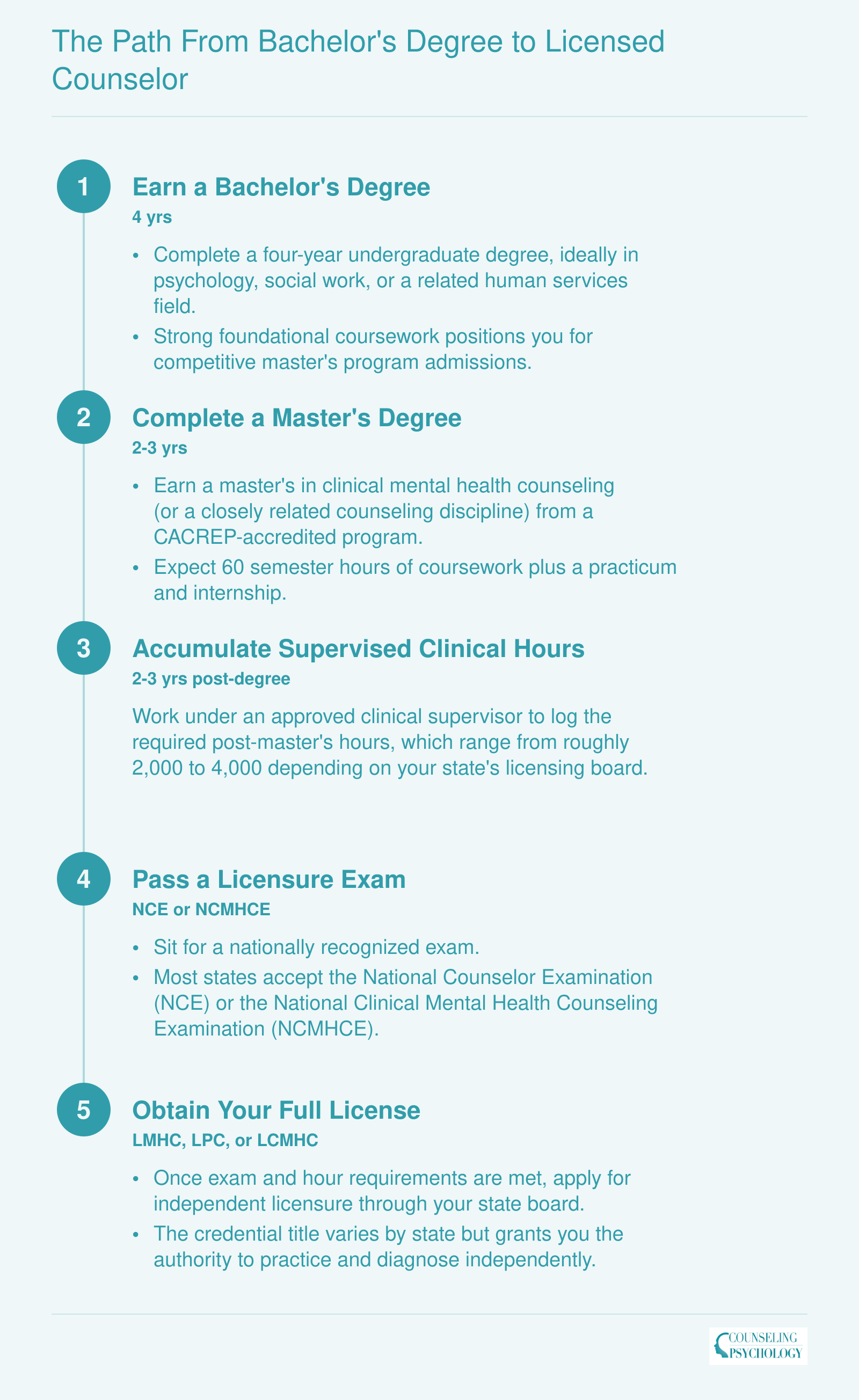
- Most states require a CACREP-accredited master's degree plus 2,000 to 4,000 supervised clinical hours for full licensure.
- The path from bachelor's degree to licensed community mental health counselor typically spans 8 to 10 years.
- NHSC offers up to $50,000 in loan repayment for counselors who commit to two years at an approved community site.
- BLS projects strong job growth for mental health counselors, fueled by over 6,900 shortage areas nationwide as of 2026.
With nearly 7,000 designated Mental Health Professional Shortage Areas across the U.S. as of early 2026, the distance between a person in crisis and a qualified provider can be measured in months-long waitlists and hundred-mile drives. Community mental health counselors close that gap, working in under-resourced clinics, schools, and crisis centers where private practitioners rarely set up shop.
The path to licensure requires a CACREP-accredited master's, 2,000 to 4,000 supervised clinical hours, and a passing score on either the NCE or NCMHCE. In return, community-based roles unlock access to NHSC loan repayment awards of up to $50,000 and a caseload that prioritizes public need over insurance paperwork.
Median annual pay for community counselors remains below the broader mental health counselor figure in most states, a trade-off that reflects the field's reliance on strained public funding rather than private-pay margins.
What Does a Community Mental Health Counselor Do?
Community mental health counselors are the backbone of the public behavioral health system, delivering therapy, crisis support, and case management to populations that private practice rarely reaches. Their work blends clinical skill with relentless advocacy, often in under-resourced settings where need far outpaces available time.
Daily Duties: More Than Just Talk Therapy
A community mental health counselor's day moves far beyond the 50-minute therapy hour. Sessions include individual and group psychotherapy, but clinicians also perform crisis intervention, de-escalating suicidal or psychotic episodes on the spot, and provide psychoeducation to help clients and families understand diagnoses and medications. Case management is equally central: connecting clients to housing, food assistance, primary care, and vocational services. Most counselors participate in interdisciplinary team meetings multiple times a week, coordinating with psychiatrists, social workers, peer specialists, and nurses to align treatment plans. For a closer look at the rhythm of clinical work, see this overview of a typical work day for a licensed professional counselor.
Caseloads and Productivity Demands
Agency settings define the pace. Community mental health counselors commonly carry 25 to 35 active clients each week, though in high-volume clinics caseloads can edge above 40.1 Productivity expectations typically demand 25 to 30 billable hours per week, leaving counselors to manage back-to-back sessions while squeezing in paperwork.1 Data from practice management platforms suggests burnout risk accelerates sharply when weekly client contact exceeds 30 hours, a line many community counselors walk daily.1
Documentation: The Hidden Workload
The clinical encounter is only half the story. Progress notes written for Medicaid and insurance billing must meet strict medical necessity standards, and treatment plans require regular updates tied to measurable goals. Counselors routinely spend one to two hours each day on documentation alone, often after regular business hours when session volume is high. Coordination with prescribing psychiatrists and social service agencies adds another layer of written communication, from release-of-information forms to care coordination notes.
Mission-Driven Work with High-Need Populations
What distinguishes community mental health is who is served. Clients are predominantly Medicaid recipients, uninsured individuals, people experiencing homelessness, justice-involved individuals transitioning from incarceration, and children in foster care. These populations bring complex, co-occurring challenges (trauma, substance use, chronic medical conditions) that demand flexible, wraparound approaches. The work is intense and high volume, driven by a mission to expand access rather than to optimize a self-pay schedule. In contrast, private practice therapists typically maintain a caseload of 20 to 25 weekly clients, enjoy lighter documentation requirements, and work with insured or out-of-pocket clients who often present with less acute needs.1 If you are weighing your options across the field, exploring careers in counseling can help clarify where community mental health fits alongside other paths. The next section explores the structural differences between agency and private practice in depth, because that choice reshapes everything from daily stress to career longevity.
Community Mental Health Counselor Vs. Private Practice: Key Differences
Community mental health agencies and private practice represent two distinct settings that shape everything from daily responsibilities to long-term earning potential. While both require a master's degree and state licensure, the differences in client population, payer mix, and autonomy often guide career decisions.
Salary Trajectories and Earning Potential
Earnings differ markedly between the two paths. The median annual wage for community mental health counselors was approximately $59,190 (2024), while private practice clinicians earned a median of around $96,500 (2025, 2026).1 However, entry-level pay flips this pattern: new counselors in community agencies earned about $52,800 annually, whereas those launching a private practice often started at roughly $42,000 while building a client base. Over time, private practice offers a higher ceiling, but agency work provides more predictable income from day one.
Client Populations and Payer Mix
Community mental health agencies predominantly serve clients covered by Medicaid, which translates to lower per-session reimbursement but consistent, funded client volume.3 In contrast, private practice clinicians typically rely on commercial insurance or self-pay clients, allowing higher rates but requiring active marketing and insurance paneling. This payer mix affects clinical focus: agency counselors often treat more severe, chronic conditions, while private practitioners may have more flexibility to specialize. For those interested in specializing in community mental health, agency roles can provide deep exposure to underserved populations.
Autonomy and Work Environment
Community-based counselors operate within structured agency protocols, which can mean less autonomy over scheduling and treatment methods.4 However, they benefit from on-site supervision, multidisciplinary teams, and administrative support. Private practice offers high autonomy, from setting hours to choosing therapeutic approaches, but also demands business management tasks such as billing, compliance, and marketing.3 If you are weighing options beyond private practice, exploring best jobs for a mental health counselor can help clarify which setting aligns with your strengths.
Job Market and Growth
Both settings share a strong job outlook. The Bureau of Labor Statistics projects 17% growth for substance abuse, behavioral disorder, and mental health counselors from 2024 to 2034, with about 48,300 annual openings nationwide.5 Demand is robust regardless of setting, so the choice often boils down to personal preference for structure, client type, and income model.
Questions to Ask Yourself
Step 1: Earn the Right Degree for Community Mental Health
Choosing a master's program means balancing speed against long-term portability: a faster, cheaper route may save time now but limit licensure mobility later. The degree you earn becomes the foundation for supervised hours, exam eligibility, and state board approval, so selecting a program with rigorous clinical training and recognized accreditation is the single most consequential decision in your career path.
The Bachelor's Foundation
The journey starts with a bachelor's degree, typically in psychology, social work, human services, or a related behavioral science. While no single major is required, coursework in abnormal psychology, developmental psychology, and research methods builds the base for graduate study. Students exploring a master's degree in psychology should note that some programs offer an accelerated bachelor's-to-master's track, but most students complete a four-year degree and then apply to a standalone master's program. The key is to maintain a strong GPA and gain relevant volunteer or work experience in mental health settings, which strengthens your application.
Why CACREP Accreditation Matters
For the master's stage, the gold standard is CACREP accreditation, the Council for Accreditation of Counseling and Related Educational Programs. Graduating from a CACREP-accredited program streamlines licensure in most states, satisfies the educational requirements for the National Certified Counselor (NCC) credential, and is increasingly expected by community mental health agency employers. While non-CACREP programs may be less expensive or more flexible, they often require additional documentation or coursework review for state licensure, and portability across state lines can become a hurdle. In 2026, more than 900 programs hold CACREP accreditation, so there are options in most regions.
What to Look for in a Community-Focused Program
A degree labeled "clinical mental health counseling" is the terminal practice degree for this field. Within that, prioritize programs that embed community-specific training. Look for: - Practicum placements: Direct placements in community mental health agencies, crisis centers, or integrated care settings rather than university counseling centers alone. - Trauma-informed care: Dedicated coursework that addresses adverse childhood experiences, crisis intervention, and recovery-oriented models. - Multicultural counseling: Required classes that explore cultural humility, systemic inequities, and strategies for working with marginalized populations. - Substance abuse training: Electives or concentrations in co-occurring disorders, given the high overlap in community settings. These elements signal that the curriculum is designed for the realities of agency work, not just private practice preparation.
How Long It Takes and the Fastest Route
A standard CACREP-accredited master's requires 60 credit hours and takes two to three years of full-time study. Part-time tracks extend to three to five years, allowing students to work simultaneously. Accelerated formats (online or in-person with condensed terms) can finish in about two years. If you are asking what the quickest legitimate path looks like, it is a 60-credit CACREP program completed full-time in roughly two years, including summers. A few non-CACREP programs may be slightly shorter, but the state licensing board will scrutinize coursework equivalency, which can delay your license by months. Investing in a recognized program upfront avoids those headaches and keeps you on track for community practice as soon as possible.
The Path From Bachelor's Degree to Licensed Counselor
Becoming a licensed community mental health counselor is a multi-stage commitment that typically spans 8-10 years from the start of your bachelor's degree to full licensure. Here is the sequence at a glance so you can plan accordingly.
Step 2: Complete Supervised Clinical Hours in a Community Setting
After earning your master's degree, you enter a post-graduate period where you practice counseling under the oversight of a licensed supervisor before you can apply for full licensure on your own. This is not a formality. It is the stage where classroom knowledge becomes clinical skill, and state licensing boards take it seriously.
How Many Hours Do You Need?
Most states require between 2,000 and 4,000 hours of supervised clinical experience before you can sit for full licensure. The exact number depends on your state and the license you are pursuing. Hours typically include direct client contact, documentation time, and regular supervision sessions with a qualified supervisor.
Here is where many new graduates are surprised: accumulating your hours faster than expected does not automatically move you to the finish line. Many state boards enforce what practitioners informally call the two-year rule, which requires that supervised practice span a minimum of two calendar years post-graduation, regardless of how quickly you log your hours. If your state has this requirement, there is no workaround. Planning for a two-to-three-year supervised period is the realistic expectation.
How Supervision Works Inside a Community Agency
In a community mental health setting, supervision is structured and ongoing. You will typically participate in weekly individual supervision sessions with your licensed supervisor and join group supervision meetings where cases are discussed across the clinical team. Because you are not yet fully licensed, your clinical work is billed under your supervisor's license number, a standard arrangement that is well understood by agencies and insurers. (If you are curious how supervision hours work across different license types, the requirements vary considerably by credential.)
The caseload variety in community settings is genuinely broad. You might see clients presenting with severe mental illness, substance use disorders, trauma histories, housing instability, or co-occurring conditions, often in the same week. That exposure sharpens diagnostic thinking and treatment flexibility faster than more narrowly focused settings can.
Why Community Agencies Are an Efficient Path for Hour Accumulation
Community agencies carry high client volumes by design, which means you are seeing more clients per week than you likely would in a private-practice supervision arrangement. More client contact translates directly into faster hour accumulation, which matters when you are working against a two-to-three-year timeline.
Critically, most community agencies hire master's-level clinicians as provisionally licensed counselors or licensed associate counselors from day one. You are an employee earning a salary while you accumulate your supervised hours, not an unpaid intern waiting for opportunity. That financial stability makes the supervised experience period significantly more manageable for graduates carrying student loan debt.
Step 3: Pass Licensure Exams and Get Licensed
Two primary pathways stand between you and a counseling license: the broad National Counselor Examination (NCE) and the clinical specialty National Clinical Mental Health Counseling Examination (NCMHCE). Which one you take depends largely on where you plan to practice, and the choice sets the stage for your credential type and interstate mobility.
The NCE and NCMHCE: Which Exam Do You Need?
Most states accept the NCE for initial licensure as a Licensed Professional Counselor (LPC) or its equivalent, administered by the National Board for Certified Counselors (NBCC). The NCE assesses foundational counseling knowledge and is often used for the title Licensed Associate Counselor (LAC) or similar provisional status before full licensure. In contrast, the NCMHCE is a clinical simulation exam required by many states for the Licensed Professional Clinical Counselor (LPCC) or Licensed Mental Health Counselor (LMHC) designation. It tests your ability to apply clinical reasoning to simulated case scenarios. A handful of states require both: the NCE for initial registration and the NCMHCE for the independent clinical credential. Always verify the specific exam sequence with your state board.
License Titles Vary by State but Are Equivalent
Don't let the alphabet soup confuse you. Whether your state calls it LPC, LMHC, LCMHC, or LPCC, these titles represent the same core competency: a master's-level clinician qualified to diagnose and treat mental health conditions. The differences are largely historical and administrative. For example, Texas uses LPC, Washington uses LMHC, North Carolina uses LCMHC, and California uses LPCC. When you see a job posting requiring one of these, you are generally eligible with any of them, provided you can secure state endorsement. For a handy decoder, see our guide to counseling licensure acronyms.
CACREP Accreditation Streamlines Licensure Portability
Graduating from a program accredited by the Council for Accreditation of Counseling and Related Educational Programs (CACREP) gives you a significant advantage when moving between states. Many state boards accept CACREP graduates' coursework without a tedious course-by-course review, and some states require CACREP for initial licensure. This national standard ensures your education meets the core curriculum, making it easier to transfer your license when you relocate.
The Counseling Compact: Interstate Practice Without a New License
If you hold a valid LPC or LPCC license and reside in one of the 39 states that have enacted the Counseling Compact (covering 40 jurisdictions as of 2026), you can apply for a "privilege to practice" in any other member state.12 This is not a national license but a mutual recognition agreement that lets you offer services in person or via telehealth across state lines without obtaining additional full licenses. You must still follow the receiving state's scope-of-practice laws and meet any continuing education requirements.2 The application is submitted online through the Counseling Compact Commission, and fees include both a state and a Commission fee.3 As of May 2026, the compact is fully operational in Arizona, Louisiana, Minnesota, and Ohio, with the remaining 36 jurisdictions in the process of going live.2 Discipline information is shared across states, so ethical practice everywhere is paramount.4 This compact dramatically reduces the time and cost for counselors serving in community mental health, where client needs may span state borders.
LMHC Vs. LCSW: Pay, Scope, and Career Differences
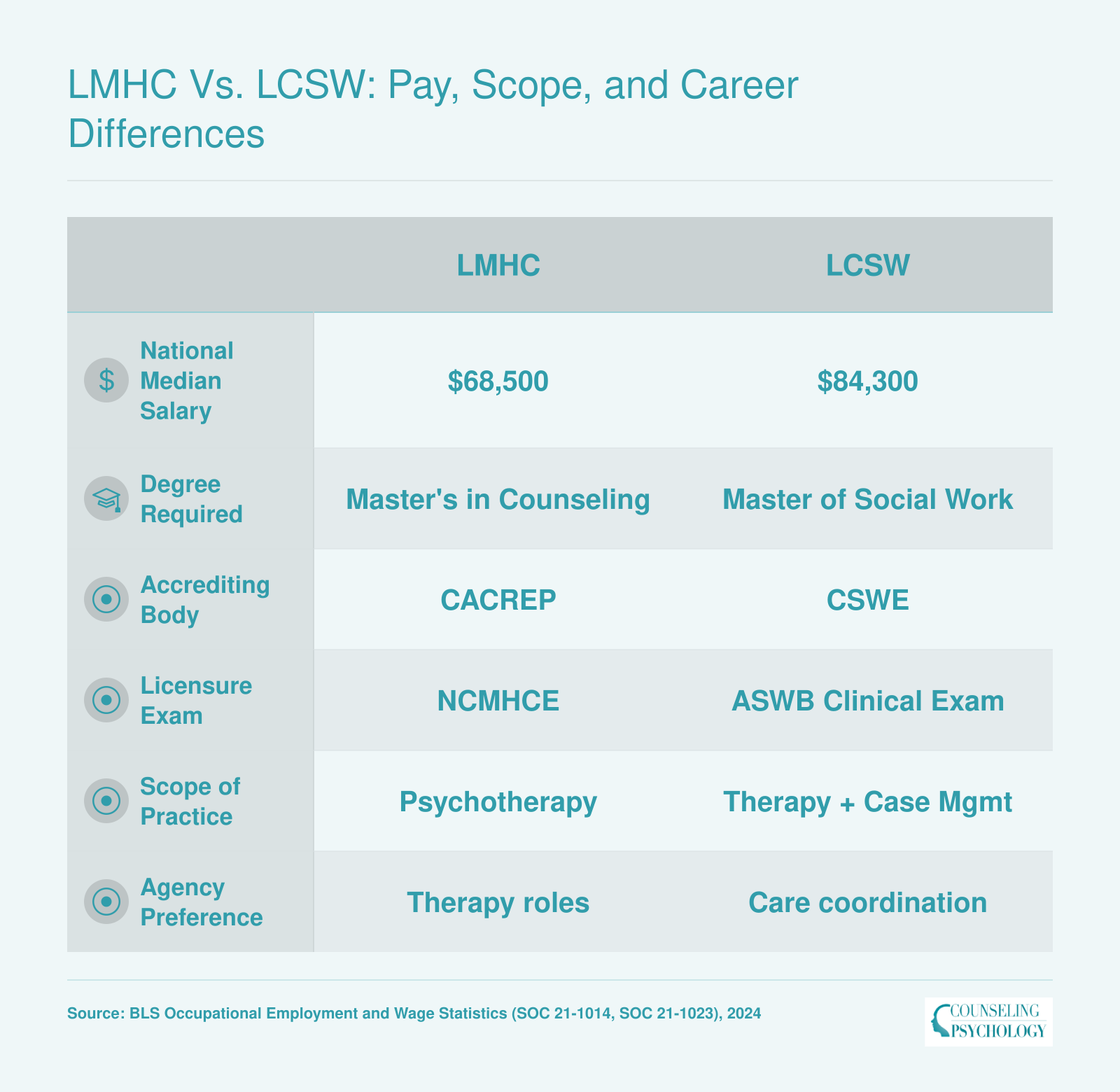
One of the most common questions prospective community counselors ask is whether the LMHC or LCSW credential pays more. Nationally, LCSWs earn a higher median salary, roughly $84,300 compared with $68,500 for LMHCs based on 2024 BLS data. However, at many community mental health agencies the two roles fall within the same pay band, and your actual earnings will depend more on your employer, region, and years of experience than on which license you hold.
Community Mental Health Counselor Salary by State
Salaries for community mental health counselors vary significantly depending on where you practice. The table below shows median annual wages for substance abuse, behavioral disorder, and mental health counselors across all 50 states and D.C., based on the latest BLS data. Alaska leads the nation with a state median of $79,220, while several southern states fall below $50,000. Keep in mind that cost of living differences can substantially affect real purchasing power.
| State | Total Employment | 25th Percentile | Median Salary | 75th Percentile | Mean Salary |
|---|---|---|---|---|---|
| Alaska | 1,060 | $63,690 | $79,220 | $96,940 | $88,870 |
| New Mexico | 2,070 | $55,060 | $70,770 | $80,840 | $71,010 |
| Oregon | 6,410 | $56,290 | $69,660 | $84,970 | $72,860 |
| North Dakota | 1,180 | $50,810 | $66,450 | $75,120 | $68,220 |
| District of Columbia | 980 | $47,980 | $66,140 | $83,040 | $71,200 |
| Utah | 4,720 | $42,210 | $65,920 | $94,630 | $71,890 |
| Idaho | 2,130 | $48,570 | $65,240 | $78,100 | $65,290 |
| New Jersey | 14,640 | $51,170 | $64,710 | $84,690 | $75,900 |
| Nebraska | 1,980 | $46,900 | $64,410 | $81,210 | $66,690 |
| Washington | 13,150 | $52,070 | $64,220 | $80,440 | $70,230 |
| Arizona | 8,970 | $50,650 | $63,830 | $79,990 | $67,890 |
| Connecticut | 6,470 | $49,120 | $62,960 | $77,610 | $66,920 |
| Wisconsin | 9,450 | $50,870 | $62,470 | $77,800 | $70,180 |
| New York | 22,450 | $50,880 | $62,070 | $76,680 | $69,290 |
| Wyoming | 840 | $42,610 | $61,640 | $79,830 | $65,650 |
| California | 63,110 | $47,650 | $61,310 | $90,370 | $72,530 |
| Maine | 1,610 | $48,360 | $60,970 | $73,510 | $64,050 |
| Iowa | 3,030 | $49,170 | $60,880 | $78,830 | $65,960 |
| Texas | 19,520 | $47,600 | $60,630 | $76,390 | $67,920 |
| Vermont | 1,150 | $52,890 | $60,410 | $67,670 | $63,060 |
| Illinois | 18,170 | $47,640 | $59,570 | $81,250 | $69,010 |
| Michigan | 11,090 | $42,480 | $59,530 | $74,360 | $61,960 |
| Nevada | 2,240 | $46,960 | $59,470 | $76,260 | $64,430 |
| Colorado | 13,670 | $47,750 | $59,190 | $78,350 | $66,280 |
| Massachusetts | 17,950 | $47,120 | $59,030 | $73,000 | $64,020 |
| Minnesota | 7,910 | $49,880 | $58,720 | $64,370 | $59,020 |
| Montana | 1,900 | $39,220 | $58,660 | $68,360 | $57,350 |
| Oklahoma | 4,460 | $44,320 | $58,610 | $78,710 | $62,220 |
| New Hampshire | 3,100 | $48,310 | $58,520 | $73,770 | $61,100 |
| Virginia | 16,860 | $47,530 | $58,410 | $76,530 | $63,630 |
| Pennsylvania | 26,510 | $46,910 | $58,320 | $72,800 | $61,040 |
| Maryland | 8,180 | $48,980 | $57,820 | $70,990 | $68,830 |
| Kansas | 2,410 | $45,050 | $57,760 | $67,540 | $59,530 |
| Ohio | 16,690 | $47,370 | $56,990 | $67,470 | $59,960 |
| Florida | 24,680 | $46,640 | $56,830 | $67,700 | $60,480 |
| Missouri | 7,500 | $42,930 | $56,640 | $66,810 | $58,230 |
| North Carolina | 8,930 | $47,460 | $56,470 | $68,470 | $60,440 |
| Georgia | 8,680 | $46,150 | $55,320 | $71,980 | $61,250 |
| Hawaii | 1,580 | $49,630 | $54,390 | $76,220 | $75,610 |
| South Dakota | 1,510 | $46,260 | $53,400 | $59,770 | $55,890 |
| Kentucky | 8,030 | $39,560 | $51,790 | $75,310 | $58,190 |
| South Carolina | 4,680 | $40,480 | $50,720 | $65,770 | $55,450 |
| Arkansas | 2,860 | $37,280 | $49,990 | $69,630 | $58,960 |
| Rhode Island | 1,560 | $42,550 | $49,770 | $67,370 | $58,860 |
| Delaware | 1,240 | $41,630 | $49,680 | $65,270 | $56,120 |
| Indiana | 10,400 | $41,860 | $49,280 | $62,780 | $54,630 |
| Alabama | 3,340 | $40,480 | $48,880 | $58,540 | $52,120 |
| Tennessee | 7,310 | $36,910 | $48,170 | $60,900 | $51,480 |
| Mississippi | 2,220 | $37,830 | $46,810 | $56,800 | $54,120 |
Highest-Paying Metro Areas for Mental Health Counselors
Geography plays a major role in what community mental health counselors earn. The table below ranks large metropolitan areas by mean annual wage for substance abuse, behavioral disorder, and mental health counselors, according to BLS data. Keep in mind that higher wages in coastal metros often reflect a higher cost of living, so weigh salary figures against local housing, transportation, and other expenses before relocating for a position.
| Metro Area | Total Employment | Mean Annual Wage | Median Annual Wage | 75th Percentile Wage |
|---|---|---|---|---|
| San Francisco, Oakland, Fremont, CA | 8,080 | $83,140 | $72,950 | $108,410 |
| Sacramento, Roseville, Folsom, CA | 3,570 | $78,880 | $69,510 | $99,790 |
| Portland, Vancouver, Hillsboro, OR/WA | 3,640 | $75,920 | $71,530 | $86,150 |
| New York, Newark, Jersey City, NY/NJ | 23,790 | $75,500 | $64,900 | $81,680 |
| Washington, Arlington, Alexandria, DC/VA/MD/WV | 7,590 | $73,210 | $63,170 | $83,780 |
| Seattle, Tacoma, Bellevue, WA | 7,040 | $71,930 | $65,290 | $81,230 |
| Chicago, Naperville, Elgin, IL/IN | 14,010 | $70,920 | $61,150 | $83,770 |
| Los Angeles, Long Beach, Anaheim, CA | 23,330 | $69,630 | $58,880 | $84,030 |
| Houston, Pasadena, The Woodlands, TX | 4,230 | $68,820 | $64,140 | $76,890 |
| Baltimore, Columbia, Towson, MD | 4,530 | $68,750 | $56,980 | $68,670 |
| San Diego, Chula Vista, Carlsbad, CA | 5,010 | $68,560 | $58,690 | $79,380 |
| Phoenix, Mesa, Chandler, AZ | 6,830 | $67,740 | $63,990 | $82,350 |
| Riverside, San Bernardino, Ontario, CA | 5,170 | $66,800 | $60,860 | $78,210 |
| Denver, Aurora, Centennial, CO | 6,670 | $66,000 | $59,100 | $74,860 |
| Boston, Cambridge, Newton, MA/NH | 10,980 | $65,330 | $60,780 | $74,300 |
| Philadelphia, Camden, Wilmington, PA/NJ/DE/MD | 12,860 | $65,190 | $59,990 | $76,700 |
| Atlanta, Sandy Springs, Roswell, GA | 5,510 | $64,030 | $58,990 | $73,630 |
| Dallas, Fort Worth, Arlington, TX | 5,320 | $63,740 | $57,700 | $76,580 |
| Columbus, OH | 3,630 | $62,750 | $59,110 | $71,950 |
| Minneapolis, St. Paul, Bloomington, MN/WI | 4,610 | $61,530 | $60,540 | $68,440 |
Job Outlook and Career Growth in Community Mental Health
Community mental health counseling offers some of the strongest employment prospects in the behavioral health workforce, balancing high demand with structured advancement opportunities that reward both clinical skill and leadership development. The field is poised for significant expansion through the next decade, driven by policy shifts and public health priorities that directly benefit counselors willing to work in mission-driven, publicly funded settings.
National Job Growth Projections
The Bureau of Labor Statistics projects that employment for mental health counselors will grow 17 percent between 2024 and 2034, a pace considerably faster than the average for all occupations.1 This expansion is expected to create approximately 81,000 new positions nationwide, building on a base of 483,500 jobs as of 2024.2 For new graduates, this growth translates into consistent hiring across community mental health agencies, federally qualified health centers, school-based programs, and crisis intervention services.
Demand Drivers Reshaping the Field
Several converging forces are fueling demand for community-based counselors. Medicaid expansion in many states has increased insurance coverage for mental health services, particularly in integrated care settings where counselors work alongside primary care teams. The COVID-19 pandemic raised public awareness of mental health needs and accelerated telehealth adoption, making it easier for agencies to reach underserved populations. The 2022 launch of the 988 Suicide and Crisis Lifeline created immediate workforce needs for crisis counselors trained in de-escalation and safety planning. These trends are closely tied to the broader mental health workforce shortage, which continues to create openings in community settings. Federal and state grants supporting school-based mental health services have also opened new positions for counselors willing to work with children and adolescents in educational settings.
Career Advancement Pathways in Community Agencies
Community mental health offers a well-defined career ladder that extends far beyond direct clinical work. Most counselors begin as licensed clinicians carrying a full caseload and providing individual, group, and family therapy. With two to three years of experience, clinicians often advance to clinical supervisor roles, overseeing other therapists, reviewing treatment plans, and ensuring compliance with state regulations and grant requirements. From there, program coordinator positions involve budgeting, staff development, and collaboration with community partners. Clinical director roles manage entire service lines (such as crisis services, outpatient therapy, or school partnerships), while agency executive directors oversee all operations, funding, and strategic direction for the organization. These varied pathways make community mental health counseling one of the nation's most needed counseling specialists.
Specialized Credentials That Accelerate Growth
Certifications beyond state licensure can accelerate advancement and open specialized roles. The Certified Clinical Mental Health Counselor (CCMHC) credential, offered by the National Board for Certified Counselors, signals advanced competence in mental health treatment and is increasingly recognized by employers for supervisory positions. EMDR (Eye Movement Desensitization and Reprocessing) certification equips counselors to treat trauma, a core presenting issue in community settings. Substance abuse credentials such as the Master Addiction Counselor (MAC) or state-specific Credentialed Alcoholism and Substance Abuse Counselor (CASAC) designations allow counselors to serve dual-diagnosis clients and qualify for positions in integrated behavioral health programs, which are among the fastest-growing segments of community mental health.
Loan Repayment and Financial Incentives for Community Counselors
Licensed mental health counselors can receive up to $50,000 in loan repayment through the National Health Service Corps (NHSC) Loan Repayment Program with a two-year full-time service commitment at an approved community health site.
National Health Service Corps (NHSC) Loan Repayment
The NHSC Loan Repayment Program (LRP) offers competitive financial support for counselors who serve in Health Professional Shortage Areas (HPSAs). Licensed professional counselors and clinical mental health counselors are eligible disciplines. Key details for the current cycle include:
- Award amount: Up to $50,000 for full-time (32+ hours/week) for an initial two-year contract. Part-time awards are up to $25,000 for a two-year commitment.
- Service commitment: You must work at an NHSC-approved site with a qualifying HPSA score. Many community mental health agencies, federally qualified health centers, and rural health clinics qualify.
- Continuation contracts: After the initial term, you can apply for continuation contracts, which may offer higher awards and longer service commitments.
- Substance use disorder focus: The NHSC Substance Use Disorder Workforce LRP provides similar awards for counselors working in SUD treatment settings, with slightly different eligibility criteria.
Visit nhsc.hrsa.gov to check current HPSA scores, open application windows, and detailed program rules. Eligibility can shift annually, so always confirm directly on the official site.
Public Service Loan Forgiveness (PSLF)
Community mental health counselors employed by government agencies or 501(c)(3) nonprofit organizations may qualify for Public Service Loan Forgiveness after making 120 qualifying monthly payments under an income-driven repayment plan. PSLF is not automatic; it requires careful documentation.
- Qualifying employer: Use the PSLF Help Tool on StudentAid.gov to verify that your agency meets the employer criteria. Most community mental health centers that operate as nonprofits or public entities will qualify.
- Repayment strategy: Enroll in an income-driven repayment plan early to keep payments manageable and maximize forgiveness.
- Annual certification: Submit your Employment Certification Form yearly to track qualifying payments and catch any issues before you finish your ten-year path.
Because PSLF requires a decade of qualifying employment, it pairs well with a counseling career dedicated to community-based public service.
State-Level Loan Repayment Programs
Many states supplement federal programs with their own loan repayment initiatives tailored to mental health professionals. These programs often target specific geographic regions or practice settings.
- Examples: California's Mental Health Services Act (MHSA) funds loan repayment for counselors in public mental health systems. Minnesota's Rural Mental Health Loan Repayment Program supports providers in underserved areas.
- How to find them: Search your state's health department website, often under "loan repayment" or "workforce development." The American Counseling Association (ACA) and American Mental Health Counselors Association (AMHCA) also maintain updated lists of state opportunities on their advocacy pages.
- Application windows: State programs typically have their own cycles, which may differ from federal timelines. Set reminders and check requirements early.
Partner with Your Financial Aid Office
Graduate school financial aid offices and career services teams are an underused resource. They can help you navigate federal and state loan repayment options, clarify employer eligibility, and even connect you with alumni who have successfully used these programs. Understanding counselor salary by state can also help you weigh the real-world value of loan repayment awards against your expected earnings.
Reach out to your program's financial aid advisor for current details and personalized advice. Many schools keep internal databases of loan repayment opportunities and can guide you through application paperwork specific to your community and license type.
As of early 2026, the United States has 6,959 designated Mental Health Health Professional Shortage Areas, according to data tracked by the Kaiser Family Foundation. That means tens of millions of Americans live in communities where mental health providers are critically scarce, underscoring just how urgently community counselors are needed.
Frequently Asked Questions About Community Mental Health Counseling Careers
Below are answers to the questions prospective community mental health counselors ask most often. Each response is kept brief and actionable so you can quickly find the information you need as you plan your career path.