
What you’ll learn in this article…
- Online applied psychology doctorates typically take four to seven years and require synchronous sessions, on-campus residencies, and practicum hours.
- Total tuition ranges from roughly $40,000 at public universities to $150,000 or more at private institutions.
- BLS data show industrial-organizational psychologists earn the highest national median pay among applied psychology careers.
- At least a dozen state licensing boards impose specific restrictions on doctorates earned through distance education.
The Ph.D. trains researchers; the PsyD trains practitioners. But in applied psychology, that clean split breaks down the moment you look at where graduates actually work. Most online doctoral programs in this space are neither clinical-only nor general psychology degrees; they concentrate on using psychological science to solve problems in organizations, healthcare systems, and communities.
Choosing an online format adds a layer of scrutiny: students face legitimate questions about accreditation pathways for psychologist licensure and whether employers view distance-delivered doctorates with the same weight as campus-based credentials.
Yet for consulting, research, government, and higher education roles, many of which do not require state licensure, the landscape allows for online programs that hold regional accreditation but not necessarily APA programmatic accreditation.
What Is an Online Doctorate in Applied Psychology?
An online doctorate in applied psychology is a research or professional degree that trains graduates to take psychological theory and use it to solve concrete problems in workplaces, schools, healthcare systems, government agencies, and communities. This distinguishes it from clinical or counseling psychology, which centers on delivering therapy and mental health treatment to individual clients. Applied psychology asks a different question: not "how do I help this person heal?" but "how do I design this system, organization, or intervention so that people function better within it?"
A Field Within a Field
The phrase "applied psychology" is an umbrella, and a wide one. Programs using this label may concentrate on any number of distinct subfields:
- Industrial-organizational (I-O) psychology: Workplace behavior, employee selection, leadership development, and organizational change.
- Human factors and ergonomics: Designing technology and environments that match human cognitive and physical capabilities.
- Applied behavior analysis (ABA): Using behavioral science principles to change specific behaviors, often in educational or clinical support contexts.
- Community psychology: Addressing social problems at the population level through program design and policy.
- Health psychology: Applying behavioral science to chronic illness management, health promotion, and patient outcomes.
- Educational psychology: Improving learning environments, curriculum design, and student motivation.
Each track leads to different employers and credentials, so the subfield a program emphasizes matters as much as the degree name itself. If you are drawn to the I-O track, for example, learning how to become an industrial-organizational psychologist can help you map the career path before committing to a program.
What "Online" Actually Means at the Doctoral Level
Few doctoral programs in this space are fully asynchronous. The more common format blends online coursework with periodic in-person requirements, such as intensive residency weekends, dissertation seminars, or supervised practicum placements. Fielding Graduate University, for example, uses a distributed learning model with periodic in-person clusters alongside its hybrid coursework.1 Fully asynchronous programs do exist, but they are largely concentrated among non-APA-accredited offerings.
The Accreditation Divide
This distinction carries real consequences. The American Psychological Association does not accredit fully online doctoral programs, which means programs delivered entirely at a distance cannot earn APA accreditation under current policy.3 California Southern University offers a fully online PsyD in Applied Psychology, and it is not APA-accredited.4 Programs without APA accreditation are generally not designed to lead to psychologist licensure.
For students whose goal is independent practice as a licensed psychologist, APA accreditation is not an optional consideration. For those pursuing careers in organizational consulting, behavior analysis, or research roles that do not require licensure, a regionally accredited non-APA program may be a practical path. The accreditation question deserves its own careful look, which the next section covers in full.
Ph.D. Vs. Psyd in Applied Psychology: Key Differences
Most psychology doctorate comparisons treat the Ph.D. and PsyD as interchangeable options split mainly by research appetite, but in applied psychology the distinction runs deeper and shapes career trajectory in ways that matter before you ever fill out an application.
What Each Degree Is Actually Training You For
A Ph.D. in applied psychology centers on original empirical research.1 Graduates typically produce a dissertation that contributes new knowledge to the field, and many pursue careers in academia, research institutions, or policy-oriented roles. A PsyD in the same field tilts the other direction: the culminating requirement is usually an applied doctoral project or professional capstone rather than a dissertation, and the training prioritizes consulting, organizational development, clinical service, and direct practice roles.
This practitioner orientation is one reason PsyD programs dominate the online applied psychology landscape. Ph.D. programs with a strong research identity are harder to deliver at a distance, so genuinely rigorous online Ph.D. options remain relatively uncommon. Graduates who want to become a clinical psychologist will find both degree types can qualify them, though each route emphasizes different competencies.
Admissions, Timeline, and Money
The two degree paths differ sharply on selectivity, duration, and cost:3
- Admissions: Ph.D. programs in applied psychology typically admit 10 to 15 percent of applicants. PsyD programs can accept closer to 40 percent, making them more accessible but not less demanding once you are enrolled.
- Time to completion: A Ph.D. commonly runs five to eight years; a PsyD is structured to finish in four to six.
- Funding: Ph.D. students frequently receive tuition waivers and stipends tied to research or teaching assistantships. PsyD students are mostly self-funded, and full tuition remission is rare. That gap can translate to significant out-of-pocket costs over the life of the program.
Licensure Considerations
Both degrees can lead to licensure as a psychologist, but the pathway depends on accreditation and state-specific rules. When the program holds APA accreditation, most state licensing boards accept either credential. The complication arises with non-APA-accredited programs: some state boards scrutinize degree type more closely and may impose additional requirements on PsyD holders from programs without that stamp of approval. Before enrolling, confirm how your target state's licensing board treats the specific credential and accreditation status of the program you are considering.
Questions to Ask Yourself
Am I more drawn to research and teaching or to direct clinical practice?
Does the program's accreditation align with my state's licensure requirements?
Can I manage the required in-person residencies and supervised clinical hours alongside my other responsibilities?
Accreditation and Licensure for Online Applied Psychology Doctorates
Accreditation is the single most important factor separating a doctorate that leads to psychologist licensure from one that does not. For applied psychology students considering online delivery, three accreditation tiers matter, and each carries different career consequences.
The Three Tiers That Matter
- APA accreditation: The gold standard for any doctorate intended to lead to psychologist licensure. The American Psychological Association does not currently accredit fully online doctoral programs. Its accredited list spans hundreds of campus-based programs, plus a small number of hybrid or distributed-learning options.2 Fielding Graduate University is the most prominent example of an APA-accredited distributed learning program, mixing online coursework with required in-person residencies.3
- CACREP accreditation: Relevant for counseling-track doctorates rather than applied psychology proper. CACREP signals quality for counselor educator and licensed professional counselor pathways, not psychologist licensure.
- Regional accreditation only: Required at minimum for any legitimate online psychology doctorate, but on its own it limits licensure options in many states.
State Licensure Implications
State psychology boards diverge sharply on whether they accept non-APA programs:
- California: The Board of Psychology does not categorically require APA accreditation. Regionally accredited non-APA programs can qualify with additional documentation of curriculum and supervised hours.
- Florida: Accepts regionally accredited non-APA doctorates provided clinical training was completed in person, though the board explicitly notes that APA accreditation is the safest licensure path.
- Texas: Does not require APA accreditation if curriculum and supervised experience criteria are met, but fully online programs frequently fail to satisfy internship requirements.
- New York: Strongly prefers APA-accredited or equivalent programs. Fully online non-APA doctorates face a high risk of application rejection.6
- Oklahoma: Even Fielding's APA-accredited distributed program is not eligible for licensure here, a reminder that program-level accreditation does not guarantee universal portability.3
When Non-APA Is Still a Reasonable Choice
Many online applied psychology doctorates are designed for graduates who will never seek a clinical license. These programs prepare students for industrial-organizational psychologist careers, UX and human factors research, organizational development, program evaluation, or academic and corporate research roles. For those career paths, regional accreditation plus a strong faculty and research portfolio is often sufficient. The danger is enrolling in a non-APA program while planning to practice clinically, then discovering after graduation that the state board will not accept the degree. Confirm licensure intent before signing an enrollment agreement, and verify directly with the board in every state where you may eventually practice.
Related Articles
Admissions Requirements and Competitiveness
Getting into an online doctoral program in applied psychology depends more on your preparation and fit than on a single metric, but understanding the benchmarks helps you position yourself competitively.
GPA Expectations
Most online doctoral programs in applied psychology set a minimum GPA of 3.0 on a 4.0 scale.1 The Chicago School of Professional Psychology and Nova Southeastern University both list this threshold for their PsyD programs.23 However, the minimum is rarely the competitive standard. Admitted students typically hold GPAs between 3.4 and 3.6, with research-focused Ph.D. tracks often skewing toward the higher end. PsyD programs tend to be slightly more flexible on GPA floors, especially when applicants demonstrate strong clinical experience or professional accomplishments.
The GRE Landscape in 2025-2026
Standardized testing requirements have shifted dramatically over the past few years. Many online doctoral programs have adopted test-optional or test-free policies, responding to broader questions about what the GRE actually predicts. Nova Southeastern University, for example, offers GRE waivers for qualifying applicants.3 That said, exceptions persist. Harvard's psychology Ph.D. program still requires GRE scores, and some research-intensive programs continue to use test results as one data point among many.4 If you have strong scores, submitting them can strengthen your application at test-optional schools; if testing is a barrier, you have more pathways than ever before.
Prerequisite Coursework
Expect to document foundational coursework before admission. Common prerequisites include:
- Research methods: Understanding experimental design and qualitative approaches
- Statistics: At least one course, sometimes two (Nova Southeastern requires 3 semester hours specifically)3
- Abnormal psychology: Core knowledge for clinical and applied tracks
- Developmental psychology: Human development across the lifespan
Some programs, like The Chicago School's PsyD in Applied Clinical Psychology, require a master's degree in psychology or a related mental health field before enrollment.2 Others accept applicants directly from bachelor's programs, though master's-level candidates often have an edge.
Understanding Acceptance Rates
Acceptance rates vary widely and deserve careful interpretation. Online PsyD programs often accept between 50 and 70 percent of applicants, reflecting their professional training mission and larger cohort sizes. Research-focused Ph.D. programs, whether online or residential, are far more selective, sometimes admitting only 10 to 20 percent of applicants due to limited faculty mentorship slots and funding.
Higher acceptance rates do not signal lower quality. PsyD programs prioritize clinical competence and practitioner development, while Ph.D. programs emphasize research productivity and scholarly potential. The right fit depends on your career goals, not on selectivity alone.
Curriculum, Residencies, and Time to Completion
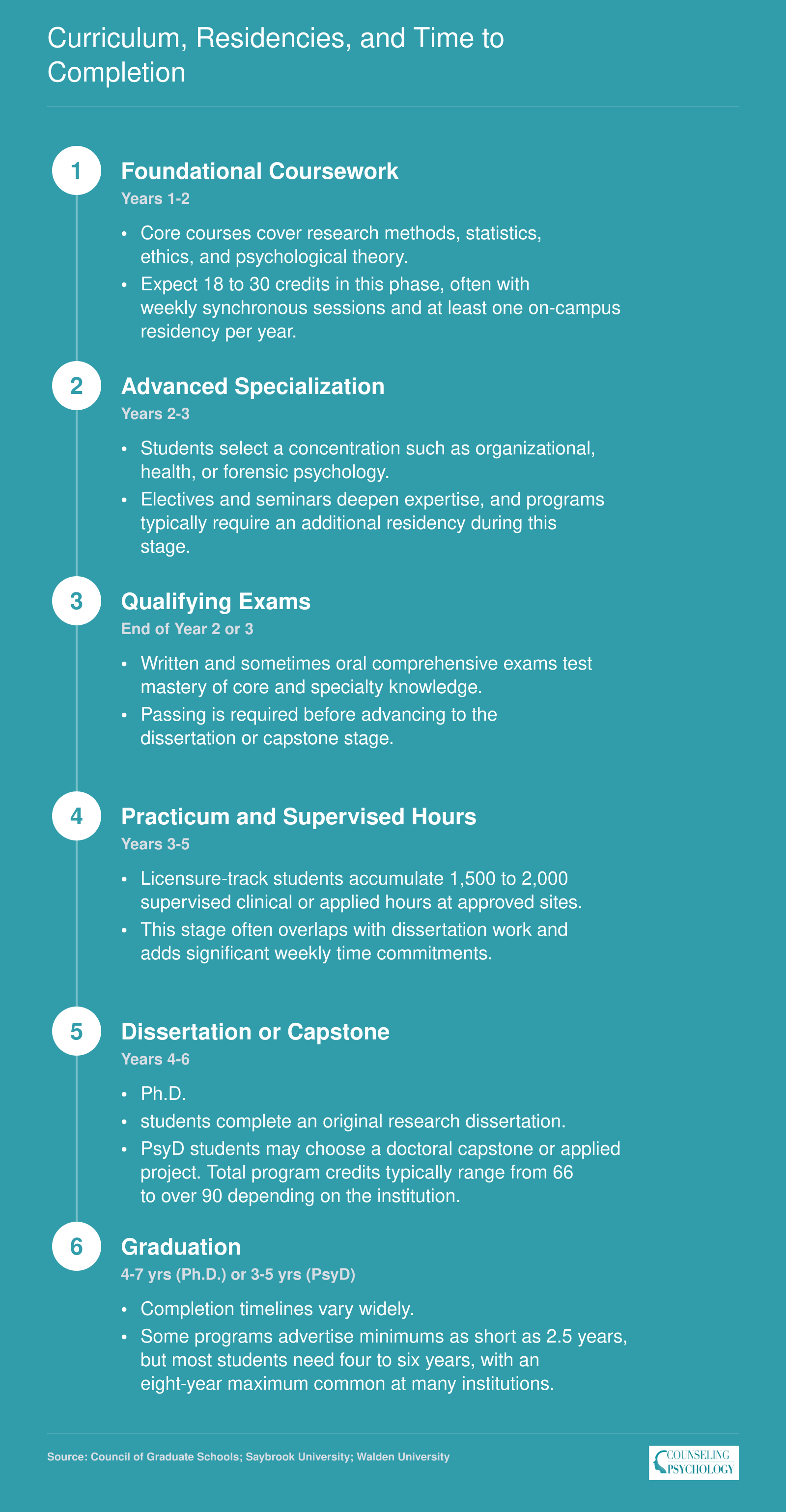
Earning an online applied psychology doctorate is not a straight path through asynchronous coursework. Most programs require synchronous live sessions each week, mandatory on-campus residencies (typically one to three per year, lasting three to five days each), and substantial practicum hours, often 1,500 to 2,000 supervised hours for licensure-track students. National data show that roughly 35% of psychology doctoral students do not finish within ten years, so understanding the real time commitments before you enroll is critical.
Cost Comparison and Funding Options for Online Doctoral Students
An online applied psychology doctorate is a multi-year financial commitment, and the sticker price varies more than most prospective students expect. A working professional finishing a PhD at a state-affiliated public university may spend $40,000 to $60,000 in total tuition, while a candidate at a private or for-profit institution can easily clear $100,000 to $150,000 by graduation. Knowing where a program sits on that spectrum, and what funding levers exist, matters as much as the curriculum itself.
Sample Tuition at Online Applied Psychology Doctorates
The numbers below are current published rates for 2026. Always verify directly with the school, since fees, residency costs, and dissertation continuation charges can add meaningfully to the total.
- Capella University (PhD in Psychology): roughly $555 per credit, with an estimated total program cost around $86,768.2
- Walden University (doctoral programs in psychology): approximately $695 per credit; total depends on the specialization and credit load.3
- Fielding Graduate University (PhD in Applied Psychological Science): about $10,290 per term, billed on a term-based rather than per-credit structure.4
- Liberty University (online PhD in Psychology): roughly $9,150 in annual tuition, one of the lower published rates among private nonprofits.
- The Chicago School (PsyD, PhD, and EdD programs): approximately $1,879 per credit for 2026-2027, placing it at the higher end of online doctoral pricing.5
For a budget-conscious comparison point, California Southern University's online PsyD is also worth a look. Per-credit rates between $500 and $800 are common at the more accessible end; rates above $1,500 per credit signal a premium-priced program.
Funding Realities for Online Doctoral Students
Full tuition waivers and graduate assistantships, the standard funding model for on-campus PhDs, are rare in online doctoral programs. Most online students self-fund through a combination of sources:
- Federal Grad PLUS and Direct Unsubsidized loans: the dominant funding mechanism for most online doctoral students.
- Employer tuition reimbursement: hospitals, school districts, and large nonprofits often cover $5,000 to $10,500 annually for relevant graduate work.
- Military and VA benefits: Post-9/11 GI Bill, Yellow Ribbon participation, and Tuition Assistance can substantially reduce out-of-pocket costs at participating schools.
- Institutional scholarships and alumni discounts: smaller awards, often $1,000 to $5,000, that returning professionals frequently overlook.
- Reduced per-credit rates: some schools offer locked-in tuition or discounted rates for active-duty military, first responders, or returning graduate alumni.
Students exploring related doctoral paths, such as counseling doctoral programs, will find similar funding constraints in most online formats. Build a multi-year budget that includes residencies, technology fees, and dissertation continuation charges before signing enrollment paperwork. The published per-credit rate is rarely the full picture.
Salaries for Applied Psychology Careers
The table below draws on 2024 national wage estimates from the Bureau of Labor Statistics for three occupations most relevant to applied psychology doctorate holders. Industrial-Organizational Psychologists command the highest median pay but represent a very small employment base; Clinical and Counseling Psychologists make up the largest group with solid mid-career earnings; and the Psychologists, All Other category captures professionals in forensic, community, and other specialized applied roles. These figures reflect the occupations broadly and are not limited to graduates of online programs.
| BLS Occupation | Total U.S. Employment | 25th Percentile Salary | National Median Salary | 75th Percentile Salary |
|---|---|---|---|---|
| Industrial-Organizational Psychologists | 1,050 | $80,790 | $109,840 | $198,170 |
| Clinical and Counseling Psychologists | 72,190 | $67,470 | $95,830 | $131,510 |
| Psychologists, All Other | 17,790 | $73,820 | $117,580 | $145,200 |
Career Paths and Job Growth With an Applied Psychology Doctorate
Where do applied psychology doctorates actually work, and how quickly are those fields growing? Graduates pursue a far broader range of careers in psychology than the traditional academic-or-clinical fork suggests, and many of the fastest-growing opportunities lie outside traditional clinical practice.
Career Paths by Applied Psychology Subfield
Industrial-organizational (I-O) psychologists apply research to workplace performance, talent selection, and organizational culture. Typical employers include consulting firms (McKinsey, Korn Ferry), HR departments at large corporations (Google, Amazon, Microsoft), tech companies building people-analytics platforms, and federal agencies. I-O roles often carry titles like talent strategist, organizational development consultant, or people scientist.
User experience (UX) researchers with applied psychology doctorates work on product teams at software companies, design agencies, and financial services firms. They conduct usability studies, eye-tracking research, and behavioral experiments to shape interface design. This subfield values mixed-methods research skills and iterative testing protocols.
Forensic psychologists consult with courts, correctional systems, and law enforcement on criminal behavior, competency evaluations, and risk assessment. Health psychologists and behavioral psychologists design interventions for chronic disease management, smoking cessation, and medication adherence, often employed by hospital systems, public health agencies, or pharmaceutical companies.
Employer Perceptions: Does Online Delivery Matter?
For non-licensed roles in I-O psychology, UX research, and consulting, employers focus on research portfolio, methodological skills, and domain expertise rather than degree delivery format. Hiring managers review published studies, conference presentations, and analytic capabilities. A well-executed dissertation on algorithmic bias or workplace diversity carries more weight than where you sat during seminars.
For licensed clinical or counseling roles, accreditation status drives employer and state board decisions. APA-accredited programs (whether online or campus-based) meet licensure prerequisites; unaccredited programs do not. Delivery format itself is secondary to that credential.
Job Growth and Emerging Opportunities
Psychology occupations overall are projected to grow faster than the national average of 3.1 percent between 2024 and 2034.1 Clinical and counseling psychologists are projected to see 11 percent job growth between 2022 and 2032, reflecting strong demand for mental health services.2 Industrial-organizational psychology holds Bright Outlook designation from the Bureau of Labor Statistics, signaling expected growth of at least 5 percent and strong demand driven by organizational focus on employee engagement, remote-work adaptation, and data-driven talent management.3
Applied psychology doctorates increasingly lead to roles outside traditional psychology titles. Data science consulting, human-centered AI research (evaluating algorithmic fairness, bias detection, explainability), corporate well-being program design, and policy analysis for government and nonprofits all recruit candidates with advanced training in behavioral science, experimental design, and quantitative methods. These hybrid roles reflect growing recognition that psychological expertise shapes technology, policy, and business strategy.
Highest-Paying Metro Areas for Applied Psychology Careers
Geography has an outsized effect on psychologist salaries. Across the metro areas below, median pay can run 30 to 50 percent above the relevant national median, and the gap widens further at the 75th percentile. This matters for online doctoral graduates more than you might expect: many applied psychology roles, particularly those in industrial-organizational psychology, human factors, and UX research, are increasingly performed remotely. That means professionals who earn their doctorate online can negotiate compensation benchmarked to high-cost metros even if they never relocate. The BLS metro-level figures here cover clinical and counseling psychologists, school psychologists, and the broader "psychologists, all other" category, which captures many applied specializations.
| Metro Area | Occupation | Total Employed | Median Salary | 25th Percentile | 75th Percentile |
|---|---|---|---|---|---|
| San Francisco-Oakland-Fremont, CA | Clinical and Counseling Psychologists | 2,220 | $160,210 | $104,640 | $173,270 |
| Denver-Aurora-Centennial, CO | Clinical and Counseling Psychologists | 1,430 | $126,260 | $110,600 | $152,810 |
| Philadelphia-Camden-Wilmington, PA-NJ-DE-MD | Clinical and Counseling Psychologists | 2,090 | $106,330 | $75,150 | $138,720 |
| New York-Newark-Jersey City, NY-NJ | Clinical and Counseling Psychologists | 7,610 | $101,400 | $78,180 | $135,810 |
| Los Angeles-Long Beach-Anaheim, CA | Clinical and Counseling Psychologists | 3,760 | $100,330 | $80,340 | $134,820 |
| Los Angeles-Long Beach-Anaheim, CA | Psychologists, All Other | 500 | $160,640 | $122,820 | $160,640 |
| Philadelphia-Camden-Wilmington, PA-NJ-DE-MD | Psychologists, All Other | 320 | $128,400 | $78,200 | $147,950 |
| Boston-Cambridge-Newton, MA-NH | Psychologists, All Other | 420 | $126,870 | $75,990 | $149,050 |
| New York-Newark-Jersey City, NY-NJ | Psychologists, All Other | 1,030 | $121,470 | $85,220 | $127,840 |
| Washington-Arlington-Alexandria, DC-VA-MD-WV | Psychologists, All Other | 730 | $112,880 | $80,130 | $146,680 |
| San Francisco-Oakland-Fremont, CA | School Psychologists | 940 | $127,730 | $106,460 | $136,490 |
| Los Angeles-Long Beach-Anaheim, CA | School Psychologists | 3,170 | $108,130 | $102,060 | $127,210 |
| San Diego-Chula Vista-Carlsbad, CA | School Psychologists | 920 | $108,010 | $84,620 | $133,470 |
| Washington-Arlington-Alexandria, DC-VA-MD-WV | School Psychologists | 1,740 | $105,620 | $81,030 | $132,310 |
| New York-Newark-Jersey City, NY-NJ | School Psychologists | 6,180 | $101,790 | $80,540 | $130,030 |
How to Choose the Right Online Applied Psychology Doctoral Program
State licensing boards in at least a dozen states impose specific restrictions on doctorates earned through distance education, making program selection far more consequential than it might first appear. A structured decision framework can prevent costly missteps.
Filter 1: Accreditation Aligned with Your Career Goal
If your end goal involves clinical licensure as a psychologist, prioritize APA-accredited programs or, at minimum, programs designated as APA "accreditation eligible." If you are headed toward a non-licensed role in organizational consulting, research, or higher education, regional accreditation from an agency recognized by the U.S. Department of Education is typically sufficient. Getting this filter wrong can waste years of coursework that a licensing board will not accept.
Filter 2: Subfield Match
Not every online applied psychology doctorate covers the same ground. Some programs concentrate on industrial-organizational psychology, others on forensic or health psychology, and still others on broad clinical application. Confirm that the curriculum, elective tracks, and practicum sites align with your intended specialization before you apply.
Filter 3: Total Cost and Funding
Tuition sticker prices vary dramatically across online doctoral programs, but cost alone is a poor selection criterion. A cheaper or faster program that lacks appropriate accreditation may save money upfront yet block licensure or limit employer interest later. Compare net cost after assistantships, employer tuition benefits, federal loans, and any institutional scholarships. The cost comparison section earlier in this article breaks down typical ranges.
Filter 4: Residency and Practicum Compatibility
Most online doctorates require in-person residency weekends, intensive summer sessions, or supervised practicum hours at approved sites. Evaluate whether those commitments fit your current work schedule, caregiving responsibilities, and geographic location. Programs that appear fully online sometimes still require hundreds of on-site clinical hours.
Filter 5: Faculty Research Fit
A dissertation is only as productive as the mentorship behind it. Review faculty publication records, active research labs, and stated dissertation advising capacity. Programs with small cohorts often provide more direct faculty access, which matters when you are developing original research from a distance.
Two Steps Most Applicants Skip
First, contact your state licensing board before enrolling. Ask specifically whether it accepts degrees from the online program you are considering, because policies vary and change. A quick phone call can save you from discovering a problem after graduation.
Second, request completion and attrition rates directly from each program's admissions office. These figures are not always published on program websites, but institutions track them internally and are generally willing to share when asked. High attrition can signal inadequate student support, unclear milestone expectations, or hidden costs that push students out before they finish.
Choosing a doctoral program is a decision that will shape your career for decades. Prioritize these five filters in order, verify licensing board acceptance in writing, and treat unpublished outcome data as essential due diligence rather than optional curiosity.
Frequently Asked Questions About Online Applied Psychology Doctorates
Prospective doctoral students often share a common set of concerns about online applied psychology programs. The answers below draw on accreditation standards, typical program structures, and labor market data discussed throughout this guide.
- What can you do with a Ph.D. in applied psychology?
- Graduates work in roles such as industrial-organizational psychologist, human factors researcher, program evaluator, behavioral health consultant, and university faculty. Applied psychology doctorates also open doors in UX research, public policy analysis, and organizational development. According to the Bureau of Labor Statistics, industrial-organizational psychologists earned a national median salary of roughly $147,420 as of the most recent data, making this one of the higher-paying psychology specializations.
- Are there APA-accredited online Ph.D. programs in applied psychology?
- APA accreditation currently applies to programs in clinical, counseling, and school psychology rather than to applied psychology broadly. Some online clinical or counseling psychology doctorates do hold APA accreditation and may include applied coursework. If you plan to pursue licensure as a psychologist, confirm that your program meets your state board's accreditation requirements. Regional institutional accreditation (such as HLC or SACSCOC) is essential regardless of specialty.
- How long does an online Ph.D. in applied psychology take to complete?
- Most online Ph.D. programs in applied psychology require four to seven years, depending on dissertation progress and whether you enroll full or part time. PsyD programs tend to fall on the shorter end, typically four to six years, because they emphasize practitioner training over original research. Some programs accept transfer credits or allow accelerated tracks that can shave a semester or two off the timeline.
- Is an online doctorate in psychology respected by employers?
- Yes, provided the program holds recognized regional accreditation. Employers in consulting, government, healthcare, and academia increasingly accept online doctoral credentials, especially from established universities. What matters most is the rigor of the curriculum, the quality of supervised field experiences, and (where relevant) whether the degree satisfies state licensure requirements. Hybrid formats that include in-person residencies or practica can further strengthen your candidacy.
- How much does an online doctorate in psychology cost?
- Total tuition for online doctoral programs in psychology typically ranges from about $50,000 at public universities to $150,000 or more at private institutions. Per-credit rates commonly fall between $500 and $1,200. Funding options include graduate assistantships, employer tuition reimbursement, federal direct unsubsidized loans, and program-specific scholarships. Some schools offer lower per-credit rates for active-duty military students. Always calculate total cost of attendance, including residency travel and fees.
- What is the difference between a Ph.D. and a PsyD in applied psychology?
- A Ph.D. in applied psychology emphasizes research methodology, statistical analysis, and original dissertation work, preparing graduates for academic or research-heavy careers. A PsyD focuses on clinical practice, professional application, and supervised fieldwork, making it a better fit for students aiming at direct service delivery or organizational consulting. Ph.D. programs generally offer more funding through assistantships, while PsyD programs often have higher acceptance rates but higher out-of-pocket costs.