
What you’ll learn in this article…
- Most Ph.D. programs in developmental psychology are fully funded with tuition waivers and annual stipends.
- The national median wage for psychologists in related categories reached $117,580 according to recent BLS data.
- Median time to degree for psychology research doctorates was 5.7 years per NSF figures from 2022.
- Faculty mentor subspecialty fit, not overall program ranking, is the strongest predictor of doctoral success.
Developmental psychology examines how people grow and change from infancy through old age, encompassing everything from early language acquisition to cognitive decline in later years. The need for doctoral-level expertise in this field is substantial: the BLS reports a median annual wage of $117,580 for psychologists, a category that includes many developmental specialists.
The online doctorates highlighted below were selected for their affordability, strong graduate outcomes, and reliable completion data. Subsequent sections compare the Ph.D. and PsyD paths, unpack funding and cost, and map career trajectories, all while emphasizing that your subspecialty alignment often matters far more than program ranking.
Best Online Developmental Psychology Doctorate Programs
Fully online doctoral programs in developmental psychology remain relatively rare, which makes the handful of accredited options worth examining closely. The three programs below each take a distinct approach to studying human growth across the lifespan, from structured credit caps and virtual residencies to faith-integrated curricula. Program-level earnings and completion data are not yet available for these listings, so institution-wide figures are provided as context.
- Program relevance and specialization depth
- Tuition affordability and cost caps
- Delivery format and flexibility
- Institutional graduation and retention rates
- Faculty model and student support
- Independent program research
- Internal program database
- College Scorecard graduate earnings — collegescorecard.ed.gov
- NCES-IPEDS federal institutional data — nces.ed.gov
Capella University
Capella University's PhD in Psychology with a Developmental Psychology specialization is built around lifespan development, policy, and advocacy. The 84-quarter-credit curriculum combines seven core courses with seven specialization courses, three virtual residencies, and a four-course dissertation sequence, all delivered through the GuidedPath format in structured 10-week quarters. A notable cost control is the $48,000 tuition cap for eligible students, and no GRE or GMAT is required for admission. The institution-wide graduation rate is 20%, a figure that reflects Capella's large, nontraditional student body rather than any single program's outcomes.
- Online GuidedPath format with 10-week quarters
- 84 quarter credits: 7 core + 7 specialization courses
- 3 virtual residencies and 4 dissertation courses
- $570 per quarter credit; $2,780 per dissertation quarter
- $48,000 tuition cap for eligible students
- No GRE, GMAT, or application fee required
- Up to 24 transfer credits accepted
- Military and employer discounts available
PhD in Psychology, Developmental Psychology Specialization — Online
Walden University
Walden University stands out for offering multiple named specialization tracks within its online PhD in Developmental Psychology, including Child and Adolescent Development, Health and Human Development, Teaching, and a Self-Designed option. The program ranges from 80 to 110 quarter credits depending on prior coursework, with completion possible in as few as 33 months for students who hold a related master's degree. Each student is paired with a Doctoral Degree Coach and must complete four in-person residencies. Tuition runs $645 per quarter credit, with grants of up to $5,000 available. Institution-wide graduation rate data is not reported for Walden, so prospective students should inquire directly about doctoral completion rates.
- Fully online with four required residencies
- 80 quarter credits for master's-prepared applicants
- Completable in as few as 33 months
- $645 per quarter credit; $185 quarterly program fee
- No application fee, essay, or SAT/ACT required
- Doctoral Degree Coach assigned to every student
- Focuses on growth and change from infancy through adolescence
- 80 quarter credits for related master's holders
- Same tuition rate and residency structure as general track
- Up to $5,000 grant available for eligible students
- Easy credit transfer from prior graduate work
- Dissertation required for completion
- Explores intersections of health, wellness, and lifespan growth
- 80 to 110 quarter credits depending on background
- As few as 42 months for students with unrelated degrees
- Four residencies with fees of $1,420 to $1,520 each
- Accredited by the Higher Learning Commission
- Not designed as a licensure pathway
PhD in Developmental Psychology, General — Online
PhD in Developmental Psychology, Child and Adolescent Development — Online
PhD in Developmental Psychology, Health and Human Development — Online

Liberty University
Liberty University delivers its Ph.D. in Psychology with a Developmental Psychology concentration through a compact 60-credit-hour, 100% online curriculum built on 8-week courses. The program integrates a biblical worldview into its study of human development, making it a distinctive fit for students seeking a faith-based doctoral education. Up to 50% of credits may transfer in, and optional on-campus intensives in Lynchburg, Virginia, add a face-to-face dimension for those who want it. The institution-wide graduation rate is approximately 65%, and military discounts are available.
- 100% online with optional on-campus intensives
- 60 total credit hours in 8-week course blocks
- Transfer up to 50% of degree credits
- No standardized testing required for admission
- Biblical worldview integrated throughout curriculum
- Competitive tuition with military discount options
Ph.D. in Psychology, Developmental Psychology Concentration — Online
Ph.D. Vs. Psyd in Developmental Psychology: Key Differences
Choosing between a Ph.D. and a PsyD in developmental psychology starts with understanding what each degree is designed to do. The Ph.D. follows a scientist-practitioner model that prioritizes original research, while the PsyD follows a practitioner-scholar model built around clinical application. Because developmental psychology is fundamentally a research-oriented subfield, the vast majority of doctoral programs award the Ph.D., and PsyD options with a true developmental focus are rare. The American Psychological Association outlines these distinctions in its overview of doctoral degrees.
| Dimension | Ph.D. in Developmental Psychology | PsyD in Developmental Psychology |
|---|---|---|
| Training Model | Scientist-practitioner (Boulder model). Students spend the bulk of their time designing studies, analyzing data, and publishing. | Practitioner-scholar (Vail model). Coursework and supervised practice center on clinical service delivery, with research playing a supporting role. |
| Research Emphasis | High. A dissertation involving original empirical research is the capstone, and most programs expect students to co-author publications before graduating. | Lower. Students complete a doctoral project or applied dissertation, but day-to-day training leans toward assessment and intervention skills. |
| Clinical Hours | Moderate. Some programs include practicum rotations, especially those housed within clinical or school psychology departments, but clinical training is not always required. | High. Programs typically require 1,500 or more supervised clinical hours plus a predoctoral internship, preparing graduates for direct client care. |
| Typical Program Length | 5 to 7 years (including dissertation research). Funding packages often offset tuition during that span. | 4 to 6 years. Shorter research timelines can reduce total time, though clinical placements add semesters. |
| APA Accreditation Landscape | Standalone developmental Ph.D. programs are not APA-accredited because APA accredits clinical, counseling, and school psychology programs. A Ph.D. student who wants APA-accredited clinical training typically enrolls in a clinical psychology program with a developmental concentration. | Same principle: a purely developmental PsyD is not APA-accredited on its own. PsyD programs that carry APA accreditation do so under clinical or combined program designations, sometimes offering a developmental track. |
| Licensure Implications | Graduates of APA-accredited clinical programs are eligible for licensure as psychologists. Those in research-only developmental programs generally are not, unless they complete additional supervised clinical hours that satisfy state licensing boards. | Graduates almost universally pursue clinical licensure and are well positioned for it, provided their program holds APA accreditation or meets state-specific requirements. |
| Program Prevalence in Developmental Psychology | Common. Developmental psychology has historically been a Ph.D. discipline, and dozens of universities offer doctoral programs or developmental science concentrations. | Rare. Very few PsyD programs offer a dedicated developmental specialization. Students interested in clinical work with a developmental lens more often find it as an elective track within a broader clinical PsyD. |
Questions to Ask Yourself
Online Vs. On-Campus Developmental Psychology Doctorates
Choosing between an online and on-campus doctoral program in developmental psychology involves more than personal preference. It shapes the kind of training you receive, the research opportunities available to you, and how future employers and postdoc committees evaluate your credentials. Here is a practical breakdown of the tradeoffs.
Pros
- Online programs offer schedule flexibility that lets working professionals, parents, or caregivers pursue a doctorate without relocating.
- Geographic barriers disappear with online delivery, opening access to programs you could not attend in person.
- Online doctorates often carry a lower effective cost once you factor in eliminated commuting, relocation, and campus fees.
- On-campus programs immerse you in active research labs where you can design studies, collect data, and co-author publications with faculty.
- Faculty mentorship tends to be stronger on campus, with regular in-person meetings, lab group discussions, and informal collaboration.
- On-campus students typically have direct access to participant populations, developmental labs, and university resource centers that support hands-on research.
Cons
- Online programs provide limited opportunities for hands-on laboratory research, which is central to most developmental science careers.
- Mentorship touchpoints are fewer in online formats, making it harder to build the close faculty relationships that drive recommendation letters and research networks.
- Some employers and postdoctoral selection committees still favor candidates from traditional, on-campus doctoral programs.
- Most top-ranked developmental psychology Ph.D. programs are residential; online options are more commonly broader psychology doctorates with a developmental concentration rather than dedicated developmental science programs.
- On-campus programs impose geographic constraints, requiring you to live near a specific university for four to seven years.
- Residential students face higher costs of living and less schedule flexibility, which can be especially challenging for those balancing family or work obligations.
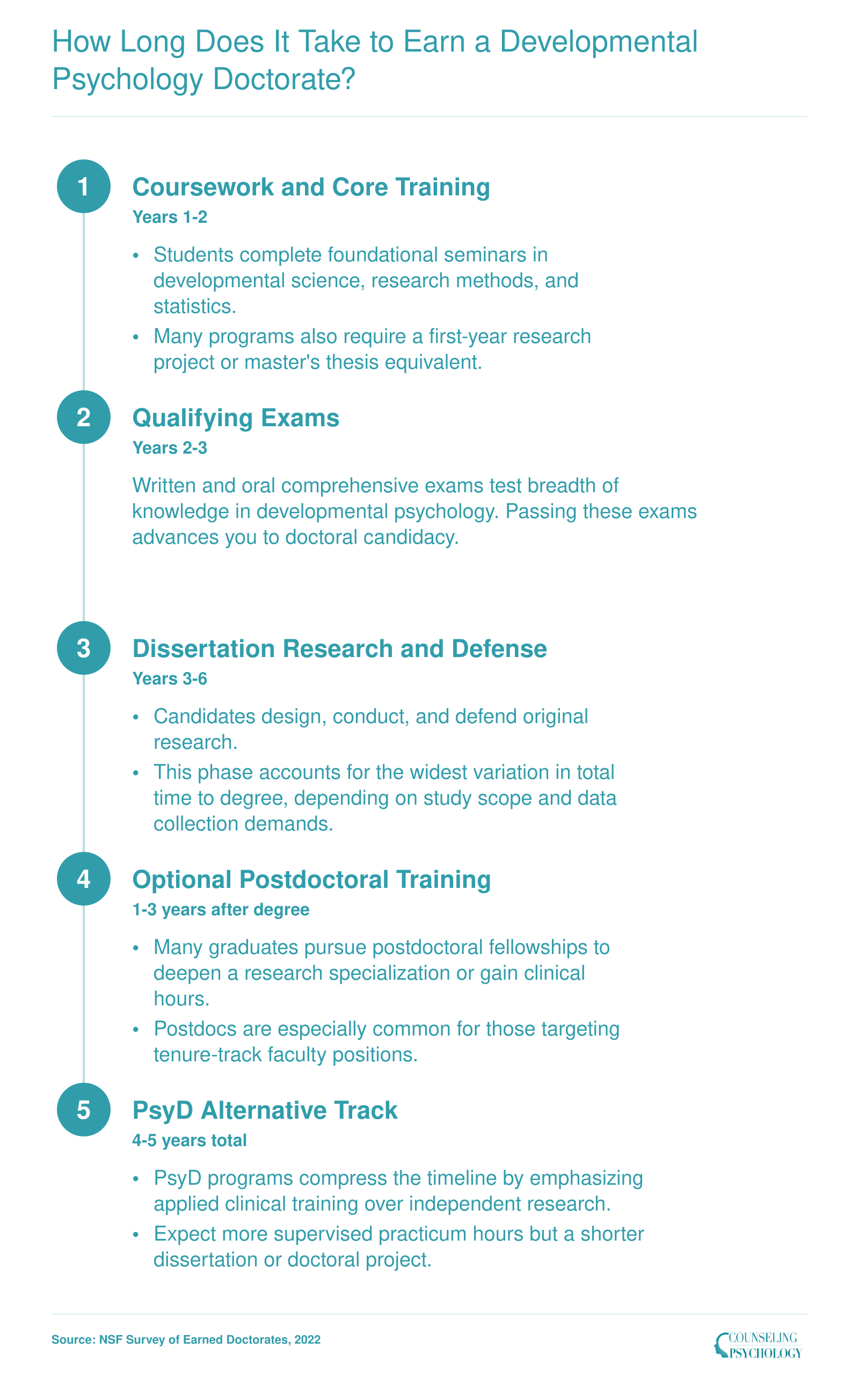
How Long Does It Take to Earn a Developmental Psychology Doctorate?
Earning a developmental psychology doctorate is a multi-year commitment, and the timeline varies depending on program type. According to NSF data, the median time to degree for psychology research doctorates was 5.7 years as of 2022, though the average from graduate school entry to completion has historically run closer to 7 years. PsyD programs tend to be shorter (typically 4 to 5 years) but pack in substantially more practicum hours.
Admissions Requirements and What Programs Look For
Developmental psychology doctoral admissions have shifted meaningfully since 2020, with many programs dropping standardized test requirements while placing greater weight on demonstrated research experience and faculty fit. Understanding what committees actually prioritize can help you build a stronger application.
GPA Thresholds and Academic Preparation
Most developmental psychology Ph.D. programs expect a minimum undergraduate GPA between 3.0 and 3.5, though admitted cohorts often average higher. UC Davis, for example, lists a 3.0 minimum1, while the University of Denver requires a 2.5 undergraduate GPA but expects 3.0 or higher for applicants with prior graduate coursework.2 These minimums represent floors rather than targets. Competitive applicants typically present GPAs well above the stated threshold, particularly in psychology, statistics, and research methods courses.
A bachelor's degree is the standard prerequisite across programs. Harvard, NYU, USC, UC Davis, and the University of Denver all accept applicants directly from undergraduate study without requiring a master's degree first.345 That said, a completed master's can strengthen your application if you are changing fields, if your undergraduate research experience is limited, or if you want to demonstrate graduate-level academic performance before committing to a five-to-seven-year doctorate. If you are weighing that option, our guide to online master's in psychology programs covers what to look for in a program that prepares you well for doctoral work.
The Current GRE Landscape
Standardized testing requirements vary considerably. Harvard still requires GRE scores for its developmental psychology track3, while NYU, USC, UC Davis, and the University of Denver have adopted test-optional policies or offer GRE waivers.4512 This reflects a broader trend in graduate psychology admissions, but policies can change from year to year. Check each program's current admissions page before assuming you can skip the exam.
Research Experience and Faculty Fit
Admissions committees weigh research experience heavily. Programs like Harvard explicitly state they expect applicants to have prior research involvement, typically through lab assistantships, honors theses, or post-baccalaureate research positions.3 Even programs that do not list research experience as a formal requirement favor candidates who can speak knowledgeably about study design, data collection, and the research questions they hope to pursue. If you are wondering how hard it is to get into grad school for psychology, research experience is often the differentiating factor.
Perhaps the single most important factor is alignment between your interests and the work of specific faculty members. Developmental psychology spans cognitive development, social-emotional growth, developmental psychopathology, language acquisition, and more. Committees look for applicants who have identified faculty mentors whose research genuinely intersects with their own questions. A strong statement of purpose names those faculty members, references their recent work, and articulates how your interests complement or extend their lab's direction.
Letters of Recommendation
Most programs require three letters of recommendation, with at least one or two coming from faculty who have supervised your research. Letters that speak to your intellectual curiosity, independence in the lab, and readiness for doctoral-level work carry more weight than letters focused primarily on classroom performance. If you have worked as a research assistant, that supervisor's perspective is essential.
Funding and Cost: Stipends, Tuition Waivers, and ROI
Fully funded Ph.D. offers are the norm in developmental psychology at research-intensive universities, and that single fact reshapes the entire cost calculus of a doctoral education.
What "Fully Funded" Actually Means
At most research universities, an acceptance letter for a developmental psychology Ph.D. comes bundled with a financial package that covers full tuition plus an annual stipend for teaching or research assistantship work. Stipend amounts vary by institution and cost of living, but the typical range in 2025, 2026 sits between roughly $20,000 and $35,000 per year.1 A few concrete examples illustrate the spread:
- Temple University: $27,000 annual stipend, full tuition waiver, and health insurance coverage, guaranteed for five years.2
- University of Denver: $26,539 annual stipend with a full tuition waiver, health insurance, and the possibility of supplemental awards up to $4,500, also guaranteed for five years.3
- George Mason University (Applied Developmental Psychology): $23,000 stipend with four years of guaranteed support.4
- University of Minnesota: Full tuition waiver, subsidized health insurance, and guaranteed summer funding across a five-year package.5
Nationally, guaranteed funding windows for developmental psychology Ph.D. students span four to six years, which generally aligns with expected time to degree.1 Programs that guarantee five years give students meaningful breathing room to complete a dissertation without scrambling for outside income.
PsyD and Online Programs: A Different Financial Picture
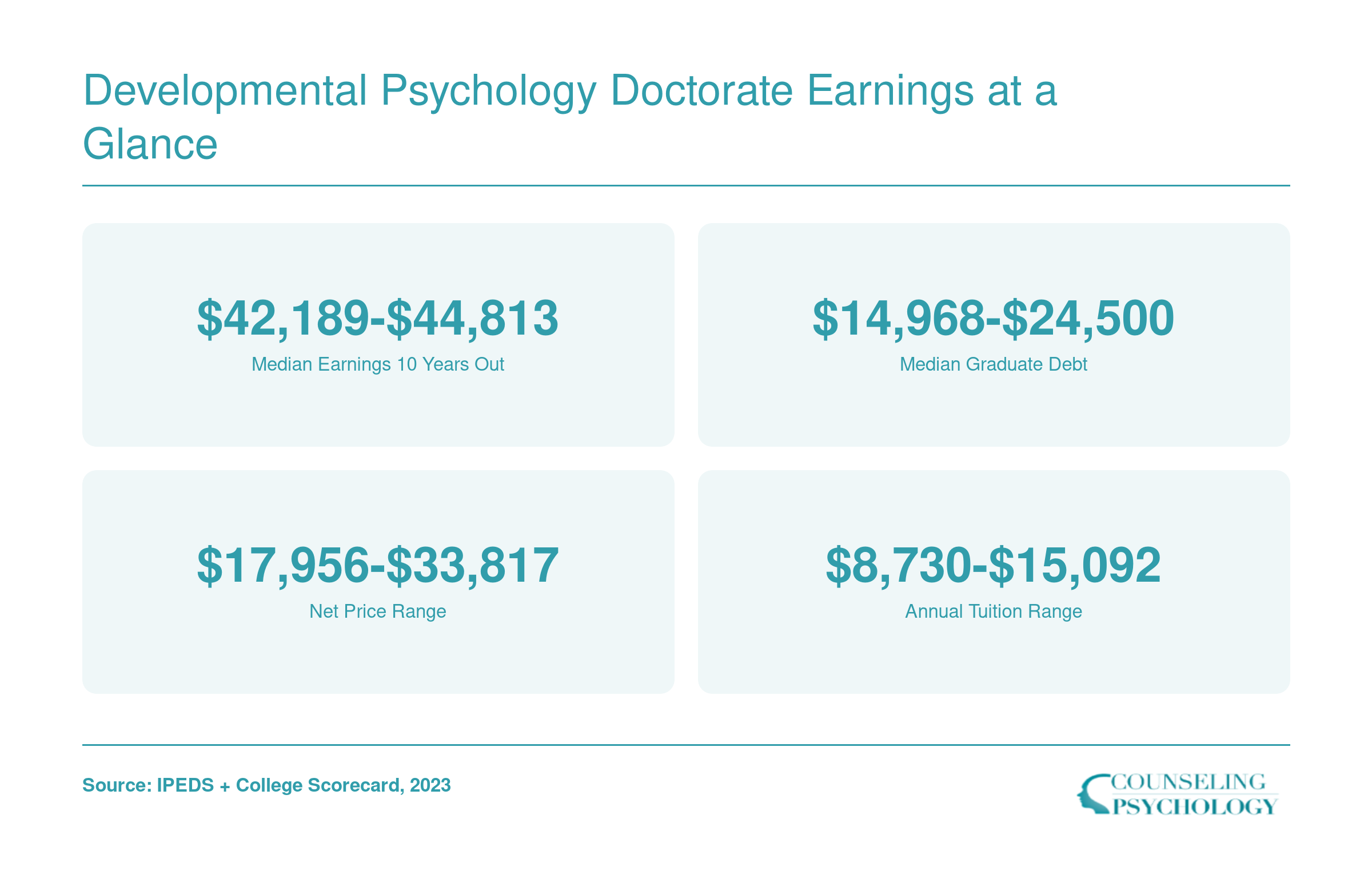
The funding landscape shifts dramatically for PsyD programs and online doctorates. These formats rarely offer full tuition waivers or stipends. Students should expect to self-fund through loans, employer tuition assistance, or personal savings. Among the online developmental psychology doctorates in our ranked list, institutional tuition runs from roughly $8,700 to $15,100 per year. That is lower than many on-campus sticker prices, but without stipend support the cumulative cost still adds up. Median graduate debt at those institutions ranges from approximately $15,000 to $24,500, which is moderate compared to many professional programs but still significant when weighed against early-career earnings.
Framing the Return on Investment
ROI in a doctoral program depends on two numbers: what you owe at completion and what you earn afterward. For funded Ph.D. graduates, debt at completion is often near zero, which means almost any post-graduation salary delivers a positive return immediately. Program-level earnings data for developmental psychology doctorates specifically are not yet published for most institutions, but institution-wide median earnings ten years after enrollment at the online schools in our data set range from about $42,000 to $45,000. When median debt sits around $15,000 to $25,000 and ten-year earnings reach the low-to-mid $40,000s, the ratio is workable but not exceptional, especially if you are financing the degree entirely through loans.
Contrast that with a funded Ph.D. graduate who enters academia or a research position with zero debt: even a starting salary in the $55,000 to $70,000 range (common for postdoctoral or assistant professor roles) represents a far stronger financial position. The takeaway is straightforward. If research and academia are your goals, prioritize programs that offer full funding. If you are drawn to an online or PsyD path for its flexibility, build a realistic budget that accounts for total borrowing costs, interest accrual during a multi-year program, and the salary trajectory you can reasonably expect in your target career. The career outcomes section of this article breaks down earning potential by role and setting in more detail.
Developmental Psychology Doctorate Earnings at a Glance
The figures below reflect institution-level outcomes for completers at the online developmental psychology doctorate programs featured in our rankings. Program-level earnings, debt, employment share, and poverty-threshold data are not yet published for these specific doctoral programs, so we present the broader institutional medians instead. Keep in mind these numbers cover all graduates at each school, not just developmental psychology doctorates.
Career Outcomes and Salary After a Developmental Psychology Doctorate
The national median annual wage for psychologists in the "all other" category, which includes many developmental psychology Ph.D. holders, stood at $117,580 as of the most recent BLS data.1 That figure sits well above the median for all occupations, but the range is wide: earners at the 10th percentile brought home roughly $47,450, while those at the 90th percentile exceeded $157,420.2 Where you land on that spectrum depends heavily on the career path you choose and how closely your training aligns with employer needs.
Major Career Paths
A developmental psychology doctorate opens several distinct trajectories:
- University faculty and researcher: Tenure-track positions in psychology or human development departments combine teaching with grant-funded research. The BLS reports that postsecondary psychology teachers (SOC 25-1066) earn a national median that generally trails the research-scientist track but comes with institutional stability, sabbatical opportunities, and access to graduate mentees.
- Clinical developmental psychologist: Graduates who complete supervised clinical hours and obtain licensure can work in pediatric hospitals, developmental clinics, or private practice. This route is most accessible to those whose doctoral training included a clinical or developmental psychopathology emphasis. For context on the broader licensed-practice pathway, see our guide on how to become a clinical psychologist.
- Policy analyst at government agencies: Organizations such as NIH, CDC, and state-level departments of children and family services hire developmental scientists to design evidence-based programs, evaluate interventions, and advise on policy. Scientific Research and Development Services was the top-paying industry sector for "all other" psychologists in recent BLS data, with a mean wage of $131,220.2
- Research scientist in the private sector or nonprofits: Ed-tech companies, child welfare organizations, and UX research teams increasingly recruit doctorates with expertise in cognitive development, learning science, or lifespan assessment.
What the Earnings Data Shows
BLS projections estimate 6 percent job growth for psychologists (all other) from 2024 to 2034, roughly in line with the average for all occupations.1 For graduates of the online developmental psychology programs featured in this article, program-level earnings data are not yet available from federal reporting sources. That means prospective students should weigh institution-level outcomes, median graduate debt, and overall return-on-investment ratios when comparing schools like Capella University, Walden University, and Liberty University.
Why Subspecialty Training Shapes Your Ceiling
The doctorate itself is the entry ticket, but your concentration determines which doors open widest. Training in developmental psychopathology can qualify you for licensed clinical roles in hospital and community mental health settings. A focus on cognitive development or learning sciences positions you for high-demand roles in ed-tech product design and UX research, sectors where salaries often compete with or exceed academic pay. Lifespan developmental expertise, meanwhile, is increasingly sought by aging-services organizations and health systems investing in geriatric programming.
Before committing to a program, map its faculty research strengths and practicum partnerships against the specific career you want. A doctorate takes years to complete; aligning your subspecialty with a target employment sector from the start can meaningfully affect both your earning trajectory and your professional satisfaction.
In developmental psychology doctoral training, your faculty mentor's specific research area (infant cognition, bilingual development, adolescent risk-taking, aging) matters far more than the program's overall ranking. Your mentor IS your program: they shape your dissertation, open professional networks, and define your expertise for the next decade of your career.
How to Choose the Right Developmental Psychology Program
The right developmental psychology doctorate begins with a clear subspecialty match, not a university brand name. Before shortlisting programs, articulate your research questions and theoretical orientation (cognitive development across infancy and early childhood, social-emotional growth in adolescence, developmental psychopathology linking risk factors to outcomes, or lifespan perspectives that follow trajectories from childhood into old age), then map them to faculty who publish in those domains. A program ranked first overall may offer weak training in your niche, while a mid-ranked department with a nationally recognized lab in your area will open more doors. Review recent publications and grant portfolios: faculty whose work excites you are the ones you want to apprentice under for five to seven years.
Program Culture and Training Structure
Once faculty fit is clear, evaluate program culture. Cohort size matters: intimate cohorts (three to five admitted per year) foster close mentorship but may limit peer collaboration, while larger cohorts dilute faculty attention but expose you to broader methods and perspectives. Ask whether the program permits lab rotations during the first year or expects you to commit to a single advisor at entry. Investigate cross-departmental ties: strong developmental programs collaborate with education, neuroscience, public health, or social work departments, yielding interdisciplinary methods training and broader job-market appeal. Clarify publication and conference expectations before candidacy; some programs require a first-author manuscript by the end of year two, others do not formalize benchmarks until the dissertation phase.
Practical Realities: Money, Workload, and Placement
Geographic location and cost of living directly impact quality of life when stipends hover around $25,000 to $35,000. A stipend of $30,000 in a low-cost Midwest city affords comfortable living; the same figure in San Francisco or Boston creates financial strain. Compare teaching-assistantship versus research-assistantship ratios: TA-heavy loads (two sections per semester) delay research progress, while RA funding ties you more tightly to your advisor's grant timeline. Most critical: scrutinize placement records. If you aim for tenure-track academic jobs, count how many recent graduates secured postdocs at R1 institutions or faculty lines. If you target industry roles (tech, nonprofits, policy think tanks), look for alumni working outside academia. A program with stellar academic placement but zero industry alumni will struggle to support non-academic career pivots.
Student Perspectives Trump Marketing Copy
Reach out to current doctoral students, not just faculty, before you apply or accept an offer. Ask candid questions about mentorship accessibility (does your advisor respond within days or weeks?), funding reliability (have students ever lost stipends mid-program?), and work-life balance (are eighty-hour weeks normalized or stigmatized?). Students will reveal whether the program's culture matches its recruitment pitch and whether departmental support structures (mental health resources, family leave policies, professional development funds) function in practice. A fifteen-minute conversation with a third-year student often surfaces red flags that no website will disclose.
Frequently Asked Questions About Developmental Psychology Doctorates
Prospective doctoral students often have overlapping questions about program format, licensure, and career outcomes. Below are concise answers to the questions we hear most often, drawn from current admissions data and professional licensing guidelines.