
What you’ll learn in this article…
- Most online developmental psychology programs are offered at the master's level, with few fully online bachelor's or doctoral options.
- Regional accreditation matters most for licensure eligibility, and not every program leads to a professional credential.
- Program-level earnings data remains unpublished, so institution-wide College Scorecard figures are the best available benchmark.
- Practicum hours are almost always completed locally, making site approval policies a critical factor when choosing a program.
The demand for developmental specialists in schools, clinics, and social service agencies is rising faster than the supply of licensed professionals, especially in rural and underserved communities. Online developmental psychology programs have stepped in to close that gap, offering master's and doctoral degrees that let students train without uprooting their lives.
But the convenience comes with a tradeoff: many online programs focus on research or nonclinical pathways, which means not every degree leads directly to the state license you might need for independent practice. Checking accreditation and fieldwork requirements before enrolling is not just a box-ticking exercise. It determines whether your degree can be converted into a credential that employers and insurance panels recognize.
Best Online Developmental Psychology Programs
The programs below are ranked using a composite that weighs online delivery format alongside institution-wide graduation rates, net price after aid, and available outcomes data. No single metric drives the order; the goal is to surface accredited online developmental psychology programs that balance affordability, academic quality signals, and career relevance. Program-level earnings data is not yet available for these specific offerings, so institution-wide median earnings are noted for context where applicable.
- Online delivery and flexibility
- Institution graduation and retention rates
- Net price after financial aid
- Graduate earnings and debt outcomes
- Program depth and curricular breadth
- Independent program research
- Internal program database
- NCES-IPEDS federal institutional data — nces.ed.gov
- College Scorecard graduate earnings — collegescorecard.ed.gov

Bay Path University
Bay Path University pairs a low 8:1 student-to-faculty ratio with a fully online master's program built around 36 credits of lifespan development coursework and 160 hours of community fieldwork. The school's net price of roughly $14,271 is the lowest in this list, and its institution-wide median earnings of $55,383 at ten years out signal solid long-term value. Notably, the MS in Developmental Psychology also offers a concentration in Alcohol and Drug Use Counseling, which adds 300 fieldwork hours in a primary substance-use treatment setting for students interested in that career track.
- 36-credit fully online graduate program
- 160 hours of required community fieldwork
- Optional concentration in Alcohol and Drug Use Counseling
- No GRE or GMAT required for admission
- Three annual start dates (January, May, September)
- Research methods and ethical practice emphasis
- Admits with preferred 3.0 GPA and personal essay
Master of Science in Developmental Psychology — Online
Capella University
Capella University's PhD in Developmental Psychology is structured around 84 quarter credits delivered entirely online through the GuidedPath format, with 10-week terms that keep doctoral students on a predictable schedule. A $48,000 tuition cap and $570-per-credit rate give prospective students a concrete cost ceiling, and three virtual residencies replace in-person requirements. The program does not lead to licensure, so it is positioned squarely for careers in research, teaching, or consulting rather than clinical practice.
- 84 quarter credits, fully online delivery
- $570 per quarter credit with $48,000 tuition cap
- Three virtual residencies replace campus visits
- No GRE, GMAT, or application fee required
- GuidedPath format with structured 10-week quarters
- Master's degree and 3.0 GPA required for admission
- Up to 24 transfer credits accepted
- Military and employer tuition discounts available
PhD in Developmental Psychology — Online

Liberty University
Liberty University offers both a doctoral and a master's track in developmental psychology, giving students two entry points depending on career stage. The PhD in Psychology with a Developmental Psychology concentration runs 60 credit hours in accelerated 8-week online courses, while the 36-credit MA in Applied Psychology follows the same flexible format. Both programs integrate a biblical worldview throughout the curriculum and allow transfer of up to 50% of required credits, which can significantly shorten time to completion for students with prior graduate work.
- 60 credit hours, 100% online delivery
- Accelerated 8-week course format
- Transfer up to 50% of degree credits
- No standardized testing required for admission
- Biblical worldview integrated across coursework
- Optional on-campus intensive sessions available
- 36 credit hours, fully online format
- $565 per credit hour graduate tuition rate
- 8-week accelerated online courses
- SACSCOC regional accreditation
- No GRE or standardized test required
- Research-focused developmental curriculum
- Transfer up to 50% of credits from prior work
PhD in Psychology, Developmental Psychology — Online
Master of Arts in Applied Psychology, Developmental Psychology — Online
Walden University
Walden University's PhD in Developmental Psychology stands out for breadth: students choose among five specialization tracks, including Child and Adolescent Development, Health and Human Development, Teaching, and a Self-Designed option that lets them tailor coursework to a specific population or theme. The program requires 80 quarter credits for those entering with a related master's degree (110 for unrelated backgrounds) and includes four required residencies. An MPhil credential is available en route to the PhD, providing a formal milestone for students who need to pause before the dissertation. Like Capella's offering, this is explicitly a non-licensure program geared toward research, academic, and consulting roles.
- 80 quarter credits (110 for unrelated master's degrees)
- $645 per quarter credit, fully online
- Completable in as few as 33 months
- No application fee, essay, or entrance exam
- Four required residencies throughout program
- MPhil degree option available before dissertation
- Doctoral Degree Coach tool for milestone planning
- Same 80-credit online structure as General track
- Focus on developmental research with children and teens
- Four residencies and dissertation required
- Up to $5,000 program savings grant available
- No GRE or GMAT for admission
- Financial aid and scholarship options offered
- Specialization in lifespan health and wellness
- 80 or 110 quarter credits based on prior degree
- $645 per quarter credit, asynchronous format
- Four residencies required during enrollment
- Self-Designed specialization also available
- Higher Learning Commission accredited
- Not a licensure program, research and consulting focus
PhD in Developmental Psychology, General — Online
PhD in Developmental Psychology, Child and Adolescent Development — Online
PhD in Developmental Psychology, Health and Human Development — Online
How We Ranked These Programs
The rankings on this page are built from a composite of publicly available data points designed to help you compare programs on factors that directly affect your wallet and your odds of finishing. No single number can capture whether a program fits your learning style, but these metrics give you a grounded starting point.
How We Score Each Program
The ranking begins with an eligibility filter: every program on this list is offered by a regionally or nationally accredited institution. Without that baseline, a school could not be included. From there, four data points carry the most weight:
- Online focus: Programs with a proven track record of distance delivery, not just emergency-remote courses, receive a boost. We prioritize schools that have invested in asynchronous, cohort-based, or hybrid models designed specifically for online learners.
- Net price after aid: This is the institution-wide average that full-time, first-year undergraduates actually pay after grants and scholarships are deducted. It is not your individual price tag, which will vary based on your residency, degree level, and financial aid package, but it offers a transparent benchmark for affordability.
- Graduation rate: We use the share of first-time, full-time students who complete a bachelor's degree within 150% of normal time. While this number reflects the full institution, not a specific department, it signals how well the school supports students through to the finish line.
- Earnings outcomes: Where available, we incorporate median earnings data for graduates a few years after leaving the institution. These figures come from federal scorecard sources and provide a snapshot of early-career earning potential.
What the Ranking Doesn't Capture
No dataset can measure the nuance of a curriculum, the mentorship quality of a faculty member, or the intangible satisfaction of a student community. Our rankings deliberately avoid subjective factors like faculty reputation surveys, student reviews, and curriculum design. Those details matter, but they are best assessed by reaching out to program directors or attending virtual open houses, not by a single algorithm. If you are also exploring broader graduate options, you may find it helpful to review our list of best online master's in psychology programs, which uses a similar methodology.
A Note on Accreditation
Institutional accreditation is the non-negotiable floor: it ensures the school meets baseline academic and financial standards. Programmatic accreditation, such as from the American Psychological Association or other field-specific bodies, is an additional quality signal, but it is not required for inclusion in this ranking. The accreditation section later in this guide covers those distinctions in detail.
Understanding the Price Data
The net price figure you see is an average across all undergraduates, so your true cost could be lower (if you receive more aid) or higher (if you are an out-of-state online student or a graduate learner, where pricing structures often differ). Use it as a comparison tool between schools, then contact the financial aid office for a personalized estimate.
Questions to Ask Yourself
Types of Online Developmental Psychology Degrees
The degree landscape for developmental psychology online has grown considerably more varied in recent years, giving students more entry points than ever but also more decisions to sort through before committing.
Bachelor's Degrees
Few universities offer an undergraduate degree in developmental psychology specifically. At the bachelor's level, you are more likely to encounter a general psychology major with a developmental concentration or a cluster of courses in the area. That is not necessarily a drawback. A broad psychology foundation at the undergraduate level provides flexibility, and most careers in psychology require graduate training anyway. If a bachelor's program explicitly labels itself "developmental psychology," read the curriculum carefully to confirm it offers more than a handful of specialized electives.
Master's Degrees
This is where the degree landscape gets substantive. Master's programs represent the practical sweet spot for most students entering the field. You will find two main formats: research-focused programs (typically leading to a thesis) and applied programs oriented toward direct practice, education, or program administration. Some programs carry the developmental psychology label directly; others house it within a psychology or human development department as a named concentration. The distinction matters more than it might seem. A degree specifically in developmental psychology can signal specialized expertise to employers, but a general psychology master's with a strong developmental emphasis may offer broader licensure pathways depending on your state.
Graduate Certificates
Certificates in developmental psychology or lifespan development are designed as skill add-ons rather than standalone credentials. They work well for professionals already holding a graduate degree who want targeted coursework in areas like early childhood development, adolescent behavior, or aging. They do not substitute for a full degree in most hiring contexts, but they can sharpen a resume or satisfy continuing education requirements.
Doctoral Degrees: PhD vs. PsyD
At the doctoral level, the PhD and PsyD serve different purposes. PhD programs in developmental psychology are research-oriented, preparing graduates for academic positions and original inquiry. PsyD programs lean toward clinical application. Not all PsyD programs include a dedicated developmental specialization, so you will need to confirm that the curriculum aligns with your goals before applying.
Developmental Psychology vs. Child Psychology
One confusion worth addressing directly: developmental psychology and child psychology are related but not the same. Developmental psychology covers the full lifespan, from prenatal development through late adulthood and aging. Child psychology narrows the focus to children and adolescents. The career tracks diverge accordingly. Developmental psychologists working with aging populations, for instance, often move into gerontology settings, research institutions, or policy organizations. Child psychologists are more likely to work in schools, pediatric clinics, or family service agencies. If you are interested in understanding the full range of psychologist education and career options, exploring multiple program types early on is worthwhile. If you are drawn specifically to working with children, a program with a child and adolescent concentration may serve you better than a broad lifespan curriculum.
Online Vs. On-Campus Developmental Psychology Degrees
Online developmental psychology programs deliver the same core curriculum as their campus counterparts, but the delivery method shapes everything from networking to research opportunities and employer perceptions. Understanding these differences helps you choose a format that supports your career goals, not just your schedule.
What Online Programs Offer
- Flexibility: Asynchronous courses let working professionals study around jobs and family. You can enroll in programs across the country without moving.
- Cost: Eliminating relocation and commuting often lowers total cost, even if per-credit tuition is similar.
- Specializations: Many online programs offer concentrations in child development, adult development, or applied settings, just like on-campus options.
The On-Campus Advantage
- Hands-on research: In-person access to labs, observation rooms, and faculty mentors creates richer research experiences, which can matter for PhD applicants.
- Networking: Daily interactions with peers and professors build professional relationships that often lead to practicum placements and job referrals.
- Practicum placement: Some local clinical or school-based sites give preference to students from nearby universities.
The Hybrid Reality
Pure 100% online is rare. Many programs require short campus intensives, synchronous video sessions, or practicum work done locally under supervision. Verify these expectations before enrolling; your schedule and location may limit supposedly "online" options.
How Employers and Doctoral Programs Perceive Online Degrees
A 2024 survey of 600 HR managers by SHRM found that 47% would consider a candidate with an online master's in psychology for relevant roles, and 66% place high value on supplemental certifications.1 Employers increasingly prioritize skills over degree format, especially in non-clinical fields like human resources, research coordination, or program evaluation. Still, bias lingers, particularly against for-profit online schools.
For doctoral programs, the picture is more nuanced. While regionally accredited online master's degrees are generally accepted, admissions committees for research-intensive PhDs may favor applicants with documented in-person research experience. Clinical psychology programs, which are highly competitive, sometimes still prefer traditional credentials. If a doctorate is your ultimate goal, supplement an online degree with strong research projects, publications, and solid GRE scores to offset any skepticism.
Regionally accredited online programs hold equal standing to campus-based ones for most non-clinical career paths. With careful planning, your online developmental psychology degree can open the same doors.
Related Articles
Accreditation and Licensure: Which Programs Lead to Which Credentials
Not every online developmental psychology program leads to a professional license, and confusing accreditation types with licensure eligibility is one of the most common mistakes prospective students make. Before you commit tuition dollars, you need to understand how the accreditation layers stack up and whether the specific program you are considering actually qualifies you for the credential you want.
Three Layers of Accreditation You Should Know
Accreditation operates at different levels, and each one serves a different purpose.
- Institutional (regional) accreditation: This is the baseline. Any program worth your time should be housed at an institution accredited by a recognized regional or national accrediting body. Without it, credits rarely transfer, federal financial aid is off the table, and licensing boards in most states will not accept the degree.
- APA accreditation: The American Psychological Association accredits doctoral programs in clinical, counseling, and school psychology. Most master's-level developmental psychology programs fall outside APA's scope entirely, since they are not practice-oriented doctoral programs.2 If you plan to eventually pursue a doctorate and independent licensure as a psychologist (which requires passing the EPPP and completing roughly 4,000 supervised hours), APA accreditation at the doctoral level matters. It does not apply to a standalone master's in developmental psychology.
- CACREP and MPCAC accreditation: The Council for Accreditation of Counseling and Related Educational Programs accredits counseling programs specifically. A general developmental psychology degree is not eligible for CACREP accreditation. However, some universities offer developmental psychology programs with embedded counseling concentrations or dual tracks that do meet CACREP-aligned standards. MPCAC (Masters in Psychology and Counseling Accreditation Council) fills a similar role for applied master's programs. If licensure as a counselor is your goal, look for programs that carry one of these designations or explicitly align their curriculum and clinical requirements with CACREP standards.
The LPC Path: When a Developmental Psychology Degree Can Work
A developmental psychology master's on its own typically does not lead to Licensed Professional Counselor status. LPC licensure generally requires a 60-credit master's degree with specific counseling coursework, a passing score on the NCE or NCMHCE exam, and between 2,600 and 3,600 supervised clinical hours (the exact number varies by state). Students who are exploring this route may also want to become a counselor to understand the full scope of steps involved.
That said, some developmental psychology programs are structured to include the clinical hours and counseling-focused coursework that meet these requirements. The distinction is program-specific, not degree-title-specific. Two programs both labeled "M.A. in Developmental Psychology" at different universities can have entirely different licensure outcomes based on their curriculum and practicum structure. You need to confirm the details with both the program and your state licensing board.
The School Psychologist Path: More Coursework Than You Might Expect
School psychologist licensure typically requires a specialist-level degree (Ed.S. or equivalent), which means at least 60 graduate credits and a supervised internship of at least 1,200 hours, with a minimum of 600 of those hours completed in a school setting.3 Programs accredited by the National Association of School Psychologists meet these benchmarks. A standard master's in developmental psychology, which often runs 30 to 36 credits, falls well short of these requirements. Some states, like North Carolina, frame this as a "sixth-year specialist" credential issued through the North Carolina Department of Public Instruction rather than a psychology licensing board.4
If school psychology is your target, a general developmental psychology master's is a starting point at best. You will almost certainly need additional graduate coursework and a program specifically designed to meet NASP standards.
Verify With Your State Before You Enroll
Accreditation status alone does not guarantee that you will qualify for any specific license. State licensing boards set their own rules about which degrees, credit counts, practicum hours, and exam scores they accept, and these requirements shift over time. Before you enroll in any online developmental psychology program with licensure ambitions, contact your state board directly. Ask whether the specific program (not just the institution) meets their requirements. Get the answer in writing if you can. This single step can save you years of frustration and thousands of dollars in additional coursework down the road.
What Developmental Psychology Graduates Actually Earn
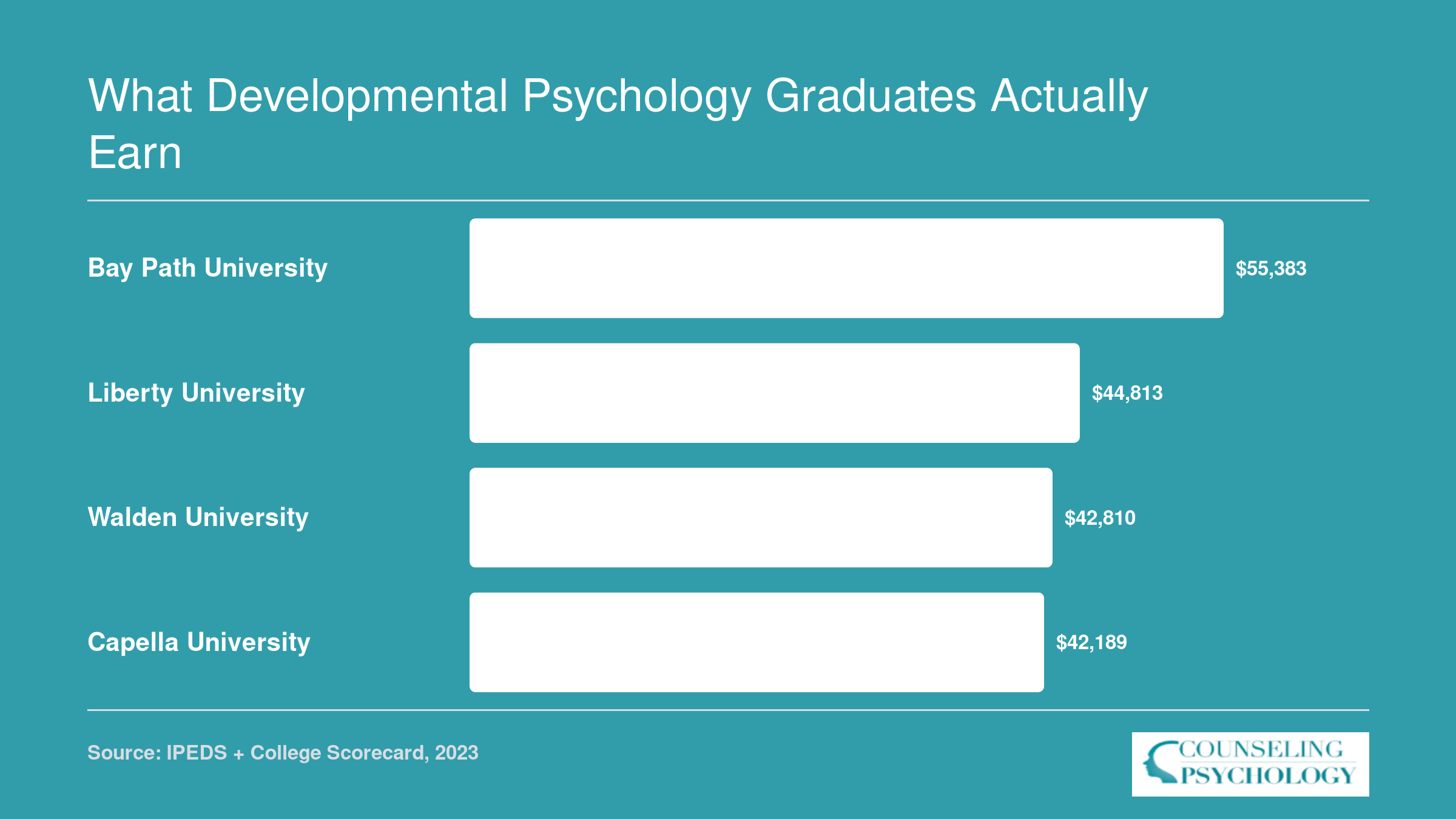
Program-level earnings data for these developmental psychology programs has not yet been published, so the chart below uses institution-wide median earnings at 10 years after enrollment from the College Scorecard. These figures reflect all graduates at each school, not just developmental psychology completers, but they give you a useful baseline for comparing long-term earning potential across institutions.
Careers and Salary Outcomes With a Developmental Psychology Degree
A developmental psychology degree opens doors to meaningful, mission-driven work, but it is not a high-salary credential. The degree's value lies in career flexibility, preparation for doctoral study, and access to roles that examine human growth across the lifespan. Unlike clinical licensure tracks in counseling or social work, most developmental psychology graduates work in research, program evaluation, nonprofit management, or policy analysis without needing state licensure.
What You Can Do with a Developmental Psychology Degree
Graduates typically enter roles that blend research skills, population-specific knowledge, and program coordination:
- Child Life Specialist: Work in hospitals, pediatric settings, or rehabilitation centers to help children and families cope with medical procedures and stress. National mean annual wage is approximately $60,877, with a range from $48,839 to $74,999, according to 2025 data.1 The broader occupational family that includes child life specialists is projected to grow 7 percent over the next decade, with about 53,500 current positions nationally.2
- Early Intervention Specialist: Coordinate developmental services for infants and toddlers with delays or disabilities. Salaries overlap with community and social service managers, who earned a national median of approximately $72,000 in recent Bureau of Labor Statistics reports.
- Research Coordinator: Manage data collection, participant recruitment, and IRB compliance for university labs, hospitals, or contract research organizations. Salaries align with social science research assistants, typically in the $45,000 to $55,000 range at entry level.
- Community Services Manager: Oversee programs in nonprofits, family resource centers, or government agencies. National median wages for community and social service managers are approximately $72,000 annually, with projected 10-year growth around 11 percent.
- School Psychologist (with additional credentials): Assess student learning and behavior in K-12 settings. Entry requires specialist-level graduate work (EdS or PhD) beyond a developmental psychology master's; national median salaries for school psychologists are approximately $81,500.
- Gerontology Specialist: Design programs or conduct research in aging services, senior centers, or long-term care facilities. Students interested in clinical work with older adults may also want to explore a path as a geriatric counselor. Salaries vary by setting and role, often overlapping with program manager or research analyst ranges.
Actual Earnings from These Online Programs
Program-level earnings data remain limited for many developmental psychology degrees, but institutional College Scorecard figures offer a snapshot. Bay Path University graduates across all programs earned a median of $55,383 ten years after entry, reflecting the institution's mix of healthcare, psychology, and education pathways. Liberty University showed a median of $44,813, Walden University $42,810, and Capella University $42,189. These figures represent institutional medians, not program-specific outcomes, so your actual earnings will depend on your role, sector, and region.
The Non-Licensure Research and Applied Track
Many developmental psychology master's holders work in roles that do not require licensure: UX research for child-facing products, policy analysis in state health departments, program evaluation for Head Start or early intervention agencies, and grant management in foundations. These positions value research design, data interpretation, and knowledge of developmental milestones, but they do not lead to clinical practice. If your goal is therapy or counseling, a counseling career may be the more appropriate path.
Job Growth and Long-Term Demand
The Bureau of Labor Statistics projects steady growth in community and social service occupations over the next decade, with roles tied to aging populations, early childhood programs, and behavioral health services expanding faster than average. Demand for research coordinators and program evaluators will track with federal and state investment in evidence-based interventions. However, competition for research-track roles can be intense, especially in academic settings, and many positions require additional experience or a doctoral degree for advancement.
Honest Expectations
A master's in developmental psychology will not match the earning potential of clinical psychology, nursing, or physician assistant programs. Median starting salaries cluster in the $45,000 to $60,000 range, and career ceilings in non-licensed roles often plateau in the $70,000 to $85,000 range without doctoral credentials or a transition into management. The degree is best suited for students who prioritize working with specific populations (children, families, older adults), who plan to continue to a PhD, or who want research and evaluation skills applicable across education, health, and human services sectors.
Most online developmental psychology programs require practicum or fieldwork hours completed at a site in your local community, not on the university campus. Before enrolling, verify how the program handles site approval, the total hours required, and whether those placements satisfy licensure boards in your state if you are pursuing a credential such as school psychology certification or counseling licensure.
How to Choose the Right Online Developmental Psychology Program
Choosing between a program built for licensure and one designed for research or doctoral preparation is not just a preference question. It shapes which courses you take, what fieldwork you complete, and what doors open after graduation. Getting clear on that distinction first makes every other decision easier.
Start with Your Career Goal
Developmental psychology programs serve at least three different professional paths: licensure-track counseling careers, applied research roles in education or policy, and doctoral-level academic or clinical work. These paths are not always interchangeable.
A master's program like Bay Path University's MS in Developmental Psychology (36 credits, 160 hours of community fieldwork) is structured around applied skill-building. Doctoral programs at schools like Capella and Walden are explicit that their degrees are not designed for licensure. Liberty University's PhD integrates a distinct worldview emphasis. Before comparing tuition or format, confirm that the program type matches your intended outcome, including whether you plan to apply to a doctoral program afterward and whether the programs you are targeting recognize the degree as sufficient preparation.
Factor 2: Accreditation and Licensure Match
Regional accreditation is the baseline. Beyond that, if your goal involves clinical licensure, ask the admissions office directly: does this program meet the academic requirements for licensure in your state? That question is not trivial. Requirements vary by state, and a degree that qualifies you in one state may fall short in another. If your interest leans toward clinical mental health counseling online programs, be especially careful to verify that a developmental psychology degree satisfies your state's coursework requirements. Admissions staff should be able to answer plainly; if they cannot, treat that as useful information.
Factor 3: Total Cost and Debt Load
Tuition across the programs ranked on this site ranges considerably. Bay Path's program runs roughly $15,000 in total program tuition, while net prices at some private schools reach well above $29,000 once fees are included. When program-level earnings data is not yet published (as is the case for several of these programs), you lose a clean debt-to-income comparison. In that situation, look at institution-level median graduate debt figures: Bay Path's median graduate debt sits around $24,900, Capella's around $14,968, and Walden's around $20,834. A useful rule of thumb is to compare expected first-year earnings in your target role against the total debt you expect to carry. If debt significantly exceeds one year of anticipated salary, that gap deserves serious attention before you sign promissory notes.
Factor 4: Format and Fieldwork Fit
Asynchronous programs suit students managing work and family obligations. Synchronous or hybrid formats build cohort relationships that matter for mentorship and doctoral applications. Practicum requirements add another layer: some programs expect you to arrange your own placement, others provide placement support. Ask specifically whether the admissions office helps connect students with fieldwork sites in your area, especially if you live outside the program's home state.
Factor 5: Doctoral Feeder Potential
If a PhD or PsyD is part of your longer-term plan, ask doctoral programs you are considering whether they have admitted graduates from the master's program you are evaluating. Students exploring counseling doctoral programs should pay close attention to whether a developmental psychology master's meets prerequisite expectations. A program's scholarly reputation, thesis or capstone rigor, and faculty research activity all influence how competitive you will be as an applicant. Contacting admissions offices at target doctoral programs, not just the master's program, is worth the extra calls.
Frequently Asked Questions About Online Developmental Psychology Programs
Prospective students often have overlapping questions about program format, career value, and credential requirements. Below are direct answers to the most common concerns, grounded in current program data and accreditation realities.
Explore Programs
Explore Programs
- Best Online Applied Behavior Analysis
- Best Online Applied Psychology Degree
- Best Online Associate Degrees in Psychology
- Best Online Autism Spectrum Disorders
- Best Online Bachelor's in Psychology
- Best Online Child Psychology Degree
- Best Online Clinical Psychology
- Best Online Cognitive Psychology Degree
- Best Online Counseling Psychology
- Best Online Educational Psychology Degrees
- Best Online Forensic Psychology Degree
- Best Online Graduate Certificate in Psychology
- Best Online Health Psychology
- Best Online I/O Psychology
- Best Online International Psychology
- Best Online Master's in Psychology
- Best Online Neuropsychology
- Best Online Ph.D. in Psychology
- Best Online Positive Psychology
- Best Online Psychopharmacology Programs for
- Best Online PsyD
- Best Online School Psychology
- Best Online Social Psychology
- Best Online Sports Psychology
- Engineering Psychology Degrees
- Online Geropsychology