

What you’ll learn in this article…
- Fully online and hybrid sport psychology doctorates are available from accredited U.S. universities in PhD, PsyD, and EdD formats.
- PhD programs typically take five to seven years, while PsyD and EdD tracks often finish in four to five.
- Total tuition ranges from roughly $60,000 at funded PhD programs to over $200,000 for self-funded PsyD degrees.
- BLS projects psychologist employment to grow 6 percent from 2024 to 2034, faster than the national average.
Demand for doctoral-level sport psychology professionals has expanded well beyond elite athletics. The U.S. military now funds embedded mental performance consultants across multiple branches, the NCAA has formalized mental health staffing recommendations for Division I programs, and professional franchises in the NBA, NFL, and MLB routinely carry full-time applied sport psychologists on staff. A terminal degree is increasingly the baseline credential for these roles, not a differentiator.
The practical tension for most applicants is not whether to pursue a doctorate but which one, and whether an online or hybrid format can actually get them there. A PhD from an APA-accredited program opens the door to licensure as a psychologist; an EdD or non-accredited PsyD typically does not. That single distinction carries significant weight in salary negotiations, scope of practice, and long-term career mobility.
The pool of fully online or hybrid options remains small relative to the field's overall growth, and program quality varies sharply. Accreditation status, supervised practicum requirements, and residency expectations differ enough between programs that two degrees with similar names can lead to very different outcomes.
Best Online Doctoral Programs in Sports Psychology
We identified doctoral programs that can be completed primarily online and scored them on a composite of institutional quality indicators, including graduation and retention rates, student-to-faculty ratio, net price, and graduate outcomes. The pool of fully online doctorates in sport psychology remains small: as of 2026, no 100% online PhD in sport psychology holds APA accreditation, so candidates eyeing licensed psychologist status should verify their state board's requirements before enrolling. The program below emerged from our data as a strong fit for students pursuing performance consulting, coaching, or non-clinical sport psychology roles through a flexible online format.
- Online delivery availability
- Graduation and retention rates
- Student-to-faculty ratio
- Graduate debt and earnings outcomes
- Program-level specialization depth
- Independent program research
- Internal program database
- College Scorecard graduate earnings — collegescorecard.ed.gov
- NCES-IPEDS federal institutional data — nces.ed.gov

National University
National University is a private, nonprofit institution based in San Diego that serves a large population of working adults and military-affiliated students. Its 100% online PhD in Psychology with a Sport and Performance Psychology specialization is designed for professionals who want doctoral-level training without relocating, offering rolling weekly start dates and individualized mentoring from doctoral faculty. The program's flexibility and fully remote format make it one of a handful of options for students who need to balance work, family, or athletic commitments while completing a research doctorate in this niche.
- 100% online delivery with no scheduled lecture hours
- 60 credit hours across 20 courses, estimated 48 months
- Rolling weekly start dates for maximum scheduling flexibility
- Covers motivation, leadership, injury psychology, and diversity
- Dissertation required with oral defense and IRB approval
- Personalized one-on-one mentoring from doctoral faculty
- Requires a completed master's degree for admission
- Aligned with performance consulting and coaching career paths
PhD in Psychology, Sport and Performance Psychology Specialization — Online
Can You Earn a Sports Psychology Doctorate Online?
Several U.S. universities now offer doctoral programs in sport and performance psychology in fully online or hybrid formats, making it possible to earn your terminal degree without relocating to campus. These programs deliver coursework through a mix of asynchronous modules, synchronous online seminars, and periodic in-person residencies, though the blend varies by institution and degree type.
What "Online" Actually Means in Doctoral Training
Coursework can be completed online, but practicum, internship, and dissertation fieldwork almost always require in-person or arranged-site components regardless of program format. Even programs marketed as fully online typically mandate short residencies for orientation, research intensives, or clinical skills labs. The dissertation defense and any clinical training hours must meet accreditation standards, which often means face-to-face supervision and on-site work with clients or athletes.
Kinesiology vs. APA-Accredited Psychology Programs
Kinesiology-housed programs are more commonly available online than APA-accredited clinical psychology programs. The American Psychological Association does not currently accredit fully online doctoral degrees in psychology, which means online sport psychology doctorates are typically offered through departments of kinesiology, education, or performance science rather than APA-recognized clinical or counseling psychology tracks. This distinction has significant licensure implications: graduates of non-APA programs generally cannot sit for psychology licensure exams or use protected titles such as "psychologist," limiting them to performance consulting, coaching, and non-clinical roles unless they also complete an APA-accredited degree or separate clinical program. If you are weighing a traditional clinical psychology doctorate programs route, understand that those tracks carry different accreditation and licensure advantages.
As of 2026, the University of Western States offers an EdD in Sport and Performance Psychology delivered online, though it is explicitly a non-licensure program unless combined with the university's Clinical Mental Health Counseling specialization. The University of Arizona Global Campus offers a PsyD with a Sport and Performance Psychology Specialization online, but it is not APA-accredited and does not lead to licensure as a psychologist. National University, often cited in online degree lists, currently offers only a master's degree in sport psychology, not a doctorate.
The Online Landscape Remains Small
The number of online options has grown modestly since 2020, driven by pandemic-era shifts and investments in distance education infrastructure, but the roster remains small compared to on-campus programs. Readers should expect selective admissions, rigorous prerequisite requirements, and limited cohort sizes. For a broader look at what the profession entails, see our guide on how to become a sports psychologist. If licensure as a psychologist is your goal, verify APA accreditation and confirm that the program's delivery model meets your state board's internship and residency rules before you apply.
Choosing Between a PHD, Psyd, and EDD in Sport Psychology
The landscape of sport psychology training has shifted as employers and licensure boards increasingly distinguish between degrees that lead to clinical licensure and those that remain firmly rooted in sport science. That single distinction shapes everything from your course load to your career ceiling, so it pays to understand it before you apply.
The Licensure Divide
- PhD (Psychology Department): When housed in an APA-accredited clinical or counseling psychology program, this degree satisfies every core requirement for psychologist licensure. You will complete a full diagnostic and therapeutic curriculum, an APA-accredited internship, and a research dissertation. Graduates pursue licensure as a psychologist and can deliver mental health services with a sport specialization.1
- PsyD: The PsyD is the practice-oriented counterpart. Clinical training hours are heavier, the internship is still APA-accredited, and the final project may be a clinical dissertation or applied analysis rather than a traditional research study. Licensure eligibility is equivalent to the PhD, and most PsyD holders become licensed psychologists who treat athletes and performers.1
- EdD or PhD (Kinesiology Department): These programs do not meet the coursework or internship requirements for psychologist licensure. Clinical psychopathology training is minimal or absent, and an APA internship is not part of the curriculum. Graduates are not eligible for psychologist licensure in the overwhelming majority of states and instead work as mental performance consultants or coaches.
This is the most consequential fork in the road. If your goal is to diagnose and treat mental health disorders (even within a sport context), you need a PhD or PsyD from a psychology department that holds APA accreditation. For performance-only consulting, a kinesiology-based doctorate can be appropriate, but it closes the door on licensure permanently.
Research vs. Clinical Training
A PhD in psychology places research at the center. You will design original studies, analyze data, and defend a dissertation. This path naturally feeds academic and research careers, though licensed practice remains common. PsyD programs flip the emphasis: you still learn to consume research, but your time is dominated by supervised clinical placements. Practicum and internship hours often exceed those of PhD programs, preparing you for immediate client-facing work upon graduation.1 Kinesiology-based doctorates involve research as well, but the focus is on sport science topics such as motivation, team dynamics, or exercise adherence rather than clinical trials of interventions for mental illness.
Where You Study Matters: Psychology vs. Kinesiology
Department housing is a separate axis from degree type. A PhD in clinical psychology with a sport psychology concentration exists inside a psychology department; a PhD in kinesiology with a sport psychology emphasis resides in a college of education or human movement. The former builds on a generalist clinical foundation and layers sport-specific coursework on top. The latter assumes you are a sport scientist first, with limited exposure to abnormal psychology, assessment, or therapy techniques. Even when both are called a PhD, the kinesiology version does not lead to licensure. EdD programs sit within education schools and prepare scholar-practitioners, but they similarly lack the clinical scope required for psychologist licensure.
If the CMPC credential matters to you, all three paths can qualify provided the program includes the required sport psychology coursework and supervised experience. But remember: a CMPC does not authorize you to treat depression, anxiety, or eating disorders unless you also hold a separate clinical license. Pairing a CMPC with a licensed psychologist credential (only attainable via the APA-accredited PhD or PsyD route) is the most versatile combination for practitioners who want to work across the full spectrum of mental health and performance. For a broader look at the steps, timelines, and credentials involved, our guide on how to become a sport psychologist walks through the full process.
Related Articles
Questions to Ask Yourself
Core Coursework and Training in a Sport Psychology Doctorate
Sport psychology doctoral training has grown more structured in recent years, driven in part by AASP's ongoing refinement of what certified practitioners actually need to know. Programs today are expected to cover far more ground than performance enhancement alone, blending clinical skill-building, research rigor, and applied field experience into a coherent sequence.
Curriculum Pillars
Most doctoral programs build their curriculum around several interlocking areas. Expect coursework in sport and exercise psychology theory, psychophysiology, counseling and intervention skills, research methods and statistics, and professional ethics. These mirror the eight knowledge domains AASP identifies as required for Certified Mental Performance Consultant (CMPC) eligibility, covering topics from performance enhancement strategies and psychological assessment to group dynamics and health psychology.1 A program may teach all of this material without explicitly organizing syllabi around CMPC language, so verifying course-by-course alignment before you enroll is essential, not optional.
Practicum and Internship Hours
The supervised experience requirements differ sharply depending on whether your program sits in a psychology department or a kinesiology and sport science department.
- Clinical and counseling psychology programs: These typically require an APA-accredited doctoral internship, often demanding 1,500 to 2,000 or more supervised hours. Completion of that internship is generally a graduation requirement, not an optional add-on.
- Kinesiology-based and performance psychology programs: These programs tend to emphasize supervised applied sport psychology experience, with 400-plus hours commonly required to satisfy CMPC mentorship criteria. AASP's current standards (2025-2026) require 1,500 total supervised hours and 100 hours of mentorship, with no more than 20 of those mentorship hours fulfilled through group formats.1
Dissertation Versus Applied Capstone
Research expectations also diverge by degree type. PhD programs require an original empirical dissertation that contributes new knowledge to the literature. Some EdD and PsyD programs allow an applied capstone project instead, focused on solving a practical problem in a real organizational or clinical context. Neither format is inherently superior; the right choice depends on whether you plan to pursue a research career or move directly into applied psychology careers.
A Note on CMPC Alignment
AASSP certification renewal requires 75 continuing education units every five years, a commitment that begins the moment you earn the credential.2 More immediately, not every doctoral program actively maps its curriculum to the eight CMPC knowledge domains. Some graduates discover gaps only after finishing their degree. The Certification Program Candidate Handbook from AASP spells out the required domains in detail, and comparing that document against a program's course catalog before you apply can save considerable time and money down the road.
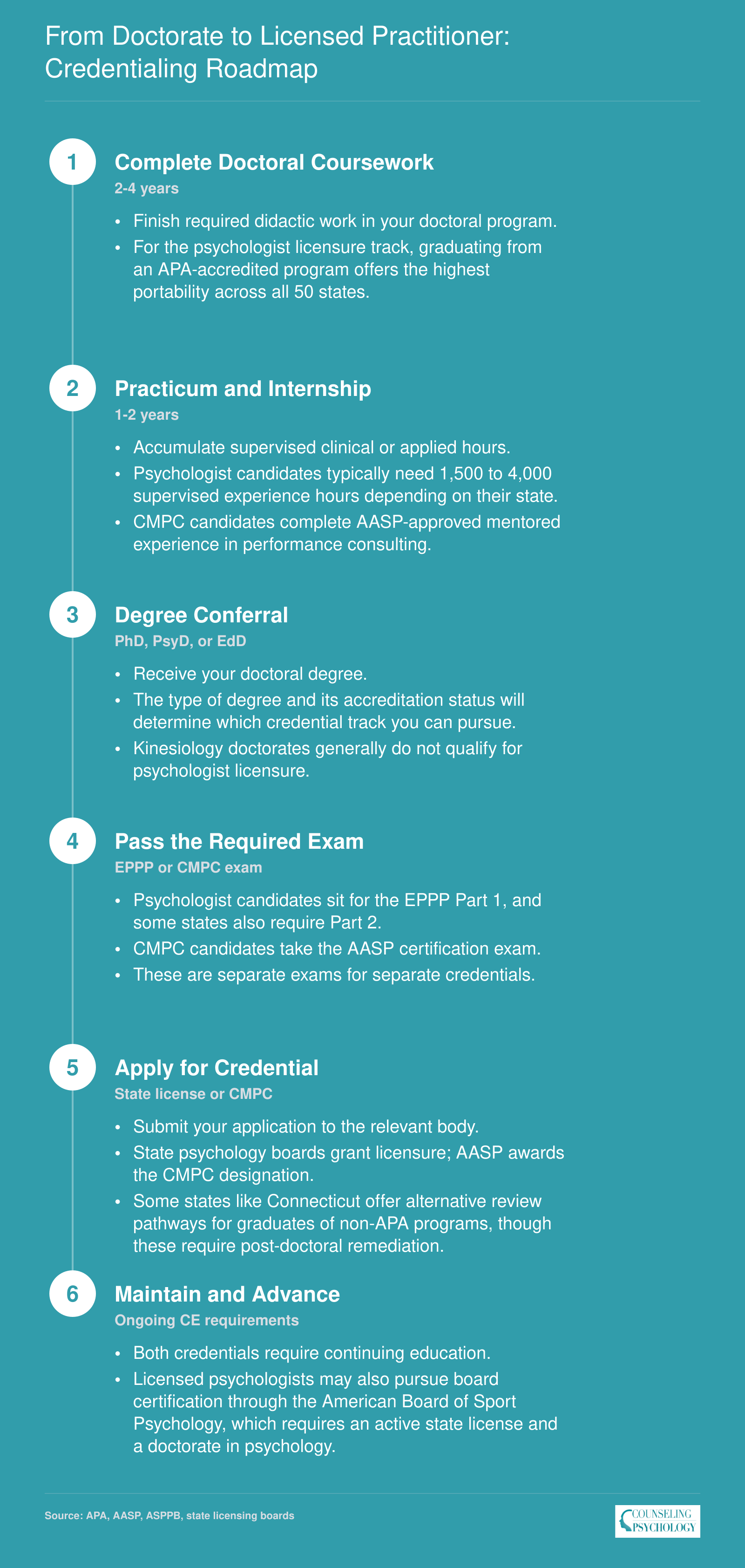
From Doctorate to Licensed Practitioner: Credentialing Roadmap
Earning a sport psychology doctorate is only part of the journey. Two distinct credential tracks exist, and they open different doors. Licensed psychologists (via an APA-accredited PhD or PsyD) can diagnose and treat mental health conditions. Certified Mental Performance Consultants (CMPCs) provide performance consulting but cannot conduct therapy. The timeline below captures the shared steps and where the paths diverge.
How Long Does an Online Sports Psychology Doctorate Take?
How long will it actually take to finish an online doctorate in sports psychology? The honest answer depends on your degree path, enrollment pace, and how quickly you move through the dissertation phase.
Typical Timelines by Degree Type
In practice, most students find these ranges realistic:
- PhD in Sport Psychology: 5, 7 years. The heavy research emphasis and dissertation often extend the timeline.
- PsyD in Sport/Performance Psychology: 4, 6 years. Less research-intensive than a PhD, but still requires a doctoral project and clinical hours.
- EdD in Sport and Performance Psychology: 3, 5 years. Designed for working professionals, though part-time enrollment frequently pushes this toward 4, 6 years.
Online delivery does not automatically shorten these windows. The same milestones (course credits, supervised practice, and a culminating project) still apply.
Where the Time Goes
Most of the timeline is consumed by three phases:
- Coursework: 2, 3 years. Foundational and advanced classes in sport psychology, ethics, assessment, and intervention. Some programs let you overlap coursework with early practicum hours.
- Practicum and Internship: 1, 2 years, though this often runs concurrently with later coursework. The 1,000, 2,000+ supervised hours required for licensure or CMPC certification represent a fixed time investment that cannot be fast-tracked.
- Dissertation or Doctoral Project: 1, 3 years. This is frequently the bottleneck. Many students stall at ABD (all but dissertation) status while juggling work and family obligations.
Part-Time and Accelerated Traps
Because online programs appeal to mid-career professionals, part-time enrollment is common. A 3-year EdD blueprint easily becomes 5 or 6 years when taking one course per term. Programs advertising a 2-year doctorate raise a red flag: they almost certainly do not include the required supervised practice hours for licensure or CMPC certification. If you are still mapping out the full career pathway, our guide on how long it takes to become a sports psychologist breaks down each stage in detail. Verify that any accelerated timeline still maps to your state's licensure requirements before committing. Students weighing alternative online doctoral programs in psychology should apply the same scrutiny to advertised completion timelines.
Tuition Ranges, Total Costs, and How to Fund Your Doctorate
Choosing a doctorate in sports psychology is as much a financial decision as an academic one. The degree format and funding model you select today can shape your earnings and debt for the next decade. Understanding the true cost means looking beyond per-credit rates to the total price tag and, crucially, to the funding packages that can transform a six-figure obligation into a near-zero out-of-pocket investment.
Side-by-Side Cost Comparison
The numbers shift dramatically depending on whether you pursue a PhD, PsyD, or EdD, and whether you secure a funded position. The table below frames typical ranges for 2024 to 2026 program data.1
- PhD in sport psychology (funded): Per-credit cost $600, $1,300; total credits 60, 75; estimated total program cost $75,000, $125,000, but covered by full tuition waiver and annual stipend of $18,000, $30,000. Out-of-pocket cost often near $0.
- PsyD in sport psychology (typically unfunded): Per-credit cost $1,100, $1,700; total credits 90, 120; total program cost $120,000, $200,000. Most students pay full tuition or rely on loans.3
- EdD in sport psychology/performance (limited funding): Per-credit cost $700, $1,600; total credits 48, 64; total program cost $40,000, $100,000. Formal assistantships are less common, though employer tuition benefits can reduce the burden.
For context, the national average total cost for a doctorate is about $60,000 at public universities and $143,000 at private ones, with an overall average of $98,000.1 PsyD programs in sport psychology often run well above these averages, while a funded PhD falls far below.
Funding Realities and Stipend Support
The availability of funding is the single biggest cost differentiator. PhD programs housed in psychology departments frequently offer full tuition remission and a stipend designed to cover basic living expenses. These stipends, typically $18,000, $30,000 per year, come with teaching or research assistantship duties and effectively eliminate tuition costs. For students weighing different psychology degree programs, this funding advantage is worth serious consideration early in the planning process.
PsyD and EdD programs, by contrast, are tuition-driven. They rarely provide full funding; assistantships, if available, tend to be partial and competitive. Most students in these programs finance their education through federal loans, private loans, or employer tuition reimbursement. Some EdD programs, designed for working professionals, offer reduced per-credit rates and flexible scheduling, which can lower the total cost even without funding.
Weighing the Return on Investment
A high sticker price does not automatically make a program a poor choice, but the long-term math is clear. If you graduate from a funded PhD with no debt and enter a career where sport psychologists earn a modest median salary, your financial footing is far stronger than that of a PsyD graduate carrying six-figure loans. When evaluating programs, consider the total cost of the degree in light of the career paths and earning potential outlined in the career section. The funded-versus-unfunded distinction often matters more than the starting per-credit rate, because it directly affects how long you will carry educational debt after licensure.
The Bureau of Labor Statistics projects psychologist employment to grow 6 percent from 2024 to 2034, faster than the average for all occupations. This steady demand reflects expanding roles in athletic settings, healthcare systems, and corporate wellness programs where doctoral-trained sport psychology professionals are increasingly valued.
Getting In: Admissions Criteria and Program Selectivity
Funded PhD programs vs. self-paying PsyD and EdD tracks represent two very different admissions games. The PhD route is a research apprenticeship with a tiny gate; the PsyD and EdD routes are larger professional cohorts where strong applied experience and the ability to finance the degree matter more than research pedigree. If you're wondering how hard it is to get into grad school for psychology, sport psychology doctorates are among the most selective subfields.
Standard Requirements Across Degree Types
Most sport psychology doctorates expect a master's degree before you apply, particularly PsyD and EdD programs that build on prior clinical or applied coursework. A handful of PhD programs still admit applicants directly from a bachelor's, but those slots are rare. Plan on the following baseline:
- GPA: A 3.0 minimum is typical, with competitive applicants landing in the 3.3 to 3.5 range.
- GRE: Required by some PhD programs, waived or optional at a growing number of PsyD and EdD programs. Check each program's current cycle policy.
- Letters of recommendation: Usually three, ideally from faculty or supervisors who can speak to research or clinical readiness.
- Personal statement: Should connect your background to specific faculty, training models, or applied populations.
- Relevant experience: Research assistantships for PhD, supervised clinical hours for PsyD, coaching or athletic administration for EdD.
What Each Degree Weighs Most Heavily
For PhD admissions, research fit is the deciding factor. Committees want to see conference presentations, lab experience, or a master's thesis that signals you can produce publishable work. PsyD reviewers look harder at clinical hours, practicum evaluations, and your reasoning about practitioner identity. EdD programs often prioritize years of professional experience in coaching, athletics administration, or performance consulting.
Cohort Size and Realistic Odds
Funded PhD cohorts in sport psychology often admit only two to five students per year, with acceptance rates in the single digits. PsyD and EdD cohorts run larger, commonly 10 to 25 students, which improves admit odds but shifts the cost burden onto the student. For PhD applicants, identify one or two faculty whose research lines up with yours and contact them before you apply. Advisor fit is the single most predictive factor in whether your file moves forward.
Career Paths and Earning Potential With a Sport Psychology Doctorate
Sport psychology doctoral graduates enter a field that rewards specialization but demands versatility. Understanding how degree type and licensure shape your options is the first step toward building a sustainable career.
How Your Credential Shapes Your Options
The career landscape splits along two main lines: licensure and certification. Graduates of PhD or PsyD programs who complete the required supervised hours and pass the EPPP can become licensed psychologists, which opens doors to clinical practice, university counseling centers, hospital-based performance programs, and private practice. The Certified Mental Performance Consultant (CMPC) credential, awarded by the Association for Applied Sport Psychology, is available to graduates of any qualifying doctoral program and focuses specifically on performance consulting with athletes and teams. Many practitioners hold both, combining clinical work with consulting to maximize both income and professional reach.
PhDs also carry a distinct advantage in academic settings. Tenure-track faculty positions at research universities typically require a doctoral degree with a strong publication record, and those roles blend teaching, research, and sometimes applied consulting. For a broader look at the profession, explore careers in psychology across specializations.
Salary Benchmarks and What to Expect
The Bureau of Labor Statistics reports a 2023 national median annual wage of $117,750 for the broader "Psychologists, All Other" category (SOC 19-3039), which captures psychologists working outside the largest clinical and school-based roles and includes some sport and performance psychology positions. For clinical, counseling, and school psychologists (SOC 19-3031), the national median has trended lower historically. The BLS also reports a 2024 median annual wage of $94,310 for psychologists overall. These are national figures, and individual outcomes vary considerably by setting and specialization.
In practical terms, the range is wide:
- University or college athletic department roles: Salaried positions typically fall between $60,000 and $90,000 annually, depending on institution size and geographic location.
- Private practice and independent consulting: Established consultants working with professional athletes or high-performance organizations often earn $100,000 to $200,000 or more, though building that client base takes years.
- Military and federal human performance programs: The U.S. military has expanded sport and performance psychology staffing, and federal pay scales for licensed psychologists generally fall in the $90,000 to $130,000 range depending on grade and location.
- Academic faculty: Assistant professor salaries in psychology range broadly, often between $65,000 and $100,000 at the entry level, with research funding and consulting supplementing base pay.
A Small Field That Rewards Breadth
The honest reality is that full-time positions dedicated solely to sport psychology remain limited. The BLS projects roughly 6% growth for psychologists overall through 2034, a pace described as faster than average, but the sport-specific slice of that workforce is small. Most successful practitioners deliberately build hybrid careers, pairing sport consulting with broader clinical work, adjunct teaching, or corporate performance consulting. That breadth is not a compromise; for many, it is the design. Graduates who enter the field with a clear sense of which roles they want to pursue, and who develop competencies across more than one area, tend to find more stable and financially rewarding careers than those focused exclusively on working with elite athletes.