What you’ll learn in this article…
- Becoming a sports psychologist takes 6 to 8 years via the master's route or 10 to 14 years through a doctorate.
- The CMPC credential covers mental performance consulting, while state licensure is required to diagnose or treat clinical disorders.
- BLS projects 6% growth for psychologists overall from 2024 to 2034, with roughly 12,900 annual openings nationwide.
- Most practitioners build portfolio careers across collegiate athletics, private practice, military, and rehabilitation settings.
The Association for Applied Sport Psychology lists more than 700 Certified Mental Performance Consultants (CMPCs) working with Olympic teams, NCAA athletic departments, military readiness units, and a rapidly growing esports sector. That number has roughly doubled over the past decade as demand for performance-focused mental health services has spread well beyond elite athletics.
Getting there is not a single path. Sport psychology splits into two distinct credential tracks (one clinical, one consulting), with different degrees, supervised hours, and licensing rules attached to each. The choice you make at the graduate level determines what you can legally call yourself and which clients you can serve.
The sections that follow trace each track from undergraduate coursework through licensure, salary expectations, and the realities of where these professionals actually work.
The Role of a Sports Psychologist, and Why Job Titles Matter
Few fields carry as much confusion about credentials and job titles as sport psychology. Two professionals can work side by side with the same athletic team, doing overlapping work, while holding entirely different credentials, operating under different legal obligations, and carrying different job titles. Understanding why that happens is the first step toward choosing the right career path.
What the Work Actually Involves
At its core, sport psychology addresses the mental and behavioral dimensions of athletic performance and physical activity. Depending on a practitioner's training and credentials, that work can span several domains:
- Performance enhancement: Teaching focus, confidence-building, arousal regulation, and goal-setting skills to athletes and teams.
- Clinical mental health treatment: Diagnosing and treating anxiety, depression, eating disorders, trauma, and other conditions that arise in athletic populations.
- Injury rehabilitation psychology: Helping athletes cope with the psychological toll of injury, surgery, and return-to-play uncertainty.
- Team dynamics and organizational consulting: Working with coaches, front offices, and sport organizations on culture, communication, and cohesion.
Not every practitioner in this field is qualified or licensed to provide all of these services. That distinction lives in the credential.
Licensed Clinical Sport Psychologist vs. CMPC
A licensed psychologist who specializes in sport has completed a doctoral degree, passed state licensing examinations, and fulfilled supervised clinical training requirements. That licensure authorizes them to diagnose mental health disorders and provide clinical treatment in addition to performance work. The APA's model licensing act reserves the title "licensed psychologist" for individuals who have met those requirements.
A Certified Mental Performance Consultant, or CMPC, holds a credential issued by the Association for Applied Sport Psychology. CMPCs are trained in performance optimization: mental skills coaching, consultation, and applied sport science. What they are not authorized to do is diagnose or treat clinical disorders, and in most states they cannot use the word "psychologist" to describe themselves unless they also hold independent state licensure as a psychologist.2
Texas makes this explicit. Under the Texas Behavioral Health Executive Council's 2026 psychology rulebook, using the title "psychologist" without meeting state credentialing requirements is a violation of state law.3 A CMPC working in Texas must market their services under an alternative title. New Jersey similarly reserves the psychologist title for individuals who have completed doctoral training and obtained licensure through the state, though CMPCs can and do work in sport performance roles there without restriction on their actual consulting activities.2 Florida's Chapter 490 statutes tie the regulated title directly to state licensure, placing it beyond the reach of those who hold only a national certification.4
The practical consequence is significant. In most states, calling yourself a "sports psychologist" without a psychology license is not a branding choice; it is a legal risk. Sport psychology is just one of many careers in psychology where understanding licensure boundaries is essential before you begin your training.
Exercise Psychologist: A Related but Distinct Role
One more role worth distinguishing is the exercise psychologist. While sport psychologists focus primarily on competitive athletes and performance contexts, exercise psychologists concentrate on the behavioral and psychological factors that influence physical activity adoption and adherence across general populations. Their work often intersects with public health, chronic disease prevention, and rehabilitation settings rather than competitive sport. The populations differ, the settings differ, and in many cases the training pathways differ as well.
Undergraduate Foundations: Choosing the Right Bachelor's Degree
What should you major in if you want to become a sports psychologist? The honest answer is that no single undergraduate major is required, but certain fields will set you up with a stronger foundation and a smoother path into graduate programs.
Recommended Majors
Most students in this field gravitate toward one of these four undergraduate tracks:
- Psychology: Gives you the broadest exposure to human behavior, cognition, and mental health principles that graduate programs expect.
- Kinesiology: Pairs movement science with behavioral coursework, which mirrors the dual nature of sport psychology itself.
- Exercise science: Builds fluency in physiology and biomechanics, both of which inform applied sport psychology work.
- Sport science: Often includes sport-specific electives in motivation, group dynamics, and performance enhancement.
That said, admissions committees for graduate programs in sport psychology care more about whether you have completed specific prerequisite courses than about the title printed on your diploma. Students who major in biology, sociology, or even business can be competitive applicants as long as they cover the coursework that matters.
Coursework That Graduate Programs Want to See
Regardless of your major, prioritize these classes during your undergraduate years:
- Statistics (at least one semester, ideally two)
- Research methods in psychology or a related discipline
- Abnormal psychology
- Biomechanics
- Exercise physiology
- Introductory and developmental psychology
Graduate admissions committees look for evidence that you can handle data analysis and understand both the psychological and physiological sides of athletic performance. If your major does not include all of these courses, use your elective slots or take them during a summer session.
Building a Competitive Application Early
Coursework alone rarely distinguishes one applicant from another. Seek out an undergraduate research assistant position in a psychology or kinesiology lab, even if the research topic is not directly about sport. Familiarity with study design, data collection, and IRB processes signals that you are prepared for graduate-level inquiry.
Volunteering or interning with your school's athletic department is another practical move. Whether you assist with team mental skills workshops or simply shadow the athletic training staff, these experiences demonstrate genuine engagement with the performance environment and give you material for a compelling personal statement.
A Note for Career Changers
If you are entering this field after working in counseling psychology careers, athletic training, coaching, or a related profession, you do not necessarily need to go back and earn a second bachelor's degree. Many graduate programs accept students from these backgrounds provided they can demonstrate equivalent prerequisite knowledge. Some schools offer bridge or post-baccalaureate prerequisite courses that let you fill gaps in a single semester or two. Others allow conditional admission with the understanding that you will complete missing coursework alongside your graduate studies. The key is to contact programs directly and ask which prerequisites they consider non-negotiable, because policies vary widely from one institution to the next.
Questions to Ask Yourself
Graduate Education: Master's Vs. Doctorate Paths in Sport Psychology
Graduate education is where you decide not only your specialization but also your professional title, scope of practice, and career ceiling. The degree you pursue (master's or doctoral) determines whether you can call yourself a psychologist, practice independently, diagnose mental health conditions, and work across clinical or performance-only settings.
Master's Programs: The Path to Mental Performance Consulting
A master's degree in sport and performance psychology typically requires two to three years of full-time study. Graduates of these programs qualify for the Certified Mental Performance Consultant (CMPC) credential from the Association for Applied Sport Psychology, assuming they meet coursework and supervised-hour requirements. With a master's degree, you can work as a mental performance consultant, sport psychology consultant, or related titles, supporting athletes in areas like goal-setting, imagery, confidence-building, and team cohesion.
However, you generally cannot use the title "psychologist" with only a master's degree. Most states reserve that title for individuals who hold a doctoral degree and are licensed by the state psychology board. Master's-level practitioners may pursue licensure as a Licensed Professional Counselor (LPC) or Licensed Mental Health Counselor (LMHC) if their program meets state counseling-board requirements, enabling them to provide counseling services in some contexts.
Several programs now offer online master's degrees that fulfill CMPC coursework requirements. The University of Wisconsin, Stevens Point offers a 100% online M.S. in Sport & Performance Psychology with an applied practice concentration that is an AASP GPAC applicant.2 Commonwealth University also offers a fully online M.S. in Sports and Performance Psychology.3 Traditional on-campus programs remain common as well. The University of Denver offers an MA in Sport & Performance Psychology on campus4, and the University of North Texas provides an M.S. in Kinesiology with a Sport and Exercise Psychology concentration.5
Doctoral Programs: The Psychologist Track
A doctoral degree (PhD or PsyD) in clinical or counseling psychology, often with a sport psychology concentration, takes four to seven years and is required if you want to become a licensed psychologist. Doctoral training includes advanced coursework, comprehensive exams, a dissertation, and typically 2,000 or more hours of supervised clinical practice through practica and a predoctoral internship. Graduates can diagnose and treat mental health disorders, conduct psychological assessments, and practice independently under state licensure.
Only APA-accredited doctoral programs are recognized by most state licensing boards. The University of North Texas, for example, offers an APA-accredited Counseling Psychology program.5 Because doctoral programs require extensive in-person clinical training, fully online doctoral degrees in psychology are rare and generally not APA-accredited.
The Direct Answer: Can You Work in This Field with a Master's?
Yes. You can absolutely become a sports mental performance professional with a master's degree. You will not be called a psychologist in most jurisdictions, but you can build a rewarding career as a mental performance consultant, work with athletes at all levels, and earn CMPC certification. If your goal is clinical practice, independent licensure, or using the psychologist title, a doctorate is required.
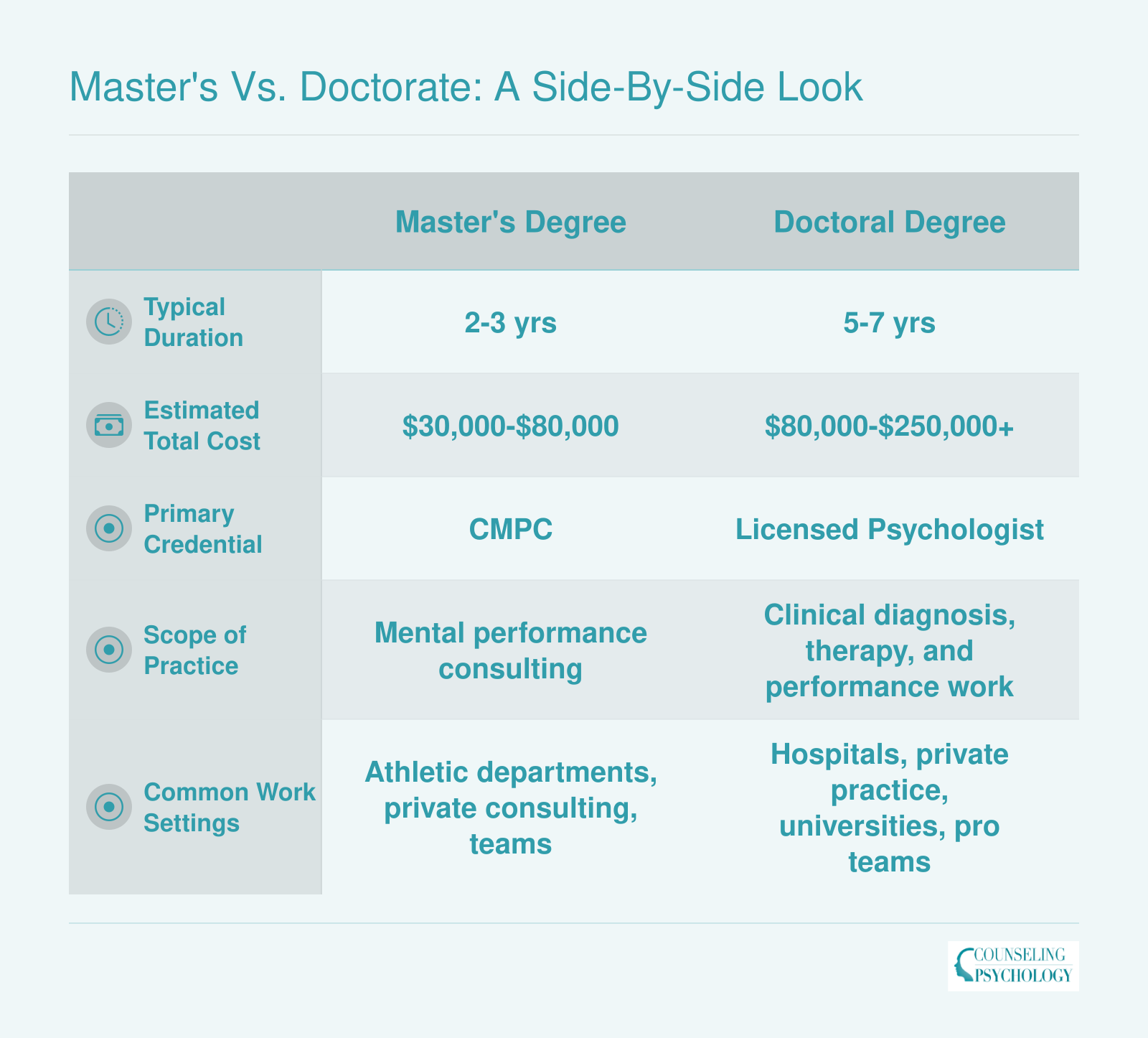
Master's Vs. Doctorate: A Side-By-Side Look
Your graduate degree choice shapes your credential, scope of practice, and career trajectory. Here is a quick comparison of the two primary routes into sport psychology.
Supervised and Mentored Experience: Logging Your Required Hours
The hours requirement is where many candidates get tripped up, not because the standards are vague, but because the structure is more layered than a single number suggests. Whether you are pursuing the CMPC, a doctoral internship, or both simultaneously, understanding exactly what counts, what does not, and how to document it correctly will save you from rebuilding your log at the application stage.
The CMPC Mentored Experience Framework
As of the 2025-2026 cycle, AASP requires a total of 400 mentored experience hours to sit for the CMPC. That total breaks down into specific categories, and meeting the overall number is not enough on its own. You must also satisfy each sub-requirement:
- Direct client contact: at least 200 hours working directly with clients
- Support activities: at least 150 hours (case notes, program design, consultation prep)
- Mentorship hours: at least 40 hours of contact with your approved mentor, of which at least 20 must be individual (one-on-one) sessions
- Direct knowledge of services: at least 10 hours during which your mentor directly observes or reviews your work
- Sport population: at least 100 hours must involve athletes or sport-related clients specifically
Your mentor cannot be just anyone with a CMPC. They must appear on AASP's Registry of Approved Mentors, which requires Certification Council approval and, since a July 2024 update to the mentorship hour structure, at least 6 hours of continuing education in mentorship. If you want to work with someone who is not yet on the Registry, they can apply for approval, so it is worth raising the question early rather than assuming they do not qualify.
Group mentorship sessions count, but groups are capped at 15 mentees. Most candidates find that a combination of individual and group hours keeps the relationship productive without stretching a single mentor too thin.
Can Graduate Practicum Hours Count?
Yes, with an important condition. Hours completed during your graduate program's practicum are eligible if they are supervised by an approved mentor and meet all category criteria. This overlap is one of the most practical ways to build hours efficiently. If your program supervisor is already on the Registry, or is willing to apply, you can log practicum hours toward CMPC requirements at the same time you are satisfying your degree's field experience component.
The documentation process moved to Certemy in January 2025. All mentors are invited into the platform at the same time when you initiate your application, and hours are logged using the Record of Mentored Experience Hours Form. Keeping that form current throughout your experience, rather than reconstructing it at the end, makes verification considerably smoother.
The Doctoral and Licensure Path: Internship and Postdoctoral Hours
If you are pursuing psychology licensure alongside or instead of the CMPC, the hour requirements are more substantial. Most doctoral programs require a predoctoral internship of roughly 1,500 to 2,000 hours, often completed through an APA-accredited site. After graduation, most state licensing boards add a postdoctoral supervised experience requirement, commonly 1,500 to 2,000 additional hours under a licensed psychologist. Candidates who want to explore other licensure tracks in psychology can review what it takes to become a clinical psychologist for a useful comparison of supervised-hour expectations.
These hours and CMPC mentored experience hours can overlap in some cases, particularly if your internship or postdoctoral site involves sport or performance populations and your supervisor holds CMPC mentor status. Check with both your state board and AASP before assuming any particular hour log satisfies both requirements.
Finding Placements and Mentors
Securing quality placements takes active outreach rather than waiting for listings to appear. A few approaches that consistently produce results:
- Contact university athletic departments directly and ask whether they have a sport psychology consultant on staff who mentors graduate students
- Search AASP's Registry of Approved Mentors by region or specialty and reach out with a specific, concise inquiry
- Look for graduate assistantships that embed applied sport psychology work into the role, since these often come with faculty mentors who are already Registry-approved
- Ask your academic advisor which local or regional organizations have hosted past students, since established relationships speed up placement considerably
Start this process well before you need the hours. Mentor capacity is limited, and the candidates who secure the strongest placements are typically those who began conversations a semester or two ahead of when they planned to start logging hours.
Related Articles
Licensure and Certification: CMPC, State Licensure, and Other Credentials Explained
Two professional tracks exist in sport psychology, and each unlocks different titles, scopes of practice, and legal permissions. The Certified Mental Performance Consultant credential serves non-clinical professionals, while state psychology licensure authorizes clinical practice and the legal use of the title "psychologist." Understanding the differences between these credentials and how to obtain them is crucial for planning your career.
CMPC: The Primary Credential for Mental Performance Consultants
The Certified Mental Performance Consultant (CMPC) designation, offered by the Association for Applied Sport Psychology (AASP), is the gold standard for professionals who help athletes optimize performance through mental skills training without providing clinical therapy. To qualify, you must hold a master's or doctoral degree in sport and exercise psychology or a closely related field, complete at least 400 hours of applied mentorship experience under a qualified supervisor, and document specific coursework in areas like counseling skills, psychopathology, ethics, and diversity.
After meeting eligibility requirements, you submit a non-refundable application fee and pay a separate exam fee. The CMPC exam is a computer-based, multiple-choice test administered at testing centers or via remote proctoring. Scoring uses a criterion-referenced cut score rather than a curve, meaning your performance is measured against a fixed standard of competence.
Once certified, the CMPC credential requires renewal every five years. You must earn 75 continuing education units (CEUs) during that cycle, excluding your initial certification year. The recertification application window opens September 1 and closes November 30, with a $25 late fee for submissions after the deadline. If your certification lapses, you have a two-year reinstatement period; beyond that, you must contact the AASP certification team and submit a completed application through the Certemy platform.
State Psychology Licensure: The Clinical Path
If you want to legally use the title "sports psychologist" and provide therapy or psychological services, you must earn state psychology licensure. This path requires a doctoral degree (PhD or PsyD) in psychology from an APA-accredited program, completion of a pre-doctoral internship, and post-doctoral supervised hours that vary by state. You must also pass the Examination for Professional Practice in Psychology (EPPP), a comprehensive computer-based exam covering the science and practice of psychology.
State licensure boards set their own passing scores and additional requirements, so the timeline and cost differ depending on where you intend to practice. Some states require jurisprudence exams or oral interviews alongside the EPPP. Maintaining licensure demands ongoing continuing education, typically 20 to 40 hours every two years.
LPC and LMHC Pathways: A Middle Ground
Master's-level graduates who do not pursue doctoral training can seek licensure as a licensed professional counselor or Licensed Mental Health Counselor (LMHC), depending on state terminology. These credentials allow you to provide counseling services and specialize in working with athletes and sport populations, though you cannot legally call yourself a psychologist. Requirements generally include a 60-credit master's degree in counseling, 2,000 to 4,000 hours of supervised clinical experience, and passing the National Counselor Examination (NCE) or National Clinical Mental Health Counseling Examination (NCMHCE).
Board Certification and Title Protection
Licensed psychologists who specialize in sport psychology can pursue board certification through the American Board of Sport Psychology (ABSP), an additional credential that signals advanced expertise. However, this is optional and typically pursued by senior practitioners.
Title protection laws are strict: in most states, only licensed psychologists may use the term "sports psychologist" or "psychologist" in any form. CMPC holders should identify as mental performance consultants, mental skills coaches, or sport psychology consultants to avoid legal issues. For a full breakdown of how different counseling licensure acronyms map to scope of practice, always check your state's regulations before choosing a professional title.
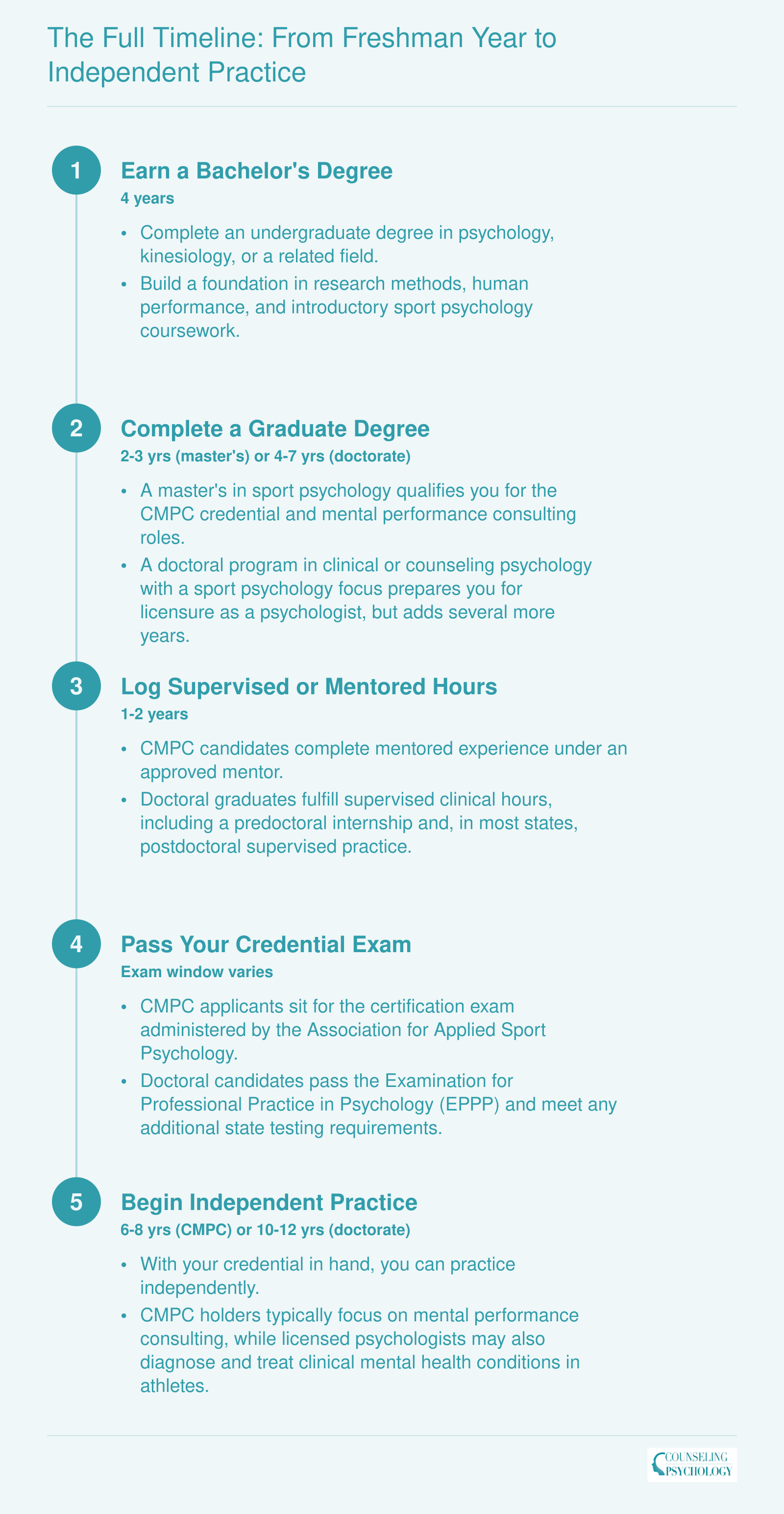
The Full Timeline: From Freshman Year to Independent Practice
One of the most common questions prospective sports psychologists ask is how long the journey takes. The answer depends on which career path you choose. The master's-level route to Certified Mental Performance Consultant (CMPC) typically spans 6 to 8 years, while the doctoral route to licensed psychologist status generally requires 10 to 12 years from the first day of college to independent practice.
If you already hold licensure as a counselor, work as an athletic trainer, or coach at any level, your path into sport psychology is shorter than you might assume. Many graduate programs welcome applicants from non-psychology backgrounds provided you complete prerequisite coursework, and LPC holders can layer sport-focused specialization through continuing education and mentored hours toward CMPC certification.
Sports Psychologist Salary: National, State, and Metro Pay Data
The Bureau of Labor Statistics does not publish a standalone category for sport psychologists, so salary estimates depend on which occupational classification best fits your role. The figures below reflect national medians and percentile ranges from the BLS for related occupational categories. Clinical practitioners typically fall under Clinical and Counseling Psychologists or the broader Psychologists, All Other grouping, while those who teach at the university level or work primarily in coaching and consulting roles may align with different codes.
| Occupational Category | Total U.S. Employment | 25th Percentile | National Median | 75th Percentile | Mean (Average) |
|---|---|---|---|---|---|
| Psychologists, All Other | 17,790 | $73,820 | $117,580 | $145,200 | $111,340 |
| Clinical and Counseling Psychologists | 72,190 | $67,470 | $95,830 | $131,510 | $106,850 |
| Psychologists (Broad Category) | 154,860 | $71,140 | $94,310 | $126,340 | $102,100 |
| Psychology Teachers, Postsecondary | 41,610 | $62,290 | $80,330 | $106,640 | $93,530 |
| Coaches and Scouts | 250,940 | $33,960 | $45,920 | $61,930 | $58,910 |
Highest-Paying States for Psychologists
Because the BLS does not track sport psychologists as a standalone occupation, the tables below draw from two relevant categories: "Psychologists, All Other" (which captures many sport psychology practitioners) and "Clinical and Counseling Psychologists" (the classification for those who hold clinical licensure and treat athletes). These are state-level median annual wages, not national figures. Your actual earnings will depend on your credential type, work setting, and whether you combine clinical practice with performance consulting.
| State | BLS Category | Median Annual Wage | 25th Percentile | 75th Percentile |
|---|---|---|---|---|
| California | Psychologists, All Other | $147,650 | $78,310 | $169,330 |
| Oklahoma | Psychologists, All Other | $147,010 | $103,330 | $161,350 |
| Nevada | Psychologists, All Other | $144,390 | $131,250 | $153,890 |
| Nebraska | Psychologists, All Other | $137,990 | $93,790 | $163,880 |
| North Carolina | Psychologists, All Other | $137,130 | $90,440 | $157,190 |
| South Carolina | Psychologists, All Other | $135,950 | $115,090 | $152,960 |
| Utah | Psychologists, All Other | $90,270 | $82,220 | $129,810 |
| Oregon | Psychologists, All Other | $82,960 | $79,380 | $130,520 |
| New York | Clinical and Counseling Psychologists | $99,910 | $78,500 | $132,520 |
| Iowa | Clinical and Counseling Psychologists | $98,580 | $73,520 | $124,640 |
| Maine | Clinical and Counseling Psychologists | $97,630 | $86,180 | $117,120 |
| Illinois | Clinical and Counseling Psychologists | $97,470 | $66,570 | $138,890 |
| Tennessee | Clinical and Counseling Psychologists | $92,320 | $81,790 | $120,450 |
| North Carolina | Clinical and Counseling Psychologists | $91,840 | $68,660 | $117,060 |
| Pennsylvania | Clinical and Counseling Psychologists | $90,450 | $67,450 | $124,990 |
| Utah | Clinical and Counseling Psychologists | $88,990 | $68,080 | $121,980 |
Job Outlook and Demand for Sport Psychology Professionals
The Bureau of Labor Statistics projects 6% growth for psychologists overall between 2024 and 2034, with an estimated 12,900 job openings per year across that period. Clinical and counseling psychologists specifically were projected to grow at 11% from 2022 to 2032, well above the 3% average for all occupations. Sport psychology sits within those broader categories, and the underlying demand drivers suggest the field is positioned to outpace general psychology trends in several niches.
What Is Fueling Demand
Several converging forces are pushing mental performance work into settings that barely acknowledged it a decade ago.
- Professional and collegiate sports: Mental health has moved from a stigmatized topic to a widely discussed priority in locker rooms, driven partly by high-profile athletes speaking publicly about their experiences. Leagues and universities are responding with dedicated support staff.
- NCAA policy shifts: The NCAA has increasingly emphasized mental health resources at member institutions, prompting athletic departments to hire full- or part-time mental performance and counseling staff rather than relying solely on referrals.
- Military and human performance programs: The Department of Defense and branches of the military have expanded human performance programs that incorporate sport psychology principles for service members, creating a parallel pipeline of positions outside traditional athletics.
- Esports: Collegiate and professional esports organizations are beginning to hire performance consultants, extending the field into a sector that is still defining its professional infrastructure.
Honest Assessment of Competitiveness
Growth projections do not tell the whole story. Positions attached to professional franchises and Olympic programs remain extraordinarily competitive. The number of practitioners who work directly with a major league roster or a national team on a full-time basis is small, and many of those roles go to professionals with a doctorate, a state license, and a substantial track record. Aspiring sport psychologists should plan realistically: most build sustainable careers through private practice, university counseling or athletic departments, or contracts with multi-sport organizations rather than landing an immediate role with a professional team. Those weighing adjacent paths may also want to explore broader counseling careers to understand where their skills transfer.
Where the Faster Growth Is Happening
Mental performance consulting roles, which typically require a master's degree plus the Certified Mental Performance Consultant (CMPC) credential rather than a doctorate and licensure, are expanding more quickly than clinical sport psychologist positions. The lower barrier to entry means more practitioners can qualify sooner, and the roles themselves are cropping up in high schools, fitness facilities, corporate performance programs, and youth sports organizations. For practitioners who want to reach a broad client base without completing a doctoral program, this track offers the most accessible growth pathway in the near term.
Where Sport Psychology Professionals Work: Settings and Specializations
Sport psychology professionals rarely occupy a single full-time position under one employer. Most practitioners piece together a portfolio of contracts, consulting gigs, and part-time roles that span multiple environments, allowing them to serve diverse populations and maintain a sustainable income. The settings in which you can work, and the access you gain within those settings, depend largely on your credential. Licensed psychologists are able to provide clinical intervention, diagnose disorders, and accept insurance reimbursement, opening doors in hospital systems, private practice, and rehabilitation clinics. CMPC-certified mental performance consultants, by contrast, focus on performance enhancement work and typically find opportunities in sport teams, athletic departments, and training facilities where clinical diagnosis is not required.
Professional and Collegiate Sport Organizations
National and professional sport teams remain the most visible employers, though full-time positions at this level are scarce. The NFL, NBA, MLB, and other major leagues increasingly employ sports psychologists and mental performance consultants to support athlete resilience, focus, and team dynamics. NCAA Division I athletic departments have followed suit, embedding performance psychology staff within their strength and conditioning or sports medicine units. Many of these roles are part-time appointments or seasonal contracts, not year-round salaries.
Private Practice and Rehabilitation Clinics
Licensed psychologists who specialize in sport psychology often operate private practices where they see athletes struggling with performance anxiety, injury recovery, or burnout. Others join multidisciplinary clinics alongside physical therapists, sports medicine physicians, and athletic trainers. This setting allows for clinical billing and the treatment of mental health conditions that co-occur with sport participation, such as depression, eating disorders, and substance abuse.
Emerging and Niche Sectors
Several newer markets are reshaping where sport psychology services are delivered. Youth sport development organizations now hire consultants to train coaches and parents in creating psychologically healthy competitive environments. Esports organizations employ performance psychologists to address burnout, communication breakdowns, and the unique stressors of competitive gaming. Military human performance programs integrate tactical psychologists who work with special operations units on decision-making under stress, team cohesion, and post-deployment transition. Adaptive sport programs serving athletes with disabilities represent another growing niche, requiring practitioners who understand both performance psychology and the psychosocial dimensions of disability. Professionals interested in that intersection may also explore rehabilitation counselor requirements for complementary credentials.
The Multi-Setting Reality
It is common to see a single practitioner consulting with a local college soccer team two days a week, running a Friday night workshop for a youth basketball league, and maintaining a small private practice for adult athletes recovering from injury. This blended model offers variety, protects against income volatility, and builds a referral network across different levels of sport.
Explore Careers
- Become a Behavior Interventionist
- BCaBA
- BCBA
- Biogerontologist
- Child Psychologist
- Clinical Psychologist
- Cognitive Neuroscientist
- Cognitive Psychologist
- Comparative Psychologist
- Consumer Psychologist
- Counseling Psychologist
- Criminal Psychologist
- Cultural Psychologist
- Forensic Psychologist
- Air Force Psychologist
- Applied Psychologist
- Army Psychologist
- Educational Psychologist
- Engineering Psychologist
- Environmental Psychologist
- Experimental Psychologist