
What you’ll learn in this article…
- Arizona replaced its legacy LASAC and LISAC credentials in 2025 with three new tiers: LACT, LAAC, and LIAC.
- The state employs roughly 8,970 substance abuse and mental health counselors, with wages above several national benchmarks.
- Most top ranked Arizona addiction counseling programs use online or hybrid delivery, suiting working professionals.
- Graduate certificates lead to associate level licensure faster, while a master's degree unlocks independent practice.
Arizona recorded 2,453 overdose deaths in 2024, and the state employs roughly 8,970 substance abuse, behavioral disorder, and mental health counselors to meet the resulting clinical demand. That gap, combined with the 2025 overhaul of state credentials into the LACT, LAAC, and LIAC tiers, has reshaped what prospective counselors need from a graduate program.
The options below span graduate certificates and masters in addiction counseling programs, delivered fully online, on campus in Phoenix and Tucson, and in hybrid formats. Tuition spreads are wide, and program approval by the Arizona Board of Behavioral Health Examiners varies by tier, so the right fit depends as much on your licensure target as on cost or schedule. Credentialing rules tend to move faster than program catalogs, a reality worth tracking through enrollment.
Best Addiction Counseling Programs in Arizona: Our Rankings
Arizona's addiction counseling landscape offers a focused but varied set of graduate options, from master's degrees designed around state licensure to specialized graduate certificates emphasizing research and cultural competency. Each program below serves a different type of learner, whether you want a full MS that prepares you for independent practice, an accelerated online degree, or a research-oriented certificate rooted in work with underserved communities. Program-level earnings and debt figures are not yet published for these specific addiction counseling credentials, so we frame cost and outcomes at the institutional level where data exists and note the distinction clearly.
- Alignment with Arizona licensure requirements
- Accreditation and board approval status
- Program format and accessibility
- Institutional outcomes and graduate debt
- Curriculum depth and practicum hours
- Independent program research
- Internal program database
- NCES-IPEDS federal institutional data — nces.ed.gov

Arizona State University
Arizona State University delivers both a graduate certificate and a full master's degree in addiction-related fields, all offered online and explicitly structured around Arizona Board of Behavioral Health Examiners standards. The university's median graduate debt of $19,500 and institution-wide graduation rate of 68% (reflecting all undergraduates, not the addiction programs specifically) provide useful context, though program-level earnings data for these credentials are not yet available. ASU's 7.5-week course blocks and multiple start dates per year give working professionals in the Phoenix metro and beyond the scheduling flexibility that a clinical career often demands.
- Online format with 21 credit hours of coursework
- Designed to meet Arizona BBHE licensure requirements
- Covers psychopharmacology, assessment, and multicultural issues
- Emphasizes evidence-based intervention strategies
- Requires bachelor's or master's degree with minimum 3.0 GPA
- Applicants submit transcripts, resume, and personal statement
- Online 33-credit core plus practicum and applied project (45 total credits)
- Prepares graduates for state licensure and national certification
- Includes training in clinical supervision and public advocacy
- Structured in 7.5-week course blocks for scheduling flexibility
- Requires bachelor's degree, preferably in behavioral health
- NAADAC-approved education provider designation
- Practicum component builds hands-on clinical experience
Graduate Certificate in Addiction and Substance-Use Related Disorders — Online
Master of Science in Addiction Psychology — Online

Northern Arizona University
Northern Arizona University's Culturally-Centered Addictions Research Training (C-CART) graduate certificate is a distinctive 15-unit hybrid offering aimed at clinicians and doctoral students, not a standalone master's degree. Its year-long research experience is built around substance use disorders in rural and tribal communities, making it especially relevant for professionals serving Northern Arizona's diverse populations. NAU's institution-wide graduation rate is 61.3% and median graduate debt sits at $19,000, though these figures reflect the university overall rather than this specialized certificate.
- Hybrid delivery combining web-based and community-based learning
- 15-unit program completed over approximately one year
- Year-long research experience in culturally diverse settings
- Focus on substance use disorders in interprofessional healthcare
- Targets rural and underserved Arizona populations
- Requires enrollment in a doctoral program or relevant clinical experience
- Emphasizes culturally centered, evidence-based research methods
Culturally-Centered Addictions Research Training (C-CART) Graduate Certificate — Hybrid

Ottawa University-Surprise
Ottawa University-Surprise offers an accelerated online Master of Science in Addiction Counseling carrying NASAC accreditation, a credential that directly supports Arizona licensure applications. The 36-credit curriculum includes 150 supervised practicum contact hours, giving students structured clinical exposure alongside coursework in psychopharmacology, family systems, and multicultural counseling. Note that the institution-wide graduation rate of 18.2% reflects the undergraduate population at this small private campus and should not be read as an indicator of graduate program completion. Median graduate debt across the university is $21,500.
- Online accelerated format with 36 total credit hours
- NASAC-accredited program supporting state licensure
- Includes 150 supervised practicum contact hours
- Curriculum covers psychopharmacology and family systems
- No entrance exam required for admission
- Positions graduates for roles in hospitals, treatment centers, and private practice
- Coursework addresses multicultural counseling competencies
Master of Science in Addiction Counseling — Online
How We Ranked These Arizona Addiction Counseling Programs
Choosing an addiction counseling program often comes down to a fundamental tradeoff: affordable tuition versus strong career outcomes. Our ranking methodology weighs both sides of that equation, along with several other factors that matter to working professionals and traditional students alike.
What the Numbers Actually Measure
We built these rankings using a weighted formula that evaluates five core metrics: tuition and net price, program-level earnings outcomes, graduation rates, student debt at completion, and return on investment ratio. Each factor contributes to an overall score, with heavier emphasis on outcomes that directly affect your financial future after graduation.
Program-level earnings and debt data come from federal College Scorecard records tied to the specific CIP code (substance abuse and addiction counseling) and credential level. This means the salary and debt figures you see reflect what graduates of these particular programs actually earned and owed, not institution-wide averages.
Where the Data Gets Murky
Transparency matters here. Graduation rates and net price figures are institution-wide metrics from College Scorecard, not specific to addiction counseling programs. A large university's overall graduation rate may differ significantly from completion rates within its counseling department. We use these broader numbers because program-specific retention data simply is not published at the federal level.
This limitation applies across all schools in our ranking. Whether you are comparing programs here or exploring online clinical mental health counseling programs, keep in mind that institutional profiles shape these metrics differently.
Format as a Factor
We also considered whether programs offer online, on-campus, or hybrid delivery options. This is not a quality indicator; a fully online program is not inherently better or worse than a traditional classroom format. However, format availability serves as a reader-value signal, recognizing that many aspiring addiction counselors in Arizona are already working in the field and need scheduling flexibility to complete their degrees.
Arizona Licensure Pathways: LASAC vs. LISAC Requirements
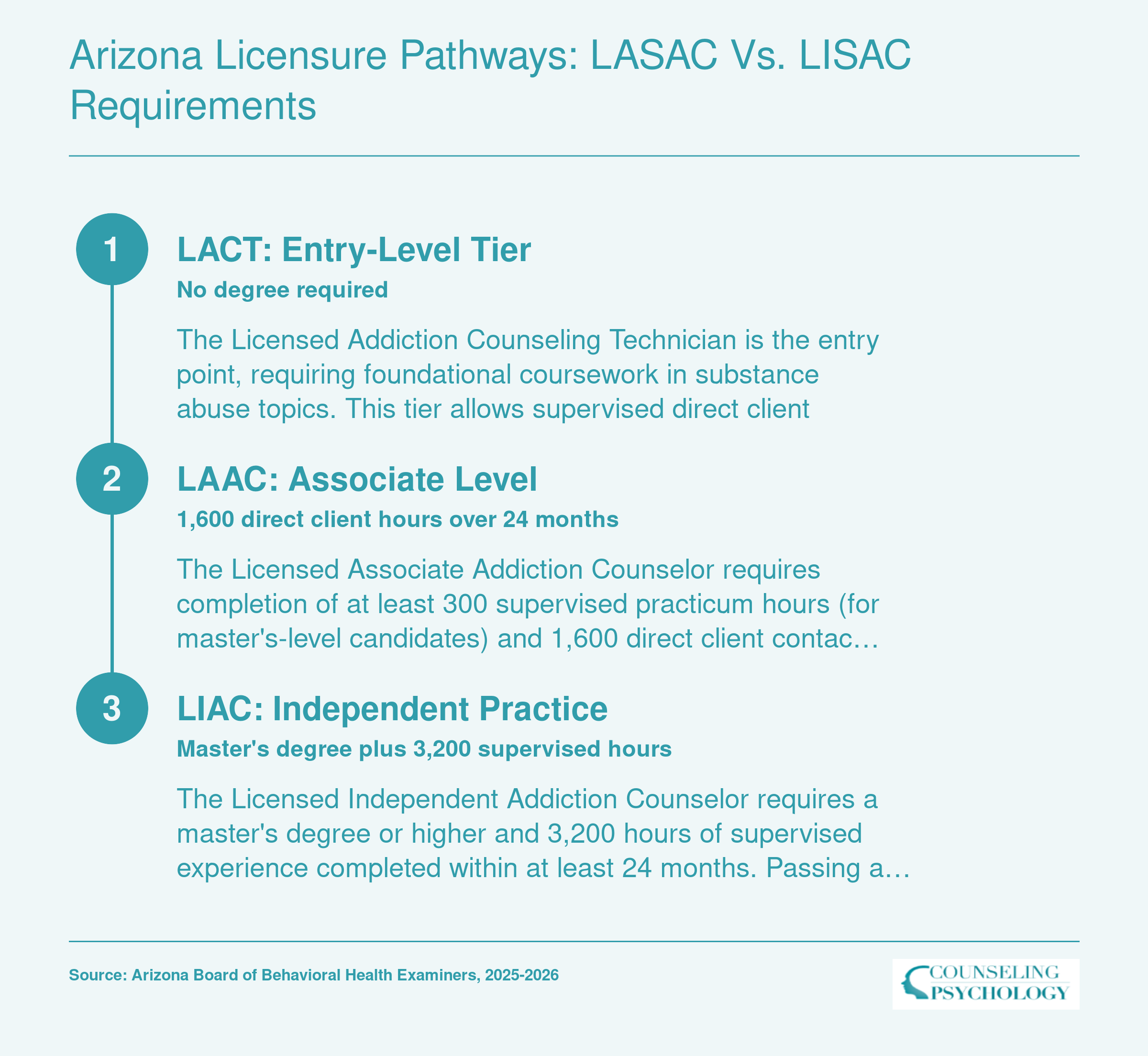
Arizona restructured its substance abuse counseling credentials in 2025, replacing the legacy LSAT, LASAC, and LISAC titles with three updated tiers: Licensed Addiction Counseling Technician (LACT), Licensed Associate Addiction Counselor (LAAC), and Licensed Independent Addiction Counselor (LIAC). Each tier builds on the last, adding education, supervised hours, and exam benchmarks. Here is the progression as defined by the Arizona Board of Behavioral Health Examiners.
Which Arizona Programs Are Approved by the Board of Behavioral Health Examiners?
When choosing between a Licensed Addiction Counselor Technician (LACT) and a Licensed Associate Substance Abuse Counselor (LASAC) pathway, the degree level and program approval status can steer your entire career timeline. The Arizona Board of Behavioral Health Examiners (AZBBHE) designates specific programs as meeting curriculum standards for each license tier, and failing to attend an approved program may delay or block your path to licensure.1
Why BBHE Approval Matters
Arizona's substance abuse counselor licenses are tiered by education and supervised experience. LACT requires an associate or bachelor's degree from a program the board recognizes as covering core addiction counseling content. LASAC and the independent LISAC demand progressively more advanced coursework and clinical hours. If your degree program has not been approved or curriculum-reviewed by the BBHE, you may need to complete additional post-degree coursework or find another program that meets the criteria, adding time and cost.
Programs with Current BBHE Recognition
Among the ranked and notable programs in Arizona, several hold formal BBHE approval:3
- Arizona State University: B.S. in Counseling and Applied Psychological Science (Substance Abuse and Addictions) is approved for LACT (9/11/2020 to 9/10/2030).
- Grand Canyon University: B.S. in Counseling (Emphasis in Addiction, Chemical Dependency and Substance Abuse) is approved for LACT (2/3/2017 to 2/2/2027).
- South Mountain Community College: B.S. in Behavioral Sciences was recognized by the BBHE in 2025 as meeting addiction counselor curriculum requirements, with an approval window through 2030.4
These approvals cover the LACT level, but for master's-level LASAC or LISAC pathways, the picture shifts. Many graduate programs in Arizona seek board curriculum review individually rather than receiving blanket approval. Under A.R.S. § 32-3253(14), the board may review curricula of regionally accredited institutions for consistency with licensure requirements.3 The board evaluates whether the master's coursework includes the required hours in counseling theory, ethics, addiction treatment, and supervised practice.
Accreditation Alone Doesn't Guarantee Licensure
Contrary to common assumption, holding CACREP or NAADAC accreditation does not automatically make a program's graduates eligible for Arizona licensure.1 The BBHE reviews all programs against its own curriculum requirements, even if they are nationally accredited. A CACREP-accredited master's in clinical mental health counseling may still need additional addiction-specific coursework if the board determines gaps exist. Always cross-check the program's curriculum with the board's published requirements.
How to Confirm Approval Status
The BBHE maintains an interactive online database of approved programs rather than a static list.1 Because approvals expire and new recognitions are added periodically, the most reliable step is to search the board's portal directly. You can also contact program coordinators and ask them to confirm current AZBBHE status for the license level you intend to pursue.
Questions to Ask Yourself
Tuition and Cost Comparison Across Arizona Addiction Counseling Programs
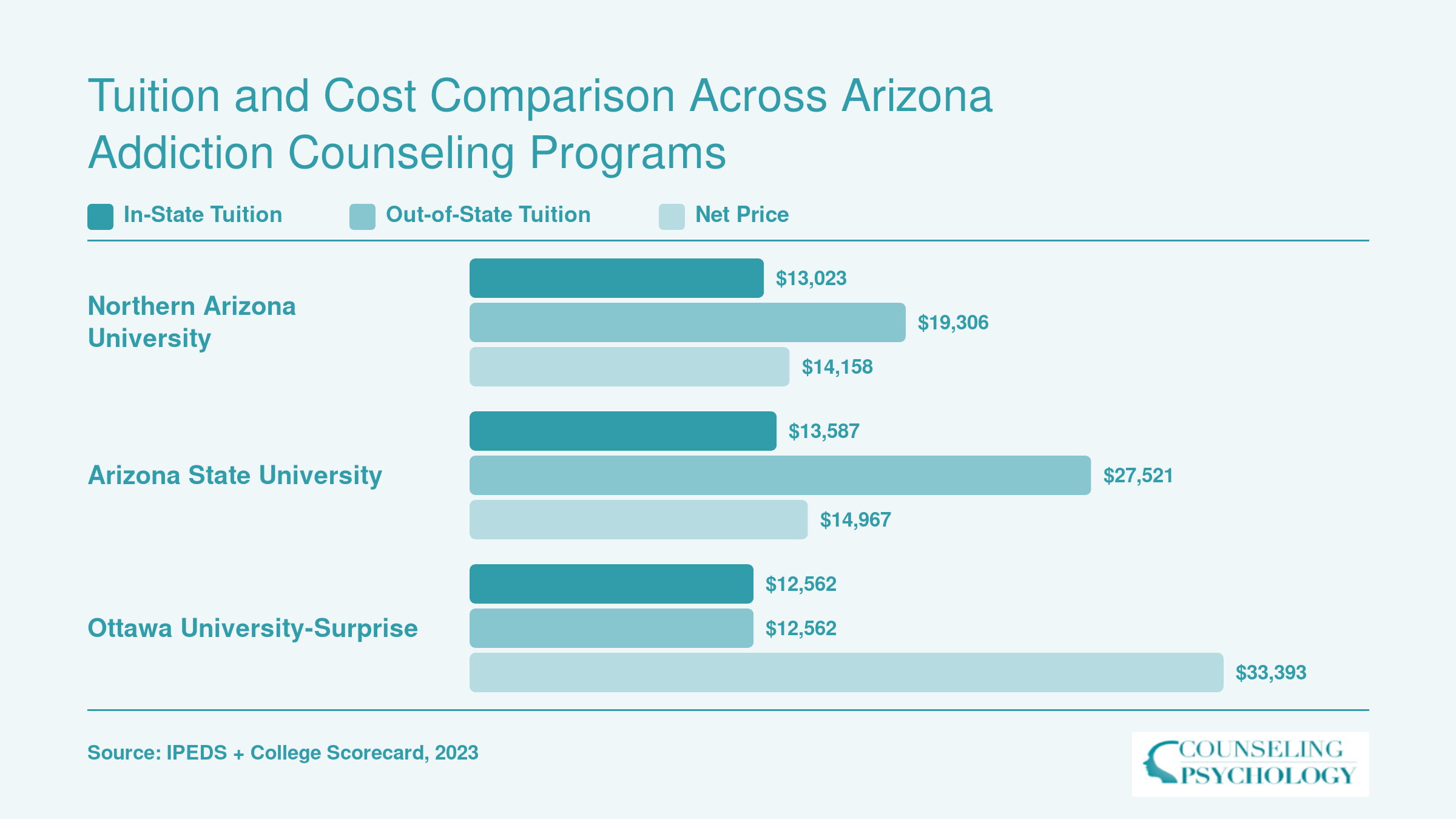
Sticker-price tuition tells only part of the story. The net price figures below reflect institution-wide averages after grants and scholarships, so your actual out-of-pocket cost may differ based on your financial aid package, residency status, and enrollment intensity. Program-level earnings and debt data are not yet available for these specific addiction counseling programs, but institution-wide median graduate debt ranges from $19,000 to $21,500.
Online vs. On-Campus vs. Hybrid: Program Format Guide
Choosing the right program format shapes your daily schedule, clinical training logistics, and overall cost. Most ranked Arizona addiction counseling programs lean toward online or hybrid delivery, but every format comes with trade-offs worth weighing before you commit. The table below compares the three formats across the dimensions that matter most for licensure-track students.
| Dimension | Online | On-Campus | Hybrid |
|---|---|---|---|
| Flexibility | Highest. Coursework is asynchronous or scheduled around working professionals' hours. ASU's MS in Addiction Psychology and Ottawa University-Surprise's MS in Addiction Counseling both deliver didactic content fully online. | Lowest. Fixed class schedules typically require daytime or evening availability on a set campus. | Moderate. Northern Arizona University's C-CART certificate, for example, combines web-based coursework with community-based learning, letting students balance online study with periodic in-person sessions. |
| Practicum Logistics | This is the critical catch. Arizona's Board of Behavioral Health Examiners requires supervised clinical hours for both LASAC and LISAC credentials, so even fully online programs mandate in-person practicum. ASU and Grand Canyon University both require students to complete fieldwork at approved local sites. Online students may need to identify and coordinate their own placement, though some programs offer placement assistance. | Programs typically maintain established relationships with nearby treatment centers, hospitals, and community agencies, making site placement more straightforward. | Often the smoothest path: the community-based component is built into the curriculum from the start, so practicum coordination is integrated rather than bolted on. |
| Networking Opportunities | Peer interaction happens through discussion boards, virtual cohorts, and occasional residency events. Professional connections depend largely on your practicum site and personal initiative. | Strongest. Daily contact with faculty, guest lecturers, and classmates builds relationships that often lead to job referrals and mentorship. | A middle ground. In-person intensives or community rotations create face-to-face networking windows, supplemented by online collaboration. |
| Cost Implications | Can be lower overall because you avoid relocation and commuting costs. However, tuition rates vary: ASU's graduate tuition runs roughly $13,587 in-state and $27,521 out-of-state, while Ottawa University-Surprise charges a flat $12,562 regardless of residency. | Tuition may be comparable, but housing, transportation, and campus fees add up, especially in metro areas like Phoenix or Tempe. | Costs tend to fall between the two. Travel to periodic on-site sessions adds expense, but less than full-time campus attendance. |
| Licensure Readiness | Accredited online programs at ASU and Ottawa University-Surprise are designed to meet Arizona LASAC requirements. Confirm that your chosen program's curriculum aligns with the specific hour and coursework mandates set by the Board. | Traditionally the most direct route to licensure, with built-in clinical training structures and faculty who can verify competency firsthand. | NAU's hybrid certificate targets clinicians and doctoral students already working in the field, adding specialized credentials rather than serving as a standalone licensure pathway. |
Career Outcomes and Earnings for Arizona Addiction Counselors
Arizona employs roughly 8,970 substance abuse, behavioral disorder, and mental health counselors (BLS SOC 21-1018), and statewide wages run meaningfully above some national benchmarks. The table below shows Arizona-specific annual wage percentiles from the Bureau of Labor Statistics. Keep in mind that program-level earnings reported on federal scorecards reflect what graduates of a specific degree program earn one or two years after completing their credential, which may differ substantially from these occupational wage figures because early-career counselors often start at the lower end of the pay distribution and because scorecard data captures all graduates regardless of whether they entered this particular occupation. Nationally, BLS projects 17 percent job growth for this occupation through 2034, a rate classified as much faster than average compared to the 3 percent average across all occupations, with an estimated 48,300 annual openings. Arizona's ongoing behavioral health workforce expansion, driven partly by Medicaid coverage of substance use treatment and sustained demand from the opioid crisis, positions the state as one of the more active hiring markets in the Southwest.
| Wage Percentile | Annual Salary (Arizona, BLS) |
|---|---|
| 25th Percentile | $50,650 |
| Median (50th Percentile) | $63,830 |
| Mean (Average) | $67,890 |
| 75th Percentile | $79,990 |
Graduate Certificates vs. Master's Degrees in Addiction Counseling
Choosing between a graduate certificate and a master's degree in addiction counseling comes down to how far you want to go in Arizona's licensure system. A certificate can get you into the field faster at the Licensed Associate Substance Abuse Counselor (LASAC) level, while a master's degree opens the door to independent practice as a Licensed Independent Substance Abuse Counselor (LISAC). Both paths have real trade-offs worth weighing carefully.
Pros
- Graduate certificates typically take 12 to 18 months and cost significantly less, making them an efficient on-ramp to LASAC licensure in Arizona.
- Certificate holders can begin accruing supervised clinical hours sooner, which means earning a paycheck while building experience in the field.
- A master's degree qualifies you for LISAC independent licensure, removing the requirement for ongoing clinical supervision and expanding your scope of practice.
- Master's graduates generally access broader career options, including clinical director roles, private practice, and positions at hospitals or integrated health systems.
- Higher credential levels correlate with stronger earning potential; LISAC holders in Arizona typically command higher salaries than LASAC holders in comparable settings.
Cons
- Graduate certificates cap your advancement at the LASAC tier, meaning you will always need a supervisor and cannot bill insurance independently in Arizona.
- Certificate programs cover a narrower curriculum, which may leave gaps in clinical theory, research methods, or co-occurring disorder training.
- Master's programs require two to three years of full-time study and a substantially larger financial investment, including tuition, fees, and opportunity cost.
- The longer timeline for a master's degree delays your entry into the workforce, which can be a real burden for career changers or students managing family obligations.
Arizona recorded 2,453 overdose deaths in 2024, according to the CDC. That translates to nearly seven people lost every day, underscoring the critical need for trained addiction counselors across the state. As treatment demand rises, Arizona-approved programs are expanding clinical training seats to meet the workforce gap.
Frequently Asked Questions About Addiction Counseling Programs in Arizona
Choosing the right addiction counseling program involves understanding licensure requirements, salary expectations, and program formats. Below are answers to the questions prospective students ask most often about pursuing this career path in Arizona.