What you’ll learn in this article…
- D.C. hosts two in-person doctoral social work programs, so most DSW candidates enroll online through out-of-state universities.
- Social workers in the D.C. metro area earned a median hourly wage of $43.37 in 2024, with doctoral holders clustering higher.
- Ph.D. programs often cover tuition and pay stipends, while online DSW programs typically cost $40,000 to $80,000 out of pocket.
- NASW and CSWE are both headquartered in D.C., giving doctoral students unique access to policy and accreditation networks.
Doctoral social work candidates in Washington, D.C. face a narrow local field: just two CSWE-accredited universities (Catholic University and Howard) offer a campus-based Ph.D., and no D.C. institution currently runs its own DSW. That scarcity is the defining tension. Residents who want a practice doctorate must look to out-of-state online programs, while those drawn to research can stay local at an HBCU with a Black Perspective concentration or at a program grounded in Catholic social teaching.
The geography matters more here than in most cities. NASW, CSWE, and dozens of federal agencies sit within commuting distance, shaping dissertation topics, assistantship work, and post-graduation hiring well before a student picks a school. For D.C. residents still weighing related graduate pathways, our guide to counseling schools in Washington DC offers a useful complement to the doctoral options explored below.
Best Doctoral Social Work Programs in Washington, D.C. (2026 Rankings)
Washington, D.C. is home to just two brick-and-mortar doctoral social work programs, but what the market lacks in volume it makes up for in focus. One program is rooted in Catholic social teaching and streamlined research training; the other is a historically Black university with deep ties to community-engaged scholarship and multiple concentration tracks. Because options are so limited locally, understanding each program's distinct identity, cost structure, and career orientation is essential before you apply.
- Graduate earnings and debt outcomes
- Program focus and concentrations
- Institutional graduation and retention
- Tuition and net price affordability
- Research mission and community fit
- College Scorecard graduate earnings — collegescorecard.ed.gov
- Internal program database
- Independent program research
- NCES-IPEDS federal institutional data — nces.ed.gov

The Catholic University of America
The Catholic University of America pairs a compact, 45-credit Ph.D. in Social Work with a social justice and human rights mission grounded in Catholic social teaching. Situated minutes from Capitol Hill, the program channels DC's policy ecosystem into its research training, preparing graduates for academic, research, and advocacy leadership roles. The school-level graduation rate stands at roughly 80%, and the institution reports a median graduate debt of $26,000 with median earnings of $73,250 ten years after enrollment (both figures are school-wide, not specific to the doctoral social work program).
- 45-credit-hour curriculum plus dissertation
- Tuition runs approximately $1,200 per credit hour
- Campus-based format in Washington, D.C.
- Emphasizes social justice, mercy, and human rights
- Comprehensive exam and dissertation defense required
- Trains advanced research and social work theory skills
- Prepares graduates for academia, research, and policy roles
Ph.D. in Social Work — On-Campus

Howard University
Howard University, ranked among the top social work schools nationally, offers a research-oriented Ph.D. in Social Work with three distinct concentrations: Family and Community, Health and Mental Health, and International Development. As a premier HBCU in the nation's capital, the program centers a Black Perspective and strengths-based framework, training scholars to address systemic inequities affecting urban, Black, and marginalized communities. The GRE is not required for admission, and competitive graduate assistantships are available for early applicants. Note that the school-level graduation rate is approximately 70%, with median graduate debt of $24,500 and median earnings of $63,066 at the ten-year mark; these are institution-wide figures, not specific to the doctoral program. Program-level earnings data are not yet available for these concentrations.
- 48-credit-hour research-oriented curriculum
- Campus-based, full-time program in Washington, D.C.
- Centers the Black Perspective and liberating structures
- No GRE required for admission
- MSW and minimum 3.0 GPA required for entry
- Qualifying exam plus dissertation required
- Financial aid and graduate assistantships available
- 48 credit hours focused on health disparities research
- Emphasizes mental health in oppressed communities
- Four semesters of full-time residency required
- Qualifying and comprehensive exams included
- Interdisciplinary curriculum spanning public health
- Prepares graduates for academic and policy leadership
- Graduate assistantships offered to early applicants
- 48-credit-hour track with global research focus
- Concentration on Africa, Caribbean, and diaspora issues
- Ideal for students near DC embassies and global NGOs
- MSW plus post-MSW practice experience preferred
- Personalized learning and interdisciplinary engagement
- Dissertation required with committee oversight
- Fall-only admission; no spring entry available
Ph.D. in Social Work, Family and Community — On-Campus
Ph.D. in Social Work, Health and Mental Health — On-Campus
Ph.D. in Social Work, International Development — On-Campus
DSW vs. Ph.D. in Social Work: Which Degree Is Right for You?
The choice between a DSW and a Ph.D. in social work comes down to what you want to do after you graduate. Both are terminal degrees, both carry the same prestige in the field, and in Washington, D.C., both are treated as acceptable alternatives to the MSW for LICSW licensure.1 The day-to-day work each prepares you for, however, is quite different. If you are still weighing whether a doctorate is worth pursuing at all, it helps to first understand what the difference between DSW and Ph.D. in social work really means in practice.
Purpose and Curriculum
The DSW is a practice doctorate. Coursework centers on advanced clinical methods, organizational leadership, program design, and applied scholarship, and most programs culminate in a capstone project that solves a real-world problem in an agency or community setting. The Ph.D. is a research doctorate. Students take seminars in theory, quantitative and qualitative methods, and a substantive specialization, then complete an original dissertation that contributes new knowledge to the field.
Admissions profiles reflect that split. DSW cohorts tend to be mid-career clinicians with several years of post-MSW practice, while Ph.D. applicants are often recent MSW graduates with research experience or a clear scholarly agenda.
Time, Format, and D.C. Availability
DSW programs typically run three to four years part-time and are designed for working professionals, with online or hybrid scheduling. Ph.D. programs usually require four to six years of full-time, in-person study with teaching and research assistantships. In D.C., that distinction matters: Catholic University and Howard offer Ph.D. programs locally, but anyone wanting a DSW will be looking at online options from out-of-state schools.
Licensure and Career Outcomes
Neither degree is required for LICSW licensure in D.C.1 The District accepts a CSWE-accredited MSW, and a doctorate does not reduce the 3,000 supervised hours, the 1:32 supervision ratio, the 100 face-to-face supervision hours, or the ASWB Advanced Clinical exam requirement.1 What a doctorate does unlock is the next tier of roles: clinical directorships, policy positions, agency leadership, and adjunct or faculty teaching.
For tenure-track faculty work at research universities, the Ph.D. is essentially non-negotiable. For senior clinical leadership, private practice expansion, or teaching at the practitioner level, the DSW is the more efficient path, and its part-time format lets you keep billing hours and accruing supervision while you study.
Questions to Ask Yourself
Online DSW Programs That Accept Washington, D.C. Residents
Washington, D.C. does not currently host a CSWE-member university offering its own practice doctorate in social work, which means residents pursuing a DSW almost universally enroll in an out-of-state online program. That structural gap, more than any individual program's appeal, explains why the conversation about DSW options in the District is really a conversation about distance education.
Why Online Is the Default Path for D.C. Residents
The two doctoral social work programs based in the immediate region (Catholic University and Howard University) are research-focused Ph.D. tracks. A nearby practice doctorate is launching at the University of Maryland, Baltimore for Fall 2026, with 50 credits required, but it remains the exception rather than the rule.1 For working clinicians in D.C. who want a practice doctorate without leaving their jobs, an online DSW is effectively the only realistic route.
The good news: the online DSW market has matured. Most established programs are designed around employed mid-career clinicians, with asynchronous coursework, evening synchronous sessions, and part-time pacing built into the standard plan of study.
Accredited Online DSW Options Open to D.C. Residents
The programs below accept students nationally, including from the District. Confirm current tuition and residency requirements directly with each school before applying, since both shift year to year.
- University of Southern California (Suzanne Dworak-Peck): 78 quarter credits, fully online, with optional in-person immersion experiences. Geared toward clinical leadership.
- Tulane University: 54 credits, fully online format. Tulane's DSW emphasizes leadership and clinical expertise for experienced MSWs.
- University of Tennessee, Knoxville: 45 credits, online delivery. One of the more credit-efficient options on the list.
- University of St. Thomas (Minnesota): 45 credits, online. Frequently chosen by clinicians moving into supervision and program leadership.
- Simmons University: 48 credits, online, with a clinical practice orientation that suits licensed therapists.3
- Millersville University (Pennsylvania): Hybrid format with in-person residency components; out-of-state tuition is approximately $1,041 per credit for 2025-2026, which makes total cost relatively predictable for D.C. residents.4
A Note on Accreditation and Residencies
CSWE accredits MSW and BSW programs, not DSW programs, so you will not find a CSWE seal on a practice doctorate. What matters instead is that the university itself is regionally accredited and that the underlying MSW you already hold was CSWE-accredited, which is what D.C. licensure as an LICSW relies on. If you are also weighing a research doctorate in a related field, our guide to counseling doctoral programs covers that pathway in detail. Several programs above include short in-person immersions, typically one to three visits across the degree, so factor travel into your planning even when a program markets itself as fully online.
Related Articles
Salary and Career Outcomes for Doctoral Social Workers in D.C.
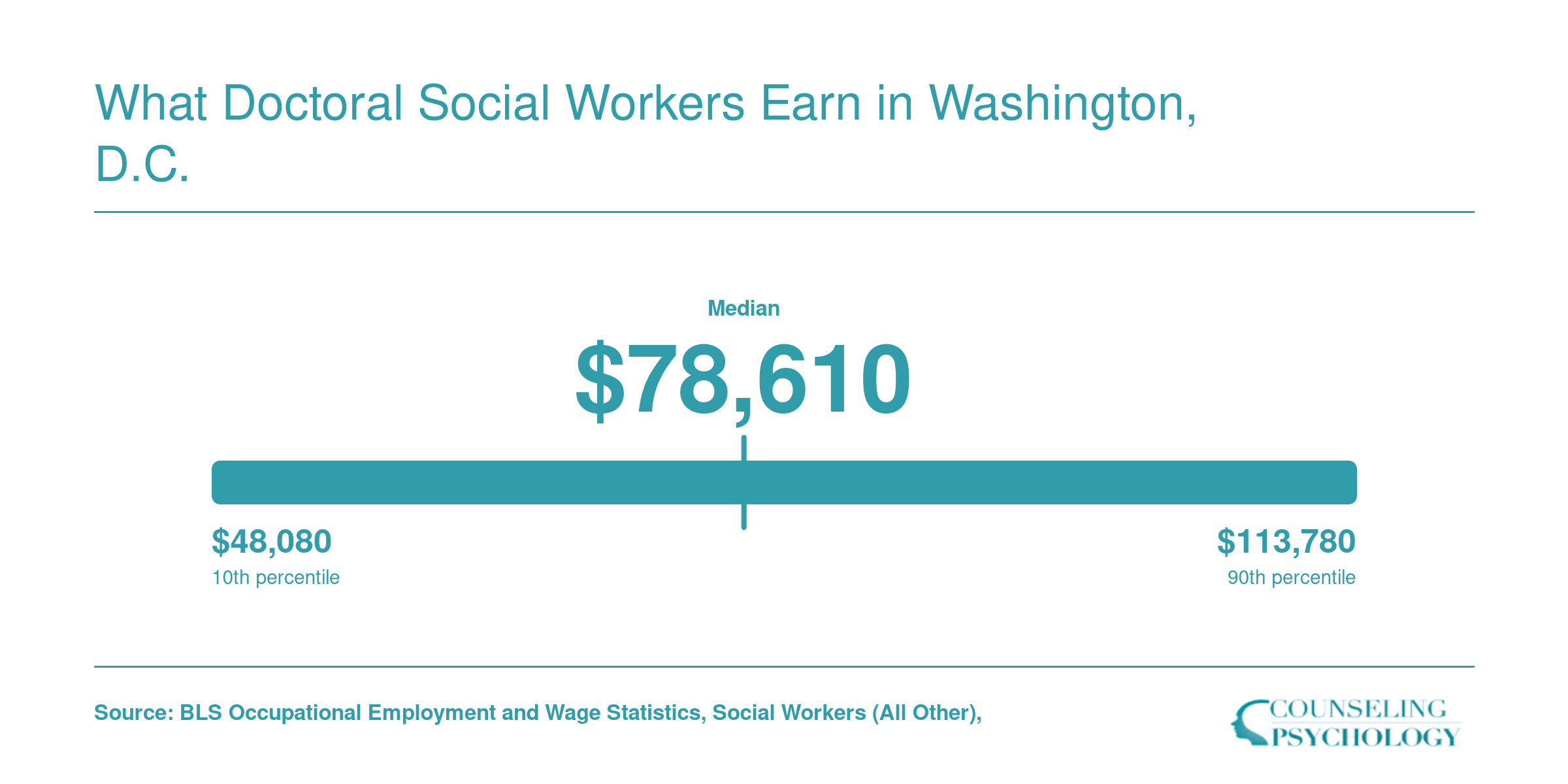
The median hourly wage for social workers in the Washington-Arlington-Alexandria metro area reached $43.37 in 2024, according to Bureau of Labor Statistics data for the 21-1029 occupational category.1 Doctoral-level social workers, however, typically earn substantially more, clustering in the 75th percentile ($51.25 per hour) and 90th percentile ($65.93 per hour) ranges, particularly when they move into policy, administration, and research roles.1 While program-level graduate earnings data are not yet published for Catholic University of America's PhD in Social Work or Howard University's PhD program, these wage distributions provide a useful benchmark for understanding the doctoral premium in the D.C. metro market.
Federal Agencies and the GS-0185 Series
Washington, D.C. stands out as a national hub for doctoral social workers in federal service. The GS-0185 Social Work series governs most federal social work positions, and doctoral degree holders typically enter at GS-13 or GS-14 levels, depending on experience. In 2026, a GS-13 social worker in the D.C. locality area earns a base salary ranging from approximately $98,000 to $127,000, while GS-14 positions start near $116,000 and can exceed $151,000. Agencies actively recruiting doctoral-level social workers include the Substance Abuse and Mental Health Services Administration (SAMHSA), the Department of Veterans Affairs, the National Institutes of Health, and the Department of Health and Human Services. These roles emphasize policy development, program evaluation, and systems-level intervention rather than direct clinical practice.
Universities, Think Tanks, and Major NGOs
Beyond federal employment, D.C.'s concentration of universities and research institutions creates steady demand for doctoral social workers in tenure-track faculty positions, postdoctoral fellowships, and senior research roles. The Urban Institute, Brookings Institution, and similar policy shops hire doctoral social workers to lead research on poverty, housing, child welfare, and health equity. Major NGOs headquartered in the region, including national advocacy organizations and international development agencies, also recruit doctoral holders for director-level positions in program design and evaluation. Prospective students weighing nearby options may also want to explore DSW programs in Richmond, VA, where Virginia Commonwealth University offers another CSWE-accredited pathway. These non-federal roles frequently offer salaries competitive with or exceeding federal wages, though they vary widely by organization type and funding model.
Cost of Living and Salary Realities
D.C.'s cost of living ranks among the highest in the nation, but doctoral-level salaries in policy and leadership roles often exceed clinical practice wages by 30 to 50 percent. A master's-level clinical social worker in private practice or community mental health might earn closer to the metro median of $43.37 per hour, translating to roughly $90,000 annually at full-time equivalent. Doctoral holders in federal policy roles, university administration, or senior nonprofit leadership routinely cross the six-figure threshold within a few years of degree completion. The salary premium reflects the specialized expertise, research capabilities, and systems-level perspective that doctoral training confers, making the investment particularly viable for those who plan to remain in the capital region long-term.
What Doctoral Social Workers Earn in Washington, D.C.
Social workers in the Washington, D.C. metropolitan area earn significantly more than the national median, reflecting the concentration of federal agencies, policy organizations, and major health systems in the region. Doctoral-level professionals typically cluster at the 75th percentile and above, where roles in clinical leadership, program administration, and policy research command the strongest compensation.
Admissions Requirements and Applicant Profiles
Doctoral social work admissions have shifted meaningfully over the past several years, with a growing number of programs dropping or waiving the GRE and placing greater weight on professional experience and writing samples. That said, requirements still vary enough from one program to the next that careful homework is non-negotiable.
What Most Programs Expect
Whether you are applying to a Ph.D. or DSW program, a few baseline requirements show up almost universally:
- MSW degree: Nearly every doctoral social work program requires a master's in social work from a CSWE-accredited institution. A small number accept related master's degrees on a case-by-case basis, but this is uncommon.
- Minimum GPA: Thresholds typically fall between 3.0 and 3.5 on a 4.0 scale. Ph.D. programs at research-intensive universities tend to sit at the higher end.
- Clinical or professional experience: DSW programs commonly require two to five years of post-MSW practice. Ph.D. programs may be more flexible on the experience front but look for strong research aptitude instead.
- Writing sample: Expect to submit an academic or professional writing sample, sometimes a published article or a policy brief, alongside a detailed statement of purpose.
- GRE scores: Many programs have moved to GRE-optional or GRE-waived policies, but a handful of competitive Ph.D. programs still require them. Check each school's doctoral admissions page directly.
Finding Reliable Admissions Data
Acceptance rates for doctoral social work programs are not published in a single centralized database. Ph.D. programs at top research universities are notoriously selective, sometimes admitting fewer than 10 percent of applicants in a given cycle. If you are curious about how hard it is to get into grad school for psychology, comparable selectivity dynamics apply across many doctoral-level helping professions. DSW programs, particularly those offered online, tend to have broader admissions criteria and higher acceptance rates, though published figures are scarce.
To get the clearest picture, contact program coordinators directly and ask for cohort size and application volume. You can also search peer-reviewed social work education journals for published admissions data. Forums like GradCafe and social work listservs can offer useful firsthand accounts of what successful applicant profiles look like, though treat anecdotal data with appropriate caution.
Verify Accreditation and Stay Current on Policy
Before applying, confirm that both your MSW program and your target doctoral program hold CSWE accreditation. The Council on Social Work Education maintains a searchable directory of accredited programs. It is also worth checking the National Association of Social Workers for any policy updates that could affect admissions standards or licensure pathways tied to doctoral credentials. Requirements can shift between application cycles, so always rely on the most current information posted on each school's admissions or doctoral program page rather than outdated forum posts or third-party summaries.
Funding Your Doctoral Social Work Education in D.C.
PhD programs in social work typically cover tuition and provide stipends through research assistantships, while DSW programs expect students to pay tuition out of pocket or through loans. This funding gap is the single largest financial difference between the two doctoral paths and shapes the affordability equation for most D.C. applicants.
PhD Funding vs. DSW Costs
PhD programs at both Catholic University and Howard University offer research assistantships that include tuition remission and modest annual stipends. At Catholic University, the PhD program charges $1,200 per credit hour for the 45-credit curriculum, but admitted students in funded cohorts generally receive tuition coverage plus a stipend tied to research or teaching duties. Howard's PhD program follows a similar model, prioritizing applicants who can commit to full-time study in exchange for financial support.
DSW programs, particularly online formats, operate under a tuition-based model. Students pay per-credit or per-term rates and finance the degree through federal loans, employer tuition assistance, or personal savings. Institutional data show that doctoral social work completers at Catholic University carried a median debt of $26,000, while Howard completers held $24,500 in median graduate debt, though these figures aggregate all programs and may not isolate DSW borrowers.
Federal and DC Government Employee Benefits
Washington, D.C.'s large federal workforce creates unique funding opportunities for doctoral students. Under OPM Academic Degree Training provisions, federal agencies may reimburse up to 100 percent of tuition and required materials for employees pursuing job-related degrees, subject to agency approval and budget availability.1 VA employee education benefits follow a parallel structure, requiring agency approval and demonstration that the degree advances mission-critical competencies.1
DC government employees may also access a tuition-discount program at Catholic University's School of Professional Studies, which offers a 10 percent tuition reduction and waives the application fee for graduate degrees and certificates.2
Loan Repayment and Social Work-Specific Aid
The National Health Service Corps Loan Repayment Program accepts applications from doctoral-level social workers practicing in Health Professional Shortage Areas. NHSC awards can offset up to $50,000 in educational debt in exchange for a two-year service commitment at an approved site. The Federal Employee Education and Assistance Fund provides emergency loans and scholarships to federal workers and dependents, including those enrolled in doctoral programs.
Net Price Realities
Institutional net price figures offer a rough proxy for undergraduate and master's aid but rarely reflect doctoral funding packages. Catholic University's average net price of $29,561 and Howard's $50,539 apply to undergraduates; doctoral students experience different aid structures altogether. Prospective applicants should request program-specific financial aid breakdowns during the admissions process rather than rely on institution-wide averages.
PhD programs in Washington, D.C. often cover tuition and pay a modest stipend, but expect a four to six year commitment. Online DSW programs typically cost between $40,000 and $80,000 or more out of pocket, yet many candidates finish in two to three years while maintaining full time employment. That faster timeline preserves your earning power, potentially offsetting the higher sticker price through continued income during your studies.
Why Washington, D.C. for Doctoral Social Work?
NASW and CSWE both maintain their national headquarters in the Washington, D.C. metropolitan area, placing doctoral social work students at the center of the profession's policy and accreditation ecosystem. This geographic advantage shapes research opportunities, fieldwork placements, and career trajectories in ways few other cities can match.
Federal Policy Access
D.C. hosts the agencies that shape social welfare at scale. The Department of Health and Human Services, the Substance Abuse and Mental Health Services Administration, the Veterans Administration, and the Social Security Administration all maintain major operations in or near the capital. For doctoral students, this proximity translates into tangible research and practice opportunities: analyzing policy implementation as it unfolds, accessing national administrative datasets, and embedding in federal programs for capstone or dissertation projects. Students studying child welfare reform, substance use treatment policy, or veterans' services can engage directly with the bureaucracies administering those systems.
Think Tanks and Advocacy Organizations
The Urban Institute, the Brookings Institution, Child Trends, and the Center on Budget and Policy Priorities represent just a fraction of the research organizations concentrated in D.C. National advocacy groups focused on housing, immigration, racial justice, and health equity also cluster here. Doctoral students routinely collaborate with these organizations on research briefs, program evaluations, and policy analyses. For DSW students pursuing applied capstones, partnerships with advocacy nonprofits can produce work that reaches policymakers within months of completion.
A Living Laboratory for Social Work Practice
D.C. presents stark contrasts that create rich contexts for practice and research. Income inequality in the District ranks among the highest in the nation, with significant disparities in housing stability, food access, and health outcomes across neighborhoods. Racial health disparities remain pronounced, and the availability of BIPOC therapists is an active area of concern as the city's unhoused population faces chronic service gaps. For doctoral students, these conditions offer urgent, consequential research questions alongside clinical and macro practice opportunities that carry real stakes.
Professional Networking
Beyond coursework, D.C. students encounter policymakers, national association leaders, and conference organizers with unusual frequency. Congressional briefings, NASW policy forums, and CSWE annual meetings often take place locally or within easy travel distance. These interactions build professional networks that extend well beyond graduation, connecting doctoral graduates to leadership roles in federal agencies, national organizations, and academic institutions nationwide.
How to Choose the Right Doctoral Social Work Program
Choosing a doctoral program in social work often comes down to weighing what you want your career to look like in five years against the practical realities of how you live and work right now. A cheaper online option might save tens of thousands of dollars, but a D.C.-based program with fieldwork placements on Capitol Hill or at a federal agency could open doors that no virtual classroom can replicate. Getting clear on your own priorities before you apply will save you time, money, and frustration.
Build Your Decision Checklist
Before you compare specific schools, answer a few core questions honestly:
- Research or practice? If you want to publish, secure grant funding, and pursue a tenure-track faculty position, a Ph.D. is the stronger fit. If you want to elevate your clinical work, lead a nonprofit, or shape agency-level policy, a DSW is purpose-built for that path.
- Format flexibility: Can you be on campus multiple days a week, or do you need a fully online or hybrid schedule? Some Ph.D. programs require full-time, in-person enrollment, while most DSW programs are structured around working professionals.
- Cost and funding: Ph.D. students often receive tuition waivers and stipends in exchange for research or teaching assistantships. DSW students typically pay tuition out of pocket or through employer sponsorship. Know what you can realistically afford.
- Career goals: Faculty roles, clinical leadership, executive nonprofit management, and federal policy work each favor different credentials and different program cultures. Match the program to the destination.
- Mission alignment: Read the program's stated values and research centers. A school deeply invested in health equity, for example, will offer different mentorship and networking than one focused on child welfare systems.
Can You Work While Enrolled?
This is one of the most practical distinctions between the two degree types. DSW programs are designed with the assumption that students hold full-time jobs. Coursework is typically scheduled on evenings, weekends, or in intensive weekend residencies. Many Ph.D. programs, by contrast, expect students to treat doctoral study as their primary commitment, especially during the first two years of coursework and qualifying exams. If stepping away from your career is not feasible, a DSW or a part-time Ph.D. track (where available) may be your only realistic option. For a deeper look at how these credentials compare, including the DSW vs Ph.D. cost comparison, that context can sharpen your decision.
Factor in the D.C. Advantage
Washington, D.C. is not just another metro area for social work. It is the epicenter of federal social policy, home to agencies like the Department of Health and Human Services, the Children's Bureau, and dozens of advocacy organizations. If your goal involves influencing policy at scale, a program that places students in these settings for practicum or dissertation research carries weight that a remote program cannot easily match. Proximity to congressional offices, think tanks, and international development organizations adds a networking layer that is difficult to replicate elsewhere. Weigh that access against cost differences honestly, but do not undervalue it.
Take Action Before You Commit
Once you have narrowed your list to two or three programs, go beyond the website:
- Contact admissions offices directly and ask about cohort sizes, dissertation completion rates, and post-graduation career placement.
- Attend virtual or in-person information sessions. Pay attention to how faculty describe mentorship and how responsive staff are to your questions.
- Ask to speak with a current doctoral student. Their unfiltered perspective on workload, advising relationships, and program culture is often the most valuable data point you will find.
A doctoral program is a multi-year commitment with lasting career implications. Spending a few extra weeks on due diligence before you apply is one of the highest-return investments you can make.
Frequently Asked Questions About Doctoral Social Work Programs in D.C.
Prospective doctoral students in social work often have overlapping questions about degree types, earning potential, and program logistics. Below are answers to the most common questions, drawn from the program details and labor data covered throughout this article.