What you’ll learn in this article…
- Rochester sits within a federally designated Mental Health Professional Shortage Area, driving strong demand for doctoral-level counselors.
- New York counseling doctorate tuition ranges from roughly $13,800 at SUNY campuses to nearly $58,000 at private universities.
- CACREP and APA accreditation each unlock different New York licenses, so choosing the wrong one can block your career path.
- Ph.D., Ed.D., and Psy.D. programs lead to distinct credentials: picking the right track depends on your practice and research goals.
Is a doctoral degree in counseling actually worth pursuing in upstate New York, or is the master's credential enough for the market? For many practitioners, the answer hinges on what Monroe County data already signals: the region and surrounding Finger Lakes counties carry federal Mental Health Professional Shortage Area designations, meaning demand for advanced-level providers is not speculative.
Programs within reach of Rochester span all three degree types. The University of Rochester offers a CACREP-accredited Ph.D. in Counseling; University at Buffalo and University at Albany hold APA-accredited counseling psychology doctorates; Syracuse University runs a CACREP-accredited counselor education Ph.D. Each credential routes graduates toward a different licensure title and practice setting under New York law. Students already exploring graduate options in the state may find our overview of best counseling programs in New York a useful starting point.
The practical tension for most applicants is not ambition but tradeoffs: five-plus years of training, tuition ranging from roughly $13,800 at SUNY campuses to over $57,000 at private research universities, and a licensure pathway that varies depending on whether a program carries CACREP or APA accreditation. Choosing the wrong credential type can delay or complicate New York licensure significantly.
Best Doctorate in Counseling Programs Near Rochester, NY
New York State hosts a rich selection of doctoral programs in counseling, counseling psychology, and related behavioral sciences. The schools listed here were selected based on proximity or accessibility to Rochester, recognized accreditation (CACREP or APA where applicable), institutional outcomes, and overall value. While only one university sits within Rochester proper, several strong options in Buffalo, Syracuse, Ithaca, Albany, and the New York City metro area offer competitive doctoral pathways worth considering. Program-level earnings data is not yet available for most of these programs, so institution-wide figures are provided for context.
- Accreditation status and type
- Institutional graduation and retention rates
- Net price and financial support
- Geographic accessibility from Rochester
- Graduate debt and earnings outcomes
- NCES-IPEDS federal institutional data — nces.ed.gov
- College Scorecard graduate earnings — collegescorecard.ed.gov
- Independent program research
- Internal program database

University of Rochester
The University of Rochester is the only school on this list located in Rochester itself, making it the most convenient option for local students. Its Warner School of Education offers a CACREP-accredited PhD in Counseling with a School Counseling concentration, reporting a 90% completion rate and an 82% job placement rate. The university maintains a 9:1 student-to-faculty ratio and an institution-wide graduation rate of 85.4%. Note that PhD applications are expected to open in Fall 2026, so prospective students should monitor the admissions portal closely.
- CACREP-accredited doctoral program
- 90% program completion rate reported
- 82% job placement rate for graduates
- Campus-based format in Rochester, NY
- Comprehensive preparation for school counseling leadership
- Strong 9:1 student-to-faculty ratio
PhD in Counseling, School Counseling Concentration — On-Campus

University at Buffalo
The University at Buffalo, roughly 75 miles west of Rochester, offers an APA-accredited PhD in Counseling/School Psychology with two distinct concentrations. The program follows a scientist-practitioner model requiring 96 credits and at least 1,000 practicum hours, with no GRE required for admission. UB's in-state graduate tuition of $14,530 makes it one of the most affordable options on this list, and the institution-wide net price sits at roughly $20,995. The university posts a 75.2% institution-wide graduation rate.
- APA-accredited scientist-practitioner model
- 96 credits required, five-year timeline
- 1,000 supervised practicum hours
- No GRE or MAT required for admission
- Full-time, campus-based study mandatory
- Diverse faculty research expertise
- APA-accredited program focused on child and adolescent mental health
- 96 credits over five or more years
- Multicultural counseling training included
- Behavioral therapy and academic intervention focus
- No GRE required for admission
- Prepares graduates for state licensure
PhD in Counseling/School Psychology, Counseling Psychology Concentration — On-Campus
PhD in Counseling/School Psychology, School Psychology Concentration — On-Campus

Syracuse University
Syracuse University, about 90 miles east of Rochester, houses a CACREP-accredited PhD in Counseling and Counselor Education that spans 96 credits. The program prepares students for academia, research, and advanced clinical practice, with emphases in supervision, teaching, and multicultural counseling. Graduate assistantships, conference funding, and medical benefits help offset the school's higher tuition. A School Counseling concentration is also available within the same doctoral framework. Syracuse's institution-wide graduation rate is 83.6%.
- CACREP-accredited, 96-credit doctoral curriculum
- Graduate assistantships and conference funding available
- Comprehensive supervision and teaching training
- Multicultural counseling emphasis throughout
- Minimum 3.25 graduate GPA for admission
- National leadership preparation focus
- CACREP-accredited with school counseling specialization
- Leadership and advocacy curriculum
- Hands-on fieldwork opportunities
- Financial support through assistantships
- Research and teaching development integrated
- Nationally recognized counselor education faculty
PhD in Counseling and Counselor Education — On-Campus
PhD in Counseling and Counselor Education, School Counseling Concentration — On-Campus

Cornell University
Cornell University in Ithaca, roughly 90 miles south of Rochester, offers a PhD in Human Behavior and Design that bridges environmental psychology and the social sciences. This STEM-certified program does not require a prior design degree and provides full funding for four years. The university's institution-wide graduation rate stands at 95.4%, and its 9:1 student-to-faculty ratio supports a highly individualized doctoral experience. While not a traditional counseling degree, this program appeals to students interested in how environments shape psychological well-being.
- Multidisciplinary research bridging design and social science
- Full four-year funding package provided
- STEM-certified doctoral program
- No prior design degree required
- GRE recommended score of 310
- Minimum 3.0 undergraduate GPA for consideration
- Prepares for careers in academia, research, and industry
PhD in Human Behavior and Design — On-Campus

Columbia University in the City of New York
Columbia University's Teachers College in New York City offers a 75-credit PhD in Developmental Psychology built around close faculty mentorship and empirical research. Students study human development across the lifespan, integrating psychology with linguistics and other social sciences. Despite a listed graduate tuition near $57,973, Columbia's robust financial aid brings the institution-wide net price down to approximately $21,590. The school's 96.1% institution-wide graduation rate and 6:1 student-to-faculty ratio reflect exceptional institutional support.
- 75-credit doctoral program with faculty mentorship model
- Empirical research focus spanning all life stages
- Integrates psychology, social sciences, and linguistics
- Summer and Fall entry options
- Full-time, campus-based study in New York City
- Strong academic record required for competitive admission
- Institution-wide 6:1 student-to-faculty ratio
PhD in Developmental Psychology — On-Campus

University at Albany
The University at Albany, part of the SUNY system and about 225 miles east of Rochester, houses a PhD in Counseling Psychology that has held APA accreditation since 1980. This full-time program blends coursework, supervised practica, and a 2,000-hour pre-doctoral internship, following a scientist-practitioner model with a strong emphasis on diversity and contextual factors. In-state graduate tuition of $13,808 and a net price around $17,167 make UAlbany among the most cost-effective APA-accredited options statewide.
- APA-accredited since 1980
- Scientist-practitioner training model
- 2,000-hour pre-doctoral internship required
- 80 credits plus dissertation
- Full-time, in-residence study mandatory
- Emphasis on diversity and contextual counseling factors
- Supervised practica integrated throughout program
PhD in Counseling Psychology — On-Campus

St. John's University-New York
St. John's University in Queens offers a Psy.D. in School Psychology grounded in a practitioner-scientist model, with APA accreditation through 2029. The five-year, full-time program includes bilingual and general tracks, extensive supervised practica, and a full-year doctoral internship. Doctoral fellowships and graduate assistantships are available. St. John's institution-wide net price is approximately $29,999, and its graduate tuition is $36,227.
- APA-accredited through 2029
- Practitioner-scientist training model
- Full-time, five-year program structure
- Bilingual and general tracks offered
- Full-year doctoral internship included
- Doctoral fellowship and assistantship opportunities
- Prepares for New York State certification and licensure
Doctor of Psychology (Psy.D.) in School Psychology — On-Campus

SUNY Downstate Health Sciences University
SUNY Downstate Health Sciences University in Brooklyn offers a PhD in Neural and Behavioral Science that combines molecular genetics, brain imaging, and computational modeling. Full scholarships and stipends are available for full-time doctoral students, and the program's small class sizes and 9:1 student-to-faculty ratio create a highly personalized research environment. While this is not a counseling degree per se, students interested in the neuroscience foundations of human behavior will find it a compelling option. In-state graduate tuition is $11,982.
- Full scholarships and stipends for full-time students
- Small class sizes with personalized mentorship
- Core coursework in neuroscience, biochemistry, and ethics
- Lab rotations and research seminars after first year
- In-state graduate tuition of $11,982
- 9:1 student-to-faculty ratio
- Graduates placed at leading research institutions
PhD in Neural and Behavioral Science — On-Campus

Adelphi University
Adelphi University in Garden City offers a Psy.D. in School Psychology focused on social justice, multicultural practice, and evidence-based interventions. Students gain hands-on clinical experience at the Derner Hempstead Child Clinic and Equity Lab Institute, working directly with diverse student populations. The practitioner-scientist model prepares graduates for careers as school psychologists, mental health counselors, researchers, and educators. Graduate assistantships are available, and the institution-wide net price is approximately $30,783.
- Practitioner-scientist training model
- Social justice and multicultural curriculum emphasis
- Clinical training at Derner Hempstead Child Clinic
- Hands-on experience through Equity Lab Institute
- Graduate assistantships available
- Recommended 3.5 GPA for admission
- December 15 application deadline
- Multiple career pathways upon graduation
PsyD in School Psychology — On-Campus
Ph.D. vs. Ed.D. vs. Psy.D.: Which Counseling Doctorate Is Right for You?
New York recognizes three distinct doctoral pathways into licensed practice, and each one routes you toward a different title: LMHC, Licensed Psychologist, or a school-based or higher-ed leadership role. Picking the right letters after your name starts with matching curriculum focus to the career you actually want.
What Each Degree Emphasizes
- Ph.D. in Counseling Psychology: Heavy research training, dissertation required, and typically APA-accredited. Coursework balances theory, statistics, and supervised clinical hours. Graduates often pursue licensure as a psychologist, academic positions, or VA and hospital roles.
- Psy.D. in Clinical or Counseling Psychology: Practitioner-focused, also APA-accredited at reputable programs, with less emphasis on original research and more on clinical competency. Designed for students who want to practice as a Licensed Psychologist without an academic research career.
- Ed.D. in Counseling or Counselor Education and Supervision: Often CACREP-accredited when offered through a counseling department. Curriculum centers on counselor education, supervision, leadership, and applied research. Common path for LMHCs aiming to teach, supervise, or lead clinical programs.
Verifying Career Fit and Licensure Acceptance
Before committing, do three things. First, review each program's website for accreditation status: APA for Psy.D. and counseling psychology Ph.D. programs, CACREP for counselor education Ed.D. and Ph.D. tracks. The accreditor signals which licensure path the curriculum is built for. Second, check the Bureau of Labor Statistics occupational outlook pages for psychologists, school psychologists, and mental health counselors to compare projected demand and typical work settings, then cross-reference with career resources from the APA and the American Counseling Association. If you are still exploring what a psychology license can lead to, our overview of careers in psychology covers a wide range of practice settings and specializations.
Third, and most important for New York residents: go directly to the NYSED Office of the Professions site and read the specific requirements for the Licensed Psychologist title and the LMHC title. For those leaning toward the LMHC route, our guide on how to become a licensed mental health counselor breaks down the steps in detail. Acceptance hinges on degree content, supervised hours, and program registration with the state, not just the credential name. When in doubt, email a program's admissions advisor and the NYSED licensing board with your specific situation. Official answers beat general advice every time.
Questions to Ask Yourself
CACREP vs. APA Accreditation: What It Means for Your New York Licensure
Choosing a doctoral program without understanding its accreditation status is one of the most consequential mistakes a prospective counselor can make, because accreditation determines not just program quality but your legal eligibility for licensure in New York.
Two Accrediting Bodies, Two Different Tracks
CACREP (the Council for Accreditation of Counseling and Related Educational Programs) and APA (the American Psychological Association) each accredit doctoral programs, but they serve distinct professional tracks and should not be treated as interchangeable.
CACREP accredits counseling programs, including doctoral-level programs in counselor education and supervision and clinical mental health counseling. If your career goal is becoming a Licensed Mental Health Counselor (LMHC) in New York, a CACREP-accredited program is the most direct path. The New York State Education Department (NYSED) recognizes degrees from CACREP-accredited programs, NYSED-registered programs, and programs deemed substantially equivalent when evaluating LMHC applications.1
APA accreditation, by contrast, covers doctoral programs in psychology, primarily clinical, counseling, and school psychology. This credential is the relevant benchmark if you are pursuing licensure as a Licensed Psychologist (LP) in New York, not LMHC. Completing an APA-accredited psychology doctorate and then applying for LMHC licensure is a more complicated route and may require additional coursework to satisfy LMHC-specific content requirements.
LMHC Requirements Under New York Law
To qualify for LMHC licensure in New York, candidates must complete at least 60 graduate credit hours in a program focused on clinical mental health counseling, followed by 3,000 hours of post-degree supervised experience.1 That supervised experience breaks down into 1,500 hours of direct client contact and 1,500 hours of indirect contact. Programs are also required to include a supervised internship of at least 600 hours with a practicum emphasis on mental health counseling.1 These figures reflect NYSED requirements as published in 2024 on the NYSED Office of the Professions website.
Graduates of programs that fall outside CACREP accreditation and NYSED registration are not automatically excluded, but they must demonstrate substantial equivalence, a process that adds time, documentation, and uncertainty to an already demanding licensing timeline.
Interstate Portability and Why Accreditation Travels With You
Accreditation also matters beyond New York's borders. Many states use CACREP accreditation as a threshold requirement for counselor licensure reciprocity or endorsement. If there is any chance you will practice in another state later in your career, graduating from a CACREP-accredited program significantly reduces the friction of that transition. For a broader look at counseling doctoral programs across the country, comparing accreditation standards is a useful starting point. APA accreditation carries similar portability advantages for psychologist licensure across most states.
Before you enroll anywhere, confirm the program's current accreditation status directly with the accrediting body. CACREP publishes a searchable directory of accredited programs, and APA maintains a comparable list for psychology programs. Accreditation can be granted, placed on probation, or withdrawn, so checking at the time of application matters more than relying on a program's marketing materials.
Tuition, Net Price, and Funding Opportunities for Counseling Doctorates
Sticker prices for counseling doctorates in New York range from roughly $13,800 at SUNY campuses to nearly $58,000 at private research universities, but most doctoral students never pay full tuition. The net price figures below are institution-wide averages drawn from federal data and reflect all undergraduate and graduate students combined; your actual cost will depend on the funding package your program offers. Program-level debt and earnings data are not yet available for these doctoral programs, so the median graduate debt column shows the all-graduate institutional figure to give you a realistic starting point.
| Institution | Graduate Tuition (In-State) | Graduate Tuition (Out-of-State) | Avg. Net Price (Institution-Wide) | Median Graduate Debt | Notable Doctoral Funding |
|---|---|---|---|---|---|
| University at Albany | $13,808 | $27,468 | $17,167 | $19,500 | Assistantships administered by academic departments; tuition scholarships and stipends available |
| University at Buffalo | $14,530 | $28,210 | $20,995 | $19,000 | Departmental assistantships with tuition support; contact the counseling psychology program directly for details |
| Columbia University | $57,973 | $57,973 | $21,590 | $21,500 | Teachers College doctoral students may be eligible for institutional fellowships; confirm funding with your admitting program |
| Cornell University | $30,160 | $30,160 | $28,690 | $14,000 | Full four-year funding packages reported for admitted doctoral cohorts |
| University of Rochester | $39,310 | $39,310 | $29,278 | $21,000 | Most full-time Warner School doctoral students receive assistantships (15 to 20 hours per week) for up to three years, including full or partial tuition remission, a stipend, and a health fee waiver |
| St. John's University | $36,227 | $36,227 | $29,999 | $25,000 | Doctoral fellowship opportunities noted by the Psy.D. program |
| Adelphi University | $32,822 | $32,822 | $30,783 | $25,000 | Graduate assistantships available; social justice scholarship emphasis |
| Syracuse University | $48,132 | $48,132 | $38,793 | $26,000 | Graduate assistantships available within the CACREP-accredited counselor education doctoral program |
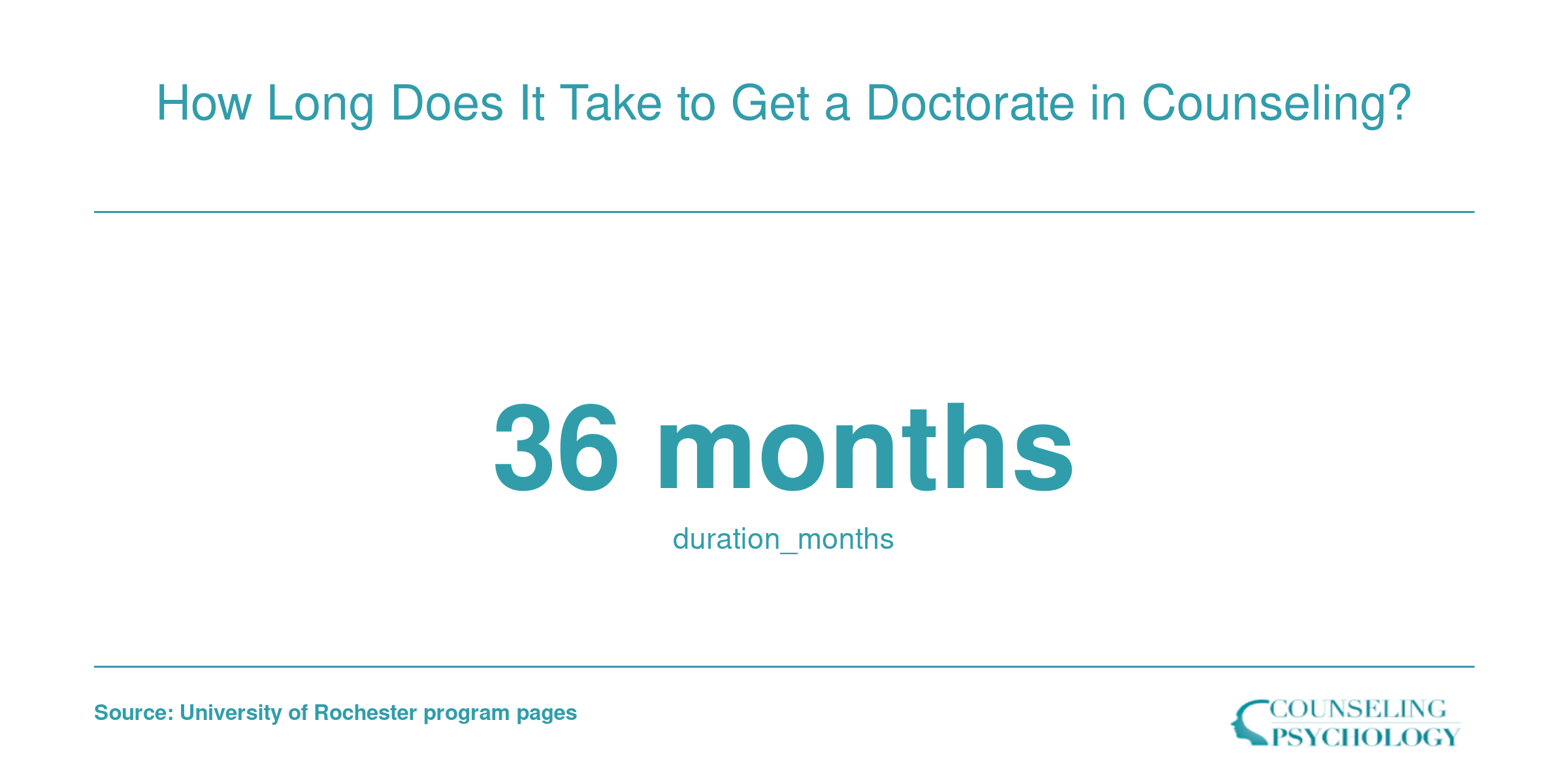
How Long Does It Take to Get a Doctorate in Counseling?
Career Outcomes and Earning Potential After a Counseling Doctorate
The median earnings of graduates from the University of Rochester reach $79,042 a decade after entering the institution, according to federal data. Other New York institutions with doctoral programs in counseling-related fields report similar or higher medians: Cornell University ($104,043), Columbia University ($102,491), and Syracuse University ($79,164). While these figures reflect all graduates, not just counseling doctorate completers, they signal the earning power a research-focused doctorate can unlock in this region.
Earnings at a Glance for Doctoral Graduates
Program-level earnings data at one, two, and four years after completion is not yet reported for these schools, so institutional medians offer the clearest available benchmark. Graduates who move into licensed clinical roles, faculty positions, or private practice often see increases as they build postdoctoral experience. Short-term employment share and poverty-rate metrics are also not published at the program level, making direct comparisons difficult. Nevertheless, the median debt at graduation remains manageable: University of Rochester graduates carry a median of $21,000 in federal loans, with many programs offering assistantships that offset costs.
National Salary Ranges for Key Counseling Roles
Nationally, the Bureau of Labor Statistics places the median annual wage for mental health counselors at $59,190 (2024), while substance abuse and behavioral disorder counselors earn $53,710 (2023).12 Clinical psychologists, who often complete a Ph.D. or Psy.D., command higher medians, particularly in healthcare systems and private practice. For a deeper breakdown by degree level and specialty, our counselor salary guide covers the full range. The field is expanding quickly, with a projected 17% growth rate for substance abuse and mental health counselors from 2024 to 2034.3 In New York State, wages tend to run above the national average, especially in metropolitan regions like Rochester, where employer demand stretches across hospitals, community agencies, and school districts.
Career Options with a Counseling Doctorate
A doctorate in counseling opens doors beyond direct client care. Many graduates move into roles as licensed clinical supervisors, overseeing counseling master's programs online graduates and other master's-level clinicians while shaping treatment programs. University faculty positions allow them to train the next generation of counselors while conducting research. Private practice ownership grants autonomy and higher earning potential, and leadership positions in community mental health centers or integrated care systems leverage the doctoral credential for program design and grant administration. The CACREP-accredited Ph.D. in Counseling at the University of Rochester's Warner School, for instance, emphasizes counselor education and supervision, preparing students for academic and leadership tracks.
Sustained Demand in the Rochester Region
The Rochester-Finger Lakes area has long been designated as a mental health professional shortage region by the Health Resources and Services Administration. This persistent gap means that doctoral-level practitioners who can supervise, train, and fill specialized clinical roles are especially valued. Local hospital networks, private practices, and school systems compete for advanced credentials, and many graduates from the area's counseling programs stay to meet that need. A doctorate not only deepens clinical expertise but also positions professionals to advocate for systemic improvements in mental health access, making the investment resonate personally and communally.
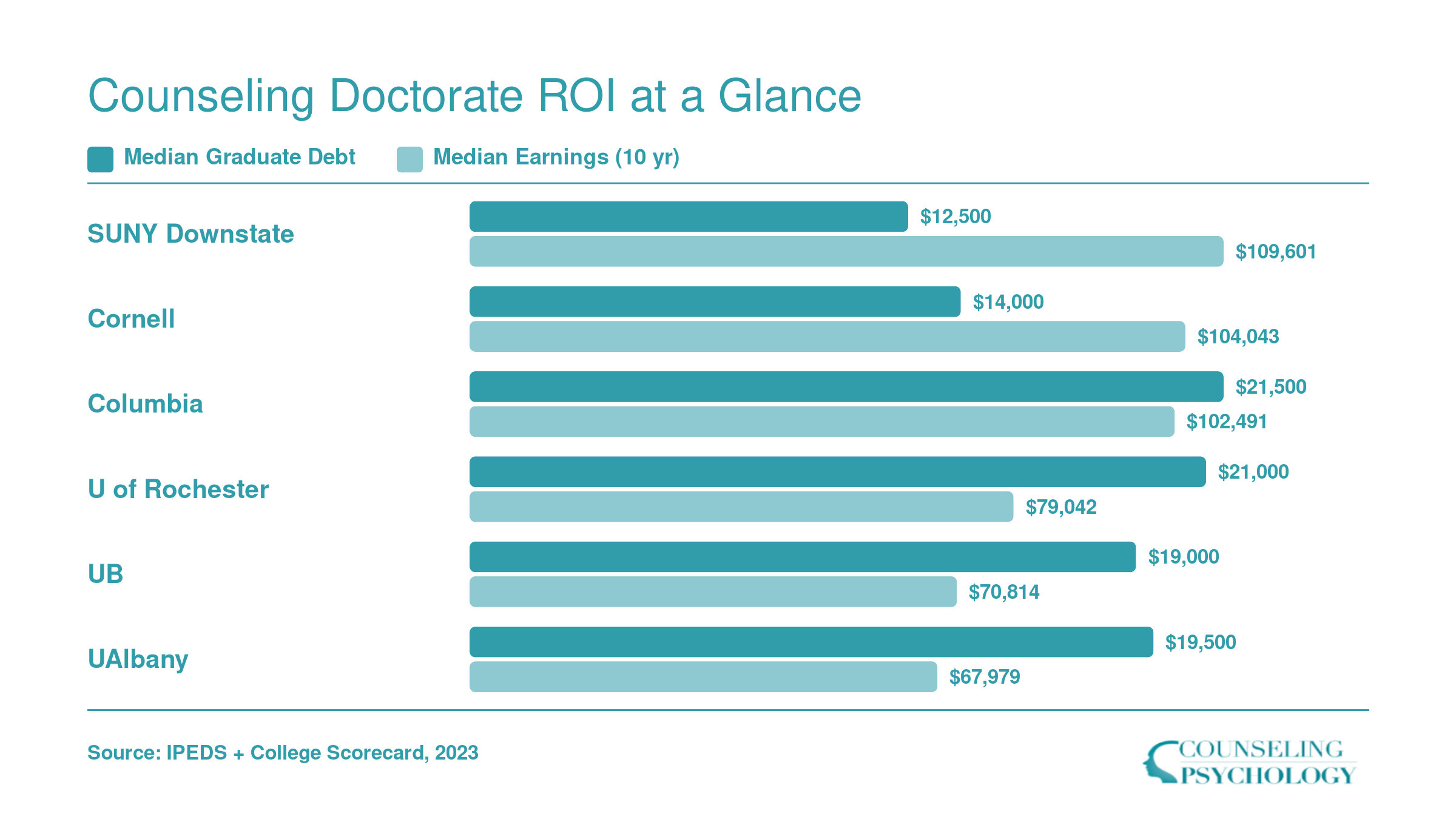
Counseling Doctorate ROI at a Glance
How far do your post-graduation earnings stretch relative to the debt you carry? The chart below ranks six New York doctoral programs by their earnings-to-debt ratio, comparing median graduate debt against institution-wide median earnings ten years after enrollment. Program-level earnings shortly after completion are not yet published for these programs, so the institution-level figures offer the best available benchmark.
New York Licensure Requirements for Doctoral-Level Counselors
New York requires a minimum of 60 graduate semester hours from a qualifying program to sit for the Licensed Mental Health Counselor (LMHC) credential, a threshold that every doctoral counseling program in the state exceeds.1 Understanding the full licensure pathway before you enroll can save you years of misaligned coursework and supervision planning.
LMHC Requirements at a Glance
The New York State Education Department (NYSED) Office of the Professions sets several requirements for the LMHC:1
- Degree: A graduate degree of at least 60 credit hours from a CACREP-accredited clinical mental health counseling program, a NYSED-registered program, or a substantially equivalent program.
- Supervised practicum: 600 clock hours of practicum or internship completed during the degree.
- Post-degree supervision: 3,000 hours of supervised experience after graduation, including at least 1,500 hours of direct client contact, with supervision occurring at a minimum of one hour per week.
- Exam: A passing score on the National Clinical Mental Health Counseling Examination (NCMHCE).
- Additional requirements: Applicants must be at least 21 years old, complete mandated child-abuse-recognition training, and meet character and fitness standards.
Once licensed, LMHCs renew every three years and must complete 36 continuing-education hours per renewal cycle.2
Does a Doctoral Degree Change the Supervision Timeline?
A common misconception is that holding a Ph.D., Ed.D., or other doctoral credential shortens the post-degree supervised-experience requirement. In New York, it does not.1 NYSED treats the LMHC as a single-tier license: doctoral graduates must still accumulate the full 3,000 supervised hours and pass the NCMHCE, just like master's-level applicants. Practicum and internship hours completed during the doctoral program do count toward the 600-hour in-program requirement, but the post-degree clock starts only after the degree is conferred.
That said, many doctoral students accumulate substantial clinical hours through assistantships and practica that can overlap with supervision requirements if properly documented. Work closely with your program's clinical training director to ensure every eligible hour is captured.
The Licensed Psychologist (LP) Pathway
Graduates who earn a Psy.D. or a Ph.D. in counseling psychology (or a closely related field) may instead pursue licensure as a Licensed Psychologist through NYSED. For a broader look at this career path, see our guide on how to become a psychologist. The LP pathway requires a doctoral degree, completion of an approved internship, additional post-doctoral supervised experience, and a passing score on the Examination for Professional Practice in Psychology (EPPP). This route opens different scope-of-practice privileges, including psychological testing and assessment, which LMHCs cannot perform independently. The LP credential may be a better fit if your career goals center on assessment, forensic work, or academic medical settings.
Reciprocity and Interstate Mobility
If you anticipate practicing outside New York at some point, accreditation matters enormously. Graduating from a CACREP-accredited doctoral program simplifies licensure transfer to other states, because most state boards recognize CACREP accreditation as meeting their educational standards. Our counseling licensure overview breaks down how requirements vary from state to state. States that have adopted the CACREP-aligned national portability model can process endorsement applications faster, with fewer course-by-course evaluations. Similarly, APA-accredited doctoral programs in counseling psychology are widely recognized for the LP pathway across state lines.
Planning for licensure portability at the program-selection stage is far easier than retrofitting credentials after graduation. If there is any chance you will relocate, prioritize nationally accredited programs from the outset.
Monroe County and adjacent Finger Lakes counties are all designated as Mental Health Professional Shortage Areas by HRSA, reflecting a critical need for advanced practitioners. Earning your doctorate here puts you in a prime position for rapid job placement and access to loan repayment programs through New York’s Primary Care Service Corps and federal NHSC initiatives.
Is It Worth Getting a Doctorate in Counseling?
A doctoral degree in counseling opens doors that a master's degree simply cannot, but it also demands years of additional training and a significant financial commitment. The answer depends on how you plan to use the credential and whether the long-term payoff aligns with your career goals.
Pros
- Higher earning ceiling over time: institution-level median earnings ten years after enrollment at nearby New York doctoral programs range from roughly $79,000 to over $109,000, reflecting the financial upside of advanced training.
- Authority to supervise other licensed clinicians, a role that master's-level practitioners generally cannot fill under New York regulations.
- Eligibility for tenure-track faculty and counselor education positions, which almost universally require a doctoral degree and CACREP-accredited training.
- Deeper clinical expertise through extended practicum, internship, and dissertation research, giving you specialized skills that set you apart in private practice or agency leadership.
- Stronger positioning for program director, department chair, and policy advocacy roles within behavioral health organizations.
Cons
- Time commitment of four to six years beyond the master's degree, during which peers with master's credentials are already earning clinical income and accumulating experience.
- Significant debt burden: median graduate debt at New York doctoral institutions in this field ranges from roughly $12,500 to $26,000, and actual totals can be considerably higher once living expenses are factored in.
- Opportunity cost is real. A master's-level licensed counselor can begin full-time practice years earlier, and many direct clinical roles do not require or reward a doctorate with meaningfully higher pay.
- Intensive dissertation and research requirements may not appeal to students whose primary goal is client-facing clinical work rather than scholarship or teaching.
- Funding is not guaranteed at every program; students without assistantships or scholarships may need to take on loans or work part-time, extending their timeline further.
Common Questions About Counseling Doctorates Near Rochester
Prospective doctoral students often share a similar set of concerns about timelines, costs, and whether an advanced degree is truly necessary. Below are answers to the questions we hear most frequently from candidates exploring counseling doctorates in the Rochester, New York area.