

What you’ll learn in this article…
- Georgia has only four I-O psychology programs, spanning Georgia Tech's PhD and three master's options at UGA, Valdosta State, and Wesleyan College.
- Georgia Tech's doctoral I-O track delivers roughly a 4.7 to 1 earnings to debt ratio, the highest among the state's programs.
- Valdosta State offers Georgia's only fully online I-O master's degree, while UGA uses a weekend cohort format.
- Only doctoral graduates may use the title "psychologist" in Georgia; master's level practitioners work under titles like I-O consultant.
Georgia is home to more than a dozen Fortune 500 headquarters, from Home Depot and UPS to Delta Air Lines, and the consulting firms that orbit them constantly need professionals who can apply behavioral science to workforce problems. That demand makes the state a natural fit for industrial organizational psychology degree online programs, yet only four institutions currently offer dedicated I-O graduate options, spanning master's through doctoral levels and covering online, hybrid, and on-campus formats.
The limited supply creates a real tension: fewer programs mean less competition for practicum placements and faculty attention, but it also means fewer chances to find the right cost, format, and credential level for your career goals. Georgia Tech's PhD track remains the state's only doctoral option, while UGA, Valdosta State, and Wesleyan College divide the master's market with notably different price points and delivery models.
Best I-O Psychology Programs in Georgia: Rankings Overview
Georgia offers a small but well-differentiated set of industrial-organizational psychology programs spanning master's and doctoral levels. Whether you want a weekend-format professional master's, a fully online degree, or a research-intensive PhD, the four institutions below cover the spectrum. Program-level earnings and debt figures are not yet reported for these I-O programs in federal datasets, so the institutional data points below provide the best available context for comparing costs and outcomes.
- Tuition and net price
- Institutional graduation and retention rates
- Graduate median earnings
- Program format and accessibility
- Completion and debt outcomes
- Internal program database
- NCES-IPEDS federal institutional data — nces.ed.gov
- Independent program research
- College Scorecard graduate earnings — collegescorecard.ed.gov

University of Georgia
The University of Georgia pairs a practitioner-oriented professional master's with a research-driven doctoral program, giving students two distinct pathways into I-O psychology under one department. The master's is delivered at UGA's Gwinnett Campus in Lawrenceville through weekend sessions built around working professionals' schedules, while the PhD follows a traditional on-campus scientist-practitioner model in Athens. With an institution-wide graduation rate of roughly 90% and median graduate debt of $18,500, UGA offers strong outcomes at a competitive public-university price point.
- Two-year hybrid master's at UGA's Gwinnett Campus in Lawrenceville
- Five weekend class sessions per semester for schedule flexibility
- Practitioner-focused curriculum in analytics and leadership
- Collaborative cohort model designed for full-time professionals
- Priority application deadline for Fall 2026 is April 5
- In-state tuition approximately $11,002 per year
- On-campus PhD following a scientist-practitioner training model
- Interdisciplinary curriculum with concentration options available
- Prepares graduates for academic, consulting, and corporate roles
- Emphasis on research methodology and applied social psychology
- Located at UGA's main Athens campus
- Strong faculty mentorship with 17:1 student-to-faculty ratio
Professional Master's Program in Industrial-Organizational Psychology — Hybrid
Industrial-Organizational Doctoral Program — On-Campus

Georgia Institute of Technology
Georgia Tech's PhD program in psychology with an I-O specialization sits inside one of the nation's top research universities, giving doctoral students access to exceptional quantitative and methodological training. The program emphasizes personnel selection, organizational motivation, and job design, preparing graduates for high-impact careers in academia, consulting, and corporate R&D. Georgia Tech's institution-wide graduation rate of 94% and median earnings of $102,772 ten years after enrollment reflect the caliber of the broader university, though those figures span all fields, not I-O specifically.
- Full-time, on-campus doctoral program in Atlanta
- Nationally recognized for research methodology training
- Covers personnel selection, motivation, and job design
- Prepares students for academic and applied research positions
- In-state tuition approximately $15,962 per year
- Institution-wide 98% first-year retention rate
- Median graduate debt of $21,672 across all programs
Doctor of Philosophy with a Major in Psychology, Industrial/Organizational Specialization — On-Campus

Wesleyan College
Wesleyan College in Macon offers a fast-track Master of Industrial-Organizational Psychology that can be completed in roughly 18 months. The hybrid format pairs online coursework with on-campus sessions in the evening, making it accessible to professionals balancing work and study. As a private, women's college with an 8:1 student-to-faculty ratio, Wesleyan provides a more individualized learning environment, with coursework emphasizing workplace justice, diversity education, and strategic human resources.
- 18-month accelerated hybrid program in Macon
- Evening classes structured for working professionals
- Curriculum emphasizes workplace justice and inclusion
- 8:1 student-to-faculty ratio for personalized mentorship
- Private college tuition of $11,573 per year
- Diverse career preparation spanning consulting, HR, and nonprofits
Master of Industrial-Organizational Psychology — Hybrid

Valdosta State University
Valdosta State University stands out for affordability and flexibility, offering both a fully online 36-credit-hour master's and a more intensive 60-credit-hour on-campus option in I-O psychology. The online track is among the most budget-friendly in the state at roughly $6,316 per year for Georgia residents. VSU's program has been recognized as the 19th-ranked master's-level I-O psychology program nationally, and students can gain hands-on experience through the university's Azalea Consulting group.
- Fully online format with 36 total credit hours
- Lowest in-state tuition among Georgia I-O programs at roughly $6,316
- Faculty who are active researchers and practitioners
- Interdisciplinary curriculum focused on workplace psychology
- Requires minimum 3.0 undergraduate GPA and 15 psychology credits
- No summer semester admission available
- Traditional campus format with 60 total credit hours
- On-site practicum experiences for applied training
- Optional master's thesis pathway
- Involvement in Azalea Consulting student group
- Interdisciplinary course options across departments
- Strong job placement record reported by the university
Master of Science in Industrial/Organizational Psychology (Online) — Online
Master of Science in Industrial/Organizational Psychology (On-Campus) — Online
Tuition, Financial Aid, and ROI for Georgia I-O Degrees
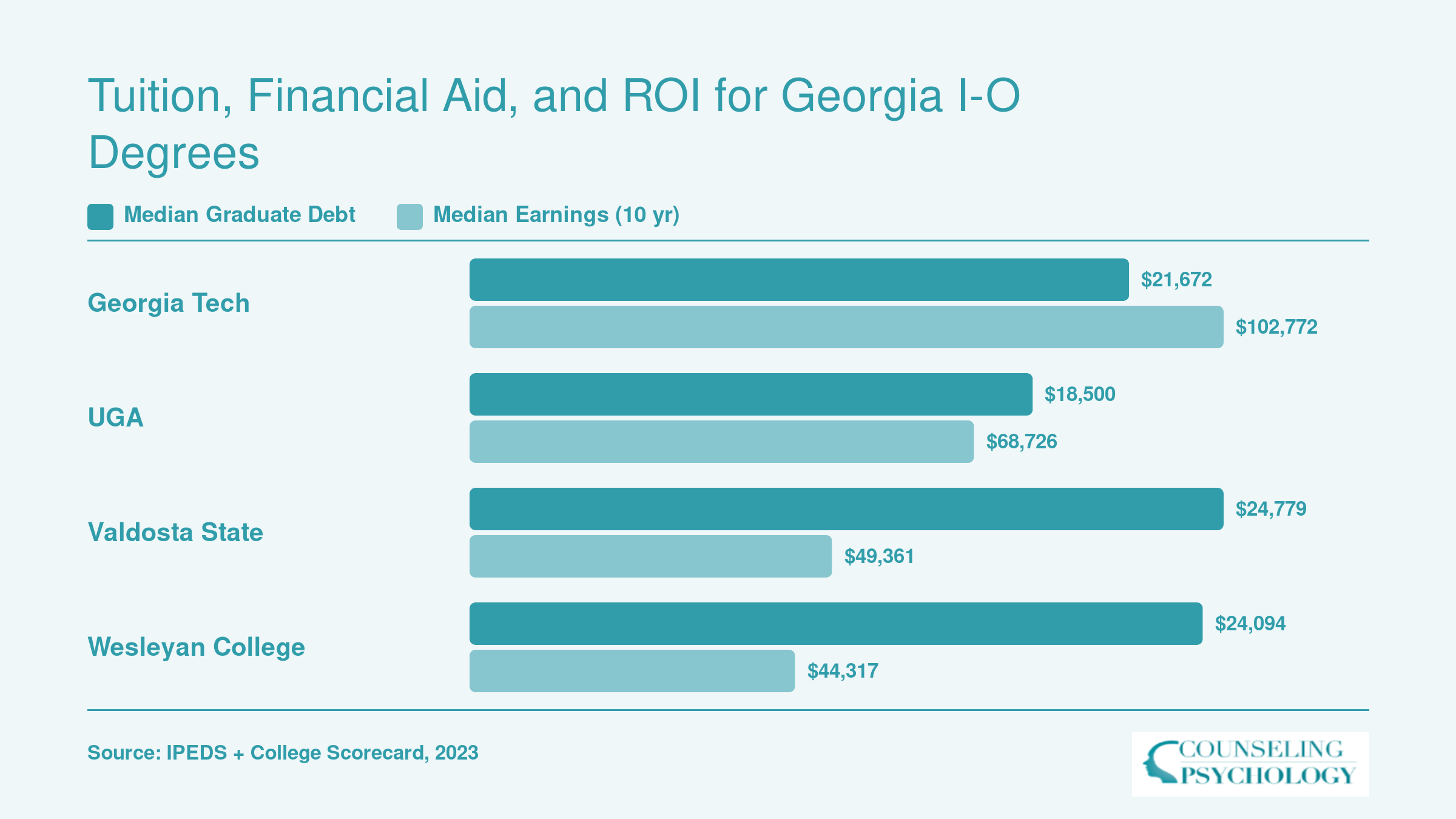
Tuition is only one piece of the equation. When you stack median graduate debt against institution-level earnings ten years after enrollment, Georgia Tech's doctoral I-O track stands out with a roughly 4.7-to-1 earnings-to-debt ratio. UGA's professional master's follows at about 3.7-to-1. Valdosta State and Wesleyan College carry higher median debt relative to their institutional earnings benchmarks, so financial aid packages and assistantship offers deserve close scrutiny at those schools. Note that program-level earnings are not yet available for these I-O programs specifically; the figures below reflect each institution's overall median graduate debt and median earnings ten years after enrollment.
Admission Requirements Compared Across Georgia I-O Programs
Admissions for industrial organizational psychology graduate programs have shifted considerably since 2020, with test-optional policies and holistic review approaches now the norm at many institutions. Georgia's handful of I-O programs each set their own bar, but a clear pattern emerges: doctoral admission is a rigorous, research-focused gauntlet, while the master's path offers a more course-driven entry point. Below we compare the key requirements side by side so you can target your preparation.
Admission Matrix at a Glance
- University of Georgia (PhD): UGA's I-O doctoral program is not admitting students for the 2026 academic year, but its historical requirements give a sense of the typical bar.1 A minimum undergraduate GPA of 3.2 was recommended, and the GRE was required with a preferred combined score of 308. Three letters of recommendation, a statement of purpose, and a curriculum vitae were part of the application. Work experience was not required, though relevant professional or research background was considered favorably. The deadline was December 1.1
- Georgia Tech (PhD): Georgia Tech's I-O PhD emphasizes research fit above all.2 The program does not publish a formal GPA cutoff, and GRE scores are not required for the 2025-2026 admissions cycle, reflecting a permanent test-optional shift. Applicants must submit three letters of recommendation, a statement of purpose, and a résumé or CV. Prior research experience, especially with a faculty mentor, carries more weight than work history. The application deadline is December 1.3
- Valdosta State University (MS): This master's program requires a bachelor's degree in psychology or a closely related field, with at least 15 credit hours completed in specific psychology coursework: general psychology, experimental psychology, and statistics. No GRE or fixed GPA minimum is published, though successful candidates often present an undergraduate GPA of 3.0 or higher. Letters of recommendation are typically requested but not strictly mandated. The program welcomes applicants with relevant work or volunteer experience, but it is not a prerequisite.
Application Deadlines and Timing
Both Atlanta-area doctoral programs set a December 1 cutoff for fall admission. Because UGA's program is on hiatus for 2026, applicants targeting a fall start should focus on Georgia Tech's December 1 timeline.3 Valdosta State uses rolling admissions; priority is given to files received by early spring. Regardless of the program, starting your application materials at least six months in advance leaves room for GRE prep (if needed), securing strong letters, and refining your personal statement.
How to Strengthen Your Application
- If your GPA is below the typical threshold: Use your statement of purpose to explain any upward trends or extenuating circumstances. Highlight exceptional performance in psychology and statistics courses, and consider enrolling in a post-baccalaureate or graduate certificate course to demonstrate recent academic strength.
- If the GRE is required (or recommended): Aim for scores that meet or exceed the program's preferred benchmarks. For UGA's historical standard, that meant a combined verbal and quantitative score of 308. Invest in a structured prep plan and take the exam early enough to retake it if necessary.
- If research experience is thin: Seek out volunteer research assistant roles in a psychology lab, even if only for a semester. For PhD applicants, a clear statement of research interests that aligns with a faculty member's active projects is often the single most influential component.
- Letters of recommendation: Choose recommenders who can speak to your academic or research abilities, not just your work ethic. Provide them with a brief reminder of your accomplishments and deadlines to ensure timely, supportive letters.
- Prerequisite gaps: Master's applicants missing required coursework (such as statistics) can complete those classes at a community college or through online, accredited providers before applying to Valdosta State.
Questions to Ask Yourself
Online, Hybrid, and On-Campus I-O Programs in Georgia
Georgia's I-O psychology programs span three distinct delivery formats, so matching the right modality to your schedule and learning style is a practical first step. Here is how each institution structures its program.
Valdosta State: Georgia's Fully Online I-O Master's
If you are searching for an online industrial organizational psychology master's in Georgia, Valdosta State University is the primary option. The M.S. in Industrial-Organizational Psychology is delivered entirely online through a structured, cohort-based format across 36 credit hours.1 No campus residency is required at any point in the program. A three-credit practicum is completed on-site at an approved organization, which means you arrange fieldwork near your own location rather than traveling to Valdosta.2
The program does not currently specify whether coursework is synchronous or asynchronous, so prospective students should confirm scheduling details directly with the department.2 That said, the cohort model means you move through courses on a set timeline alongside the same group of peers, which tends to create built-in accountability and networking even in a virtual setting. For working professionals juggling a full-time job, this format removes geography as a barrier while still keeping you on a predictable graduation track.
University of Georgia: Hybrid Delivery on the Gwinnett Campus
UGA's Professional Master's Program in I-O Psychology follows a hybrid model designed around working adults. Classes are held on weekend schedules at the university's Gwinnett Campus, located in the metro Atlanta area rather than the main Athens campus. This setup blends face-to-face instruction with online components, giving students direct interaction with faculty and classmates without requiring a Monday-through-Friday commute. The two-year, practitioner-focused curriculum makes it a strong middle ground for people who want some in-person engagement but cannot commit to a traditional full-time residential schedule.
Wesleyan College: Fast-Track Hybrid in Macon
Wesleyan College in Macon offers an 18-month hybrid master's program that combines online coursework with evening on-campus sessions. The format is explicitly geared toward professionals who need flexibility but still benefit from periodic classroom time.
Georgia Tech: Full-Time On-Campus Doctoral Program
Georgia Tech's Ph.D. in Psychology with an I-O specialization is a traditional on-campus program based in Atlanta. It is research-intensive and structured for full-time doctoral students, with no online or hybrid option. For a broader look at how this program compares nationally, see our guide to industrial organizational psychology Ph.D. programs. Expect to be embedded in labs, seminars, and research teams throughout your time in the program.
What Online I-O Students Should Expect
Online delivery in I-O psychology still involves meaningful applied work. You will likely complete practicum hours at a local organization, participate in group projects built around real workplace problems, and engage with faculty during structured office hours or virtual meetings. The flexibility is genuine, but the workload mirrors what on-campus students face. Budget time accordingly, especially if you are balancing the degree with a full-time role.
Master's vs. Doctoral I-O Programs: Choosing the Right Level
Georgia's I-O psychology landscape splits cleanly by degree level. Three schools offer master's programs (University of Georgia, Valdosta State University, and Wesleyan College), while Georgia Tech is the state's sole doctoral option with its PhD specialization in Industrial/Organizational Psychology. Understanding what each level unlocks, and what it costs, is essential before you commit.
| Dimension | Master's (MS or MA) | Doctorate (PhD) |
|---|---|---|
| Typical Duration | 1.5 to 2 years (Wesleyan College's fast-track finishes in about 18 months; UGA's professional master's runs two years) | 4 to 6 years, including dissertation research (Georgia Tech's program follows a traditional research-intensive timeline) |
| Georgia Schools Offering | University of Georgia (hybrid, Gwinnett Campus), Valdosta State University (fully online), Wesleyan College (hybrid, Macon) | Georgia Institute of Technology (on-campus, Atlanta) |
| In-State Tuition (Annual) | Ranges from roughly $6,316 (Valdosta State) to $11,573 (Wesleyan College) to $11,002 (UGA) | Approximately $15,962 at Georgia Tech, though many PhD students receive assistantships that offset costs |
| Typical Career Roles | Talent management specialist, organizational development consultant, HR analytics manager, employee engagement lead, compensation analyst | University professor, senior research scientist, director-level consulting roles, psychometrician, policy researcher |
| Research Emphasis | Applied and practitioner-focused; coursework centers on workplace problem-solving with a capstone or practicum rather than a dissertation | Heavy original research emphasis; students publish, present at conferences, and complete a dissertation |
| Salary Ceiling | Master's holders typically reach mid-career salaries in the $80,000 to $120,000 range in applied roles, depending on industry and location | PhD holders can command $130,000 or more in senior consulting or academic positions; Georgia Tech's institution-wide median earnings 10 years after enrollment sit at $102,772 |
| Licensure Eligibility | Most applied I-O roles do not require licensure; Georgia does not license master's-level I-O psychologists as 'psychologists' | A doctorate is required to use the title 'psychologist' in Georgia; licensure through the Georgia Board of Examiners of Psychologists demands a doctoral degree plus supervised experience |
| Debt Considerations | Lower total program cost; shorter time out of the workforce means faster ROI for practitioners entering talent management or consulting | Longer time to degree increases opportunity cost, but funded PhD positions and higher long-term earnings can offset that over a career |
Career Outcomes and Salary Expectations in Georgia
Industrial-organizational psychologists working in Georgia command salaries that reflect the state's position as a major corporate hub, though specific program-level earnings data for Georgia I-O graduates is not yet published by federal sources.
What I-O Psychologists Earn in Georgia
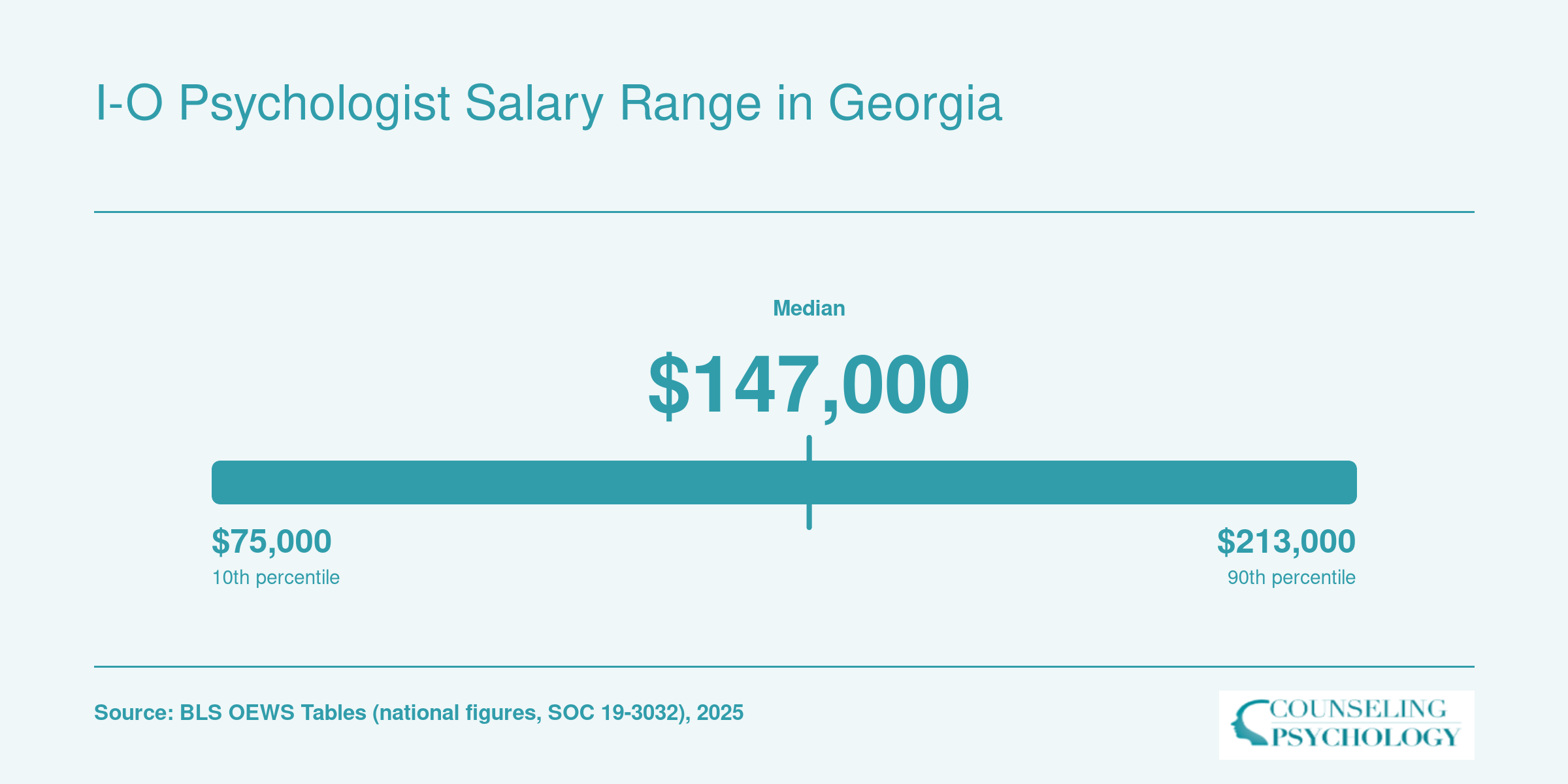
Nationally, industrial-organizational psychologists earned a median annual wage of $147,420 in 2023 according to Bureau of Labor Statistics data.1 The salary range is substantial: those at the 10th percentile earned approximately $45,860, while top earners at the 90th percentile brought in $219,810.1 State-specific wage data for Georgia I-O psychologists is limited due to the relatively small number of practitioners in this specialized field (just over 1,000 I-O psychologists are employed nationally), but metro Atlanta's concentration of Fortune 500 headquarters suggests competitive local compensation.
To answer a common question directly: How much does an industrial organizational psychologist make in Georgia? While precise state-level BLS figures are not published for this occupation due to sample size constraints, I-O professionals in the Atlanta metro area typically earn within the national range, with salaries varying based on employer type, years of experience, and whether the role focuses on consulting, corporate HR analytics, or talent management.
Major Employers in the Atlanta Area
Atlanta's corporate landscape creates strong demand for I-O expertise. Several categories of employers actively recruit graduates:
- Fortune 500 headquarters: Home Depot, UPS, Cox Enterprises, and Delta Air Lines maintain internal organizational development and talent analytics teams that value I-O training.
- Global consulting firms: Korn Ferry, Deloitte, and McKinsey all have Atlanta offices with practices in human capital, leadership assessment, and organizational effectiveness.
- Healthcare systems: Emory Healthcare and Wellstar Health System employ organizational psychologists to address workforce engagement and operational efficiency.
Practicum Pipelines and Career Launch Advantages
Georgia's I-O programs leverage these employer relationships to benefit students. Georgia Tech's doctoral program connects students with research collaborations at major corporations, while UGA's professional master's program at the Gwinnett Campus deliberately situates itself near Atlanta's business corridor to facilitate practicum placements. Valdosta State and Wesleyan College encourage applied projects with regional employers, giving students portfolio-ready experience before graduation. For those still exploring the broader landscape of I-O psychology master's programs, understanding how Georgia's options compare nationally can sharpen your decision.
These internship and practicum pipelines often convert into full-time offers, particularly at consulting firms that use graduate-level project work as an extended interview. Students who secure placements at firms like Korn Ferry or internal roles at companies like Home Depot frequently transition into permanent positions upon completing their degrees. The field's blend of research rigor and business application positions graduates for careers that span applied psychology careers and corporate strategy alike.
I-O Psychologist Salary Range in Georgia
Precise Georgia-specific salary percentiles for industrial-organizational psychologists (SOC 19-3032) are not consistently published by the BLS due to small sample sizes in many states. To build a complete picture, search the BLS Occupational Employment and Wage Statistics tool for code 19-3032 and filter by Georgia, check the Georgia Department of Labor's occupational wage reports, review the SIOP Salary Survey for regional breakdowns, and compare real-time postings on Glassdoor, Indeed, and LinkedIn filtered to Georgia and your experience level.
How to Become an Industrial-Organizational Psychologist in Georgia
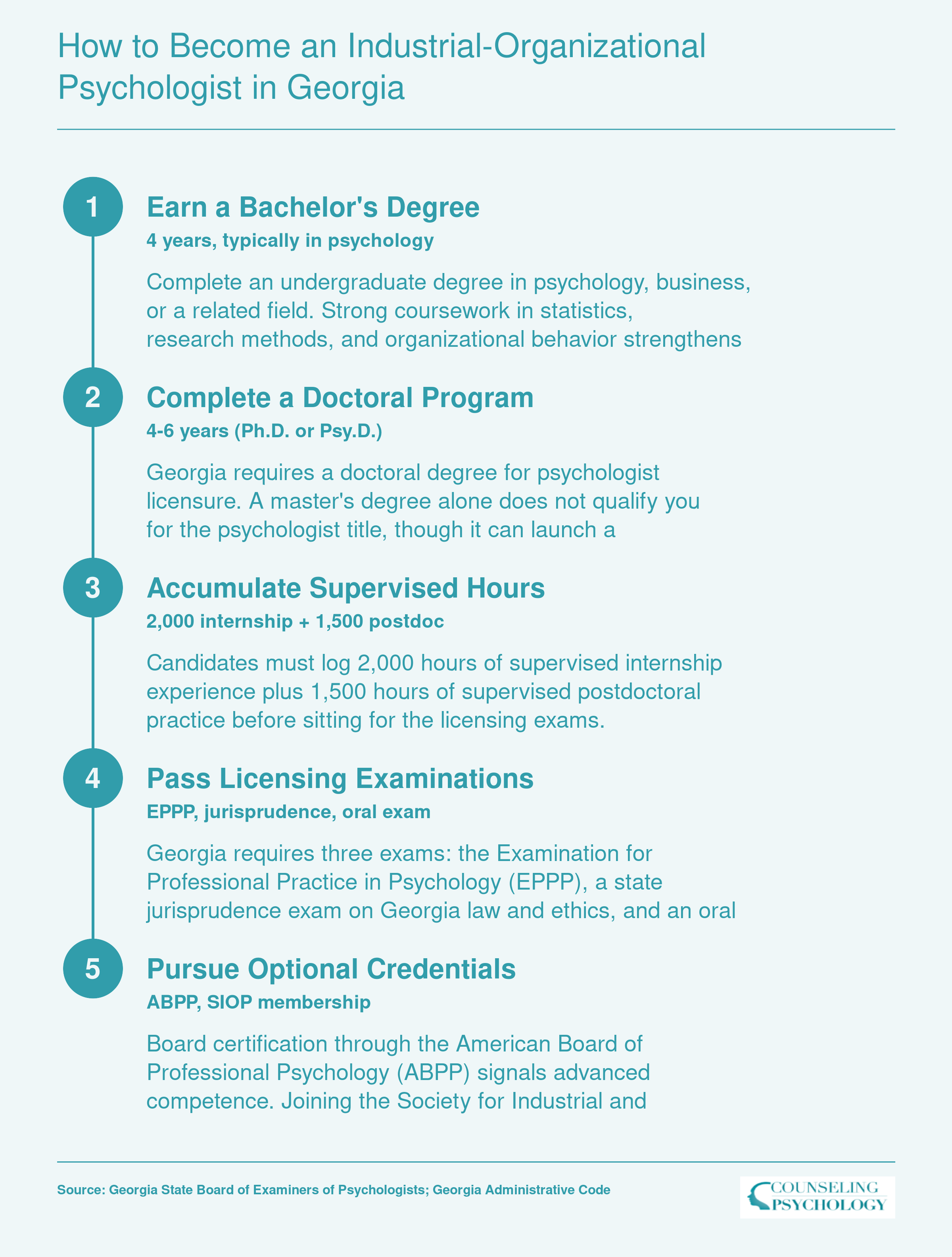
Georgia protects the title "psychologist," so only doctoral-level professionals licensed through the Georgia State Board of Examiners of Psychologists may use it. Master's-level I-O practitioners can work in the field under alternative titles such as I-O consultant, organizational consultant, or HR analytics specialist, and they generally do not need state licensure. The pathway below outlines the full doctoral credentialing route for those who want to practice as a licensed I-O psychologist in the state.
Georgia’s handful of I-O programs means you’ll face less competition for practicum slots and build closer relationships with local employers. Atlanta’s dense corporate landscape, packed with Fortune 500 headquarters, gives graduates a job market edge over many other regions.
Frequently Asked Questions About I-O Psychology in Georgia
These are some of the most common questions prospective students ask about industrial-organizational psychology programs in Georgia. Each answer draws on current data and program details to help you make a well-informed decision.