
What you’ll learn in this article…
- Total tuition for ABA master's programs near New Haven ranges from roughly $26,000 to $55,000.
- New BCBAs in Connecticut typically earn between $55,000 and $65,000 in their first year.
- The BACB publishes annual exam pass rates by university, making program comparison straightforward.
- ABAI accreditation and a BACB verified course sequence are not the same credential.
Connecticut ranks among the fastest-growing states for BCBA demand, with job postings for behavior analysts increasing by more than 30 percent between 2023 and 2025. New Haven anchors the state's ABA education corridor, placing students within commuting distance of three BACB-aligned master's programs and a dense network of clinical practicum sites across Yale-affiliated hospitals, public school districts, and private ABA providers.
The field is competitive but small. Only three institutions within an hour of New Haven offer coursework verified by the Behavior Analyst Certification Board, and each uses a different delivery model: fully online, hybrid evening, and traditional on-campus. Tuition spans a wide range, from under $15,000 at public universities to more than $50,000 at private institutions, yet BCBA exam pass rates and graduate earnings remain tightly clustered.
Most students enter these programs already working as registered behavior technicians or paraprofessionals, so flexibility and supervised fieldwork access matter as much as classroom rigor. Connecticut does not require a separate state license for BCBAs, but practicum placement and exam preparation timelines still shape how quickly you can move from enrollment to independent practice.
Top ABA Master's Programs Near New Haven, CT
Connecticut offers a small but strong set of master's programs in applied behavior analysis within easy reach of New Haven. Each takes a different approach to format, pacing, and specialization, so the right fit depends on whether you prioritize online flexibility, local hybrid coursework, or an on-campus experience with an autism concentration. Below are the top programs ranked for 2026, with tuition figures drawn from federal IPEDS data.
- BCBA exam preparation alignment
- Tuition and net price affordability
- Delivery format and flexibility
- Institutional graduation and retention rates
- Regional relevance to New Haven
- Independent program research
- NCES-IPEDS federal institutional data — nces.ed.gov
- College Scorecard graduate earnings — collegescorecard.ed.gov
- Internal program database

Southern Connecticut State University
Located directly in New Haven, Southern Connecticut State University places ABA students at the center of the region's school districts, clinics, and service agencies. The hybrid M.S. program is housed in the Department of Inclusive Education and Behavior Science, giving it a strong orientation toward special educators, school psychologists, and related professionals already working in Connecticut classrooms. SCSU also offers a sixth-year diploma and a graduate certificate in ABA for candidates who hold advanced degrees and simply need the BACB-aligned coursework.
- Hybrid format blending online coursework with on-campus sessions
- 30-credit curriculum with cohort-based admissions every three semesters
- Core courses in single-subject research methods and principles of ABA
- Elective fieldwork options in local educational and therapeutic settings
- No GRE required; 3.0 cumulative GPA needed to graduate
- Covers organizational behavior management and ethical practice
- In-state tuition approximately $14,930 per year (IPEDS)
Applied Behavior Analysis, M.S. — Hybrid

Western Connecticut State University
Western Connecticut State University delivers its 30-credit M.S. in Applied Behavior Analysis entirely online, making it accessible to students across the New Haven area without a commute to the Danbury campus. The program runs on an accelerated cohort timeline of roughly 16 months, and its curriculum goes beyond standard BCBA preparation with coursework in grant writing and applied technology. Multiple national ranking outlets have recognized the program among the strongest online ABA degrees in the country.
- Fully online, asynchronous format completed in about 16 months
- 30-credit BACB-aligned curriculum with cohort progression
- Includes coursework in grant writing and relevant technology
- Capstone project synthesizing research and field application
- Admission requires a 2.8 GPA; no GRE needed
- In-state tuition approximately $15,039 per year (IPEDS)
- Out-of-state tuition approximately $19,397 per year (IPEDS)
- Comprehensive exam required for degree completion
Master of Science in Applied Behavior Analysis — Online

University of Saint Joseph
The University of Saint Joseph in West Hartford offers both a general M.S. in Applied Behavior Analysis and a specialized M.S. in Autism and Applied Behavior Analysis, giving candidates the option to build deep expertise in autism spectrum disorders. The campus-based format features small cohorts with a 10:1 student-to-faculty ratio, and students can choose between two-year and three-year completion tracks. USJ holds the highest institution-wide graduation rate among the three Connecticut programs listed here, at roughly 64% (note: this figure reflects all undergraduates at the university, not the ABA program specifically).
- Campus-based program with ABAI-verified course sequence
- Prepares graduates for the BCBA certification examination
- Two-year or three-year completion tracks available
- Curriculum covers behavior assessment, intervention, and ethics
- Admission requires 3.0 GPA, recommendations, and personal essay
- Capstone project integrating research methods and practice
- Tuition is $17,604 per year for all students (IPEDS)
- Dedicated autism concentration within BACB-approved curriculum
- Hands-on learning with emphasis on autism spectrum disorders
- Fall and spring entry options for scheduling flexibility
- Graduate assistantships available to offset costs
- Ethical and professional training woven throughout coursework
- Letter of intent and recommendation letters required
Applied Behavior Analysis, M.S. — On-Campus
Master of Science in Autism and Applied Behavior Analysis — On-Campus
How We Ranked These ABA Programs
Rankings that do not show their work are not rankings at all. Every program on this list was evaluated against a defined set of criteria, and the reasoning behind each placement is explained below so you can weigh the factors that matter most to your situation.
What the Data Covers
Four primary factors shaped the rankings:
- Tuition and total cost: Published per-credit and program-total figures, including fees where reported, with attention to whether in-state, out-of-state, or flat-rate pricing applies to distance learners.
- Graduate earnings and debt: Where available, post-enrollment earnings and typical borrowing figures come from the federal College Scorecard, which reports institution-level outcomes. These are useful reference points, not precise guarantees for any specific program.
- Graduation rates: Completion data drawn from IPEDS reflects the institution as a whole. A school with a strong overall graduation rate creates a reasonable inference about student support infrastructure, but a high number here does not promise the same result in one particular graduate program.
- Format availability: Whether a program is offered fully online, in a hybrid structure, or requires regular on-campus presence affects accessibility for working adults and those outside commuting distance of New Haven.
Where Editorial Judgment Enters
Not everything useful about a program lives in a federal dataset. BACB Verified Course Sequence status, ABAI accreditation, reported BCBA exam pass rates, and the depth of supervised fieldwork placements are evaluated editorially, drawing on program websites and published disclosures. If you are still exploring how these credentials fit into the broader landscape, our guide to online applied behavior analysis programs offers additional context. When a school does not publish a data point, that absence is noted rather than filled with an assumption.
How This Differs from Other Rankings
Many ranking lists in the counseling and behavioral health space publish numerical scores or letter grades without explaining the inputs behind them. This list does not assign a composite score or imply a false precision. Programs appear in an order that reflects the balance of factors above, and where programs are closely matched, format and cost accessibility tip the placement. The goal is to give prospective students a starting point for research, not a final verdict.
Tuition and Cost Comparison for ABA Programs Near New Haven
Tuition varies significantly depending on whether you attend a public or private institution and whether you qualify for in-state rates. The table below compares per-credit costs, total program credits, and estimated total tuition for ABA master's programs within reach of New Haven. All figures reflect the most recent published rates as of the 2025-2026 academic year and are subject to change; always confirm directly with the school's graduate admissions office.
| School | Type | Format | Credits Required | Per-Credit Cost | Est. In-State Total | Est. Out-of-State Total |
|---|---|---|---|---|---|---|
| Southern Connecticut State University | Public | Hybrid | 30 | $880 | Approx. $26,400 | Approx. $26,400 (out-of-state rate may differ by semester billing) |
| Western Connecticut State University | Public | Online | 30 | N/A | Approx. $15,039 (IPEDS annual) | Approx. $19,397 (IPEDS annual) |
| University of Saint Joseph | Private | On Campus | Varies (two or three year tracks) | $978 | $978 per credit (no in-state distinction) | $978 per credit (same rate) |
| University of New Haven | Private | N/A | N/A | $1,136 (standard graduate rate, not ABA specific) | N/A | N/A |
Questions to Ask Yourself
BCBA Exam Pass Rates for Connecticut ABA Programs
Pass rates on the BCBA exam are one of the most concrete data points you can use when comparing programs. The Behavior Analyst Certification Board publishes annual pass-rate figures by university, giving prospective students a window into how well each program prepares graduates for the credentialing exam.1
How Connecticut Programs Stack Up
The national first-time pass rate for the BCBA exam in 2024 was 54 percent, meaning roughly half of first-time test-takers across all programs passed.1 Retake candidates fared considerably worse, with a 25 percent pass rate nationally in the same year.1
Three Connecticut programs near New Haven reported figures worth noting:
- Southern Connecticut State University: 57 percent first-time pass rate in 2024, modestly above the national average.2
- Western Connecticut State University: 74 percent first-time pass rate in 2024, a more substantial margin above the national figure.2
- University of Saint Joseph: An 80 percent three-year average first-time pass rate through 2024, the strongest result among Connecticut programs in this data set.3
University of Saint Joseph and Western Connecticut State University both outperform the national average by a meaningful margin, which is worth weighing alongside other factors like cost, format, and clinical placement opportunities.
What Pass Rates Do and Don't Tell You
A high pass rate is encouraging, but context matters. Programs that graduate small cohorts each year can see their percentages swing dramatically from one year to the next based on just a few outcomes. A program reporting 80 percent based on ten graduates is statistically less stable than one reporting 74 percent based on fifty. When you review these figures, try to find out how many candidates each school submitted, not just the percentage.
Pass rates also reflect exam preparation, not necessarily the depth of clinical training or how graduates perform on the job over time. A program could drill heavily on exam content while offering thinner supervision experiences, or vice versa. If you are still exploring the broader landscape of applied behavior analysis masters programs, comparing pass rates across a wider set of schools can help calibrate your expectations. Use pass rates as one signal among several rather than the deciding factor.
How to Look Up Pass Rates Yourself
The BACB publishes its university pass-rate report annually. Navigate to the resources or examination section and look for the most recent pass-rate document. You can search by state to isolate Connecticut programs, and the data typically includes both first-time and retake figures alongside the number of candidates each school submitted. Checking the source directly lets you see updated numbers as new reports are released.
ABAI Accreditation vs. BACB-Verified Course Sequence: What's the Difference?
One of the most common points of confusion for students entering this field is the difference between two credentials that sound similar but carry very different weight: ABAI accreditation and a BACB-verified course sequence. Understanding the distinction matters, because it directly affects your eligibility to sit for the BCBA exam and, in some cases, your competitiveness in certain job markets.
What Is a BACB-Verified Course Sequence?
A verified course sequence (VCS) is the baseline requirement you must complete before you can sit for the BCBA certification exam. The Behavior Analyst Certification Board reviews and approves specific course sequences within master's programs, confirming that the coursework aligns with its content standards. Having a VCS does not say anything about the broader quality of the program or its faculty; it simply confirms that the required topics are covered in the right depth and order. If your primary goal is clinical practice, a VCS from a regionally accredited university is typically all you need to move toward certification.
What Is ABAI Accreditation?
ABAI accreditation is a voluntary, program-level quality mark issued by the Association for Behavior Analysis International Accreditation Board.3 This is not the same thing as regional or institutional accreditation (which covers the university as a whole). ABAI accreditation evaluates the ABA program specifically, looking at factors like faculty qualifications, research output, student mentoring, and curriculum rigor. Think of it as a stamp of distinction rather than a gatekeeping requirement. Programs seek it to signal a higher tier of training, and it can carry weight if you plan to pursue doctoral work, academic positions, or research-oriented roles.
Where Connecticut Programs Stand
As of 2026, no master's-level ABA program in Connecticut holds ABAI accreditation.3 Southern Connecticut State University, the closest option to New Haven, offers an M.S. in Special Education with an ABA concentration built around an eight-course verified course sequence.1 That VCS fully qualifies graduates to apply for the BCBA exam, but the program itself is not ABAI-accredited. The nearest ABAI-accredited master's program is at Salve Regina University in Rhode Island, which holds accreditation from the ABAI Accreditation Board for its M.S. in Behavior Analysis.2
Does ABAI Accreditation Matter for You?
The honest answer depends on your career trajectory. Consider these scenarios:
- Clinical practice: If your plan is to become a BCBA and work in schools, clinics, or home-based ABA therapy, a VCS-approved program at a regionally accredited university will meet every requirement you need. Most employers in Connecticut hiring BCBAs care about your certification and supervised fieldwork hours, not whether your program carried the ABAI seal.
- Academic or research careers: If you see yourself eventually pursuing a doctorate, conducting ABA research, or teaching at the university level, graduating from an ABAI-accredited program can strengthen your application. Doctoral admissions committees in behavior analysis tend to recognize the distinction.
- Portability concerns: ABAI accreditation is recognized internationally, which may matter if you plan to practice outside the United States at some point.
For most students near New Haven whose goal is direct clinical work as a BCBA, the verified course sequence at Southern Connecticut State University provides a clear, efficient path. Students still weighing whether behavior analysis is the right fit may want to explore whether ABA is a good career before committing to a program. If the ABAI credential aligns with longer-term academic ambitions, Salve Regina is within reasonable commuting or relocation distance and worth evaluating.
Online, Hybrid, and On-Campus Format Options
Most ABA master's students in Connecticut are already working as RBTs or in related roles, so delivery format can make or break your ability to finish on schedule. The three ranked programs near New Haven each use a different model, giving you a genuine choice. Here is how they compare across the dimensions that matter most to working professionals.
| Dimension | Western Connecticut State University (Online) | Southern Connecticut State University (Hybrid) | University of Saint Joseph (On-Campus) |
|---|---|---|---|
| Format | Fully online, 30-credit program designed for remote learners | Hybrid format blending online coursework with periodic in-person sessions in New Haven | Traditional on-campus delivery at the West Hartford campus |
| Flexibility for Working Professionals | High. Asynchronous coursework lets RBTs and other practitioners schedule study around client hours | Moderate. Most content is accessible remotely, but some face-to-face meetings require travel to campus | Lower day-to-day flexibility, though USJ offers two-year and three-year completion tracks to accommodate different workloads |
| Typical Time to Completion | Approximately 2 years at a full-time pace | Approximately 2 years, with part-time options available | 2 to 3 years depending on track selected |
| Practicum Coordination | Students arrange fieldwork independently, often at their current employer; faculty advise remotely | In-person components can align with local practicum placements across the greater New Haven area | On-site faculty facilitate placement connections with Hartford-area agencies and clinics |
| Peer Networking Opportunities | Virtual cohort interaction; limited organic face-to-face networking | Combines online discussion with in-person class sessions, offering a middle ground for relationship building | Strongest in-person cohort experience, with a 10:1 student-to-faculty ratio supporting close mentorship |
| Student-to-Faculty Ratio | 11:1 | 11:1 | 10:1 |
| Best Fit For | Full-time RBTs or professionals who need maximum schedule control and live farther from campus | Students who want some in-person engagement without committing to a fully on-campus schedule | Learners who thrive in a structured classroom setting and value direct faculty and peer interaction |
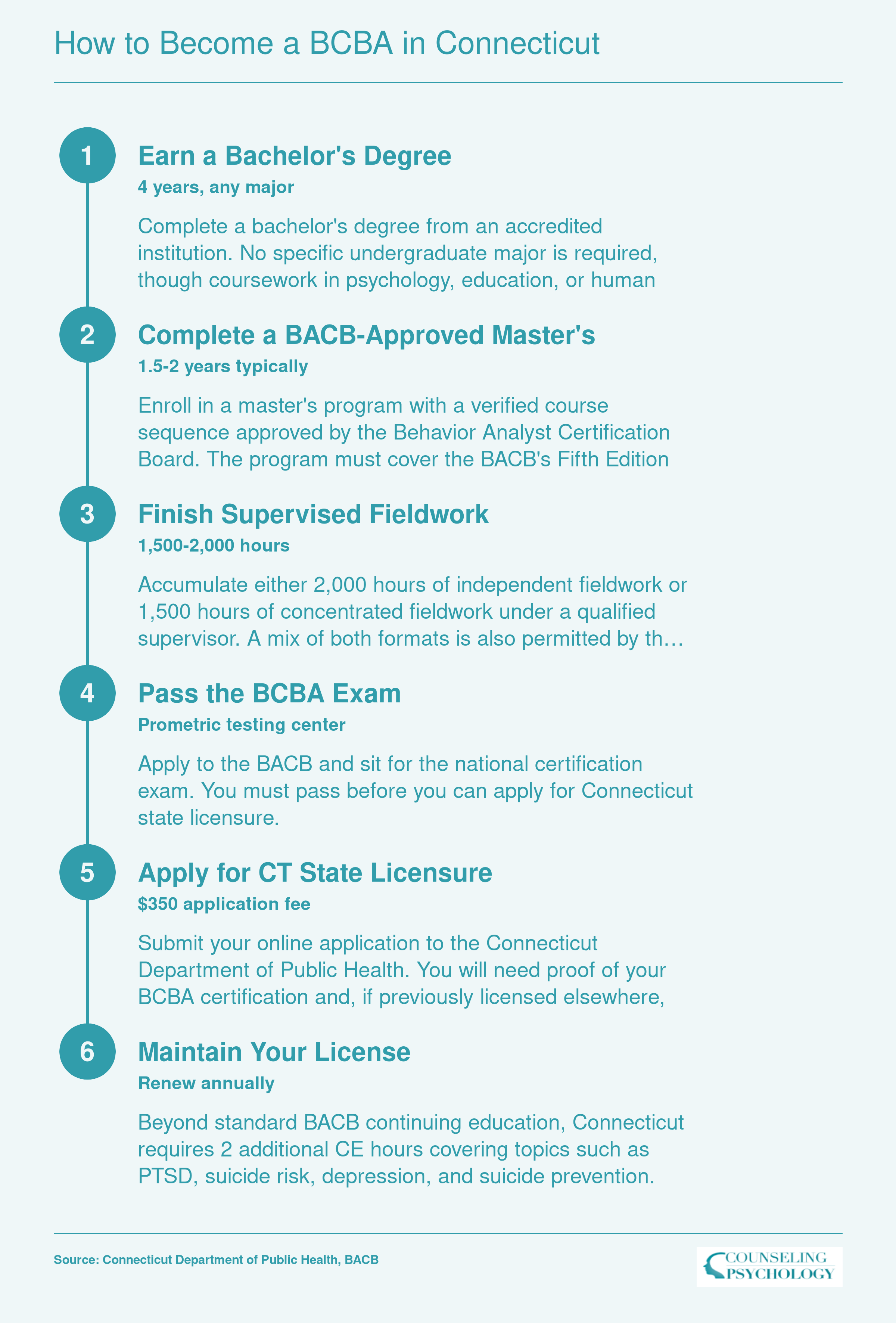
How to Become a BCBA in Connecticut
The path from undergraduate degree to practicing Board Certified Behavior Analyst in Connecticut follows a clear sequence. Each step builds on the last, and skipping ahead is not an option. Here is the credentialing ladder you will need to climb.
Practicum Sites and Major ABA Employers Near New Haven
Where can ABA master's students near New Haven find practicum placements that satisfy BACB supervised fieldwork requirements?
The short answer: the New Haven metro area has a healthy mix of clinical providers, school districts, and university-affiliated programs, so most students can complete their required fieldwork hours without a long commute. That said, placement quality and variety still matter. Accumulating hours across multiple settings (home, school, clinic, community) gives you stronger preparation for the BCBA exam and a more competitive resume.
ABA Therapy Providers in the New Haven Area
Several established organizations actively employ behavior technicians and accept practicum students in the region:1
- Achieve Beyond (New Haven): Located at 157 Church St, this provider serves clients from birth to age 21 across Fairfield and New Haven counties.2
- Cultivate Behavioral Health & Education: Offers in-home and in-school ABA therapy in New Haven, Hamden, and West Haven, giving practicum students exposure to both settings.3
- Champions ABA: Delivers in-home and community-based services throughout New Haven.4
- The Perfect Child (North Haven): Provides in-home ABA for individuals ages 3 to 21.5
- Milestones Behavioral Services (Milford): A short drive south of New Haven, expanding placement options slightly beyond city limits.5
- Creative Interventions LLC: Another local ABA provider operating in the New Haven area.6
- ABLE Home Healthcare: Offers in-home ABA therapy statewide, making it a flexible option if you need to log hours closer to home.7
School Districts and Educational Cooperatives
Public school systems are an often-overlooked source of fieldwork. East Haven Public Schools, for example, regularly advertises behaviorally intensive and autism-support positions.1 ACES (Area Cooperative Educational Services), a regional educational service center, hires ABA home instructors and collaborates with multiple districts. School-based placements are valuable because they let you practice in structured educational environments alongside IEP teams.
Yale-Affiliated Opportunities
The Yale Child Study Center is one of the most recognized behavioral health research and clinical facilities in the country. While practicum slots there can be competitive, students enrolled in nearby ABA therapy programs should explore fieldwork possibilities through Yale New Haven Hospital's broader behavioral health network. These placements tend to emphasize research-informed practice and interdisciplinary collaboration.
How Accessible Are Local Placements?
Most students in the New Haven metro will not need to travel far. The density of providers within a 20-mile radius is strong enough that securing a placement locally is realistic, though popular sites fill quickly. Start contacting potential supervisors early, ideally the semester before your fieldwork begins. If your program does not pre-arrange placements, having a shortlist of BACB-eligible supervisors at local agencies puts you ahead of the curve. Students in more rural parts of Connecticut may face a longer search, but New Haven itself is well served.
Career Outcomes and Salary Outlook for BCBAs in Connecticut
Choosing between clinical work in a private practice versus school-based services shapes not just your daily routine but also your earning trajectory as a BCBA in Connecticut. Both paths offer strong demand, though compensation and job stability vary by setting.
What BCBAs Earn in Connecticut
According to 2024 BLS data for Connecticut (SOC 21-1018), behavior analysts earn a statewide median annual wage of $62,960. The full range spans from roughly $43,030 at the 10th percentile to $98,660 at the 90th percentile, with experienced BCBAs in supervisory or clinical director roles often earning between $77,000 and $99,000 annually. These figures reflect statewide averages; metro-specific wage data for Bridgeport-New Haven is not separately published by BLS, though compensation in this region tends to align closely with state medians given the concentration of ABA providers.
Program-level earnings data for ABA master's completers at Connecticut schools is not yet available through federal reporting, so direct comparisons between specific programs and early-career wages remain limited.
Is a Master's in ABA Worth the Investment?
With total program costs at Connecticut schools ranging from roughly $15,000 to $48,000 depending on residency and institution, the math generally favors pursuing the degree. At median earnings of nearly $63,000 and a clear pathway into the $77,000 to $99,000 range with experience, most graduates can expect to recoup tuition costs within two to four years of entering the field. Median graduate debt at regional programs hovers around $22,000 to $27,000, suggesting manageable repayment timelines given BCBA salaries. For anyone still weighing whether this credential is the right fit, understanding how to become a BCBA can clarify the full investment of time and money required.
Demand Drivers in Connecticut
Several factors fuel consistent demand for BCBAs near New Haven and across Connecticut:
- Autism prevalence: Rising diagnosis rates continue to expand the client base requiring ABA therapy.
- Insurance mandates: Connecticut law requires insurers to cover ABA services for autism spectrum disorders, ensuring steady reimbursement and employer confidence in hiring.
- School-based services: Public schools increasingly contract with BCBAs to support students with behavioral needs, creating positions beyond the traditional clinical setting.
Connecticut employed approximately 6,470 behavior analysts statewide as of 2024, a figure that reflects both growing demand and the state's established network of ABA providers, school districts, and healthcare systems.
Expect to invest between roughly $26,000 and $55,000 in total tuition for a master's in ABA near New Haven, with first year earnings for new BCBAs in Connecticut typically landing between $55,000 and $65,000. That ratio means most graduates can reasonably pay down their program debt within two to three years of entering the field, making this a solid return on a focused credential.
Frequently Asked Questions About ABA Master's Programs in Connecticut
Choosing a master's program in applied behavior analysis is a significant decision, and prospective students in Connecticut tend to ask many of the same questions. Below are straightforward answers to the ones we hear most often.