
What you’ll learn in this article…
- Most ACGC-accredited online genetic counseling programs take 21 to 27 months, matching traditional on-campus timelines.
- No fully remote option exists: every accredited program requires supervised, in-person clinical fieldwork at approved sites.
- BLS projects 14 percent national job growth for genetic counselors through 2032, well above the average for all occupations.
- Employers evaluate candidates on ABGC board certification and clinical skills, not whether coursework was completed online or on campus.
Genetic counseling is a master's-level healthcare profession projected by the Bureau of Labor Statistics to grow 18 percent through 2032, far outpacing the average for all occupations. Until recently, earning the required degree meant relocating to one of a limited number of campus-based programs. A small but growing set of ACGC-accredited online and hybrid options has changed that calculus, giving working professionals and geographically constrained students a viable path into the field.
The word "online" requires a caveat: every accredited program still mandates hundreds of hours of supervised clinical fieldwork completed in person. No fully remote route to board certification exists. All programs referenced in these pages hold accreditation from the Accreditation Council for Genetic Counseling, the sole recognized accreditor and the prerequisite for sitting for the ABGC board exam and obtaining state licensure.
Best Online Genetic Counseling Master's Programs
Online and hybrid master's programs in genetic counseling allow students to pursue this growing healthcare field while maintaining professional and personal commitments. These programs typically combine online coursework with required in-person clinical rotations, preparing graduates to sit for the American Board of Genetic Counseling (ABGC) certification exam. The programs below represent some of the strongest options available nationally, selected for their accreditation status, clinical training opportunities, and flexible delivery formats.
- Independent program research
- U.S. Department of Education College Scorecard (collegescorecard.ed.gov)
- National Center for Education Statistics (NCES-IPEDS) (nces.ed.gov)
University of Michigan-Ann Arbor
The University of Michigan's Department of Human Genetics offers a highly regarded MS in Genetic Counseling through one of the nation's top research universities. With a 93% graduation rate and median earnings of $83,648 among graduates, Michigan provides exceptional outcomes. The program leverages the university's world-class medical center for clinical training and research opportunities.
- Housed within a nationally ranked Department of Human Genetics
- Access to Michigan Medicine's extensive clinical network
- ABGC-accredited program preparing for board certification
- Strong emphasis on genomic research and clinical application
- Supervised clinical rotations across diverse specialty areas
- Faculty actively engaged in cutting-edge genetic research
- 93% institutional graduation rate reflects strong support
MS in Genetic Counseling — Hybrid
University of Connecticut
UConn's MS in Genetic Counseling is an ABGC-accredited program that combines rigorous coursework with extensive supervised clinical experiences. The university boasts an 83% graduation rate and strong post-graduate outcomes with median earnings of nearly $74,000. UConn's program benefits from partnerships with leading healthcare systems throughout New England.
- ABGC-accredited master's program with hybrid delivery options
- Clinical rotations at major New England medical centers
- Comprehensive training in prenatal, cancer, and pediatric genetics
- 83% institutional graduation rate with strong student support
- Faculty with active clinical and research portfolios
- Interdisciplinary curriculum covers psychosocial counseling skills
- Graduates eligible to sit for ABGC board certification exam
MS in Genetic Counseling — Hybrid
Bay Path University
Bay Path University offers an MS in Genetic Counseling designed with working professionals in mind, featuring flexible online coursework combined with clinical fieldwork. As a smaller institution, Bay Path provides personalized attention and mentoring throughout the program. The university has built a reputation for accessible graduate education with a net price well below its listed tuition.
- Hybrid format combines online coursework with clinical rotations
- Designed for flexibility to accommodate working students
- ABGC-accredited program leading to board certification eligibility
- Small cohort sizes allow individualized faculty mentorship
- Training in prenatal, pediatric, cancer, and adult genetics
- Psychosocial counseling and ethics integrated into curriculum
- Fieldwork placements at healthcare facilities nationwide
Genetic Counseling MS — Hybrid
Medical University of South Carolina
MUSC's genetic counseling program is housed within the College of Health Professions and benefits from the institution's status as South Carolina's only comprehensive academic health center. Students gain access to diverse clinical training environments across MUSC's hospital system, including specialized genetics clinics. The program emphasizes hands-on clinical preparation alongside didactic coursework.
- Located within South Carolina's leading academic health center
- Clinical rotations through MUSC's extensive hospital network
- ABGC-accredited program with strong board pass rates
- Interprofessional education alongside other health disciplines
- Curriculum covers molecular genetics and genomic medicine
- Training in laboratory genetics and variant interpretation
- Supervised experiences in prenatal, cancer, and pediatric settings
MS in Genetic Counseling — Hybrid
University of South Florida
USF's College of Public Health offers an MSPH in Genetic Counseling that uniquely integrates public health principles with clinical genetic counseling training. With in-state tuition starting at just $6,410 per year, it represents one of the most affordable pathways into the profession. The university's 77% graduation rate and robust clinical partnerships across Florida support student success.
- Unique public health approach to genetic counseling education
- Among the most affordable programs with in-state tuition at $6,410/yr
- ABGC-accredited with strong clinical training components
- Clinical rotations across Tampa Bay area healthcare systems
- Emphasis on health equity and population-level genomics
- Dual public health and genetic counseling competency training
- Faculty expertise in cancer genetics and prenatal counseling
MSPH in Genetic Counseling — Hybrid
Kean University
Kean University's MS in Genetic Counseling provides students with comprehensive training in clinical genetics and psychosocial counseling. The program prepares graduates for ABGC board certification through a combination of coursework and supervised clinical experiences at healthcare facilities across the New Jersey and New York metropolitan area.
- Clinical placements across the NJ/NY metropolitan region
- ABGC-accredited program preparing for board certification
- Curriculum covers cytogenetics, molecular biology, and genomics
- Psychosocial counseling skills integrated throughout program
- Access to diverse patient populations in clinical rotations
- Smaller program size fosters close faculty-student relationships
- Training in ethical, legal, and social implications of genetics
Genetic Counseling MS — Hybrid
Southern California University of Health Sciences
SCU's MS in Genetic Counseling is offered at a health sciences-focused institution, providing a clinically immersive educational environment. The program prepares students for ABGC certification through integrated didactic and clinical training. With tuition at $10,476 per year, it offers a cost-effective pathway for aspiring genetic counselors in Southern California.
- Health sciences-focused institution with clinical emphasis
- Competitive tuition at $10,476/yr for all students
- ABGC-accredited program with board certification preparation
- Clinical rotations across Southern California medical centers
- Interprofessional learning alongside other health disciplines
- Curriculum includes genomic medicine and variant interpretation
- Small cohorts support personalized mentoring and advising
Master of Science in Genetic Counseling — Hybrid
University of California, San Francisco
UCSF's genetic counseling program is situated within one of the nation's premier health sciences universities and medical centers. The program offers unparalleled access to cutting-edge genetic research and diverse clinical populations. UCSF's global reputation in biomedical research and patient care provides students with a transformative training environment in the heart of San Francisco's medical district.
- Housed at a top-ranked health sciences university
- Access to UCSF Medical Center's world-class clinical resources
- Exposure to pioneering genomics research and precision medicine
- Diverse clinical rotations across UCSF's specialty clinics
- ABGC-accredited with strong alumni network in the profession
- Faculty leaders in cancer genetics, prenatal, and rare diseases
- Located in a major hub for biotech and genomic innovation
MS in Genetic Counseling — Hybrid
Online vs. Hybrid vs. On-Campus: Understanding Genetic Counseling Program Formats
No ACGC-accredited genetic counseling master's program is delivered fully remotely from start to finish.1 Every accredited program, regardless of how its lectures are packaged, requires supervised clinical fieldwork at approved sites. What differs across formats is how the didactic coursework is delivered and how often students physically travel to campus.
The Three Delivery Formats
Genetic counseling programs generally fall into one of three buckets:
- Fully online didactic with remote clinical placement: Programs like Bay Path University and the University of Connecticut deliver all coursework online and do not require campus intensives. Students still complete clinical rotations in person, but those placements are arranged in or near the student's home region rather than at the host university.2
- Hybrid with campus intensives: Augusta University, the Medical University of South Carolina (MUSC), and Southern California University of Health Sciences (SCU) deliver most coursework online but require students to come to campus periodically, typically one to three times per year, for immersive sessions covering counseling skills practice, lab work, standardized patient encounters, and cohort building. Intensives often run several days to a full week.3
- Traditional on-campus: Students attend lectures, labs, and clinical rotations in person at the university and its affiliated medical center.
Synchronous vs. Asynchronous Coursework
Online and hybrid programs mix two delivery styles. Synchronous classes meet at a scheduled time over video conference, replicating a live seminar with real-time discussion and case review. Asynchronous content (recorded lectures, readings, discussion boards, case assignments) is completed on the student's own schedule within weekly deadlines.
Most ACGC-accredited online programs use a blend, with synchronous sessions concentrated in counseling skills and case conference courses where live practice matters most.
Weekly Time Commitment
Plan on a full-time workload. Students typically report 40 to 50 hours per week across coursework, synchronous meetings, asynchronous study, and clinical hours once rotations begin. Part-time tracks exist at some schools and stretch the timeline accordingly, but the per-credit intensity does not shrink.
Questions to Ask Yourself
How Long Does an Online Genetic Counseling Master's Take?
Twenty-one months is the fastest timeline you will find among ACGC-accredited online genetic counseling programs, with most students finishing in 21 to 27 months.1 This two-year window closely mirrors traditional on-campus programs because the Accreditation Council for Genetic Counseling sets the same clinical hour requirements regardless of delivery format.
Standard Program Timelines
Most online and hybrid programs cluster around a 21- to 24-month completion window. Charles R. Drew University's hybrid Master of Science in Genetic Counseling requires 66 credits and is structured for completion in 21 months.2 Boise State University's online program runs 24 months, as does the University of Connecticut's online track.34 These timelines assume full-time enrollment with summer terms included, so students should plan for year-round coursework rather than traditional fall and spring semesters only.
Extended and Part-Time Options
For working professionals who cannot commit to a full-time schedule, some programs offer extended tracks stretching up to 36 months. Southern California University of Health Sciences structures its online program with a flexible 21- to 36-month completion window, allowing students to pace their coursework around professional obligations.5 Individualized extended plans may be available at other institutions on a case-by-case basis, though most programs operate on a cohort model that limits flexibility. If part-time enrollment matters to you, confirm availability directly with admissions before applying.
Why Accelerated Options Are Rare
Unlike some graduate fields where motivated students can compress their timeline, genetic counseling programs face a structural floor. Clinical rotation hours, typically 600 or more, cannot be rushed. Fieldwork placements depend on site availability, supervisor schedules, and case volume, which limits how quickly students can accumulate the required patient contact. This reality means you will rarely find an accredited program promising completion in under 21 months, and anyone making such claims should prompt careful scrutiny of their accreditation status.
Tuition and Cost Comparison for Online Genetic Counseling Programs
Genetic counseling master's programs vary widely in price, and the online or hybrid format does not always mean a discount. Because ACGC-accredited online programs remain a small group, comparing published per-credit rates is the most reliable way to estimate your bottom line. Confirm current figures directly with each program before applying, since rates often shift year to year.
What You'll Pay at the Major Online and Hybrid Programs
The figures below reflect publicly listed tuition for recent academic years. Treat them as ballpark planning numbers, not guarantees.
- University of Connecticut (online): UConn's hybrid/online program lists tuition on its program page and provides a modest annual stipend (around $2,000) to enrolled students, which offsets a small portion of total cost.1
- Indiana University School of Medicine (on-campus comparison): For the 2025-2026 year, IU lists roughly $22,956 for in-state students and $58,476 for out-of-state students across the program. IU is a useful benchmark for what a traditional, residency-based program costs.2
- Southern California University of Health Sciences (100% online coursework): SCUHS publishes a single per-credit rate that applies to all students regardless of residency, which is typical of private institutions.3
For other ACGC-accredited programs (MUSC, Bay Path, Augusta, Emory, and similar), verify per-credit rates and required credit totals on each program's official cost page before estimating totals.
In-State vs. Out-of-State for Online Students
Residency policy is one of the biggest swing factors. Public universities like Indiana and UConn historically distinguish in-state and out-of-state rates, though some extend in-state or a reduced "e-tuition" rate to fully online learners. Private institutions like SCUHS and Bay Path typically charge a flat rate to everyone. If you live outside a public program's home state, ask admissions in writing whether the online cohort qualifies for the resident rate. Learning how to evaluate an online counseling or psychology degree program can help you weigh cost against quality more systematically.
Costs Beyond Tuition
Sticker tuition is only part of the picture. Plan for:
- Clinical rotation travel: Site placements may be hours from home, with mileage, lodging, and parking out of pocket.
- Campus intensives: Hybrid programs often require one or more on-campus weeks per year. Budget for flights, hotels, and meals.
- Technology and lab fees: Per-semester charges of a few hundred dollars are common.
- Professional liability insurance: Required before clinical work, typically $35 to $150 per year.
- Background checks, immunizations, and board exam fees add several hundred dollars across the program.
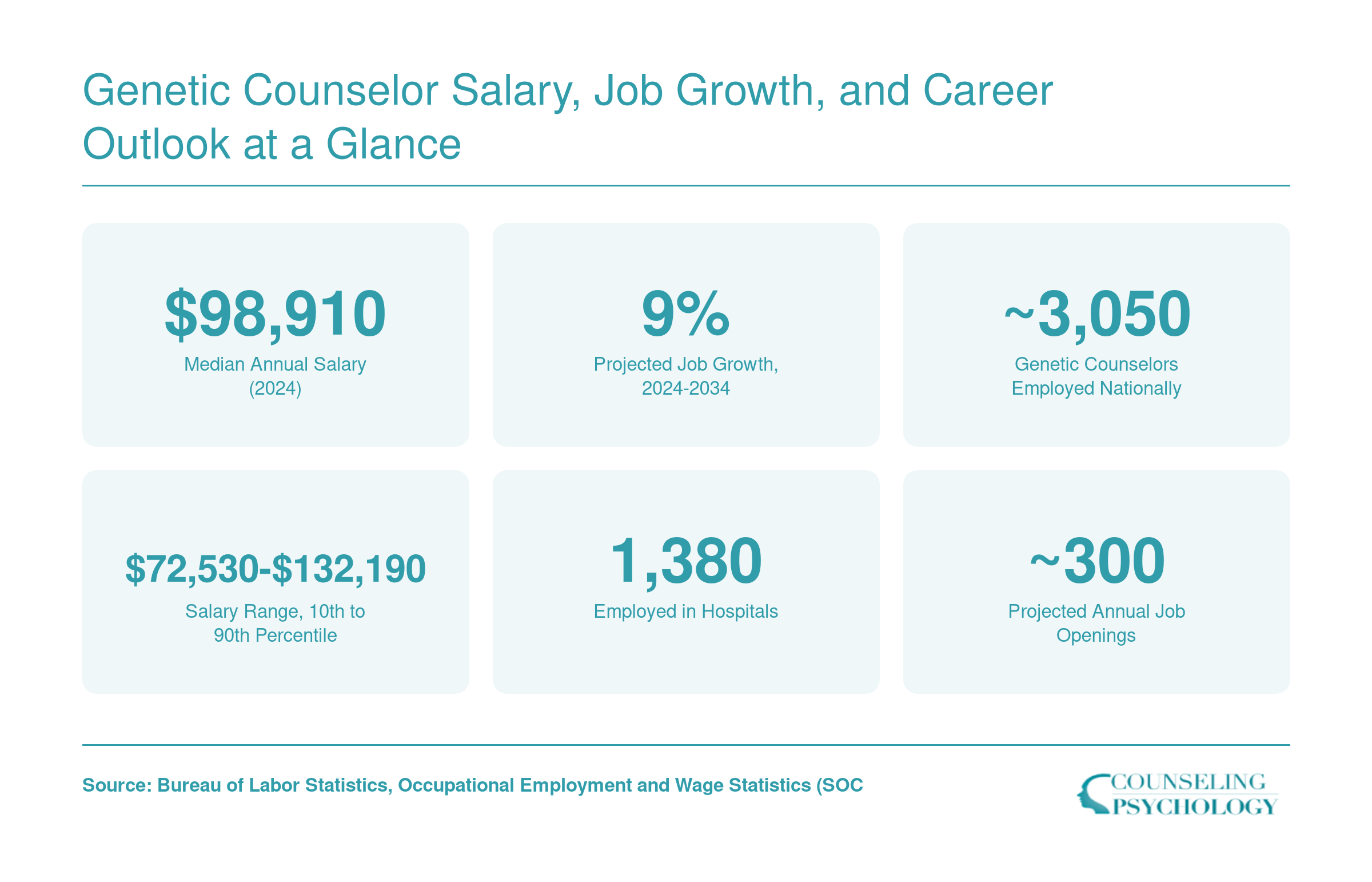
Genetic Counselor Salary, Job Growth, and Career Outlook at a Glance
The genetic counseling profession continues to offer strong compensation and steady demand. The figures below reflect national data for all genetic counselors, regardless of whether their master's degree was completed online, in a hybrid format, or on campus.
Admission Requirements and How Competitive Are These Programs?
Genetic counseling remains one of the most selective graduate paths in allied health, and online or hybrid programs are no exception. Understanding what admissions committees expect, and how the process works, is essential before you invest time in an application.
Prerequisite Coursework and GPA Benchmarks
ACGC-accredited online and hybrid programs require a minimum cumulative GPA of 3.0 on a 4.0 scale, though competitive applicants typically land in the 3.4 to 3.7 range. Before applying, you will need undergraduate coursework in several foundational areas:2
- Biology: At least one semester, often two, covering cellular and molecular concepts.
- Genetics: A dedicated course in human or molecular genetics is non-negotiable.
- Biochemistry: Most programs list this as a standalone requirement.
- Statistics: One course minimum; some programs accept biostatistics.
- Psychology: Introductory or abnormal psychology satisfies most programs.
- General Chemistry: Typically one to two semesters with lab.
Specific programs may add their own prerequisites. The University of Wisconsin-Madison hybrid program, for example, requires advanced genetics in addition to the standard list.3 Always check each program's admissions page directly.
Selectivity: Online vs. On-Campus
Across all ACGC-accredited programs, historical acceptance rates have hovered around 8 to 15 percent. Online and hybrid programs tend to be somewhat less restrictive, with acceptance rates reported in the 20 to 40 percent range for recent cycles. Part of this difference reflects larger cohort sizes: online programs typically enroll 10 to 20 students per cohort, compared to 6 to 10 at many traditional on-campus programs.4 A wider cohort does not mean the bar is low. Programs still screen heavily for relevant experience, including genetic counseling shadowing, patient advocacy, crisis counseling, or volunteer work in genetics-related settings. If you are curious about selectivity in related fields, our guide on how hard it is to get into grad school for psychology provides useful context.
Application Components
Most online genetic counseling programs have dropped the GRE requirement.5 Programs at the University of Utah, the University of Wisconsin-Madison, the Medical College of Wisconsin, and the University of South Florida all listed no required standardized exam for the 2024-2025 cycle.2367 Expect to submit:
- A personal statement addressing your motivation and relevant experiences.
- Three letters of recommendation, ideally from faculty and professionals who can speak to your aptitude for counseling.
- An interview, which may be conducted virtually for online cohorts.
The GC Admissions Match
Many ACGC-accredited programs, including online and hybrid options, participate in the Genetic Counseling Admissions Match administered through National Matching Services (NMS).5 The process works similarly to medical residency matching: after you interview, both you and the program submit ranked preference lists. An algorithm then pairs applicants and programs based on mutual preferences. Participating in the Match means you commit to attending the program where you are placed, so ranking order matters. Confirm whether each program you are considering uses the Match, because the timeline and commitment rules will shape your entire application strategy.
Curriculum, Clinical Fieldwork, and the Online Student Experience
The central tension in any online genetic counseling program is this: coursework can travel with you, but clinical training cannot. Understanding how programs bridge that gap, and what it costs you personally, is as important as evaluating any course catalog.
Year One: Foundations in the Classroom (and on Your Screen)
Most programs build the first year around foundational science and counseling theory. Expect courses in molecular genetics, cytogenetics, biochemical genetics, and genomic technologies running alongside psychosocial theory, ethics, and communication skills. Delivery is typically a mix of asynchronous lecture modules you complete on your own schedule and synchronous sessions, including case conferences, role-play exercises, and small-group seminars held over video.1
Peer cohort bonding happens more intentionally online than students often expect. Programs structure group case discussions, shared reflection exercises, and virtual study groups to replicate the collegial environment of a physical campus. Some programs introduce light fieldwork early, with one clinical day per week during the first year, as MGH Institute's genetic counseling program does, to build patient contact skills before full rotations begin.2
Year Two: Rotations, Real Patients, and Progressive Responsibility
The second year shifts toward clinical immersion. ACGC accreditation standards are competency-based rather than purely hour-based, though historically programs have aimed for 600 to 700 supervised clinical hours and 150 to 200 patient cases.3 Rotations typically run six to eight weeks each, with students completing four to eight rotations across required specialty areas: prenatal, pediatric, and cancer genetics, plus at least one additional specialty.4 Elective options often include clinical laboratory, industry, research, and telehealth settings.
For remote students, programs work to place you at accredited sites near your home, but proximity is not guaranteed. Clinical sites are distributed nationally, and some students do need to travel or temporarily relocate for a rotation. Those costs, including housing, transportation, professional attire, health screenings, and background checks, fall primarily on the student. Some programs offer partial support: the University of Michigan, for example, provides financial assistance for clinical training and partial funding for conference travel, but students should budget for out-of-pocket expenses regardless of program.6
Online vs. On-Campus: Does Format Affect Specialty Breadth?
Online students complete the same required specialty rotations as on-campus peers. The ACGC mandates exposure to prenatal, pediatric, and cancer genetics for all accredited programs regardless of format.4 Where online students may notice a difference is in the informal learning that happens between rotations: the hallway conversations, the spontaneous case debriefs, the easy access to faculty. Programs compensate through structured synchronous touchpoints, video-based patient simulations, and regular supervisor check-ins, but self-directed students tend to thrive more readily in distributed formats than those who rely heavily on in-person mentorship.
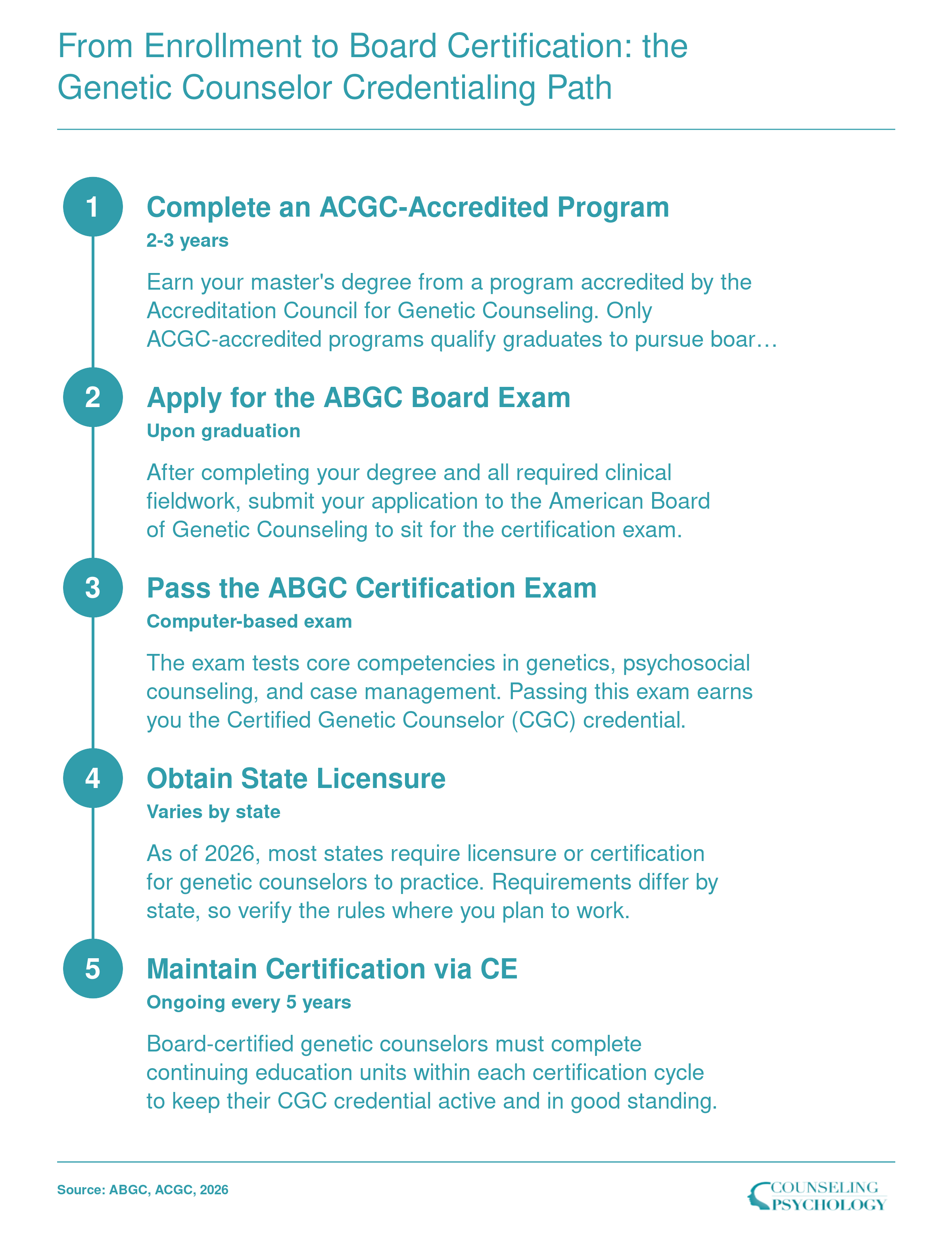
From Enrollment to Board Certification: The Genetic Counselor Credentialing Path
Becoming a board-certified genetic counselor follows a clear, sequential credentialing path. Every step builds on the one before it, and skipping any stage is not an option. Notably, ACGC accreditation is the non-negotiable prerequisite: without it, graduates cannot sit for the ABGC certification exam.
Accreditation, ABGC Exam Pass Rates, and State Licensure
On-campus and online programs may look equally appealing in a brochure, but the one factor that determines whether either opens doors is accreditation. A degree from a non-accredited genetic counseling program, no matter how well-designed, will block your path to board certification and state licensure. Understanding the landscape of accreditation, board exam performance, and licensure requirements is how you separate a legitimate career investment from a dead end.
Why ACGC Accreditation Is Non-Negotiable
The Accreditation Council for Genetic Counseling (ACGC) is the sole accrediting agency recognized for genetic counseling master's programs in the United States.1 Graduating from an ACGC-accredited program, whether online, hybrid, or on-campus, is the only way to qualify for the American Board of Genetic Counseling (ABGC) certification exam.2 Without that certification, you cannot obtain state licensure in states that require it, effectively shutting you out of most clinical roles. Always verify a program's current accreditation status on the ACGC website before applying. Accreditation is not a one-time checkbox; programs undergo periodic reaccreditation, so check for any probationary status or recent adverse actions.
ABGC Exam Pass Rates: What the Numbers Show
The ABGC Certified Genetic Counselor (CGC) exam is the gatekeeper to the profession. For prospective students, a program's exam pass rates offer a direct window into how well it prepares graduates.
- Overall pass rates: According to the ABGC's August 2025 National Data Report, the overall pass rate for all test-takers was 82%.3 An earlier 2021 snapshot showed a first-time pass rate of 80.1%.2
- Online and hybrid program data: Program-level outcomes are self-reported and can differ sharply.1 Boston University's hybrid genetic counseling program, for instance, discloses a first-time pass rate of 74% for the 2022 to 2024 period but an overall pass rate of 97%, meaning most who did not pass on the first attempt succeeded after retakes.4
- What to ask schools: Not all online or hybrid programs publish a detailed breakdown of first-time versus overall pass rates, or separate their online cohort's performance. When comparing programs, request specific ABGC pass rate data for their online track. A lower first-time rate is not automatically a red flag if comprehensive remediation and high eventual pass rates are demonstrated, but full transparency is essential.
State Licensure and Multi-State Practice
As of 2025, over half of all U.S. states require genetic counselors to hold a state-issued license or certification to practice.2 This number continues to grow as the National Society of Genetic Counselors (NSGC) and state professional groups push for expansion. Pending legislation in multiple states may further widen the licensure map during the 2025 to 2026 legislative sessions.
For students in online programs, state licensure adds a layer of complexity around clinical fieldwork. Even if you live in one state and attend a program based in another, the clinical rotations you complete may need to occur in yet a third location. Most online genetic counseling programs manage state authorization through the National Council for State Authorization Reciprocity Agreements (NC-SARA), but NC-SARA membership does not guarantee blanket authorization.4 Some states impose additional professional licensing board requirements or restrict out-of-state clinical placements.
Before enrolling, confirm with the program that it is authorized to place students in clinical rotations in the state where you plan to train and, later, to work. A program's clinical placement coordinator should provide a clear map of current state authorizations and any state-specific limitations. This due diligence prevents a situation where you complete your degree but cannot sit for licensure in your intended practice state.
Career Outcomes: Are Online Genetic Counseling Degrees Respected by Employers?
This is one of the most common concerns prospective students raise, and the short answer is reassuring. Employers in clinical genetics, hospital systems, and telehealth companies evaluate candidates primarily on ABGC board certification, clinical competence, and interpersonal skills. Once you hold that credential from an ACGC-accredited program, the delivery format is largely invisible on your transcript and in the hiring process.
Pros
- ABGC certification is the universal hiring standard, and it does not distinguish between online and on-campus graduates.
- Employers evaluate clinical rotation performance and board exam results, not how coursework was delivered.
- Online programs expand access for students in rural or underserved regions who might otherwise never enter the field.
- The rapid growth of telehealth genetic counseling roles gives digitally fluent online graduates a practical edge.
- Flexible scheduling lets working professionals gain the credential without relocating, broadening the talent pipeline.
Cons
- Some hiring managers at legacy academic medical centers may carry unconscious bias toward traditional on-campus programs.
- Networking and mentorship opportunities can require more deliberate effort when you are not physically on a campus.
- Clinical placement variety may be limited by your geographic location, potentially narrowing your exposure to specialty areas.
- Newer online programs often have smaller alumni networks, which can slow early-career job referrals and professional connections.
Frequently Asked Questions About Online Genetic Counseling Programs
Prospective students often have similar questions when exploring online genetic counseling programs. Below are straightforward answers to the most common concerns, drawn from current program details and professional credentialing standards.