What you’ll learn in this article…
- Maryland counseling master's programs range from roughly $11,000 to over $23,000 in average annual net price after aid.
- Licensure requires the LGPC credential first, then 3,000 supervised hours to advance to the LCPC.
- BLS data shows mental health counselors in Maryland earn a median salary near $57,000 annually.
- Child counseling specializations remain limited, though Loyola and Johns Hopkins offer relevant graduate tracks.
Net prices for the four ranked Maryland counseling master's programs run from roughly $13,300 a year at the University of Maryland Eastern Shore to about $30,600 at Loyola University Maryland, a spread that reshapes the total cost of the degree by tens of thousands of dollars. McDaniel College and Frostburg State University fall between those endpoints, with online and hybrid formats available across the group.
That price range matters because Maryland's counseling labor market keeps pulling in new graduates, particularly for child counseling and clinical mental health roles serving children and adolescents. Demand is real, but so is the licensure timeline: LGPC first, LCPC after supervised practice. Program choice locks in cost, format, and specialization for the next two to five years.
Best Counseling Master's Programs in Maryland
Maryland offers a small but distinct set of counseling programs that range from fully online school counseling degrees to hybrid clinical mental health tracks. The four programs below were evaluated on affordability, graduation outcomes, program design, and alignment with Maryland licensure pathways. Whether you are a working educator looking to add a school counseling credential or a career changer pursuing clinical practice, these options represent the strongest combination of value and preparation available in the state for 2026.
- Institutional graduation and retention rates
- Net price and graduate debt burden
- Program format and flexibility
- Licensure and certification alignment
- Earnings outcomes after graduation
- College Scorecard graduate earnings — collegescorecard.ed.gov
- NCES-IPEDS federal institutional data — nces.ed.gov
- Internal program database
- Independent program research

University of Maryland Eastern Shore
As the lowest-cost counseling master's option in Maryland, UMES delivers a 60-credit clinical mental health counseling program through a hybrid schedule of evening and weekend courses designed for working adults. The university is an HBCU with a deep social justice orientation and a particular commitment to serving rural and underserved communities on the Eastern Shore and throughout the mid-Atlantic. Graduates are prepared to pursue Licensed Graduate Professional Counselor (LGPC) status in Maryland, with clinical placement settings that include outpatient facilities, community agencies, and private practice. The institution-wide student-to-faculty ratio of 11:1 supports close mentoring throughout the program.
- 60-credit hybrid master's with evening and weekend scheduling
- Prepares graduates for Maryland LGPC licensure
- Strong social justice and client-centered curriculum focus
- Multiple clinical placement settings across the region
- In-state net price of approximately $13,338 per year
- 11:1 institution-wide student-to-faculty ratio
- 3.0 GPA minimum for admission
- Professional counselor identity development emphasis
Counselor Education, Clinical Mental Health Counseling Concentration — Hybrid

McDaniel College
McDaniel College stands out as one of the few fully online school counseling programs in Maryland, making it especially practical for educators who cannot relocate or attend campus regularly. The 51-credit M.S. in Counseling is delivered in accelerated eight-week sessions, with an average completion time of 36 months. Coursework is aligned with Maryland State Department of Education standards, and field experiences, including a 100-hour practicum and 600-hour internship, can often be arranged within a student's own Maryland school system when supervision requirements are met. The institution-wide graduation rate is 63.3%, and median graduate debt sits at $25,000.
- Fully online coursework in accelerated 8-week sessions
- 51 credits with an average 36-month completion timeline
- 100-hour practicum plus 600-hour school-based internship
- Curriculum aligned with MSDE certification standards
- Fall and spring admission cycles available
- Minimum 3.0 GPA, resume, goal statement, and interview required
- Covers diversity-sensitive counseling and ethical practice
- Includes research and program evaluation coursework
Master of Science in Counseling, School Counseling — Online

Loyola University Maryland
Loyola University Maryland pairs a CACREP-accredited school counseling program (accredited through 2029) with outcomes that are hard to match: a reported 100% licensure examination pass rate and 97% job placement rate. Students choose between an M.A. (thesis-focused, for practitioner-researchers) or an M.Ed. (practice-oriented, with electives such as college advising), both delivered in a hybrid format that blends on-campus and online learning across 60 credits. Graduates may qualify for both Maryland school counselor certification and, with additional post-degree requirements, Licensed Professional Counselor (LPC) status, giving them dual-pathway career flexibility. The institution-wide graduation rate is 79.2%, and median earnings at ten years after enrollment reach $82,652.
- 60-credit hybrid program with full-time or part-time pacing
- CACREP accredited through 2029
- Thesis track for practitioner-researchers
- 100% reported licensure exam pass rate
- 97% reported job placement rate
- Supervised 100-hour practicum and 600-hour internship
- GRE not required for admission
- Completable in as few as two years full-time
- 60-credit hybrid program with practice-oriented electives
- College advising elective available for career readiness roles
- CACREP accredited through 2029
- Recognized by the Maryland State Department of Education
- Evening and weekend class options for working professionals
- Prepares for both school counselor certification and LPC pathway
Master of Arts (M.A.) in School Counseling — Hybrid
Master of Education (M.Ed.) in School Counseling — Hybrid

Frostburg State University
Frostburg State University's post-master's certificate is designed for school counselors who already hold a master's degree and want to sharpen advanced skills without committing to a second full degree. Delivered entirely online during summer and winter sessions, the program aligns with K-12 academic breaks so practitioners can study without leaving their current positions. Coursework covers sophisticated intervention techniques, treatment planning, and family and child counseling, all aimed at preparing graduates for the National Counselor Examination and the National Certified School Counselor credential. As a public university, Frostburg offers in-state graduate tuition that is among the lowest in Maryland, and median graduate debt institution-wide is approximately $21,105.
- Fully online with summer and winter session scheduling
- Prepares for National Counselor Examination (NCE)
- Pathway to National Certified School Counselor (NCSC) credential
- Covers advanced intervention and treatment planning techniques
- Family, parent, and child counseling coursework included
- Lower total credit and cost burden than a second master's
Post-Master's Certificate in Advanced School Counseling Practice — Online
How We Ranked Maryland Counseling Programs
What factors actually matter when comparing counseling master's programs in Maryland?
Not every ranking tells you how it arrived at its conclusions. Many program lists simply compile schools alphabetically or by reputation without explaining the criteria behind their selections. Our approach prioritizes transparency and the financial realities that graduate students face.
Our Ranking Methodology
We weighted several measurable factors that directly affect your educational investment and career preparation:
- Net price: What students actually pay after financial aid, not just sticker price tuition
- Financial aid availability: The percentage of students receiving institutional grants and scholarships
- Graduation rate: Institution-wide completion rates that indicate overall student support
- Program-level earnings: Post-graduation salary data specific to counseling graduates when available
- Median debt at graduation: Total borrowing that shapes your financial future
- Online availability: Programs offering flexible delivery formats for working professionals
The affordable filter in our methodology gives extra weight to programs demonstrating strong value, meaning lower net costs combined with solid outcomes. If you are exploring counseling master's programs online beyond Maryland, the same methodology applies to our national rankings.
Data Sources and Limitations
Our rankings draw from the U.S. Department of Education's College Scorecard and the Integrated Postsecondary Education Data System. These federal databases provide standardized metrics across institutions, though some limitations exist. Graduation rates reflect institution-wide performance rather than counseling-specific completion, since program-level graduation data is not consistently reported. When program-level earnings data is not yet published for a specific counseling program, we note that gap rather than substitute broader institutional figures.
Why Methodology Transparency Matters
Many competitor sites list programs without disclosing their selection criteria, leaving prospective students to guess whether rankings reflect educational quality or advertising relationships. By explaining exactly what we measure and how we weight each factor, you can evaluate whether our priorities align with yours. If affordability and online flexibility matter most to your situation, these rankings reflect that emphasis.
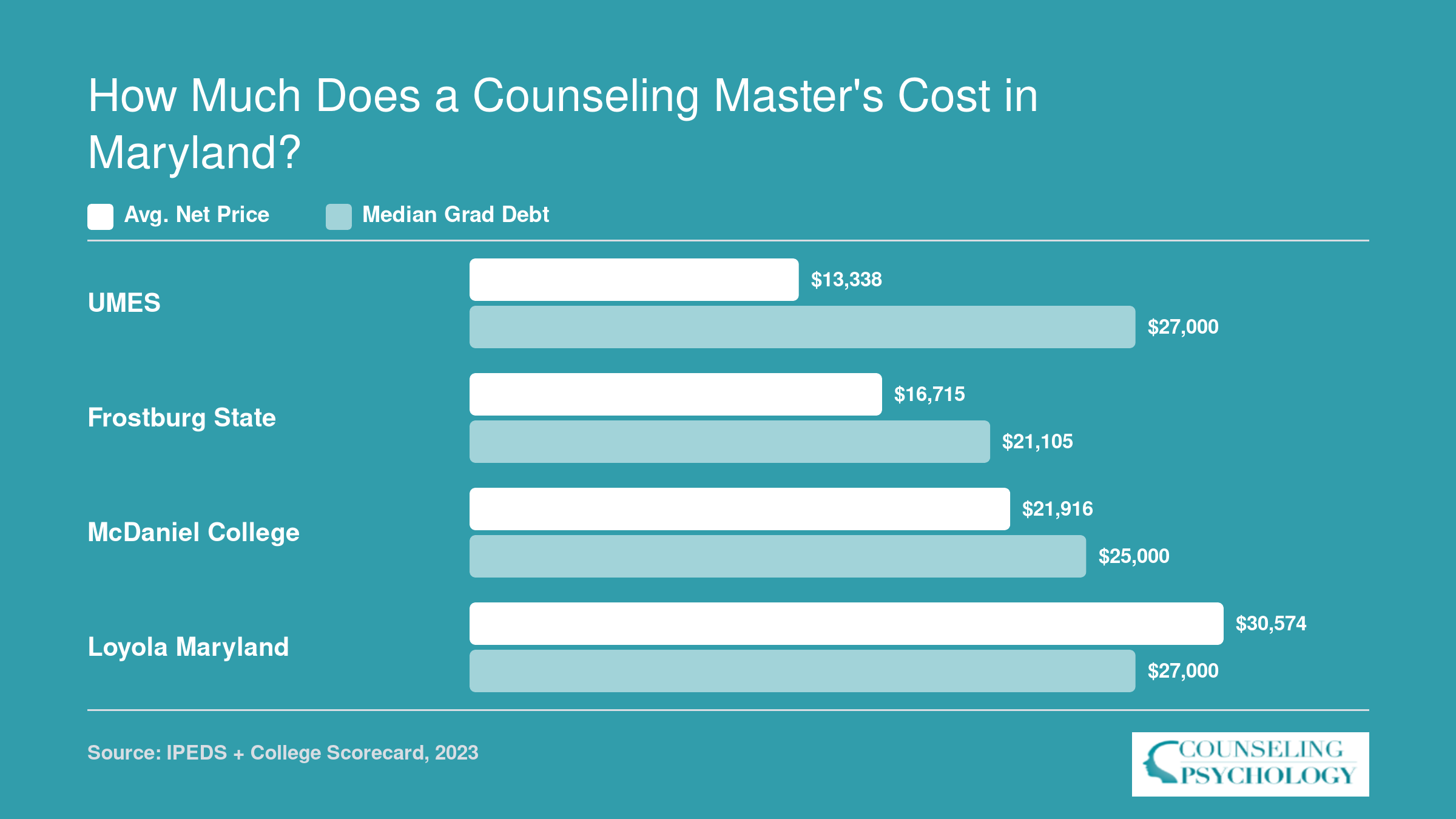
How Much Does a Counseling Master's Cost in Maryland?
The cost of a counseling master's degree in Maryland varies widely depending on the institution. The figures below reflect each school's average annual net price after financial aid, which is an institution-level average and not a guaranteed quote for every student. Median debt at graduation also differs, ranging from about $21,100 to $27,000. Understanding these spreads can help you budget realistically and weigh return on investment before you commit.
Related Articles
Online Vs. On-Campus Counseling Programs in Maryland
Online delivery versus traditional on-campus enrollment presents a genuine fork in the road for Maryland counseling students, and each mode carries distinct trade-offs in flexibility, cost, and community.
The Case for Online Counseling Programs
Flexibility stands as the headline advantage. Working professionals juggling existing caseloads, family obligations, or full-time employment can complete coursework asynchronously, often reviewing lectures and submitting assignments on evenings or weekends. Geography becomes less restrictive: a student in Western Maryland gains the same access to a Baltimore- or College Park-based program as someone living two blocks from campus. Effective cost often tilts lower, too, once you remove commuting expenses, parking fees, and the opportunity cost of daytime campus attendance.
The Case for On-Campus Programs
Structured schedules impose discipline that some students need to maintain momentum through a rigorous 60-credit curriculum. Face-to-face classroom discussions deepen clinical reasoning in real time, and cohort bonds formed over two years translate into referral networks and peer supervision long after graduation. Practicum and internship placements frequently flow from faculty introductions and on-site partnerships that on-campus students encounter organically, which can be especially valuable for those exploring careers in counseling for the first time.
Are Online Counseling Degrees Respected?
Yes, provided the program holds CACREP accreditation. CACREP applies uniform standards to all delivery modes: online, on-campus, and hybrid tracks undergo identical curricular review, faculty credential audits, and clinical training requirements.1 Maryland's Board of Professional Counselors and Therapists treats CACREP-accredited online degrees as equivalent to campus-based degrees for LCPC licensure eligibility.2 Both formats must satisfy the same 60-semester-hour minimum, include face-to-face supervised clinical placements in real-world sites, and meet regional institutional accreditation standards. Students pursuing a licensed professional clinical counselor degree will find that employers and licensing boards evaluate the accreditation seal and clinical competencies, not the classroom's physical location.
Hybrid Models and Practical Considerations
Some Maryland programs blend online coursework with periodic campus intensives for skills labs, group supervision, or elective workshops. These hybrids preserve flexibility while anchoring students in a learning community. Regardless of format, every candidate will complete hundreds of direct client-contact hours in Maryland-based practicum and internship sites, ensuring that clinical training remains grounded in supervised, in-person practice.2
Questions to Ask Yourself
Counseling Specializations and Child-Focused Tracks in Maryland
Where can you find a graduate certificate in child counseling in Maryland, and which programs offer concentrations in working with young clients?
Maryland universities offer a limited but growing selection of specialized training for counselors focused on children and adolescents. Most options fall into two categories: standalone graduate certificates in related areas, and child-focused concentrations embedded within master's programs. Because dedicated child counseling certificates are not widely advertised, prospective students should search institution websites directly and contact admissions offices to confirm current offerings.
Finding Child and Adolescent Graduate Certificates
To locate child counseling graduate certificates in Maryland, start by reviewing academic program listings at major institutions that house counseling programs. Loyola University Maryland, Johns Hopkins University, and the University of Maryland system are logical first stops. Search each school's graduate catalog or department page using terms like "graduate certificate in child counseling," "child and adolescent mental health certificate," or "certificate in play therapy." For a broader look at what is available nationally, explore counseling graduate certificate options to compare formats and curricula.
Johns Hopkins previously offered a Clinical Mental Health Counseling Post-Master's Certificate requiring 15 credits, but it is not admitting new students for the 2025, 2026 academic year.1 The University of Maryland College Park lists Special Education and School Counseling Graduate Certificates available in-person, online, and blended formats, though these focus on school counseling rather than clinical child work.2 The Community College of Baltimore County offers a Behavioral Health Counseling Advanced Certificate in-person and online, but it does not emphasize child-specific content.3
Verifying Online Availability and Stackability
Once you identify a certificate program, confirm the delivery mode by reviewing the course schedule or catalog. Many schools list "delivery mode" or "instructional method" for each course. To determine whether certificate credits stack into a master's degree, look for language in program descriptions such as "may be applied toward the M.A. in Clinical Mental Health Counseling" or contact an academic advisor. Stackable certificates allow you to complete foundational coursework while deciding whether to pursue full licensure.
Child and Adolescent Concentrations Within Master's Programs
For students planning to complete a full master's degree, child and adolescent counseling concentrations offer deeper training. Review the curriculum section of each school's counseling or clinical mental health master's program website. Most programs list specializations, electives, or certificate tracks in their student handbook or department page.
National online programs like Capella University offer a Master of Science in Clinical Mental Health Counseling with a Child and Adolescent Counseling concentration (90 quarter credits, fully online), though this is not Maryland-based.4 The University of Maryland Global Campus offers a Master's in Clinical Professional Counseling online but does not currently advertise a child-specific track.5
Professional Resources and Career Alignment
Consult the American Counseling Association and the Maryland Board of Professional Counselors for lists of accredited programs and licensure pathways. Maryland requires a master's degree with at least 60 graduate semester hours for licensure as a Licensed Graduate Professional Counselor.6 Cross-check career outlooks on the Bureau of Labor Statistics website to ensure your chosen credential aligns with demand in child and family services, schools, or clinical settings.
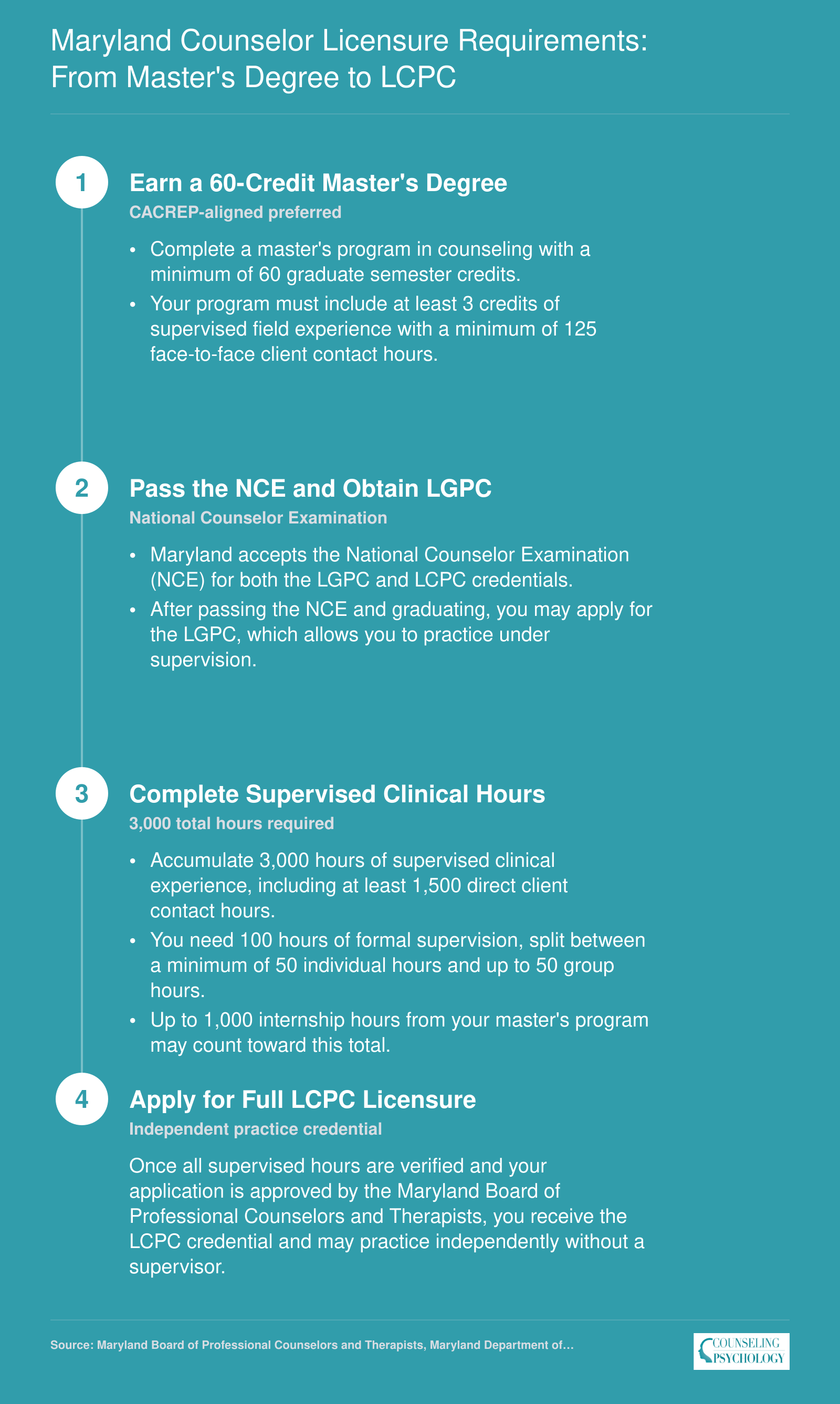
Maryland Counselor Licensure Requirements: From Master's Degree to LCPC
Maryland uses a two-tier counseling license structure. Graduates first earn the Licensed Graduate Professional Counselor (LGPC) credential, then advance to the Licensed Clinical Professional Counselor (LCPC) after completing supervised practice. Maryland does not currently offer a child-specific counseling endorsement, though counselors may pursue national credentials such as the Registered Play Therapist designation independently.
Career Outcomes and Earnings for Maryland Counselors
Career outcomes for Maryland counseling graduates center on three key questions: what you'll earn in your first years after graduation, how those earnings grow over time, and whether the degree pays off given the debt you'll carry. The answers depend on your specialization, geographic market, and credential pathway, but the data paint a clear picture of what's realistic in 2026.
Early-Career Earnings Trajectory
Program-level earnings data from Maryland's ranked counseling programs show a predictable upward arc. Graduates of Loyola University Maryland's School Counseling program, for example, earn a median of approximately $82,600 ten years post-enrollment, reflecting strong demand for school counselors in the Baltimore metro area. McDaniel College's online School Counseling graduates show median ten-year earnings near $60,700, while Frostburg State University and University of Maryland Eastern Shore Clinical Mental Health Counseling graduates report ten-year medians around $55,500 and $47,700 respectively. These figures represent outcomes for all program graduates, not just those in counseling roles, and ten-year snapshots typically capture mid-career rather than entry-level pay. One-year and four-year post-graduation earnings are not yet available for these programs, so prospective students should treat these long-term medians as context rather than immediate salary expectations.
Occupation-Level Salary Data for Maryland Counselors
BLS occupational data from May 2023 provide broader benchmarks. Substance Abuse, Behavioral Disorder, and Mental Health Counselors in Maryland earn a median annual wage of $57,820, with the tenth percentile at $41,160 and the ninetieth percentile at $97,050.1 The national median for the same occupation is $59,190, so Maryland counselors earn slightly below the national average.1 School and career counselors nationally earn a median of $65,140, reflecting the higher pay typical of school-based roles.1 The Baltimore-Columbia-Towson metro area often commands higher wages than rural Maryland markets, particularly for counselors working in hospital systems, large group practices, or specialty clinics near D.C. suburbs.
LPC vs LMFT Earnings Comparison
Prospective students frequently ask whether Licensed Professional Counselors or Licensed Marriage and Family Therapists earn more in Maryland. National data suggest the difference is modest: LPCs and LMFTs earn comparable medians in most states, with variation driven more by setting and experience than credential type. Maryland does not publish separate state-level medians for LMFTs versus LPCs, but both fall within the behavioral health counselor occupation category. In practice, LMFTs working in private practice or specialty clinics may edge slightly higher due to reimbursement rates for couples and family therapy, while LPCs in clinical counseling or substance abuse settings cluster near the state median.
Return on Investment: Debt and Monthly Payments
Median graduate debt among Maryland's ranked programs ranges from $21,100 at Frostburg State to $27,000 at Loyola and UMES. A $27,000 federal loan at 6.54 percent interest on a standard ten-year plan translates to roughly $305 per month. Against an early-career salary of $45,000 to $50,000, that's manageable but not trivial. Programs with lower net prices and shorter completion times improve ROI: Frostburg's lower tuition and UMES's hybrid model both reduce total borrowing. Students should compare debt-to-earnings ratios, aiming for total debt below one year's expected starting salary to preserve financial flexibility during supervised practice hours.
Higher-Paying Markets: Baltimore and D.C. Metros
Maryland's proximity to Washington, D.C., and the economic density of the Baltimore metro create stronger job markets and higher pay for counselors willing to commute or relocate. Those interested in community mental health counselor roles will find ample opportunity in Montgomery and Howard counties, where starting salaries run 10 to 15 percent above the state median. These premiums are driven by federal contracts, hospital networks, and suburban school systems with competitive pay scales. Rural markets in Western Maryland and the Eastern Shore offer fewer openings and lower starting wages, though cost-of-living adjustments can narrow the real-income gap.
Maryland's counseling job market offers strong earning potential and steady demand. Graduates from top programs report median earnings around $50,000 to $60,000 within four years of completion, while BLS data shows mental health counselors in Maryland earning a median salary near $57,000 annually. With projected job growth of approximately 19 percent through 2032, the state presents a favorable outlook for new counselors entering the field.
Frequently Asked Questions About Counseling Programs in Maryland
Prospective counseling students in Maryland often have questions about cost, program format, and licensure. Below are answers to some of the most common questions, drawn from current program data and state licensing guidelines.