What you’ll learn in this article…
- Missouri's top-ranked counseling master's programs feature CACREP accreditation and average net prices well below national norms.
- Full LPC licensure requires a qualifying master's degree, a provisional license (PLPC), supervised clinical hours, and board examinations.
- BLS projects 18 percent job growth for mental health counselors from 2022 to 2032, far outpacing most occupations.
- UMSL offers a 12-credit Graduate Certificate in Child and Adolescent Counseling for credentialed professionals seeking specialization.
Eighteen online and hybrid counseling master's programs met the bar for this year's Missouri rankings, which weigh affordability heavily alongside accreditation and specialization. The list includes CACREP-accredited school counseling and clinical mental health tracks, as well as a child counseling certificate route. Cost comparisons, licensure steps, and earnings data further shape the choice across the page. For a field where the BLS projects 18% national employment growth through 2032, the practical tension is between keeping student debt low and meeting Missouri's supervised-hour requirements for full LPC licensure.
Best Master's in Counseling Programs in Missouri, 2026 Rankings
Missouri offers a broad range of counseling master's programs, from CACREP-accredited clinical mental health tracks to faith-integrated school counseling degrees. The 2026 rankings below weigh affordability, online or hybrid delivery options, and institutional quality signals so you can compare programs side by side. Program-level earnings data is not yet available for any of these programs, so we have included institution-wide figures where they can help you gauge longer-term return on investment.
- Net price and tuition affordability
- Online and hybrid delivery options
- Accreditation and licensure alignment
- Institutional graduation and retention rates
- Program concentration breadth
- Independent program research
- Internal program database
- NCES-IPEDS federal institutional data — nces.ed.gov
- College Scorecard graduate earnings — collegescorecard.ed.gov

University of Missouri-Kansas City
The University of Missouri-Kansas City sits in one of the state's largest metro areas, giving counseling students access to diverse practicum placements across urban school districts. Its hybrid MA in Counseling meets both Missouri and Kansas school counselor licensure requirements, a practical advantage for students living near the state line. The institution posts a 55.5% graduation rate and a 13:1 student-to-faculty ratio, signaling manageable class sizes at the graduate level.
- Hybrid format blending online coursework with face-to-face sessions
- 45 core credit hours plus 15 to 18 emphasis area hours
- Meets both Missouri and Kansas licensure requirements
- Practicum and internship completed in K-12 school settings
- Full-time students typically finish in 2.5 to 3 years
- No specific prerequisite coursework required
- Minimum 2.75 undergraduate GPA for admission
Master of Arts in Counseling, School Counseling — Hybrid

Truman State University
Truman State University delivers two fully online, CACREP-accredited counseling tracks at $584 per credit hour, making it one of the most cost-effective options in the state. Cohorts are capped at roughly 24 students, which keeps faculty interaction high despite the online format. The school reports a 68.5% graduation rate and an 85% retention rate, among the strongest in this ranking. Rolling admission with two annual start terms gives working professionals flexibility to begin in August or January.
- 100% online, CACREP-accredited school counseling track
- 60 credit hours with a cohort-based delivery model
- 400 hours of field experience in school settings
- $584 per credit hour, roughly $35,040 total
- GRE waived for applicants with 3.0 GPA or above
- Rolling admission with August and January start dates
- 100% online, CACREP-accredited clinical mental health track
- 60 credit hour curriculum with practical field placements
- Same cohort model and per-credit pricing as the school track
- Prepares graduates for Missouri LPC licensure
- Experienced, licensed faculty mentoring throughout
- Federal financial aid eligible at six or more credits per term
Counseling: School Counseling (MA) — Online
Counseling: Mental Health Counseling (MA) — Online

University of Missouri-St Louis
The University of Missouri-St. Louis pairs a 60-credit MEd in Counseling with a reported 94% certification exam pass rate, one of the highest in the state. The hybrid format splits coursework between online and on-campus sessions at a net price of roughly $15,071. Graduates are eligible for Missouri school counselor certification as well as Licensed Professional Counselor and National Certified Counselor credentials. A 13:1 student-to-faculty ratio supports close mentorship during practicum placements across the St. Louis metro area.
- Hybrid delivery combining online and on-campus learning
- 60 credit hours covering counseling theory and school practice
- 94% certification exam pass rate among graduates
- Eligible for Missouri school counselor certification
- Pathway to LPC and NCC credentials after graduation
- Requires 3.0 GPA and two professional references
- Admissions open twice per year
Master of Education in Counseling, School Counseling — Hybrid

Missouri State University
Missouri State University in Springfield offers both school counseling and clinical mental health counseling concentrations under a single MS in Counseling umbrella, all in hybrid format. The school counseling track specifically addresses Missouri certification requirements, including guidance for applicants who do not hold a teaching certificate. With an institution-wide graduation rate of 57.9% and a net price of approximately $17,613, the program balances accessibility with breadth of training across K-12 and clinical settings.
- Hybrid format for working educators and career changers
- Meets Missouri certification requirements for school counselors
- Applicants without a teaching certificate take three additional courses
- MEGA assessment passing score required for certification
- Focus on practical K-12 counseling skills
- Prepares students for diverse educational environments
- Hybrid delivery mixing online and on-campus coursework
- Prepares graduates for Provisional Licensed Professional Counselor status
- Includes supervised practicum and internship hours
- National Counselor Examination preparation integrated into coursework
- Flexible scheduling designed for working professionals
- Training spans diverse clinical settings
Master of Science in Counseling, School Counseling — Hybrid
Master of Science in Counseling, Clinical Mental Health Counseling — Hybrid

Northwest Missouri State University
Northwest Missouri State University's 45-credit-hour MSEd in School Counseling is delivered entirely online in a cohort model designed to be completed in two years. It is one of the shorter programs on this list, which keeps total tuition exposure lower even at a net price of about $16,244. The developmental counseling framework emphasizes consultation, coordination, and direct counseling in alignment with the Missouri Comprehensive Guidance Program. The school carries a 54.2% institution-wide graduation rate and a 16:1 student-to-faculty ratio.
- 100% online with a supportive cohort structure
- 45 credit hours, completable in two years
- Developmental approach aligned with Missouri guidance standards
- Minimum 2.75 undergraduate GPA required for admission
- Three letters of recommendation and a written statement needed
- Additional coursework available for those without a teaching certificate
- Personalized faculty advising throughout the program
Master of Science Education in School Counseling — Online

University of Missouri
The University of Missouri in Columbia is the state's flagship research institution, posting the highest graduation rate (74.9%) and retention rate (93%) among programs on this list. Its online MEd with Certification in School Counselor covers both elementary and secondary levels, grounded in a scientist-practitioner model that integrates counseling psychology theory with multicultural practice. The net price of about $20,268 is higher than several competitors, but the institution's median 10-year earnings of $63,403 suggest strong long-term value.
- Available fully online or on campus in Columbia
- Covers both elementary and secondary school counseling levels
- Scientist-practitioner model with multicultural emphasis
- Requires 3.0 GPA, three recommendation letters, and a statement of purpose
- Curriculum integrates counseling psychology theory and research
- Prepares graduates for Missouri school counselor certification
- Institution posts a 74.9% graduation rate, highest on this list
School Counselor: Elementary and Secondary (MEd) — Online

Evangel University
Evangel University in Springfield stands out for combining CACREP accreditation with some of the lowest per-credit tuition among accredited programs, at roughly $420 per credit hour for the online school counseling degree. The university integrates a Christian faith perspective into both its school counseling and clinical mental health counseling tracks. An institution-wide graduation rate of 65% and a 15:1 student-to-faculty ratio point to solid student support. Graduates are prepared for the National Counselor Exam and Missouri LPC licensure.
- 100% online, CACREP-accredited school counseling program
- Approximately $420 per credit hour, among the lowest CACREP options
- Nine-semester timeline with a summer start option
- Small class sizes for personalized faculty attention
- Prepares graduates for the National Counselor Exam
- Christian faith integration throughout the curriculum
- Hybrid format with CACREP accreditation
- Prepares students for both NCMHCE and NCE exams
- Seven or nine-semester completion options available
- Training across diverse clinical settings
- Pathway to Missouri LPC licensure
- Financial aid options available for qualifying students
Master of Science in School Counseling — Online
Master of Science in Clinical Mental Health Counseling — Hybrid

Mission University
Mission University offers a fully online MA in Biblical Counseling that is distinct from every other program on this list: it does not lead to state licensure as a professional counselor. Instead, the 39 to 45 credit-hour curriculum prepares graduates for ministry-based counseling roles and certification through ACBC and IABC. With a 7:1 student-to-faculty ratio, students receive close mentorship, though the institution's 44.4% graduation rate is the lowest in this ranking. Prospective students should weigh whether church and ministry counseling, rather than clinical licensure, aligns with their career goals.
- 100% online with six-week course sessions
- 39 to 45 credit hours depending on certification track
- Eligible for ACBC and IABC certification, not state LPC licensure
- Students may transfer up to 50% of credits
- Regionally accredited by HLC and nationally by ABHE
- 7:1 student-to-faculty ratio for close mentorship
- Faculty bring direct ministry and counseling experience
Master of Arts in Biblical Counseling — Online

Missouri Baptist University
Missouri Baptist University in the St. Louis area offers both a fully online MA in School Counseling and a hybrid MA in Clinical Mental Health Counseling, giving students two licensure-aligned pathways under one roof. The school counseling program is Missouri DESE-approved and designed for completion in about 24 months, one of the fastest timelines here. The clinical mental health track is CACREP-accredited at $724 per credit hour over 60 credits. The institution's net price of roughly $27,006 is the highest among ranked schools, so financial aid planning is especially important.
- 100% online with Missouri DESE approval
- 45 credit hours, completable in approximately 24 months
- Prepares graduates for K-12 school counseling certification
- Christian worldview woven into the curriculum
- Experienced faculty with school counseling backgrounds
- Flexible scheduling for working professionals
- Hybrid delivery combining traditional and livestream classes
- CACREP-accredited, 60 credit hour program
- $724 per credit hour with evening and online class options
- Three-year completion timeline
- Professional clinical training with supervised fieldwork
- Christian faith-based approach to counselor education
Master of Arts in School Counseling — Online
Master of Arts in Clinical Mental Health Counseling — Hybrid

University of Central Missouri
The University of Central Missouri in Warrensburg rounds out the ranking with a CACREP-accredited MS in Counseling that emphasizes school counseling within a hybrid delivery model. The program reports a 99% post-graduation employment rate, and its net price of about $14,462 makes it one of the most affordable public options on this list. Students train in the university's on-site clinics, gaining hands-on experience with child and adolescent populations. No GRE is required for admission, lowering one common barrier to entry.
- CACREP-accredited hybrid program
- Net price of approximately $14,462, among the lowest in this ranking
- 99% reported post-graduation employment rate
- Hands-on training in university-operated clinics
- Focus on child and adolescent development and crisis intervention
- No GRE required for admission
- Financial aid and scholarship options available
Master of Science in Counseling, School Counseling — Hybrid
How We Ranked Missouri Counseling Programs
What makes one Missouri counseling master's program rank above another, and how can you know the difference matters for your career? Our rankings are built to cut through marketing claims and highlight the factors that directly affect your wallet, your schedule, and your path to licensure.
What We Prioritize: Cost, Flexibility, and Recognized Quality
Because this list is filtered for affordability, net price and financial aid metrics carry substantial weight. We look for programs that keep out-of-pocket costs low, whether through competitive tuition, graduate assistantships, or institutional aid. Online and hybrid delivery options also factor heavily, since working adults and students in rural Missouri need flexible access. Beyond cost, we verify CACREP accreditation independently. It is not a scored ranking field, but it serves as a gatekeeper because CACREP alignment streamlines Missouri's licensed professional counselor (LPC) requirements and signals that a curriculum meets national standards. If you are comparing options beyond the state level, our broader list of best online master's in counseling programs offers a useful reference point.
Signals from Federal Data: Earnings, Debt, and Completion
To gauge value, we use program-level median earnings and typical debt from the U.S. Department of Education's College Scorecard, alongside institution-wide graduation rates. A school that moves a high percentage of students through to a degree suggests strong support systems, a meaningful proxy when program-specific completion data is not always public. We also check the earnings-to-debt ratio to ensure graduates are not over-leveraged for a Missouri counseling salary.
What the Rankings Can't Tell You
Our approach does not capture subjective elements like curriculum depth, faculty-to-student ratios, or the quality of practicum and internship placements, all of which can make or break your clinical training. For those details, you will need to dig into the individual program profiles and school admissions pages we provide below. Rankings are a useful starting point, but they must be paired with your own research on specialization fit and learning format.
What Does a Counseling Master's Really Cost in Missouri?
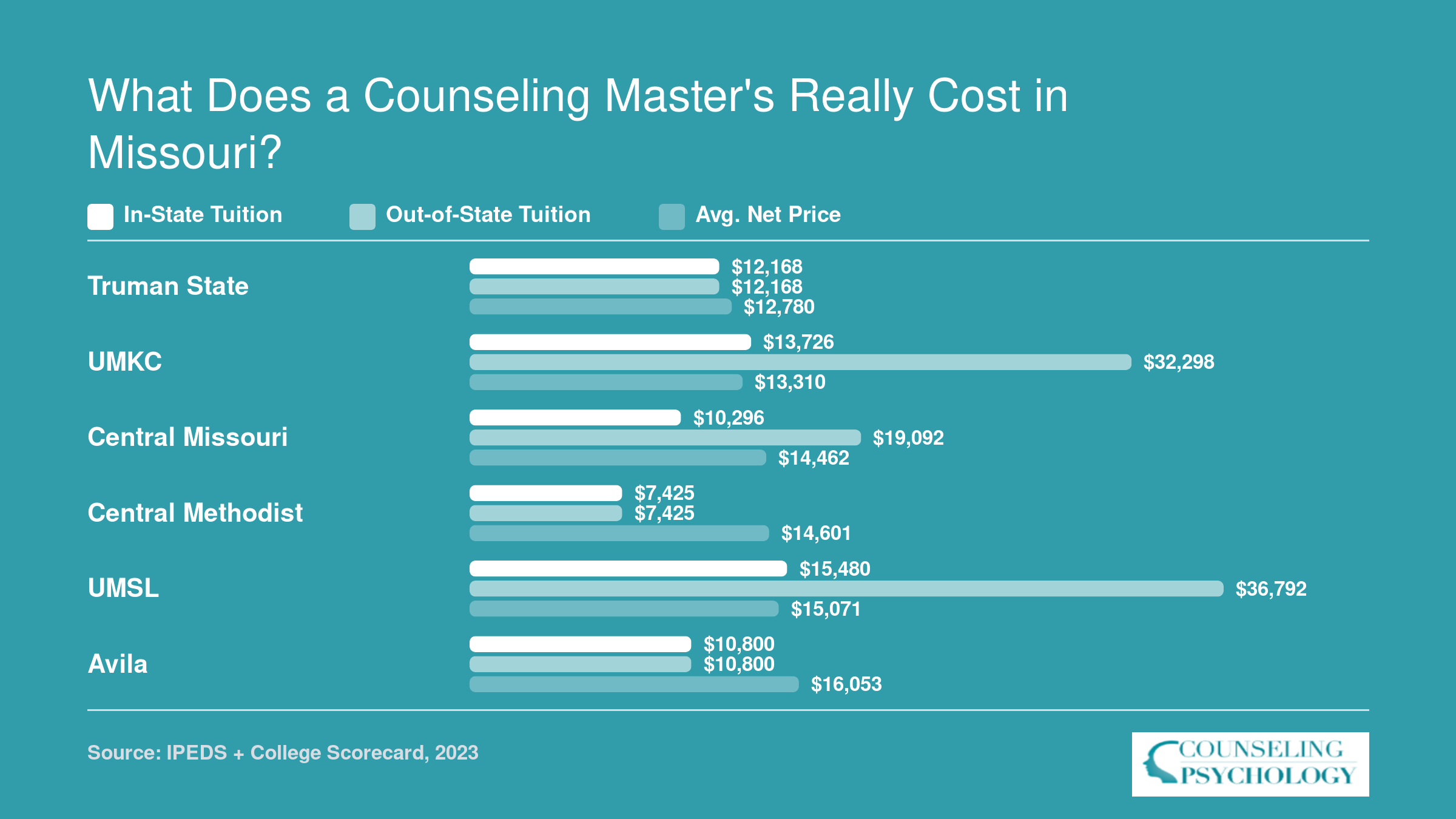
Tuition sticker prices only tell part of the story. The net price, which is an institution-wide average after grants and scholarships, gives a more realistic picture of what students actually pay. Across six top-ranked Missouri counseling programs, average net prices range from roughly $12,780 to $16,053. Keep in mind these are institutional averages and not guaranteed quotes for graduate students specifically. Median graduate debt at these schools ranges from about $17,619 to $25,000. On a standard 10-year repayment plan, that translates to roughly $180 to $260 per month, a figure worth weighing against projected counselor earnings.
Questions to Ask Yourself
Online vs. On-Campus Counseling Programs in Missouri
Every ranked program on this page offers online or hybrid coursework, giving Missouri students real flexibility in how they earn a counseling master's degree. That said, the online format comes with trade-offs worth weighing before you commit. Here is what the data and licensing landscape actually look like in 2026.
Pros
- Lower average net price: online programs among our ranked Missouri schools range roughly from $18,000 to $42,000, often undercutting traditional on-campus tuition.
- Schedule flexibility lets working professionals complete coursework evenings and weekends without relocating or leaving a job.
- Statewide access means you can enroll in a top CACREP-accredited program in Kansas City or St. Louis while living anywhere in Missouri.
- When a program holds CACREP accreditation, online degrees meet the same licensure standards as on-campus degrees, and employers recognize them accordingly.
Cons
- Practicum and clinical hours (Missouri requires supervised field experience) must still be completed in person at an approved site near you.
- Building peer and faculty relationships takes more deliberate effort online, which can limit professional networking opportunities.
- Some employers and licensing boards outside Missouri may scrutinize online credentials from programs that lack CACREP accreditation, so verifying accreditation status is essential.
- Self-directed pacing demands strong time management; students who thrive on structured classroom interaction may find the format challenging.
CACREP-Accredited Counseling Programs in Missouri
Accreditation is the single most consequential filter when shortlisting a counseling master's, because it shapes licensure eligibility, internship placement, and how portable your degree is if you ever leave Missouri. The tradeoff: a CACREP-accredited program signals a rigorous, standardized curriculum recognized across state lines, but it can also mean higher tuition, more credit hours, and stricter practicum requirements than a non-accredited alternative. For most Missouri students aiming to become a licensed professional counselor, CACREP accreditation is worth the added rigor.
Verify Accreditation at the Source
Program pages and marketing brochures are not the right place to confirm accreditation status. Accreditation can lapse, be granted mid-cycle, or apply only to specific tracks within a department.
- Primary source: Search the official CACREP directory at www.cacrep.org/directory. Filter by Missouri to see currently accredited programs and the exact tracks covered.
- Confirm the track: A single university may house several counseling concentrations (Clinical Mental Health Counseling, School Counseling, Marriage and Family, Addictions, Career), but not every track at every school is CACREP-accredited. Verify the specific specialization you want.
- Check status: Look for distinctions between fully accredited and "in process" or pending status, which can affect your licensure timeline.
Cross-Reference With Licensing and Career Sources
Accreditation gets you in the door; state licensure rules determine what happens after graduation. Understanding how to become a counselor from the outset helps you map accreditation requirements to your long-term career plan.
- Missouri Committee for Professional Counselors: The state board publishes current LPC requirements, including approved coursework, supervised hours, and exam expectations.
- Bureau of Labor Statistics (BLS.gov): Use BLS for occupational projections and wage context, keeping in mind national figures differ from Missouri-specific numbers.
- Professional associations: The American Counseling Association (ACA) and the Missouri Counseling Association (MCA) track accreditation changes, advocacy updates, and continuing education that affect practicing counselors.
Building your shortlist from these four sources, rather than rankings alone, gives you a defensible answer to the question every admissions committee and future employer will ask: is this program recognized where it counts?
Counseling Specializations and Child Counseling Certificates in Missouri
Can you get a graduate certificate in child counseling in Missouri? Yes. University of Missouri, St. Louis offers a 12-credit Graduate Certificate in Child and Adolescent Counseling designed for professionals who already hold a master's degree in mental health or a related field.1 The certificate includes an Advanced Play Therapy course option, equipping counselors to work with younger populations using evidence-based therapeutic techniques.2 Missouri State University offers a 12-credit Graduate Certificate in Forensic Child Psychology, focusing on child abuse, the legal system, and forensic assessment rather than general child counseling.3 Both certificates serve post-master's professionals seeking to add child-focused credentials without completing a second full degree.
Master's Specialization Tracks in Missouri
Missouri counseling programs offer four major specialization pathways. Clinical mental health counseling prepares graduates for LPC licensure and work in private practice, community mental health centers, and hospitals. School counseling aligns with Missouri Department of Elementary and Secondary Education (DESE) certification requirements, enabling graduates to work as K-12 school counselors. Those considering this path can learn more about how to become a school counselor, including degree and certification requirements. Marriage and family therapy tracks meet COAMFTE accreditation standards and prepare students for LMFT licensure. Child and adolescent counseling concentrations, available within some clinical mental health programs, focus coursework and practicum hours on developmental psychopathology, family systems, and play therapy techniques.
Post-Master's Certificate Pathways for Child Counseling
Counselors who earned a generalist counseling degree can add child-focused expertise through post-master's certificates. The UMSL certificate, for example, allows a practicing LPC to complete 12 credits part-time while maintaining employment, then market themselves as child and adolescent specialists. This pathway is faster and less expensive than pursuing a second master's or doctoral degree. Certificates do not by themselves confer licensure, but they document advanced training that can differentiate a practitioner in competitive markets and support referrals from pediatricians, schools, and family courts.
Linking Child Counseling to Licensure and Certification
A child counseling specialization within a master's program does not replace the LPC or school counselor credential. Missouri LPC candidates must complete 3,000 supervised hours post-master's regardless of specialization. School counselor certification through DESE requires a master's degree in school counseling specifically, typically 48 to 60 credits including a school-based practicum. Graduates who complete a clinical mental health master's with a child focus pursue LPC licensure and work in private practice, outpatient clinics, or residential treatment settings serving children and families. For a broader look at child counseling certification requirements, prospective counselors should review national standards alongside Missouri's rules. Those who complete school counseling programs pursue DESE certification and work in public or private K-12 schools. The certificate programs serve as add-ons for professionals already holding one of these primary credentials.
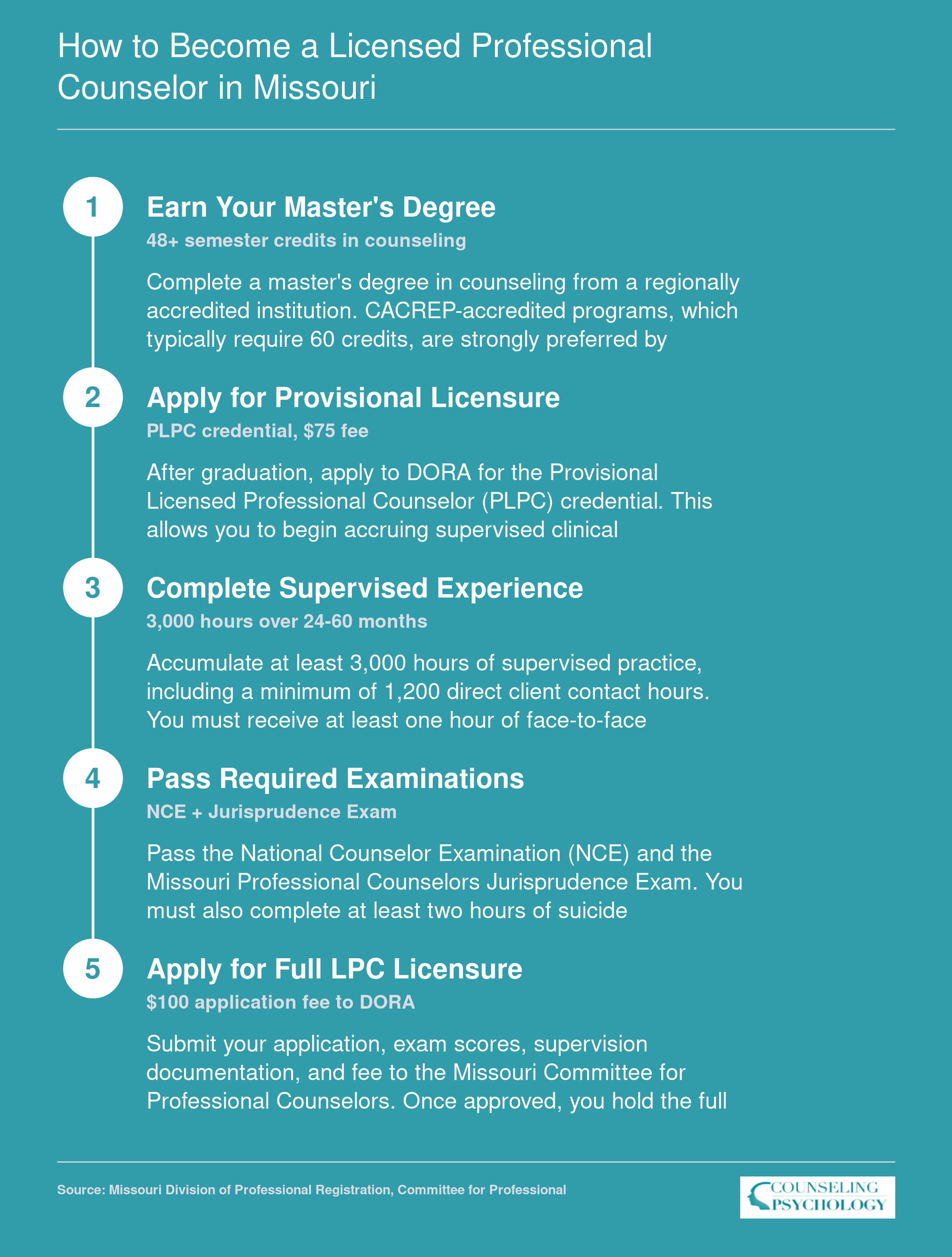
How to Become a Licensed Professional Counselor in Missouri
Missouri's path to full LPC licensure is structured but takes dedication. After completing a qualifying master's degree, graduates apply for a provisional license (PLPC), accumulate supervised clinical hours, and then pass required examinations before earning the full LPC credential through the Missouri Division of Professional Registration (DORA). For those on a school counseling track, Missouri's Department of Elementary and Secondary Education (DESE) offers an alternative route through the Initial Student Services Certificate, which requires passing the Praxis 5422 exam and is valid for four years.
Counselor Earnings and ROI in Missouri
Return on investment for a counseling master's comes down to a simple comparison: what you earn after graduation versus what you borrowed to get there. In Missouri, those numbers work out more favorably than in many higher-cost states, largely because tuition at public institutions stays moderate while counselor salaries track close to national norms.
What Missouri Counselors Actually Earn
According to the Bureau of Labor Statistics (May 2024 Occupational Employment and Wage Statistics), counselors in Missouri earn the following median annual wages:
- Mental Health Counselors (SOC 21-1014): $56,640 median, with the 10th percentile at $35,630 and the 90th percentile reaching $80,160.1
- Substance Abuse, Behavioral Disorder, and Mental Health Counselors (SOC 21-1018): Same Missouri figures: $56,640 median, ranging from $35,630 to $80,160.2
- Educational, Guidance, and School Counselors (SOC 21-1012): $59,730 median in Missouri, with the middle 50% earning between $49,500 and $70,320, and the top 10% above $83,980.3
School counselors tend to out-earn clinical mental health and substance abuse counselors at the median in Missouri, though district contracts, nine-month schedules, and licensure paths differ. Students interested in the substance abuse track specifically may want to explore addiction counseling degree options to understand the credential requirements. Note that BLS does not publish a separate Missouri wage line for licensed professional counselors (LPCs) specifically; LPC roles typically fall under the 21-1014 or 21-1018 categories above.
Comparing Debt to Earnings at Top-Ranked Programs
The internal scorecard data we have covers institution-wide medians, not program-specific outcomes for these counseling master's tracks. With that caveat, here is how graduate debt stacks up against institutional 10-year earnings figures for the five top-ranked Missouri programs in this guide:
- University of Missouri (Columbia): Median graduate debt around $20,500; institutional median earnings $63,403.
- University of Missouri-Kansas City: Debt around $18,750; earnings $59,637.
- Truman State University: Debt around $21,000; earnings $56,280.
- University of Missouri-St. Louis: Debt around $20,000; earnings $53,037.
- Lindenwood University: Debt around $26,000; earnings $53,278.
On a standard 10-year repayment at roughly 7%, a $20,000 loan runs about $232 per month, less than 6% of gross monthly income at Missouri's mental health counselor median. That is a workable ratio, though clinical counselors in their first one to two years post-graduation (pre-LPC) typically earn closer to the 10th percentile while accumulating supervised hours, so budget accordingly for the licensure-track years.
According to the Bureau of Labor Statistics Occupational Outlook Handbook, employment of substance abuse, behavioral disorder, and mental health counselors is projected to grow 18 percent from 2022 to 2032, which is much faster than the average for all occupations. That means thousands of new positions are expected to open nationally each year.
Admission Requirements and Practicum Hours: What to Expect
What GPA and test scores do I actually need for a Missouri counseling master's?
Admission standards vary, but most CACREP-accredited programs in Missouri set a minimum undergraduate GPA around 2.75 on a 4.0 scale.1 Missouri State University, for example, lists this as its floor, though competitive cohorts often exceed it. Many programs now treat the GRE as optional: Missouri State offers a waiver, though you may still submit MAT or GRE scores if you wish.1 Expect to provide three letters of recommendation and a personal statement that articulates your fit for the profession. A bachelor's degree is the baseline prerequisite; specific undergraduate coursework in psychology or a related field is rarely required, but having some background can strengthen an application. Interviews are a common hurdle: Missouri State requires one, and UMKC and University of Central Missouri also screen finalists this way.1 Some programs also mandate a background check before clinical placement.
Practicum and Internship Hours
All CACREP-accredited programs build toward licensure with a standardized clinical sequence: a practicum of at least 100 hours, followed by a 600-hour internship.2 At UMKC, students typically spend about 10 hours per week in practicum and then ramp up to roughly 17 hours per week during internship.3 These experiences are supervised, site-based, and designed to give you direct client contact under professional mentorship. If you are mapping the full path from graduate school to practice, our guide on how to become a mental health counselor outlines every step after graduation.
How Online Students Arrange Local Placements
If you choose an online program like Central Methodist University's MS in Clinical Counseling, the fieldwork component works the same way, but you will need to coordinate placements near your own community.4 Most programs have a clinical placement coordinator who helps identify approved sites, such as community mental health centers, private practices, or school counseling settings. Be prepared to initiate contact and secure a site early, as slots can fill. The key is ensuring the site meets CACREP's supervision requirements.2 Online students may also participate in synchronous remote supervision sessions to stay connected with faculty.
Evaluating Programs: A Comparison Framework
To compare Missouri counseling master's effectively, weigh these factors side by side:
- GPA floor: See if the program has a hard cutoff or prefers a higher average. A 2.75 minimum is common, but some may admit provisionally.
- Testing policy: Note whether GRE/MAT scores are optional, waived, or required. This can simplify your application timeline.
- References and essays: Count the letters required and note any specific prompts; some programs ask for a diversity statement or a counseling philosophy.
- Interview and background check: Determine if an on-campus or video interview is part of the process and whether a background check is needed upfront.
- Clinical hours structure: Confirm the practicum and internship hour totals match CACREP standards, and ask how placements are set up, especially if you are an online learner.
- Specialty tracks: Some Missouri programs offer emphasis areas like school counseling, clinical counseling, or addictions; align these with your career goals.
Using this checklist will help you weigh options like Missouri State, UMKC, UCM, and Central Methodist and find a program that fits both your academic profile and logistical needs.
Frequently Asked Questions About Missouri Counseling Programs
Choosing a counseling master's program raises a lot of practical questions, from costs and accreditation to licensing timelines. Below are answers to the questions prospective students ask most often about Missouri counseling programs.
More Missouri Counseling Master's Programs to Consider
In addition to our top-ranked programs, these additional Missouri counseling master's programs offer diverse formats and specializations that may match your needs. Be sure to visit each program's website to verify current CACREP accreditation status and request detailed information about admission requirements and curriculum.
Central Missouri
- Master of Science in Clinical Counseling
- Behavioral Health
- Master of Education in Counseling (Addiction Counseling)
Kansas City Area
- Master of Arts in Education in K-12 School Counselor
St. Louis Area
- Counseling (MA) School Counseling Track
- Clinical Mental Health Counseling
- MA in Counseling (Clinical Mental Health Counseling)
Northeast Missouri
- Master of Arts in Counseling (Clinical Mental Health)