Key Takeaways
- CACREP accreditation is essential for smooth Oregon LPC licensure and interstate credential portability.
- Oregon graduate counseling tuition ranges from roughly $9,640 to $22,470 per year across ranked programs.
- Oregon mental health counselors earn a median annual wage above $55,000 according to state level BLS data.
- All formats, including fully online programs, require in person practicum and internship hours in Oregon.
Oregon's demand for licensed professional counselors and marriage and family therapists has grown steadily over the past five years, driven by expanding telehealth access and statewide mental health initiatives. Today, prospective students in Oregon can choose from ten ranked master's programs offering clinical mental health counseling, school counseling, or marriage and family therapy specializations. Tuition varies widely: annual costs range from approximately $9,640 at Corban University to $22,470 at Oregon Institute of Technology for in-state students, and private institutions like George Fox and Corban offer hybrid formats designed for working adults.
Most Oregon programs now blend online coursework with mandatory in-person practicum and internship hours, a hybrid model that reduces commute time without compromising supervised clinical training. CACREP and COAMFTE accreditation remain the gold standard for licensure eligibility, and choosing an accredited program today determines whether you can sit for the National Counselor Examination or pursue reciprocal licensure in other states three years from now. Students interested in the couples and family track should also explore accredited MFT programs online for additional options.
Program length, clinical hour requirements, and specialization options differ sharply across institutions. Some students prioritize low tuition and public-university ROI; others value smaller cohorts, faith-integrated curricula, or child and adolescent counseling certificates. If you are still exploring whether counseling is the right fit, our overview of how to become a counselor walks through the full career path. Understanding how Oregon's Board of Licensed Professional Counselors evaluates degree programs and clinical hours is the first filter in matching your financial constraints and career goals to the right program format.
Best Counseling Master's Programs in Oregon: 2026 Rankings
Oregon offers a strong mix of public and private counseling master's programs, many of which use hybrid or fully online delivery to serve working professionals across the state and Pacific Northwest. The rankings below weight net price and financial aid availability heavily, reflecting the affordability and online filters active on this page. Graduation rates cited are institution-wide figures reported to the federal government, not specific to an individual counseling program.
- Net price and financial aid
- Graduation and retention rates
- Online or hybrid delivery
- Accreditation and licensure alignment
- Graduate earnings outcomes
- Internal program database
- College Scorecard graduate earnings — collegescorecard.ed.gov
- NCES-IPEDS federal institutional data — nces.ed.gov
- Independent program research

Oregon Institute of Technology
Oregon Institute of Technology brings a health-sciences orientation to its Marriage and Family Therapy M.S., one of only a few hybrid MFT programs in southern Oregon designed to address rural mental health workforce gaps. Students choose among three concentrations and complete clinical hours through regional partnerships, all while benefiting from one of the lowest average net prices among Oregon four-year institutions. The institution-wide graduation rate is 53.8%.
- Hybrid format blends online coursework with campus sessions
- Concentrations in Medical Family Therapy, Substance Use Disorder Treatment, and Integrated Behavioral Healthcare
- Emphasis on rural mental health and multicultural competence
- Training in trauma-informed care and co-occurring disorders
- Average net price of approximately $15,706 (institution-wide)
- Curriculum aligned with AAMFT and ACA ethical codes
- Southern Oregon health-profession partnerships support clinical placements
Marriage and Family Therapy M.S. — Hybrid

Oregon State University
Oregon State University's College of Education delivers CACREP-accredited hybrid master's programs in both Clinical Mental Health Counseling and School Counseling, each structured as a three-year, part-time pathway so students can keep working. Coursework is completed online through Ecampus with bimonthly in-person sessions in Corvallis, and the programs are designed to meet licensure requirements in Oregon, Washington, and many other states. The university reports an institution-wide graduation rate of 70.1%.
- CACREP-accredited hybrid program with online and in-person components
- Part-time, three-year design for working professionals
- Prepares graduates for LPC licensure in multiple states
- Diversity and social justice integrated throughout the curriculum
- Reported 1:12 faculty-to-student ratio in counseling cohorts
- No full-time enrollment option, reinforcing the part-time schedule
- CACREP-accredited hybrid format with Ecampus delivery
- Three-year, part-time completion timeline
- Eligible for National Certified Counselor credential
- Cohort-based learning with twice-quarterly campus meetings
- Focused on K-12 student academic and social-emotional development
- Designed for educators and career changers alike
Master of Counseling in Clinical Mental Health — Hybrid
Master of Counseling in School Counseling — Hybrid

University of Oregon
The University of Oregon's Couples and Family Therapy program is one of the few COAMFTE-accredited master's options in the state, requiring 90 credits and 350 direct client contact hours. A Spanish Language Specialization sets it apart from every other Oregon counseling program, directly addressing bilingual counseling workforce needs across the Pacific Northwest. The institution-wide graduation rate stands at 71.7%.
- COAMFTE-accredited 90-credit program with cohort model
- 350 direct client contact hours required for graduation
- Clinical training at the Center for Healthy Relationships
- Spanish Language Specialization available for bilingual practice
- Cohort of 22 to 24 students admitted each year
- Prepares graduates for LMFT licensure in Oregon
- Faculty recognized with teaching and research awards
Couples and Family Therapy M.S. — Hybrid

Bushnell University
Bushnell University in Eugene offers a CACREP-accredited MA in Clinical Mental Health Counseling alongside a graduate certificate in School Counseling, both delivered in hybrid evening and online formats. The clinical mental health program reports an 81 to 90 percent licensure exam pass rate and can be completed in about 28 months, while the school counseling certificate adds PK-12 licensure eligibility for professionals who already hold a graduate degree. With a 12:1 student-to-faculty ratio, cohorts are small and practitioner-instructors lead most courses.
- CACREP-accredited 60-credit hybrid program
- Approximately 28-month completion timeline
- Reported 81 to 90 percent licensure exam pass rate
- Onsite counseling clinic provides supervised client hours
- Tuition approximately $830 per credit hour
- Multicultural counseling emphasis woven into core courses
- 33-credit hybrid evening and online program
- Completed in approximately 22 months
- Requires an existing graduate degree for admission
- 600 hours of internship in local school settings
- TSPC-accredited for PK-12 counseling licensure
- Cohort model with practitioner-instructors
MA in Clinical Mental Health Counseling — Hybrid
Certificate in School Counseling — Hybrid

Corban University
Corban University pairs CACREP accreditation with a Christian worldview in its 60-credit MA in Clinical Mental Health Counseling, delivered through hybrid evening and online classes on its Salem campus. The two-year, full-time track is among the shortest completion timelines of any CACREP-accredited hybrid program in Oregon, and scholarships are available to offset the private-institution price tag. The institution-wide graduation rate is 60.6%.
- CACREP-accredited 60-credit hybrid program
- Two-year full-time completion option
- Evening and online classes on the Salem campus
- Biblical foundation integrated with social justice coursework
- Scholarships available to reduce total cost
- Diverse practicum and internship placement sites
- Faculty with active clinical experience
MA in Clinical Mental Health Counseling — Hybrid

George Fox University
George Fox University stands out for offering dual-licensure preparation: graduates of its Marriage, Couple and Family Counseling program can pursue both LPC and LMFT credentials in Oregon. A separate Clinical Mental Health Counseling master's adds play therapy and trauma response electives. Both degrees are CACREP-accredited and available through online synchronous or hybrid tracks with predictable scheduling, and completion timelines range from two to four years. The institution-wide graduation rate is 72%.
- 64-credit CACREP-accredited program with dual LPC and LMFT preparation
- Online synchronous and hybrid tracks available
- 700 supervised clinical internship hours required
- Tuition approximately $826 per semester credit hour
- Three- and four-year completion options
- Spiritual integration without exclusively Christian counseling focus
- 280 hours of direct client contact plus 120 relational hours
- CACREP-accredited with online and in-person options
- Prepares graduates for LPC licensure in Oregon
- Play therapy and trauma response specialization coursework
- Flexible day, evening, and weekend class scheduling
- Systemic counseling perspective throughout the curriculum
- Two- to four-year completion timeline
Marriage, Couple and Family Counseling — Hybrid
Clinical Mental Health Counseling Master's — Hybrid

University of Western States
University of Western States delivers a fully online MS in Clinical Mental Health Counseling built around 90 quarter credits and an innovative standardized patient program that sharpens diagnostic skills before students enter community placements. Based in Portland, the program holds MPCAC accreditation and charges approximately $631 per credit, positioning it as a competitively priced private option for students who need 100% online coursework. Net price data is not currently available for this institution.
- 100% online delivery with local clinical placements
- MPCAC-accredited 90-quarter-credit curriculum
- Standardized patient program for clinical skill building
- Approximately $631 per credit hour
- Five terms of supervised clinical placement
- Faculty-assisted placement support for internship sites
- Spring and fall entry terms available
MS in Clinical Mental Health Counseling — Online

Portland State University
Portland State University leverages its urban location to offer a CACREP-accredited Marriage, Couple, and Family Counseling program with deep community-based internship partnerships across the Portland metro area. The 90-credit, three-year cohort model includes evening classes and daytime clinical training, preparing graduates for both LPC and LMFT licensure. As a public institution, PSU's average net price of roughly $9,552 is the lowest on this list for Oregon residents.
- CACREP-accredited 90-credit cohort-based program
- Prepares for both LPC and LMFT licensure in Oregon
- In-person evening classes with daytime clinical requirements
- Estimated resident total cost of approximately $56,350
- Community Counseling Clinic provides on-campus client hours
- Internships of 20 to 30 hours per week in the final year
- Multicultural counseling and legal/ethical coursework included
Marriage, Couple, and Family Counseling — Hybrid

Eastern Oregon University
Eastern Oregon University's 100% online MS in Clinical Mental Health Counseling is designed for students who cannot travel to campus at all, with no residency requirement and a flat tuition rate of roughly $537 per credit. The program's curriculum meets licensure requirements in 41 states, making it one of the most portable credentials on this list. With a 14:1 student-to-faculty ratio, EOU offers more individualized mentoring than many larger online programs.
- 100% online with no in-person residency requirement
- 90 quarter credits with full- or part-time pacing
- Flat tuition rate of approximately $537 per credit
- Designed to meet licensure requirements in 41 states
- No GRE required for admission
- Three terms of supervised clinical experience
- 14:1 student-to-faculty ratio for individualized support
MS in Clinical Mental Health Counseling — Online

Western Seminary
Western Seminary's CACREP-accredited MA in Counseling integrates Christian theological perspective with rigorous clinical training, culminating in 700 clinical experience hours and a reported 98% first-attempt national counselor exam pass rate. The hybrid program operates from its Portland campus with flexible scheduling, and an optional Addiction Studies certificate deepens expertise for students drawn to substance use treatment. Net price and graduation rate data are not currently reported for this institution.
- CACREP-accredited 68-credit hybrid program
- Reported 98% first-attempt national exam pass rate
- 700 clinical experience hours across diverse settings
- Christian theological integration throughout curriculum
- Three-year completion option with flexible scheduling
- Optional Addiction Studies certificate available
- Portland campus with regional hybrid access for PNW students
MA in Counseling (Clinical Mental Health Counseling) — Hybrid
Online vs. On-Campus Counseling Programs in Oregon
Oregon offers counseling master's programs in fully online, hybrid, and traditional on-campus formats. Each has trade-offs across cost, scheduling, and peer connection. One thing remains constant: regardless of how you take your coursework, practicum and internship hours must be completed face to face at an approved clinical site in your community. Oregon students typically need 700 clinical hours before graduating, plus 1,900 hours of supervised post-degree experience for LPC licensure, so your ability to secure a local placement matters as much as the delivery format you choose. The good news is that employers and licensing boards evaluate your degree based on accreditation status, not whether classes were online or in person. A CACREP-accredited online program carries the same weight as a CACREP-accredited campus program.
| Factor | Online Programs | Hybrid Programs | On-Campus Programs |
|---|---|---|---|
| Schedule Flexibility | Highest flexibility; coursework is asynchronous or synchronous from home (e.g., Eastern Oregon University's fully online MS) | Moderate flexibility; most coursework online with periodic campus visits (e.g., Oregon State University Ecampus M.Coun. meets twice per quarter on campus) | Least flexible; set class times, often evenings (e.g., Portland State University's in-person CMHC program) |
| Clinical Hour Requirements | 700 hours of practicum and internship completed in person at a community site; programs like EOU help students secure placements near their home | 700 hours at community sites, often coordinated through the campus clinical training office | 700 hours typically completed at campus clinics and affiliated community agencies |
| Peer Interaction | Virtual cohort connections; George Fox's online synchronous track adds in-person residencies to strengthen peer bonds | Stronger peer connections through quarterly or monthly campus intensives | Daily face-to-face interaction with classmates and faculty |
| Typical Credit Load | 90 quarter credits (EOU) to 64 semester credits (George Fox) | 90 quarter credits (Oregon State) to 68 semester credits (Western Seminary) | 90 quarter credits (Portland State) |
| Cost Considerations | May save on commuting and housing; EOU charges roughly $537 per credit regardless of residency | Similar tuition to on-campus, but reduced travel costs between campus visits | Full campus fees plus commuting or relocation costs; Portland State estimates about $56,350 for the full resident program |
| Accreditation and Employer Perception | Respected equally when the program holds CACREP (or equivalent) accreditation; what matters for Oregon LPC licensure is accreditation, not delivery format | Same accreditation standards apply; many Oregon hybrid programs are CACREP-accredited (e.g., Corban University, Western Seminary) | Same accreditation standards; Portland State's CMHC is CACREP-accredited |
| Best Suited For | Working professionals and students in rural or underserved areas of Oregon who need maximum scheduling control | Students who want a blend of independent study and regular face-to-face mentorship | Students who prefer immersive, daily campus engagement and easy access to on-site training clinics |
Child and Adolescent Counseling Specializations in Oregon
Earning a full master's degree versus adding a focused certificate represents the core decision for counselors who want to specialize in working with children and adolescents. If you are still completing your graduate education, choosing a program with dedicated child and family coursework saves time. If you already hold a master's degree and want to pivot into child counseling, a post-master's certificate can get you there without repeating years of study. For a broader look at what the field involves, our guide on how to become a child counselor covers degree paths and requirements.
Oregon Programs With Child and Adolescent Coursework
Several counseling master's programs in Oregon weave child-focused content into their curricula, though the depth varies. When evaluating any program, look for coursework in these areas as signals of a strong child counseling track:
- Child development: Covers cognitive, social, and emotional milestones and how deviations inform clinical work.
- Trauma-informed care: Teaches evidence-based approaches for treating childhood adversity, abuse, and complex trauma.
- Play therapy: Introduces therapeutic techniques designed for younger clients who may not respond to traditional talk therapy.
- Family systems: Explores how family dynamics shape a child's mental health and how to engage caregivers in treatment.
School counseling tracks at Oregon institutions typically incorporate many of these topics, making them a natural fit for students drawn to child and adolescent populations.
Graduate Certificate Options for Oregon Residents
Oregon offers several certificate pathways that let you specialize without starting a new degree.
Portland State University's School Counseling Certificate for Post-Master's Students requires 18 to 32 credits and is available in both in-person and online formats.1 Applicants must hold a master's degree in counseling, psychology, or social work, and completers earn a Preliminary School Counselor License.
Bushnell University offers a Certificate in School Counseling delivered in a hybrid format over 22 months.2 At 33 credits, this is a more substantial commitment, but it leads to a PK-12 Preliminary School Counseling License and is approved by Oregon's Teacher Standards and Practices Commission.
For those interested in childhood trauma counseling rather than school-based practice, the University of Oregon's Ballmer Institute offers a fully online Graduate Microcredential in Child Behavioral Health.3 At just 12 credits and open to anyone with a bachelor's degree, it is the most accessible entry point, though it does not lead to licensure on its own.
Bridge Pathways for Career Changers
If you already hold a master's degree in a related field, post-master's certificates like those at Portland State and Bushnell are designed specifically for your situation. They let you add a school counseling credential without repeating foundational coursework you have already completed. The credit range at Portland State (18 to 32) reflects this flexibility: students with more prior coursework may need fewer credits to satisfy Oregon licensing standards.
Keep in mind that Oregon's Licensed Professional Counselor pathway requires three years of supervised post-master's experience regardless of specialization.4 Adding a child-focused certificate does not change that timeline, but it does position you for roles in school districts, pediatric mental health agencies, and community organizations that serve youth. If your goal is clinical work with children outside the school setting, pairing an LPC with specialized training in play therapy or trauma-informed care strengthens your candidacy considerably.
Questions to Ask Yourself
Accreditation and Oregon Licensure Requirements for Counselors
Choosing a program is partly a bet on accreditation: the school you pick today determines how smoothly you can sit for exams and get licensed three to seven years from now. In Oregon, that bet centers on whether your program holds CACREP accreditation, because the state's licensure pathway is built around the standards CACREP enforces.
CACREP vs APA: What Each Covers
CACREP (the Council for Accreditation of Counseling and Related Educational Programs) accredits master's and doctoral programs in counseling, covering clinical mental health counseling, school counseling, marriage and family counseling, and similar tracks. APA (American Psychological Association) accreditation, by contrast, applies almost exclusively to doctoral programs in psychology (PhD and PsyD), along with internships and postdoctoral residencies. APA does not accredit master's-level counseling degrees.
For anyone planning to become a licensed professional counselor in Oregon or a certified school counselor, CACREP is the relevant credential. APA accreditation matters if you are pursuing a doctoral psychology license instead.
CACREP-Accredited Programs in Oregon
CACREP maintains a live directory that is updated as programs gain, renew, or lose accreditation.1 Rather than rely on a static list that may go stale between application cycles, verify current Oregon programs directly through the CACREP directory before you apply. Search by state and filter by specialty area (clinical mental health, school counseling, etc.) to see which Oregon institutions and tracks are currently accredited.
Oregon LPC Licensure Steps
The Oregon Board of Licensed Professional Counselors and Therapists (OBLPCT) sets the LPC pathway.2 Core requirements:
- Degree: A master's or doctoral degree in counseling or a closely related field, with at least 60 semester hours of graduate coursework.3
- Practicum and internship: 700 total clinical hours during your program, including at least 280 hours of direct client contact.3
- Post-degree supervised experience: 1,900 hours of supervised work, completed over a minimum of 36 months. Up to 400 hours earned pre-degree (within one year of graduation) can count toward this total under rules effective July 1, 2023.1
- Exams: Pass the NCE or NCMHCE, plus an Oregon state law and rules exam.3
- Background check: Required for all applicants.3
School Counselor Certification
Oregon school counselors are licensed through the Teacher Standards and Practices Commission, not OBLPCT. The pathway requires a master's in school counseling and a school counselor license, and it does not require the NCE or the 1,900 post-degree hours. For a broader look at this career track, see our guide on how to become a school counselor.
The Non-CACREP Risk
Graduating from a non-CACREP program is not an automatic disqualifier in Oregon, but OBLPCT will scrutinize your transcript course by course to confirm it meets content requirements. Expect delays, possible coursework gaps to backfill, and additional documentation. Starting with a CACREP-accredited program removes that friction entirely.
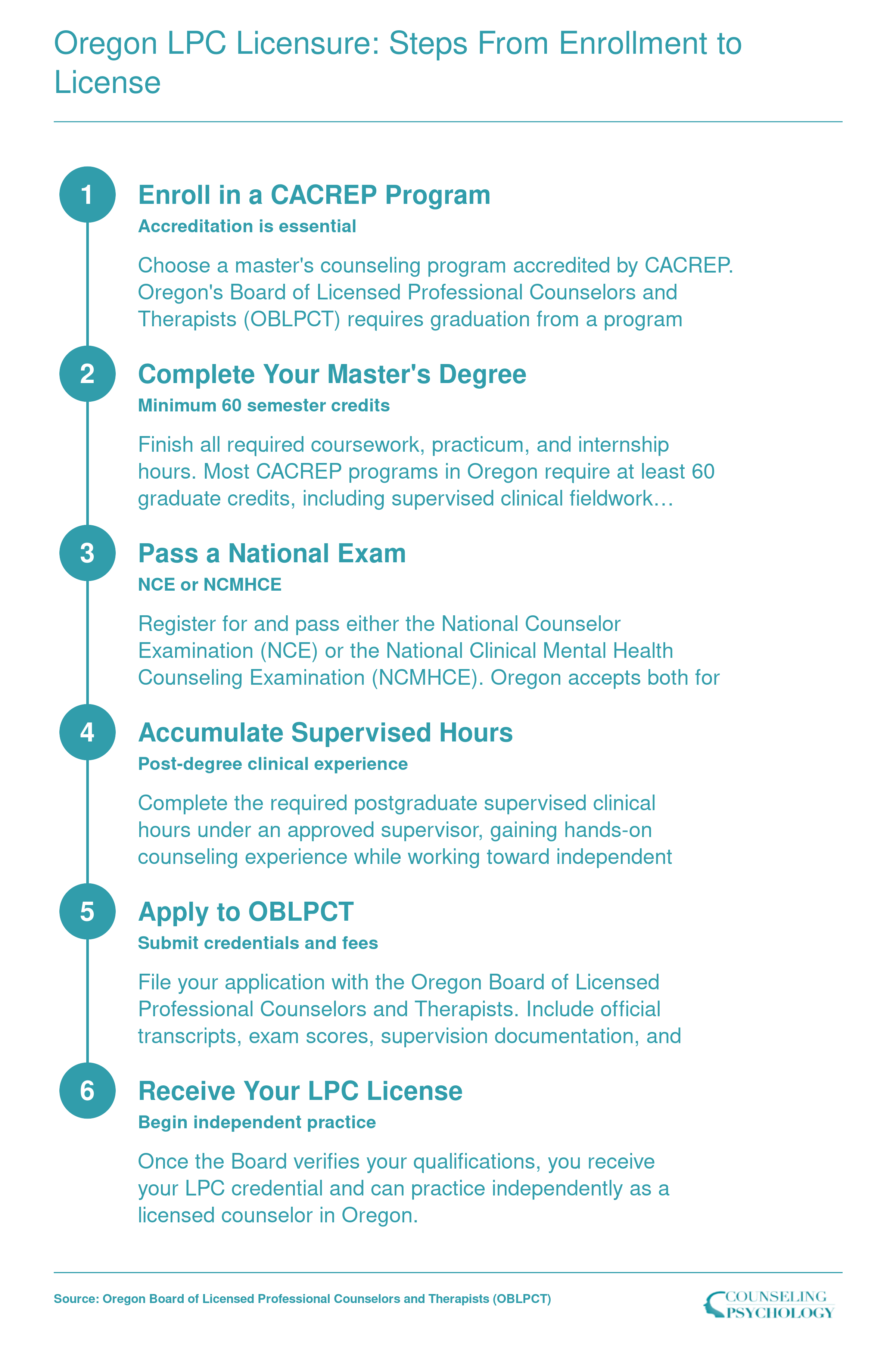
Oregon LPC Licensure: Steps from Enrollment to License
Earning your Licensed Professional Counselor (LPC) credential in Oregon follows a clear, sequential path. Each step builds on the last, so understanding the full timeline before you enroll helps you plan efficiently and avoid delays.
Tuition, Financial Aid, and Return on Investment
How much does an online Master's in counseling cost in Oregon? Based on the programs in our 2026 ranked set, graduate tuition ranges from roughly $9,640 per year (Corban University) to $22,470 per year (Oregon Institute of Technology for in-state students), though total program costs vary by credit requirements and program length. The net price figures shown below are institution-wide averages drawn from federal data and do not reflect program-specific costs for counseling master's students. Program-level earnings and debt data are not yet available for these specific counseling programs, so the table uses institution-wide medians from College Scorecard to give a general sense of return on investment. Portland State University stands out as the most affordable option by net price ($9,552), while Oregon Institute of Technology posts the strongest institution-wide earnings figure ($72,273), giving it the highest ROI ratio in the set.
| School | Tuition (In-State) | Tuition (Out-of-State) | Net Price (Institution Avg.) | Median Graduate Debt | 10-Year Median Earnings (Institution) | ROI Ratio |
|---|---|---|---|---|---|---|
| Oregon Institute of Technology | $22,470 | $36,164 | $15,706 | $22,500 | $72,273 | 3.21 |
| University of Oregon | $19,474 | $33,379 | $22,182 | $20,139 | $61,324 | 3.05 |
| Oregon State University | $16,206 | $33,351 | $19,604 | $21,221 | $64,010 | 3.02 |
| Portland State University | $17,745 | $23,334 | $9,552 | $20,500 | $57,906 | 2.82 |
| George Fox University | $15,920 | $15,920 | $31,679 | $24,250 | $59,761 | 2.46 |
| Eastern Oregon University | $19,332 | $19,332 | $17,148 | $20,500 | $50,112 | 2.44 |
| Bushnell University | $18,040 | $18,040 | $20,789 | $23,500 | $53,623 | 2.28 |
| Corban University | $9,640 | $9,640 | $28,035 | $22,625 | $48,917 | 2.16 |
| University of Western States | $16,134 | $16,134 | N/A | N/A | $27,382 | N/A |
Career Outlook and Salaries for Counselors in Oregon
How much can you actually earn as a licensed counselor in Oregon, and is the job market strong enough to justify the investment in a master's degree?
Oregon Wage Data for Mental Health Counselors
According to occupational wage data published by the Bureau of Labor Statistics, mental health counselors (SOC 21-1014) in Oregon earn a median annual wage that falls in line with the broader Pacific Northwest market but varies significantly by experience and setting.1 Workers at the 10th percentile, typically those just entering the field or working in lower-paying community agencies, earn considerably less than the median, while those at the 90th percentile (often supervisors, private practitioners, or counselors in specialized settings) earn substantially more. Oregon's cost of living, particularly in the Portland metro area, should factor into how you evaluate these numbers. State-specific wage estimates are published through the Occupational Employment and Wage Statistics (OEWS) program, and Oregon QualityInfo maintains its own wage tables that may differ slightly in methodology from the national BLS figures.2
School and Career Counselors in Oregon
School and career counselors (SOC 21-1012) in Oregon tend to earn higher median wages than their clinical mental health counterparts, largely because school counselor positions carry salary schedules tied to district pay scales and often include benefits such as retirement plans and summer schedules.1 If you are weighing a clinical mental health counseling track against a school counseling track, the wage gap is worth noting. Oregon State University and Bushnell University both offer school counseling pathways that prepare graduates for TSPC licensure and entry into K-12 settings where compensation is generally more predictable.
LPC vs. LMFT: Which License Pays More in Oregon?
This is one of the most common questions prospective students ask. In Oregon, Licensed Professional Counselors (LPCs) and Licensed Marriage and Family Therapists (LMFTs) occupy overlapping but distinct roles. LPCs typically have a broader scope of practice covering individual and group counseling across clinical settings, while LMFTs specialize in relational and systemic therapy with couples and families. From a salary perspective, the BLS does not break out separate Oregon-specific wage estimates for LMFTs versus LPCs under a single clean comparison, because marriage and family therapists fall under a different SOC code (21-1013) with a smaller sample size in many states.1 In practice, Oregon LPCs and LMFTs working in agency settings earn similar wages. The real income difference tends to emerge in private practice, where LMFTs who build a niche in couples or family therapy can command higher session rates. Programs at George Fox University and Portland State University that prepare students for dual LPC and LMFT licensure can give graduates flexibility to pursue whichever path proves more lucrative.
What Do Graduates of Oregon Programs Actually Earn?
Program-level earnings data from the College Scorecard are not yet available for the counseling master's programs ranked on this list. That means we cannot report one-year or longer-term post-graduation median earnings specific to these degrees at this time. However, institution-wide median earnings ten years after entry offer a rough frame of reference. Oregon Institute of Technology graduates report the highest figure among the ranked schools at roughly $72,270, followed by Oregon State University near $64,010 and the University of Oregon at about $61,320. Keep in mind these are all-program averages and not specific to counseling degrees.
Job Growth Outlook
The Bureau of Labor Statistics projects strong demand for substance abuse, behavioral disorder, and mental health counselors nationally through the end of the decade, with growth rates well above average for all occupations.1 Oregon mirrors this trend. Expanding insurance parity laws, growing awareness of mental health needs in rural communities, and school districts investing in student wellness all contribute to a favorable hiring environment across the state. For students exploring counseling careers, the combination of strong projected demand and multiple licensure pathways in CACREP-accredited programs positions Oregon as a solid market to launch a counseling career. Those interested in the clinical track specifically may also want to review the best masters in mental health counseling programs to compare options beyond Oregon's borders.
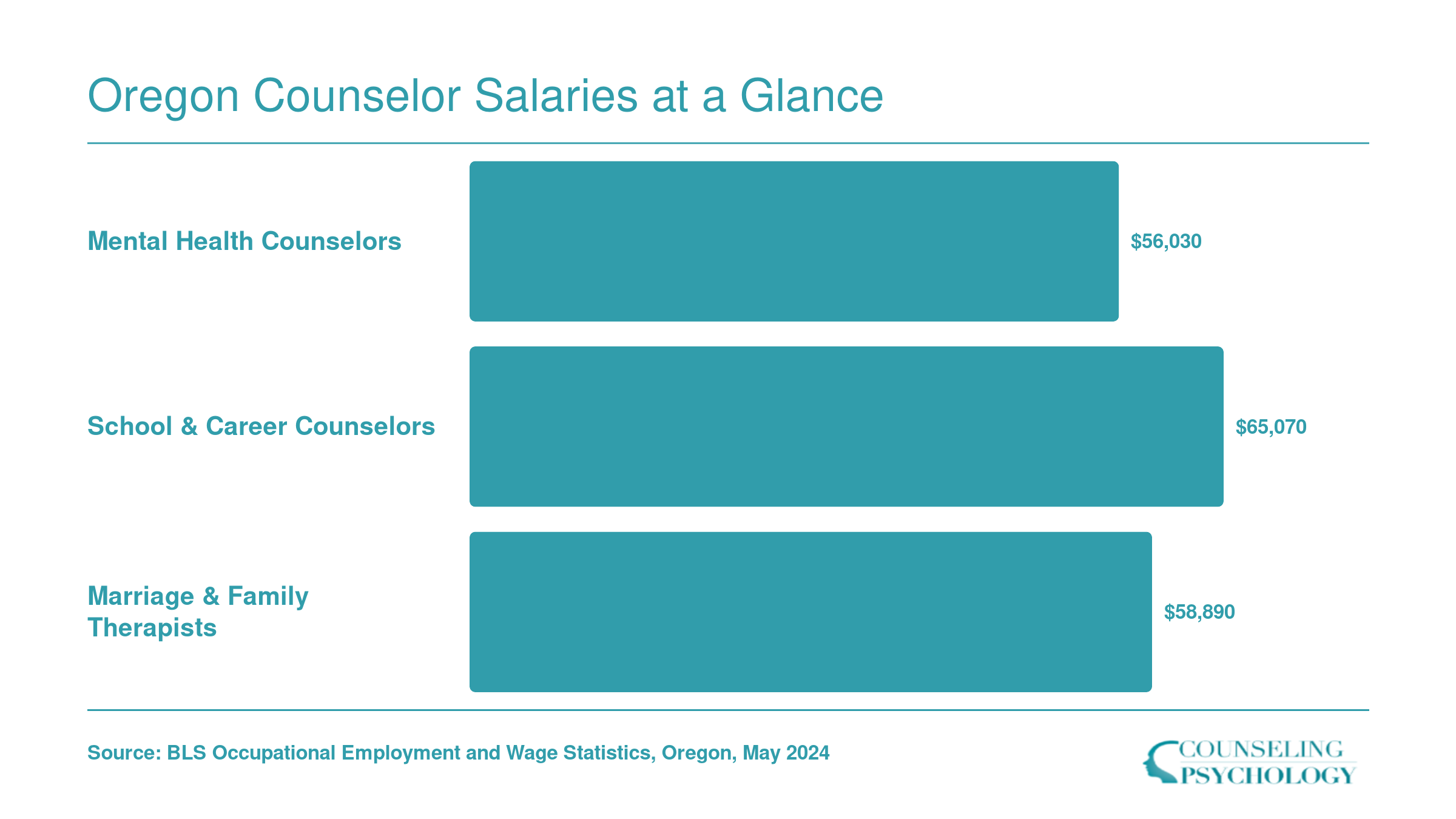
Oregon Counselor Salaries at a Glance
Salaries for counseling professionals in Oregon vary by specialty. The grouped comparison below shows Oregon-specific median annual wages for three common counselor occupations, based on BLS data.
How to Choose the Right Counseling Program in Oregon
Choosing the right counseling program starts with understanding which credential leads to the career you want. Oregon offers three main graduate pathways in the counseling field, each serving distinct professional roles and requiring different licensure tracks. Clinical mental health counseling programs prepare you to work as a Licensed Professional Counselor (LPC) in private practice, community agencies, hospitals, or substance abuse treatment centers. School counseling programs lead to dual credentials as both an LPC and a school counselor endorsed by the Teacher Standards and Practices Commission, allowing you to work in K-12 settings. Counseling psychology MA programs typically emphasize research and assessment alongside clinical training and can prepare you for doctoral study or roles in organizational, college, or community counseling settings.
Start with CACREP Status and Licensure Alignment
Before comparing tuition or location, verify whether each program holds Council for Accreditation of Counseling and Related Educational Programs (CACREP) accreditation. CACREP status ensures your degree meets Oregon Board of Licensed Professional Counselors standards for LPC licensure without additional coursework or transcript review delays. If a program is not CACREP-accredited, ask whether it meets Oregon's specific 60-credit and curriculum requirements for licensure eligibility. Once you confirm accreditation, match the program's specialization tracks to your career goals. If you plan to counsel children and adolescents in schools, prioritize programs offering both clinical mental health and school counseling tracks. If you aim to treat substance use disorders, look for programs with addiction counseling electives or dual LPC and CADC (Certified Drug and Alcohol Counselor) pathways, or consider supplementing your degree with an addiction counseling certificate online.
Bridge Options for Career Changers
If your bachelor's degree is outside psychology or counseling, many Oregon programs require prerequisite courses in abnormal psychology, lifespan development, or statistics before you can begin graduate coursework. Some universities offer post-baccalaureate certificate programs or bridge pathways that bundle prerequisites with conditional admission to the master's program. Graduate certificates in child and adolescent counseling can serve two purposes: they allow you to test the field before committing to a full master's, and they add a credential you can stack toward the master's later if you decide to continue. Exploring counseling graduate certificate options can help you identify the right entry point. These certificates typically require 12 to 18 credits and can be completed in one year part-time.
Practical Decision Criteria Beyond Curriculum
Once you have narrowed your list to CACREP-accredited programs aligned with your licensure goals, consider logistical and financial factors that affect completion and employment. Practicum and internship site proximity matters: if you live in rural Oregon, confirm that the program has partnerships with agencies near you or allows you to secure your own sites with faculty approval. Employer tuition assistance can cut your out-of-pocket cost significantly, so check whether your current employer offers education benefits and whether the program's schedule accommodates working professionals. Cohort-model programs move students through courses as a group, building peer support but limiting flexibility, while self-paced or asynchronous online programs let you accelerate or slow down based on work and family demands. Finally, if you want the option to work in schools or private practice, choose a program that offers both clinical mental health counseling and school counseling tracks under one roof, so you graduate eligible for both LPC and school counselor credentials without needing a second degree. For a broader comparison of counseling master's programs online, our national rankings can help you benchmark Oregon options against schools in other states.
Frequently Asked Questions About Oregon Counseling Degrees
Choosing a counseling master's program raises practical questions about cost, reputation, and the path to licensure. Below are answers to the questions prospective Oregon counseling students ask most often, grounded in current program data and state licensing requirements.