
What you’ll learn in this article…
- Virginia issues the LPC, not a separate LPCC credential, so your master's degree leads directly to full clinical licensure.
- In-state net prices across the ten ranked programs range from roughly $7,600 to about $24,000 per year.
- All listed schools hold CACREP accreditation, which Virginia requires for licensure eligibility.
- Total cost from enrollment through independent licensure typically exceeds tuition alone by several thousand dollars in exams, supervision, and fees.
Southwest Virginia is underserved by mental health providers, and the master's degree required for LPC licensure in Virginia carries a real price tag. At public universities in the state, institutional net prices for graduate programs range from roughly $14,600 to $25,000 per year after aid, while private institutions in this ranking push closer to $25,000 to $30,000.
The practical tension for Roanoke-area students is straightforward: Virginia's LPC pathway requires a CACREP-accredited 60-credit master's degree, 3,400 supervised clinical hours post-graduation, and passing the National Counselor Examination before independent practice is possible. That timeline runs three to five years from enrollment to full licensure, and the cost of the degree is only one part of the total investment.
Nearby programs at Radford University (roughly 40 miles from Roanoke) and Virginia Tech's Roanoke campus offer accessible options for students who cannot or do not want to relocate. The gap between the most and least affordable programs in this ranking exceeds $15,000 in annual net price, a difference that compounds significantly across a two- or three-year program.
Best Affordable LPCC Programs Near Roanoke, Virginia
For students in the Roanoke area, the good news is that several Virginia public universities offer CACREP-accredited clinical mental health counseling master's programs with in-state net prices that keep graduate education within reach. Net prices across these ten schools range from roughly $14,500 to just over $30,000, so the gap between the most and least affordable options is significant. Below, we have reordered the list to prioritize programs that combine low cost with strong Roanoke-area relevance, whether that means a campus you can commute to, an online format you can complete from home, or clinical placement networks embedded in Southwest Virginia.
- Net price and in-state affordability
- CACREP accreditation status
- Roanoke proximity and online access
- Institutional graduation and retention rates
- Clinical placement and licensure preparation
- Independent program research
- Internal program database
- NCES-IPEDS federal institutional data — nces.ed.gov
- College Scorecard graduate earnings — collegescorecard.ed.gov

Radford University
Radford University sits roughly 45 minutes from downtown Roanoke, making it one of the most commuter-friendly public options for aspiring counselors in the region. Its Clinical Mental Health Counseling M.S. emphasizes hands-on clinical practice and personal growth, with practicum and internship sites drawn heavily from Southwest Virginia community agencies and school systems. Schools offering this program have an institution-wide graduation rate of about 49%, and the no-GRE admissions policy removes one common barrier. With a net price near $14,578 for in-state students, Radford pairs geographic convenience with genuine affordability.
- Campus-based program on Radford's main campus
- No GRE or GMAT required for admission
- Minimum 2.75 undergraduate GPA to apply
- Clinical practice emphasis with regional placements
- Prepares graduates for Virginia LPC licensure
- Competitive cohort admits roughly 40 students yearly
- Prepares candidates for K-12 school counseling licensure
- In-person format with supervised clinical practice
- Hands-on school placements in Southwest Virginia
- Admissions essay and three reference letters required
- Focus on personal and professional growth
- Meets Virginia Department of Education requirements
M.S. in Counseling and Human Development, Clinical Mental Health Counseling — On-Campus
M.S. in Counseling and Human Development, School Counseling — On-Campus

Virginia Polytechnic Institute and State University
Virginia Tech delivers its Clinical Mental Health Counseling M.A.Ed. directly on a Roanoke campus, the only program on this list physically located in the city itself. That means students can live, work, and complete internships without ever leaving the metro area. The program's social-justice advocacy focus is intentionally tied to serving rural and underserved communities in Western Virginia, and its clinical site partnerships span Roanoke-area hospitals, community mental health centers, and K-12 school divisions. Schools offering this program carry an institution-wide graduation rate of about 86%, among the highest on this list, though the net price of roughly $24,953 sits in the mid-range for Virginia publics.
- CACREP-accredited with Roanoke campus delivery
- Research-practitioner model with social justice emphasis
- Strong local agency and hospital partnerships
- Prepares students for Virginia LPC licensure
- Evidence-based, strength-based counseling strategies
- Multicultural competence integrated across curriculum
- 60-hour program completed in two years full-time
- Campus-based cohort model in Roanoke
- Practicum and internship in PK-12 schools
- Focus on social justice in school settings
- Meets Virginia school counseling licensure requirements
- Ethics and group counseling covered in core courses
Clinical Mental Health Counseling M.A.Ed. — On-Campus
School Counseling M.A.Ed. — On-Campus

Liberty University
Liberty University in Lynchburg, about 90 minutes from Roanoke, offers both a residential and a fully online CACREP-accredited Clinical Mental Health Counseling M.A. The online track is especially relevant for Roanoke-area students who want to keep their current jobs and avoid relocation costs. Military and first-responder tuition discounts, which Liberty widely advertises, can meaningfully reduce the price tag in a region with a substantial veteran population. Schools offering this program have a graduation rate of about 65%, and many graduates complete practicum and internship placements at Central and Southwest Virginia community agencies.
- 60-credit CACREP-accredited campus program
- Faith-based counseling perspective integrated throughout
- Practicum and internship in diverse clinical settings
- Prepares graduates for LPC licensure in Virginia
- Covers psychopathology, treatment planning, and ethics
- Career paths in agencies, hospitals, and private practice
- CACREP-accredited fully online format
- Flexible 8-week course structure
- Transfer up to 50% of credits from prior programs
- No standardized testing required for admission
- Required intensives supplement online coursework
- Military tuition discount available
M.A. in Clinical Mental Health Counseling (Residential) — On-Campus
M.A. in Clinical Mental Health Counseling (Online) — On-Campus

Old Dominion University
Old Dominion University's 60-credit M.S.Ed. in Counseling with a Clinical Mental Health Counseling concentration is a well-regarded CACREP-accredited pathway to LPC licensure. Located in Norfolk, the program requires relocation or a long commute from Roanoke, but its net price of about $14,638 makes it one of the two lowest-cost options on this list for Virginia residents. Students complete 100 practicum hours and 600 internship hours under nationally recognized faculty. The institution-wide graduation rate is approximately 46%, and the 13:1 student-to-faculty ratio supports close mentorship.
- 60-credit CACREP-accredited program
- 100 practicum hours plus 600 internship hours
- Nationally recognized counseling faculty
- Prepares graduates for LPC licensure in Virginia
- Late-afternoon and evening class scheduling
- Graduate assistantships available
- 60-credit CACREP-accredited school counseling track
- 600-hour internship in school settings
- Focus on societal disparities and equity
- Study abroad opportunities offered
- Meets Virginia licensing requirements
- Graduate assistantships available
M.S.Ed. in Counseling, Clinical Mental Health Counseling — On-Campus
M.S.Ed. in Counseling, School Counseling — On-Campus

Norfolk State University
Norfolk State University, a public HBCU in Norfolk, offers a 60-credit Mental Health Counseling master's degree that emphasizes multicultural competence and community-agency practice. Its in-state net price of roughly $15,282 keeps it among the most affordable paths to LPC licensure in Virginia, though Roanoke-area students would need to relocate or pursue distance options if available. Schools offering this program have a graduation rate of about 39%, and the curriculum's focus on underserved populations aligns well with the workforce needs of rural Southwest Virginia.
- 60-credit program aligned with CACREP standards
- 600-hour internship in community agencies
- Emphasis on multicultural counseling competencies
- Prepares graduates for LPC licensure
- Placements in substance abuse and rehab settings
- Focus on ethical practice and professional assessment
- 60-credit CACREP-accredited program
- Designed for PreK-12 school counseling careers
- Clinical practicum and internship included
- Meets Virginia Department of Education licensure
- Career development and group counseling skills
- Research techniques embedded in coursework
Mental Health Counseling M.A. — On-Campus
Professional School Counseling M.A. — On-Campus

James Madison University
James Madison University's CACREP-accredited Clinical Mental Health Counseling program in Harrisonburg is a standout for outcomes: the program reports a 95% completion rate and a 100% licensure exam pass rate. That track record reduces the financial risk of not finishing or failing boards, an often-overlooked cost factor. The in-state net price of approximately $23,322 is higher than the top-ranked options here, and Harrisonburg is roughly two hours from Roanoke, so relocation is likely. Schools offering this program have a graduation rate of about 80%.
- CACREP-accredited 60-credit-hour curriculum
- 95% student completion rate reported
- 100% licensure exam pass rate reported
- Full-time and part-time enrollment options
- Three-year typical completion timeline
- On-campus delivery in Harrisonburg, VA
Counselor Education M.A., Clinical Mental Health Counseling — On-Campus

Virginia Commonwealth University
Virginia Commonwealth University's M.Ed. in Counselor Education offers two CACREP-accredited concentrations: College Counseling and Student Affairs, and Couples and Family Counseling. Both are 60-credit, campus-based programs in Richmond with no GRE requirement for admission. The net price for in-state students is about $23,433. Schools offering these programs have an institution-wide graduation rate of roughly 63%, and graduates are positioned for both LPC and, in the couples track, LMFT licensure.
- CACREP-accredited 60-credit curriculum
- No GRE required for admission
- Full-time and part-time scheduling available
- Clinical experiences in postsecondary settings
- Minimum two-year completion timeline
- Supports LPC licensure preparation
- 60-credit program preparing for LPC and LMFT
- Systemic framework for couples and family work
- Competitive admissions with personal interview
- Three recommendation letters required
- CACREP accreditation pursued for this track
- Meets Virginia licensure requirements
M.Ed. in Counselor Education, College Counseling and Student Affairs — On-Campus
M.Ed. in Counselor Education, Couples and Family Counseling — On-Campus

William & Mary
William and Mary in Williamsburg offers CACREP-accredited M.Ed. concentrations in Clinical Mental Health, Addictions Counseling, and Relationship, Marriage and Family Counseling. Despite being a public university, its sticker price runs higher than many VA peers, but a net price near $19,096 and available assistantships help close the gap. Schools offering these programs carry an institution-wide graduation rate of roughly 89%, the highest on this list. Students benefit from a statewide clinical-site network, including placements at the on-campus New Horizons Family Counseling Center.
- CACREP-accredited 63-credit program
- 150-hour practicum plus 600-hour internship
- Two-year on-campus program in Williamsburg
- Prepares for Virginia LPC and LMFT licensure
- Culturally inclusive counseling frameworks
- Faculty-supervised New Horizons clinical center
- CACREP-accredited 60-credit curriculum
- Focus on addictions and substance abuse counseling
- Part-time enrollment options available
- Licensure as Substance Abuse Treatment Practitioner
- No prior counseling experience required
- Community agency clinical placements
- CACREP-accredited with on-campus and online options
- Emphasis on cultural competence and ethics
- Financial aid and assistantships available
- Comprehensive clinical instruction
- Bachelor's degree is the only prerequisite
- Prepares for diverse client populations
M.Ed. in Counseling, Relationship, Marriage and Family Counseling — On-Campus
M.Ed. in Counseling, Clinical Mental Health and Addictions — On-Campus
M.Ed. in Counseling, Clinical Mental Health — On-Campus

Shenandoah University
Shenandoah University in Winchester is a private institution whose net price of roughly $30,298 places it on the higher end of this list. However, its M.S. in Clinical Mental Health Counseling offers 600 hours of internship experience and an evidence-based, multicultural approach that prepares graduates for a range of clinical settings. Schools offering this program have a graduation rate of about 67%. Some schedule flexibility, including evening options, may lower opportunity costs for students who are working, though no Roanoke-specific cohort or satellite site exists.
- 600 total internship hours across placements
- Evidence-based practice focus throughout curriculum
- Multicultural counseling approach embedded in courses
- Group and individual supervision provided
- Research and publication opportunities for students
- 3.0 GPA recommended for admission
M.S. in Clinical Mental Health Counseling — On-Campus

Marymount University
Marymount University in Arlington is the most expensive option on this list, with a net price around $29,137 and a per-credit cost that can exceed $1,100. The trade-off is a CACREP-accredited Clinical Mental Health Counseling M.A. with several specialized tracks, including Pastoral Clinical Mental Health Counseling in a hybrid format and a dual-degree pairing forensic psychology with clinical counseling. Schools offering these programs have a graduation rate of about 54%. The hybrid pastoral track could reduce trips to Arlington for Roanoke-based students, but in-person requirements and overall cost make this a stretch for budget-focused learners.
- CACREP-accredited 60-credit master's degree
- Individual and group counseling techniques covered
- Advanced psychotherapy training included
- Practicum and internship embedded in curriculum
- Multicultural counseling and ethics emphasis
- Prepares graduates for LPC licensure
- Hybrid format blending online and in-person work
- CACREP-accredited 60-credit curriculum
- Focus on integrating pastoral care with counseling
- Fall intake available each year
- No GRE required for recent admission cycles
- Prepares for both LPC licensure and pastoral roles
- 75 total credits across two master's degrees
- Campus-based interdisciplinary coursework
- Prepares for LPC licensure and NBCC exam
- Forensic psychology emphasis alongside clinical skills
- Located in Arlington, VA
- Clinical techniques and legal psychology integrated
M.A. in Counseling, Clinical Mental Health Counseling — On-Campus
M.A. in Counseling, Pastoral Clinical Mental Health Counseling (Hybrid) — On-Campus
Dual M.A. in Forensic and Legal Psychology and Clinical Mental Health Counseling — On-Campus
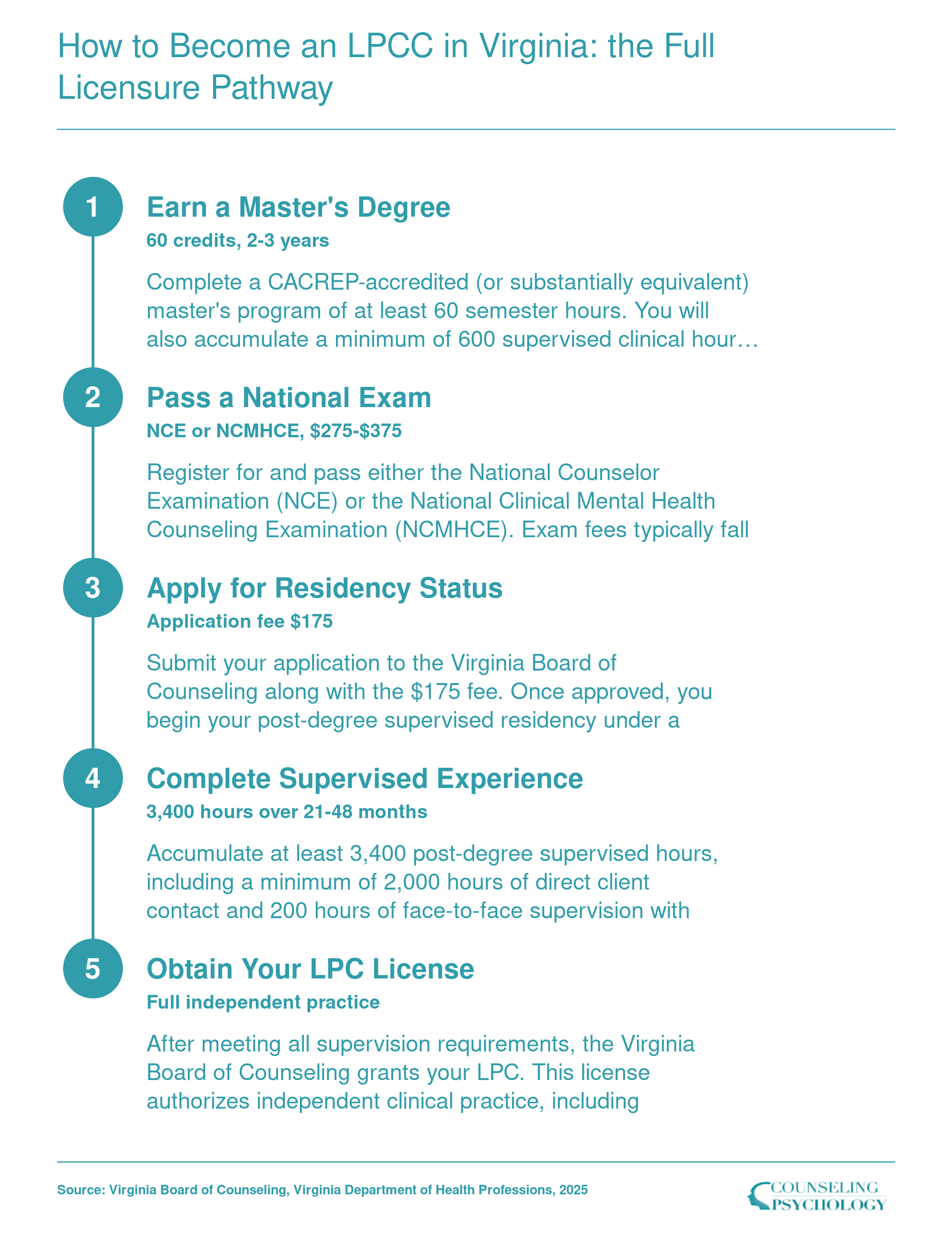
How to Become an LPCC in Virginia: The Full Licensure Pathway
Virginia does not offer a separate LPCC credential. The Licensed Professional Counselor (LPC) is the full clinical license, authorizing diagnosis, treatment, and independent practice. The pathway below outlines what it takes to move from enrollment to independent licensure, a process that typically spans four to six years.
Roanoke-Area Program Cost Comparison
Every school listed below is accessible from Roanoke, whether by a short drive or through an online or hybrid format. All tuition and net price figures come from IPEDS and the College Scorecard and reflect the most recent reporting year. Keep in mind that net price calculations work differently at public and private institutions: public school net prices factor in state subsidies and are often lower for Virginia residents, while private school net prices reflect institutional aid against a single sticker price. One more thing worth noting: Roanoke's overall cost of living runs roughly 9% below the national average in 2026, with one-bedroom rents averaging $900 to $1,150 per month. Compare that to Richmond ($1,150 to $1,450), Charlottesville ($1,400 to $1,800), or Northern Virginia ($1,900 to $2,400). Over a two- or three-year master's program, that gap can translate into $8,000 to $30,000 in living expense savings, making proximity to Roanoke a genuine financial advantage.
| School | Sector | Tuition (In-State) | Tuition (Out-of-State) | Net Price | Format | City |
|---|---|---|---|---|---|---|
| Radford University | Public | $13,762 | $23,525 | $14,578 | Campus | Radford |
| Old Dominion University | Public | $15,390 | $36,174 | $14,638 | Campus | Norfolk |
| Norfolk State University | Public | $13,412 | $25,826 | $15,282 | Campus | Norfolk |
| Longwood University | Public | $7,758 | $19,944 | $19,066 | Campus | Farmville |
| William & Mary | Public | $17,666 | $36,684 | $19,096 | Campus | Williamsburg |
| James Madison University | Public | $13,464 | $30,984 | $23,322 | Campus | Harrisonburg |
| Virginia Commonwealth University | Public | $17,252 | $32,470 | $23,433 | Campus | Richmond |
| Virginia Tech | Public | $18,564 | $35,092 | $24,953 | Campus | Blacksburg |
| Bluefield University | Private | $9,540 | $9,540 | $25,573 | Hybrid | Bluefield |
| Liberty University | Private | $8,730 | $8,730 | $29,357 | Campus | Lynchburg |
| Marymount University | Private | $23,446 | $23,446 | $29,137 | Campus | Arlington |
| Shenandoah University | Private | $26,722 | $26,722 | $30,298 | Campus | Winchester |
Questions to Ask Yourself
Financial Aid and Funding Options for Counseling Students
Graduate tuition is the biggest line item in your path to licensure, but most counseling students never pay the full sticker price. The real question is how aggressively you pursue funding before and during your program, because the gap between what you owe and what you actually need to pay can be substantial.
Grants and Need-Based Aid at the Graduate Level
Pell Grants are the most familiar form of federal aid, though they primarily apply to undergraduate study. Still, the share of undergraduates receiving Pell funding at a given institution signals how committed that school is to serving students with financial need. Among the Virginia counseling programs ranked nearby, Pell recipient rates range widely: Norfolk State University reports roughly 78% of its undergraduates receiving Pell Grants, Liberty University about 71%, and Radford University around 54%. While these figures reflect undergraduate populations, schools with high Pell percentages often maintain robust graduate financial aid offices and may offer comparable need-based aid, institutional grants, or tuition discounts for master's students. Always ask admissions directly what graduate-level need-based funding is available.
Graduate Assistantships and Tuition Waivers
Virginia's public universities are among the best places to look for assistantships that combine a modest stipend with partial or full tuition waivers. Programs at Radford University, Virginia Tech, James Madison University, and Virginia Commonwealth University all have histories of offering graduate assistantships in counseling departments or related campus offices. Positions typically require 10 to 20 hours of work per week in areas like research support, student services, or teaching assistance. Competition is real, so apply early, often during the fall before your intended start semester.
Federal Workforce Programs: HRSA and NHSC
Two federal programs deserve special attention for counseling students willing to serve high-need communities.
- HRSA BHWET Grants: These institutional grants (typically between $1 million and $3 million per award cycle) fund training slots focused on behavioral health care for children, adolescents, and young adults.12 Virginia Commonwealth University and Eastern Mennonite University have both received BHWET funding.1 Students at recipient institutions may gain access to funded practicum placements, stipends, or training enhancements without applying separately.
- NHSC Loan Repayment Program: Licensed professional counselors who commit to working at least two years at an NHSC-approved site in a Health Professional Shortage Area can receive up to $50,000 in loan repayment.3 Parts of southwest Virginia, including rural communities surrounding Roanoke, qualify as shortage areas, making this a realistic option for graduates who plan to stay in the region.
No Virginia-specific state loan forgiveness program for licensed professional counselors has been confirmed as of 2026, so federal options like the NHSC program carry extra weight for students in this field.1
Employer Tuition Reimbursement
If you already work at a community mental health agency, community services board, or hospital system in the Roanoke area, check whether your employer offers tuition reimbursement. Many behavioral health employers in Virginia provide annual reimbursement (often $3,000 to $5,250, matching the IRS tax-free threshold) specifically to retain and upskill clinical staff. Some agencies will increase the benefit or offer schedule flexibility if you commit to staying on after graduation. This approach works especially well with part-time or evening program formats.
Putting It All Together
The most effective funding strategies stack multiple sources. An assistantship at a public university might cover tuition, a BHWET-funded practicum placement could add a training stipend, and NHSC loan repayment after graduation can erase remaining debt. Start mapping your plan at least a semester before you apply. Counseling program directors and financial aid offices can point you toward deadlines and opportunities that are not always listed on the main admissions page.
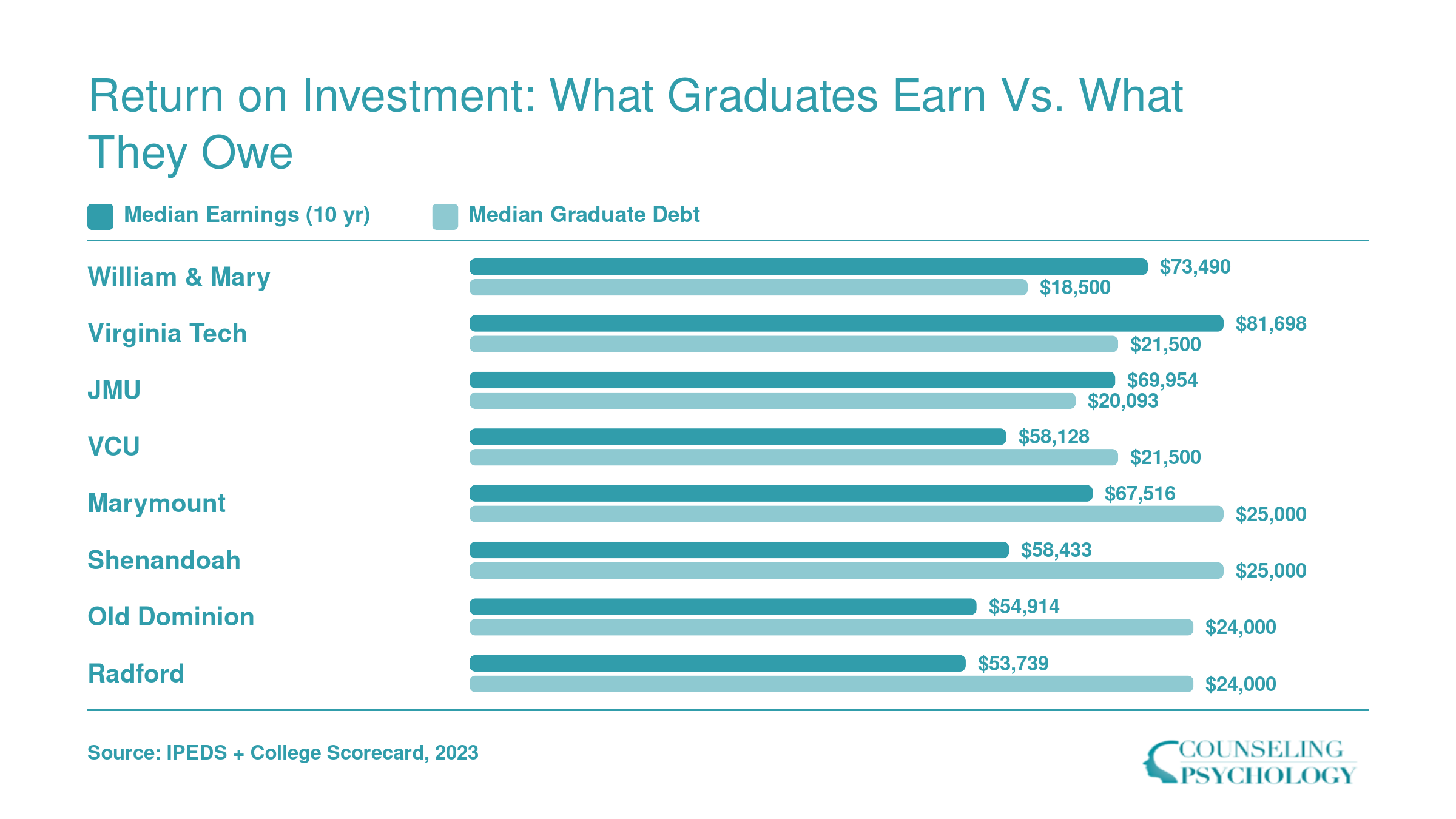
Return on Investment: What Graduates Earn vs. What They Owe
Program-level earnings data (such as median salary one or four years after completion) are not yet published for these counseling programs, so the chart below uses institution-wide median earnings ten years after enrollment alongside median graduate debt. Keep in mind that debt figures reflect federal loans only; total borrowing, including private loans and graduate PLUS loans, may be considerably higher.
Online vs. On-Campus Programs: Tradeoffs for Roanoke Students
Roanoke students weighing affordable LPCC programs have a genuine choice between online and on-campus formats, and neither is universally better. The right fit depends on your budget, work schedule, and how much help you want securing clinical placements. Several programs ranked in this article offer both delivery modes, so understanding the tradeoffs is worth your time before you commit.
Pros
- Online programs open the door to lower tuition from out-of-state CACREP-accredited schools without requiring you to relocate from the Roanoke area.
- Flexible online scheduling lets working professionals maintain employment while completing coursework on evenings and weekends.
- On-campus programs near Roanoke, such as those at Radford University and Virginia Tech, maintain established clinical placement pipelines with local sites like Roanoke City School District, Into Action Recovery and Wellness Center, and Inner Harmony Wellness.
- In-person cohorts offer peer networking and faculty mentorship that many students find difficult to replicate in asynchronous online formats.
- On-campus enrollment may qualify you for graduate assistantships that offset tuition, a funding source rarely available to fully online students.
- Liberty University, located in nearby Lynchburg, offers both online and residential counseling tracks, giving students a hybrid option with access to local practicum partnerships.
Cons
- Online students must arrange their own local practicum and internship placements, which can be time-consuming in a mid-sized metro like Roanoke where site availability fluctuates.
- Fewer CACREP-accredited on-campus options exist within easy commuting distance of Roanoke, potentially forcing a relocation that raises total program cost.
- Online learners often report weaker peer connections and less spontaneous faculty mentorship compared to residential cohorts.
- Some local practicum sites, such as Catawba Hospital, may have limited or competitive intern slots, making self-arranged placements harder for online students without institutional support.
- On-campus programs typically lock you into a fixed class schedule, which can conflict with full-time employment or family obligations.
- If you enroll on campus at a school outside the Roanoke area, housing and commuting expenses can erode any tuition savings you found.
Career Outlook for Counselors in Southwest Virginia
The next decade looks remarkably steady for mental health professionals in southwestern Virginia. While exact Roanoke metro data points are limited, the signals from state and national figures point to strong demand, competitive wages, and a wide range of employment settings. Understanding how those factors interact helps you weigh the cost of an LPCC program against what the region actually offers after graduation.
Salaries and Employment Data in Context
National wage information for substance abuse, behavioral disorder, and mental health counselors provides a useful baseline. In 2024, the Bureau of Labor Statistics reported a national median annual wage of $59,190 for this broad category, with a 10th percentile of $39,090 and a 90th percentile of $98,210.1 Virginia's statewide median sits slightly lower at $58,410.2 For areas outside major metropolitan hubs, the most relevant published figure comes from the Northeast Virginia nonmetropolitan area, where the median reached $59,210 in 2024.2 While the BLS does not isolate a Roanoke metropolitan statistical area median for this occupation, the southwestern Virginia landscape typically aligns with the state and nonmetropolitan benchmarks. Entry-level community-based positions may start closer to the 25th percentile, around $47,170 nationally, while experienced clinicians in specialized roles can reach well above the state median.3 For a broader look at how pay scales shift with education and specialization, see our overview of counselor salary expectations.
Where Counselors Work in Southwest Virginia
Employer variety in the Roanoke region is one of the steadiest features of the local job market. The largest employers consistently include community services boards, which operate the public behavioral health safety net across multiple counties, and the Salem VA Medical Center, a major hub for veterans' mental health care. School districts across the valley hire counselors at all grade levels, often blending academic guidance with clinical support. Carilion Clinic's behavioral health service line, headquartered in Roanoke, spans inpatient, outpatient, and integrated care settings, creating an ongoing need for licensed professionals. Smaller group practices, faith-based counseling centers, and solo private practices round out the picture, with some counselors eventually splitting their week between agency work and a growing private caseload. This diversity of settings reflects the broader landscape of careers in counseling available to LPCC holders.
Job Growth and Workforce Demand
National projections for mental health counselors show a 17 percent increase in employment from 2024 to 2034, far outpacing the average for all occupations. That momentum is magnified in rural and medically underserved pockets of Virginia, where workforce shortages have been documented for years. Southwest Virginia, with its mix of urban anchors and remote mountain communities, sits at the intersection of high need and limited provider density. For marriage and family therapists, the national projected growth rate is 12.6 percent over the same period, still robust but noticeably lower.5 Combined, these trends suggest that new LPCC graduates who are flexible about setting and willing to serve areas outside downtown Roanoke will encounter multiple job openings with relatively short hiring cycles.
LPC vs. LMFT: Does the Credential Change Pay?
A common question is whether the LPC (or LPCC) route pays differently than the LMFT path. In Virginia, the reality is less about the letters after your name and more about where you work. Both licenses qualify professionals for overlapping roles in community mental health, hospitals, and private practice. Some insurance panels reimburse at identical rates, while certain state-funded programs may favor one designation for specific contracts. Because the BLS does not publish separate median wage data for LPCs and LMFTs at the state or metro level, a direct pay comparison for southwestern Virginia is not possible. What is clear is that earning potential tends to rise with clinical experience, supervisory responsibilities, and the decision to move into higher-reimbursement settings such as hospital systems or specialized trauma programs, rather than by simply holding one credential over the other.
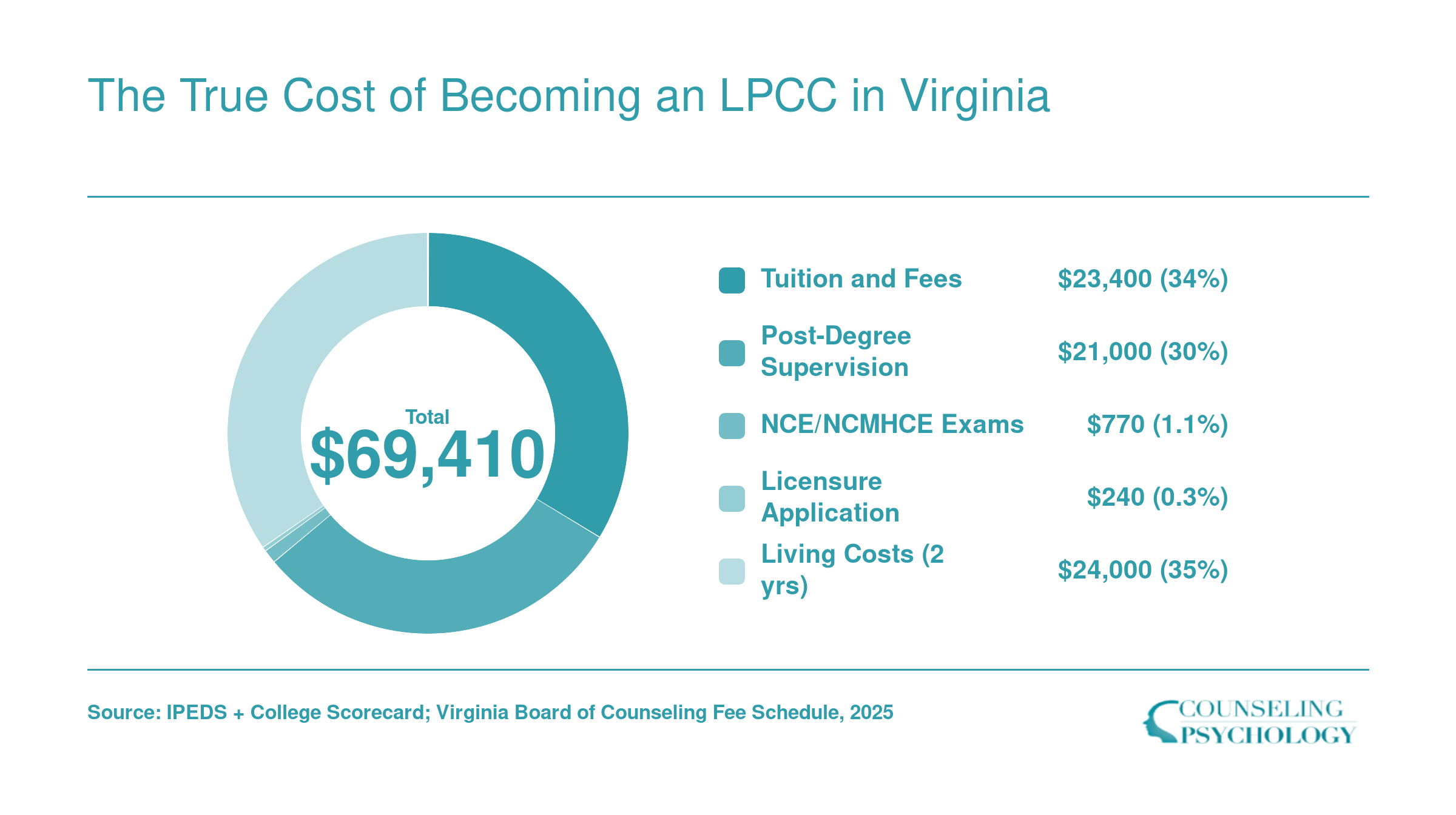
The True Cost of Becoming an LPCC in Virginia
Tuition is only one piece of the puzzle. From the day you enroll in a master's program through the moment you hold a fully independent clinical license, several expenses stack up. The breakdown below uses the median net price of Roanoke-area ranked programs (roughly $23,400 for a 60-credit master's) alongside current Virginia Board of Counseling fees and typical supervision rates. Financial aid, graduate assistantships, and employer tuition reimbursement can cut the out-of-pocket total significantly, so treat this as a ceiling rather than a floor.
Frequently Asked Questions About LPCC Programs in Virginia
Navigating the path from graduate student to licensed professional clinical counselor raises a lot of practical questions. Below are answers to the ones Roanoke-area students ask most often, grounded in current Virginia requirements and verified program data.