
What you’ll learn in this article…
- Five master's counseling programs in Tennessee currently hold active CACREP accreditation, a key factor for LPC-MHSP licensure.
- Annual tuition at ranked Tennessee programs ranges from roughly $8,300 at public universities to over $30,000 at private institutions.
- Tennessee LPC-MHSP licensure requires a graduate degree plus supervised clinical hours governed by the state licensing board.
- Several top ranked programs have dropped the GRE requirement, widening access for nontraditional applicants across the state.
Tennessee's mental health workforce shortages are pushing demand for licensed counselors higher, making a master's in the field a practical career move. But the cost of getting there varies wildly. After factoring in grants and scholarships, some CACREP-accredited programs on this list leave graduates with less than $11,000 in total net tuition, while others exceed $33,000. That spread isn't small change; it's a years-long financial difference. Add in choices about online versus hybrid delivery, specialization tracks like masters in addiction counseling, and the licensure pathway you commit to, and the program you pick shapes your earning potential and professional flexibility from day one.
Best Master's in Counseling Programs in Tennessee
Tennessee offers a strong mix of public and private institutions with counseling master's programs that prepare graduates for LPC-MHSP licensure or school counselor certification. The programs below span fully online, hybrid, and on-campus formats, with tuition ranging from about $8,300 to nearly $28,000 per year. Program-level earnings data is not yet available for these counseling degrees, so we present institution-wide financial outcomes to help you gauge overall return on investment. Each school is profiled with its key concentrations, format, and financial snapshot.
- Tuition and net price affordability
- Graduate debt relative to earnings
- Accreditation and licensure alignment
- Program format and flexibility
- Institutional graduation and retention rates
- College Scorecard graduate earnings — collegescorecard.ed.gov
- NCES-IPEDS federal institutional data — nces.ed.gov
- Independent program research
- Internal program database

The University of Tennessee-Martin
UT Martin delivers one of the most affordable counseling pathways in the state through its fully online M.S.Ed. in Counseling with a School Counseling concentration. Both CAEP and CACREP accredited, the program carries an in-state tuition of roughly $11,916 and a net price near $10,701, making it the lowest-cost option on this list. The institution reports a median graduate debt of $21,024 and institution-wide median earnings of $44,213 ten years after enrollment (note: this is a school-wide figure, not specific to the counseling program). With 60 credit hours for the full degree and a 30-credit licensure-only track, UT Martin gives both career changers and working educators flexible entry points.
- 100% online coursework with no campus visits required
- Full degree track requires 60 credit hours
- Licensure-only option available at 30 credit hours
- CACREP and CAEP dual accreditation
- Prepares graduates for Tennessee school counselor licensure
- 12:1 student-to-faculty ratio in the program
- Designed to accommodate working professionals
Master of Science in Education in Counseling, School Counseling — Online

Lincoln Memorial University
Lincoln Memorial University's M.Ed. in Professional Counseling offers a Mental Health Counseling track delivered in a hybrid format from its Appalachian campus in Harrogate. The 60-credit program includes 700 hours of supervised field experience, giving students extensive clinical preparation before graduation. LMU's tuition is $22,154 regardless of residency, with a net price around $20,406 and a median graduate debt of $20,000. Institution-wide, graduates report median earnings of $49,956 ten years after enrollment, and the 10:1 student-to-faculty ratio supports close mentorship throughout the program.
- Hybrid format blending online and in-person sessions
- 60 total credit hours with two concentration options
- 700 hours of supervised practicum and internship
- Prepares students for Tennessee LPC licensure
- CAEP accredited program
- 10:1 student-to-faculty ratio
- Covers therapeutic techniques, ethics, and diverse populations
Master of Education in Professional Counseling, Mental Health Counseling — Hybrid

Freed-Hardeman University
Freed-Hardeman University stands out for its compact, 37-credit-hour M.S. in School Counseling, which can be completed in as few as two years through a hybrid format with web-conferenced classes. Despite being a private institution, graduate tuition runs about $11,970 per year (approximately $665 per credit hour), making it competitive with many public programs. The institution-wide graduation rate of 70.8% is among the highest on this list, and median graduate debt sits at $21,500. FHU integrates Christian principles into its counseling curriculum while fully preparing graduates for Tennessee K-12 school counselor licensure.
- 37 credit hours, completable in two years
- Hybrid format with flexible web-conference classes
- Approximately $665 per credit hour
- Full-time and part-time enrollment options available
- Leads to Tennessee school counselor licensure
- Christian faith integration throughout the curriculum
- Experienced faculty with professional counseling backgrounds
Master of Science in School Counseling — Hybrid

Lipscomb University
Located in Nashville, Lipscomb University offers a hybrid School Counseling program through its College of Education, with both M.Ed. and Ed.S. degree tracks. At roughly $953 per credit hour and a 25% tuition discount for in-service educators, Lipscomb keeps costs manageable despite its private-school sticker price of $17,334 per year. The institution posts a 72.2% graduation rate and institution-wide median earnings of $55,541 at the ten-year mark, the second highest among schools on this list. No GRE is generally required, and multiple scholarship opportunities further reduce the overall investment.
- Hybrid online and in-person delivery in Nashville
- 38 to 44 credit hours depending on degree track
- Approximately $953 per credit hour
- No GRE generally required for admission
- 25% tuition discount for in-service educators
- Practicum and internship placements included
- Focus on college access and career exploration strategies
- Multiple scholarship opportunities available
School Counseling — Hybrid

Milligan University
Milligan University's CACREP-accredited M.S. in Clinical Mental Health Counseling is a 60-credit-hour hybrid program with concentrations in general counseling and addictions counseling. Tuition is notably low at $8,358 per year, though the institution-wide net price is approximately $21,365. The addictions counseling track includes six specialized courses and is supported by regional healthcare organizations. Milligan reports a 100% licensure exam pass rate for its counseling graduates, and the program integrates a Christian faith component alongside rigorous clinical training.
- CACREP accredited with hybrid delivery format
- 60 credit hours, typically completed in two years
- General and addictions counseling concentrations available
- Prepares graduates for Tennessee LPC licensure
- Reports 100% licensure exam pass rate
- Includes practicum and internship experiences
- 10:1 student-to-faculty ratio
- Christian faith integration component
- Two-year, 60-credit-hour hybrid program
- Six addiction-specific courses in the curriculum
- Supported by regional healthcare organizations
- Prepares for LPC licensure in Tennessee
- Clinical mental health foundation with addiction focus
- Faith-integrated counseling curriculum
Master of Science in Clinical Mental Health Counseling — Hybrid
Master of Science in Counseling, Addictions Counseling — Hybrid

East Tennessee State University
East Tennessee State University offers a fully online Graduate Certificate in Clinical Addiction Counseling Studies, a 12-credit-hour credential designed for professionals who already hold a bachelor's degree in a behavioral health field. While this is a certificate rather than a full master's degree, ETSU's public-university pricing makes it one of the most accessible entry points into addiction counseling: in-state tuition is approximately $11,366 per year, and the net price is around $15,983. The institution-wide median graduate debt of $19,442 is the lowest on this list, and credits may transfer into ETSU's MSW program for students who continue their education.
- 100% online with mainly asynchronous coursework
- 12 credit hours focused on addiction counseling
- Requires a bachelor's in a behavioral health field
- Minimum 2.5 GPA for admission
- Up to six years allowed for completion
- Credits transferable toward ETSU's MSW program
- Prepares for state addiction counseling licensure or certification
- No on-campus requirements
Graduate Certificate in Clinical Addiction Counseling Studies — Online

Johnson University
Johnson University in Knoxville offers a CACREP-accredited M.A. in Counseling with concentrations in both School Counseling and Clinical Mental Health Counseling. The hybrid program totals 60 credit hours and includes 600 to 1,000 clinical contact hours depending on the track, giving graduates extensive supervised experience before entering practice. Graduate tuition is $8,305 per year, though the institution-wide net price is approximately $22,063. Johnson integrates a Christian worldview throughout its counseling curriculum and maintains a 12:1 student-to-faculty ratio for close faculty mentorship.
- CACREP-accredited school counseling concentration
- Hybrid format with limited campus residencies
- 60 credit hours with 600+ clinical experience hours
- Prepares for Tennessee Professional School Counselor licensure
- 12:1 student-to-faculty ratio
- Christian worldview integration
- CACREP-accredited clinical mental health concentration
- Hybrid format with two weekend campus residencies
- Up to 1,000 clinical contact hours
- Prepares for Tennessee LPC licensure
- Diverse practicum placement options available
- Professional supervisor credentials supported
- Flexible pacing for working students
Master of Arts in Counseling, School Counseling — Hybrid
Master of Arts in Counseling, Clinical Mental Health Counseling — Hybrid

Southern Adventist University
Southern Adventist University in Collegedale offers three distinct counseling-related master's programs: an M.S. in School Counseling, an M.S. in Clinical Mental Health Counseling, and a Master of Ministry with a Biblical Counseling concentration. The school counseling track spans 50 credit hours, while the clinical mental health path requires 60, and both include 700 hours of supervised clinical practice. Tuition is approximately $13,760 per year, with a net price near $24,345 and median graduate debt of $24,500. Institution-wide, graduates report median earnings of $53,723 ten years after enrollment.
- 50-credit-hour CACREP-accredited curriculum
- 700 hours of clinical practice in school settings
- Prepares for Tennessee school counselor certification
- Hybrid program format with on-campus components
- Focused on K-12 academic and emotional development
- Holistic approach to student support
- 60 credit hours with hybrid delivery
- 700 supervised clinical practice hours
- Prepares for Tennessee LPC licensure
- Covers ethical practice and diverse counseling settings
- National exam preparation included
- Bachelor's degree required for admission
- Hybrid format combining religion and psychology
- Biblical Counseling concentration
- First such program among Adventist institutions
- Free tuition may be available for qualifying students
- Integrates theological and clinical frameworks
M.S. in School Counseling — Hybrid
M.S. in Clinical Mental Health Counseling — Hybrid
Master of Ministry, Biblical Counseling — Hybrid

Belmont University
Belmont University in Nashville rounds out the list with its M.A. in Mental Health Counseling, which includes a School Counseling concentration delivered through an online format with periodic on-campus intensives. The 60-credit-hour program boasts a 100% Praxis exam pass rate, and it satisfies Tennessee's educational requirements for school counselor licensure. Belmont's tuition is the highest on this list at $27,810 per year, with a net price of approximately $33,147, but the institution's 70.7% graduation rate and institution-wide median earnings of $55,930 suggest strong overall academic outcomes. Median graduate debt of $20,500 remains moderate relative to the sticker price.
- Online program with periodic on-campus intensives
- 60 credit hours of comprehensive coursework
- 100% Praxis exam pass rate reported
- Prepares for Tennessee school counselor licensure
- Professional practicum experience included
- 12:1 student-to-faculty ratio
- Located in Nashville with access to metro school districts
Master of Arts in Mental Health Counseling, School Counseling — Online
How We Ranked Tennessee Counseling Programs
Transparency matters when you are choosing a graduate program, and the methodology behind any ranking should be easy to understand. Many competing lists for counseling programs in Tennessee offer no explanation of how schools were selected or ordered. That lack of clarity makes it impossible to know whether a ranking reflects genuine value or editorial preference. Here, we take a different approach.
Affordability as the Primary Lens
Net price and financial aid availability carry the heaviest weight in our rankings. We prioritize these factors because affordability is consistently one of the top concerns prospective counseling students raise, and because lower debt loads after graduation give new counselors more flexibility in choosing where and how they practice. Programs that keep costs manageable, whether through competitive tuition, generous institutional aid, or both, rise to the top of this list.
Online and Hybrid Delivery
Every program featured in our rankings offers online or hybrid coursework, meaning you can complete a significant portion of your degree through distance-friendly formats. We filtered specifically for these delivery modes so the list stays relevant to working professionals, career changers, and students who may not live near a Tennessee campus. If you are also exploring national options, our guide to the best masters in mental health counseling programs can help you compare Tennessee schools against a broader field.
Data Sources and Their Limits
Our analysis draws on publicly available institutional data from the College Scorecard and IPEDS. It is important to understand that metrics like graduation rates and post-graduation earnings reflect school-wide outcomes, not figures specific to a counseling master's program. Program-level earnings data for many graduate programs is not yet available through federal reporting. We flag this distinction so you can use the data appropriately rather than assuming it describes counseling graduates alone.
Why This Matters
If a ranking does not tell you how it was built, you have no way to evaluate whether the results align with your priorities. By making our criteria visible, especially our emphasis on affordability and delivery format, we give you the context to decide whether this list fits your needs or whether you should weigh other factors more heavily in your own search.
CACREP-Accredited Counseling Programs in Tennessee
Five master's-level counseling programs in Tennessee currently hold active CACREP accreditation, a credential that carries real weight when you apply for licensure as a Licensed Professional Counselor with Mental Health Service Provider (LPC-MHSP) designation in the state.
Why CACREP Accreditation Matters in Tennessee
Tennessee's LPC-MHSP licensure board recognizes CACREP-accredited programs as meeting the educational standards required for clinical practice. Graduating from a CACREP-accredited program also gives you portability: if you relocate after graduation, most other states either require or strongly prefer CACREP credentials for licensure. Choosing a non-CACREP program is not automatically disqualifying, but it can create additional documentation burdens during the licensure process and may limit your options if you later move.
Currently Accredited Programs
The following programs held active CACREP accreditation through the 2025-2026 academic cycle, based on the CACREP program directory:
- University of Tennessee, Knoxville: School Counseling track. Accredited since October 1982, with the current accreditation term running through October 2028.1 One of the longest-standing CACREP programs in the state.
- East Tennessee State University: Clinical Mental Health Counseling. Active accreditation status confirmed for 2025-2026.2 ETSU also offers additional counseling tracks; prospective students should verify the specific track's accreditation status directly with the program.
- Freed-Hardeman University: Clinical Mental Health Counseling. Accredited since July 2018, with the current term running through March 2028.
- Johnson University: M.A. in Counseling. Accreditation reaffirmed with a term extending to 2034, one of the longer windows among Tennessee programs.4
- Trevecca Nazarene University: Clinical Mental Health Counseling. Active CACREP accreditation confirmed for 2025-2026.5 Specific renewal dates were not available at publication; confirm the current term directly with the program or through the CACREP directory at cacrep.org.
Research Gaps and What to Verify
CACREP accreditation terms change, and some programs in Tennessee have historically held accreditation that later lapsed or entered a pending review cycle. The list above reflects confirmed status for the current period, but it may not capture every program in the state. Before you apply, check the CACREP directory directly to confirm a program's standing, particularly for programs that advertise accreditation without specifying an expiration date. A program in candidacy or pending status does not carry the same guarantees as full accreditation, and that distinction matters when you sit for licensure. If you are still exploring clinical mental health counseling online programs, compare CACREP-accredited options across states to ensure you find the best fit.
Questions to Ask Yourself
Online vs. On-Campus Counseling Programs in Tennessee
Choosing between online and on-campus delivery is one of the first decisions you will face when applying to a counseling master's program in Tennessee. Every ranked program on this page offers online or hybrid coursework, but one universal rule applies: clinical fieldwork hours, typically 600 or more, must be completed in person regardless of format. Hybrid models, which combine weekend residencies with online coursework, have become a popular middle ground at several Tennessee institutions.
Pros
- Flexible scheduling lets working professionals complete coursework evenings and weekends without relocating closer to campus.
- Online tuition often carries a lower effective cost once you factor in eliminated commuting, parking, and housing expenses.
- Students anywhere in Tennessee can access top CACREP accredited programs without being limited to schools in their metro area.
- Hybrid models with periodic weekend residencies offer structured face time while preserving most of the flexibility of online learning.
- Recorded lectures and asynchronous discussions let students review material at their own pace, which can deepen comprehension.
Cons
- Practicum and internship hours still require supervised, in person clinical placements in your local community, which you must arrange yourself in many cases.
- Spontaneous peer networking and informal mentorship happen less naturally online, requiring extra effort to build professional relationships.
- Self discipline demands are higher because online learners must manage their own schedules without the external structure of a physical classroom.
- Some students find it harder to practice counseling micro skills, such as nonverbal observation, through a screen before entering fieldwork.
- Limited access to on campus resources like counseling labs, libraries, and career services may affect the overall student experience.
Tuition and Financial Aid for Tennessee Counseling Programs
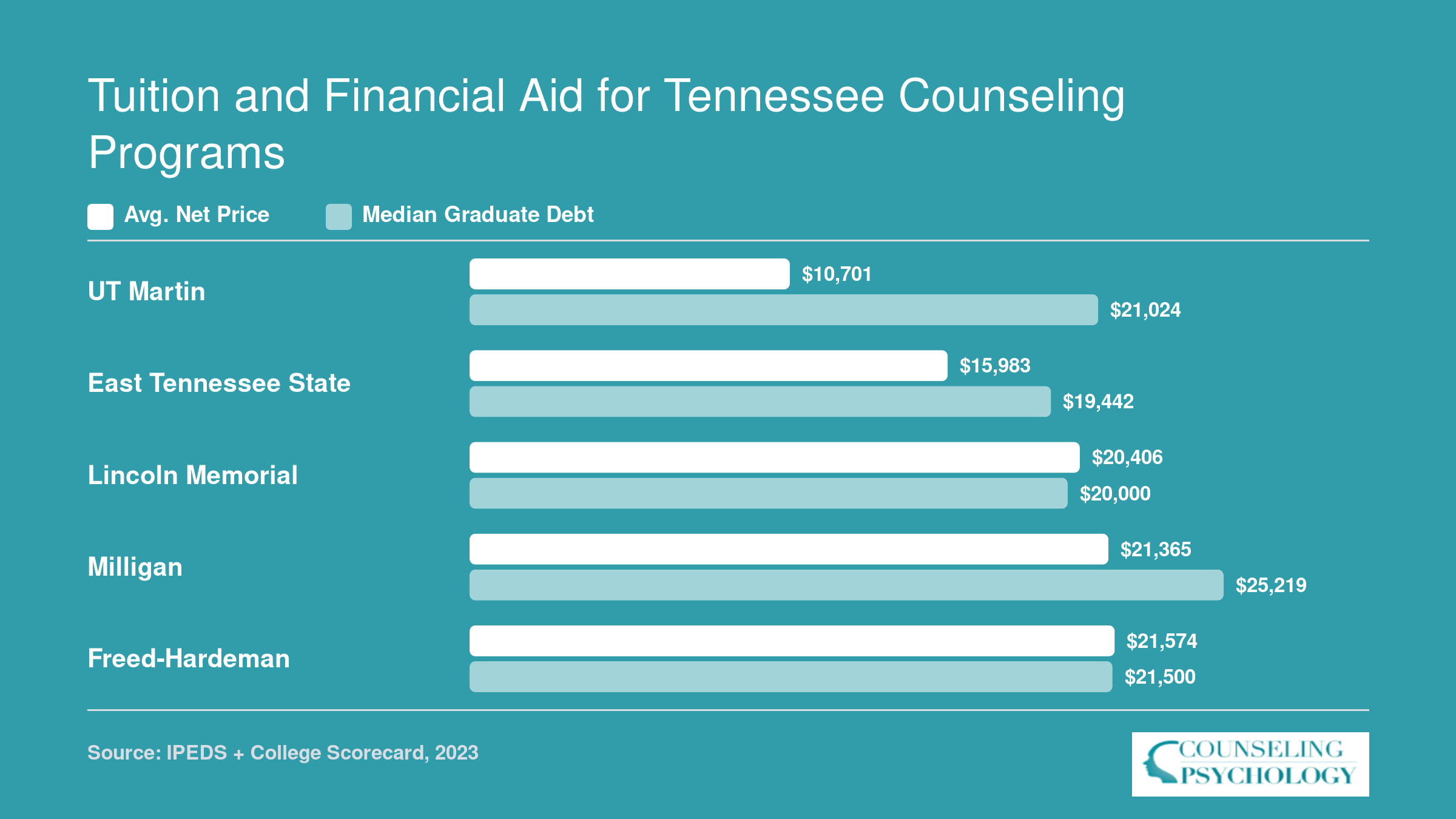
The cost gap between public and private counseling programs in Tennessee is significant, but net price tells a more realistic story than sticker tuition. The figures below reflect each institution's average net price after grants and scholarships, paired with the median debt graduates carry. Keep in mind that net price is an institutional average across all students and aid packages, not a guaranteed quote for your situation. Program-level earnings and debt outcomes are not yet available for these specific counseling programs, so the debt figures shown are institution-wide medians.
Tennessee LPC-MHSP Licensure Requirements
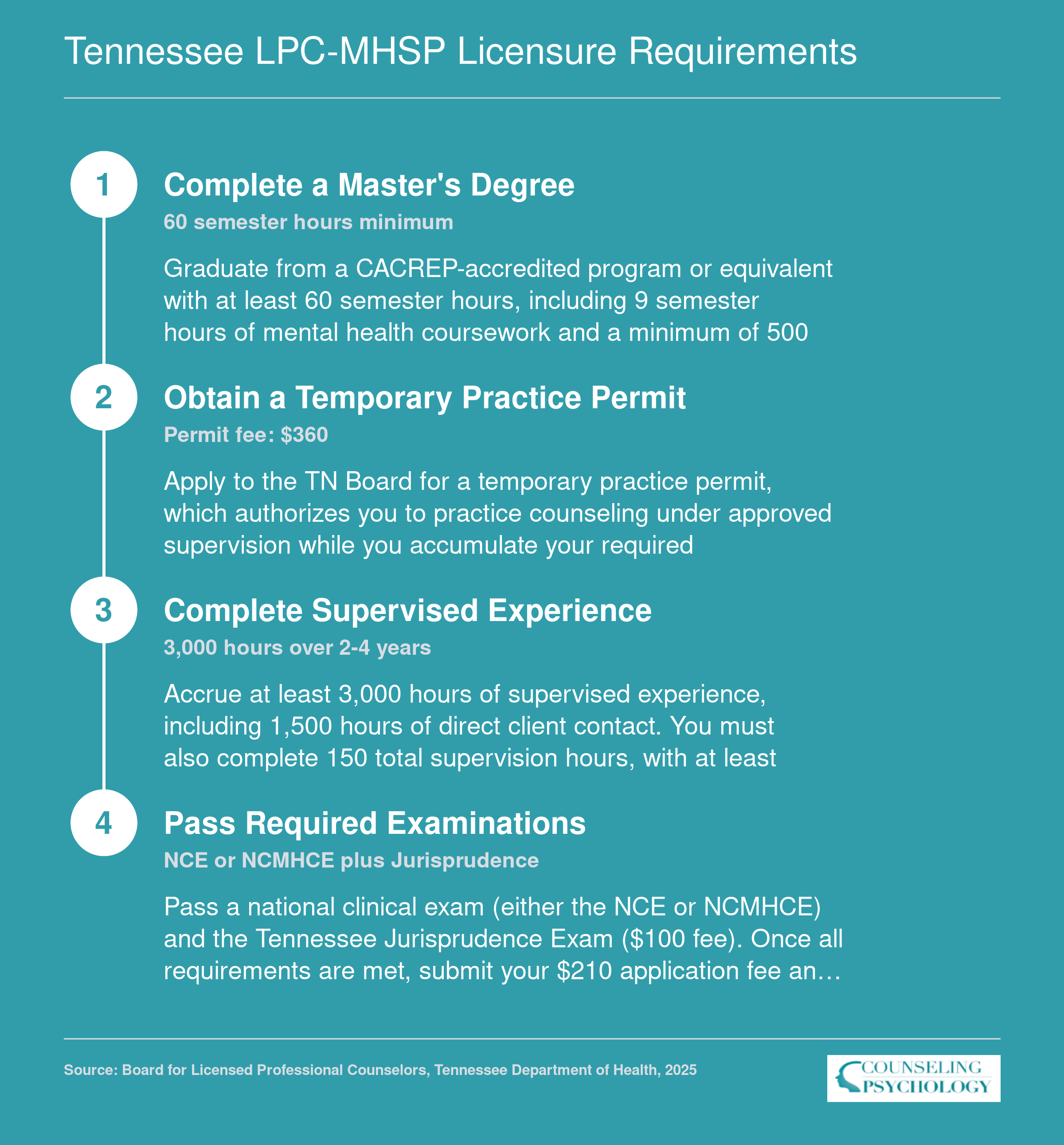
Earning your Licensed Professional Counselor with Mental Health Service Provider (LPC-MHSP) designation in Tennessee follows a clearly defined pathway set by the TN Board of Licensed Professional Counselors. As of the 2025-2026 rules, candidates must complete a graduate degree, accumulate supervised clinical experience, and pass national and state examinations. A temporary practice permit is available during the supervised experience phase, allowing candidates to practice under supervision while accruing hours. The application fee for the temporary permit is $360, and the full LPC-MHSP application fee is $210.
Counseling Specializations Available in Tennessee
A counseling specialization is the focused track within your master's degree that determines the population you serve, the settings you work in, and the license you ultimately pursue. Tennessee programs offer several distinct pathways, and understanding how they differ will help you choose the one that aligns with your career goals. For a broader look at how counseling specializations compare nationally, start there before drilling into Tennessee-specific options.
Clinical Mental Health Counseling
This is the most common track at Tennessee universities. Programs typically require 60 to 61 semester hours and prepare graduates to pursue LPC and, ultimately, LPC-MHSP licensure.1 Career settings include private practices, community mental health centers, hospitals, and substance abuse treatment facilities. The curriculum covers psychopathology, crisis intervention, group counseling, and evidence-based therapeutic techniques.
School Counseling
School counseling tracks also run about 61 semester hours, but the credential at the end is a Tennessee School Counselor license rather than an LPC.2 Graduates work in K-12 settings, guiding students through academic planning, social-emotional development, and college or career readiness. If you later decide you want to practice clinical counseling outside a school, you would typically need additional coursework and supervised hours to qualify for the LPC pathway.
Marriage and Family Therapy
MFT programs train students to treat relational and systemic issues, working with couples and families rather than focusing solely on individuals. The licensure endpoint in Tennessee is the LMFT, which operates under a separate board and set of supervised-experience requirements from the LPC-MHSP. Graduates often work in family service agencies, faith-based counseling centers, and private practice. Because MFT programs may carry a different accreditation standard, understanding the difference between COAMFTE vs. CACREP accreditation is worth your time.
Child and Adolescent Counseling
Because this page spotlights the child counseling category, it is worth noting which Tennessee programs offer dedicated child or adolescent coursework. Child and adolescent tracks generally fall under the clinical mental health counseling umbrella, requiring 60 to 61 semester hours and leading to LPC or LPC-MHSP licensure.3
What sets them apart is specialized training in developmental considerations, play therapy, trauma-informed care for minors, and family systems work.
The University of Tennessee at Chattanooga incorporates child and adolescent coursework into its Clinical Mental Health Counseling program.4 Lipscomb University goes a step further with a distinct Play Therapy Specialization within its clinical mental health degree, preparing graduates for the LPC-MHSP credential while building competency in one of the most widely used modalities for younger clients.5
Choosing the Right Track
A few practical questions can narrow your decision:
- Preferred population: Do you see yourself working primarily with children, couples, or a general adult caseload?
- Work setting: Schools require the school counselor credential; community agencies and private practice generally require the LPC-MHSP or LMFT.
- Licensure timeline: LPC-MHSP and LMFT each carry their own post-master's supervised hours, so factor that into your planning.
If child and adolescent work appeals to you but a dedicated concentration is not available at your preferred school, look for elective courses in play therapy, child psychopathology, or adolescent development. Many clinical mental health programs allow enough elective flexibility to build informal expertise even without a named specialization.
GRE Requirements and Admission Trends at Tennessee Counseling Programs
The contrast between programs that require standardized testing and those that have dropped the requirement entirely defines much of the current admissions landscape for counseling master's programs in Tennessee. Over the past several years, a growing number of graduate programs have moved toward test-optional or test-free policies, and counseling programs are no exception. Understanding where each school stands before you apply can save considerable time and stress.
The Shift Away from the GRE
Many Tennessee counseling programs have reduced or eliminated GRE requirements in recent admissions cycles. The rationale is straightforward: research consistently shows that GRE scores are weak predictors of success in professional counseling programs, and the test can create unnecessary barriers for strong candidates. Programs at institutions such as East Tennessee State University, Austin Peay State University, Lipscomb University, and Trevecca Nazarene University have each adjusted their admissions criteria in recent years, though policies can change cycle to cycle.
Because policies shift, you should not rely on secondhand summaries. Visit the official graduate admissions page for each program you are considering and check for the most current requirements for the 2025-2026 cycle. If a program's website is ambiguous, contact the admissions office or the departmental graduate coordinator directly by phone or email. Ask specifically whether a test-optional policy applies to all applicants or only to those who meet a certain GPA threshold.
GPA Minimums and Other Requirements
Most Tennessee counseling programs set a minimum undergraduate GPA in the range of 2.75 to 3.0, though competitive applicants typically present higher averages. Beyond GPA, common requirements include:
- Letters of recommendation: Usually two or three, ideally from academic or clinical supervisors.
- Personal statement: Reviewers look for clarity of purpose, self-awareness, and genuine motivation for the profession.
- Resume or curriculum vitae: Relevant experience in mental health, social services, or education strengthens an application.
- Interview: Some programs, including those at Vanderbilt's Peabody College and the University of Memphis, conduct formal interviews as part of the selection process.
Where to Find Reliable, Current Information
For state-level employment context to support your application narrative, the Bureau of Labor Statistics at BLS.gov publishes occupational outlook data that can inform your personal statement and career goals. For a complete list of accredited programs, the Council for Accreditation of Counseling and Related Educational Programs (CACREP) maintains a searchable directory on its website. If you are also exploring counseling graduate certificate options to complement your degree, several accredited programs offer flexible online formats.
Professional organizations such as the American Counseling Association and the Tennessee Counseling Association also publish resources on application trends, ethical standards, and career development. Staying connected to these organizations early signals to admissions committees that you are engaged with the profession beyond the classroom.
Counselor Salary Outlook in Tennessee
What can you realistically expect to earn as a licensed counselor in Tennessee? Salary is a practical concern for any graduate student weighing program costs against future income, and Tennessee's counseling wage landscape reflects both regional cost-of-living advantages and below-national-median pay scales.
Tennessee Counselor Wages Compared to National Benchmarks
According to Bureau of Labor Statistics data, mental health and substance abuse counselors in Tennessee earned a median annual wage of $49,280 in 2023.1 That figure sits well below the national median of $59,190 for the same combined occupation category in 2024.2 The 10th percentile in Tennessee started at $30,890, while the 90th percentile reached $75,240.2 Nationally, the 10th percentile was $39,090 and the 90th percentile was $98,210.2 The gap is consistent across the distribution: Tennessee counselors typically earn about 15 to 20 percent less than their national counterparts, but the state's lower housing and living costs help offset that difference for many practitioners.
Regional Wage Variations Across Tennessee Metro Areas
Within Tennessee, counselor salaries vary by metro area, though detailed breakdowns by city for this combined occupation are not consistently published in recent BLS reports.3 Anecdotally, Nashville and Memphis tend to offer higher wages due to larger populations, more agency employers, and greater demand for specialized services. Knoxville and Chattanooga follow closely, with robust community mental health systems and hospital-based counseling roles. Counselors in rural counties or smaller towns often earn at or below the state median, though some find lower practice overhead and stronger community ties offset the pay difference.
Earnings Potential for Program Completers
Institutional median earnings for graduates of the ranked Tennessee programs are not yet available in the College Scorecard dataset for counseling-specific degree programs. However, the overall 10th percentile institutional earnings for universities like Belmont ($55,930) and Lipscomb ($55,541) suggest that completers across all programs at these schools tend to command competitive salaries. Keep in mind these figures reflect all graduates from the institution, not counseling majors alone, so they serve as broad context rather than program-specific guarantees.
When Counselors Earn Above the Median
Licensed Professional Counselors with Mental Health Service Provider designation (LPC-MHSP) in private practice, or those working in specialized niches such as childhood trauma counseling, addiction treatment, or employee assistance programs, frequently earn above the state median. Supervisory roles, clinical directorships, and contract positions with school systems or telehealth companies also push earnings into the upper percentiles. Exploring broader counseling careers can help you identify which specializations command premium pay in your area. Building a full caseload in private practice and accepting insurance panels or offering sliding-scale fees can yield annual incomes in the $60,000 to $75,000 range or higher, particularly in Nashville and Memphis markets.
Several of the top ranked counseling programs on this list carry CACREP accreditation, charge tuition well below the national average, and produce graduates who earn above Tennessee's state median for counselors. Affordability and strong career outcomes are not mutually exclusive in Tennessee's counseling landscape, so cost alone should never be the reason you rule out a quality program.
Frequently Asked Questions About Counseling Programs in Tennessee
Below are answers to some of the most common questions prospective students ask about pursuing a master's in counseling in Tennessee. For deeper detail on any topic, refer to the corresponding sections earlier in this article.