
Key Takeaways
- Tennessee's in-state tuition for school counseling master's programs ranges from roughly $8,300 to $58,000 per year.
- BLS data shows Tennessee school counselors earn a state median salary of $59,090 annually across about 6,090 positions.
- Only 8 of Tennessee's 148 school districts meet the recommended 1:250 student-to-counselor ratio.
- CACREP-accredited programs streamline the Tennessee Professional School Counselor licensure process significantly.
Tennessee's K-12 schools operate with a student-to-counselor ratio of 429:1, nearly double the 1:250 benchmark the American School Counselor Association recommends. That shortfall translates into sustained hiring demand and a clear pathway for new counselors entering the field.
The state hosts 16 masters in counseling programs in Tennessee, spread across public flagships, regional universities, and private institutions in Nashville, Memphis, Knoxville, Chattanooga, and smaller cities. Delivery formats split roughly evenly between on-campus, fully online, and hybrid models. Most CACREP-accredited options require 60 credit hours and 600 to 750 hours of supervised practicum and internship work.
Tuition varies sharply, from about $8,300 per year at the lowest-priced private programs to nearly $58,000 at Vanderbilt, with most public in-state options landing between $10,500 and $16,000.
Top Master's in School Counseling Programs in Tennessee
Tennessee offers a broad landscape of master's in school counseling programs, from flagship research universities to smaller faith-based institutions with tight-knit cohorts. The programs below span every delivery format (fully online, hybrid, and traditional on-campus) and range in credit-hour requirements from 37 to 60 hours. Every school on this list prepares graduates for Tennessee PreK-12 school counselor licensure, though accreditation status, fieldwork hours, and tuition vary considerably. Program-level earnings and debt data are not yet published for any of these school counseling tracks, so we rely on institution-wide figures where available.
- CACREP or national accreditation status
- Tuition and net price affordability
- Institution-wide graduation and retention
- Clinical and fieldwork hour depth
- Program delivery flexibility
- NCES-IPEDS federal institutional data — nces.ed.gov
- Internal program database
- College Scorecard graduate earnings — collegescorecard.ed.gov
- Independent program research

The University of Tennessee-Knoxville
The University of Tennessee, Knoxville is a flagship research institution whose College of Education, Health and Human Sciences houses a CACREP-accredited school counseling track with a strong social-justice orientation. The program emphasizes advocacy in underserved and rural Appalachian communities, giving graduates direct relevance in East Tennessee's public school systems. A 92% first-year retention rate and 73.9% institution-wide graduation rate reflect broad student support across all programs.
- CACREP-accredited, 60 credit hours required
- 700 hours of supervised practicum and internship
- Full-time completion in two years including summers
- Face-to-face instruction with cohort model
- Prepares for Tennessee PreK-12 licensure
- Social-justice and advocacy curriculum focus
- Admissions include GRE scores and in-person interview
- Comprehensive exam required for graduation
Counseling Major, MS (School Counseling Concentration) — On-Campus

Tennessee Tech
Tennessee Tech offers an affordable, CACREP-accredited Master of Arts in School Counseling focused on preparing K-12 practitioners for public schools throughout the Upper Cumberland and rural Tennessee. With the lowest median graduate debt among the public universities on this list ($15,650) and graduate tuition starting at $12,386 in-state, it is one of the most budget-friendly options in the state. Schools offering this program have a 57.7% institution-wide graduation rate.
- CACREP nationally accredited program
- On-campus delivery in Cookeville, TN
- K-12 school counseling preparation focus
- Minimum 2.75 undergraduate GPA required
- Three recommendation letters needed for admission
- Strong ties to Upper Cumberland school districts
Counseling and Psychology, School Counseling (MA) — On-Campus

Lipscomb University
Lipscomb University, a private Nashville institution, delivers its school counseling program in a hybrid format that blends online coursework with in-person intensives. Students can pursue either a Master of Education or an Education Specialist degree, and in-service Tennessee educators may qualify for a 25% tuition discount or potential full tuition grants. The program centers on college-access strategies, aligning with Tennessee's Drive to 55 postsecondary attainment goals. Schools offering this program have a 72.2% institution-wide graduation rate.
- Hybrid online and in-person format
- No GRE generally required for admission
- $953 per credit hour with scholarship opportunities
- 25% discount for in-service Tennessee educators
- Focus on college access and postsecondary planning
- Practicum and internship placements included
- Ed.S. pathway available beyond master's level
School Counseling (M.Ed.) — Hybrid

Freed-Hardeman University
Freed-Hardeman University offers one of Tennessee's most compact school counseling programs at just 37 credit hours, making it completable in two years through a flexible hybrid and web-conference format. Designed for working professionals in smaller and rural districts, the curriculum integrates counseling techniques with Christian principles while meeting all Tennessee Department of Education standards. The institution posts a 70.8% graduation rate and a 10-to-1 student-to-faculty ratio.
- Hybrid delivery with web-conference classes
- 37 credit hours, completable in two years
- $665 per credit hour
- Full-time and part-time enrollment options
- Tennessee K-12 school counselor licensure pathway
- Christian faith integration throughout curriculum
- Experienced faculty with practitioner backgrounds
Master of Science in School Counseling — Hybrid

East Tennessee State University
East Tennessee State University's CACREP-accredited school counseling concentration within its M.A. in Counseling is tailored to the cultural and economic realities of Appalachian communities. Graduates earn Tennessee K-12 licensure and enjoy reciprocity with Virginia and North Carolina, a meaningful benefit for students near state borders. In-state tuition sits at $11,366, and the median graduate debt institution-wide is $19,442. Schools offering this program have a 53.2% institution-wide graduation rate.
- CACREP-accredited school counseling track
- Prepares for Tennessee K-12 licensure
- Licensure reciprocity with VA and NC
- Multicultural and rural counseling emphasis
- Professional ethics training embedded
- Campus-based instruction in Johnson City
Counseling, MA (School Counseling Concentration) — On-Campus

The University of Tennessee-Martin
UT Martin stands out as the only fully online school counseling program in the University of Tennessee system, making it accessible to students across the entire state regardless of geography. The 60-credit full degree is CAEP and CACREP accredited, and a 30-credit licensure-only option exists for candidates who already hold a qualifying master's degree. In-state tuition of $11,916 and a remarkably narrow out-of-state gap ($12,978) keep costs manageable. Schools offering this program have a 52.5% institution-wide graduation rate.
- 100% online coursework for full degree
- 60 credit hours for full master's pathway
- 30-credit licensure-only option available
- CAEP and CACREP dual accreditation
- Tennessee school counselor licensure eligible
- Designed for students in remote or rural areas
- Affordable out-of-state tuition differential
M.S. in Education, Counseling (School Counseling Concentration) — Online

University of Memphis
The University of Memphis prepares school counselors specifically for the realities of urban, suburban, and charter school environments, with strong practicum pipelines into Memphis-Shelby County Schools. Students complete 750 hours of field experience, among the highest totals on this list, and the CACREP-approved program aligns with the ASCA National Model. In-state tuition is $11,628, and the institution-wide median graduate debt is $23,300. Schools offering this program have a 50.9% graduation rate.
- CACREP-approved master's program
- 750 hours of supervised field experience
- Aligned with the ASCA National Model
- Tennessee school counselor licensure preparation
- Strong ties to Memphis-area school districts
- Full-time and part-time enrollment available
- Optional counseling certificates offered
School Counseling (MS) — On-Campus

The University of Tennessee-Chattanooga
UTC's 60-hour Master of Education in School Counseling embeds Tennessee's Praxis II exam requirement directly into the degree plan, so students graduate exam-ready. The program requires 700 clinical placement hours split across elementary and secondary Tennessee schools, and formative fitness evaluations ensure candidates meet state dispositional standards throughout. In-state tuition of $11,110 is among the lowest on this list. Schools offering this program have a 50.2% institution-wide graduation rate.
- 60-credit-hour comprehensive program
- 700 hours of clinical placement required
- Internships in both elementary and secondary settings
- Praxis II preparation built into degree plan
- Professional fitness evaluations throughout
- Multicultural counseling and crisis intervention focus
- Tennessee PreK-12 certification upon completion
Counselor Education: School Counseling (M.Ed.) — On-Campus

Lee University
Lee University, a private institution in Cleveland, Tennessee, offers a 60-semester-hour Master of Science grounded in the ASCA model. The program features a full-year placement in a school setting, exceeding Tennessee's minimum internship requirement and providing extended hands-on experience. Tuition is $17,480 (flat rate regardless of residency), and the institution-wide median graduate debt is $25,750. Schools offering this program have a 62.6% graduation rate.
- 60 semester hours of graduate coursework
- Full-year school placement for internship
- Based on ASCA counseling model framework
- Prepares for elementary and secondary settings
- Tennessee school counselor licensure pathway
- 13-to-1 student-to-faculty ratio at institution
Master of Science, School Counseling — On-Campus

Tennessee State University
Tennessee State University, Nashville's only public HBCU, offers a Master of Science in Professional School Counseling with a Pre-K-12 concentration. The program is designed explicitly to meet Tennessee State Board of Education licensure requirements, and candidates without a teaching license complete 51 credit hours to fulfill the state's additional coursework mandate. A minimum of four semesters plus a summer of residential study are required. In-state tuition is $11,188, and the 13-to-1 student-to-faculty ratio supports close mentorship.
- Pre-K-12 school counseling concentration
- No prior teaching license required
- 51 credit hours for non-licensed candidates
- Culturally responsive counseling approach
- Four semesters plus summer residential study
- Minimum 2.75 undergraduate GPA for admission
- Serves diverse student populations across Tennessee
Master of Science in Professional School Counseling (Pre-K-12) — On-Campus

Vanderbilt University
Vanderbilt's Peabody College houses a highly selective M.Ed. in Human Development Counseling with a School Counseling concentration. The 60-credit program reports a 100% job placement rate and exam pass rate, and students complete a full-year internship across varied school settings. Sticker tuition is $57,868, but the institution-wide net price is considerably lower at $15,846, reflecting robust financial aid. Schools offering this program have a 93.5% graduation rate, the highest on this list, and the median graduate debt of $14,000 is the lowest.
- 60-credit-hour campus-based program
- Full-year internship across school levels
- 100% job placement rate reported
- 100% licensure exam pass rate reported
- 8-to-1 student-to-faculty ratio
- Minimum 3.0 GPA required for admission
- Diverse specialized coursework in crisis counseling
- Located in Nashville at Peabody College
Human Development Counseling, M.Ed. (School Counseling Concentration) — On-Campus

Belmont University
Belmont University offers its Master of Arts program with a School Counseling track delivered primarily online with periodic in-person intensives. The program boasts a 100% Praxis exam pass rate and prepares graduates for Tennessee PreK-12 licensure through 60 credit hours of coursework, practicum, and internship. As a private Nashville institution, tuition is $27,810 with a median graduate debt of $20,500 institution-wide. Schools offering this program have a 70.7% graduation rate.
- Online program with in-person intensives
- 60 credit hours of comprehensive coursework
- 100% Praxis exam pass rate
- Tennessee school counselor licensure preparation
- Professional practicum experience included
- 12-to-1 student-to-faculty ratio at institution
Master of Arts in Mental Health Counseling (School Counseling Concentration) — Online

Milligan University
Milligan University, a small Christian liberal-arts institution in northeast Tennessee, offers a Master of School Counseling designed to prepare compassionate practitioners for K-12 settings. With a 10-to-1 student-to-faculty ratio and graduate tuition of $8,358 (flat rate), it is among the most affordable private options on this list. Schools offering this program have a 63.4% institution-wide graduation rate. Program-level earnings data are not yet available for this track.
- Campus-based graduate program
- Affordable flat-rate tuition at $8,358
- 10-to-1 student-to-faculty ratio
- Professional school counseling preparation
- Focus on student academic and emotional development
- Located in northeast Tennessee near Appalachian communities
Master of School Counseling — On-Campus

Austin Peay State University
Austin Peay State University's CACREP-accredited school counseling concentration is built around 120 practicum hours and a 600-hour internship, meeting Tennessee educator licensing requirements. Located in Clarksville near Fort Campbell, APSU serves a large military-connected student body. In-state tuition of $10,518 and the lowest institution-wide net price on this list ($9,735) make it a strong value option. Schools offering this program have a 40.2% institution-wide graduation rate.
- CACREP-accredited program
- 120-hour practicum included in curriculum
- 600-hour internship in school settings
- Meets Tennessee educator licensing requirements
- Eight core counseling curriculum areas covered
- Supports K-12 elementary through high school roles
- Strong projected job growth in Tennessee
Counseling, School Counseling Concentration — On-Campus

Southern Adventist University
Southern Adventist University offers a 50-credit-hour M.S. in School Counseling through a hybrid format that includes 700 clinical practice hours. The CACREP-accredited curriculum prepares graduates for Tennessee school counselor certification while also advising on multi-state licensing options. Graduate tuition is $13,760 (flat rate), and the institution-wide median graduate debt is $24,500. Schools offering this program have a 49.4% graduation rate.
- 50 credit hours of graduate coursework
- 700 clinical practice hours required
- CACREP-accredited curriculum
- Hybrid delivery format
- Tennessee school counselor certification pathway
- Multi-state licensing guidance available
M.S. in School Counseling — Hybrid

Johnson University
Johnson University in Knoxville provides a 60-credit-hour Master of Arts in Counseling with a School Counseling concentration delivered in a hybrid format. Students complete over 600 hours of practicum and internship, gaining experience in individual and group counseling, classroom guidance, and educational advocacy. The program integrates a Christian worldview and maintains a 12-to-1 student-to-faculty ratio. CACREP accreditation supports licensure portability beyond Tennessee. Schools offering this program have a 56.8% institution-wide graduation rate.
- CACREP-accredited school counseling program
- Hybrid learning format in Knoxville
- 60 credit hours of graduate coursework
- Over 600 hours of clinical experience
- 12-to-1 student-to-faculty ratio
- Christian worldview integration
- Licensure preparation for Tennessee and beyond
Master of Arts in Counseling (School Counseling Concentration) — Hybrid
Online vs. On-Campus School Counseling Programs in Tennessee
Tennessee's master's in school counseling programs span a range of delivery formats. Several institutions offer fully online options, others are strictly on campus, and a growing number blend both approaches into hybrid models. Each format has genuine advantages, and the right choice depends on your location, schedule, and learning style. Keep in mind that every format, whether online, on campus, or hybrid, must satisfy CACREP standards and Tennessee's practicum and internship hour requirements, which always include supervised in-person clinical fieldwork.
Pros
- Online programs offer scheduling flexibility that lets working professionals and career changers complete coursework around existing commitments.
- Students in rural parts of Tennessee can access top CACREP accredited programs without relocating or committing to long commutes.
- Online tuition is sometimes lower because students avoid campus fees, housing costs, and commuting expenses.
- Hybrid models combine the convenience of remote coursework with periodic on-campus intensives for skills practice and cohort building.
- On-campus programs make it easier to coordinate face-to-face practicum placements through established local school district partnerships.
- In-person cohorts naturally build professional networks and peer support systems that carry into your career as a school counselor.
- Direct, regular contact with faculty mentors on campus can deepen clinical skill development and strengthen recommendation letters.
Cons
- Fully online students may need to arrange their own local practicum and internship sites, which requires extra initiative and planning.
- On-campus schedules are less forgiving for students who work full time or have family obligations that limit daytime availability.
- Some online learners report feeling isolated without the daily peer interaction that a campus cohort provides.
- Campus-based programs may carry higher total costs once you factor in commuting, parking, and on-campus fees.
- Hybrid formats still require periodic travel to campus, which can be challenging for students living far from the university.
- Regardless of format, all students must complete in-person supervised fieldwork hours, so a purely remote experience is not possible in this field.
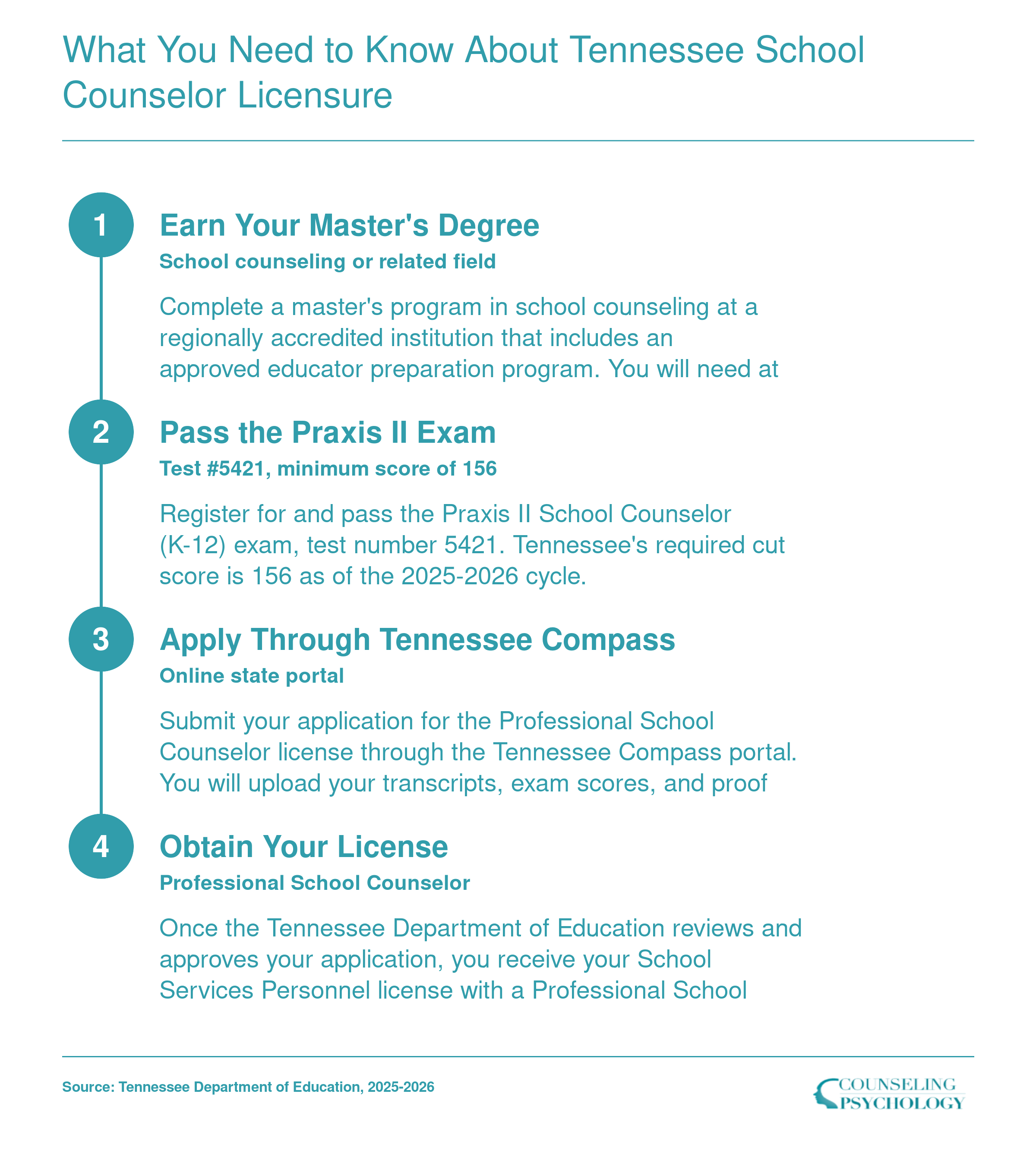
What You Need to Know About Tennessee School Counselor Licensure
Tennessee requires school counselors to hold a Professional School Counselor credential issued by the Tennessee Department of Education. The pathway is straightforward but has specific benchmarks you need to hit. Completing a CACREP-accredited program can streamline the process, particularly if you ever seek reciprocity in another state.
CACREP Accreditation and Why It Matters in Tennessee
What does CACREP accreditation actually mean for your school counseling career in Tennessee?
Understanding the distinction between types of accreditation can save you significant time and frustration down the road. While regional accreditation applies to entire institutions, CACREP (the Council for Accreditation of Counseling and Related Educational Programs) is a programmatic accreditation specific to counseling programs. This specialized designation signals that a school counseling curriculum meets rigorous national standards for training future counselors.
Tennessee's Stance on CACREP
Tennessee does not require CACREP accreditation for school counselor licensure.1 Graduates from non-CACREP programs can still pursue licensure by completing an approved program and passing the Praxis exam.2 However, choosing a CACREP-accredited program often streamlines your path forward.
The state currently has several CACREP-accredited school counseling programs to consider:
- Austin Peay State University: CACREP-accredited since 20193
- Middle Tennessee State University: CACREP-accredited and approved by the Tennessee Department of Education2
- Lincoln Memorial University: CACREP-accredited4
- Vanderbilt University: CACREP-accredited through March 20305
- University of Tennessee at Martin: CACREP-accredited6
Before enrolling in any program, especially online options, verify its current accreditation status through the CACREP accredited online school counseling programs directory.7 Accreditation periods expire and must be renewed, so checking directly protects your investment.
Preparing for the 80/20 Standard
The American School Counselor Association recommends that school counselors spend 80 percent of their time on direct and indirect student services, with only 20 percent devoted to administrative tasks. CACREP-aligned curricula specifically prepare graduates for this model, emphasizing practical skills in individual counseling, group work, classroom guidance, and consultation with teachers and families.
Programs that meet CACREP standards typically include structured practicum and internship experiences that mirror real school environments, helping you enter your first position ready to prioritize student outcomes over paperwork.
Licensure Reciprocity Considerations
If your career might take you beyond Tennessee's borders, CACREP accreditation becomes even more valuable. Many states offer expedited counseling licensure pathways for CACREP graduates, reducing the hurdles you would otherwise face when relocating. Even within Tennessee, hiring committees at competitive school districts often view CACREP credentials favorably during the selection process.
Questions to Ask Yourself
Tuition and Cost Comparison Across Tennessee Programs
Tuition for a master's in school counseling in Tennessee ranges from roughly $8,300 to nearly $58,000 per year, though the sticker price rarely tells the full story. Public universities cluster between about $10,500 and $16,000 for in-state students, while private institutions span a much wider band. The net price column below reflects an institution-wide average after grants and scholarships, so your actual out-of-pocket cost may be higher or lower depending on your individual aid package. Program-level earnings data are not yet available for these school counseling programs, so the table focuses on tuition, net price, and median institutional debt.
| Institution | Type | In-State Tuition | Out-of-State Tuition | Avg. Net Price | Median Graduate Debt |
|---|---|---|---|---|---|
| Milligan University | Private | $8,358 | $8,358 | $21,365 | $25,219 |
| Johnson University | Private | $8,305 | $8,305 | $22,063 | $21,500 |
| Austin Peay State University | Public | $10,518 | $15,702 | $9,735 | $20,547 |
| The University of Tennessee, Martin | Public | $11,916 | $12,978 | $10,701 | $21,024 |
| The University of Tennessee, Chattanooga | Public | $11,110 | $19,174 | $14,265 | $19,500 |
| Tennessee State University | Public | $11,188 | $23,808 | $15,796 | $27,000 |
| East Tennessee State University | Public | $11,366 | $26,486 | $15,983 | $19,442 |
| University of Memphis | Public | $11,628 | $15,840 | $12,397 | $23,300 |
| Freed-Hardeman University | Private | $11,970 | $11,970 | $21,574 | $21,500 |
| Tennessee Tech | Public | $12,386 | $15,746 | $14,246 | $15,650 |
| Southern Adventist University | Private | $13,760 | $13,760 | $24,345 | $24,500 |
| The University of Tennessee, Knoxville | Public | $15,972 | $34,760 | $18,976 | $20,500 |
| Lee University | Private | $17,480 | $17,480 | $18,878 | $25,750 |
| Lipscomb University | Private | $17,334 | $17,334 | $24,739 | $19,500 |
| Belmont University | Private | $27,810 | $27,810 | $33,147 | $20,500 |
| Vanderbilt University | Private | $57,868 | $57,868 | $15,846 | $14,000 |
Funding Your Degree: Scholarships and Financial Aid for TN School Counseling Students
Funding a master's in school counseling means identifying grants, loans, service-exchange programs, and university-specific support that reduce your out-of-pocket cost. Most graduate students combine federal student aid with a smaller pool of scholarships and assistantships, and Tennessee offers several resources worth pursuing early in your planning process.
Tennessee State Scholarships and Fellowships
The Tennessee Behavioral Health Pathways Scholarship provides up to $15,000 per year (maximum $30,000 total) for Tennessee residents enrolled in counseling and related programs.1 In exchange, recipients commit to working at a state-funded treatment agency for a period equal to the years of support. The 2026 application cycle was closed as of early this year but is expected to reopen later in the year. If you plan to work in public mental health settings, this scholarship offers significant funding paired with a clear post-graduation pathway.
The Tennessee Education Association awards $1,000 scholarships to Education Support Professionals who are TEA members and enrolled in educator preparation programs, which may include school counseling tracks depending on program classification.2
National Scholarships for School Counseling Students
The NBCC Foundation administers multiple scholarships for CACREP-aligned counseling students.3 The Master's Minority Fellowship Program supports students committed to serving underserved populations. The Military Scholarship targets students planning to work with military families, and the Rural Scholarship prioritizes those committed to rural practice. Each program has specific eligibility criteria and application windows, so review the foundation's scholarship page early.
Federal Aid and Loan Repayment Options
Federal Stafford loans (subsidized and unsubsidized) form the backbone of graduate financial aid. File the FAFSA by the Tennessee priority deadline to maximize eligibility. The TEACH Grant may apply if your program includes teacher-education components and you commit to serving in a high-need school, though traditional school counseling tracks do not always qualify. Verify eligibility with your program's financial aid office.
The National Health Service Corps Loan Repayment Program is available to licensed behavioral health providers working in Health Professional Shortage Areas.3 School counselors in qualifying rural or underserved districts may be eligible after licensure, making this a post-graduation option rather than immediate funding.
University Assistantships and Graduate Certificates
Many Tennessee universities offer graduate assistantships that provide tuition waivers and stipends in exchange for research, teaching, or administrative work. Availability varies by campus and cohort size, and most are awarded on a competitive basis. Contact program offices directly in the fall before your intended start term to ask about assistantship timelines and application requirements.
If you already hold a master's degree in a related field (such as education or counseling), some universities offer graduate certificate pathways in school counseling that require fewer credits and lower total cost. Students with a counseling background may also explore adjacent credentials such as marriage and family therapy programs in Tennessee. Certificates alone do not confer licensure, but they may satisfy specific coursework gaps for career changers seeking state certification.
School Counselor Salary and Job Outlook in Tennessee
According to the most recent BLS data for Tennessee, Educational, Guidance, and Career Counselors and Advisors earn a state median salary of $59,090 per year, with approximately 6,090 professionals employed across the state. That median represents an established, mid-career figure. By contrast, program-level earnings data from federal sources often reflect what graduates earn within one to two years of completing their degree, so early-career salaries may appear notably lower. The gap between those early-career figures and the BLS median illustrates a meaningful salary trajectory: school counselors in Tennessee can expect substantial wage growth as they gain experience, complete licensure requirements, and move into higher-responsibility roles.
| Wage Percentile | Annual Salary (Tennessee) |
|---|---|
| 25th Percentile | $49,630 |
| Median (50th Percentile) | $59,090 |
| Mean (Average) | $60,390 |
| 75th Percentile | $68,780 |
In Tennessee, the student-to-school-counselor ratio is 429:1, far above the 1:250 benchmark recommended by the American School Counselor Association. Only 8 of the state’s 148 districts meet that standard, according to a 2024 report by Nashville Public Radio. This severe shortage means many students lack consistent access to the guidance that helps them navigate academic challenges, career planning, and personal growth.
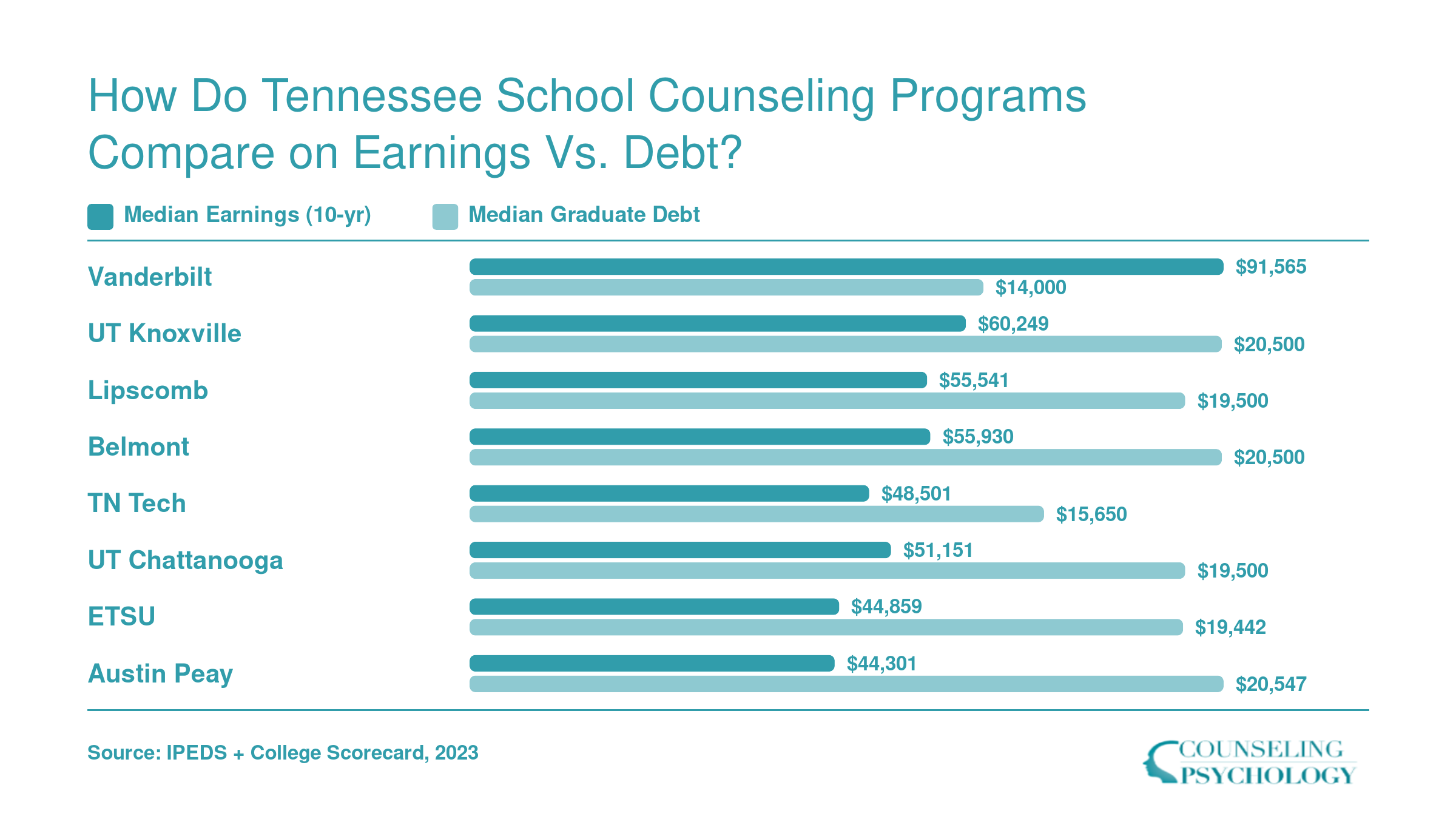
How Do Tennessee School Counseling Programs Compare on Earnings vs. Debt?
One practical way to evaluate a graduate program is to compare what graduates typically earn against the debt they carry. The ROI ratio shown here divides the institution's median earnings (ten years after enrollment) by the median graduate debt. A higher ratio means graduates are earning more relative to every dollar they borrowed. Keep in mind that these are institution-wide figures, not specific to the school counseling program. Program-level earnings data are not yet available for these schools, so treat these numbers as a directional signal rather than a precise program-specific measure. Institutions with larger graduating classes generally produce more statistically reliable earnings figures.
How to Choose the Right School Counseling Program in Tennessee
Choosing a master's in school counseling program comes down to a handful of practical questions: Is the program accredited? Does the format fit your life? Can you complete clinical hours near where you live and work? Answering those questions honestly before you apply saves a lot of frustration later.
Start with Accreditation
CACREP accreditation is the clearest quality signal available, and in Tennessee it has direct consequences for licensure.1 The Tennessee Department of Education expects applicants for school counselor licensure to have completed an approved counselor education program, and many districts will not consider candidates whose programs fall outside that standard. Middle Tennessee State University's professional counseling program, for example, holds CACREP accreditation, and that status matters when you eventually apply for your license or pursue positions across state lines.2 Verify accreditation status directly with each program before you commit.
Credit Hours, Pacing, and Program Length
Most Tennessee school counseling programs fall in the 48-to-60-credit range, which aligns with CACREP standards.3 Tennessee State University's program requires 48 credits for students who already hold a valid teaching license and 51 credits for those who do not.4 The University of Tennessee Knoxville's counseling program requires 60 credits.5 Full-time students typically finish in two to three years, but credit totals vary enough that you should confirm the exact requirements and sequencing with each school's program coordinator before planning your timeline. For a broader look at curriculum norms and what to expect nationally, our guide to best online masters in school counseling programs is a useful reference point.
Format, Placement, and Schedule
Online and hybrid formats give working adults flexibility, but proximity to K-12 practicum and internship sites still matters. Most programs require hundreds of hours of supervised fieldwork in school settings, and coordinating that around a job or family schedule is far easier when the partner districts are nearby. Ask programs directly which school districts they have formal placement partnerships with, and whether those sites are accessible from where you live.
Dual Tracks and Specializations
If you are weighing options beyond traditional school counseling, some Tennessee programs offer pathways worth exploring. Carson-Newman University offers an MSC/EdS dual degree program with concentrations in both professional school counseling and clinical mental health counseling.6 MTSU's program also includes a clinical mental health counseling concentration alongside the school counseling track.2 A dual-track option can broaden your licensure eligibility and is worth considering if private practice or community agency work is part of your long-term picture. Students interested in the clinical side may also want to review licensed professional clinical counseling programs to understand how those credentials compare.
Long-Term Goals
Finally, think past the degree itself. If licensure portability matters because you might relocate, CACREP accreditation provides the most consistent recognition across states.1 If a doctoral program is on your radar, ask whether faculty in the program actively mentor students through that pathway. Matching the program to where you want to be in ten years is just as important as matching it to where you are right now.
Frequently Asked Questions About School Counseling Programs in Tennessee
Choosing a school counseling program raises practical questions about credentials, timelines, and career requirements. Below are answers to the questions prospective Tennessee students ask most often.