Key Takeaways
- Virginia counseling master's tuition ranges from roughly $13,500 to $31,700 per year before institutional aid.
- CACREP accreditation, not online versus on-campus format, determines a program's credential value for LPC licensure.
- LPC licensure in Virginia typically requires four to seven years including graduate study and a post-degree residency.
- Programs with child-focused tracks in play therapy and trauma-informed care address rising pediatric mental health demand statewide.
Virginia's Board of Counseling requires 60 graduate semester hours for LPC licensure, a threshold that shapes which master's programs prepare candidates most efficiently for independent practice. The state's demand for mental health counselors continues to outpace supply, particularly in community services boards and school districts seeking clinicians trained to work with children and adolescents.
For 2026, this ranking highlights online and affordable CACREP-accredited options across Virginia, with attention to programs offering child-focused specializations such as play therapy coursework or school counseling concentrations. The sections that follow compare clinical mental health counseling and school counseling tracks, break down tuition and ROI by program, outline Virginia's LPC licensure pathway, and identify graduate certificates in mental health counseling for counselors seeking additional credentials in child therapy.
Best Master's in Counseling Programs in Virginia, 2026 Rankings
Virginia is home to a wide range of counseling programs, from CACREP-accredited clinical mental health tracks to hybrid school counseling degrees that pair well with in-state licensure requirements. The programs below were evaluated with an emphasis on net price and financial accessibility, then filtered for online or hybrid availability so working professionals across the commonwealth can realistically complete their degree. Where program-level earnings data is available we include it; otherwise, institution-wide median earnings give a general sense of return on investment.
- Net price and financial aid
- Online or hybrid availability
- Accreditation and program quality
- Graduate earnings outcomes
- Institutional graduation metrics
- College Scorecard graduate earnings — collegescorecard.ed.gov
- Independent program research
- Internal program database
- NCES-IPEDS federal institutional data — nces.ed.gov

William & Mary
William & Mary blends the prestige of one of the nation's oldest public universities with flexible online delivery for its counseling programs. Its School of Education offers both a CACREP-accredited M.Ed. in School Counseling and a Clinical Mental Health Counseling track with a Military and Veterans concentration, making it one of the few Virginia schools addressing both K-12 and veteran-serving career paths. With a school-level graduation rate near 89% and a median graduate debt of $18,500, William & Mary combines strong outcomes with manageable borrowing.
- CACREP-accredited online program with two campus residencies
- Designed for K-12 school counselor licensure in Virginia
- Curriculum emphasizes social justice and diversity
- Includes supervised practicum and internship hours
- Small class sizes on a dynamic online platform
- Completable in as few as three years
- CACREP-accredited 60-credit-hour program
- Military and Veterans Counseling concentration
- Fully online format with fieldwork placements
- Prepares graduates for Virginia LPC licensure
- Includes both practicum and internship requirements
- Dedicated faculty with small cohort sizes
M.Ed. in Counseling, School Counseling — Online
M.Ed. in Counseling, Clinical Mental Health Counseling — Online

Regent University
Regent University in Virginia Beach is a private Christian institution that consistently appears on national lists of affordable online counseling programs. Because it charges a flat per-credit rate regardless of residency, out-of-state students pay the same as Virginians, an important advantage for distance learners. Its counseling unit spans CACREP-accredited master's degrees in School Counseling and Clinical Mental Health Counseling, graduate certificates, addiction counseling tracks, and a doctoral program in Counselor Education and Supervision.
- CACREP-accredited hybrid format with two on-campus residencies
- 60-plus credit hours preparing for state licensure
- Integrates a Christian worldview throughout the curriculum
- Internship placement support included
- Comprehensive K-12 counseling curriculum
- Prepares graduates for Virginia school counselor endorsement
- CACREP-accredited with online and on-campus options
- 60 credit hours meeting Virginia LPC education requirements
- Multicultural counseling focus woven through coursework
- Includes practicum and internship components
- Approximately $730 to $750 per credit hour
- Biblical principles integrated into clinical training
- Fully online 30-credit program
- No GRE required for admission
- Faith-based approach to addiction treatment
- Comprehensive training in intervention techniques
- Multiple career pathways upon completion
- Spiritual and scientific methods combined
- Online 30-credit program at approximately $615 per credit
- No GRE required for admission
- Prepares students for various counseling roles
- Blend of interactive learning methods
- Accessible tuition among private institutions
- Christian counseling philosophy throughout
- Online master's with 39-plus credit hours
- No GRE required for admission
- Multicultural addiction focus in coursework
- Research and intervention skill development
- Faith-based treatment approaches explored
- Career path toward addiction counseling roles
- Online 12-credit graduate certificate
- Designed for professionals with an existing graduate degree
- Focuses on K-12 developmental counseling strategies
- Meets school counselor standards
- Cost of approximately $730 per credit
- Christian worldview perspective integrated
- Online 9-credit graduate certificate
- Advanced clinical training for practicing counselors
- Professional endorsement credential format
- Christian worldview integration
- Approximately $730 per credit hour
- Focused on mental health counseling competencies
- CACREP-accredited hybrid doctoral program
- 66 total credit hours with three residencies
- Advanced research training and leadership focus
- Dissertation capstone experience required
- Mentorship opportunities with faculty
- Christian worldview integrated throughout
M.A. in School Counseling — Hybrid
M.A. in Clinical Mental Health Counseling — Online
M.A. in Human Services, Addictions Counseling — Online
M.A. in Human Services, Christian Counseling — Online
M.S. in Psychology, Addictions Concentration — Online
Certificate in School Counseling — Online
Certificate in Clinical Mental Health Counseling — Online
Ph.D. in Counselor Education and Supervision — Hybrid

Liberty University
Liberty University is among the most affordable private online options in the country for counseling master's degrees, with online graduate tuition frequently cited around $7,900 annually. Like Regent, Liberty charges a single online rate for all students regardless of state, and it offers robust military tuition discounts that are especially relevant given Virginia's large service-member population. Its CACREP-accredited M.Ed. in School Counseling uses a hybrid model, while addiction and pastoral counseling tracks are available entirely online with flexible 8-week terms.
- CACREP and CAEP accredited hybrid format
- 60 credit hours completable in about 2.5 years
- Campus intensives paired with online coursework
- Transfer up to 50% of qualifying credits
- Christian perspective woven into curriculum
- Multiple start dates throughout the year
- Fully online 48-credit-hour program
- Prepares for professional certification and licensure
- Covers biological, ethical, and multicultural aspects
- Eight-week accelerated course terms
- No standardized testing for admission
- Military tuition discount available
- Non-licensure online program accredited by ATS
- Integrates theology with psychotherapy approaches
- 150-hour supervised internship requirement
- Courses include crisis intervention topics
- Multicultural counseling focus in curriculum
- Transfer up to 50% of credits
- 36-credit online program with 8-week courses
- Focus on systematic theology and doctrine
- Accredited by ATS with flexible scheduling
- Military discounts available for eligible students
- No standardized testing required for admission
- Prepares graduates for pastoral and counseling roles
- Online 18-credit certificate program
- Affordable at $565 per credit hour
- No standardized testing for admission
- Transfer up to 50% of credits
- Non-licensure professional development pathway
- Covers evidence-based intervention techniques
M.Ed. in School Counseling — Hybrid
M.A. in Addiction Counseling — Online
M.A. in Pastoral Counseling — Online
M.A. in Pastoral Counseling, Theology Concentration — Online
Graduate Certificate in Addiction Studies — Online

James Madison University
James Madison University is a well-regarded Virginia public university in Harrisonburg with strong graduate counseling programs. The entry in this ranking reflects its CACREP-accredited Ph.D. in Counseling and Supervision, delivered in a hybrid format for practicing counselors seeking advanced credentials. With in-state tuition around $13,464 and a school-level graduation rate near 80%, JMU pairs public-university value with a focused doctoral curriculum in crisis counseling and supervision.
- CACREP-accredited hybrid low-residency format
- 60-credit curriculum with crisis counseling emphasis
- Full-time completion in approximately three years
- Part-time option available in about four years
- 100% alumni employment reported by the program
- Designed for currently licensed counseling professionals
Ph.D. in Counseling and Supervision — Hybrid

Virginia Commonwealth University
Virginia Commonwealth University is a major research institution in Richmond offering graduate certificates and master's programs in addiction studies and clinical mental health counseling. Its CACREP-accredited M.S. in Rehabilitation and Mental Health Counseling with a Clinical Mental Health Counseling concentration uses a hybrid format, while its addiction studies certificates are fully online and co-developed with King's College London and the University of Adelaide. The school-level graduation rate is about 63%, and the institution-wide median earnings 10 years after enrollment are approximately $58,128.
- CACREP-accredited 60-credit hybrid program
- 100 hours of practicum plus 600 hours of internship
- Meets Virginia LPC licensure education requirements
- Minimum two-year completion timeline
- Licensed professional counselor preparation track
- Hybrid format combines online and in-person learning
- Fully online 36-credit master's program
- International collaboration with three universities
- Focus on leadership roles in addiction science
- Research project component required
- Full-time and part-time enrollment options
- Covers scientific methodology and treatment advances
- Fully online 24-credit graduate certificate
- Interdisciplinary addiction science curriculum
- Joint program with King's College London
- No on-campus attendance required
- Multiple admission pathways available
- International student friendly
- Online 12-credit graduate certificate
- Multidisciplinary perspectives on addiction
- Distance learning format throughout
- Potential pathway to advanced certificate or master's
- Minimum 3.0 GPA required for admission
- Three 4-credit core courses
M.S. in Rehabilitation and Mental Health Counseling, Clinical Mental Health Concentration — Hybrid
M.S. in Addiction Studies — On-Campus
Graduate Certificate in Addiction Studies, Advanced International — Online
Graduate Certificate in International Addiction Studies, Intermediate — Online

Emory & Henry University
Emory & Henry University, a small private institution in southwest Virginia, offers a 60-credit M.S. in Clinical Mental Health Counseling and a separate M.S. in Addiction Counseling. The clinical mental health track uses a hybrid format completable in 24 consecutive months, while the addiction counseling program is delivered online with brief on-campus residencies. Despite a sticker price above $31,000, Emory & Henry's net price after aid drops to roughly $19,061, making it the lowest net-price private school on this list.
- 60-credit hybrid program over 24 months
- Humanistic counseling approach with multicultural emphasis
- Practicum and internship experiences included
- Minimum 2.75 GPA required for admission
- Group interview as part of the admissions process
- Three professional recommendations required
- 60-credit online program with brief residencies
- One week on campus per semester (three total)
- Prepares graduates for Virginia licensure
- Focus on prevention and intervention strategies
- Developmental wellness model framework
- Serves diverse career settings
M.S. in Clinical Mental Health Counseling — Hybrid
M.S. in Addiction Counseling — Online

Hampton University
Hampton University is a historically Black university (HBCU) in Hampton, Virginia, with doctoral-level counselor education programs delivered in a hybrid format. Its Ph.D. in Counselor Education and Supervision offers concentrations in School Counseling and Community Mental Health Counseling, both structured as 64-credit programs completable in about 3.5 years. At $695 per credit, the doctoral tracks are competitively priced, and the institution's school-level median earnings 10 years after enrollment sit near $59,159.
- Hybrid 64-credit-hour doctoral program
- School Counseling concentration focus
- Completable in approximately 3.5 years
- $695 per credit hour tuition
- GRE waiver may be available
- Covers advanced group and family counseling, ethics, and research
- Hybrid format with 64 credit hours
- Community Mental Health Counseling concentration
- Financial aid available for eligible students
- Three recommendation letters and writing sample required
- Prepares graduates for clinical leadership roles
- Enhances research and ethical practice skills
Ph.D. in Counselor Education and Supervision, School Counseling — Hybrid
Ph.D. in Counselor Education and Supervision, Community Mental Health Counseling — Hybrid

Averett University
Averett University in Danville offers an online B.S. in Psychology with a Substance Abuse Counseling concentration that serves as a pre-professional pipeline for students who plan to pursue a graduate counseling degree. While it is not itself a master's program, it appears on this list because its accelerated online format and certification-exam preparation provide a practical foundation for Virginia residents entering the counseling field. The institution's net price after aid is about $22,925.
- 100% online with asynchronous class sessions
- Accelerated completion for transfer students
- Internship placements available in student's own city
- Prepares for Substance Abuse Counselor Certification Exam
- Coursework covers multicultural issues and clinical interviewing
- Small interactive online classes with Zoom conferences
B.S. in Psychology, Substance Abuse Counseling Concentration — Online

Shenandoah University
Shenandoah University in Winchester offers hybrid master's degrees in both School Counseling and Clinical Mental Health Counseling, making it one of the few mid-size Virginia private schools with dual counseling tracks designed around regional practice placements. Its M.S. in School Counseling targets the PreK-12 counselor shortage, while the clinical mental health track includes a 600-hour internship. Shenandoah's counseling practica are oriented toward Virginia and mid-Atlantic agencies and school divisions, a benefit for students who intend to practice locally.
- Hybrid format covering PreK-12 counseling competencies
- Seeking CACREP accreditation status
- Addresses critical school counselor shortage in Virginia
- Two recommendation letters required for admission
- Background check mandatory before clinical placements
- Interview is part of the admissions process
- Hybrid program with 600-hour internship requirement
- Evidence-based and multicultural counseling practices
- Full-time and part-time enrollment options available
- Research publication opportunities for students
- Comprehensive clinical training in ethical practice
- Regionally focused practicum placements across Virginia
M.S. in School Counseling — Hybrid
M.S. in Clinical Mental Health Counseling — Hybrid

Marymount University
Marymount University in Arlington places students near the Washington, D.C. metro area, one of the country's strongest job markets for counseling professionals. Its online Ph.D. in Counselor Education and Supervision aligns with CACREP standards and allows transfer of up to 48 credits from a CACREP-accredited master's program. The institution-wide median earnings 10 years after enrollment are approximately $67,516, among the highest on this list, likely reflecting the D.C.-area labor market.
- Online format aligned with CACREP standards
- 108 total credits with up to 48 transfer credits accepted
- Dissertation preparation integrated into curriculum
- Supervision practicum included in requirements
- Covers advanced counseling theories and research methods
- Focus on leadership in counselor education and clinical settings
Ph.D. in Counselor Education and Supervision — Online
Child and Adolescent Counseling Specializations in Virginia
Which Virginia counseling programs offer specialized training for working with children and adolescents? For students aiming to become child therapists, school counselors, or registered play therapists, finding a program with dedicated coursework and clinical opportunities is essential. While many master's in counseling programs provide broad clinical training, a few Virginia universities stand out by integrating child and adolescent content directly into their curricula or offering post-master's certificates that sharpen this focus.
Master's Programs with Child and Adolescent Focus
Several master's in counseling programs in Virginia weave child and adolescent training into their core or elective offerings. At George Mason University, the School Counseling concentration requires EDCD 606 Counseling Children and Adolescents, giving students a direct foundation for working with younger populations.2 Even in clinical mental health counseling online programs, universities may offer electives in play therapy, family counseling, or child trauma. Virginia Tech's MAEd in Clinical Mental Health Counseling, a 60-credit program completed over two years, allows room for elective specialization, and many students target internships in settings like community mental health centers that serve children.3 While not every program advertises a formal child concentration, reviewing course catalogs for classes on child assessment, adolescent development, or play-based interventions can reveal hidden gems.
Graduate Certificate Programs
For those who already hold a master's in counseling and want to deepen their child-focused expertise without pursuing a full additional degree, post-master's certificates offer a streamlined path. Virginia Commonwealth University's Certificate in Professional Counseling is a 15-credit, campus-based program open to individuals with a master's in counseling. Though designed broadly for LPC, CRC, or CSAC eligibility, its curriculum can include electives relevant to child and adolescent work.1 Similarly, George Mason University's Counseling Graduate Certificate consists of 15 credits and may be completed on a part-time basis. It offers two concentrations: School Counseling and Clinical Mental Health Counseling. The School Counseling concentration explicitly includes child- and adolescent-focused coursework, making it a strong choice for those who want to work in K-12 settings.2 Check with program advisors about tailoring the plan of study to emphasize child therapy.
The Registered Play Therapist (RPT) Credential
Play therapy is a powerful modality for helping children express emotions and process trauma. Earning the Registered Play Therapist (RPT) credential through the Association for Play Therapy (APT) requires specific graduate-level coursework, supervised play therapy experience, and licensure. Virginia programs do not typically house a full RPT pathway, but several offer play therapy electives that count toward APT's instructional hours. Students should verify that any play therapy course aligns with APT content areas such as theories of play therapy, child development, and play therapy techniques. Practicum and internship sites that provide supervised play therapy hours are available across Virginia, particularly in university clinics, private practices, and children's hospitals. Those interested in this pathway may also want to review our guide on how to become a child counselor for a broader look at degree and certification requirements.
Gaining Clinical Experience with Children and Adolescents
Practical experience is the cornerstone of child and adolescent counseling training. Virginia's diverse landscape, from urban centers like Richmond and Northern Virginia to rural Appalachian communities, offers a wide array of practicum and internship settings. School counseling students often complete rotations in public schools, while clinical mental health counseling students may work in outpatient youth services, residential treatment centers, foster care agencies, or juvenile justice programs. Building connections with sites that prioritize child clients early in your program can ensure you graduate with the hours and skills needed for licensure and credentials like the RPT.
Questions to Ask Yourself
Online vs. On-Campus Counseling Programs in Virginia
One of the most common questions prospective students ask is whether online master's degrees in counseling are respected by employers and licensing boards. The short answer: CACREP accreditation, not delivery format, is what determines a program's credential value for LPC licensure in Virginia. Both online and on-campus graduates sit for the same exams and complete the same supervised clinical hours. That said, each format carries distinct advantages worth weighing carefully before you commit.
Pros
- Flexible scheduling lets working professionals in Virginia complete coursework around jobs and family obligations
- Students in rural parts of the state can access top CACREP-accredited programs without relocating
- Online programs often carry a lower net price when you factor out commuting, parking, and campus fees
- A broader selection of specializations becomes available when geography is no longer a constraint
- Most online CMHC programs still require in-person practicum and internship hours, which students arrange in their own communities
Cons
- On-campus programs offer face-to-face clinical skill practice such as live role-plays and group supervision
- Building relationships with faculty and a close-knit cohort is often easier in an immersive classroom setting
- Students on campus typically have more direct access to university-affiliated practicum placements and training clinics
- An in-person environment can create stronger accountability and structure for students who thrive with routine
- Networking events, guest lectures, and professional development workshops happen more organically on a physical campus
Related Articles
CACREP-Accredited Counseling Programs in Virginia
Choosing a CACREP-accredited program versus one without that credential is one of the most consequential decisions you will make as a prospective counseling student, especially if you think you might ever practice outside Virginia or pursue national certification. Here is what you need to know about accreditation in the Commonwealth and which programs currently hold it.
What CACREP Accreditation Means and Why It Matters
CACREP, the Council for Accreditation of Counseling and Related Educational Programs, is the gold-standard specialty accreditor for master's-level counseling programs. Graduating from a CACREP-accredited program matters for three practical reasons:
- Licensure portability: A growing number of states require or strongly prefer CACREP-accredited degrees for Licensed Professional Counselor (LPC) eligibility. If you ever relocate, a CACREP credential smooths the path to licensure in your new state.
- National certification: The National Board for Certified Counselors (NBCC) uses CACREP accreditation as a benchmark for the National Certified Counselor (NCC) credential, which can strengthen your professional profile.
- Virginia Board recognition: While the Virginia Board of Counseling does not currently mandate CACREP accreditation for LPC licensure, the Board's regulations align closely with CACREP standards, and many supervisors and employers in the state treat CACREP graduation as a strong signal of preparation.
Because Virginia does not require a CACREP degree, you can technically earn licensure through a non-CACREP program that meets the Board's coursework and credit-hour requirements. That said, if there is any chance you will practice in another state or seek national certification, CACREP accreditation is well worth prioritizing. Students exploring broader options may also want to review best clinical mental health counseling programs nationally before committing to a Virginia-specific school.
Virginia Programs With CACREP-Accredited CMHC Tracks
As of the 2025-2026 academic year, three Virginia institutions hold CACREP accreditation specifically for their Clinical Mental Health Counseling (CMHC) programs:1
- College of William & Mary: The M.Ed. in Counseling with a Clinical Mental Health Counseling concentration is CACREP-accredited through October 2032. William & Mary also holds CACREP accreditation for its School Counseling track and offers both campus-based and online delivery.2
- Liberty University: The M.A. in Clinical Mental Health Counseling carries CACREP accreditation through March 2032.
- Regent University: The M.A. in Clinical Mental Health Counseling is CACREP-accredited, with campus and online options available.3
Notably, the University of Virginia relaunched a Clinical Mental Health specialization within its M.Ed. in Counselor Education, but that program does not currently hold CACREP accreditation for the CMHC track.4 Students considering UVA should verify directly with the program whether CACREP candidacy is in progress.
CACREP vs. CAEP: A Distinction That Trips Up Students
One common point of confusion is the difference between CACREP and CAEP (the Council for the Accreditation of Educator Preparation). CAEP accredits teacher and school counseling programs housed within colleges of education, while CACREP accredits clinical mental health counseling, school counseling, and other counseling specializations as standalone tracks. A school counseling program can hold CAEP recognition through its parent education school and also carry CACREP accreditation at the program level, but the two serve different purposes. If your goal is clinical mental health practice and eventual LPC licensure, CACREP is the accreditation to look for. If you are pursuing a school counselor career, check whether the program holds both CAEP and CACREP credentials, since CACREP-accredited school counseling programs also offer stronger licensure portability.
Before enrolling, confirm a program's current accreditation status through the CACREP directory. Accreditation periods expire and must be renewed, so what held true a year ago may have changed by the time you apply.
How Much Does a Master's in Counseling Cost in Virginia?
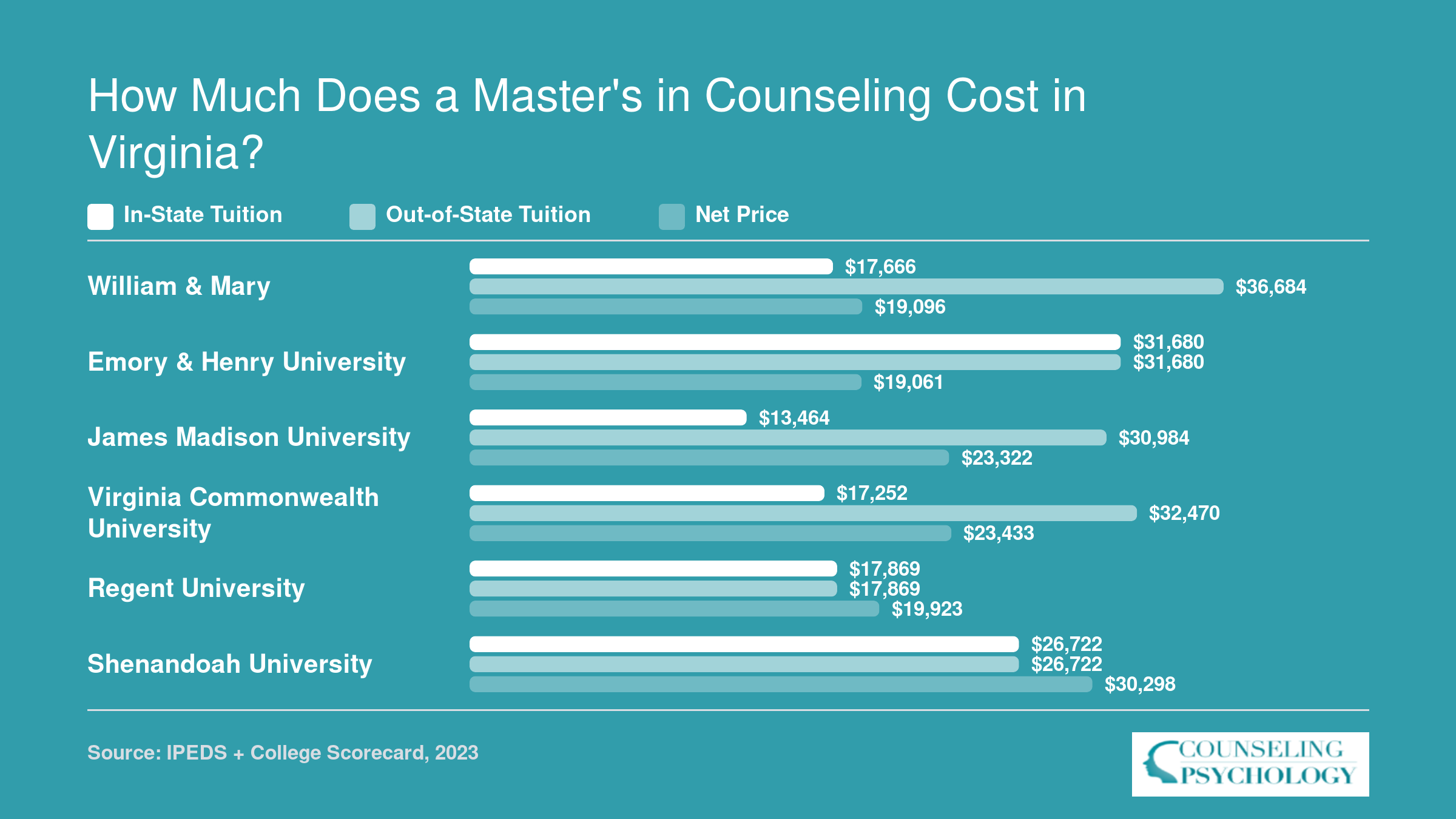
Tuition for an online or hybrid master's in counseling in Virginia ranges roughly from $13,500 to $31,700 per year depending on the school and residency status. After institutional aid, the average net price at these programs falls between about $19,000 and $30,300. Median graduate debt across these institutions ranges from $18,500 to $26,332, which translates to estimated monthly payments of roughly $190 to $275 on a standard 10-year repayment plan. Keep in mind that net price figures are institution-level averages and approximate; your actual cost will depend on your financial aid package, enrollment status, and program length.
Virginia Counseling Salary and ROI: What Graduates Earn
What can you expect to earn after completing a master's in counseling program in Virginia, and which programs offer the best return on your investment?
Salary outcomes for counseling graduates in Virginia depend on practice setting, specialization, and geographic location. Understanding both program-level earnings data and state labor market trends helps you make informed decisions about where to study and how to plan your financial future.
Median Salaries for Mental Health Counselors in Virginia
According to 2024 Bureau of Labor Statistics data, mental health counselors in Virginia earn a median annual wage of $58,410, just below the national median of $59,190.1 Entry-level counselors at the 10th percentile earn approximately $39,150, while experienced counselors at the 90th percentile earn $96,230.1 The 25th to 75th percentile range spans from $47,530 to $76,530, reflecting significant earning potential as you gain experience and credentials.
Geographic location within Virginia substantially affects salary. The Charlottesville metro area reports a median annual wage of $53,960 for mental health counselors, with the 10th percentile at $41,030 and the 90th percentile reaching $78,820.2 Northern Virginia, Richmond, and Virginia Beach typically offer higher compensation due to cost of living and demand density, though specific metro-level data for those regions varies by year.
Salary Context for Child and Adolescent Counselors
The BLS does not report separate wage data for child and adolescent counselors specifically. However, practice setting plays a major role in compensation. School counselors working in public K-12 systems typically earn salaries aligned with teacher pay scales and benefit from predictable schedules and summers off. Community mental health counselor roles at agencies often pay less than private practice settings but offer more supervision hours toward licensure. Private practitioners specializing in child therapy can command higher hourly rates once fully licensed, though income variability is greater.
Counselors who focus on trauma, play therapy, or specialized interventions for children and adolescents often pursue additional certifications that can enhance earning potential, particularly in private practice or hospital-based settings. Exploring the full range of counseling careers can help you identify which specializations align with both your professional interests and your financial goals.
Program-Level Earnings and ROI Leaders
While comprehensive post-graduation earnings data is not yet available for all Virginia counseling programs, debt-to-earnings ratios from federal scorecard data highlight which institutions offer the strongest return on investment. William & Mary leads with an ROI ratio of 3.97, reflecting its combination of relatively low graduate debt (median $18,500) and strong early-career earnings. James Madison University follows closely with an ROI of 3.48 and median graduate debt of $20,093. Virginia Commonwealth University offers an ROI of 2.70 with median debt of $21,500.
Private institutions show more variation. Marymount University and Hampton University both report ROI ratios around 2.3 to 2.7, with median debt in the $25,000 to $25,500 range. Liberty University's graduate certificate programs and Regent University's post-master's options tend to carry lower debt loads, making them financially accessible pathways for career changers or those adding credentials.
When evaluating ROI, consider not only the sticker price of tuition but also your expected time to licensure, regional salary differences, and whether the program offers assistantships or other funding. Public university programs in Virginia generally deliver strong value, particularly for in-state students, while private institutions may offer flexibility and specialization worth the premium if they align closely with your career goals.
Virginia is seeing rising pediatric mental health needs, and counselors trained in child-specific approaches such as play therapy and trauma-informed care are especially sought after at community services boards and school systems across the state. If you plan to work with children or adolescents, pursuing a program with dedicated child and family coursework can give you a meaningful edge in the job market.
Clinical Mental Health Counseling vs. School Counseling in Virginia
Virginia offers two distinct master's-level pathways for aspiring counselors who want to work with children and adolescents: clinical mental health counseling (CMHC) and school counseling. While both prepare graduates to support young people, they differ sharply in training focus, work environment, licensure requirements, and scope of practice.
Degree Structure and Credit Hours
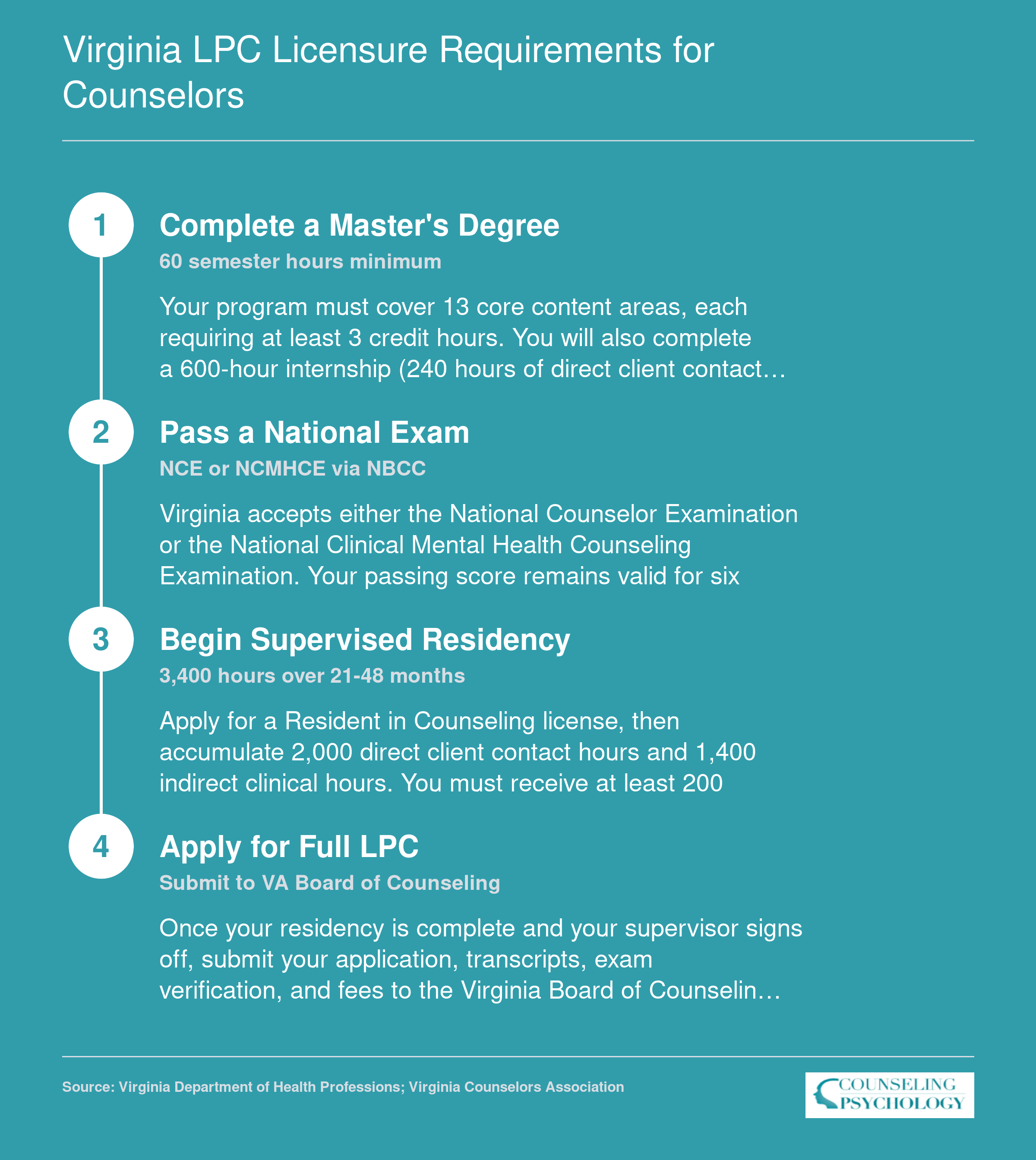
Clinical mental health counseling programs in Virginia typically require 60 semester hours to meet licensure standards set by the Virginia Board of Counseling.1 This extended curriculum includes coursework in diagnosis, psychopathology, testing and assessment, and treatment planning. School counseling programs are often shorter (48 to 60 credits depending on the institution) and emphasize developmental guidance, academic advising, and consultation with educators. Both tracks require a supervised internship before graduation: CMHC students complete at least 600 hours with 240 hours of direct client contact, while school counseling students fulfill practicum and internship requirements aligned with Virginia Department of Education (VDOE) standards.2
Licensure and Endorsement Pathways
Clinical mental health graduates pursue Licensed Professional Counselor (LPC) status through the Virginia Board of Counseling, which mandates 3,400 hours of post-degree supervised experience (including 2,000 hours of direct client contact) and 200 hours of face-to-face supervision.1 Candidates must also pass the National Counselor Examination (NCE) or National Clinical Mental Health Counseling Examination (NCMHCE) administered by the National Board for Certified Counselors. When working with children, supervisors must demonstrate competence in child and adolescent counseling, though Virginia does not require a separate child-specific credential.1 Students exploring broader options may also want to review counseling master's programs online to compare curriculum structures across states.
School counselors, by contrast, apply for a VDOE endorsement after completing their master's degree and passing the Praxis School Counselor exam. The endorsement is tied to K-12 educational settings and does not authorize independent clinical practice or diagnosis.
Work Settings and Populations Served
Licensed Professional Counselors work in private practices, community mental health centers, hospitals, residential treatment facilities, and outpatient clinics. They diagnose mental health conditions using the DSM-5, develop treatment plans, and provide psychotherapy to individuals, families, and groups. School counselors operate within K-12 buildings, delivering academic advising, college and career readiness programming, and social-emotional learning interventions. They collaborate with teachers, administrators, and parents but typically refer students with clinical diagnoses to external providers. For a deeper look at the clinical track, those interested can explore steps to become a mental health counselor.
Ability to Diagnose and Treat
This distinction matters profoundly for those who want to work therapeutically with children. LPCs can independently diagnose disorders such as anxiety, depression, ADHD, and trauma-related conditions, then provide evidence-based treatment. School counselors address developmental challenges and situational stressors but are not trained or credentialed to diagnose mental illness or conduct ongoing psychotherapy.
Salary Ranges in Virginia
Salary data reflect these different settings and scopes. School counselors in Virginia public schools earn salaries comparable to teachers, often ranging from the mid-$50,000s to the low $70,000s depending on locality and experience. Licensed Professional Counselors' earnings vary widely by practice setting, caseload, and specialization, with private practitioners and those in hospital systems typically earning more than community agency counselors.
Dual-Track and Cross-Training Options
Some Virginia universities offer dual-track programs or allow CMHC students to take school counseling electives (and vice versa). These options appeal to students who want versatility or plan to shift settings over their careers. However, graduates must still complete the full licensure or endorsement process for each credential they wish to hold.
Virginia LPC Licensure Requirements for Counselors
Earning your Licensed Professional Counselor (LPC) credential in Virginia follows a structured pathway overseen by the Virginia Board of Counseling. The process typically takes anywhere from four to seven years, including graduate study and a post-degree residency. If you plan to work with children, note that Virginia does not mandate a child-specific license, but the Registered Play Therapist (RPT) credential from the Association for Play Therapy is a respected optional add-on. Clinicians carrying child caseloads during residency should ensure their supervisor has documented competency in child and adolescent treatment. School counselors follow a separate endorsement process through the Virginia Department of Education, which requires a different degree track and a Praxis exam rather than the NCE or NCMHCE.
Frequently Asked Questions About Counseling Programs in Virginia
Choosing a counseling program in Virginia involves understanding licensure timelines, program formats, and specialization options. Below are answers to the questions prospective students ask most often, drawn from Virginia Board of Counseling requirements and current program offerings.