
What you’ll learn in this article…
- Most ranked programs require 12 to 18 graduate credits, completable in 6 to 12 months of part-time study.
- Regional accreditation and ABAI verification matter most when transferring credits or pursuing future licensure.
- National median pay for clinical and counseling psychologists reached $96,100 according to recent BLS data.
- A graduate certificate alone does not qualify holders for independent clinical licensure in any U.S. state.
Demand for professionals trained in child development and behavioral health has grown steadily across K-12 schools, early intervention programs, and pediatric behavioral clinics, driven by expanded mental-health screening mandates and rising rates of autism spectrum and ADHD diagnoses. A graduate certificate (12 to 18 credits, completed in six to twelve months) sits between a full master's degree and non-academic professional certifications, offering advanced coursework without the time or cost of a degree program.
The challenge is knowing which credential moves you forward. Not every certificate stacks toward licensure, not every program holds regional accreditation, and tuition varies from under $3,000 to over $10,000. Transfer policies, admission thresholds, and hybrid versus fully online formats shape both your timeline and your ability to apply coursework to a future degree.
The rankings below highlight ten accredited programs selected for curriculum depth, cost transparency, and alignment with applied child psychology roles. Sections that follow examine earnings data for certificate holders, what courses typically cover, and how to distinguish a credible program from a credential that carries little professional weight.
Best Online Child Psychology Graduate Certificate Programs
The programs below were selected from accredited institutions offering graduate certificates online or in a hybrid format, with direct relevance to child psychology, child development, or closely related fields such as applied behavior analysis and autism spectrum disorders. Each school was evaluated using a composite that weighs affordability (net price), institution-wide completion rates, and program-level features rather than any single metric. Because program-level earnings data are not yet available for most of these certificates, the composite leans more heavily on cost, graduation trends, and the strength of each program's child-focused curriculum.
- Online or hybrid delivery availability
- Net price and affordability
- Institution-wide graduation rate
- Program-level curriculum relevance
- Child psychology practice alignment
- Independent program research
- Internal program database
- NCES-IPEDS federal institutional data — nces.ed.gov
- College Scorecard graduate earnings — collegescorecard.ed.gov

University of Florida
A flagship research university with a 91.1% institution-wide graduation rate and a net price of $6,541, the University of Florida combines strong institutional outcomes with affordability. Its online Addiction and Recovery certificate addresses substance use across the lifespan, including adolescent populations, and coursework in family systems and co-occurring mental health disorders connects directly to child-serving practice settings. Certificate credits can stack toward certain UF master's degrees for students who later pursue a full graduate program with a child or adolescent focus.
- 18-credit certificate completable in one year
- Covers addiction neuroscience and medication-assisted treatment
- Family systems coursework relevant to child and teen contexts
- Non-degree option lets students sample courses first
- Meets educational requirements for addiction counselor certifications
- Credits may apply toward select UF master's programs
- Fully online format designed for working professionals
Addiction and Recovery Graduate Certificate — Online

Florida International University
Florida International University pairs a competitive net price of $9,288 with a hybrid ABA certificate built around South Florida's bilingual, multicultural communities. The 12-month, 21-credit program follows the BACB 5th Edition Task List and includes practicum placements in local schools and agencies that serve children with autism and behavior disorders. FIU's emphasis on culturally responsive ABA service delivery sets it apart for professionals working with diverse child populations.
- 21-credit hybrid program at $12,453 total estimated cost
- Follows BACB 5th Edition Task List for exam readiness
- Practicum sites in South Florida schools and clinics
- Emphasis on culturally and linguistically diverse populations
- Spring admission only, completable in 12 months
- Prepares graduates for Board Certified Behavior Analyst credential
- Seven courses covering ethics, principles, and behavior technologies
Graduate Certificate in Applied Behavior Analysis — Hybrid

University of Central Florida
The University of Central Florida offers two distinct child-focused online certificates at a net price of $10,411 and a 78% institution-wide graduation rate. Its ABA certificate aligns with BACB 5th Edition standards and targets K-12 educators, while its Autism Spectrum Disorders certificate carries Florida state approval for the ASD endorsement. UCF's Project ASD partnership with the Florida Department of Education gives students direct ties to school-based practice.
- 18 credit hours, fully online
- Aligned with BACB 5th Edition verified course sequence
- Designed for Education and Psychology graduate students
- Covers advanced behavior analysis, ethics, and supervision
- Prepares students for National Board Certification exam eligibility
- No direct certification granted, exam required separately
- 12 credit hours, fully online with field-based components
- State-approved pathway to the Florida ASD endorsement
- Field assignments completed in students' own school sites
- Part of UCF's Project ASD initiative with Florida DOE
- Can be taken standalone or embedded in a master's program
- Emphasizes practical ASD knowledge and classroom strategies
Applied Behavior Analysis Graduate Certificate — Online
Autism Spectrum Disorders Graduate Certificate — Online

CUNY Hunter College
CUNY Hunter College stands out for its remarkably low net price of $2,984 and its direct alignment with New York State Licensed Behavior Analyst (LBA) regulations. The 27-credit Advanced Certificate in ABA includes supervised practicum in New York City public schools and community agencies serving children with autism and developmental disabilities. With a 14:1 student-faculty ratio, Hunter delivers intensive mentoring uncommon at this price point.
- 27-credit program approved by NY State Education Department
- Satisfies educational requirements for NY LBA licensure
- Practicum in NYC schools and child-serving agencies
- Curriculum updated to reflect BACB 5th Edition Task List
- Strong focus on urban, culturally diverse child populations
- Nationally recognized ABA curriculum with supervised field hours
- Hybrid format blending online coursework and on-site practice
Advanced Certificate in Applied Behavior Analysis — Hybrid

Harvard University
Harvard Extension School's Positive Psychology and Well-Being certificate takes a different angle on child psychology, equipping students with research-based strategies for resilience, flourishing, and mental health promotion in youth. At $13,760 total and with no formal application required, it offers a flexible four-course pathway completable in as little as eight months. Several eligible courses address well-being in educational and youth development settings, and the certificate can stack into select Harvard master's degrees.
- Four online courses, $13,760 total tuition
- Completable in 8 months to 3 years
- No formal application required to start
- Courses address resilience and well-being in school contexts
- Stackable into Harvard master's programs in psychology
- Minimum B grade per course required
- Summer and fall start terms available
Positive Psychology and Well-Being Graduate Certificate — Online

University of Oklahoma-Norman Campus
The University of Oklahoma delivers its ABA certificate in a fully synchronous online format, allowing live case discussion and supervision around child and adolescent scenarios. The program addresses Oklahoma's documented shortage of ABA providers, particularly in rural areas where children with autism have limited access to services. Its BACB-verified course sequence spans seven courses and emphasizes ethical practice and real-world application with developmental disability populations.
- 100% synchronous online delivery for live interaction
- BACB-verified seven-course ABA sequence
- Targets Oklahoma's shortage of child-focused ABA providers
- Requires A or B grade in first two ABA courses for admission
- Emphasizes autism and developmental disability interventions
- No financial aid available for certificate-only students
- Flexible scheduling for working professionals in rural areas
Applied Behavior Analysis Graduate Certificate — Online

University of Virginia
The University of Virginia offers a fully online ABA certificate with no GRE requirement and a flexible one-to-seven semester timeline, making it accessible for working educators and school psychologists across the Commonwealth. UVA's coursework is designed to meet Virginia Board of Medicine behavior analyst credential requirements alongside BCBA/BCaBA exam preparation. Case examples draw heavily from Virginia K-12 settings, centering intervention design and behavioral assessment for children with autism and other disabilities.
- Fully online, no GRE required
- Flexible timeline from 1 to 7 semesters
- Approved by the Behavior Analyst Certification Board
- Supports Virginia behavior analyst credential requirements
- Focus on K-12 behavioral assessment and treatment planning
- Part-time option for current teachers and school psychologists
- Covers ethics, supervision, and evidence-based intervention
Certificate in Applied Behavioral Analysis — Online

Auburn University
Auburn University's 15-credit-hour certificate specifically targets intervention for students with autism and developmental disabilities, making it one of the most directly child-focused options on this list. Created in response to a critical shortage of ASD-competent professionals in Alabama and neighboring states, the program emphasizes evidence-based classroom practices and is open to educators and human service professionals. Both online and on-campus formats are available.
- 15-hour program available online or on campus
- Focus on evidence-based intervention for children with ASD
- Designed for special education teachers and related professionals
- Addresses Alabama's shortage of ASD-trained practitioners
- Includes verified course sequence for advanced ABA study
- Prepares professionals to improve K-12 student outcomes
- Part of Auburn's College of Education
Graduate Certificate in Intervention for Students with Autism and Developmental Disabilities — Online

University of South Florida
The University of South Florida's fully online ASD certificate is tailored for educators working with children and adolescents on the autism spectrum across Florida schools and early intervention programs. At a net price of $9,812, USF emphasizes assessment, positive behavior support, and technology-enhanced instruction consistent with Florida's statewide ASD initiatives. Credits may transfer into related master's programs in special education or applied behavior analysis for those pursuing longer-term child psychology careers.
- Fully online program completable in 1 to 2 years
- Emphasis on ASD assessment and diagnosis in schools
- Trains in positive behavior support and assistive technology
- Credits may articulate into USF master's programs
- Aligned with Florida statewide ASD training initiatives
- Designed for educators serving children and adolescents
Graduate Certificate in Autism Spectrum Disorder — Online

Vanderbilt University
Vanderbilt University's Post-Master's Certificate in ABA is an advanced credential for professionals who already hold a master's degree and want to move into leadership within child-serving ABA programs. Housed in the highly regarded Peabody College of Education, the curriculum emphasizes evidence-based interventions for children with autism and developmental disabilities in school, clinic, and early intervention settings. Financial aid options are available, and the fully online format accommodates working supervisors and clinicians nationwide.
- Requires a master's degree in a related field for admission
- Fully online format for working professionals
- Prepares graduates for ABA leadership and supervision roles
- Child and adolescent case applications emphasized throughout
- Covers ethical practices and research-based intervention
- Financial aid options available for eligible students
- Housed in Vanderbilt Peabody College of Education
Online Post-Master's Certificate in Applied Behavior Analysis — Online
What You'll Learn in a Child Psychology Certificate Program
A six-week online course and an 18-credit graduate certificate may share a title, but they represent fundamentally different commitments, outcomes, and credential weight. Understanding that gap before you enroll saves time, money, and professional frustration.
The Curriculum Core
Most graduate-level child psychology certificates center on five content areas:
- Child development theory: Cognitive, emotional, and social growth from infancy through adolescence
- Behavioral assessment: Standardized tools and clinical observation methods for evaluating children
- Developmental psychopathology: How conditions such as ADHD, anxiety, and autism spectrum disorders present and progress
- Family systems: The relational and structural dynamics that shape a child's psychological environment
- Evidence-based interventions: Treatment modalities with demonstrated efficacy for child and adolescent populations
The Chicago School of Professional Psychology illustrates this well. Its Child and Adolescent Psychology Certificate covers Psychology of the Life Span, Trauma and Crisis Intervention, and Family Systems and Family Therapy across 9 graduate credits.1 Those credits are transferable, which matters if a degree program is the eventual goal. Students interested in the trauma and crisis coursework may also want to explore how to become a crisis intervention specialist.
A typical graduate certificate in child psychology runs 18 to 28 credits across 6 to 8 courses and can be completed in roughly 12 months of focused study. Pacing varies: term-based programs lock you into scheduled cohorts, while self-paced formats let you compress or extend the timeline. That trade-off is worth examining carefully before you commit (the format comparison later in this article walks through both in detail).
Three Types of Certificates, Three Different Purposes
Not every certificate program carries the same professional value, and conflating them is a common and costly mistake.
- Career-qualifying certificates are graduate-level, credit-bearing credentials that satisfy continuing education or post-degree specialization requirements tied to licensure or professional advancement. Credits often transfer into a master's program.
- Continuing-education certificates fulfill license-renewal hours for credentialed practitioners. Penn Foster's Child Psychology Certificate, for example, awards 40.8 continuing education units over 4 courses completed in 6 to 11 months.3 It serves practitioners maintaining an existing credential, not those seeking a new one.
- Personal-enrichment certificates include most MOOC-based offerings from platforms such as Coursera. Completed in 4 to 8 weeks, these courses award a certificate of completion that carries no academic credit and no credential weight with employers or licensing boards.
What the Research Actually Requires
If your goal is licensure eligibility, clinical supervision, or a promotion into a child counselor role, you need graduate credit hours from a regionally or programmatically accredited institution. CPD designations, such as the 260-hour Advanced Certification offered by the American College of Teachers and Trainers, occupy a middle ground recognized in some professional development contexts but not as academic equivalents.5 When in doubt, check with your state licensing board or employer before enrolling.
Questions to Ask Yourself
How to Choose an Accredited Child Psychology Certificate
Not all credentials carry the same weight, and the gap between an accredited program and an unaccredited one can determine whether your coursework counts toward a license, transfers to a degree program, or gets recognized by a future employer. Understanding how accreditation works before you enroll is the single most practical step you can take.
Start With Institutional (Regional) Accreditation
Institutional accreditation is the baseline. In the United States, regional accreditors such as the Higher Learning Commission (HLC), the Southern Association of Colleges and Schools Commission on Colleges (SACSCOC), the Middle States Commission on Higher Education, and their counterparts cover most regionally recognized universities. A graduate certificate from an institution holding this kind of accreditation produces credits that other institutions will typically accept in transfer and that employers treat as legitimate graduate-level work. Without it, neither outcome is guaranteed.
Child psychology certificates are rarely accredited at the program level on their own; the institutional accreditation of the university offering the certificate is what matters most in practice.2
Programmatic Accreditation: When It Enters the Picture
Programmatic accreditation applies to specific degree programs and becomes relevant depending on the career path you are targeting.3
- CACREP (Council for Accreditation of Counseling and Related Educational Programs): Matters for students pursuing licensure as a counselor. Many state licensing boards require or strongly prefer a master's from a CACREP-accredited program, so if a certificate is embedded within or stackable toward such a degree, that relationship is worth confirming.
- NASP (National Association of School Psychologists): Covers graduate programs in school psychology at the specialist and doctoral levels. Completing a NASP-approved program allows graduates to apply for the Nationally Certified School Psychologist (NCSP) credential without additional review.4 A standalone certificate does not carry this benefit unless the host program holds NASP approval.
- APA (American Psychological Association): Accredits doctoral and postdoctoral programs only.5 A certificate will not carry APA accreditation, but if you eventually plan to pursue licensure as a psychologist, many states require a doctoral degree from an APA-accredited program, so your certificate choice should align with that longer-term path.
- MPCAC (Master's in Psychology and Counseling Accreditation Council): Covers master's programs in psychology and counseling. Similar logic applies: a certificate embedded in an MPCAC-accredited master's carries more downstream value than one that stands entirely alone.
Students aiming toward counselor licensure may also want to explore graduate certificate in counseling options, which often align closely with CACREP requirements.
How to Verify Accreditation Before You Apply
Do not rely solely on a program's marketing language. Two independent databases let you check institutional status directly. The U.S. Department of Education's Database of Accredited Postsecondary Institutions and Programs (DAPIP) and the Council for Higher Education Accreditation (CHEA) directory both allow searches by institution name. Cross-referencing both takes about five minutes and confirms whether the accrediting body itself is recognized by federal authorities.
For programmatic accreditation, go directly to the accreditor's own website. CACREP, NASP, and MPCAC each maintain searchable lists of approved programs.
The Red Flag to Watch For
Some programs describe themselves as "certified" or "accredited" through organizations that are not recognized by the Department of Education or CHEA. These designations may sound credible but carry no weight with state licensing boards or graduate admissions committees. If you cannot find the accrediting body in either federal database, treat that as a serious warning sign. Tuition spent on an unrecognized credential rarely counts toward anything that moves your career forward.
Related Articles
Admission Requirements and Prerequisites
Admission requirements are the specific credentials, documents, and qualifications a program expects you to present before you can enroll. For online graduate certificates in child psychology, these requirements tend to be less intensive than what you would face applying to a full master's degree in psychology, but they still vary enough from school to school that reviewing each program's criteria closely is worth your time.
Degree and GPA Expectations
Every program in this space requires a completed bachelor's degree. Some schools prefer that degree to be in psychology, education, social work, or a related behavioral science, while others cast a wider net. Northeastern University, for example, accepts applicants with a bachelor's in any field, making the certificate accessible to career changers.2 The University of Washington gives preference to candidates with backgrounds in social science, science, or health science.3
Minimum GPA thresholds typically fall in the 2.75 to 3.0 range. The University of Wisconsin-Milwaukee sets its floor at 2.75, while the University of Washington expects a 3.0.3 A few programs, including Northeastern's applied psychology certificate, do not publish a hard GPA cutoff, though a competitive academic record still strengthens your application.2
Prerequisite Coursework
If your undergraduate degree is outside psychology, some programs ask you to complete foundational coursework before or during enrollment. Common prerequisites include introductory psychology and a course in child or developmental psychology. The University of Washington lists child development coursework as a desired background.3 Programs that do not require specific prerequisites may still recommend them, so checking syllabi for assumed knowledge is a practical step.
Application Materials
Most programs ask for a similar set of documents:
- Official transcripts: From all post-secondary institutions attended.
- Statement of purpose: Explaining your professional goals and interest in child psychology.
- Resume or CV: Highlighting relevant education and experience.
- Letters of recommendation: Typically one to three; the University of Washington requires three.3
One consistently good piece of news: the GRE is almost universally waived for graduate certificate programs. None of the programs reviewed here require standardized test scores, which removes a significant barrier for working professionals.
Professional Experience
This is where programs diverge most. The University of Washington requires professional experience working with children or adolescents and also mandates a criminal background check.3 The University of Wisconsin-Milwaukee targets school professionals, so its applicant pool naturally skews toward people already working in educational settings.4 Other programs, including Northeastern's certificate, carry no formal experience requirement, welcoming applicants who are just beginning to explore child counseling certification paths.
Before applying, confirm whether a program's experience expectations align with your background. If you lack direct experience with children, programs without that requirement will be the most straightforward path in.
Cost, Financial Aid, and Transfer Credit Policies
Sticker-price tuition and what students actually pay are rarely the same number. Looking across the ten ranked programs, the gap between published rates and institutional net price tells you most of what you need to know before you commit.
What These Certificates Actually Cost
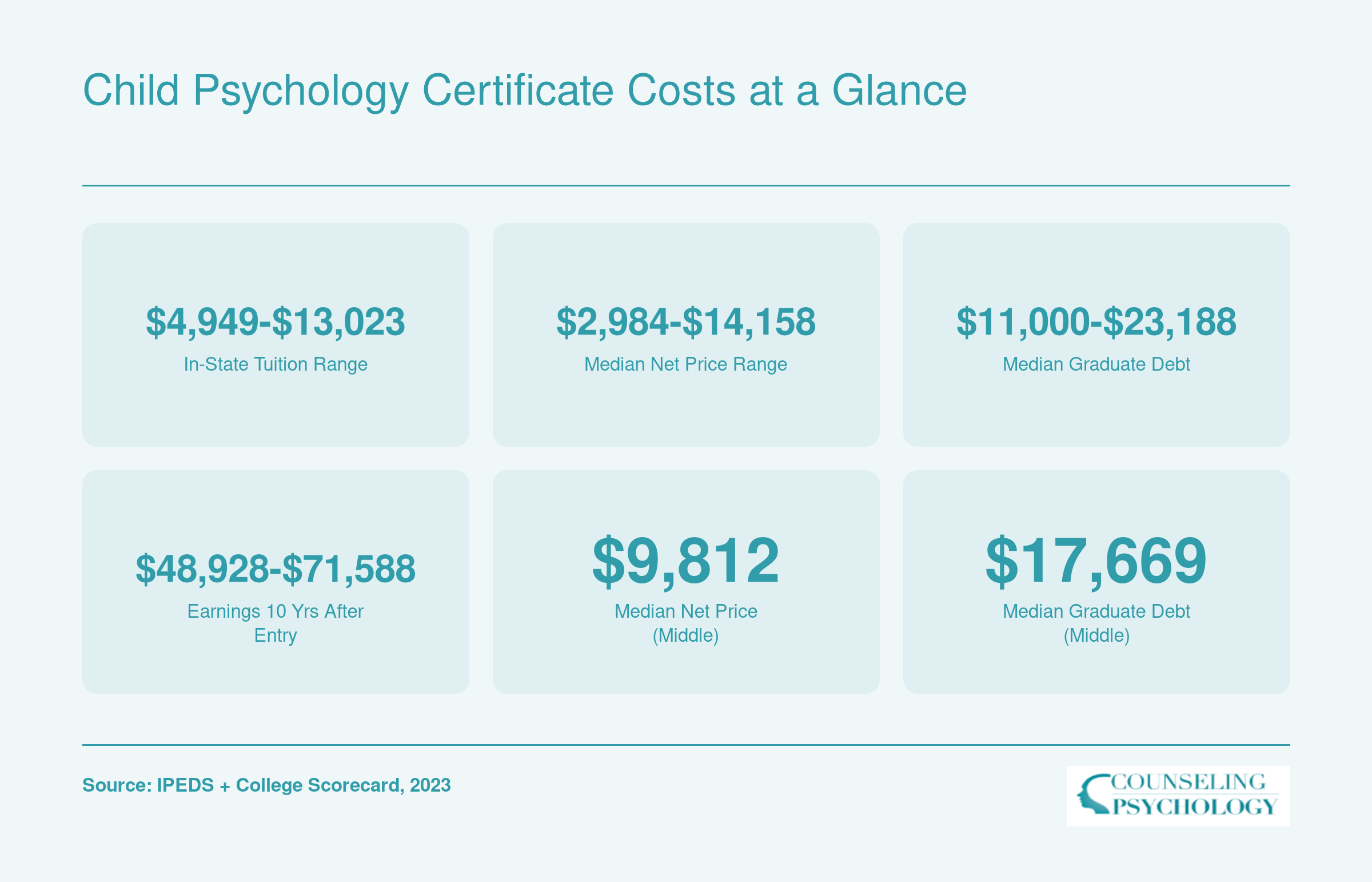
In-state graduate tuition across the ranked programs runs roughly $5,900 to $13,000 per year, with out-of-state rates climbing to nearly $30,000 at schools like the University of Florida ($28,659 out-of-state vs. $6,381 in-state) and Northern Arizona University ($29,881 vs. $13,009). For online certificates, many institutions waive the out-of-state premium, so confirm that with admissions before assuming the higher figure applies.
Institutional average net prices (what undergraduates typically pay after grant aid) range from about $2,984 at CUNY Hunter to $14,158 at UW-Whitewater and Northern Arizona. Important caveat: these net price figures are institution-wide averages drawn from undergraduate data and are not a per-student guarantee for graduate certificate enrollees. Use them as a directional signal about how generous a school's aid tends to be, not as a quote.
Federal Aid, Employer Benefits, and Military Funding
Federal financial aid eligibility for graduate certificates is narrower than most applicants expect. Under Title IV rules in the FSA Handbook (2024-2025), a graduate certificate must generally run at least one full academic year and meet minimum credit-hour thresholds to qualify students for federal loans.1 Standalone certificates also have to meet gainful employment reporting requirements.1 Shorter offerings, such as Fort Hays State's 9-credit certificate, may fall below the threshold for federal loan eligibility, in which case you'll need to look elsewhere.2
Viable alternatives include employer tuition reimbursement (common for teachers, ABA technicians, and clinical staff), military and VA education benefits, and institutional payment plans. Some programs also accept state-level workforce development grants.
Transfer Credits and Graduate Debt Context
Most of these certificates are designed so credits stack into a master's at the same institution. UW-Whitewater explicitly markets credit transfer into its master's track, and USF notes that certificate credits may transfer. Portability to a different university is a separate question entirely. Articulation agreements vary by program, accreditation status, and how recently the coursework was completed, so confirm transfer policies in writing with both the sending and receiving institution before enrolling. Students weighing related credential options, such as a counseling graduate certificate, should apply the same due diligence to transfer policies.
For context on what completers typically owe, median graduate debt at the ranked schools ranges from about $11,000 at CUNY Hunter to roughly $23,000 at UW-Whitewater. Those figures reflect all graduate programs at the institution, not certificate students specifically, but they offer a reasonable benchmark for the borrowing environment you'd be entering.
Child Psychology Certificate Costs at a Glance
Across the ten ranked programs, costs and institutional outcomes vary widely. These figures reflect institution-level data reported to IPEDS and the College Scorecard, not program-specific tuition. Keep in mind that graduate certificate pricing often differs from undergraduate sticker prices.
Career Outcomes and Earnings After a Child Psychology Certificate
Pursuing a standalone certificate versus stacking one onto an existing degree leads to different career trajectories. A graduate certificate in child psychology opens doors to specialized roles, but the earning potential and job responsibilities depend heavily on whether you treat the credential as a final destination or a stepping stone.
What Program-Level Earnings Data Shows
Program-level earnings for completers of these specific child psychology and related behavioral certificates are not yet published in federal outcome databases. This means we cannot report what graduates of individual programs actually earned one or four years after finishing. Employment share figures, which would show what percentage of completers were working rather than enrolled one year out, are also unavailable for these programs at this time.
When this data becomes available, it will offer the clearest picture of real-world outcomes for certificate holders. Until then, occupational wage benchmarks provide a useful reference point.
Occupation-Wide Wage Benchmarks
The Bureau of Labor Statistics tracks earnings for careers commonly pursued by those with child psychology training.1 These figures represent national medians across all workers in each occupation, not certificate completers specifically:
- School psychologists: $86,930 median annual wage (2024), with 1% projected job growth through 20342
- Clinical and counseling psychologists: $94,310 median annual wage (2024), with 6% projected job growth through 20341
- Child, family, and school social workers: $58,570 median annual wage (2024), with 7% projected job growth through 20341
These occupations typically require degrees beyond a graduate certificate for full entry. School and clinical psychologist roles generally demand a doctoral or specialist degree plus licensure. Social work positions usually require at least a bachelor's degree, with clinical roles needing a master's.
Concrete Roles a Certificate Can Unlock
So what can you actually do with a child psychology certificate online? The credential qualifies you for supportive and entry-level specialist positions, including:
- Behavioral interventionist working with children in schools or clinics
- School-based mental health aide under licensed supervisor direction
- Early childhood program coordinator in Head Start or daycare settings
- Child life assistant in pediatric hospital units
- Family services caseworker for state or nonprofit agencies
These roles often serve as launching points for professionals building clinical hours or deciding whether to pursue a full master's degree. Some certificate holders go on to become a child abuse counselor, while others move into school-based or family therapy tracks.
Licensure Limitations to Understand
A graduate certificate alone does not qualify you for independent licensure as a psychologist, school psychologist, or licensed professional counselor. State licensure boards typically require a master's or doctoral degree, supervised clinical hours, and passage of standardized exams. However, whether certificate credits can count toward licensure requirements varies by state. Some boards accept graduate-level coursework completed in an accredited certificate program as part of a broader degree pathway, while others do not. Check your state board's specific policies before enrolling if licensure is your ultimate goal.
For many students, the certificate functions best as a professional enhancement, adding specialized knowledge in child development, behavioral analysis, or developmental disorders to an existing counseling, education, or social work degree.
Salary Snapshot: Child Psychology-Adjacent Careers
The table below shows national median wages, 10th and 90th percentile earnings, and total employment for psychology occupations most closely related to child-focused work. These figures come from the Bureau of Labor Statistics (BLS) Occupational Employment and Wage Statistics and reflect national estimates. Keep in mind that a graduate certificate alone typically positions you for entry-level, paraprofessional, or support roles rather than independently licensed practice. Certificate holders generally earn closer to the lower end of these ranges, since the median and upper percentiles reflect salaries for professionals who hold doctoral or master's degrees and full licensure.
| Occupation | National Median Salary | 25th Percentile | 75th Percentile | Total Employment |
|---|---|---|---|---|
| School Psychologists | $86,930 | $73,240 | $108,210 | 63,830 |
| Clinical and Counseling Psychologists | $95,830 | $67,470 | $131,510 | 72,190 |
| Psychologists (Broad Category) | $94,310 | $71,140 | $126,340 | 154,860 |
Online Vs. Hybrid Format: What to Expect
Choosing between a fully online and a hybrid child psychology certificate affects more than just where you log in. Each format shapes your schedule, your networking opportunities, and the practical skills you build. The program listings in the rankings above indicate which options are fully online versus hybrid, so you can filter accordingly.
Pros
- Fully online programs let you study from anywhere, removing the need to relocate or commute to a specific campus.
- Asynchronous coursework in many online programs allows working professionals to complete assignments on their own schedule.
- Online certificates often carry lower total costs because they eliminate commuting, parking, and on-campus fees.
- Self-paced online programs can let you finish individual courses in as few as three to four months, accelerating your timeline.
- Hybrid formats include face-to-face networking with faculty and peers, which can open doors to practicum placements and job referrals.
- Hybrid programs typically incorporate hands-on observation or practicum hours that some employers specifically look for on a resume.
Cons
- Fully online certificates may not include practicum or child observation components, which can limit your competitiveness for clinical or school-based roles.
- Without structured in-person interaction, online students sometimes report feeling isolated from cohort support systems.
- Hybrid programs require proximity to a physical campus, restricting your options if you do not live near a participating institution.
- Hybrid schedules generally follow a fixed 15-week semester cadence, offering less flexibility than self-paced alternatives.
- In-person requirements in hybrid formats can conflict with full-time work schedules, especially when site visits fall during business hours.
- Term-based online programs still lock you into a semester calendar, so completion speed depends on the institution's course sequencing rather than your own pace.
A graduate certificate (typically 12 to 18 credits) takes 6 to 12 months and builds focused expertise, while a master's degree (30 to 60 credits) takes 2 to 3 years and is the credential required for clinical licensure. A non-academic certification from a professional association is a separate category entirely, often requiring no college credit. Match your choice to your actual career goal, not just the fastest path to a credential.
Frequently Asked Questions About Child Psychology Certificates
Graduate certificates in child psychology fill a specific niche, and prospective students often have practical questions about what these credentials can and cannot do. The answers below draw on current credentialing standards and employer expectations as of 2026.
More Online Child Psychology Certificate Programs to Consider
Beyond the top-ranked programs, these additional schools offer a variety of online graduate certificates in child psychology and related fields. Browse the directory below to find a program that matches your specific interests, whether that's applied behavior analysis, autism spectrum disorders, or positive psychology.
- Graduate Certificate in Applied Behavior Analysis
- Applied Behavior Analysis Certificate
- Applied Behavior Analysis Certificate (Autism Spectrum Disorder)
- Graduate Certificate in Applied Behavior Analysis
- Graduate Certificate in Autism Spectrum Disorder
- Graduate Certificate in Autism
- Teaching Students with Autism Spectrum Disorder Graduate Certificate
- Culturally-Centered Addictions Research Training
- Autism Spectrum Disorders Certificate
- Applied Behavior Analysis Graduate Credit Certificate Program
- Educating Individuals with Autism Postbaccalaureate Credit Certificate
- Applied Behavior Analysis Graduate Certificate
- Online Positive Psychology Graduate Certificate
- Graduate Certificate in Applied Behavior Analysis
- Graduate Certificate in Applied Behavior Analysis
- Graduate Certificate in Autism and Applied Behavior Analysis
- Graduate Certificate in Applied Behavior Analysis
- Positive Psychology
- Applied Behavior Analysis Graduate Certificate
- Autism Specialist - Online Graduate Certificate
- Applied Behavior Analysis Certificate of Advanced Study
- Graduate Certificate in Applied Behavior Analysis