
Key Takeaways
- APA-accredited Ph.D. programs in counseling psychology typically take 5 to 7 years, while PsyD programs average 4 to 6 years.
- The 2026 APPIC internship match rate for counseling psychology applicants was approximately 80 percent.
- BLS national median pay for clinical and counseling psychologists was $96,100 as of May 2024.
- Most APA-accredited counseling psychology doctorates remain campus-based, though hybrid options are expanding.
Research-focused Ph.D. or practice-oriented PsyD: the doctoral path you choose in counseling psychology determines your training model, your timeline, and often your debt load at graduation. Demand for licensed psychologists continues to climb, with BLS projections showing faster-than-average growth through the end of this decade, yet the supply of APA-accredited doctoral programs remains limited. That bottleneck makes program selection a high-stakes decision.
Both degree types can lead to independent licensure as a psychologist, but they differ meaningfully in research expectations, funding structures, and admissions competitiveness. Accreditation status matters more than almost any other variable; graduating from a non-accredited program can restrict licensure eligibility in many states and limit internship match prospects. For prospective students still exploring the broader landscape of careers in psychology, understanding these distinctions early is essential.
Best Counseling Psychology Doctorate Programs
The programs below span both Ph.D. and PsyD tracks in counseling psychology and closely related counselor education doctorates. Because doctoral training is a multi-year financial commitment, our ranking weights affordability and financial aid heavily alongside graduation outcomes, institutional resources, and program flexibility. Where APA or CACREP accreditation status could be confirmed, it is noted, though prospective students should always verify current accreditation directly with the accrediting body before applying. Program-level earnings and debt data are not yet published for most of these doctorates, so we include institution-wide outcome figures from the College Scorecard for context.
- Net price and financial aid
- Graduation and retention rates
- Program format and flexibility
- Accreditation and licensure alignment
- Institutional earnings outcomes
- Internal program database
- College Scorecard graduate earnings — collegescorecard.ed.gov
- Independent program research
- NCES-IPEDS federal institutional data — nces.ed.gov

Carlow University
Carlow University in Pittsburgh offers an APA-accredited PsyD in Counseling Psychology rooted in a social justice framework. With a 12:1 student-to-faculty ratio and strong retention, the program pairs rigorous clinical training with opportunities for international study. The institution's net price of roughly $20,786 is among the lowest on this list, and the median graduate debt of $25,500 stays manageable relative to the school-wide median earnings of about $51,051 ten years after enrollment. Graduates are well positioned for psychologist licensure across the Mid-Atlantic and Northeast.
- APA-accredited counseling psychology doctorate
- 93 total credit hours with social justice emphasis
- Hybrid format blends on-campus and online learning
- Practitioner-scholar training model with faculty mentorship
- Multiple practicum sites across diverse clinical settings
- International study opportunities available
- Designed to meet licensure requirements in Pennsylvania and beyond
Doctoral Program in Counseling Psychology (PsyD) — Hybrid

Felician University
Felician University's APA-accredited PsyD in Counseling Psychology is built specifically to satisfy New Jersey licensure requirements. The scholar-practitioner curriculum runs 73 to 88 credits and includes three years of practicum plus a full doctoral internship, drawing on a dense network of NJ-based hospitals, counseling centers, and community clinics. The institution-wide median graduate debt sits at about $25,000, though the net price of roughly $40,045 is the highest on this list, so applicants should explore assistantship and scholarship options carefully. School-wide median earnings ten years out reach approximately $57,602.
- APA-accredited counseling psychology program
- 73 to 88 total credits required
- Three-year practicum in diverse clinical placements
- Full doctoral internship required for completion
- Scholar-practitioner model with research emphasis
- Curriculum meets NJ psychologist licensure standards
- Integrates Franciscan values with evidence-based practice
Doctorate in Counseling Psychology (PsyD) — Hybrid

University of the Pacific
University of the Pacific's PsyD in Counseling Psychology pairs a hybrid delivery model with a guaranteed internship placement, a notable advantage in a competitive training market. Based in Stockton, California, the program requires only one to two in-person days per week, making it feasible for students across the state. Despite a sticker-price tuition above $55,000, robust financial aid brings the effective net price down to around $25,447, and the institution reports a median graduate debt of just $19,500, the lowest figure among schools on this list. School-wide median earnings reach approximately $78,445 a decade after enrollment.
- Hybrid format with one to two campus days per week
- Guaranteed internship experience included
- Comprehensive curriculum covers assessment, ethics, psychopharmacology
- Stockton, CA campus with regional practicum opportunities
- 69% institutional graduation rate signals strong support
- Low median graduate debt relative to peers
- Designed for aspiring health-service psychologists
PsyD in Counseling Psychology — Hybrid

Columbia International University
Columbia International University offers a Ph.D. in Counselor Education and Supervision delivered through online coursework with annual summer residencies in Columbia, South Carolina. The program is designed for practitioners shifting into scholar roles, with a biblical worldview integration that distinguishes it from secular alternatives. CIU's institution-wide median graduate debt is roughly $20,000, and the net price sits near $26,036. School-wide median earnings ten years out are about $38,951, though that figure reflects the full institution and not this doctoral program specifically.
- Three-year full-time study plan
- Online courses paired with summer residencies
- Requires a minimum 48-credit-hour master's degree
- 3.5 graduate GPA minimum for admission
- Dissertation-driven research component
- Biblical worldview integration throughout curriculum
- Focuses on leadership, supervision, and teaching development
Counselor Education and Supervision (PhD) — Hybrid

National University
National University's fully online Ph.D. in Psychology with a Counseling Psychology concentration targets licensed or pre-licensed clinicians who want to deepen their research and assessment expertise. The 60-credit program features weekly course starts and no fixed lecture schedule, giving working professionals maximum flexibility. The institution's net price is approximately $22,878, with a median graduate debt of $25,000. School-wide median earnings ten years after enrollment reach roughly $67,548, one of the higher figures on this list.
- 100% online doctoral program
- 60 total credit hours across 20 courses
- Weekly course starts with no set lecture times
- Designed for licensed or pre-licensed professionals
- Covers psychopharmacology, cognitive assessment, and multicultural psychology
- Faculty mentorship throughout the dissertation process
- Approximately 46 months to completion
Doctor of Philosophy in Psychology, Counseling Psychology Concentration — Online

Barry University
Barry University in Miami offers a CACREP-accredited Ph.D. in Counseling with a concentration in Marital, Couple, and Family Counseling/Therapy. The program stands out for its 7:1 student-to-faculty ratio, the smallest on this list, and its on-campus CARE Center where students gain direct clinical hours. The hybrid format includes in-person, synchronous online, and blended options, with evening classes for working professionals. The institution's net price is about $22,613; median graduate debt is roughly $26,997, and school-wide median earnings ten years out are approximately $55,966.
- CACREP-accredited doctoral program
- Hybrid format with evening class options
- 7:1 student-to-faculty ratio
- On-campus CARE Center for clinical training
- Three specialized internships in supervision, teaching, and advocacy
- Graduate tuition approximately $1,195 per credit
- Emphasizes ethics, social justice, and research leadership
Doctor of Philosophy in Counseling, Marital, Couple, and Family Counseling/Therapy — Hybrid

Lesley University
Lesley University's Ph.D. in Counseling and Psychology focuses on transformative leadership, education, and applied research rather than traditional psychologist licensure. The weekend-intensive format in Cambridge, Massachusetts, is tailored for experienced professionals with at least three years in the field. Total program cost is estimated around $77,000, and the institutional net price runs about $31,152. The school's median graduate debt is roughly $21,000, and institution-wide median earnings ten years out are approximately $51,173.
- Weekend-intensive cohort model in Cambridge, MA
- 48 total credit hours
- Requires a master's degree and 3+ years of experience
- Multidisciplinary focus on leadership and social justice
- Covers trauma-informed approaches and interpersonal neurobiology
- Designed for career advancement, not psychologist licensure
- Merit scholarships and financial aid available
Counseling and Psychology: Transformative Leadership, Education, and Applied Research (PhD) — Hybrid

Oregon State University
Oregon State University's CACREP-accredited Ph.D. in Counseling prepares graduates for roles in counselor education, supervision, and research. The hybrid program meets twice quarterly in Portland, allowing working counselors throughout Oregon and the Pacific Northwest to maintain employment while completing 150 program credits. No GRE is required. The institution's net price is approximately $19,604 for in-state students, and median graduate debt is about $21,221. School-wide median earnings ten years after enrollment reach roughly $64,010.
- CACREP-accredited counselor education doctorate
- Hybrid format with twice-quarterly Portland meetings
- 150 total program credits
- No GRE required for admission
- Part-time option for working professionals
- Median completion time of 48 months
- Admits approximately 12 students per year
Doctor of Philosophy in Counseling, Counselor Education — Hybrid

Concordia University-Irvine
Concordia University Irvine's Ph.D. in Counselor Education and Supervision is delivered primarily online with two required in-person residencies, making it practical for licensed California counselors and marriage and family therapists who want to remain in practice. The 60-unit program can be completed in three to four years at $795 per unit. The institution's net price is about $28,115, with median graduate debt near $24,247. School-wide median earnings reach roughly $65,083 ten years after enrollment.
- Primarily online with two in-person residencies
- 60 total units at $795 per unit
- Accelerated three- to four-year timeline
- 700 total fieldwork hours required
- Designed for licensed counselors and LMFTs
- Christian thought leadership integration
- Research-focused curriculum with faculty mentorship
Ph.D. in Counselor Education and Supervision — Online
How We Ranked These Counseling Psychology Programs
Transparency in doctoral program rankings has become a growing priority as applicants seek clarity on what metrics actually matter for their careers. Our methodology draws on publicly available data to help prospective students compare programs on factors that directly influence both their training experience and long-term outcomes.
Data Sources and Key Metrics
We built these rankings using College Scorecard data from the U.S. Department of Education, which tracks institutional outcomes including net price, graduation rates, median student debt at completion, and post-graduation earnings. These figures offer a standardized baseline for comparing programs across different institutional types and geographic regions.
One important clarification: graduation rates in these datasets reflect institution-wide averages, not program-specific completion rates for counseling psychology doctorates. Similarly, net price figures represent sector-conditional averages rather than individual cost projections. Your actual expenses will vary based on residency status, financial aid packages, and funding arrangements like assistantships or fellowships.
Why Affordability Carries Weight
Doctoral training in counseling psychology typically spans five to seven years, and cumulative costs can shape career flexibility for a decade or more after graduation. Our ranking methodology prioritizes programs that deliver strong professional outcomes relative to what students actually pay. A program with excellent clinical training loses some of its value if graduates carry debt loads that limit their career choices or delay financial stability. Students earlier in their academic journey may also want to explore best masters in mental health counseling programs before committing to a doctoral path.
The Accreditation Baseline
Every program in this ranking holds accreditation from the American Psychological Association. This was a non-negotiable filter, not a bonus criterion. APA accreditation matters because most state licensing boards require graduation from an accredited program to sit for the EPPP examination. Accredited programs also have significantly higher match rates for APA-accredited internships, which remain competitive nationally. Choosing an unaccredited program, regardless of other strengths, creates substantial licensure barriers that can derail an otherwise promising career path. Those interested in related counseling doctoral programs will find that accreditation standards vary by discipline, making it essential to verify requirements specific to your intended license.
Ph.D. vs. PsyD in Counseling Psychology: Key Differences
The choice between a Ph.D. and a PsyD in counseling psychology shapes every dimension of your doctoral training, from how you spend your days in coursework to what career doors open after graduation. These two degrees lead to the same licensure eligibility but take fundamentally different paths to prepare you for practice.
Training Philosophy and Structure
Ph.D. programs in counseling psychology follow the scientist-practitioner model, balancing rigorous research training with clinical preparation. You will design studies, analyze data, publish findings, and contribute new knowledge to the field while also seeing clients under supervision. PsyD programs adopt a practitioner-scholar approach, centering clinical skill development and applied training while maintaining a foundation in research literacy. You will consume and evaluate research rather than generate it at the same intensity.
Program length reflects these priorities. Most Ph.D. programs require five to seven years to complete, with dissertation research often extending timelines. PsyD programs typically run four to six years, replacing the traditional empirical dissertation with applied projects, clinical portfolios, or shorter capstone studies that emphasize practical application over original investigation.
Funding Models and Financial Impact
Ph.D. programs routinely offer full tuition waivers paired with stipends (typically $20,000 to $35,000 annually) in exchange for teaching or research assistantships. Most doctoral students in APA-accredited Ph.D. counseling psychology programs graduate with minimal to no debt from tuition. PsyD programs, by contrast, function on a tuition-revenue model. Funding is rare and competitive, leaving most students to finance their education through loans. Total debt at graduation often exceeds $150,000 for PsyD graduates, a burden that shapes post-degree career choices and financial trajectories for years.
Career Paths and Internship Outcomes
Ph.D. holders gravitate toward academic appointments, research institutions, and leadership roles in integrated health systems. PsyD graduates overwhelmingly enter direct clinical practice in private settings, community agencies, and hospitals. Those drawn to direct patient care may also explore paths such as becoming a clinical psychologist, where doctoral-level training is essential. Both degrees qualify you for licensure, but the pipeline differs.
APPIC internship match data reveals a persistent gap: Ph.D. applicants in counseling psychology consistently match at higher rates (often 85 to 90 percent) compared to PsyD applicants (70 to 80 percent range in recent cycles). The difference stems partly from training directors' preferences for research-grounded candidates and partly from the sheer volume of PsyD applicants competing for fewer funded internship slots. If securing a competitive predoctoral internship on the first attempt matters to you, training model and degree type carry real weight in that outcome.
Related Articles
Questions to Ask Yourself
What You'll Learn in a Counseling Psychology Doctorate
A counseling psychology doctorate provides an intensive, scientist-practitioner education that prepares you to assess, diagnose, and treat mental health concerns while contributing to the field's research base. The curriculum balances academic rigor with hands-on clinical training, ensuring graduates are eligible for licensure as psychologists and ready to work in diverse settings.
Core Curriculum and Foundational Knowledge
APA-accredited programs require 70 to 110 credit hours, typically completed over four to six years. The coursework builds broad clinical competence through a sequence that covers psychotherapy theory and technique, psychopathology, and psychological assessment. You'll study evidence-based interventions across multiple modalities, learn to administer and interpret cognitive and personality tests, and gain a deep understanding of ethical and legal standards in professional practice.
Multicultural counseling is woven throughout the curriculum, not treated as a standalone elective. Programs emphasize cultural awareness, humility, and adaptive clinical skills for working with clients from varied backgrounds. Research literacy is equally central: courses in quantitative and qualitative methods, statistics, and program evaluation enable you to critically consume research and contribute original scholarship through a dissertation.
Supervised Clinical Training: Practicum and Internship
Clinical training begins early and intensifies as you progress. Before the internship, students complete a practicum sequence that accumulates between 1,000 and 2,000 hours of supervised direct service.2 These practica are often located in college counseling centers, community mental health agencies, or hospital outpatient departments, giving you exposure to a range of presenting problems and intervention formats.
The predoctoral internship is a culminating, full-time experience required for program completion and eventual licensure. It spans 12 months and approximately 2,000 hours of clinical work under the supervision of licensed psychologists.3 Most students pursue APA-accredited internship sites, which meet rigorous quality standards and are often necessary for state licensure and employment in competitive settings. Securing an internship involves a national matching process, and the training is designed to solidify advanced clinical reasoning, ethical decision-making, and professional identity.
Specialization Tracks for Focused Expertise
While the core curriculum ensures generalist competence, most programs allow you to develop specialized proficiency through elective coursework, clinical placements, and research. Common areas of focus include health psychology, where you learn to address the psychological aspects of physical illness and wellness promotion; doctorate in addiction counseling; career counseling and vocational rehabilitation counseling; trauma and crisis intervention; and child and adolescent counseling. Some programs also offer formal tracks in neuropsychology, forensic psychology, or sports psychology, though availability varies.
These specializations are not merely academic. They shape your practicum placements and internship site selection, helping you build a career path aligned with your interests and the populations you aim to serve.
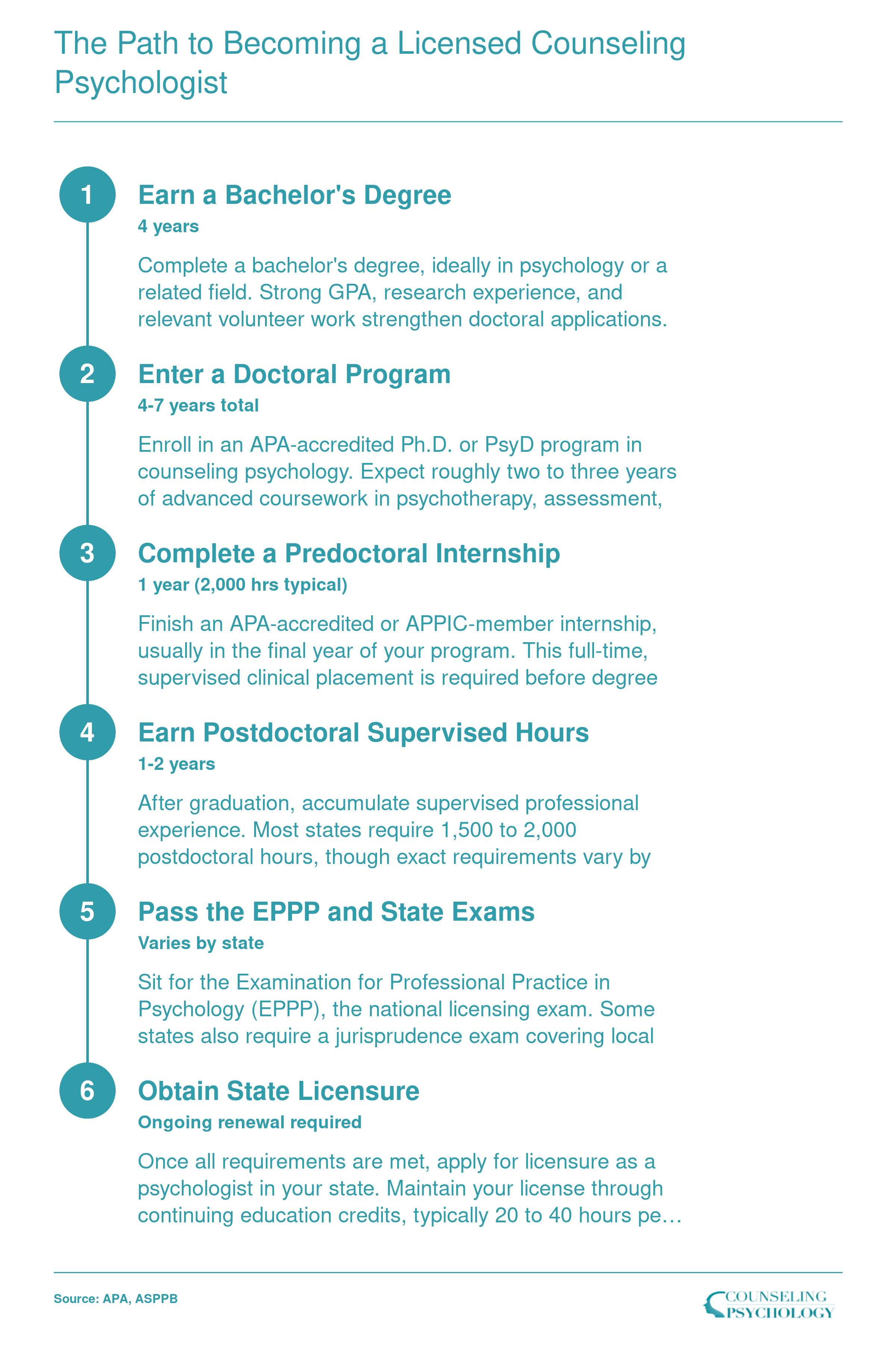
The Path to Becoming a Licensed Counseling Psychologist
From your first undergraduate course to the day you receive your license, the journey to becoming a counseling psychologist typically spans 8 to 12 years. Each stage builds on the last, so understanding the full timeline helps you plan finances, personal commitments, and career milestones well in advance.
Admissions Requirements and Application Tips
Applying to a Ph.D. program and applying to a PsyD program can feel like two very different processes, even when the programs sit side by side in a directory. Ph.D. programs at research universities often have extremely competitive acceptance rates, sometimes in the single digits, while professionally oriented PsyD programs may admit larger cohorts. Understanding where you stand before submitting a single application saves time and shapes a stronger strategy.
What Most Programs Require
APA-accredited counseling psychology doctoral programs share a broad set of baseline requirements, though the specifics vary considerably by school.
- Undergraduate GPA: Many programs cite a minimum around 3.0, but competitive applicants frequently present 3.5 or higher. Some programs weigh the last 60 credit hours separately if earlier transcripts are uneven.
- Relevant experience: Research experience matters greatly for Ph.D. programs. Clinical or community service hours carry more weight in PsyD admissions. Most programs want to see both, but the balance differs.
- Letters of recommendation: Three letters are standard. At least one should come from a faculty member or supervisor who can speak to your research or clinical capacity.
- Personal statement: This document does a lot of work. Committees look for clarity about your theoretical orientation, research or clinical interests, and how your goals fit their faculty's current work.
- Writing sample or resume: Not universal, but increasingly requested, particularly at programs with strong research cultures.
The GRE Picture Right Now
The test-optional movement that accelerated during the early 2020s has become a lasting feature of doctoral admissions. A meaningful number of APA-accredited programs have dropped the GRE requirement permanently. Others retain it as optional or still require it. Because policies continue shifting, the most reliable source is each program's current admissions page. Announcements from APA Division 17 (the Society of Counseling Psychology) periodically summarize broader trends, and that is worth monitoring if you are planning applications over the next admissions cycle.
Finding Accurate, Current Data
Centralized admissions statistics for counseling psychology doctoral programs are difficult to track reliably. Acceptance rates and GPA profiles published on third-party sites are often outdated by one or more admissions cycles.
Two authoritative starting points are APA's accreditation database, which lists all currently accredited programs with links to their home pages, and APPIC's program directory, which covers internship-affiliated training programs and often connects to application portals as well. If you are also exploring different counseling degrees at other levels, many of these same directories provide useful cross-references.
Beyond those directories, go directly to the source. Program directors and admissions coordinators generally respond to brief, specific questions, and a short email asking about current cohort size, application deadlines, or GRE policy is a reasonable step before investing significant time in an application. Published statistics may lag behind recent faculty changes, funding shifts, or policy updates that only the program itself can confirm.
Cost, Funding, and Return on Investment
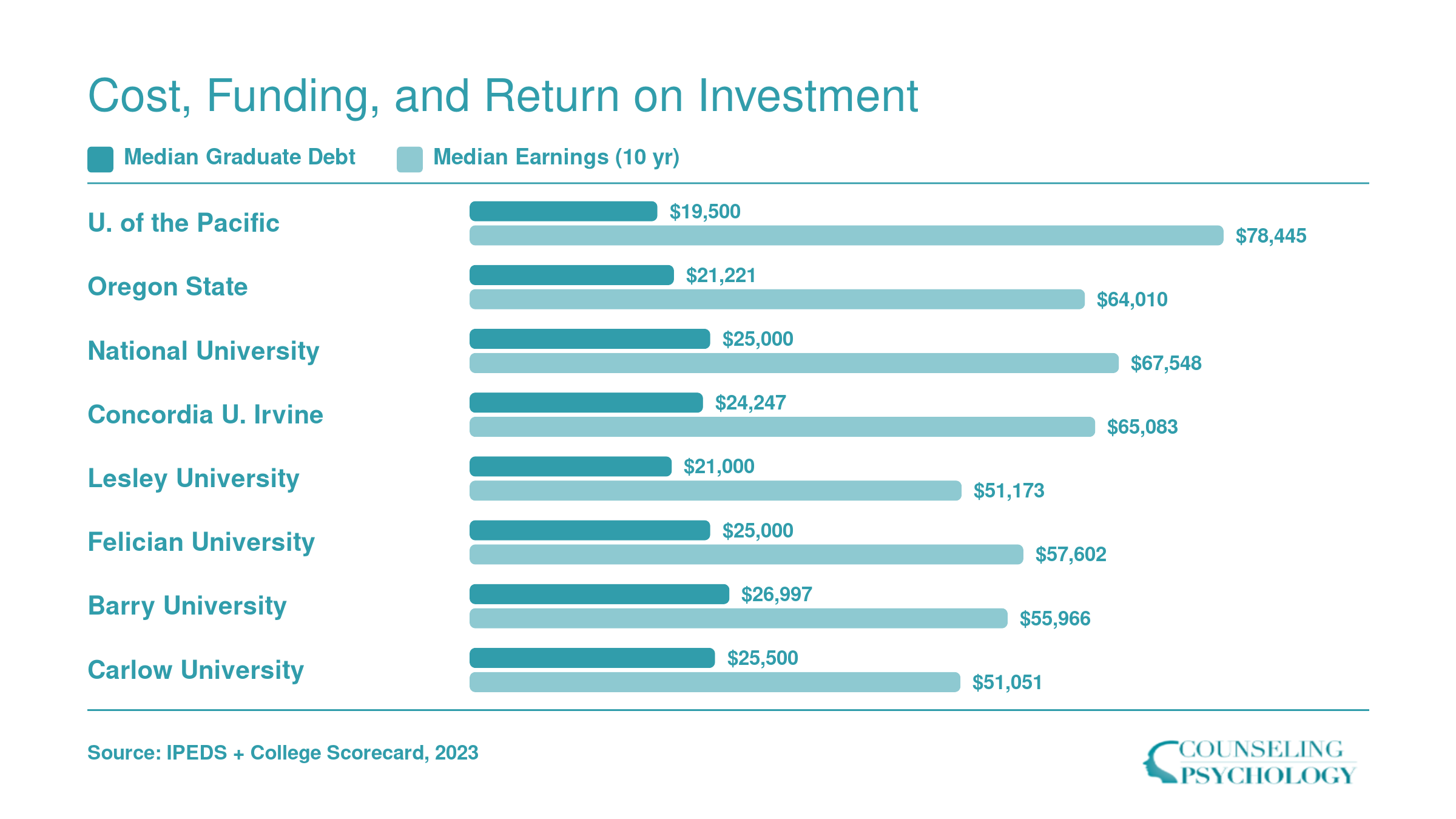
Doctoral program costs vary widely, and so does the payoff. The chart below compares median graduate debt at completion against median earnings ten years after enrollment for each ranked program. Programs with a higher earnings-to-debt ratio deliver stronger long-term value. Keep in mind that many Ph.D. programs, such as those at the University of Maryland and Boston College, guarantee full funding with tuition waivers and stipends for four to five years, which can dramatically reduce or eliminate the debt figures shown. PsyD programs typically offer less institutional aid, so borrowing tends to be higher. Program-level earnings shortly after graduation are not yet published for these schools, so the institution-wide ten-year figures serve as a general benchmark rather than a program-specific guarantee.
In the 2026 APPIC internship match cycle, counseling psychology doctoral applicants posted an overall match rate of about 80%. That means roughly one in five applicants did not secure a placement on their first attempt, making early preparation, a strong application portfolio, and a broad list of ranked sites essential for anyone approaching the internship phase.
Career Outcomes and Salary Expectations
What can you actually earn with a counseling psychology doctorate? Earnings depend heavily on licensure status, practice setting, and geographic location, but national data shows strong long-term returns for licensed professionals.
National Salary Benchmarks
According to the Bureau of Labor Statistics, clinical and counseling psychologists earned a median annual wage of $95,830 in 2024.1 The spread is wide: the lowest 10 percent made under $50,470, while the top 10 percent exceeded $170,150. The middle half of earners fell between $67,470 and $131,510. Total employment in the occupation was 76,300 in 2024, with projected growth of 11 percent from 2024 to 2034, much faster than average.
Earnings Trajectory at Ranked Programs
Program-specific earnings data is not yet published for these institutions, but the overall median earnings of former students from the ranked schools ten years after entry range from about $39,000 to $78,000. These figures capture all degree levels and fields at each university, so they only indirectly reflect the value of a doctoral counseling psychology credential. Among programs in the ranking, University of the Pacific graduates show the highest institutional median at $78,445, still below the national median for licensed psychologists, underscoring the importance of completing postdoctoral hours and obtaining full licensure.
Career Paths and Typical Settings
Counseling psychology doctorates open doors across a range of work environments: - Private practice: The most common path, offering flexibility and high earning potential once licensed. - Hospitals and integrated care: Psychologists collaborate with medical teams, often earning salaries in the upper percentiles. - Community mental health centers: Provide vital services with salaries typically closer to the national median. - Veterans Affairs (VA) and military: Federal roles come with structured pay scales, benefits, and loan repayment programs. - Academia and research: Faculty positions at universities typically require a PhD and involve teaching, research, and publishing. - Consulting and corporate wellness: Organizational psychologists and wellness consultants can command premium rates in the private sector.
For those weighing a master's-level path instead, understanding the typical counselor salary by degree and specialty can help clarify the financial case for pursuing a doctorate.
Licensure and the Salary Premium
Unlicensed postdoctoral fellows earn significantly less than independently licensed psychologists, often in the $40,000 to $60,000 range during supervised hours. Becoming a licensed professional counselor is one related credential path, but full psychologist licensure unlocks substantially higher earning power. Once licensed, many practitioners fall within the BLS 25th to 75th percentile band, and those in high-cost metro areas or specialized private practice can push into the top decile. The 11 percent growth projection means that demand for these services will outpace the broader economy, supporting steady long-term earning potential.3
Online vs. On-Campus Counseling Psychology Doctorates
Delivery format is one of the most consequential decisions you will make when choosing a doctoral program. The majority of APA-accredited counseling psychology programs remain campus-based, but a growing number of hybrid options are entering the landscape. Fully online counseling psychology doctorates exist as well, though none currently hold APA accreditation, which matters if you plan to pursue licensure as a psychologist.
Pros
- Hybrid and online formats offer scheduling flexibility that lets working clinicians maintain their caseloads while earning a doctorate.
- Geographic barriers shrink significantly: programs like Oregon State, Lesley University, and Columbia International University deliver hybrid coursework that limits required campus visits.
- Tuition can be lower in some online or hybrid programs; Concordia University Irvine, for example, lists a per-unit cost well below many traditional campus-based programs.
- Evening and weekend class structures, such as those at Barry University and Lesley University, are specifically designed for professionals with daytime responsibilities.
Cons
- APA-accredited fully online counseling psychology doctorates do not exist as of 2026; only a handful of hybrid programs, including those at Carlow University and Felician University, hold APA accreditation.
- Practicum and internship placements often require in-person clinical hours, so students in online or hybrid programs must coordinate local sites independently, which can be challenging in rural areas.
- Research mentorship tends to be less immersive when faculty interaction happens primarily through virtual channels, potentially limiting collaborative lab work and publication opportunities.
- Some licensing boards scrutinize the delivery format of doctoral training, and a program without APA accreditation may complicate or lengthen the path to licensure in certain states.
- National University offers a fully online Ph.D. concentration in counseling psychology, but because it is not APA-accredited, graduates should verify their state board's requirements before enrolling.
Frequently Asked Questions About Counseling Psychology Doctorates
Choosing a doctoral program in counseling psychology raises a lot of practical questions. Below are concise answers to the ones prospective students ask most often, drawing on the data and details covered throughout this guide.