
What you’ll learn in this article…
- APA and NASP accreditation serve different purposes, and your target state determines which credential you need for licensure.
- Expect 4 to 7 years post-master's to complete a doctoral program and accumulate the 1,800 or more supervised field hours required.
- Doctoral school psychologists consistently earn more than specialist-level practitioners and qualify for roles in private practice, supervision, and research.
- Online programs hold the same competitive admissions standards as campus programs, requiring strong GPAs, relevant experience, and faculty recommendations.
School psychologist shortages now affect nearly every state, with the National Association of School Psychologists reporting a ratio of roughly 1,127 students per school psychologist, well above the recommended 500:1. That gap has intensified interest in doctoral credentials, which unlock roles in supervision, private assessment, and university faculty positions that an EdS alone cannot reach.
Can you actually complete a school psychology doctorate online? The short answer: partially. Every NASP-approved program requires substantial in-person practicum and internship hours, but coursework increasingly happens through hybrid or asynchronous formats. The distinction matters for working professionals weighing relocation against flexibility.
Doctoral tuition ranges from under $40,000 at some public institutions to well over $100,000 at private universities, and salary premiums for doctoral holders vary by setting and geography. If you are earlier in your academic planning and still exploring graduate options, our overview of online master's in psychology programs can help you map the path leading up to doctoral study.
Best Online and Campus School Psychology Doctorate Programs
Doctoral programs in school psychology vary widely in structure, cost, and how they balance clinical training with school-based practice. The three programs below each offer a hybrid delivery format, making them accessible to working professionals while still requiring substantial in-person practicum and internship hours. We evaluated them on affordability, program design, and alignment with national credentialing standards.
- Tuition and net price affordability
- Practicum and internship structure
- Accreditation and credentialing alignment
- Program format and flexibility
- Institution graduation and retention rates
- Independent program research
- Internal program database
- NCES-IPEDS federal institutional data — nces.ed.gov
- College Scorecard graduate earnings — collegescorecard.ed.gov

University of Southern Maine
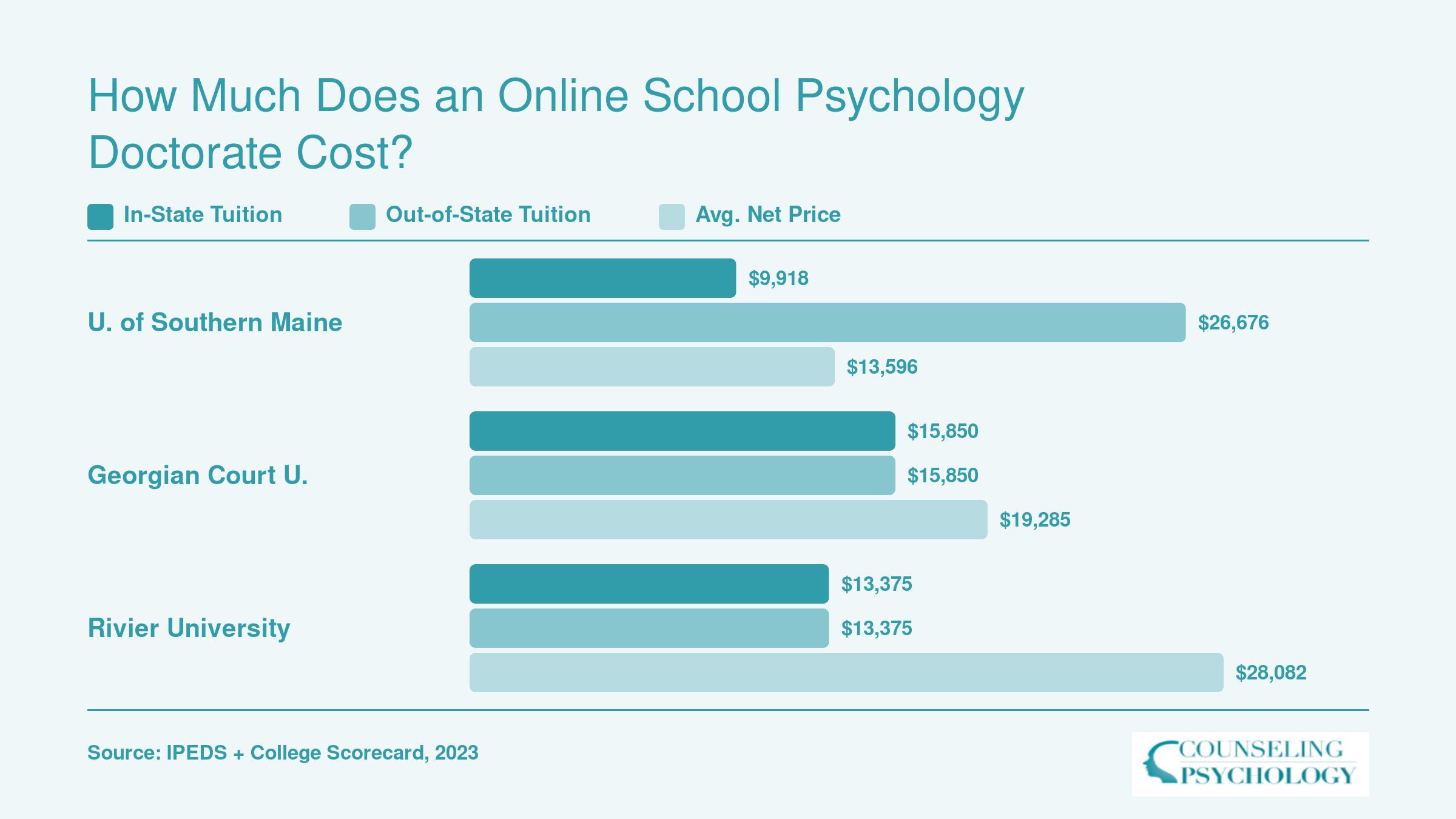
The University of Southern Maine delivers a Psy.D. in School Psychology through a rigorous hybrid model rooted in New England's public university system. With in-state tuition around $9,918 per year, it stands out as the most affordable option on this list for Maine residents and potentially for students eligible for regional tuition agreements. The program requires 111 graduate credits, 600 practicum hours, and a 1,500-hour predoctoral internship, providing thorough preparation across assessment, intervention, and consultation domains. Schools offering this program have an institution-wide graduation rate of 40.3%, and the institution reports median earnings of $49,958 ten years after enrollment.
- Hybrid delivery combining online coursework with in-person requirements
- 111 total graduate credits required for completion
- 600 hours of supervised practica across educational and clinical settings
- 1,500-hour predoctoral internship required
- Dissertation research component included in program
- Meets national and state school psychology certification standards
- Optional M.S. in Educational Psychology available en route
- Professional ethics training integrated throughout curriculum
School Psychology, Psy.D. — Hybrid

Georgian Court University
Georgian Court University's Psy.D. in School Psychology is built around NASP domains and offers two distinct entry pathways: a five-year track for those holding a bachelor's degree and a three-year advanced standing option for already-certified school psychologists. Students on the longer track earn an M.A. and a Certificate of Advanced Graduate Study (CAGS) along the way, giving them intermediate credentials to begin working in schools before finishing the doctorate. The GRE is no longer required, lowering a common barrier for mid-career professionals. The institution-wide graduation rate is 53.6%, and median graduate debt sits at $21,816.
- Hybrid format with evening course scheduling
- Two pathways: 5-year (bachelor's entry) or 3-year advanced standing
- Built-in M.A. and CAGS credentials earned en route to Psy.D.
- 420 practicum hours plus 1,500 to 1,750 hour internship
- No GRE required for admission
- Strong social justice and implementation science emphasis
- Curriculum aligned with NASP domains for NJ certification
- High reported job placement rate for graduates
School Psychology, Psy.D. — Hybrid

Rivier University
Rivier University offers an APA-accredited Psy.D. in Counseling and School Psychology, combining both disciplines under a practitioner-scholar training model. This dual focus prepares graduates for licensure in clinical settings as well as school-based practice, a meaningful advantage for those who want career flexibility across hospitals, clinics, private practice, and K-12 environments. The program requires a minimum of five years, 2,000 internship hours, and evening scheduling that accommodates working professionals. Tuition runs $13,375 per year, with median graduate debt of $26,956 and institution-wide median earnings of $52,248 a decade after enrollment. The institution-wide graduation rate is 51.7%.
- Fully APA-accredited doctoral program
- Combined counseling and school psychology curriculum
- Practitioner-scholar model emphasizing applied clinical skills
- Minimum 5-year program with 60 to 130 total credits
- 2,000-hour predoctoral internship required
- Weekday evening course schedule for working professionals
- Multiple practicum placements across diverse settings
- Meets New Hampshire psychology licensing requirements
Psy.D. in Counseling and School Psychology — Hybrid
Ph.D. vs. PsyD vs. EdD in School Psychology: Which Degree Fits Your Goals?
Which doctorate best aligns with your career goals in school psychology: the research-focused Ph.D., the practice-oriented PsyD, or the leadership-centered EdD?
The answer depends on five key dimensions: research emphasis, dissertation requirements, clinical training depth, typical program length, and your intended career track. While all three degrees can prepare you to work in schools, they differ substantially in focus and in how they position you for licensure and employment.
Research Focus and Dissertation Expectations
The Ph.D. in school psychology is research-intensive. You will design, conduct, and defend a traditional dissertation that contributes original knowledge to the field.1 Expect heavy coursework in quantitative methods, psychometrics, and experimental design. Programs typically require 5 to 7 years, including a full-time predoctoral internship.
The PsyD emphasizes applied clinical competence over theory-building. Your culminating project may be a dissertation, but many programs accept an applied doctoral project that addresses a real-world problem in school settings.1 The research component is lighter, and the focus shifts to supervised practice. Most PsyD programs wrap up in 4 to 6 years.
The EdD in school psychology targets educational leadership and systems-level change. Your capstone or applied dissertation typically examines a problem of practice in K-12 settings, such as improving school-wide behavioral interventions or advancing equity in special education referrals. The EdD is the shortest track, often completed in 3 to 5 years, and clinical training requirements are generally more limited than in Ph.D. or PsyD programs.
Accreditation and Licensure Eligibility
This is where paths diverge sharply. The American Psychological Association accredits both Ph.D. and PsyD programs in school psychology but does not accredit EdD programs. If you plan to seek state licensure as a psychologist, APA accreditation is often required or strongly preferred.
The National Association of School Psychologists approves programs across all three degree types. NASP approval ensures your degree meets standards for the Nationally Certified School Psychologist credential, which is recognized in most states for school-based practice. If you are still mapping out the steps to enter the profession, our guide on how to become a school psychologist walks through education and credentialing requirements in detail.
In short, the Ph.D. and PsyD offer maximum mobility for psychologist licensure. The EdD is suited for candidates who intend to stay within K-12 systems and do not plan to pursue independent clinical licensure.
Career Track and Employer Perception
Most school districts treat Ph.D. and PsyD holders equivalently when hiring school psychologists. Both degrees qualify you for the same roles and salary schedules. The Ph.D., however, opens more doors to faculty positions, postdoctoral fellowships, and research roles in universities, government agencies, and policy organizations.
The PsyD is the pragmatic choice if you want to specialize in direct services such as assessment, intervention, and consultation in schools or clinics. The EdD is best for those eyeing district-level leadership, special education administration, or systems-change roles where a deep research background is less critical than applied problem-solving and organizational leadership. If you are weighing broader careers in psychology, understanding where each degree leads can sharpen your decision.
Questions to Ask Yourself
How Much Does an Online School Psychology Doctorate Cost?
Published tuition rates only tell part of the story. The net price figures below are institution-wide averages that factor in grants and scholarships, but your actual cost will depend on residency status, cohort fees, credit load, and the financial aid package you negotiate. Median graduate debt across these three schools ranges from roughly $19,000 to $27,000, which gives a more grounded picture of what students actually borrow.
Funding Your Online Doctorate: Assistantships, Scholarships, and Loan Strategies
Assistantship-funded full-time enrollment versus out-of-pocket flexible pacing: this trade-off defines many students' doctoral funding strategy. Online school psychology programs increasingly offer remote graduate assistantships, but availability varies widely by institution, so a direct conversation with faculty and financial aid offices is essential.
Graduate Assistantships in Online Programs
Several programs extend assistantship eligibility to distance learners. Mississippi State University's school psychology program, for example, offers 4 to 6 graduate assistantships alongside 10 to 12 grant-funded positions.1 Assistants work 20 hours per week and receive annual stipends ranging from $17,000 to $20,000 in 2026, often paired with tuition waivers.1 The University of Louisiana at Lafayette reports 4 to 5 assistantships in its psychology department2, and the University of Florida guarantees five years of funding with full tuition waivers for admitted students.3 Many schools list assistantship opportunities separately from general admissions materials, so review each program's funding page or email the graduate coordinator directly. Ask whether remote students can serve as teaching assistants, research collaborators, or administrative support staff, and whether virtual modalities are supported.
National and Discipline-Specific Scholarships
The National Association of School Psychologists maintains a regularly updated list of external scholarships on its website, including the NASP-ERT Minority Scholarship. The American Psychological Foundation offers APF/COGDOP Graduate Student Scholarships, with nine annual awards in 2026 ranging from $2,000 to $5,000, open to doctoral candidates in psychology.4 The American Psychological Association also administers the Minority Fellowship Program and other targeted fellowships; visit APA's financial resources hub for current eligibility criteria and deadlines. Check individual program websites for institution-specific aid. Philadelphia College of Osteopathic Medicine and Indiana State University each maintain dedicated financial aid sections outlining tuition waivers, institutional grants, and scholarship opportunities for online doctoral students. If you are still weighing different types of psychology degrees, understanding the cost structure at each level can sharpen your funding plan.
Loan Planning and Cost-of-Living Analysis
When assistantships and scholarships do not cover the full bill, federal direct unsubsidized loans and Grad PLUS loans remain the primary borrowing vehicles. Use the Bureau of Labor Statistics cost-of-living indices at BLS.gov to estimate living expenses in your geographic area and calculate realistic loan needs. Online students often maintain part-time employment, so factor income continuity into your debt model. Contact each program's financial aid office to clarify whether tuition waivers or remote assistantships reduce the principal borrowed and whether any employer tuition reimbursement programs can stack with federal aid. Early outreach to admissions and funding coordinators can uncover rolling or priority-deadline scholarship opportunities not advertised broadly.
How Online Practicum and Internship Placements Work
The flexibility of an online doctorate runs into a hard limit the moment you reach the field-experience phase: you cannot complete 1,800+ hours of supervised school psychology work from a laptop. Every NASP-approved program, online or campus-based, holds students to the same clinical floor, so the real question is not whether you will spend years in schools and clinics, but how your program helps you get there.
The Hour Requirements Are Non-Negotiable
NASP's 2020 standards require a minimum 600-hour practicum and a 1,200-hour internship, with at least 600 of those internship hours completed in a school setting.1 Programs that also hold APA accreditation push the internship higher, typically 1,500 to 2,000 hours. In practice, that is where most online doctorates land:
- Philadelphia College of Osteopathic Medicine: 1,750 to 2,000 internship hours3
- Indiana State University: 2,000 internship hours1
- University of Dayton: 1,200 internship hours (NASP minimum)1
Supervision standards are equally strict. Interns must receive at least two hours of face-to-face supervision per week from a credentialed school psychologist, whether the program is delivered online or on campus.1
How Sites Get Arranged
Practice varies more than students expect. At many online programs, you identify a potential local site (a school district, clinic, or agency near home) and the university vets the supervisor's credentials and approves the placement.3 University of Dayton, for example, has students secure their own placements with faculty consultation. For the doctoral internship year, programs that lead to APA-eligible licensure typically route students through the APPIC competitive match, the same national process campus-based students use. PCOM and Indiana State both place interns through APPIC.1
Geography Is the Real Constraint
The quiet limit on online doctorates is not coursework; it is where you live. Programs can only place students in states where they hold authorization to operate and where qualified site supervisors are available. Rural applicants sometimes find that the nearest district with a doctoral-level supervisor is two hours away, and a handful of programs restrict enrollment to a specific list of states for this reason. Before applying, confirm two things directly with the program: that they accept students from your state, and that they have placed interns within commuting distance of your zip code in the past three years.
Accreditation and Licensure: NASP, APA, and State Requirements
Which accreditation actually matters for school psychology licensure, and does it differ from what clinical psychology programs need?
The short answer: it depends on your state and your career goals. School psychology operates under a different credentialing ecosystem than clinical or counseling psychology, and understanding that distinction early can save you from enrolling in a program that leaves you stuck at the licensure stage.
NASP Approval vs. APA Accreditation
Most school psychology doctoral programs seek approval through the National Association of School Psychologists (NASP) rather than accreditation from the American Psychological Association (APA). NASP-approved programs must meet specific training standards, including at least 60 graduate credits, 1,200 hours of supervised field experience, and 600 hours of school-based internship.1
APA accreditation is more common in clinical and counseling psychology, but a small number of school psychology programs hold both credentials.2 St. John's University's PsyD in School Psychology and the PsyD program at the Philadelphia College of Osteopathic Medicine (PCOM) are current examples of programs carrying both APA accreditation and NASP approval, though both are delivered in person.34 A hybrid option, the University of Florida's PhD in School Psychology, combines online coursework with intensive summer residencies.5
If a program lists only CAEP accreditation and holds neither NASP approval nor APA accreditation, that matters. Capella University's PsyD in School Psychology falls into this category, which has direct implications for how graduates must document their training when pursuing certain credentials.5
The NCSP and What Program Approval Actually Requires
The Nationally Certified School Psychologist (NCSP) credential, issued by NASP, does not strictly require graduation from a NASP-approved program. Candidates who completed a non-approved program can still apply, but they must submit detailed documentation demonstrating that their training aligns with NASP standards.1 The NCSP also requires passing the Praxis School Psychologist exam. Graduating from a NASP-approved program simplifies this process considerably.
State Licensure: Where It Gets Complicated
State requirements are where prospective students most often encounter surprises. Some states require graduation from a NASP-approved program for school psychologist certification. Others require APA accreditation. A few accept either. And a small number of states have restrictions or additional requirements specifically for graduates of online or distance-based doctoral programs.1
These policies change, and no single national database tracks every state's current stance on online program graduates in real time. Before committing to any program, contact your state's board of education and, if you plan to pursue independent practice, your state psychology licensing board. Confirm that the specific program you are considering meets that state's requirements for the credential you want to hold. For a broader overview of the steps involved, review the school psychologist education requirements relevant to your state.
This due-diligence step is not optional. Accreditation status, delivery format, and state policy can all interact in ways that affect your career before you ever sit for an exam.
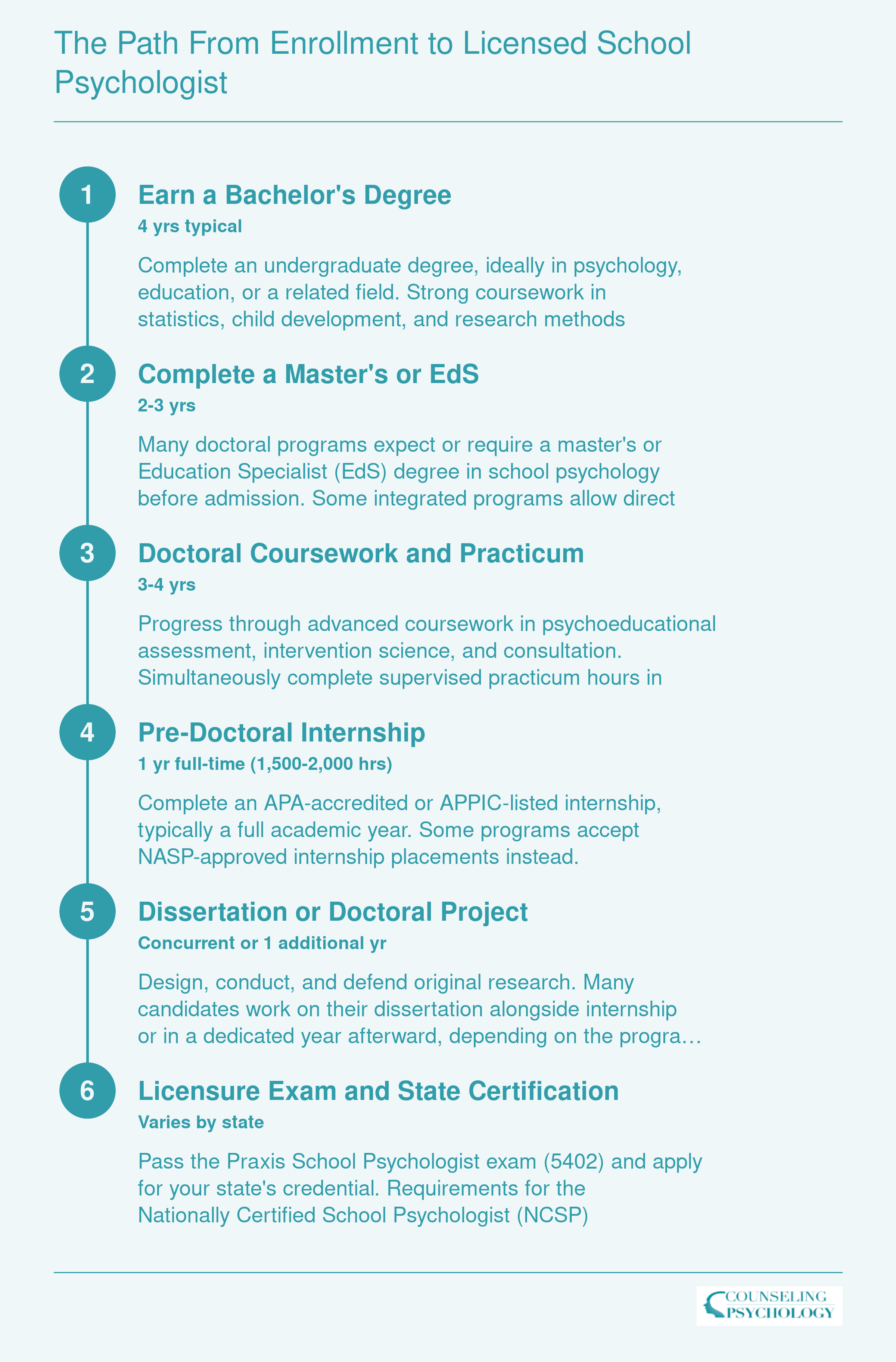
The Path From Enrollment to Licensed School Psychologist
Earning a doctorate in school psychology and securing licensure is a multi-year commitment. The timeline below maps the typical sequence from your first graduate course through independent practice. Expect 4 to 7 years post-master's for most doctoral programs, with part-time enrollment extending the upper range.
Admissions Requirements and Typical Applicant Profile
Balancing prerequisite credentials against program flexibility shapes which doctoral path makes sense for you. Some programs accept candidates directly from a bachelor's degree, while others expect you to arrive with an EdS, state certification, or years in the field. Understanding where you fall on that spectrum helps you target realistic options and avoid wasted application fees.
Standard Admissions Criteria
Most school psychology doctoral programs share a core set of requirements, though specific thresholds vary:
- Minimum GPA: Typically 3.0 to 3.5 on a 4.0 scale. The University of Findlay and Capella University both require a 3.0, which is common for online programs.12
- GRE scores: Increasingly optional or waived entirely. Georgian Court University, Alliant International University, and the University of Findlay do not require GRE scores as of 2026.31
- Prerequisite degree: This is where programs diverge significantly. Capella's PhD in Educational Psychology requires a master's degree.2 Alliant's PsyD in Educational Psychology goes further, requiring existing licensure, certification, or credentials in school psychology.3 However, the University of Findlay's Ed.D. accepts applicants with only a bachelor's degree.1
- Letters of recommendation: Most programs request two to three letters from supervisors, professors, or colleagues who can speak to your academic ability and professional readiness.
- Personal statement: Expect to articulate your research interests, career goals, and reasons for pursuing doctoral study.
- Relevant experience: Many programs give preference to applicants with practicum or internship experience at the EdS level, and some require it outright.
Who Gets Admitted
The typical admitted cohort consists largely of working school psychologists who hold an EdS and seek a doctoral credential for advancement. These candidates often want to move into supervisory roles, private practice, or university teaching positions. Their practical experience strengthens applications and helps them navigate doctoral coursework with real-world context.
That said, programs like Georgian Court offer a five-year track for students entering with only a bachelor's degree, though the credit load jumps substantially (47 to 112 credits depending on your entry point).
Program Selectivity
If you are wondering how hard it is to get into grad school for psychology, institution-level acceptance rates offer a rough proxy for competition. Georgian Court University admits approximately 79% of undergraduate applicants, while the University of Southern Maine admits around 79% as well. However, doctoral programs in school psychology often operate more selectively than their parent institutions suggest. Cohort sizes tend to be small, and faculty capacity for dissertation supervision limits enrollment. Treat institutional admission rates as a floor rather than a ceiling when estimating your chances.
Don't mistake online delivery for relaxed standards. NASP-approved online school psychology doctorates hold the same competitive admissions requirements as traditional programs: high GPAs, relevant experience, and compelling recommendations. The convenience of online study removes geographical hurdles, but every other academic expectation remains equally demanding.
Career Outcomes and Salary for School Psychology Doctorates
Specialist-level (EdS) credentials account for the vast majority of practicing school psychologists, but doctoral holders consistently earn more and qualify for positions that an EdS alone cannot unlock. Understanding the salary landscape and the career doors a doctorate opens helps you answer the central question: is the extra investment worth it?
What School Psychologists Earn Nationally
According to the Bureau of Labor Statistics (2023 data, SOC 19-3034), the national median annual wage for school psychologists is $84,940, with the middle 50% earning between roughly $70,520 and $107,400.1 The full salary range spans from about $59,250 at the 10th percentile to $131,470 at the 90th. Mean wages vary by setting: elementary and secondary schools, the largest employer, pay a mean of $90,940, while educational support services and health practitioner offices report mean wages above $102,000 and $105,000 respectively.1
Projected job growth for the field sits at about 0.7% over the 2024 to 2034 window, which is slower than average. That modest growth rate, however, masks chronic shortages in many districts and states, so doctoral-level candidates still face a favorable hiring landscape, particularly for leadership and supervisory roles.
The Doctoral Salary Premium
NASP's own workforce data consistently shows that school psychologists with a doctorate out-earn specialist-level peers, often by $10,000 to $20,000 or more annually, depending on the state, setting, and years of experience. That premium compounds over a 25- to 30-year career. It also widens when you factor in the higher-paying roles that require a doctoral credential.
Career Paths a Doctorate Unlocks
An EdS qualifies you for most school-based positions, but a doctorate opens several additional lanes:
- Private practice: Many states require a doctoral degree for independent licensure as a psychologist, allowing you to bill insurance and serve clients outside the school system.
- University faculty positions: Teaching and research roles in school psychology programs typically require a Ph.D. or PsyD.
- District-level leadership: Director of psychological services, special education administration, and policy advisory roles often list a doctorate as preferred or required.
- Clinical supervision: Supervising practicum students, interns, and early-career psychologists generally demands doctoral-level licensure.
These pathways diversify your income sources and give you professional flexibility that specialist-level practitioners rarely access. If you are also weighing a clinical psychology doctorate programs track, note that the career paths overlap in private practice but diverge sharply in school-based roles.
Is the Investment Worth It?
Program-level earnings data for the doctoral school psychology programs featured in our rankings are not yet available through federal reporting, so a direct debt-to-earnings comparison at the program level is not possible at this time. That said, you can build a reasonable estimate. Tuition across the programs we reviewed ranges from roughly $10,000 to $39,000 per year, and many doctoral students offset those costs through assistantships, tuition waivers, and scholarships.
Weigh the financial picture alongside non-monetary returns. A doctorate expands your scope of practice, qualifies you for the Nationally Certified School Psychologist (NCSP) credential with fewer additional hurdles, and makes the credential portable across state lines more smoothly. If you plan to stay in a single district for your entire career, the EdS may be sufficient. If you want the option of private practice, academic appointments, or leadership roles, the doctoral premium in both salary and professional latitude tends to justify the added years of training and expense.
Frequently Asked Questions About School Psychology Doctorates
Prospective doctoral students often have overlapping questions about format, timeline, and career value. The answers below draw on current program realities and professional association resources to help you sort fact from assumption before you apply.