What you’ll learn in this article…
- Nine ranked programs near Chicago offer Ph.D., Ed.S., and M.S. tracks in educational psychology and school psychology.
- Illinois has no standalone educational psychologist license; the closest regulated credential is the ISBE School Psychologist endorsement on a PEL.
- School Psychologists in the Chicago metro area earn above national medians, with experienced professionals exceeding six figures.
- Several Illinois programs offer part-time or hybrid formats so working teachers and school staff can earn degrees without leaving the classroom.
Doctoral programs built around research methodology and specialist tracks focused on school-based practice reflect the two poles of educational psychology training near Chicago. Nine ranked programs, from Ph.D. offerings at University of Illinois Chicago and Northern Illinois University to Ed.S. pathways at Eastern Illinois and Western Illinois, give applicants access to both public and private institutions across the metro area and beyond.
Chicago's public school system and surrounding suburban districts serve as an unmatched field for internships, diverse student populations, and applied research. Because Illinois does not issue a standalone educational psychologist license, graduates typically pursue the school psychologist endorsement or research-intensive roles, making the fit between program design and career goal a high-stakes decision from the start. Students weighing a research-focused Ph.D. in educational psychology should understand that distinction early in the planning process.
Best Educational Psychology Programs Near Chicago, Illinois
Illinois offers an unusually strong pipeline for educational psychology training, with doctoral and specialist programs stretching from downtown Chicago to research campuses across the state. The programs below span Ph.D., Ed.S., and M.S. tracks, and they range from heavily research-oriented options at flagship universities to practitioner-focused specialist pathways designed to put you into Illinois schools quickly. Whether you want to study human development in Chicago's most diverse neighborhoods or build measurement expertise that shapes state policy, this list covers the full spectrum of formats, costs, and career outcomes.
- Program relevance and specialization depth
- Graduate tuition and net price
- Institution-wide graduation and retention
- Regional partnerships and licensure alignment
- Earnings outcomes and return on investment
- Internal program database
- NCES-IPEDS federal institutional data — nces.ed.gov
- Independent program research
- College Scorecard graduate earnings — collegescorecard.ed.gov

University of Illinois Chicago
UIC's College of Education houses two distinct Ph.D. concentrations in Educational Psychology: Human Development and Learning (HDL) and Measurement, Evaluation, Statistics, and Assessment (MESA). Both are campus-based and deeply embedded in Chicago's urban school landscape, with research and practicum partnerships tied directly to Chicago Public Schools and community organizations across the city. In-state graduate tuition runs approximately $17,550 per year, and the institution reports median alumni earnings of $68,740 at the ten-year mark. The university's institution-wide graduation rate is 61.6%, though that figure reflects the full undergraduate population, not the doctoral cohort specifically.
- Interdisciplinary developmental science curriculum
- Emphasis on applied research in real-world Chicago settings
- Lifespan development and social justice themes throughout
- Strengths-based frameworks and diverse research methods
- Mentoring-style structure pairing students with faculty
- Tuition waivers and assistantships available for full-time students
- Advanced training in psychometrics and program evaluation
- Prepares graduates for state policy and testing agencies
- Comprehensive statistical and assessment design coursework
- Real-world application through CPS and district partnerships
- Faculty with diverse methodological expertise
- Campus-based with access to major research centers
PhD in Educational Psychology, Human Development and Learning — On-Campus
PhD in Educational Psychology, Measurement, Evaluation, Statistics, and Assessment — On-Campus

University of Illinois Urbana-Champaign
The flagship University of Illinois system campus in Champaign offers one of the broadest educational psychology portfolios in the Midwest, spanning a Ph.D. with four research divisions (Cognitive Science of Teaching and Learning, Counseling Psychology, Developmental Sciences, and Quantitative Research Methodology) plus an M.S. with concentrations in areas like Bilingual-Bicultural Education and Digital Learning. The Ph.D. requires a minimum of 64 credit hours beyond the master's level and at least two semesters of on-campus residency. In-state graduate tuition is approximately $19,278, and the institution posts an 85.1% graduation rate and median ten-year earnings of $81,054, the highest among schools on this list. Financial aid, including assistantships, is available, and faculty maintain research and evaluation projects with Illinois school districts statewide.
- 64 credit hours beyond master's with four division options
- Concentrations include Developmental Sciences and CSTL
- Two-semester on-campus residency requirement
- Optional Digital Learning concentration available
- Multiple affiliated research centers on campus
- Financial aid and assistantship opportunities
- Research-focused concentration in developmental science
- Faculty with wide-ranging developmental expertise
- Prepares for academia, research, and policy careers
- Requires bachelor's or master's degree for entry
- Minimum 3.0 GPA preferred for admission
- Emphasizes both theoretical and practical skills
- Campus-based master's with thesis component
- Concentrations in Bilingual-Bicultural Education and Digital Learning
- Focus on research methods and foundational education courses
- Fall-only admission cycle
- Blends theory with hands-on research practice
- Prior research experience preferred for applicants
Educational Psychology, PhD — On-Campus
Educational Psychology, PhD, Developmental Sciences — On-Campus
Educational Psychology, MS — On-Campus

Loyola University Chicago
Loyola's MEd/EdS in School Psychology is a three-year, full-time program delivered at the Water Tower Campus in downtown Chicago, directly on the CTA Red Line. It is approved by both the Illinois State Board of Education and the National Association of School Psychologists, making graduates eligible for the Illinois Professional Educator License as a school psychologist and for national certification. Students earn a Master of Education after their first year and continue into the EdS portion, completing 66 credit hours that include practicum placements in Chicago Public Schools and surrounding suburban districts. Graduate tuition is roughly $21,912 per year, with a total estimated program cost near $70,620; the institution-wide graduation rate is 73%, and median ten-year alumni earnings reach $71,530.
- Three-year full-time pathway with early master's milestone
- NASP and ISBE approved for Illinois PEL eligibility
- 66 credit hours including practicum and internship
- Located at Water Tower Campus on CTA Red Line
- Strong emphasis on equity and social justice frameworks
- Covers all ten NASP practice domains
- High job placement rates reported by the program
- Total estimated program cost approximately $70,620
MEd/EdS in School Psychology — On-Campus

Northern Illinois University
Northern Illinois University in DeKalb offers both a Ph.D. in Educational Psychology and a NASP-approved Specialist in School Psychology, making it a dual-track training hub for northern Illinois. The doctoral program emphasizes original research design, ethical standards, and professional communication, while the specialist track is a structured 60-hour pathway that includes two progressively intensive practica and a two-semester internship. Graduate tuition is approximately $9,176 per year for both in-state and out-of-state students, one of the lowest on this list. The institution-wide graduation rate is 48.7%, and median ten-year alumni earnings are $57,808. NIU's long-standing district partnerships across the far-west Chicago suburbs and northern Illinois make it a primary pipeline for school psychologists in the region.
- Campus-based doctoral program with research focus
- Original research study design and faculty review
- Internship experience required for completion
- Doctoral portfolio and dissertation assessments
- Training in ethical standards and theory application
- Emphasis on professional communication skills
- NASP-approved 60-hour specialist program
- First-year 75-hour and second-year 350-hour practica
- Two-semester internship in Illinois schools
- Includes master's degree en route to specialist
- Three-year typical completion timeline
- Focus areas include bullying prevention
Educational Psychology, Ph.D. — On-Campus
Specialist in School Psychology — On-Campus

Wheaton College
Wheaton College's Ph.D. in Clinical Psychology is an intensive five-year residential program housed at a small private institution roughly 30 miles west of downtown Chicago. While classified under clinical psychology, its training integrates educational and developmental foundations relevant to educational psychology careers. Students complete practica across greater Chicago hospitals, community mental health centers, and faith-based counseling sites. Competitive scholarships range from $24,000 to $44,000, helping offset the $20,160 annual graduate tuition. Wheaton's institution-wide graduation rate stands at 84.8%, with a 10:1 student-to-faculty ratio and median ten-year alumni earnings of $63,756.
- Five-year residential, full-time cohort model
- Summer-only entry with holistic admissions review
- Minimum 3.5 GPA and 18 psychology prerequisites required
- Competitive scholarships from $24,000 to $44,000
- Practica at Chicago-area hospitals and community agencies
- Research paper submission required for admission
- Faith-integrated clinical training approach
- 10:1 student-to-faculty ratio
Ph.D. in Clinical Psychology — On-Campus

Governors State University
Governors State University in University Park serves the south suburbs of Chicago with a part-time, cohort-based dual degree that awards both an M.A. and an Ed.S. in School Psychology over four years. This structure is specifically designed for working professionals already employed in Chicago-area schools or social services. The program requires 68 credit hours, emphasizes culturally competent and data-driven service delivery, and leads to Illinois school psychologist licensure. Graduate tuition is approximately $10,666 per year, and median ten-year alumni earnings are $58,169. The institution-wide graduation rate is 22.1%, reflecting the school's largely nontraditional, transfer-heavy undergraduate population rather than its graduate programs.
- Part-time cohort model spanning four years
- Dual degree: M.A. plus Ed.S. in School Psychology
- 68 credit hours with scientist-practitioner framework
- Culturally competent, data-driven curriculum
- Structured for working professionals in south-suburban Chicago
- Leads to Illinois school psychologist licensure eligibility
- Addresses both academic and mental health needs
- Among the lowest-cost options near Chicago
School Psychology (M.A./Ed.S. Dual Degree) — On-Campus

Southern Illinois University-Carbondale
SIU Carbondale's Ph.D. in Education with a concentration in Educational Psychology and Special Education prepares graduates for leadership in research, college teaching, and special education administration, primarily across downstate Illinois. The campus-based program pairs a multidisciplinary core with specialized electives tailored to each student's career goals. In-state graduate tuition is approximately $14,220, with out-of-state tuition at $31,122; median ten-year alumni earnings are $53,390, and the institution posts a 62.4% graduation rate. An 11:1 student-to-faculty ratio supports close mentorship.
- Doctoral concentration blending ed psych and special education
- Multidisciplinary core with individualized specialization
- Tracks in research, college teaching, and administration
- Focus on cultural and behavioral foundations of education
- Campus-based with 11:1 student-to-faculty ratio
- Prepares for leadership in downstate Illinois districts
Ph.D. in Education, Educational Psychology and Special Education — On-Campus

Eastern Illinois University
Eastern Illinois University in Charleston offers a Masters en route to the Specialist in School Psychology, a 60-semester-hour pathway approved by both the Illinois State Board of Education and NASP. The program follows a scientist-practitioner model, with coursework in assessment, research, and intervention plus a paid internship in an Illinois school district. In-state graduate tuition is about $11,647 per year, and the institution reports median ten-year alumni earnings of $51,989. The institution-wide graduation rate is 47.4%. Most graduates take positions as school psychologists in central and eastern Illinois districts.
- 60 semester hours including coursework and practicum
- Approved by ISBE and NASP for Illinois PEL
- Paid internship in an Illinois school district
- Scientist-practitioner training model
- Strong employment prospects in Illinois schools
- Competitive salaries with nine- or ten-month contracts
Masters en route to the Specialist in School Psychology — On-Campus

Western Illinois University
Western Illinois University's Specialist in School Psychology is NASP-accredited and explicitly designed to satisfy Illinois State Board of Education certification requirements, enabling graduates to step directly into Illinois school psychologist roles. The Macomb-based program reports a 100% employment rate and includes hands-on practicum experiences in local schools plus a paid third-year internship. Graduate tuition is approximately $13,683 per year (same rate for in-state and out-of-state students), and median ten-year alumni earnings are $54,163. The institution-wide graduation rate is 45.2%.
- NASP-accredited and Illinois certification-ready
- 100% reported employment rate for graduates
- Paid internship during third year
- Hands-on practicum in local Illinois schools
- 3.0 GPA required for admission
- Extensive faculty supervision throughout program
- Same tuition rate for in-state and out-of-state students
Specialist in School Psychology — On-Campus
Educational Psychology vs. School Psychology: What's the Difference?
Students exploring graduate programs in the Chicago area frequently encounter both "educational psychology" and "school psychology" as program titles, and the overlap in terminology masks some meaningful differences in training, credentials, and day-to-day work. Understanding where these two fields diverge is one of the most important steps you can take before committing to a program.
What Is Educational Psychology?
Educational psychology is, at its core, a research-oriented discipline. APA Division 15, the professional home for educational psychologists within the American Psychological Association, defines it as the science of development, learning, identity, motivations, and emotions across learning environments.1 The division's mission centers on expanding psychological knowledge and theory relevant to education, with a focus on methodology, measurement, and applications to a broad spectrum of teaching, training, and learning issues.2
Graduate training in educational psychology typically includes coursework in learning theory, human development, psychometrics, research design, and statistics.3 Professionals in this field tend to work in universities, research organizations, policy agencies, and instructional design firms rather than in K-12 classrooms. Program options range from master's degrees through Ph.D. and Ed.D. tracks, giving students flexibility depending on whether they plan to lead research teams, teach at the postsecondary level, or shape education policy. Those interested in shorter credentials can also explore an educational psychology certificate online.
What Is School Psychology?
School psychology, by contrast, is a practice-oriented field. The National Association of School Psychologists (NASP) frames it around direct student services: psychoeducational testing, behavioral intervention, crisis response, and individual or group counseling within school settings. The work is hands-on, embedded in K-12 buildings, and governed by state certification standards.
In Illinois, practicing school psychologists must hold certification through the Illinois State Board of Education (ISBE). That credential typically requires completion of an Education Specialist (Ed.S.) degree or a doctorate, along with supervised fieldwork in schools. The Ed.S. is the most common entry point, though some practitioners pursue a doctoral degree for expanded clinical or supervisory roles.
Key Distinctions at a Glance
- Primary orientation: Educational psychology emphasizes research and theory; school psychology emphasizes applied practice with students.
- Typical settings: Educational psychologists work in higher education, policy, and research organizations. School psychologists work in K-12 schools and districts.
- Credentialing in Illinois: School psychologists need ISBE certification. Educational psychologists do not hold a comparable state-issued practice credential; their career paths are shaped by the degree level they complete.
- Degree requirements: School psychology programs usually culminate in an Ed.S. or doctorate. Educational psychology programs offer master's, Ed.D., and Ph.D. tracks depending on career goals.
- Professional affiliations: APA Division 15 serves educational psychologists interested in research, teaching, or practice in educational settings.3 NASP sets standards for school psychology training and practice.
Which Path Fits You?
If you are drawn to designing studies on how students learn, developing assessment tools, or informing policy at the state or federal level, educational psychology is likely the stronger fit. Our guide on how to become an educational psychologist walks through the full career timeline. If you want to work directly with children and adolescents in schools, conducting evaluations and supporting mental health, school psychology aligns more closely with that goal. Both fields contribute to student outcomes, but the routes they take, and the credentials they require, look quite different in practice.
Questions to Ask Yourself
How to Become an Educational Psychologist in Illinois
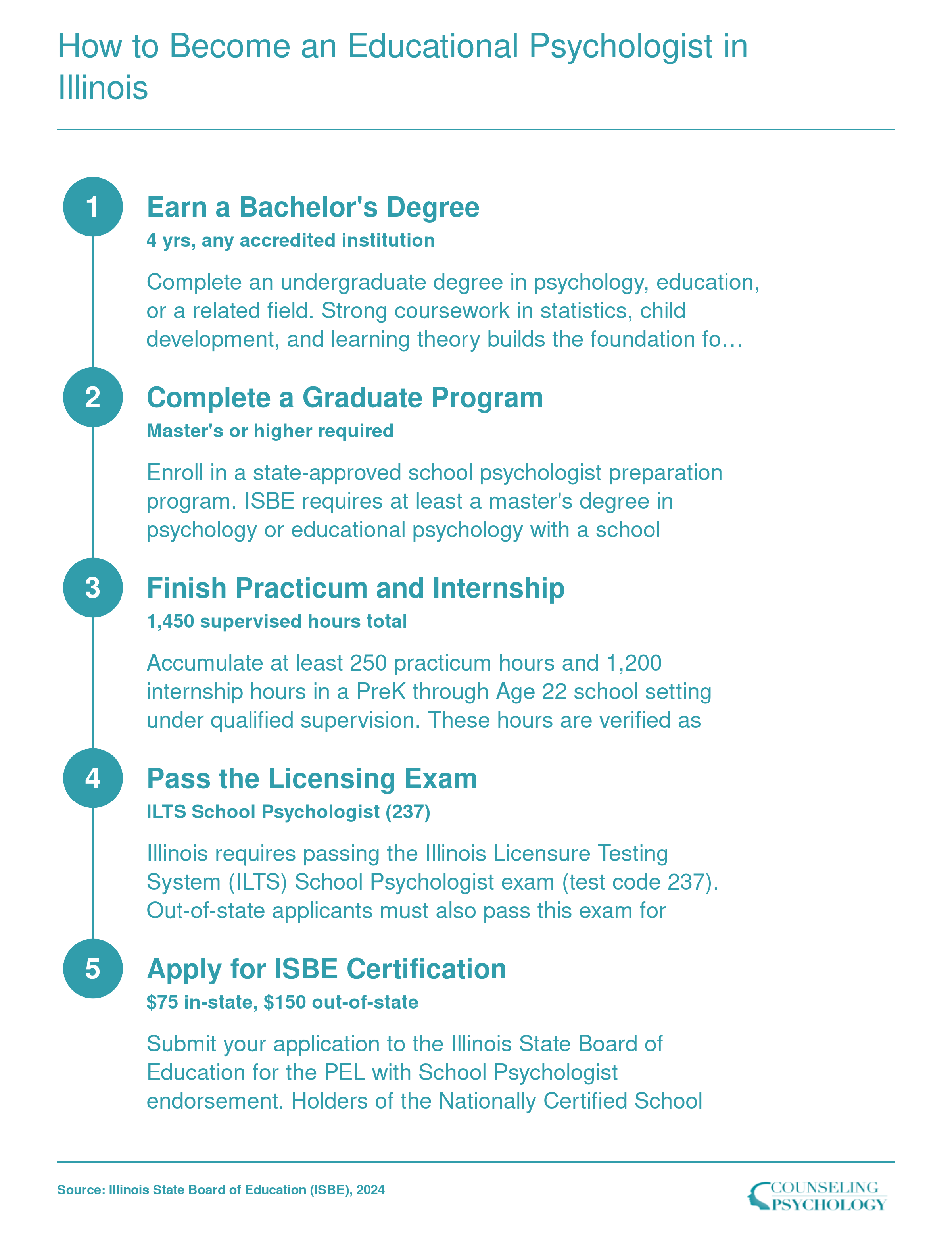
Illinois does not issue a standalone "educational psychologist" license. The regulated credential closest to the field is the Professional Educator License (PEL) with a School Psychologist endorsement, issued by ISBE for PreK through Age 22 settings. Graduates of educational psychology programs who do not pursue this credential typically move into higher education, research, curriculum design, or other roles that do not require ISBE certification.
Program Levels and Curriculum Comparison: Certificate, Master's, and Doctoral Tracks
Educational psychology programs near Chicago span multiple credential levels, and the right fit depends on your career goals, timeline, and budget. Among the nine ranked programs on this list, doctoral degrees are the most common offering (five programs), followed by master's and specialist (Ed.S.) tracks (four programs). Certificate programs in educational psychology are rare in the Chicago area and do not appear among the ranked institutions. Program-level earnings data are not yet available for these specific credentials, but institutional median earnings ten years after enrollment offer a useful proxy for comparing long-term outcomes.
| Feature | Master's (M.Ed./M.S.) | Ed.S. / Specialist | Doctorate (Ph.D.) |
|---|---|---|---|
| Typical Credit Hours | 34 to 36 credits | 60 to 68 credits (often includes a master's) | 64+ credits beyond a master's |
| Common Core Courses | Learning theory, psychometrics, child development, research methods | Assessment and intervention, consultation, applied behavioral analysis, advanced research methods | Advanced statistics, program evaluation, dissertation seminar, cognition and instruction |
| Practicum Required | Often optional (varies by program) | Required | Required at most programs |
| Internship Required | Often optional | Required (typically a full academic year) | Required (often includes a two-semester campus residency) |
| In-State Tuition Range (Annual, Ranked Programs) | $10,666 to $21,912 | $11,647 to $13,683 | $9,176 to $20,160 |
| Institutional Median Earnings, 10 Years After Enrollment | $51,989 to $71,530 | $51,989 to $54,163 | $53,390 to $81,054 |
| Delivery Format Among Ranked Programs | Primarily on campus; some part-time or cohort options | On campus | On campus |
| Typical Time to Completion | 1.5 to 2 years full time | 3 years full time (including internship year) | 4 to 6 years full time |
| Illinois Programs in This Ranking | Loyola University Chicago, Governors State University | Western Illinois University, Eastern Illinois University | UIUC, UIC, Northern Illinois University, SIU Carbondale, Wheaton College |
Related Articles
Career Outcomes and Salary Expectations for Educational Psychologists in Illinois
Educational psychology graduates in Illinois can pursue several career paths, each with distinct earning potential. The table below draws on BLS state-level wage data for Illinois to show how salaries compare across psychology-related occupations. For additional context, Illinois middle school teachers earn a median of roughly $80,000 and high school teachers about $75,200, meaning school psychologists in the state earn comparable or slightly higher wages at the median level, with significantly greater upside at the 75th percentile and above. Professionals classified under the broader 'Psychologists, All Other' category, which can include educational psychologists working outside of K-12 settings, show wider salary variation reflecting diverse employment contexts from research labs to policy organizations.
| Occupation (Illinois) | Total Employment | 25th Percentile | Median | 75th Percentile | Mean |
|---|---|---|---|---|---|
| School Psychologists | 3,440 | $66,620 | $80,220 | $101,680 | $85,660 |
| Psychologists, All Other | 960 | $51,700 | $81,270 | $137,820 | $92,810 |
| Psychology Teachers, Postsecondary | 2,510 | $48,030 | $75,350 | $99,670 | $77,540 |
| High School Teachers (Illinois) | N/A | N/A | $75,200 | N/A | N/A |
| Middle School Teachers (Illinois) | N/A | N/A | $80,000 | N/A | N/A |
What Educational Psychologists Earn in the Chicago Metro Area
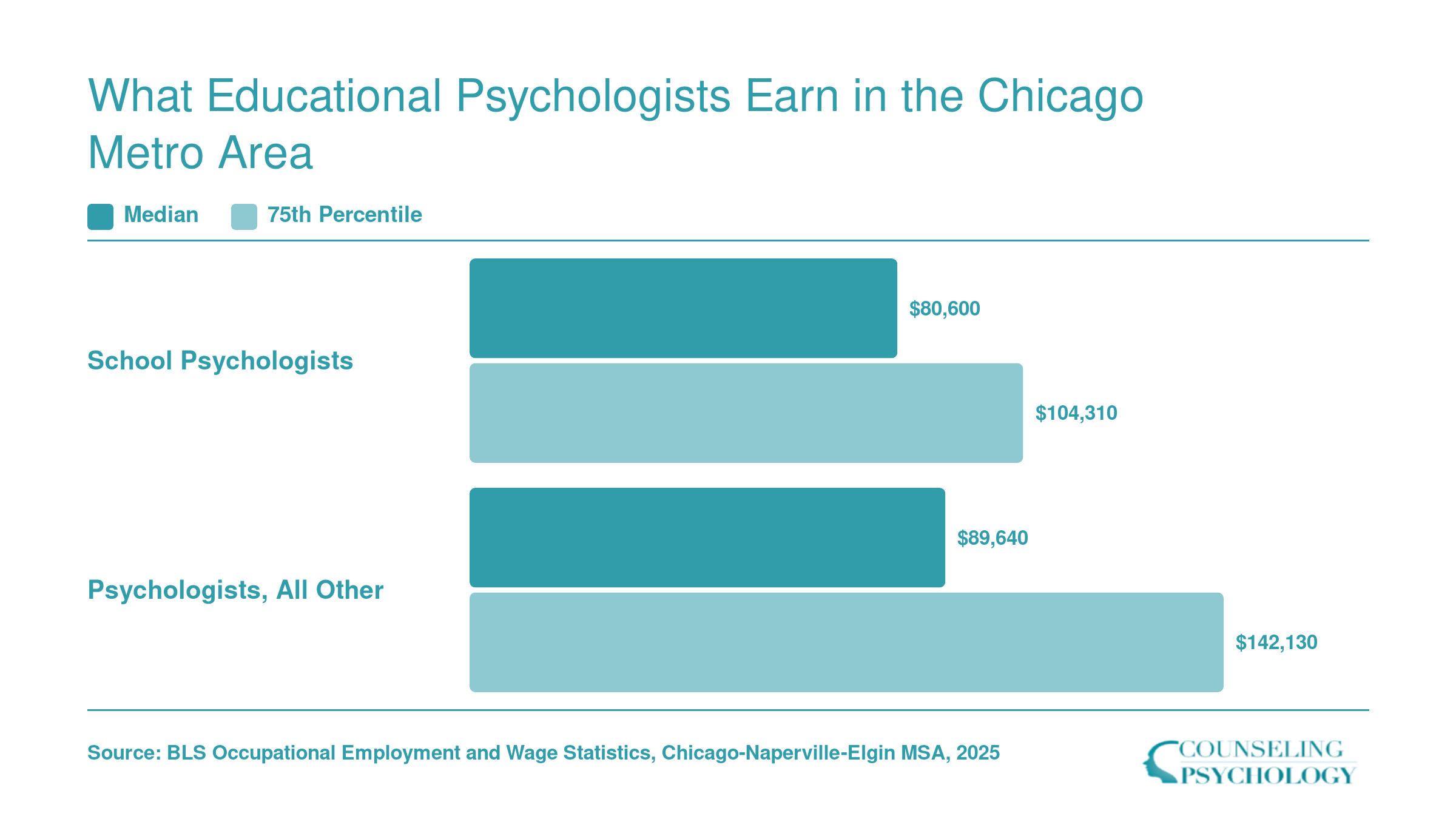
The Chicago-Naperville-Elgin metropolitan area offers strong compensation for psychology professionals working in educational settings. The two BLS categories most relevant to educational psychology graduates, School Psychologists and Psychologists, All Other, both pay above national medians in this metro area. Experienced professionals at the 75th percentile see a significant jump, especially in the broader psychologist category where research, consulting, and leadership roles push earnings higher.
Online and Part-Time Options for Working Professionals in Illinois
Can full-time teachers and school staff in Illinois pursue an educational psychology or school psychology degree without leaving the classroom? Yes, though options vary significantly across the state. Most Illinois programs in this guide remain campus-based and full-time, but a handful offer evening cohorts or hybrid formats designed specifically for working educators.
Which Programs Offer Part-Time or Evening Scheduling?
Governors State University explicitly structures its School Psychology dual-degree program as part-time and cohort-based, accommodating professionals who cannot attend daytime classes.1 The 68-credit program enrolls students in weekday evening cohorts, making it feasible to continue working while completing coursework. National Louis University's Ed.S. in School Psychology is similarly designed for working educators and career-changers, though the university does not publicly confirm whether all courses are available evenings.2
By contrast, the doctoral programs at University of Illinois Urbana-Champaign, University of Illinois Chicago, Northern Illinois University, Loyola University Chicago, and Wheaton College all operate as campus-based, full-time programs with no advertised evening or asynchronous options.3 UIUC's Educational Psychology PhD explicitly requires two consecutive semesters of on-campus residency and does not offer part-time pathways. Loyola's MEd/EdS in School Psychology is a three-year full-time campus program with no hybrid or evening track.
Practical Advantages for Chicagoland Teachers
For teachers already embedded in Chicago-area school districts, a part-time evening program offers compelling benefits: you maintain your salary and benefits, build professional networks while enrolled, and apply classroom insights directly to coursework. Governors State, located in University Park south of Chicago, serves this niche by allowing cohorts to progress together on a predictable evening schedule, reducing logistical friction for working professionals.
Trade-Offs and In-Person Requirements
No fully online educational psychology programs appear in the Illinois rankings. For those exploring broader options, a national guide to educational psychology degrees online covers programs with more flexible delivery. Even programs that offer evening scheduling still require significant in-person attendance for practicum, internship, or residency requirements. Governors State's program, though part-time, remains campus-based. Students should confirm with admissions whether summer intensives, weekend practica, or other in-person commitments will conflict with school-year responsibilities.
Tuition Differences and Cost Considerations
Tuition data for part-time versus full-time enrollment is not explicitly differentiated in published figures. Public institutions like Governors State ($10,666 annual tuition) and Eastern Illinois University ($11,647 annual tuition) generally charge per-credit rates that apply equally to part-time and full-time students, making costs more predictable over an extended timeline. Private institutions like Loyola ($21,912 annual tuition) and Wheaton ($20,160 annual tuition) may offer the same per-credit structure, but candidates should verify whether cohort models carry flat fees or credit-hour billing.
Admissions, Financial Aid, and Funding Options
Selective flagship programs versus broadly accessible regional universities: that contrast shapes not only your odds of admission but also the funding landscape you will navigate once accepted.
How Selective Are These Programs?
Admission rates across Illinois educational psychology programs vary considerably. The University of Illinois Urbana-Champaign admits roughly 42 percent of applicants institution-wide, making it the most selective school among the programs covered here. Governors State University and Wheaton College both admit close to half of applicants, while UIC, Northern Illinois University, and Loyola University Chicago fall in the 70 to 87 percent range. More accessible admission rates do not mean weaker programs, but they do signal that applicants with a range of academic backgrounds are competitive.
Specific GPA cutoffs and GRE requirements are set at the program level and change periodically, so checking directly with each department is the only reliable way to know exactly what is expected of you this cycle. If you are also weighing programs beyond Illinois, our guide to the best doctoral programs in educational psychology provides a broader comparison.
Doctoral Funding: Who Offers What
Funding is where doctoral programs diverge most sharply. A few programs make strong, structured offers to admitted students:
- UIUC Educational Psychology PhD: Graduate assistantships at a 50 percent appointment are available on a competitive basis and typically include a stipend and full tuition waiver. No separate financial aid application is required; funding consideration is built into the admissions review.1
- UIC PhD in Educational Psychology (Human Development and Learning): Assistantships are widely available. UIC commonly offers multi-year funding packages with both stipend and tuition waiver, though the exact terms depend on the individual offer.2
- Illinois State University School Psychology Doctorate: Assistantships are awarded to accepted applicants and include a monthly wage plus a 100 percent tuition waiver, making this one of the more predictable funding commitments in the region.3
- Loyola University Chicago PhD in School Psychology: Some assistantship support is available, but awards are competitive and variable. Prospective students should ask specifically what funding, if any, comes with an offer of admission.4
- Northern Illinois University PhD in Educational Psychology: Because this program is fully online, assistantship availability is limited and funding is not guaranteed. Applicants should plan for the possibility of covering costs through other means.5
Net Price and Broader Financial Aid
For students who are not admitted to funded doctoral positions, or who are pursuing master's or specialist programs, the realistic cost after institutional aid matters considerably. Among the public universities in this group, net prices after aid cluster in the low to mid teens (annually), with Eastern Illinois and Western Illinois both landing around $12,000 to $13,000 per year for in-state students after grants are factored in. UIC's net price after aid runs roughly $11,000 for in-state students, a compelling figure for a research-intensive urban campus.
Pell grant participation rates offer a rough signal of how well a school supports financially constrained students. Governors State University stands out, with more than 78 percent of its undergraduates receiving Pell grants, reflecting a student body that the institution has structured aid programs to serve. UIC and NIU also enroll high shares of Pell-eligible students, above 64 and 77 percent respectively.
Federal graduate loans remain the most common fallback for unfunded students. Unsubsidized Direct Loans and Graduate PLUS Loans are available to those enrolled at least half-time in an eligible program. Fellowship databases maintained by your target department are worth searching early; external fellowships through foundations and professional associations in educational psychology sometimes go unclaimed simply because applicants are not aware of them.
The right program depends on your goals. If you want ISBE school psychologist certification, choose a specialist or doctoral track with approved fieldwork. If research is your focus, prioritize programs with strong faculty mentorship and publication records. Compare net prices, weigh full-time versus part-time schedules against your work commitments, and confirm that Chicagoland practicum placements align with your specialty interests before you apply.
Frequently Asked Questions About Educational Psychology Programs in Illinois
Prospective students often have overlapping questions about program types, licensure steps, and career potential. Below are answers drawn from the details covered throughout this article, along with specific data points relevant to Illinois programs.