
What you’ll learn in this article…
- Idaho State University and the University of Idaho are the two public universities offering psychology master's programs in the state.
- Most Idaho psychology master's programs no longer require the GRE for admission.
- Master's graduates in Idaho typically pursue LPC or LCPC licensure because the Licensed Psychologist title requires a doctorate.
- Graduate assistantships at both schools can offset tuition and provide a living stipend to reduce student debt.
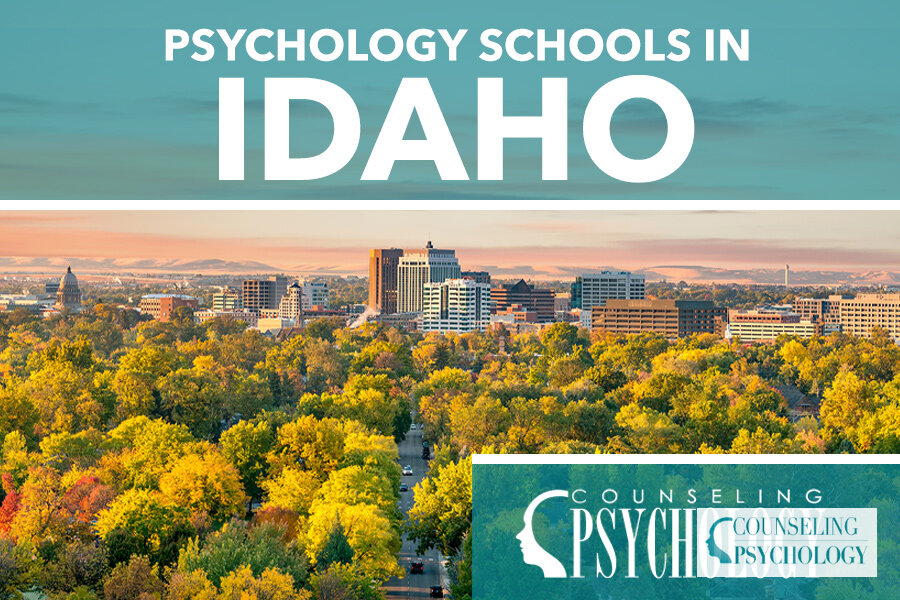
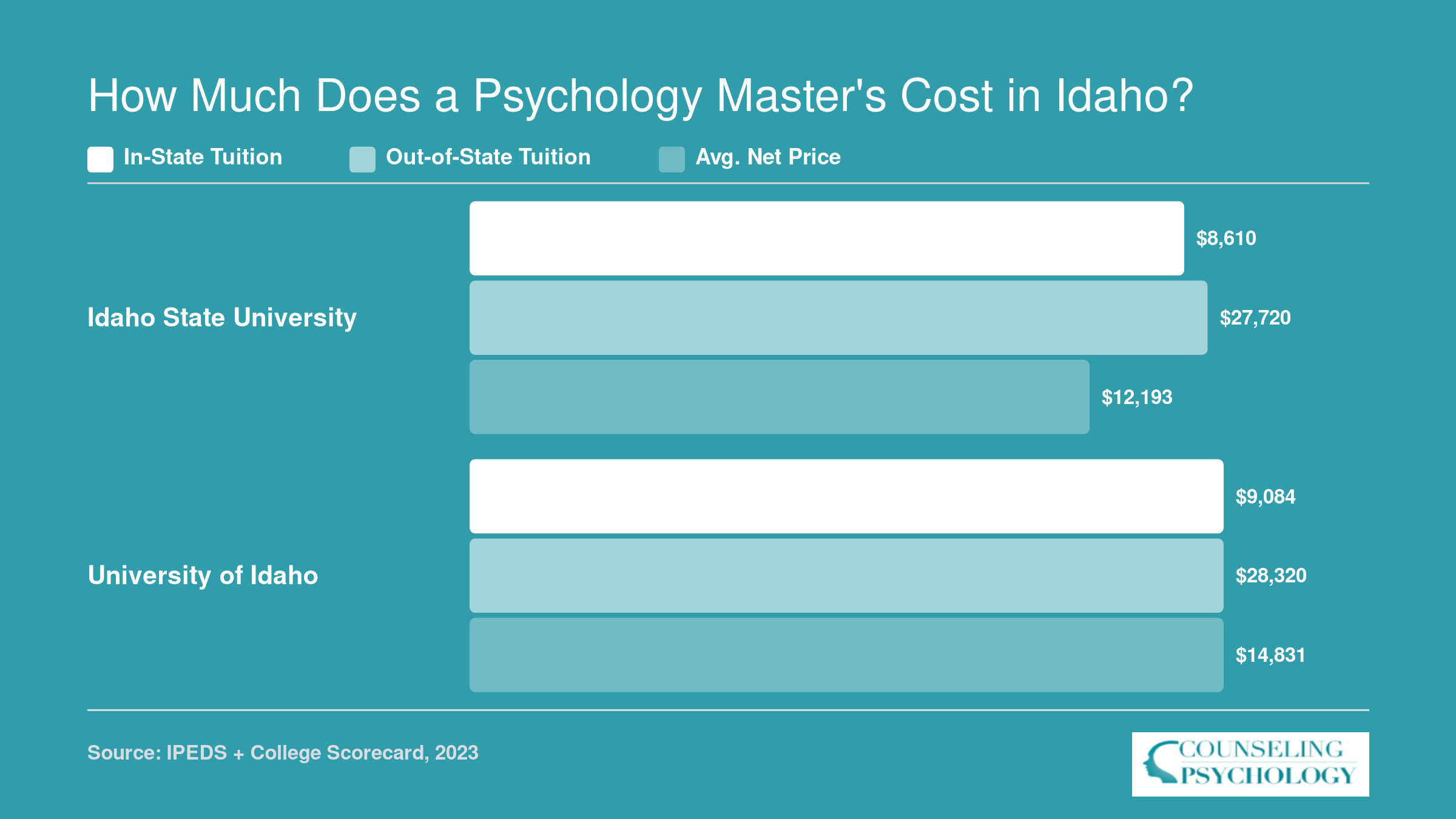
Idaho has two public research universities offering psychology programs at the graduate level: Idaho State University in Pocatello and the University of Idaho in Moscow. With in-state tuition under $10,000 per year at both institutions and net prices in the $12,000 to $15,000 range after aid, the affordability picture is unusually consistent for prospective students staying in-state.
The tighter question is fit. Master's-level graduates in Idaho cannot use the Licensed Psychologist title (that credential requires a doctorate), so most students route toward LPC or LCPC licensure through the state's counselor board. That credential constraint, more than tuition, shapes which program and concentration actually serves a given career goal. Students interested in the marriage and family therapy route should also consider MFT programs in Idaho, which follow a separate but related licensure pathway.
Best Psychology Master's Programs in Idaho
Idaho's two public research universities each offer psychology-related master's programs that blend affordability with practical training. The list below is weighted toward net price and financial aid metrics, so programs that keep out-of-pocket costs low rise to the top. Program-level earnings data is not yet available for these specific degrees, but institution-wide figures from the College Scorecard help frame the overall value picture.
- Net price and affordability
- Financial aid availability
- Institutional graduation and retention rates
- Program format and flexibility
- Graduate debt levels
- Internal program database
- NCES-IPEDS federal institutional data — nces.ed.gov
- Independent program research
- College Scorecard graduate earnings — collegescorecard.ed.gov

Idaho State University
Idaho State University, based in Pocatello, anchors its psychology graduate offerings around school psychology and clinical psychopharmacology. With an institution-wide net price of $12,193 and median graduate debt of $20,039, ISU consistently ranks among the most budget-friendly options in the state. The university reports a 14:1 student-to-faculty ratio at the institutional level, and several of its psychology master's tracks advertise an even tighter 8:1 ratio, along with near-total job placement for completers.
- Fully online synchronous delivery for maximum flexibility
- No entry exams required for admission
- Reported 8:1 student-to-teacher ratio in the program
- Near 100% job placement rate for graduates
- GPA of 3.0 or above preferred for applicants
- Serves as a pathway to an Ed.S. degree
- Two recommendation letters needed for application
- Scholarship opportunities available to enrolled students
- Hybrid format with synchronous and asynchronous courses
- NASP-accredited program with NCSP credential eligibility
- Emphasizes evidence-based interventions for P-12 learners
- Focus on culturally competent services in rural communities
- Practicum courses required for hands-on training
- Reports 100% employment rate among graduates
- Aligns curriculum with national NASP standards
- APA-designated postdoctoral program for licensed psychologists
- Two learning tracks: in-person or online
- Comprehensive 38-credit-hour curriculum
- Tuition set at $579 per credit for online track
- Prepares psychologists for medication prescription privileges
- Requires a doctoral degree in psychology for admission
- Current psychology licensure mandatory before enrollment
- Interdisciplinary clinical training with pharmacy faculty
M.Ed. in School Psychological Examiner (Child Psychology) — Online
M.Ed. in Human Exceptionality, School Psychology — Online
M.S. in Clinical Psychopharmacology — Hybrid

University of Idaho
The University of Idaho in Moscow pairs a strong research tradition with flexible delivery. Its institution-wide net price sits at $14,831, and median earnings ten years after enrollment reach $54,670, the highest among Idaho's public universities listed here. While the university's master's-level psychology catalog is narrower than ISU's, its undergraduate pipeline and research infrastructure make it a natural fit for students planning to continue toward doctoral study or pivot into counseling, social work, or human resources roles.
- Available fully online with in-state tuition for all online students
- Research participation opportunities with state-of-the-art labs
- 2+2 transfer pathways for community college students
- Internships available through community partner organizations
- Flexible curriculum allows exploration of personal interests
- Prepares graduates for careers in counseling and HR fields
B.A./B.S. in Psychology (Online) — Online
Questions to Ask Yourself
Online vs. On-Campus Psychology Master's Programs in Idaho
Idaho's two main public universities, Idaho State University and the University of Idaho, both list online psychology program options, but the details around tuition, clinical requirements, and student experience differ in ways that matter. Both schools use residency-based pricing rather than a flat online rate, so where you live has a direct impact on what you pay. Here is a side-by-side look at the practical differences between online and on-campus delivery for psychology master's students in Idaho.
| Factor | Online Delivery | On-Campus Delivery |
|---|---|---|
| Tuition Structure | Both ISU and UIdaho charge different rates for in-state vs. out-of-state students, even online. ISU's 2025-2026 in-state graduate tuition is approximately $11,640 compared to $30,840 for non-residents. UIdaho's out-of-state graduate tuition runs around $31,582. Neither school offers a flat-rate online tuition, though ISU provides a non-resident tuition waiver and participates in the Western Regional Graduate Program (WRGP), and UIdaho offers WUE eligibility and scholarship options. | Same residency-based tuition applies. On-campus students who establish Idaho residency qualify for the lower in-state rate at either institution. |
| Schedule Flexibility | Coursework is typically asynchronous or includes evening synchronous sessions, making it easier to balance employment or family obligations. Ideal for working professionals across Idaho's rural communities. | Fixed class meeting times on the Pocatello (ISU) or Moscow (UIdaho) campus. Better suited for full-time students who can commit to a weekday schedule. |
| Residency or On-Campus Intensives | Some clinical or counseling concentrations may require brief on-campus residencies, orientations, or intensive weekends. Confirm with your program whether any in-person components are mandatory before enrolling. | All coursework, labs, and seminars take place on campus. No additional travel considerations. |
| Practicum and Clinical Placement | Online students are generally responsible for securing practicum or internship sites in their own communities. Programs may assist with site approval, but coordination takes more lead time, especially for students outside the Pocatello or Moscow areas. | On-campus students benefit from established practicum partnerships with local clinics, hospitals, and community agencies near each university. |
| Faculty Access | Virtual office hours, email, and video conferencing are standard. ISU's 14:1 and UIdaho's 18:1 student-to-faculty ratios reflect institutional averages, though graduate cohorts are typically smaller. | In-person office hours, drop-in availability, and direct mentorship in research labs. Easier to build relationships for recommendation letters and research collaboration. |
| Cohort Interaction | Discussion boards, group video projects, and online study groups. Some students report that peer connections require more intentional effort in a virtual setting. | Daily face-to-face interaction with classmates, collaborative study sessions, and networking at departmental events and colloquia. |
| Programs Available | Both ISU and UIdaho are listed with online program options in our rankings. Availability of specific master's-level concentrations (clinical, counseling, experimental) online may be limited compared to the full on-campus catalog. | The broadest selection of specializations, electives, and interdisciplinary coursework is typically available on campus at both schools. |
How Much Does a Psychology Master's Cost in Idaho?
Tuition at Idaho's two main public universities remains well below many national averages, but out-of-state students should budget carefully. The net prices shown below are institution-wide averages after grants and scholarships; your actual cost will depend on your individual aid package, residency status, and enrollment intensity. Program-level median debt and monthly repayment figures are not yet available for these specific psychology programs.
Related Articles
Admissions Requirements and No-GRE Options for Idaho Psychology Master's Programs
Most Idaho applicants weigh a familiar tradeoff: how much time and money to sink into test prep versus how quickly they can assemble a competitive application. The good news for in-state and online applicants is that the GRE has largely receded as a barrier at Idaho's public psychology programs, which shifts the weight back to GPA, prerequisite coursework, and the personal statement.
GRE Status Across Idaho Programs
Based on each program's published admissions information:
- University of Idaho (M.S. in Psychology): No standardized exam is required for admission. The program lists a 3.0 minimum undergraduate GPA.1
- Idaho State University (Experimental Psychology Ph.D.): No GRE is required. A 3.0 GPA is recommended rather than strictly required, and applicants are expected to hold a bachelor's in psychology or equivalent preparation.2
- Boise State University: Psychology graduate admissions policies change cycle to cycle, so confirm current GRE status, GPA thresholds, and prerequisites directly with the department before assuming any waiver applies.
If the GRE is a dealbreaker for you, the University of Idaho M.S. and Idaho State's experimental doctoral pathway are the clearest no-GRE options on the public side right now. Applicants interested in research-focused doctoral work beyond Idaho may also want to explore online doctoral programs in psychology for additional no-GRE possibilities.
Prerequisites and GPA Thresholds
A 3.0 undergraduate GPA is the working floor at both Idaho State and the University of Idaho. Applicants coming from a non-psychology bachelor's should expect to demonstrate prior coursework in statistics, research methods, and core psychology content, either through their transcript or through post-bacc credits. Idaho State specifically frames the bachelor's in psychology (or equivalent background) as a prerequisite for the experimental doctoral track, which matters for applicants pivoting from another field.2
Deadlines and Cohort Size
Idaho State's Experimental Psychology Ph.D. uses a December 1 deadline, which is typical for funded research-track programs that admit for fall only.2 The University of Idaho's M.S. deadlines vary by track and faculty availability, so check the current cycle on the department site.
Public cohort-size figures are not consistently published for these programs. Research-mentored tracks like Idaho State's experimental Ph.D. tend to admit small cohorts (often single digits per cycle) because admission is tied to individual faculty capacity. Treat any Idaho psychology graduate program as competitive on fit, even when the GRE is off the table.
Psychology Specializations Available in Idaho
Which psychology concentration actually matches your career goals in Idaho, and which programs offer the track you need?
Idaho's master's-level psychology landscape is compact but specialized. Understanding what each school offers, and how those tracks connect to licensure or further education, helps you avoid costly detours.
Clinical Psychology at Idaho State University
Idaho State University offers an M.S. in Psychology with a Clinical Psychology concentration.1 This track operates as part of a doctoral pathway rather than a standalone terminal degree. Students earn the master's while progressing toward a Ph.D., which means the curriculum emphasizes rigorous research training alongside clinical practicum hours.1 If your goal is eventual licensure as a psychologist (not a counselor), this integrated model provides the foundation. However, if you want a terminal master's that leads directly to the workforce, this program structure may not fit your timeline.
The clinical track at ISU prepares graduates for supervised practice, research careers, and doctoral-level licensure. Expect a thesis requirement and substantial hours in ISU's training clinics.
Counseling and Applied Tracks
For students pursuing the Licensed Professional Counselor (LPC) or Licensed Clinical Professional Counselor (LCPC) credential in Idaho, a clinical mental health counseling or counseling-focused program aligns more directly with state licensure requirements. Boise State University has historically offered counseling-related graduate work through its College of Education, though program availability and format can shift. Verify current offerings directly with the department, as counseling programs must meet specific accreditation and hour requirements for Idaho licensure eligibility.
Applied tracks tend to be practicum-heavy, with less emphasis on thesis research and more on supervised fieldwork. Students drawn to practitioner-oriented paths may also want to explore broader applied psychology degree options to compare curriculum structures. These programs prepare graduates to enter clinical settings immediately upon completing licensure supervision.
Research and Experimental Tracks
Students interested in doctoral preparation or research careers outside clinical practice should examine experimental psychology or general psychology tracks. Those considering this route can learn more about the experimental psychologist career path and what it requires. These thesis-based programs prioritize research methodology, statistical analysis, and scholarly writing. Graduates often continue to Ph.D. programs or pursue roles in research institutions, government agencies, or private industry.
Human Factors and Industrial-Organizational Psychology
Idaho State University's psychology department has offered human factors coursework, a specialization focused on how people interact with systems, technology, and work environments. This interdisciplinary area intersects with industrial-organizational (I-O) psychology and prepares graduates for industry careers in user experience, safety analysis, and organizational consulting rather than clinical licensure. If you want to work in tech, manufacturing, or human resources rather than therapy settings, a human factors or I-O emphasis provides a distinct career pathway.
Matching Specialization to Your Goals
- Licensure-focused (LPC/LCPC path): Seek counseling or clinical mental health programs meeting Idaho Board requirements.
- Doctoral preparation: Thesis-based clinical or experimental tracks at ISU serve as stepping stones.
- Industry or research careers: Human factors, I-O, or experimental concentrations bypass licensure requirements entirely.
Idaho Licensure Requirements for Psychology Master's Graduates
Master's-level psychology graduates in Idaho can pursue professional counseling credentials through the Idaho Division of Occupational and Professional Licenses (DOPL), which oversees the counselor licensing board. The pathway moves from a registered counselor intern to Licensed Professional Counselor (LPC) and ultimately to Licensed Clinical Professional Counselor (LCPC). A separate track exists through the Idaho Board of Psychologist Examiners for psychologist assistant registration, but full licensed psychologist status requires a doctoral degree and is not available at the master's level.
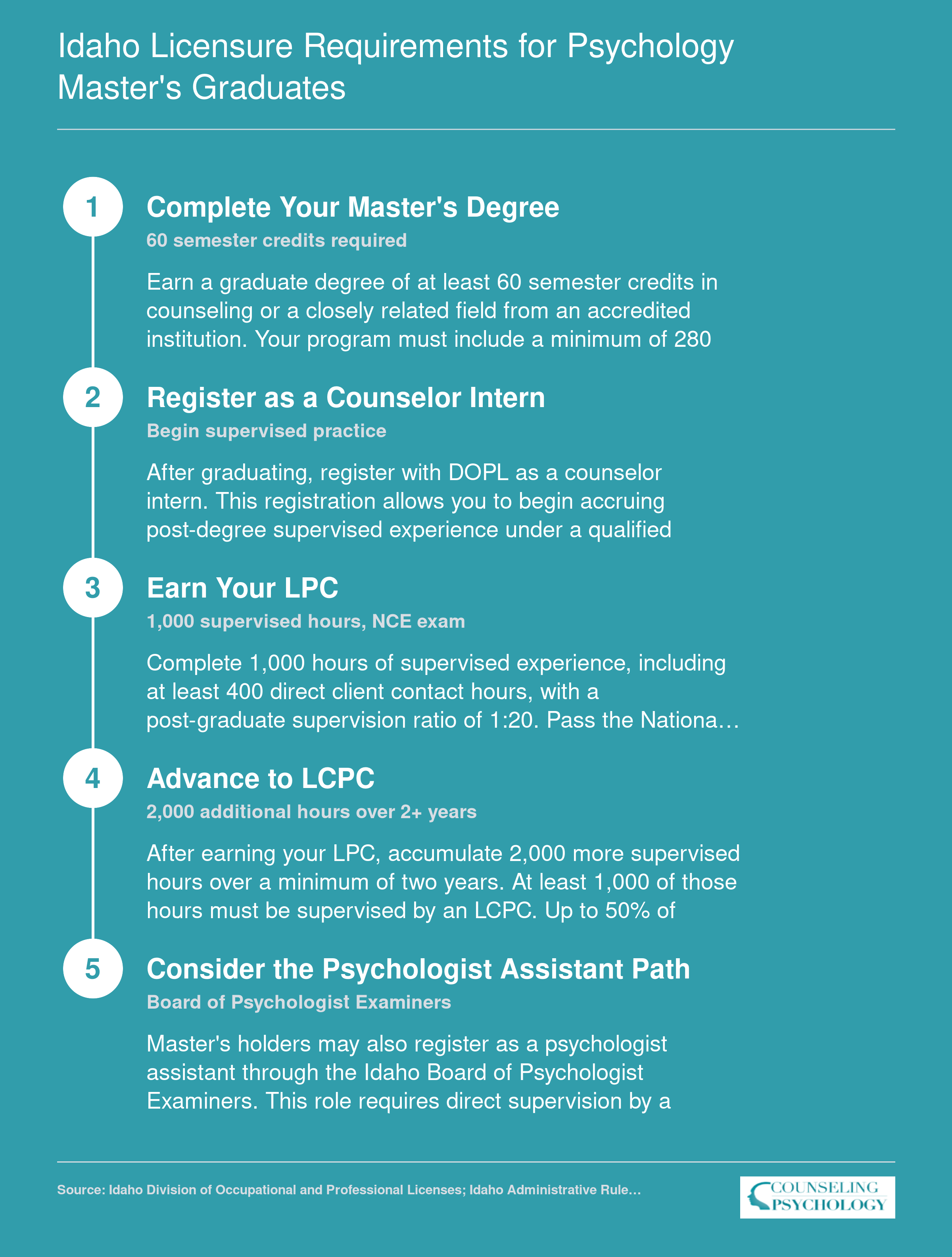
In Idaho, the Licensed Psychologist title requires a doctoral degree, so a master's in psychology alone will not qualify you for that credential. Master's graduates typically pursue LPC or LCPC licensure, or work as psychologist assistants under doctoral-level supervision. When selecting a program, confirm it includes the clinical hours and coursework your intended license requires.
Career Outcomes and Salaries for Psychology Master's Graduates in Idaho
The honest tradeoff for Idaho master's graduates is geography versus earning ceiling: clinical roles pay reasonably well across the state, but the highest-paying positions and the densest job market cluster around Boise, while rural counties offer faster hiring, loan-repayment incentives, and lighter competition at lower wage points.
What Idaho Graduates Actually Earn
Program-level earnings data for master's completers from the two state universities most often feeding Idaho's psychology pipeline, University of Idaho and Idaho State University, is not currently published in the federal College Scorecard at the graduate level for general psychology. Employment rates one year after completion and the share of graduates earning above the poverty threshold are also not reported for these specific master's programs. That gap is common for smaller-volume graduate programs and is not a signal about quality, just about reporting thresholds. Prospective students should ask each department directly for placement rates and recent graduate salary surveys, which most program coordinators will share on request.
Occupation-Level Wages in Idaho
What is well documented is the broader occupation data. According to Bureau of Labor Statistics figures from 2023, substance abuse, behavioral disorder, and mental health counselors in Idaho earn a median annual wage of $65,240, with the middle range running from roughly $43,550 at the 25th percentile to $85,960 at the 90th.1 That state median sits noticeably above the national median of $59,190 for the same occupation, which reflects Idaho's persistent behavioral health workforce shortage rather than a high cost of living.2 Nationally, clinical, counseling, and school psychologists, most of whom hold a doctorate rather than a master's, earn a median of $96,100.3 These are occupation wages, not program-completer earnings, and they describe what workers in the field make, not specifically what recent Idaho graduates start at.
Common Career Paths
With a master's in psychology or counseling, Idaho graduates typically move into one of several lanes:
- Licensed Professional Counselor (LPC) or LCPC: clinical practice in community mental health, private group practices, or telehealth.
- Behavioral health specialist: case management and integrated care in hospitals, FQHCs, and tribal health systems.
- Research analyst or program evaluator: roles at state agencies, universities, and nonprofits.
- Industrial-organizational and HR positions: talent development and workforce analytics with Idaho employers.
- Doctoral preparation: a master's as a stepping stone to a PhD or PsyD for licensure as a psychologist.
Students drawn to corporate talent development or workforce analytics may want to explore what it takes to become an industrial-organizational psychologist, a career path that pairs well with applied research skills from a master's program. Those pursuing clinical work in Idaho will find that Idaho graduate programs for counseling map closely to the LPC and LCPC licensure tracks the state requires.
Boise metro absorbs the bulk of private-practice and hospital-system hiring, while Pocatello, Idaho Falls, Coeur d'Alene, and rural districts rely heavily on community mental health centers, school-based services, and substance use programs, where state and federal loan repayment options can meaningfully change the math on a starting salary.
Assistantships, Funding, and Scholarships for Idaho Psychology Master's Students
How can you fund a psychology master's degree in Idaho without piling on debt? For many students, the answer lies in graduate assistantships that offset tuition and pay a living stipend, plus targeted scholarships. Idaho's public universities offer these opportunities, though availability varies by program and campus.
Graduate Assistantships at Idaho Public Universities
At Idaho State University (ISU), the psychology department maintains a robust assistantship program. Roughly 250 graduate assistantship positions exist across the university, and psychology students often secure roles as teaching, research, or graduate assistants.1 These positions typically cap at 19.5 hours per week while you carry a full graduate course load of 9 to 12 credits.2 The financial payoff is significant: graduate assistants commonly receive a partial or full tuition waiver, and ISU's clinical psychology track ensures that all admitted clinical students get a non-resident tuition waiver either through a GA slot or the Western Regional Graduate Program (WRGP).4 Clinical externships in the department pay $17 to $22 per hour and also include that non-resident waiver, so out-of-state students can effectively attend at in-state rates.4
The University of Idaho and Boise State University have their own graduate assistantship systems, though specific data for psychology master's students is less centralized. Both schools encourage applicants to contact the department directly to learn about RA, TA, and administrative assistantship openings. At any of these institutions, the key is to ask early and apply well before program deadlines.
Scholarship and Fellowship Opportunities
Beyond assistantships, psychology master's students can tap into department-specific awards and university-wide fellowships. ISU's Department of Psychology, for example, offers funding types ranging from traineeships to internships, often tied to research or clinical work. While some named fellowships target doctoral students, master's students remain eligible for many general graduate scholarships. The University of Idaho and Boise State similarly list graduate scholarships on their financial aid websites; these don't always filter neatly by discipline, so a broad search using keywords like "psychology" or "behavioral science" is wise.
Financial Accessibility: What Pell Data Tells You
A school's undergraduate Pell Grant share signals how accustomed the institution is to serving students with financial need, and that ethos often extends to graduate funding. At ISU, about 68% of undergraduates receive a Pell Grant, one of the highest proportions among Idaho public universities. The University of Idaho hovers around 65%. While graduate students rarely receive Pell directly, a high Pell share suggests robust support structures and a culture of affordability that can translate into more generous graduate aid packages.
Practical Tips for Securing Funding
- Timing: Many assistantship applications follow the same deadline as program admissions. ISU's psychology deadline is January 1. Submit all materials, including a statement of interest for the assistantship, by that date.
- Negotiating aid: If you have multiple admissions offers, you have leverage. Politely ask whether additional tuition remission, a higher stipend, or a director's fellowship might be available.
- Online student eligibility: Remote learners should confirm with the program whether virtual assistantships exist. Some research roles can be performed online, but teaching assistants typically need to be on campus. ISU and other schools may limit assistantships to on-campus students, so plan accordingly.
- External scholarships: Combine university funding with outside awards like the Psi Chi graduate scholarships or state-based workforce development grants. Even small scholarships reduce loan reliance.
How to Choose the Right Psychology Master's Program in Idaho
Selecting a master's program in psychology is a high-stakes decision that shapes your career trajectory, licensure eligibility, and financial health. Idaho students should approach the choice systematically, weighing accreditation, program structure, format, and cost against their professional goals.
Accreditation and Licensure Alignment
If you plan to pursue licensure as a Licensed Professional Counselor (LPC) or Licensed Clinical Professional Counselor (LCPC) in Idaho, your program must satisfy the Idaho Board of Occupational Licenses (IBOL) curriculum and practicum standards. CACREP-accredited programs in clinical mental health counseling are designed to meet these requirements and are recognized by IBOL, streamlining the licensure process. Before committing to any program, cross-check its coursework, supervised clinical hours, and degree title against Idaho's current licensure prerequisites. Programs with a nonclinical focus, such as general psychology or industrial-organizational tracks, typically do not qualify graduates for independent clinical practice.
Clinical vs. Nonclinical and Research vs. Applied Emphasis
Clinical and counseling tracks prepare you for direct client work, including assessment, diagnosis, and therapy. Nonclinical specializations such as school psychology, forensic psychology, or organizational psychology emphasize consultation, program evaluation, or research. If you envision working in a school district or corporate setting, nonclinical paths may offer faster entry and lower debt. If private practice or agency counseling is your goal, prioritize programs with robust practicum placements and supervision models that mirror real-world clinical settings. Research-focused programs typically include a thesis requirement and prepare graduates for counseling doctoral programs or academic roles, while applied tracks emphasize competency-based training and capstone projects.
Online vs. On-Campus and Part-Time vs. Full-Time
Online programs offer geographic flexibility and allow working professionals to maintain employment while earning a degree. However, clinical programs require in-person practicum and internship hours, so hybrid models are common. Full-time cohorts generally complete degrees in two to three years, while part-time enrollment extends that timeline to three to four years and may delay your eligibility to sit for licensure exams. Evaluate whether your personal and financial situation supports intensive full-time study or necessitates a slower pace.
Net Price and Debt Outcomes Over Sticker Tuition
Published tuition figures do not reflect what most students actually pay. Compare net price after institutional aid, assistantship stipends, and scholarships. Examine median debt at graduation and early-career earnings data, both available in detailed rankings tables, to assess return on investment. A lower-cost program that meets licensure requirements and produces strong employment outcomes often delivers better long-term value than a prestigious brand with higher debt loads.
Frequently Asked Questions About Psychology Master's Programs in Idaho
Below are some of the most common questions prospective students ask when exploring psychology master's programs in Idaho. Each answer draws on current program details, tuition figures, and licensure considerations to help you make informed decisions.