
Key Takeaways
- Kansas ranks 10 psychology programs for 2026 based on affordability, online access, and graduation outcomes.
- Annual net prices range from roughly $8,000 at public schools to over $27,000 at private institutions.
- The state needs 52 more mental health practitioners to resolve federal shortage area designations.
- BCBA and licensed psychologist paths both require supervised fieldwork hours set by the Kansas BSRB.
Kansas faces a growing behavioral health workforce gap; the state needs dozens more practitioners just to lift its federal shortage designations. That demand creates real opportunity, but also a financial calculation: net prices among ranked psychology programs range from under $13,000 to over $32,000 per year. Online and hybrid options at public schools like Fort Hays State and Wichita State cut costs, while private institutions often package specialized licensure tracks. Which path makes sense depends less on prestige than on your tolerance for debt and whether your target career requires a BCBA certification, an LCP, or a school psychologist credential.
2026 Best Psychology Programs in Kansas: Rankings
Kansas offers a surprisingly diverse range of psychology programs, from fully online bachelor's degrees to CACREP-accredited counseling master's and BCBA-aligned behavior analysis certificates. The 10 programs below were evaluated on affordability, online accessibility, graduation outcomes, and program depth. Graduation rates listed are institution-wide figures, not specific to psychology departments, and program-level earnings data is not yet available for most of these schools. Net price reflects the average cost after financial aid for first-time, full-time students.
- Net price and tuition affordability
- Online and hybrid availability
- Institutional graduation and retention rates
- Graduate earnings outcomes
- Program breadth and specialization options
- NCES-IPEDS federal institutional data — nces.ed.gov
- College Scorecard graduate earnings — collegescorecard.ed.gov
- Internal program database
- Independent program research

Washburn University
Washburn University in Topeka pairs a BA in Psychology with flexible online and on-campus delivery, small class sizes, and close faculty mentorship. With a net price of $15,280 and median graduate debt of just $18,127, it ranks among the more affordable options in the state. Students benefit from research opportunities, internship placements, and community engagement that prepare them for graduate study or direct entry into healthcare, education, and human services roles.
- Available fully online or on campus in Topeka
- Small class sizes foster close faculty relationships
- Research and internship opportunities built into the curriculum
- Prepares students for graduate school or entry-level careers
- Community volunteer placements enhance real-world experience
- Financial aid available to eligible students
- Flexible structure suits working adults and traditional students
Bachelor of Arts in Psychology — Online

Emporia State University
Emporia State University stands out for the sheer breadth of its psychology and counseling offerings, spanning clinical psychology, school psychology, educational psychology, and an autism spectrum disorder certificate. Its hybrid and online formats are designed around working Kansas educators and clinicians, with field placements arranged in school districts and mental health agencies across the state. A net price of $16,261 and a 56% graduation rate make ESU one of the more balanced public options for graduate-level psychology study in Kansas.
- Hybrid format blends online coursework with in-person clinicals
- Small cohorts provide personalized faculty attention
- Clinical internships in Kansas mental health agencies
- Competitive public-university tuition rates
- Prepares students for doctoral study or licensed practice
- Flexible scheduling accommodates working professionals
- 60-credit combined program leads to Kansas school psychologist licensure
- Hybrid delivery with statewide field-placement network
- Combines Master of Science and Educational Specialist degrees
- Designed specifically for K-12 school settings
- Meets Kansas State Department of Education requirements
- Practicum sites available near students' home districts
- Fully online 30-credit program with customizable electives
- Ideal for Kansas teachers seeking salary advancement
- Focuses on learning theory and instructional applications
- Does not lead to K-12 licensure on its own
- Mentoring from dedicated faculty advisors
- Requires 15 undergraduate psychology credits
- 12 graduate credit hours, fully online
- Covers ASD strategies, behavior interventions, and medical issues
- Open to family members and non-degree-seeking professionals
- Can count toward a related master's degree
- Practical skills focus for immediate classroom application
- Flexible scheduling for working educators
Master of Science in Clinical Psychology — Hybrid
School Psychology (MS/EdS Combined) — Hybrid
Educational Psychology (MS, Online) — Online
Graduate Certificate in Autistic Spectrum Disorders — Online

Wichita State University
Wichita State University offers a doctoral-level Educational Psychology track within its Educational Leadership EdD, targeting seasoned professionals who want to shape learning environments in schools, organizations, and industry. The hybrid program requires 55 graduate hours and is designed for completion in about three years. WSU's net price of $13,194 is the second lowest among public universities on this list, and its median 10-year earnings of $51,532 reflect the institution's strong placement record.
- 55 graduate credit hours with hybrid course delivery
- Three-year completion design for working professionals
- No GRE required for admission
- Customizable interdisciplinary emphasis areas
- Dissertation required with faculty mentorship
- Advanced research methodology training included
- Collaborative cohort-based learning model
Doctorate in Educational Leadership, Educational Psychology Track — Hybrid

University of Kansas
The University of Kansas brings flagship-level research strength and national name recognition to its psychology offerings. KU's online bachelor's in psychology charges a flat $445 per credit hour for all domestic students regardless of residency, effectively erasing the out-of-state penalty. At the graduate level, KU's online MA in Applied Behavioral Science meets BCBA certification requirements, and its ABAI-verified graduate certificate in applied behavior analysis provides a standalone path to board certification. Median 10-year earnings of $61,945 are the highest among public institutions on this list.
- 100% online with a flat $445 per credit hour for all domestic students
- Degree-completion program for transfers and returning adults
- Same credential as the on-campus KU psychology degree
- Rolling application deadlines with flexible study pacing
- Taught by KU's psychology faculty
- Strong foundation for graduate school or diverse career paths
- Fully online and meets BCBA certification requirements
- Includes practicum opportunities and faculty advising
- Synchronous and asynchronous delivery for scheduling flexibility
- Empirical thesis required to build research competence
- Designed for busy professionals across the U.S.
- Prepares students for Kansas licensure and national certification
- ABAI-verified course sequence, fully online
- Prepares students for BCBA certification exam
- Eight graduate-level courses taught by expert faculty
- No master's degree required for enrollment
- Uniform online tuition for Kansas and out-of-state students
- Ideal for professionals adding ABA credentials
- 15 credit hours, fully online with asynchronous coursework
- Eight-week course modules with 10 to 15 hours of weekly study
- Field observation component included
- Does not require teacher licensure for admission
- Focuses on evidence-based autism support strategies
- Bachelor's degree required for admission
Online Bachelor's in Psychology — Online
Master of Arts in Applied Behavioral Science — Online
Graduate Certificate in Applied Behavior Analysis — Online
Graduate Certificate in Autism Spectrum Disorder — Online

Ottawa University-Online
Ottawa University's online campus in Overland Park delivers a wide menu of psychology and counseling degrees through accelerated 8-week terms, from a general BA in Psychology to an MS in Addiction Counseling and an MA in Counseling with trauma-focused concentrations. Its 7:1 student-to-faculty ratio is the smallest on this list, and the fully online format is built for working adults across Kansas and beyond. Median 10-year earnings reach $55,552.
- Fully online with accelerated 8-week terms
- Broad general psychology foundation
- Prepares for entry-level careers or graduate study
- Nationwide accessibility for domestic students
- Ethical reasoning and critical thinking emphasis
- Flexible pacing suits various life stages
- Scientific research-based curriculum with multiple concentrations
- Available both online and on campus
- Experiential learning approach and career-focused skill building
- HLC-accredited program
- Preparation for graduate studies in psychology or counseling
- Seven or more concentration pathways available
- Fully online with 8-week accelerated terms
- Cultural competence training for diverse communities
- Focus on substance abuse counselor career preparation
- Practical skills in high-demand addiction services field
- HLC-accredited curriculum
- Theoretical and applied coursework balanced
- 36 credit hours, fully online
- NASAC-accredited and meets most state licensure requirements
- Includes practicum experience in counseling settings
- Covers multicultural counseling, ethics, and law
- Accelerated 8-week terms for working professionals
- Prepares for diverse career settings in addiction treatment
- Hybrid format with 63 credit hours
- Field placement and 900 client-contact hours included
- Concentrations in clinical mental health and trauma treatment
- Prepares for Kansas state licensure
- Accelerated 8-week terms with affordable tuition
- Available with a trauma, abuse, and deprivation specialization
Bachelor of Arts in Psychology — Online
Bachelor of Arts in Applied Psychology — Online
Bachelor of Science in Addiction Counseling — Online
Master of Science in Addiction Counseling — Online
Master of Arts in Counseling — Hybrid

MidAmerica Nazarene University
MidAmerica Nazarene University in Olathe offers a CACREP-accredited MA in Counseling with concentrations in clinical mental health, school counseling, and marriage and family counseling. The hybrid program blends synchronous online sessions with on-site components, letting students across Kansas participate without relocating. Program coursework is aligned with Kansas Behavioral Sciences Regulatory Board and KSDE requirements, and the faith-integrated curriculum can be completed in about 33 months. Median 10-year institutional earnings of $62,972 are the highest among private schools on this list.
- CACREP-accredited, 60 to 64 credit hours
- Hybrid format with synchronous remote attendance option
- Completes in approximately 33 months
- Aligned with Kansas licensure requirements (LPC/LCPC)
- RISE Opportunity Scholarship and financial aid available
- Faith-integrated approach with multicultural coursework
- CACREP-accredited hybrid program
- 60 to 64 credit hours, completable in 33 months
- Prepares for Kansas school counselor licensure
- Synchronous online sessions reduce commuting needs
- Integrates ethical and culturally sensitive practice
- Financial aid and scholarship opportunities available
- CACREP-accredited with hybrid delivery
- 60 to 64 credit hours over 33 months
- Concentration aligned with family counseling licensure pathways
- Cultural competency and ethical sensitivity training
- Federal loan eligibility and scholarship support
- Combines theory with supervised clinical practice
Master of Arts in Counseling, Clinical Mental Health Counseling — Hybrid
Master of Arts in Counseling, School Counseling — Hybrid
Master of Arts in Counseling, Marriage, Couple, and Family Counseling — Hybrid

Baker University
Baker University's online BS in Psychology features accelerated six-week courses that let students finish in as few as two years. The program is especially well suited to military-connected students near Fort Leavenworth or Fort Riley, offering tuition discounts and credit for prior learning. Baker's 13:1 student-to-faculty ratio supports personalized advising, and institution-wide median 10-year earnings of $63,855 are the highest on this list. Net price is $25,301.
- Fully online with accelerated six-week course format
- Completable in as few as two years
- Military tuition discounts and prior-learning credit accepted
- Small online class sizes with 10:1 student-to-faculty goal
- Year-round enrollment with multiple start dates
- Builds foundation for graduate study or entry-level careers
- HLC-accredited degree identical to on-campus credential
Bachelor of Science in Psychology — Online

Fort Hays State University
Fort Hays State University is one of the most affordable public options in Kansas, with in-state tuition under $5,000 and a net price of $12,569. FHSU offers fully online school psychology and clinical psychology master's programs at roughly $339 per credit hour, making it a standout for cost-conscious graduate students. The school psychology track requires just one brief on-campus workshop, and clinical psychology practica can often be arranged at community mental health centers across western and rural Kansas.
- Fully online, 66 credit hours at about $339 per credit hour
- Only one brief on-campus workshop required
- Both MS and EdS tracks available
- Prepares graduates for Kansas school psychologist licensure
- Part-time and full-time enrollment options
- GRE required, minimum 3.0 undergraduate GPA
- Practicum sites available nationwide
- Hybrid format completable in three years
- 62 credit hours with 15 credits of practicum and internship
- No GRE required for admission
- 600 clock-hour internship at Kansas mental health sites
- Licensure preparation for Kansas clinical practice
- Covers psychotherapy approaches, ethics, and cultural diversity
- Fully online, 9 credit hours
- Concentration in autism spectrum disorder and leadership
- Does not require teaching licensure
- Non-degree application process
- Practical strategies for K-12 educators
- Affordable per-credit pricing consistent with FHSU rates
Online School Psychology Program (MS/EdS) — Online
Master of Science in Clinical Psychology — Hybrid
Exceptional and Diverse Learners Graduate Certificate (ASD Focus) — Online

Kansas State University
Kansas State University's hybrid MS in Industrial and Organizational Psychology is tailored to working HR professionals who can attend short summer sessions in Manhattan while completing coursework online during the academic year. The 38-credit program covers performance appraisal, job analysis, and applied research methods over 2.5 years. K-State also offers an online graduate certificate for teaching students with autism spectrum disorder, targeting practicing Kansas special education teachers. The institution posts a 71% graduation rate, the highest on this list.
- 38-credit hybrid program over 2.5 years
- Summer on-campus sessions with online coursework year-round
- Designed for working HR and management professionals
- Covers performance appraisal, job analysis, and ethics
- Research practicum with faculty supervision required
- Rolling admissions with cohort-based learning
- Real-world case studies and applied projects
- 12 credit hours, 100% online at about $551 per credit hour
- Requires high-incidence special education endorsement
- Covers ASD characteristics, interventions, and advanced practicum
- Designed for practicing Kansas special education teachers
- Can apply toward MS in Special Education
- Flexible scheduling for educators statewide
Master of Science in Psychology, Industrial and Organizational Emphasis — Hybrid
Teaching Students with Autism Spectrum Disorder Graduate Certificate — Online

Ottawa University-Kansas City
Ottawa University's Kansas City campus in Overland Park rounds out the list with niche graduate counseling offerings, including a Certificate of Advanced Graduate Studies in Gerocounseling and an MA in Counseling with concentrations in expressive arts therapy and trauma treatment. The hybrid and online formats target licensed or licensure-seeking professionals across the Kansas City metro and the wider state. A 6:1 student-to-faculty ratio ensures close mentorship during the 900 required client-contact hours.
- 15 credit hours, fully online
- Specializes in geriatric mental health and aging issues
- Designed for licensure-seeking counseling professionals
- Covers perspectives on aging and wellness counseling
- HLC-accredited and flexible for working adults
- Addresses growing demand for elder care expertise
- Hybrid format with 39 core and 15 concentration credit hours
- 900 client-contact hours for licensure preparation
- Concentrations in expressive arts therapy and trauma treatment
- Multiple campus locations plus online coursework
- Prepares for Kansas LPC or LCPC licensure
- Accelerated terms with small cohort sizes
Certificate of Advanced Graduate Studies in Gerocounseling — Online
Master of Arts in Counseling — Hybrid
How We Ranked Kansas Psychology Programs
Affordability as a Cornerstone
Because this list focuses on affordable options, the ranking methodology gives significant weight to net price and financial aid metrics. We examine the average net price for full-time undergraduates after grants and scholarships, not just sticker tuition. Institutions that keep out-of-pocket costs low for in-state students or offer generous institutional aid rank higher. This ensures that the programs we highlight represent genuine value for Kansas residents without sacrificing academic quality.
Flexibility Through Online and Hybrid Delivery
For students balancing work, family, or geographic constraints, delivery format matters. Our rankings factor in the availability of online or hybrid psychology programs, whether fully remote or blended with limited on-campus requirements. Programs that provide flexible scheduling, asynchronous coursework, or multiple start dates receive a boost, reflecting the growing demand for accessible education pathways in Kansas.
Beyond Institutional Averages: Program-Level ROI
Where the U.S. Department of Education's College Scorecard provides program-level earnings and debt data for psychology graduates, we incorporate those figures to estimate return on investment. Unlike broad university-wide metrics, these data points allow us to assess what psychology alumni actually earn and owe. When such data is unavailable, we rely on institutional completion rates (drawn from IPEDS) as a proxy for student success, but note that these rates reflect the entire institution, not the psychology department alone. Graduates who continue their education through paths like clinical psychology doctorate programs will find that this same data-driven philosophy applies across our rankings.
Why Transparent Methodology Matters
Many ranking sites publish lists without revealing how they arrive at their order. This lack of transparency leaves readers guessing whether factors like advertising agreements influence results. We close that gap by openly describing our weighting logic: prioritizing affordability and flexibility while acknowledging the limitations of available data. This approach empowers you to contextualize the rankings and make a choice that fits your goals, not someone else's proprietary algorithm.
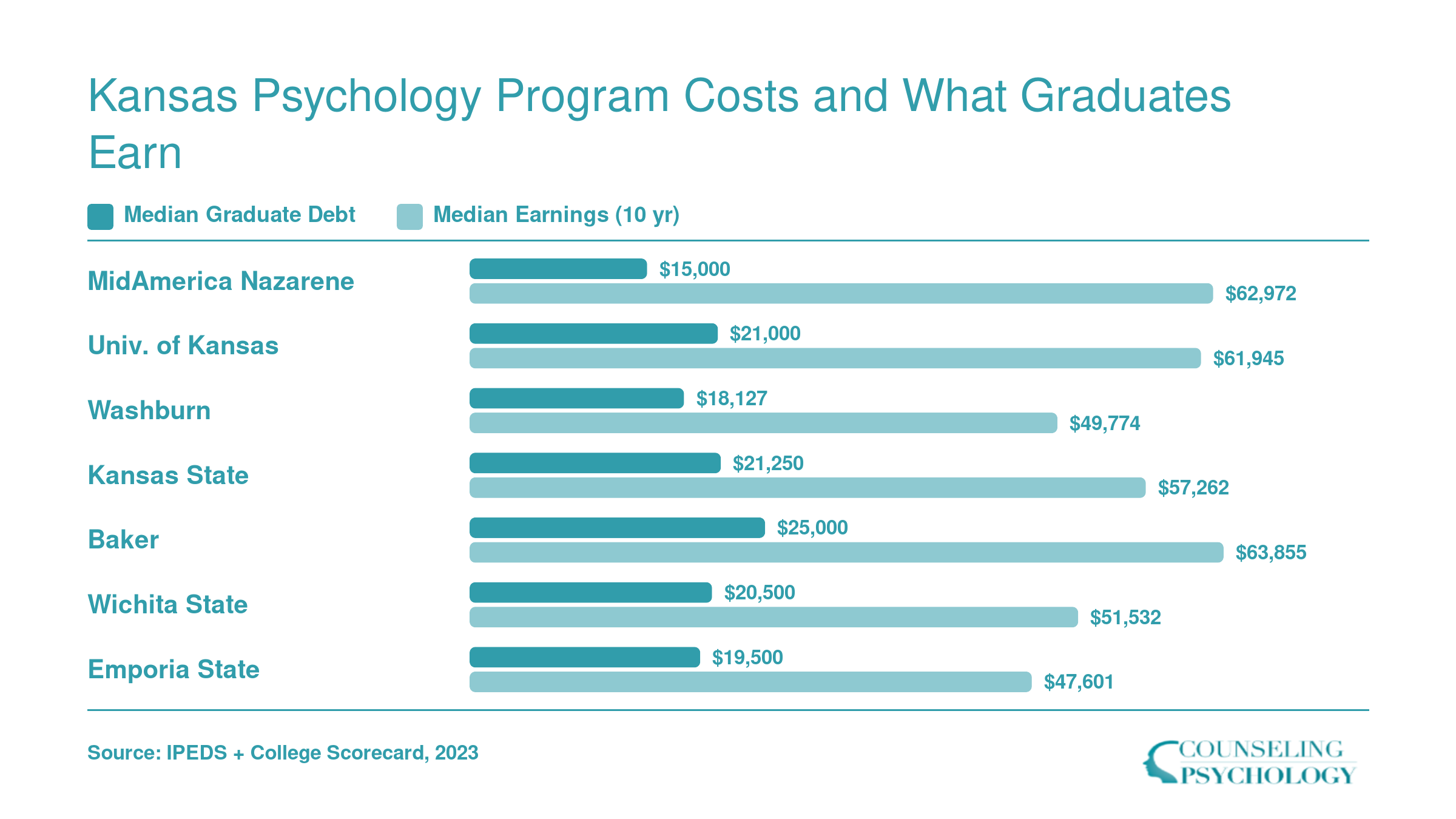
Kansas Psychology Program Costs and What Graduates Earn
Cost and return vary widely across Kansas psychology programs. The schools below represent a range of public and private options, and the gap between what graduates borrow and what they earn a decade later tells a clear story about long-term value. MidAmerica Nazarene stands out with the lowest median debt ($15,000) paired with strong earnings, while public institutions like Washburn and Wichita State keep net prices low even when debt runs slightly higher. Program-level earnings data are not yet available for these schools, so the figures below reflect institution-wide median outcomes.
Questions to Ask Yourself
Online vs. On-Campus Psychology Programs in Kansas
Kansas psychology programs span fully online, hybrid, and traditional on-campus formats, giving students real flexibility in how they earn their degree. Among the ranked programs on counselingpsychology.org, fully online options appear at schools like the University of Kansas, Fort Hays State University, Baker University, Washburn University, and Ottawa University, while hybrid formats are offered at Emporia State University, Wichita State University, Kansas State University, and MidAmerica Nazarene University. Your ideal format depends on where you live, how you learn best, and what your program requires beyond coursework.
Pros
- Online programs let students in rural parts of Kansas earn a psychology degree without relocating to a college town.
- Flexible scheduling in online formats works well for students balancing jobs, families, or military service.
- Several online Kansas programs charge a flat per-credit rate with no out-of-state surcharge, lowering total cost for distant learners.
- Accelerated online terms, such as Baker University's six-week courses and Ottawa University's eight-week terms, can shorten time to graduation.
- Online delivery gives students access to strong programs at institutions like KU and FHSU regardless of geographic distance.
Cons
- On-campus and hybrid programs provide direct access to faculty-led research labs, which matters if you plan to pursue a doctorate.
- In-person cohort models at schools like Emporia State and Kansas State build professional networks that are harder to replicate online.
- Practicum, fieldwork, and internship hours typically require face-to-face contact even in programs labeled fully online.
- Hands-on training in assessment tools and clinical techniques is easier to practice under live supervision in a campus setting.
- Hybrid programs, such as K-State's I/O Psychology master's, blend online coursework with required summer on-campus sessions, offering a middle ground but still requiring travel.
Related Articles
Psychology Degree Levels Available in Kansas
Kansas schools offer psychology programs at every level of the academic ladder, from a flexible online bachelor's to research-intensive doctoral work. Knowing which level fits your career goal saves you from spending time and money on coursework that does not advance your license or credential. For a broader look at how these tiers compare nationally, review our guide to degrees in psychology.
Bachelor's Degrees
A bachelor's in psychology is the entry point for the field and the most widely available credential across Kansas. Schools such as Washburn University in Topeka, the University of Kansas, Ottawa University-Online, and Baker University all offer bachelor's-level programs, several of them fully online. At this level, you will cover human development, research methods, abnormal psychology, and social behavior.
A bachelor's rarely qualifies you for clinical licensure on its own, but it opens doors to human services, case management, and behavioral health support roles. It also satisfies the prerequisite coursework most Kansas graduate programs expect before admission.
Master's Degrees
Master's programs are the most common pathway for students who want licensure and direct client contact without committing to a full doctoral timeline. In Kansas, master's-level options span clinical mental health counseling, school psychology, and industrial-organizational psychology. MidAmerica Nazarene University's CACREP-accredited Master of Arts in Counseling, for example, prepares graduates for licensure as a Licensed Clinical Psychotherapist (LCPT) in Kansas. Emporia State University and Fort Hays State University both offer master's tracks in school psychology leading toward school psychologist licensure.
If applied behavior analysis interests you, a master's degree paired with a BACB-approved course sequence is the standard route to BCBA certification. Several Kansas and Kansas-accessible programs embed verified course sequences into their graduate curricula.
Master's programs tend to be the sweet spot for affordability, especially at state schools where in-state tuition can fall well below $10,000 per year.
Doctoral Programs
For those targeting independent licensure as a psychologist in Kansas, a doctoral degree is required. The two main formats are the PhD, which emphasizes research and often includes a stipend, and the PsyD, which is practice-focused and typically completed in four to six years. Students interested in counseling doctoral programs should compare both formats carefully.
Wichita State University illustrates how doctoral work can look at the state's public institutions, offering an EdD in Educational Leadership with an educational psychology track delivered in a hybrid format over roughly three years. Students pursuing a clinical or counseling psychology license at the doctoral level should confirm that their program meets Kansas Behavioral Sciences Regulatory Board requirements before enrolling.
Graduate Certificates
Beyond the three primary degree levels, some Kansas schools offer graduate certificates that let licensed practitioners add a specialty without returning for a full degree. Ottawa University-Kansas City's Certificate of Advanced Graduate Studies in Gerocounseling is one example, targeting counselors who want focused training in aging and elder mental health. Understanding what different careers in psychology require can help you decide whether a certificate, master's, or doctorate is the right investment.
Popular Psychology Specializations at Kansas Schools
Kansas students often face a choice between two very different professional destinations: the clinical psychology and counseling track that leads to state licensure, or the applied behavior analysis track that leads to BCBA certification. Both fall under the psychology umbrella, but the coursework, supervised hours, and credentialing bodies are distinct. Picking the wrong lane can add years to your timeline.
Clinical and Counseling Tracks
Most graduate-level psychology programs at Kansas schools are licensure-oriented. MidAmerica Nazarene University offers a CACREP-accredited Master of Arts in Counseling with a Clinical Mental Health Counseling concentration, a 60- to 64-credit hybrid pathway designed for students pursuing LPC or LCPC licensure. Emporia State and Fort Hays State both run school psychology programs that lead to K-12 school psychologist credentialing, while Kansas State offers a hybrid Industrial and Organizational Psychology master's for students headed into HR and applied research rather than clinical practice. Wichita State's doctoral track in Educational Psychology rounds out the academic and research-oriented options. Students who want to compare broader program options nationally can explore online master's in psychology programs.
Behavior Analysis and BCBA Pathways
The University of Kansas is the only Kansas institution with ABAI-accredited online applied behavior analysis programs.1 KU offers a Master of Arts in Applied Behavioral Science in both on-campus and online formats (both ABAI-accredited and aligned with BCBA Pathway 1), plus an on-campus Ph.D. in Behavioral Psychology. For students who already hold a graduate degree in a related field, KU offers a Pathway 2 course sequence and an Online graduate certificate in applied behavior analysis with coursework including ABSC 852, Behavior Analysis in Developmental Disabilities.2 KU also operates autism-focused practicum placements and research centers, which matters if you want supervised hours with pediatric ASD populations.
Pathway 1 vs. Pathway 2: Timing Matters
One planning detail to flag: the ABAI Verified Course Sequence system sunsets December 31, 2025.3 Pathway 2 coursework completed before that date remains valid for BCBA eligibility through 2031, but after 2031 only Pathway 1 (an ABAI-accredited degree program) will qualify.4 If you are considering KU's certificate route, the deadline shapes your enrollment timeline. If you are entering a full master's program, Pathway 1 keeps your options open indefinitely.
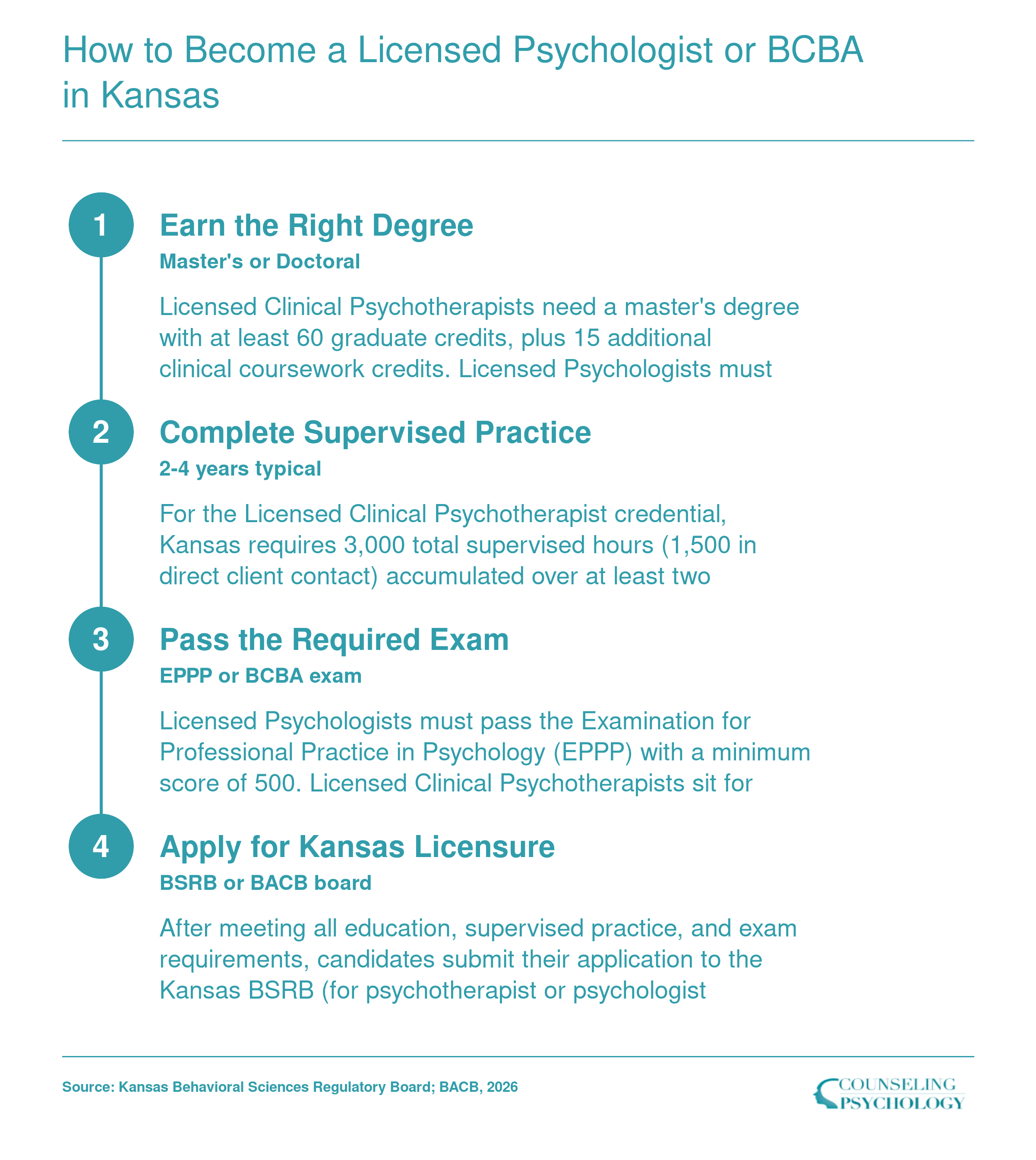
How to Become a Licensed Psychologist or BCBA in Kansas
Kansas credentials in psychology and applied behavior analysis follow distinct but structured paths, all overseen by licensing boards with specific hour and exam requirements. The Kansas Behavioral Sciences Regulatory Board (BSRB) manages both the Licensed Clinical Psychotherapist (master's level) and Licensed Psychologist (doctoral level) credentials. The BCBA certification is administered nationally by the Behavior Analyst Certification Board (BACB) but requires state-compliant supervised fieldwork. Below is a consolidated credentialing ladder covering all three tracks.
What Can You Do With a Psychology Degree in Kansas?
Graduates pursuing clinical practice versus applied behavioral roles face different timelines and earning potential in Kansas, but both paths offer robust opportunities in the state's growing mental health sector. Clinical psychologists and behavior analysts serve overlapping but distinct populations, and understanding the local labor market helps graduates align education with career goals.
Kansas Salaries for Psychology Professionals
Clinical psychologists in Kansas earned a median annual wage of $84,570 in 2025, with a mean wage of $90,160. The state employs approximately 570 clinical psychologists, and the occupation is projected to grow 16.8% between 2022 and 2032, well above the national average of 11.2%.2 Nationally, clinical psychologists earned a median of $96,100 in 2023, placing Kansas salaries slightly below the U.S. benchmark but reflecting regional cost-of-living differences.3
For those entering mental health counseling or substance abuse counseling, earnings vary by specialization and credential. Behavior analysts, particularly those holding BCBA certification, typically command competitive salaries in Kansas due to high demand for autism services and applied behavior analysis in schools and clinical settings. National figures for therapists in related categories show median wages around $63,650, though Kansas-specific data for counselors and behavioral specialists can vary widely depending on setting: rural community mental health centers, university counseling offices, or private practice.4 To benchmark compensation across credentials and locations, prospective students can explore counselor salary data for a broader picture.
Program-Level Graduate Outcomes
Graduates from Kansas programs featured in the rankings show median earnings ranging from approximately $48,900 to $63,900 ten years after completion, depending on institution and degree level. Bachelor's graduates from Washburn University earned a median of $49,774 a decade post-graduation, while those completing programs at Baker University reached $63,855. These figures reflect both psychology-specific roles and adjacent careers in human services, research coordination, and educational support.
Because program-level data aggregates all completers, not just licensed clinicians, earnings reflect a mix of career paths: some graduates pursue direct clinical work after master's or doctoral study, while others enter HR, case management, or research assistant roles immediately after the bachelor's degree. Students interested in applied roles may also consider an applied psychology degree as an alternative pathway. Employment outcomes shortly after graduation are not reported for most programs in the dataset, so prospective students should inquire directly with admissions offices about job placement rates and alumni career destinations.
Job Growth and Rural Demand
Kansas faces persistent shortages of behavioral health providers, especially in rural counties. The state's 16.8% projected growth rate for clinical psychologists far exceeds national trends, driven by expanded telehealth access, school-based mental health mandates, and the opioid crisis.2 Rural areas often offer loan repayment incentives, higher starting salaries, and faster paths to independent practice for new clinicians willing to serve underserved populations.
Behavioral analysts and licensed professional counselors also find strong demand in Kansas, particularly for professionals trained in trauma-informed care, family therapy, and substance use disorders. Graduates completing CACREP-accredited master's programs, such as the Clinical Mental Health Counseling track at MidAmerica Nazarene University, are well-positioned for licensure as LPCs, a credential that opens doors to private practice, hospital systems, and community agencies across the state.
Kansas would need 52 additional mental health practitioners to lift its federal Mental Health Professional Shortage Area designations, according to 2025 HRSA workforce data. That gap signals strong, sustained demand for psychology and behavioral health graduates entering the Kansas workforce, particularly in rural counties where access remains most limited.
Frequently Asked Questions About Kansas Psychology Programs
These are some of the most common questions prospective students ask when exploring psychology programs in Kansas. The answers draw on current accreditation standards, typical cost ranges, and licensure requirements to help you plan your next steps with confidence.