
Key Takeaways
- Ohio State, Case Western Reserve, and Ohio University rank among the state's top psychology programs for 2026.
- Online psychology degrees in Ohio start below $8,000 in average annual net price at several accredited institutions.
- Licensure as a psychologist in Ohio typically requires eight to twelve years of education and supervised experience after high school.
- APA accreditation at the doctoral level is the single most important factor for qualifying to practice independently in Ohio.
Ohio has 26 ranked psychology program listings across 19 schools in 2026, spanning bachelor's degrees under $6,400 in annual tuition to graduate certificates at research universities like Case Western Reserve. That range signals both opportunity and complexity: the credential you need depends entirely on your career target, and choosing the wrong degree level can add years and cost to your path.
The most common source of confusion is the gap between a psychology degree and a licensure-qualifying program. Earning a bachelor's in psychology does not make you a licensed psychologist in Ohio, and not every online master's program leads to independent clinical practice. Accreditation status, program type, and supervised hours all determine what you can do after graduation.
Online delivery has expanded access significantly. Programs at Ohio University, Bowling Green State, Kent State, and the University of Cincinnati now offer fully asynchronous formats, which matters for working adults balancing jobs and families. But lower cost and flexible scheduling do not automatically translate into better career outcomes, a distinction this page takes seriously throughout the rankings, cost comparisons, and licensure guidance that follow.
Online vs. On-Campus Psychology Programs in Ohio
Ohio offers psychology programs in fully online, hybrid, and traditional on-campus formats, and each delivery mode comes with real tradeoffs. The right choice depends on your schedule, budget, career goals, and how much in-person interaction you need. Here is a practical breakdown of the advantages and limitations you should weigh before committing.
Pros
- Fully online bachelor's and master's programs from schools like Ohio University, Kent State, and Franklin University let you study on your own schedule without relocating.
- Ohio University charges a flat online tuition rate regardless of residency, which can save out-of-state students thousands of dollars compared to traditional campus rates.
- Kent State's online psychology programs show only a narrow gap between in-state and out-of-state per-credit costs (roughly $612 vs. $623), making them accessible to a broad applicant pool.
- Online formats often allow faster completion: some Ohio master's programs advertise 18-month timelines, while on-campus equivalents may take two years or more.
- The rankings on counselingpsychology.org include a program format indicator, so you can filter specifically for online, hybrid, or on-campus options that fit your situation.
Cons
- Doctoral programs and clinical practica almost always require campus presence; fully online PsyD or PhD options in Ohio are rare, so plan for in-person commitments at the advanced level.
- On-campus and hybrid formats offer stronger networking, faculty mentorship, and peer collaboration that are harder to replicate in asynchronous online courses.
- Practicum and supervised fieldwork placements are typically arranged locally, which can be more complicated for online students living outside Ohio or in rural areas.
- Some online programs, such as Tiffin University's M.S. in Psychology, explicitly note they are not clinical licensure tracks, so the degree may not qualify you for direct client practice.
- Hybrid programs that blend online coursework with periodic campus visits can create unpredictable travel costs that are easy to overlook when comparing sticker prices.
Most Affordable Online Psychology Degrees in Ohio
The table below ranks the most affordable online psychology programs in Ohio by net price, from lowest to highest. Net price is an institution-wide average that reflects what students typically pay after grants and scholarships are applied; your actual cost will vary based on your financial aid package, enrollment status, and residency. All programs listed are bachelor's level except for Cleveland State University, which offers a graduate certificate. One notable detail for out-of-state students: Kent State University's online psychology programs charge only about $10 more per credit hour for non-residents, making the in-state versus out-of-state gap far smaller online than it appears in the published sticker prices below.
| School | Program | Degree Level | In-State Tuition | Out-of-State Tuition | Net Price (Avg. After Aid) | Format |
|---|---|---|---|---|---|---|
| Ohio University, Lancaster Campus | B.S. in Psychology | Bachelor's | $6,362 | $9,444 | $5,650 | Online |
| Kent State University at Stark | B.S. in Sport, Exercise and Performance Psychology | Bachelor's | $8,211 | $17,969 | $10,897 | Online |
| Kent State University at Trumbull | B.S. in Sport, Exercise and Performance Psychology | Bachelor's | $8,211 | $17,969 | $11,135 | Online |
| Kent State University at Geauga | B.S. in Sport, Exercise and Performance Psychology | Bachelor's | $8,211 | $17,969 | $12,044 | Online |
| Kent State University at Ashtabula | B.S. in Sport, Exercise and Performance Psychology | Bachelor's | $8,211 | $17,969 | $12,205 | Online |
| Kent State University at Tuscarawas | B.S. in Sport, Exercise and Performance Psychology | Bachelor's | $8,211 | $17,969 | $12,542 | Online |
| Kent State University at East Liverpool | B.S. in Sport, Exercise and Performance Psychology | Bachelor's | $8,211 | $17,969 | $13,392 | Online |
| Kent State University at Salem | B.S. in Sport, Exercise and Performance Psychology | Bachelor's | $8,211 | $17,969 | $13,799 | Online |
| Cleveland State University | Certificate in Behavior Analysis | Graduate Certificate | $11,297 | $21,107 | $14,764 | Online |
| Kent State University (main campus) | B.S. in Sport, Exercise and Performance Psychology | Bachelor's | $12,920 | $21,575 | $20,787 | Online |
Questions to Ask Yourself
Psychology Degree Levels and Specializations Available in Ohio
Two-year associate programs and four-year bachelor's degrees represent opposite ends of the undergraduate spectrum, and understanding where each one leads is essential before you commit to a program. Ohio's psychology landscape spans the full credential ladder, from bachelor's through doctoral, and the programs in this ranking reflect most of that range.
The Degree Ladder in Ohio
Bachelor's-level programs make up the majority of options here. Ohio University-Lancaster, Franklin University, Franciscan University of Steubenville, Malone University, and multiple Kent State campuses all offer bachelor's degrees, with concentrations spanning general psychology, clinical psychology, applied psychology, and sport and exercise psychology. These programs typically require 120 credit hours and are designed as either launchpads for graduate study or entry points into human services, case management, and support roles. For a broader look at how these credentials compare nationally, our guide to different types of psychology degrees is a useful starting point.
Master's degrees appear at Tiffin University (a general M.S. in Psychology), Bowling Green State University and University of Cincinnati (both focused on Applied Behavior Analysis), and John Carroll University (Educational Psychology). Each of those graduate programs signals a different career trajectory. A master's degree in psychology in general or I/O psychology, for example, can qualify graduates for roles in human resources, organizational consulting, program evaluation, and research coordination. ABA-focused master's degrees prepare graduates to sit for the BCBA exam and work with individuals with autism and other developmental disabilities. The John Carroll M.Ed. in Educational Psychology is positioned explicitly as preparation for doctoral work.
Graduate certificates round out the picture. Case Western Reserve University offers a certificate in Industrial-Organizational Psychology, Cleveland State University offers one in Applied Behavior Analysis, and Xavier University offers a neurodiversity-focused graduate certificate. These shorter credentials are best suited for professionals who already hold a degree and want to add a focused specialty, not for students building a primary credential.
What Each Level Can and Cannot Do for Your Career
If your goal is independent licensure as a psychologist in Ohio, a master's degree alone will not get you there. The Ohio State Board of Psychology requires a doctoral degree, either a Ph.D. or Psy.D., along with supervised postdoctoral hours and passage of the EPPP examination. A master's in psychology can support licensure in adjacent fields, such as professional counseling (which has its own licensure track through the Ohio Counselor, Social Worker and Marriage and Family Therapist Board, and you can explore masters in counseling Ohio options separately), but the title of "psychologist" is reserved for doctoral-level practitioners.
For roles like industrial-organizational psychologist, the master's degree is often sufficient for applied positions in business settings, though research-focused or consulting roles at senior levels increasingly prefer the doctorate.
Should You Start with an Associate Degree?
The short answer: an associate degree in psychology is rarely worth treating as a career credential on its own. Ohio community colleges do offer two-year psychology transfer pathways, but they exist to feed into bachelor's programs, not to prepare graduates for employment in psychology-adjacent roles. An associate degree signals foundational coursework, not professional readiness. If affordability is the concern, the stronger strategy is to complete the associate degree as a cost-saving first step and then transfer into one of the bachelor's programs listed here, rather than stopping at the two-year mark and expecting meaningful career traction in the field.
How to Become a Licensed Psychologist in Ohio
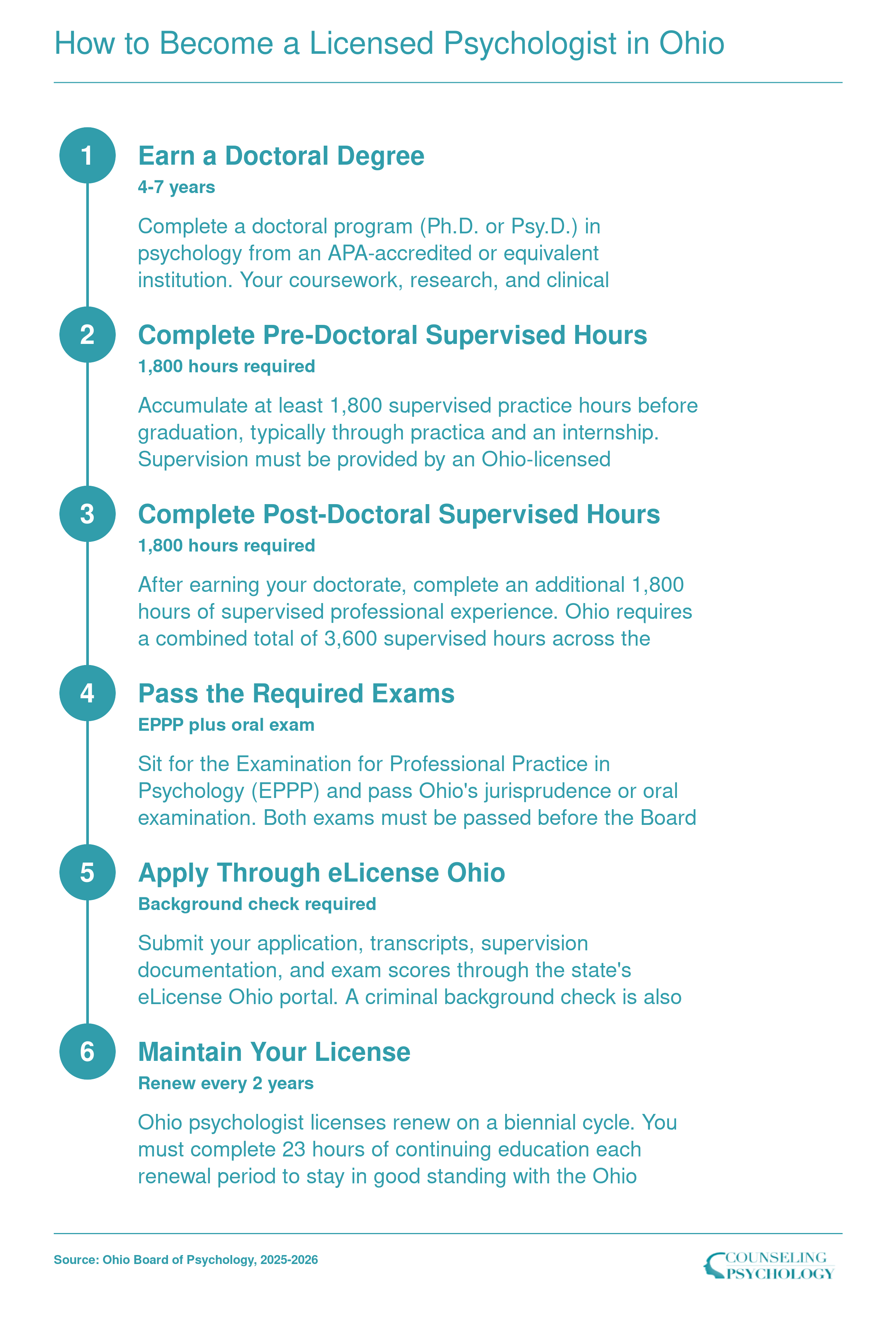
Earning your license as a psychologist in Ohio is a multistep process that typically spans eight to twelve years after high school. The pathway below reflects 2025-2026 requirements set by the Ohio Board of Psychology. Note that master's-level credentials such as the Licensed Professional Counselor (LPC) or Licensed Professional Clinical Counselor (LPCC) follow a separate, shorter track and do not authorize the title "psychologist."
Accreditation and Licensure: Which Ohio Programs Qualify
Which accreditation body determines whether your Ohio psychology program will qualify you for licensure? The answer depends on your degree level and career goal, but two organizations set the national standards: the American Psychological Association (APA) for doctoral psychologist training and the Council for Accreditation of Counseling and Related Educational Programs (CACREP) for master's-level counseling programs. Choosing a program with the right accreditation is the single most important decision you will make, because Ohio licensure boards rely on these credentials to determine eligibility.
APA-Accredited Doctoral Programs in Ohio
If you plan to become a licensed psychologist in Ohio, your doctoral program must hold APA accreditation. The APA Commission on Accreditation evaluates clinical psychology, counseling psychology, and school psychology doctoral programs nationwide. To find current APA-accredited programs in Ohio, visit the APA website and use the program search tool, filtering by state (Ohio) and program type. As of the 2025-2026 academic year, Ohio hosts APA-accredited doctoral programs at institutions including Kent State University, The Ohio State University, University of Akron, University of Cincinnati, Wright State University, and Case Western Reserve University. Program types include clinical psychology, counseling psychology, and clinical child programs. Accreditation status can change, so always verify directly on the APA site before applying.
CACREP-Accredited Master's Programs for Counseling
Master's-level counseling students should focus on CACREP accreditation, which Ohio requires for Licensed Professional Clinical Counselor (LPCC) and Licensed Professional Counselor (LPC) pathways. CACREP accredits programs in clinical mental health counseling online programs, school counseling, career counseling, and other specializations. Check the CACREP directory on their official website to identify accredited programs at Ohio universities. Major Ohio institutions offering CACREP-accredited programs include Cleveland State University, Ohio University, University of Cincinnati, John Carroll University, and Xavier University, among others. Some schools offer multiple CACREP-accredited tracks, so review each program page carefully.
Verify Licensure Requirements and Program Status Directly
Accreditation alone does not guarantee licensure. Consult the Ohio Board of Psychology for psychologist licensure requirements, including supervised hours, examination requirements, and any additional state-specific criteria. For counseling and marriage and family therapy master's programs Ohio, visit the Ohio Counselor, Social Worker, and Marriage & Family Therapist Board. Both boards publish detailed licensure pathways, application procedures, and contact information for questions.
Always verify accreditation status on the individual school's program website and contact program coordinators directly before enrolling. Accreditation reviews occur on multi-year cycles, and a program's status can be placed on probation or withdrawn. For national employment outlook and wage data across psychology occupations, refer to the Bureau of Labor Statistics (BLS.gov), which publishes projections and median earnings by occupation and, in some cases, by state.
Choosing an accredited, licensure-track program is the single most consequential decision you will make as an aspiring psychologist in Ohio. Accreditation determines whether your degree qualifies you to sit for licensing exams and practice independently, so verify a program's current status directly with the accrediting body before you enroll.
Career Outcomes and Earning Potential for Ohio Psychology Graduates
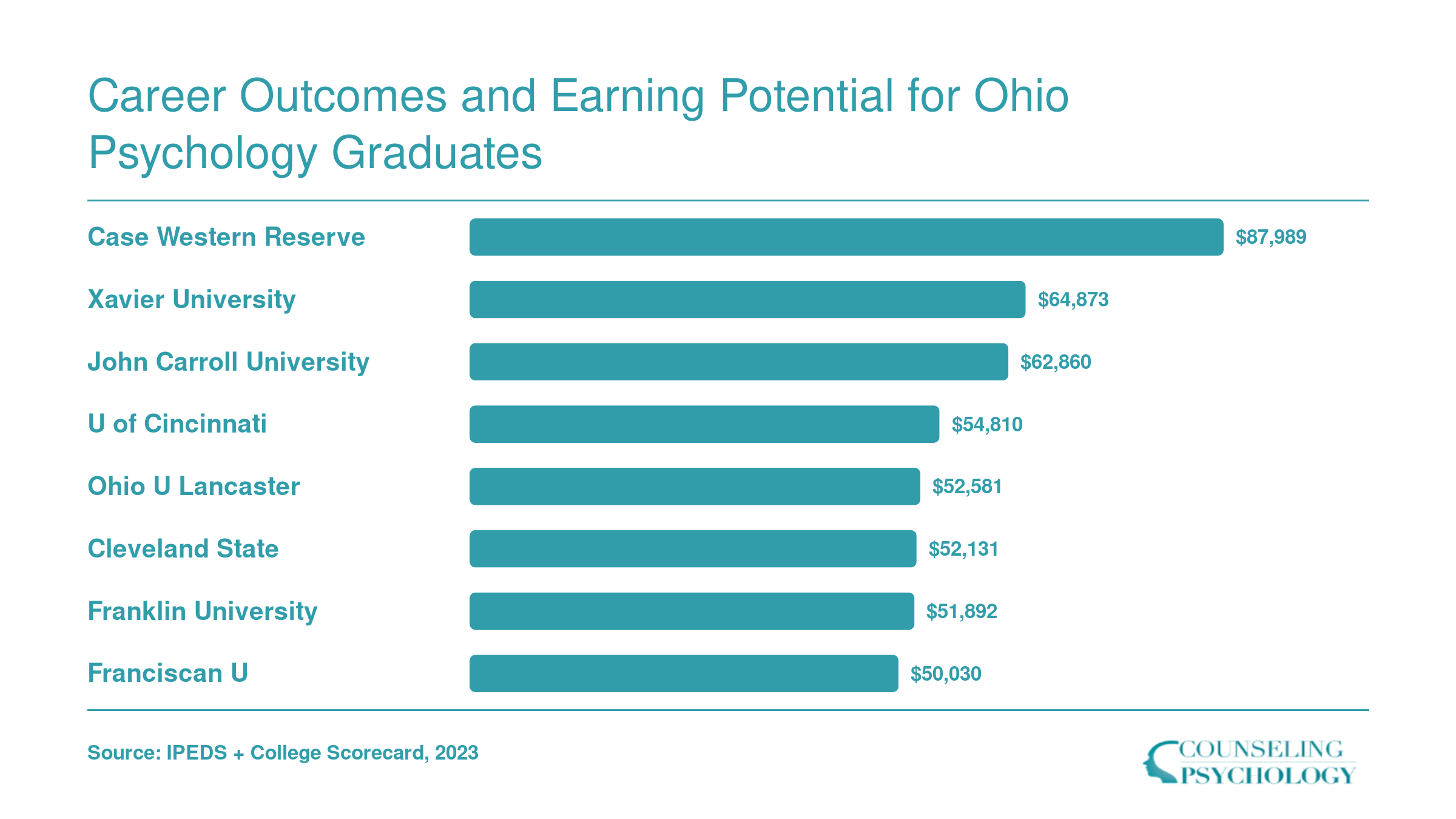
Understanding what psychology graduates actually earn helps you weigh the return on your degree investment. The institution-level median earnings shown below reflect what all graduates of each school report earning ten years after enrollment, regardless of major. These figures come from federal data and capture a broad cross-section of alumni. For occupation-specific context, the national median wage for psychologists was $94,310 in 2024 according to the Bureau of Labor Statistics, with projected job growth of 6% through 2034. Ohio-specific wage figures by percentile are not included here because verified state-level BLS data for the current reporting period was not available at publication. Keep in mind that program-level post-completion earnings for many of these specific psychology programs have not yet been published, so institution-wide figures serve as the best available proxy.
Admissions Requirements and How to Apply to Ohio Psychology Programs
A 3.0 undergraduate GPA is the most common minimum you will encounter for both master's and doctoral psychology programs across Ohio, though some programs set the bar higher. Ohio University's Accelerated Pathway in Psychological Science, for example, requires a 3.2 GPA or a combination of at least a 3.0 cumulative GPA with a 3.5 in your most recent coursework.1 Doctoral programs at research-intensive institutions may not list a higher posted minimum, but admitted cohorts typically carry averages well above 3.0. Ohio State's PhD in Psychology lists a 3.0 minimum for Autumn 2026 admissions, yet competitive applicants usually exceed that figure by a meaningful margin.2
GRE and Test-Optional Trends
Since 2020, a growing number of Ohio programs have dropped the GRE as a hard requirement. Ohio State's general Psychology PhD no longer requires the exam for Autumn 2026 applicants, while its Quantitative Psychology specialization still does.2 This split illustrates a broader pattern: many programs have gone test-optional or test-free, but specific specializations and highly competitive doctoral tracks may still require or strongly recommend GRE scores. If you are applying to multiple programs, check each one individually rather than assuming a blanket policy.
Prerequisite Coursework
Regardless of degree level, expect to complete a core set of undergraduate courses before you apply. Common prerequisites include:
- Introductory Psychology: Nearly every program expects this foundational course.
- Statistics: A college-level statistics course, often specifically in behavioral or social science statistics.
- Research Methods: Demonstrates your readiness for graduate-level empirical work.
- Content Electives: Ohio University's accelerated pathway, for instance, requires three additional courses from areas such as developmental, social, cognitive, biological, or abnormal psychology.1
Programs may also ask for letters of recommendation and a personal statement outlining your research interests and career goals.
Thesis, Dissertation, and Clinical Requirements
What you complete beyond coursework depends heavily on the degree level and specialization. Master's programs in psychological science frequently require a thesis; Ohio University's accelerated pathway is one example.1 Doctoral programs virtually always require a dissertation, and clinical or counseling psychology doctorates add a predoctoral internship, typically lasting a full year. If you are weighing a counseling doctoral programs track, note that the internship requirement alone adds significant time to your schedule. Programs oriented toward research rather than clinical practice may substitute extended research practica for formal clinical hours, but a substantial independent research project remains the norm at the doctoral level. For a broader overview of what the full career trajectory looks like, our guide on how to become a psychologist breaks down each stage from undergraduate work through licensure.
Before you apply, map out each program's full set of requirements, from prerequisite courses through culminating experiences, so you can build a realistic timeline and avoid surprises after enrollment.
Frequently Asked Questions About Ohio Psychology Programs
Choosing a psychology program in Ohio raises plenty of practical questions, from cost and accreditation to licensure timelines. Below are answers to the questions prospective students ask most often, drawn from current program data and Ohio licensing requirements.
More Ohio Psychology Programs to Consider
Beyond the top-ranked schools, Ohio offers many other psychology programs worth exploring. Below is a directory of additional options, including online and on-campus programs at various degree levels.
- Graduate Certificate in Industrial Organizational Psychology
- M.Ed. in Educational Psychology
- M.S. in Applied Behavior Analysis
- Sport, Exercise and Performance Psychology
- Sport, Exercise and Performance Psychology
- Sport, Exercise and Performance Psychology
- Sport, Exercise and Performance Psychology
- Sport, Exercise and Performance Psychology
- Sport, Exercise and Performance Psychology
- Sport, Exercise and Performance Psychology