What you’ll learn in this article…
- Colorado has five CSWE-accredited MSW programs, with Colorado State University Pueblo offering the lowest in-state tuition.
- All Colorado MSW formats (online, hybrid, on campus) require a minimum of 900 supervised field placement hours.
- Earning an LCSW in Colorado requires at least two years of supervised post-master's clinical practice through DORA.
- Clinical and macro concentrations are both available, and choosing between them is one of the earliest career-defining decisions.
Colorado's health systems, schools, and community agencies are expanding faster than the supply of master's-level social workers, creating a strong job market for MSW graduates who hold a Colorado license. In-state tuition at CSWE-accredited programs spans a wide band, roughly $10,000 to $42,000 per year, depending on whether you choose a public university or the state's lone private option. That cost spread matters, but the credential that opens doors across the Front Range and beyond is the same: a degree from a CSWE-accredited program plus a passing score on the ASWB clinical exam.
Best MSW Programs in Colorado: Rankings & Comparison
Colorado's MSW landscape spans public universities with strong affordability profiles and a nationally recognized private option, giving prospective social workers real flexibility in how they train and what they pay. The five CSWE-accredited programs below were evaluated with a clear emphasis on cost, financial aid access, and value to students, while also accounting for program format and institutional outcomes. Whether you need a fully online path, a weekend hybrid schedule, or an immersive campus experience, at least one of these programs is designed around your situation.
- Tuition and net price
- Financial aid generosity
- Institutional graduation outcomes
- Program delivery flexibility
- Graduate earning potential
- NCES-IPEDS federal institutional data — nces.ed.gov
- Internal program database
- College Scorecard graduate earnings — collegescorecard.ed.gov
- Independent program research

Colorado State University Pueblo
CSU Pueblo delivers a CSWE-accredited MSW through a hybrid model with classes meeting every other weekend at locations in both Pueblo and Colorado Springs, a schedule built for working adults. The program offers a Generalist track open to any bachelor's degree holder and an Advanced Standing track that lets BSW graduates from accredited programs finish faster. With a net price around $10,051 and no GRE requirement, it consistently ranks among the most affordable MSW options in the state. Schools offering this program have an institution-wide graduation rate of approximately 39.7%.
- CSWE-accredited hybrid program since 2019
- Classes meet every other weekend in two cities
- Generalist track requires 18 liberal arts credits
- Advanced Standing available for BSW holders
- 948 total field placement hours required
- No GRE or GMAT needed for admission
- Scholarships may be available through financial services
- Focus on social justice and policy advocacy
Master of Social Work — Hybrid

University of Colorado Colorado Springs
UCCS offers its MSW in both campus and hybrid formats, making it one of the few Colorado public universities consistently recognized in statewide best-online-MSW lists. The curriculum centers on trauma-informed practice, a natural fit given the program's proximity to major military installations in the Colorado Springs area. Students complete 60 credit hours (or 36 in the Advanced Standing pathway for BSW graduates), with elective tracks in military social work, healthcare, child welfare, and school-based practice. The institution-wide graduation rate sits at about 46.9%, and median graduate debt is $20,000.
- 60 credit hours for standard track students
- 36 credit hours for Advanced Standing BSW graduates
- Trauma-informed specialization woven throughout curriculum
- 900 total field placement hours required
- Electives in military, healthcare, and school social work
- Minimum 3.0 GPA required for admission
- Portfolio or thesis culminating experience options
- Hybrid and on-campus delivery formats available
Social Work, MSW — On-Campus

Colorado Mesa University
Colorado Mesa's campus-based MSW in Grand Junction uses a cohort model with small class sizes, giving students close faculty mentorship throughout the program. The Foundation track spans two years and 74 credits with 1,050 practicum hours, while the Advanced Standing track compresses to one year and 44 credits for BSW graduates from CSWE-accredited programs. The program emphasizes anti-racist, culturally responsive practice and includes specialization options in mental health, addictions, and forensic social work. Schools offering this program have an institution-wide graduation rate of roughly 40.6%.
- 74-credit Foundation track over two years
- 44-credit Advanced Standing track in one year
- 1,050 practicum hours for Foundation students
- 600 internship hours for Advanced Standing students
- Cohort model with small class sizes
- Focus on anti-racist and culturally responsive practice
- Specializations in mental health, addictions, forensic work
- Rolling admissions with priority deadline in February
Master of Social Work — On-Campus

Metropolitan State University of Denver
MSU Denver's hybrid MSW is regularly cited as one of Colorado's best online-accessible, public-university options, combining online coursework with Denver-area field placements through partnerships with over 700 agencies. Both a Regular Program and an Advanced Standing pathway (for BSW graduates) carry full CSWE accreditation, and the school's diverse student body, with over 30% students of color, reflects the communities graduates will serve. In-state tuition of roughly $11,017 and a 14:1 student-to-faculty ratio make it a strong value proposition in the Denver metro. Program-level earnings data are not yet available, though the institution-wide median earnings ten years after enrollment reach about $52,093.
- CSWE-accredited hybrid delivery format
- Online and on-campus course options
- Over 700 field agency partnerships
- Emphasis on ethical decision-making and cultural sensitivity
- Scholarships and stipends available
- Small class sizes with hands-on advising
- Designed for BSW graduates from accredited programs
- Shorter completion timeline than the regular track
- Same hybrid online and on-campus flexibility
- Integrative Practice approach across curriculum
- Social justice-oriented coursework throughout
- Dedicated Office of Student Services support
Master of Social Work, Regular Program — Hybrid
Master of Social Work, Advanced Standing — Hybrid

University of Denver
The University of Denver's Graduate School of Social Work is a nationally ranked private institution offering its MSW online and on campus in Denver, Durango, and Glenwood Springs. Its fully online format is one of the few CSWE-accredited options that can be completed from anywhere in the state, and concentrations in Mental Health and Trauma or Health, Equity and Wellness let students tailor their clinical focus. DU distributes roughly $9 million in scholarships annually, which helps offset a tuition of $42,173. With an institution-wide graduation rate of about 75.6% and median earnings of $71,155 ten years after enrollment, it represents the premium end of Colorado's MSW market.
- Fully online, CSWE-accredited concentration
- Full-time and part-time pacing options available
- Advanced Standing pathway for qualified BSW graduates
- Access to over 750 field internship sites statewide
- Average online class size of 22 students
- Dual-degree programs and certificate add-ons offered
- Online concentration focused on holistic health settings
- Justice-oriented curriculum with equity lens
- Customizable specialization pathways within track
- Field internships integrated into coursework
- Scholarships drawn from $9M annual institutional pool
- Prepares graduates for integrated healthcare roles
Master of Social Work, Mental Health and Trauma — Online
Master of Social Work, Health, Equity and Wellness — Online
Colorado MSW Tuition & Cost Comparison
Tuition for MSW programs in Colorado ranges widely depending on whether you attend a public or private institution. Colorado State University Pueblo offers the lowest in-state tuition among these programs, while the University of Denver, as the only private university on this list, carries the highest sticker price. Keep in mind that the net price figures shown below are institution-wide averages after financial aid and do not reflect MSW-specific costs; your actual expense will vary based on your individual aid package, including potential Title IV-E child welfare stipends, Colorado Social Work Foundation awards ($1,000 to $5,000), and graduate assistantships offered at several of these schools.
| School | Type | In-State Tuition | Out-of-State Tuition | Avg. Net Price (Institution-Wide) | Median Graduate Debt |
|---|---|---|---|---|---|
| Colorado State University Pueblo | Public | $10,064 | $16,684 | $10,051 | $21,500 |
| Colorado Mesa University | Public | $10,900 | $16,359 | $15,103 | $22,000 |
| Metropolitan State University of Denver | Public | $11,017 | $13,033 | $15,327 | $21,500 |
| University of Colorado Colorado Springs | Public | $15,704 | $27,218 | $15,788 | $20,000 |
| University of Denver | Private | $42,173 | $42,173 | $36,131 | $21,844 |
Questions to Ask Yourself
Online vs. On-Campus vs. Hybrid MSW Programs in Colorado
Choosing a delivery format is one of the biggest decisions you will make when selecting an MSW program. Every CSWE-accredited MSW in Colorado, regardless of whether it is delivered online, on campus, or as a hybrid, leads to the same degree and the same licensure eligibility. Employers and licensing boards do not distinguish between formats, so the right choice comes down to your schedule, location, and learning preferences. Below is a side-by-side look at how the three modalities compare across the factors that matter most, along with the Colorado programs that currently offer each format.
| Factor | Online | On-Campus | Hybrid |
|---|---|---|---|
| Colorado Programs | University of Denver (MSW with Mental Health and Trauma concentration) | University of Colorado Colorado Springs; Colorado Mesa University | Colorado State University Pueblo; Metropolitan State University of Denver |
| Scheduling Flexibility | Highest flexibility. Most coursework is asynchronous, allowing students to study around full-time jobs or family obligations. | Fixed class schedules during weekdays or evenings. Best for students who can commit to a regular campus routine. | Moderate flexibility. CSU Pueblo, for example, holds classes every other weekend at its Colorado Springs or Pueblo locations, with some online components. |
| Campus Visit Requirements | Minimal to none for coursework. DU's distance MSW may include brief on-site orientations or intensives. | Full in-person attendance required each semester at the school's physical location. | Periodic in-person sessions required (e.g., weekend meetings, lab days) combined with online instruction between visits. |
| Field Placement Logistics | Students can typically arrange placements in their own community but must coordinate with the program's field placement office to secure an approved site and supervisor. | Placements are often drawn from established local agency networks. UCCS offers roughly 900 hours across generalist and specialized placements; Colorado Mesa requires up to 1,050 hours. | Similar to on-campus in that programs maintain regional agency partnerships, but students living outside the immediate campus area work with placement coordinators to identify sites closer to home. |
| Peer Interaction | Virtual discussion boards, group projects, and video conferencing. Some programs create regional cohort meetups. | Daily face-to-face contact with classmates and faculty. Colorado Mesa uses a cohort model that fosters close peer relationships. | A mix of in-person weekend cohort bonding and online collaboration between sessions. |
| Typical Student Profile | Working professionals, career changers, or students in rural areas who need geographic independence. | Traditional graduate students or those who thrive with structured, in-person learning and direct faculty mentorship. | Students who want some in-person connection but cannot commit to a full-time campus schedule, such as part-time workers or parents. |
| Tuition Range (In-State) | Higher end. DU's graduate tuition is approximately $42,173 per year (same rate for in-state and out-of-state students). | Moderate. UCCS lists roughly $15,704 in-state; Colorado Mesa lists roughly $10,900 in-state. | Generally affordable. CSU Pueblo lists roughly $10,064 in-state; MSU Denver lists roughly $11,017 in-state. |
MSW Concentrations & Specializations Available in Colorado
Choosing between a clinical and macro focus is one of the earliest and most career-defining decisions an MSW student will make, and Colorado programs offer both pathways alongside a growing list of specialized niches. Understanding the distinctions between these tracks and the breadth of concentrations available helps prospective students align their academic training with specific licensure goals and career outcomes.
Clinical vs. Macro: Two Distinct Career Trajectories
Clinical social work concentrations prepare students for direct therapeutic roles and independent clinical practice. Graduates of clinical tracks typically pursue Licensed Clinical Social Worker (LCSW) credentials, enabling them to provide psychotherapy, diagnose mental health conditions, and work in private practice, hospitals, community mental health centers, and integrated behavioral health settings. The curriculum emphasizes assessment, intervention, treatment planning, and evidence-based therapeutic modalities.
Macro concentrations, by contrast, train students for systems-level change, policy advocacy, nonprofit leadership, and community organizing. Graduates pursue roles as program directors, policy analysts, grant writers, community organizers, and legislative advocates. Instead of individual therapy, macro practitioners focus on organizational development, coalition building, policy reform, and structural interventions that address root causes of inequality and injustice.
Concentrations Offered Across Colorado MSW Programs
The University of Denver's MSW program stands out for its depth of specialization, offering eight distinct concentrations and two certificate options on its Denver campus.1 Both on-campus and online students can access this range of pathways, and the program offers advanced standing for BSW graduates.23
Metropolitan State University of Denver updated its CSWE-accredited MSW curriculum effective Fall 2025, introducing multiple pathways that include clinical practice, Advancing Justice in Organizations and Communities, policy advocacy, and a unique track addressing legal issues.4 This structure reflects the program's emphasis on integrative practice and social justice, and students can choose pathways that align with micro, mezzo, or macro intervention levels.
Less Common Specializations That Set Programs Apart
While clinical mental health and macro policy tracks dominate MSW offerings nationwide, certain Colorado programs distinguish themselves through specialized niches. Concentrations in trauma-informed practice, military counseling degree tracks, substance abuse and addiction, child welfare, school social work, healthcare social work, and gerontology address high-need practice areas and regional workforce demands. These pathways often include targeted field placements, elective coursework, and partnerships with specialized agencies.
For students drawn to work with specific populations or settings, investigating which programs offer formal concentrations versus general elective courses is essential. A dedicated concentration typically includes required coursework, supervised field placements in aligned settings, and faculty expertise in the specialty area, providing deeper preparation than a single elective course.
Related Articles
MSW Admissions Requirements in Colorado
Applying to an MSW program in Colorado means navigating a set of academic prerequisites, documentation requirements, and program-specific policies that vary slightly from school to school. Most programs follow a similar baseline: a bachelor's degree from an accredited institution, minimum GPA thresholds, prerequisite liberal arts coursework, a personal statement, and letters of recommendation. However, the details matter, especially if you're deciding between the traditional Foundation track and the accelerated Advanced Standing pathway.
GPA Minimums and Academic Prerequisites
Colorado MSW programs set GPA floors that range from 2.5 to 3.0. The University of Denver accepts applicants with a 2.5 GPA but places those below 2.75 on academic probation, requiring a 3.0 or higher in the first quarter.1 Colorado State University and the University of Colorado Colorado Springs both require a 3.0 minimum GPA for admission.23
Prerequisite coursework typically includes 18 semester credits in liberal arts and social sciences. Common requirements include an introduction to social work or social welfare, statistics or research methods, human biology or anatomy, and courses in psychology, sociology, or human development. CSU and UCCS both specify 18 credits of prerequisite coursework.23 Most programs no longer require the GRE; CSU and UCCS explicitly state that no entrance exam is needed.23
Traditional Foundation Track vs. Advanced Standing
The Foundation track is a full 60-credit program designed for applicants who hold a bachelor's degree in any field. It typically takes two years of full-time study or three to four years part-time. The curriculum begins with generalist coursework and field practicum, then advances to specialized clinical or macro practice.
Advanced Standing programs, by contrast, condense the degree into 30 to 36 credits and can be completed in one year full-time or two years part-time. This track is reserved for graduates of CSWE-accredited BSW programs who earned their degree within a specified window, usually the last seven years (as CSU requires).2 Advanced Standing applicants at UCCS must submit field practicum evaluations and a recommendation from a practicum instructor or social work faculty member.3 Both the University of Denver and CSU require a 3.0 GPA from the BSW program for Advanced Standing admission, though DU's general admissions floor is 2.5.12
Application Components
Beyond transcripts and GPA verification, applicants must submit a personal statement that articulates their motivation for social work, relevant experience, and fit with the program's mission. Letters of recommendation, typically two or three, should come from academic or professional references who can speak to the applicant's readiness for graduate study and clinical or advocacy work. Students weighing related helping professions may also want to explore best online master's in counseling programs before committing to an MSW.
How Long Does It Take to Get an MSW in Colorado?
Full-time Foundation students complete the MSW in two academic years. Part-time students extend this to three or four years, depending on course load and summer enrollment. Advanced Standing students finish in one year full-time or two years part-time. UCCS's Advanced Standing program, for example, requires 36 credits, while CSU and DU typically offer 30-credit accelerated tracks.23
Selectivity and Admissions Rates
Institution-wide acceptance rates provide context but do not reflect MSW program selectivity specifically. The University of Denver admits 78% of undergraduate applicants; UCCS admits 97%; and CSU Pueblo admits 95%. MSW cohorts are generally smaller and more competitive than these campus-wide figures suggest, but specific program-level admissions data are not publicly reported by most Colorado schools.
Field Placement & Practicum Requirements for Colorado MSW Students
Field placement is the backbone of every CSWE-accredited MSW program, and in Colorado that means completing a minimum of 900 supervised hours of hands-on practice before you graduate with a traditional (two-year or three-year) degree.1 These hours are not optional extras; they are integrated directly into the curriculum and must be completed at approved sites under the supervision of a licensed social worker.
How Field Hours Are Structured
Most Colorado MSW programs split the 900-hour requirement across two distinct placements. At the University of Denver, for example, students complete 400 hours during the foundation year and 500 hours during the concentration year, each at a different agency. Advanced-standing students, who enter with a BSW, typically complete 500 to 630 hours in a single concentration-year placement. Colorado State University's hybrid-distance program follows a similar structure, requiring 900 hours for traditional students and 630 hours for advanced-standing students.3
Placements usually run concurrently with coursework, meaning you will be in the field two to three days per week during the academic year. Some programs also offer block placements during the summer for students who prefer an intensive schedule.
Placement Logistics for Online and Distance Students
If you are enrolled in an online or hybrid MSW program, field education still happens in person. Programs such as those at CSU, MSU Denver, UCCS, and DU allow distance students to secure placements in their home communities, provided the site and supervisor meet program standards. You will typically work with a field coordinator to identify and vet local agencies. Some programs also permit students already employed in a social-work setting to use their workplace as a placement site, which can simplify scheduling (DU offers this option, for instance).
Common Placement Settings
Colorado's MSW students train across a wide range of agencies. Common settings include:
- Community mental health centers: Often the most accessible option, especially for clinical concentrations.
- Hospitals and medical systems: Ideal for students interested in health-care social work or integrated behavioral health.
- Schools (K-12 and higher education): A natural fit for those pursuing school social work.
- VA facilities: Colorado is home to several Veterans Affairs sites that provide rich clinical and case-management experience.
- Child welfare agencies: County departments of human services offer placements focused on child protection, foster care, and family reunification.
DU alone partners with more than 750 placement sites across the state and beyond, giving students significant flexibility. Students drawn to child welfare may also want to explore related roles such as child abuse counselor education to understand how social work and counseling specializations can overlap.
Rural and Underserved Placement Opportunities
Colorado's geography creates both a challenge and an opportunity. Mountain communities and the Western Slope are chronically underserved by mental health professionals, so agencies in these regions are often eager to host MSW interns. For distance students living outside the Front Range, this can be an advantage: you gain clinical experience in a high-need area while building professional relationships that may lead directly to post-graduation employment. Programs like CSU's hybrid model are designed with exactly this population in mind, supporting students who live and intend to practice in rural parts of the state.3 If you are also considering clinical mental health counseling masters programs Colorado, some of those field placement networks overlap with MSW sites, which is worth keeping in mind during your search.
Regardless of which program you choose, start thinking about field placement early. Competitive sites fill quickly, and coordinating supervisor credentials, learning agreements, and liability insurance takes time. Your field education office is your most important resource in this process.
From MSW to Licensed Social Worker: Colorado's LSW & LCSW Pathway
Every CSWE-accredited MSW program in Colorado qualifies graduates for state licensure through the Department of Regulatory Agencies (DORA). The path from diploma to independent clinical practice typically takes 2.5 to 4 years and unfolds in a clear sequence. Here is what each milestone involves and what it costs.
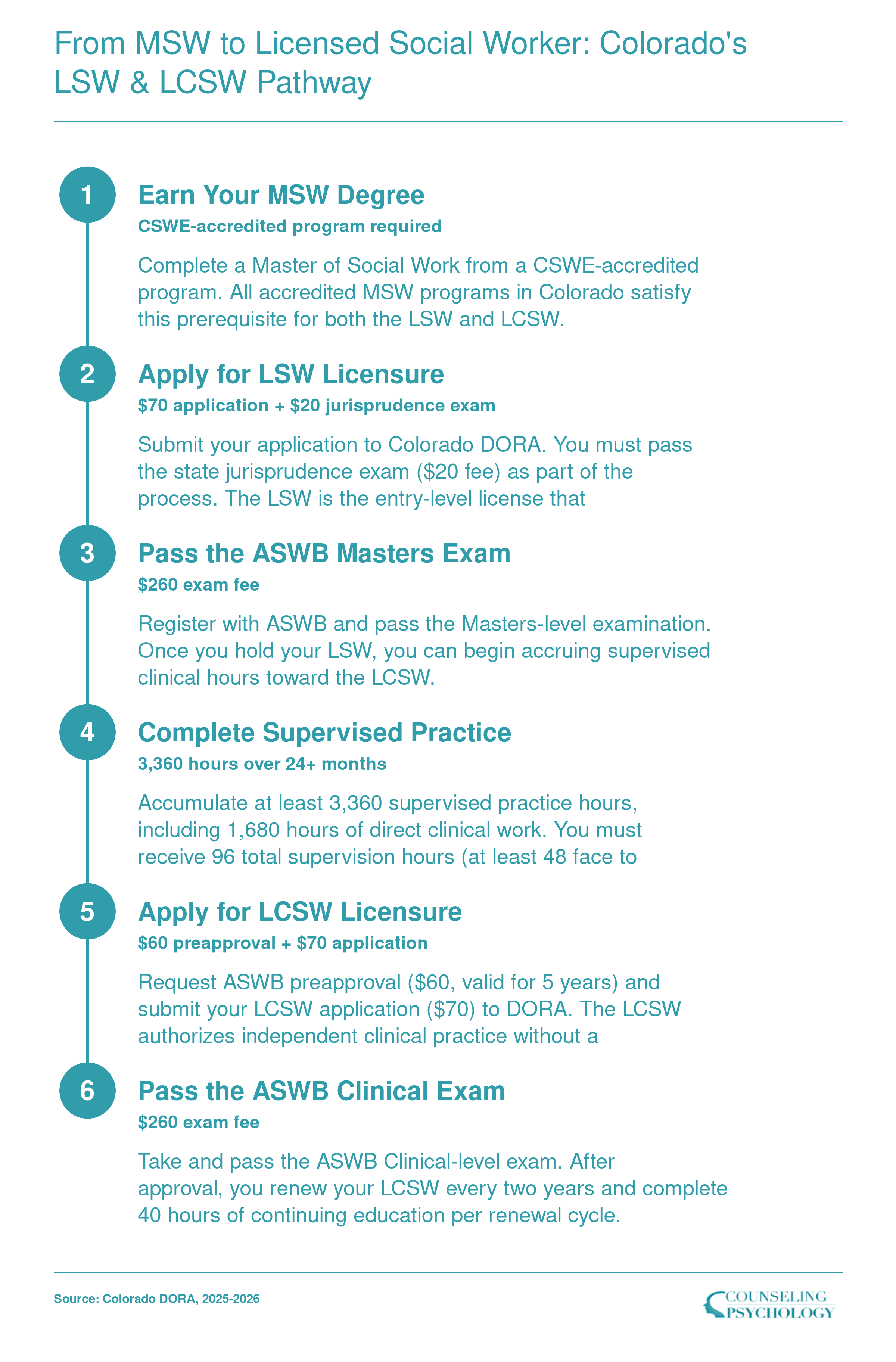
Plan for at least two years of supervised post-master’s practice before you can sit for the LCSW exam in Colorado. Budget for this period early, because supervision hours often coincide with lower starting salaries and may affect your loan repayment timeline.
MSW Career Outcomes & Salary in Colorado
Understanding salary expectations and career trajectories before committing to an MSW program helps you plan strategically for both your education investment and your professional future. Colorado offers diverse social work employment across healthcare systems, school districts, community mental health agencies, and child welfare organizations.
Where to Find Reliable Salary Data
The Bureau of Labor Statistics Occupational Employment and Wage Statistics provides the most comprehensive wage information for social work professionals.1 Search by the relevant SOC codes: 21-1021 for child, family, and school social workers; 21-1022 for healthcare social workers; and 21-1023 for mental health and substance abuse social workers. You can filter results specifically for Colorado metro areas including Denver-Aurora-Lakewood, Colorado Springs, and Fort Collins to get localized figures rather than relying solely on national averages.
For state-specific projections, the Colorado Department of Labor and Employment publishes detailed labor market information including local wage estimates and employment growth forecasts for social work occupations. Their 2024 data shows Colorado's overall mean hourly wage across all occupations sits at $36.33, with a median hourly wage of $27.99, providing useful context for comparing social work compensation to the broader labor market.2
National Salary Benchmarks by Specialization
BLS data from May 2024 reveals meaningful salary variation across social work specializations at the national level.3 Healthcare social workers earn the highest median at $65,580 annually, with the top 10% reaching above $100,250. Mental health and substance abuse social workers report a national median of $59,200, ranging from $38,650 at the 10th percentile to $96,130 at the 90th percentile. Child, family, and school social workers earn a national median of $58,570 annually. Across all social work categories combined, the national median sits at $61,330.1
State-specific median wages for these individual specializations are not always published, so you may need to contact the Colorado Department of Labor directly or reference program-specific outcomes data from universities.
Program and Professional Resources
Colorado MSW program websites frequently publish alumni outcomes data including employment rates, placement statistics, and salary ranges for recent graduates. The University of Denver and Colorado State University both track graduate outcomes that can inform your expectations for entry-level positions. If you are weighing related helping professions, exploring MFT programs in Colorado or clinical mental health counseling options can help you compare career trajectories side by side.
The Colorado Chapter of the National Association of Social Workers conducts periodic salary surveys and maintains resources on career negotiation. Their employer-specific data and compensation benchmarks prove especially valuable when evaluating job offers or negotiating raises after licensure.
Colorado MSW Graduate Earnings at a Glance
Program-completer earnings from College Scorecard, which would allow a side-by-side comparison of median first-year wages across Colorado MSW programs, are not currently available for enough schools to build a meaningful chart. As more cohorts are reported, this snapshot will be updated with school-by-school figures. Note that Scorecard earnings reflect what graduates actually earned after completing their program, not broader occupational wage estimates.
Frequently Asked Questions About MSW Programs in Colorado
Prospective MSW students often share the same set of practical questions about timelines, costs, and licensure steps. Below are answers drawn from current program catalogs and Colorado DORA licensing rules to help you plan with confidence.