
Key Takeaways
- UND holds full CSWE accreditation, while the University of Mary currently holds candidacy status, affecting licensure eligibility.
- Advanced standing MSW tracks in North Dakota can reduce total tuition costs by roughly 40% to 50%.
- North Dakota social worker salaries run below the national median, making program affordability especially important.
- Federal Public Service Loan Forgiveness and state incentive programs can significantly offset MSW tuition for qualifying graduates.
North Dakota has exactly two in-state MSW programs, and the gap between them on accreditation status, tuition structure, and delivery format is wide enough to reshape your licensure timeline and total debt. The University of North Dakota holds full CSWE accreditation; the University of Mary currently holds candidacy status, with per-credit tuition of $645 for its online track. That limited in-state pool makes cost strategy essential, especially since North Dakota social work salaries tend to run below the national median.
Out-of-state online programs with flat-rate tuition can undercut both in-state options, a factor worth weighing before you commit. Students considering related graduate credentials, such as best master in counseling programs in North Dakota, should apply the same accreditation and cost analysis before enrolling.
Best MSW Programs in North Dakota: Ranked by Affordability & Outcomes
North Dakota's graduate social work landscape is small but growing, with the University of Mary currently the primary in-state option for students seeking an affordable, fully online MSW. Because only one North Dakota institution appears in our dataset for this ranking, we present it here with full cost, outcome, and program details so you can compare it against out-of-state online alternatives covered later in this article. Program-level earnings data is not yet available for this MSW, so we rely on institution-wide outcomes and tuition metrics to frame value.
- Published tuition and net price
- Institution-wide graduation rate
- Median graduate debt at completion
- Median earnings after graduation
- Program format and flexibility
- NCES-IPEDS federal institutional data — nces.ed.gov
- College Scorecard graduate earnings — collegescorecard.ed.gov
- Independent program research
- Internal program database

University of Mary
Based in Bismarck, the University of Mary delivers its MSW entirely online through a mix of synchronous and asynchronous coursework, making it accessible to working professionals across North Dakota's rural geography. At $645 per credit, estimated total tuition runs roughly $38,700 for the 60-credit traditional track or about $19,350 for the 30-credit advanced standing option, which is open to graduates of CSWE-accredited BSW programs. Median graduate debt across all programs sits at $24,000, and institution-wide median earnings reach approximately $60,909 ten years after enrollment (note: this figure reflects all graduates, not MSW completers specifically). The program is currently in CSWE candidacy, an important accreditation detail explored further in the accreditation section below.
- Online delivery with synchronous and asynchronous options
- 60 credits for traditional track, 30 for advanced standing
- Tuition set at $645 per credit for all students
- Clinical focus prepares graduates for licensed practice
- Fieldwork placements integrated into the curriculum
- Summer institutes supplement online coursework
- Rooted in a servant leadership and person-centered framework
- Same online format and per-credit tuition as the clinical track
- Designed for students pursuing policy, advocacy, or organizational roles
- 60 credits traditional or 30 credits with an accredited BSW
- Flexible scheduling built for currently employed students
- Field experience component included in the program
- Next cohort start date listed as fall 2026
- Military education benefits accepted
Master of Social Work, Clinical Concentration — Online
Master of Social Work, Macro Practice and Leadership Concentration — Online
UND vs. University of Mary: Side-by-Side MSW Comparison
North Dakota has two institutions offering MSW programs, and they differ in meaningful ways. The University of North Dakota (UND) holds full CSWE accreditation, while the University of Mary currently holds CSWE candidacy status, which means graduates may face additional steps when pursuing licensure in some states. Both programs offer online delivery, but their cost structures, credit requirements, and admissions criteria are distinct enough to warrant a careful look before you apply.
| Feature | University of North Dakota (UND) | University of Mary |
|---|---|---|
| CSWE Accreditation Status | Fully accredited | Candidacy (as of 2025 to 2026) |
| Delivery Format | Online (hybrid components for field education) | Online with synchronous and asynchronous options; includes summer institutes |
| Total Credits (Traditional Track) | 60 credits | 60 credits |
| Advanced Standing Option | Yes, for BSW holders from CSWE-accredited programs | Yes, 30 credits for graduates of CSWE-accredited BSW programs |
| Tuition per Credit | Verify current rate on UND's graduate tuition page | $645 per credit |
| Estimated Total Tuition (Traditional Track) | Contact UND for current figures | Approximately $38,700 (60 credits at $645) |
| Estimated Total Tuition (Advanced Standing) | Contact UND for current figures | Approximately $19,350 (30 credits at $645) |
| Field Placement Hours | 900 hours (standard for CSWE-accredited programs) | Fieldwork experiences required; confirm total hours with the program |
| Minimum GPA for Admission | Varies by track; check UND admissions requirements | 2.75 cumulative GPA |
| Admissions Requirements | Typically includes personal statement, transcripts, references, and prerequisite coursework | Official transcripts, individual application review, program-specific requirements |
| Concentration Options | Clinical and other specializations | Clinical or macro tracks |
| In-State vs. Out-of-State Tuition Difference | In-state residents typically pay lower per-credit rates | Same tuition rate for in-state and out-of-state students ($645 per credit) |
Questions to Ask Yourself
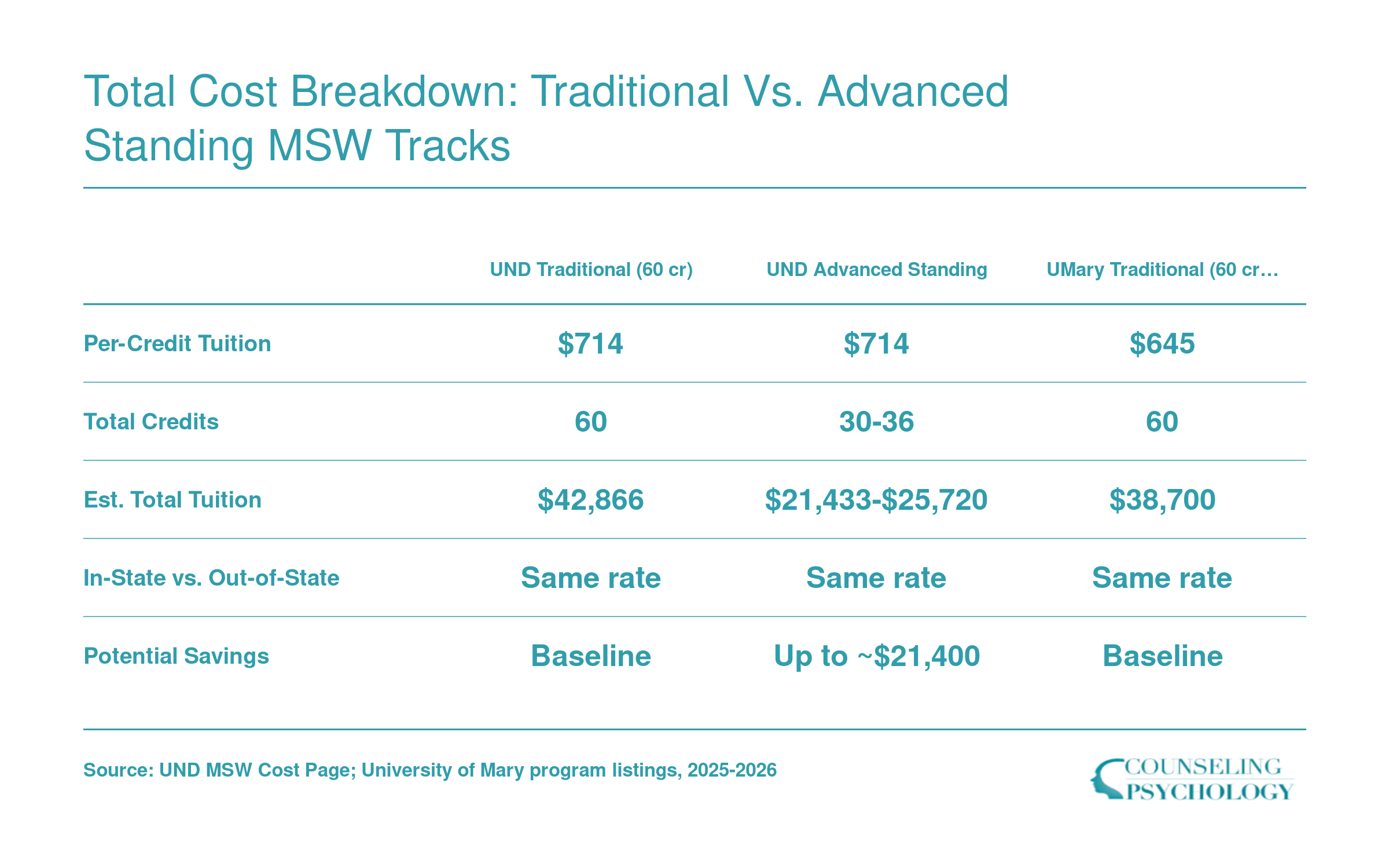
Total Cost Breakdown: Traditional vs. Advanced Standing MSW Tracks
Advanced standing MSW tracks let BSW holders skip foundational coursework, which translates directly into tuition savings. At both North Dakota programs, choosing advanced standing over the traditional track can cut your total cost by roughly 40% to 50%. Here is how the numbers compare for the 2025-2026 academic year.
Affordable Out-of-State Online MSW Programs for North Dakota Residents
North Dakota residents are not limited to in-state MSW programs. Many accredited online MSW programs across the country charge flat national tuition rates or offer reduced out-of-state pricing that makes them competitive with, and sometimes cheaper than, in-state options. Any program accredited by the Council on Social Work Education should satisfy North Dakota's educational requirements for licensure as an LCSW, meaning you can shop nationally without jeopardizing your career pathway.
Below are seven CSWE-accredited online MSW programs currently accepting North Dakota residents at attractive price points for 2026.1 All offer advanced standing pathways for students with a BSW, and most deliver coursework entirely or primarily online.
Western New Mexico University
Western New Mexico offers an advanced standing MSW delivered online with a total program cost of approximately $8,580.1 The program is CSWE-accredited and designed for working professionals who already hold a BSW. This is one of the most affordable nationally available MSW options.
California State University San Bernardino
Cal State San Bernardino's advanced standing MSW runs about $8,400 total.1 The program offers online and hybrid delivery and is CSWE-accredited. Its flat national rate makes it accessible and affordable for out-of-state students, including those in North Dakota.
University of Wyoming
The University of Wyoming's MSW program offers both advanced standing and traditional pathways with online or hybrid delivery. Total tuition ranges from $9,269 to $17,940 depending on residency classification and track, and the program is CSWE-accredited.1 Wyoming's proximity to North Dakota and competitive pricing make it a regional option worth considering.
University of North Dakota (Baseline Comparison)
For context, UND's advanced standing online MSW costs approximately $16,524 total.3 It is CSWE-accredited and includes one on-campus intensive. While this is an in-state option, several out-of-state programs listed here come in at lower or comparable cost.
University of Kentucky
The online MSW program for North Dakota residents from the University of Kentucky is delivered 100 percent online and costs about $23,700 total.2 The program is CSWE-accredited and enrolls students nationally. Kentucky's program is known for strong clinical preparation and flexible scheduling.
Boise State University
Boise State offers both traditional and advanced standing MSW tracks online. The advanced standing option runs approximately $22,194, while the traditional track (for students without a BSW) costs about $35,904.1 Both are CSWE-accredited and delivered entirely online, with no campus visits required.
Why Out-of-State Programs Make Sense
Many online MSW programs have eliminated or reduced out-of-state premiums to attract national cohorts. As long as a program holds CSWE accreditation, it will meet the educational requirements for North Dakota licensure. Compare total costs, field placement support in your region, and program fit rather than limiting your search to in-state schools alone.
MSW Accreditation in North Dakota: CSWE Status Explained
What does it actually mean when a program says it's "in candidacy" instead of "accredited" by CSWE? The distinction sounds like bureaucratic hair-splitting, but it can shape whether you can sit for licensure after graduation.
Full Accreditation vs. Candidacy
The Council on Social Work Education (CSWE) is the sole accreditor of social work degree programs in the United States. Full accreditation means a program has completed a multi-year review, demonstrated compliance with educational standards, and been granted accredited status for a defined term (typically eight years between reaffirmation reviews).
Candidacy is a different animal. It signals that a program has been formally admitted to the accreditation process and is working through the three benchmarks required to earn full status. Programs in candidacy have not yet been accredited. CSWE policy does, however, allow students who graduate from a program in candidacy to be treated as graduates of an accredited program retroactively, provided the program achieves initial accreditation before or shortly after they complete the degree. That retroactive treatment is conditional, not guaranteed.
Where North Dakota Programs Stand
The University of North Dakota's MSW carries full CSWE accreditation and has for years, so UND graduates face no accreditation-related questions at the licensure stage. The University of Mary launched its MSW more recently, and its CSWE status has moved through candidacy. Because that status can change between review cycles, do not rely on this page or any third-party summary, including the school's own marketing materials, as your final source.
Verify Before You Enroll
Go to cswe.org and search the Directory of Accredited Programs. Confirm the exact status (Accredited, In Candidacy, or Pre-Candidacy) and the dates attached to it. Then check directly with the North Dakota Board of Social Work Examiners about whether candidacy-status graduates qualify to sit for the LMSW or LCSW exam. Some state boards accept candidacy graduates; others do not. If you are also weighing related graduate credentials such as MFT programs in North Dakota, the same principle applies: always verify the accreditation body and status before committing. A ten-minute phone call before you enroll can prevent a two-year licensing problem after graduation.
How to Get Licensed as a Social Worker in North Dakota
North Dakota accepts any CSWE-accredited MSW degree for licensure, whether earned in-state or out of state, with no additional coursework requirements. Below is the step-by-step path from graduation through the LCSW credential, administered by the ND Board of Social Work Examiners.
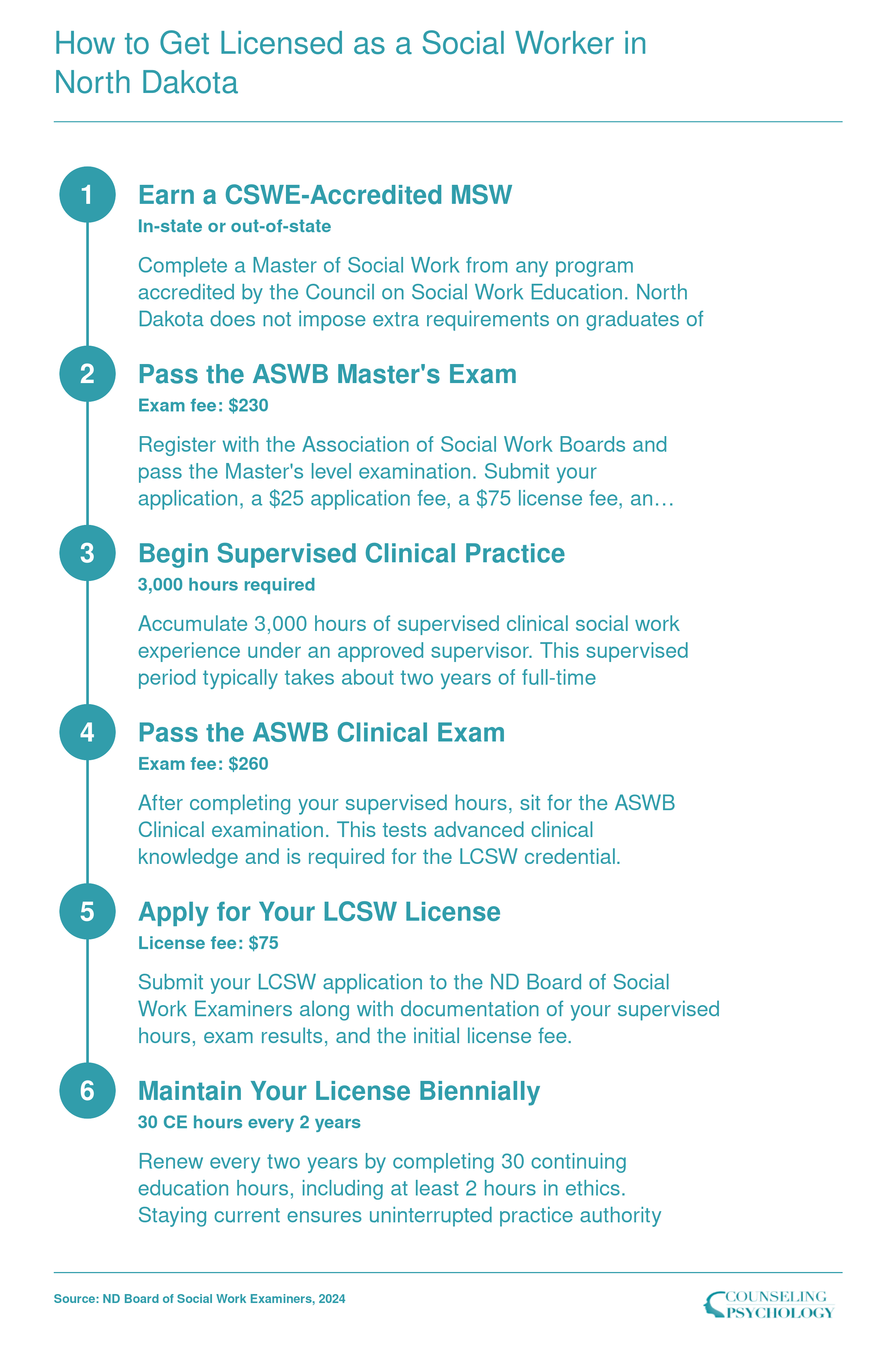
Choose carefully: a fully CSWE-accredited MSW lets you apply for North Dakota LMSW or LCSW licensure without extra hurdles. Graduating from a program still in candidacy status can trigger additional verification steps with the state board, and in some cases delay when you can sit for the ASWB exam.
North Dakota MSW Salary & Career Outlook
Earning potential in North Dakota runs below the national average for social workers, which means tuition cost matters more here than in higher-wage states. Understanding that gap before you enroll lets you weigh your investment against realistic take-home pay after graduation.
What Social Workers Earn in North Dakota
According to 2024 Bureau of Labor Statistics data, the median annual wage for social workers in North Dakota is $54,690.1 That figure sits roughly $6,600 below the national median of $61,330 for the same year.2 The gap is meaningful but not disqualifying, especially for graduates who pursue clinical licensure and move into private practice or specialized healthcare settings, where earning ceilings tend to rise.
BLS metro-level wage data for Fargo and Bismarck is not always broken out separately for North Dakota given the state's relatively small labor market, so state-level figures are the most reliable benchmark available at this time.
Program-Level Earnings Data
For the University of Mary's Master of Social Work program, program-specific post-graduation earnings are not yet available through federal reporting sources. This is common for newer or recently restructured programs, and the data should become available in future reporting cycles. In the meantime, the state median of $54,690 and the national median of $61,330 give you a reasonable earnings corridor to plan around.
Job Growth Nationally and in North Dakota
The BLS projects social worker employment nationally to grow 6 percent between 2024 and 2034, adding roughly 50,000 jobs and generating about 74,000 annual openings when you include retirements and turnover.2 That pace exceeds the average for all occupations.
North Dakota's market is smaller, but rural and frontier communities across the state face persistent shortages of licensed clinical social workers and mental health practitioners. Graduates willing to work in underserved areas often find strong hiring conditions and may qualify for loan repayment programs that effectively improve the state's return on investment.
Connecting Cost to Earning Potential
With total program costs ranging from roughly $19,000 for the University of North Dakota's advanced standing track to around $38,000 for a full traditional MSW, and a state median salary near $54,690, most graduates who land full-time roles can expect to recover tuition within two to three years of employment. Choosing the lower-cost track does not sacrifice licensure eligibility, which makes affordability a straightforward priority for most North Dakota residents. For a broader look at how compensation varies by degree and location, the counselor salary breakdown on our site puts these numbers in regional context.
Scholarships & Financial Aid for MSW Students in North Dakota
Financial aid for MSW students in North Dakota includes a mix of federal programs, state-funded incentives, and institution-specific scholarships designed to offset tuition costs and support students entering high-need practice areas. Many social workers qualify for federal Public Service Loan Forgiveness (PSLF) because they work in government agencies or nonprofit organizations, making FAFSA completion and Direct Loan enrollment essential steps for students planning nonprofit careers. In addition to federal aid, North Dakota offers targeted funding streams for students pursuing child welfare, tribal social work, and rural practice.
Title IV-E Child Welfare Stipends
The University of North Dakota partners with the state to administer Title IV-E Child Welfare Stipends, which cover tuition, fees, and a modest living allowance for MSW students who commit to working in public child welfare.1 Recipients must complete a 12-month service obligation in a North Dakota Child Welfare Human Service Zone or a North Dakota Tribal Child Welfare Agency after graduation.1 This program directly supports students interested in child protective services, foster care, and family preservation work, and it eliminates most out-of-pocket costs for qualifying students.
Federal Loan Repayment Programs
Clinical social workers (LCSWs) practicing in federally designated Health Professional Shortage Areas may qualify for the National Health Service Corps (NHSC) Loan Repayment Program, which awards up to $50,000 over two years in exchange for full-time service in an underserved community. The Health Resources and Services Administration (HRSA) also funds Behavioral Health Workforce Education and Training grants, which some MSW programs use to support students entering integrated care, substance use treatment, or mental health roles. These federal programs prioritize rural and tribal communities, making them especially relevant for North Dakota graduates.
North Dakota-Specific Scholarships
The University of North Dakota offers multiple MSW scholarships, including the Ken Dawes Social Work Scholarship (awarded to concentration-level students with a preference for those committed to practicing in North Dakota)2, the Don Schmid Welfare Leadership Scholarship (for concentration-level students)1, and the Burkland Scholarship (for graduate social work students).1 The North Dakota Indian Scholarship, administered by the North Dakota University System, supports undergraduate and graduate students of Native American heritage attending any institution in the state.3 The Bank of North Dakota administers the Career Builders Scholarship and Loan Repayment Program, which targets students entering high-demand fields; social work may qualify depending on current state workforce priorities.3
Additional Resources
Employers in North Dakota, particularly tribal social service agencies and rural health systems, sometimes offer tuition assistance or loan repayment as recruitment incentives. Students should ask prospective employers about these benefits during the job search. National resources like the NASW Foundation Scholarships provide additional funding opportunities for MSW students nationwide. All students should complete the FAFSA annually to establish eligibility for federal grants, work-study, and Direct Loans, and check individual program financial aid pages for institution-specific deadlines and scholarship applications.
Frequently Asked Questions About MSW Programs in North Dakota
Choosing an MSW program raises practical questions about cost, accreditation, licensure, and fieldwork logistics. Below are direct answers to the questions North Dakota residents ask most often.