
What you’ll learn in this article…
- D.C. metro counseling salaries consistently exceed national medians according to BLS occupational data.
- Master's programs take roughly two to three years, while doctoral tracks require five to six years of training.
- Licensure rules differ across the District, Maryland, and Virginia, so tri-jurisdiction planning is essential from day one.
- Every ranked program is fully online, letting D.C. residents earn a degree without relocating.
Washington, D.C. stands at the center of federal behavioral health policy, hosts agencies from the National Institutes of Health to the Veterans Health Administration, and draws a population that ranges from diplomats to underserved immigrants. That ecosystem creates a concentration of psychology jobs, research funding, and clinical training sites matched by few other metros. The ranked programs below are fully online, so students anywhere can access D.C.-area training without relocating or commuting to a campus.
The question is not whether counseling psychology offers strong career prospects in the region. It does. The question is which program delivers the accreditation, practicum support, and financial value you need to compete for federal postdocs, community-clinic roles, or private-practice licensure in the District, Maryland, or Virginia. Students interested in the counseling psychology phd programs ranking should pay particular attention to accreditation status and practicum partnerships.
D.C.-area licensure spans three jurisdictions, each with distinct hour requirements and supervisory rules. A master's program may lead to LPC licensure but not to the psychologist title; a doctoral program qualifies you for both but takes five to six years and typically requires a dissertation and internship year.
Best Fully Online Counseling Psychology Programs Near Washington, D.C.
Every program below is 100% online, meaning D.C.-area residents can earn a counseling psychology degree without relocating or commuting to a distant campus. Because these are fully online offerings, none of them require hybrid or in-person coursework at the home institution, though most do include supervised clinical hours you can typically complete at approved sites in the D.C. metro area. This ranking is built on a quality composite that weighs online delivery, institutional outcomes such as graduation rate and post-graduation earnings, affordability, and median student debt. It is not a prestige ranking.
- Online delivery and flexibility
- Institutional graduation rate
- Post-graduation earnings outcomes
- Affordability and net price
- Median graduate debt levels
- NCES-IPEDS federal institutional data — nces.ed.gov
- College Scorecard graduate earnings — collegescorecard.ed.gov
- Internal program database
- Independent program research

Liberty University
Liberty University sits in Lynchburg, Virginia, making it one of the closest institutions on this list to the D.C. metro. Its massive online infrastructure supports more than 600 degree programs, and the CACREP-accredited clinical mental health counseling master's emphasizes ethical practice, multicultural competence, and evidence-based techniques. With flexible eight-week course terms and no standardized-test admissions requirement, the program is built for working professionals who need to fit graduate study around existing commitments.
- CACREP-accredited, 60-credit-hour program
- No GRE or standardized testing for admission
- Flexible 8-week online course terms
- Transfer up to 50% of total degree credits
- Includes practicum and internship components
- Military tuition discount available
- Prepares graduates for LPC licensure
Master of Arts in Clinical Mental Health Counseling — Online

Northwestern University
Northwestern University pairs elite institutional outcomes, including a 95.1% graduation rate (institution-wide), with a CACREP-accredited online counseling master's that can be completed in as few as 18 months. Live online sessions, asynchronous coursework, and faculty-coordinated clinical placements in students' home communities mean D.C. residents can complete practicum and internship hours locally. A child and adolescent specialization adds depth for those drawn to youth-focused practice.
- CACREP-accredited with 24 graduate courses
- Completable in 18 months full-time or 36 part-time
- 200-hour practicum plus 600-hour internship
- Child and adolescent specialization available
- Live online classes combined with asynchronous work
- Clinical placements arranged near student's home
- In-person immersion experiences included
Master of Arts in Counseling — Online

Arizona State University
Arizona State University's online Master of Counseling focuses on clinical mental health counseling through a 60-credit, culturally responsive curriculum. Three semesters of supervised field experience give students substantial hands-on training, and ASU's 87% first-year retention rate reflects strong institutional support. The program prepares graduates to pursue LPC licensure in most states, though D.C. applicants should verify local board requirements independently.
- 60-credit-hour graduate program
- Three semesters of supervised field experiences
- Minimum 3.0 undergraduate GPA required
- Multicultural counseling integrated throughout
- Competitive admission process
- Prepares students for LPC licensure
- In-state tuition approximately $13,587 per year
Master of Counseling, Clinical Mental Health Counseling — Online

New York University
New York University's Steinhardt School delivers an online Master of Arts in Counseling for Mental Health and Wellness with concentrations in substance-related disorders, marriage and family counseling, and adolescent sexual decision-making. NYU arranges clinical placements in students' local communities, explicitly including major metro areas, so D.C. residents can expect placement support close to home. The institution's 87.6% graduation rate (institution-wide) and $82,509 median earnings ten years after enrollment underscore strong overall outcomes.
- 60-credit-hour online program, no GRE required
- Concentration in substance-related disorders
- Concentration in marriage and family counseling
- Concentration in adolescent sexual decision-making
- Live online classes plus asynchronous coursework
- Practicum and internship arranged locally
- Multicultural counseling emphasis throughout curriculum
Master of Arts in Counseling for Mental Health and Wellness — Online

University at Buffalo
The University at Buffalo offers a fully accredited Mental Health Counseling MS that blends online coursework with 600 hours of clinical experience. With no GRE or MAT requirement and a minimum 3.0 GPA for entry, the program lowers common admissions barriers. Its curriculum centers on evidence-based practices, social justice, and personal growth, and prepares graduates for LMHC licensure. The institution-wide graduation rate stands at 75.2%.
- MPCAC-accredited, 60-credit-hour program
- No GRE or MAT required for admission
- 600 hours of supervised clinical experience
- Evidence-based practice and social justice focus
- Prepares graduates for LMHC licensure
- In-state tuition approximately $14,530 per year
- Minimum 3.0 undergraduate GPA required
Mental Health Counseling, MS — Online

Marquette University
Marquette University's online Master of Science in Clinical Mental Health Counseling is CACREP-accredited, spans 60 credit hours, and can be finished in about three years. The program reports a 100% exam pass rate and 88% employment within 90 days of graduation. A child and adolescent counseling specialization is available, and three annual start dates give working professionals more scheduling options. Marquette's institution-wide graduation rate is 83.2%.
- CACREP-accredited, 60-credit-hour program
- Completable in approximately 3 years
- 100% licensure exam pass rate reported
- 88% employed within 90 days of graduation
- Child and adolescent counseling specialization
- Three start dates offered each year
- Asynchronous coursework with practicum support
Master of Science in Clinical Mental Health Counseling — Online

Prescott College
Prescott College stands out for its distinctive concentration options: Human Sexuality Counseling, Marriage, Couple, and Family Counseling, and Social Justice in Counseling. All three tracks are CACREP-accredited, require no GRE or application fee, and feature small class sizes led by clinically active faculty. The social justice lens woven through the curriculum appeals to students who want their counseling practice to address systemic inequities.
- CACREP-accredited online format
- No GRE, GMAT, or application fee
- Small class sizes with clinically active faculty
- Social justice orientation throughout coursework
- Multiple start dates for flexible enrollment
- Limited residency option available
- CACREP-accredited online program
- No GRE, GMAT, or application fee required
- Small class sizes for personalized attention
- Clinically active faculty mentorship
- Focus on social justice in family systems
- Flexible online learning with multiple starts
- CACREP-accredited online delivery
- Dedicated social justice counseling concentration
- No GRE, GMAT, or application fee
- Small classes and clinically active faculty
- Multiple annual start dates
- Flexible format for working professionals
Master of Science in Counseling, Human Sexuality Counseling — Online
Master of Science in Counseling, Marriage, Couple, and Family Counseling — Online
Master of Science in Counseling, Social Justice in Counseling — Online

University of North Dakota
The University of North Dakota's Master of Arts in Counseling ranges from 60 to 66 credit hours and offers specialization tracks in school counseling, rehabilitation counseling, and community mental health. Online students can complete clinical requirements in their home communities, making it feasible for D.C. residents. No GRE is required, and the program takes two to three years to finish. The institution-wide graduation rate is 60.5%.
- 60 to 66 credit hours depending on track
- School, rehabilitation, and community mental health tracks
- No GRE required for admission
- Completable in 2 to 3 years online
- Practicum and internship in student's local area
- Flexible asynchronous class format
- In-state tuition approximately $13,677 per year
Master of Arts in Counseling — Online

Lipscomb University
Lipscomb University's CACREP-accredited Clinical Mental Health Counseling program in Nashville offers specializations in play therapy and addiction counseling. The 61-credit-hour curriculum carries a reported 100% licensure exam pass rate and integrates faith-based perspectives with clinical training. Small class sizes and 750 hours of supervised clinical experience round out a program designed for students who value close faculty mentorship. Note that the institution-wide graduation rate of 72.2% reflects all undergraduate programs, not this specific master's track.
- CACREP-accredited, 61-credit-hour program
- 100% licensure exam pass rate reported
- Specialization in play therapy available
- Specialization in addiction counseling available
- 750 hours of supervised clinical experience
- Small class sizes for individualized guidance
- $962 per credit hour
Clinical Mental Health Counseling — Online

The University of Texas at Tyler
UT Tyler's online Master of Arts in School Counseling is a 48-credit-hour program closely aligned with Texas educator certification standards and ASCA guidelines, boasting a 99% TExES pass rate. The program's strong Texas orientation means D.C.-area applicants should carefully verify whether the curriculum satisfies their jurisdiction's school counselor licensure requirements. In-state tuition is approximately $8,480 per year, making it one of the most affordable options on this list.
- 48-credit-hour online program
- 99% TExES exam pass rate
- Aligned with ASCA national guidelines
- Approximately $24,132 total program cost
- Scholarships available for eligible Texas teachers
- Synchronous and asynchronous course mix
- 24-month completion timeline with supervised practicum
Master of Arts in School Counseling — Online
Why Washington, D.C. Is Ideal for Counseling Psychology
Few cities offer the concentration of federal health agencies and diverse clinical populations that Washington, D.C. provides to counseling psychology students. The metro area uniquely blends direct federal employment, research funding, policy influence, and rich practicum experiences, making it an unmatched training ground for future professionals.
Federal Agencies That Hire and Fund Your Work
The D.C. region is home to the nation's foremost health and defense institutions, many of which employ counseling psychologists or support psychological research.1 The National Institutes of Health in Bethesda, MD, and its National Institute of Mental Health fund studies on psychotherapy mechanisms, suicide prevention, and mood disorders, while offering competitive research fellowships.2 The Washington DC VA Medical Center provides APA-accredited practica and internships in outpatient mental health, substance use treatment, and health psychology.1 Nearby Walter Reed National Military Medical Center in Bethesda runs practicum rotations, internships, and staff psychologist positions. The Defense Health Agency in Falls Church, VA, shapes psychological health policy for service members, and the FBI employs psychologists in behavioral analysis and crisis negotiation.1 These institutions are not just employers; they are training pipelines that bring real-world clinical and research demands into the classroom.
A Training Ground Shaped by Diversity
The D.C. metro area's demographic richness creates unparalleled practicum and internship populations. Students work with clients spanning a broad spectrum of race, ethnicity, socioeconomic status, immigration background, and life experience. This exposure builds cultural competence more deeply than a homogenous setting ever could, preparing graduates for licensure in an increasingly globalized field. The growing need for diverse practitioners is well documented in research on BIPOC therapist training programs, and D.C.'s clinical landscape offers exactly the kind of cross-cultural immersion that meets this demand. From community mental health centers in Ward 8 to university counseling centers in Prince George's County, the region's clinical placements reflect the full complexity of modern American life.
Policy Influence Beyond the Clinic
Counseling psychologists in Washington can shape national mental health policy in ways few other cities allow. Proximity to the Substance Abuse and Mental Health Services Administration headquarters in Rockville, MD, and the Office of Personnel Management, which oversees federal Employee Assistance Programs, places practitioners at the intersection of research, practice, and regulation.2 Advocacy roles, advisory committees, and agency collaborations are the norm, not the exception. This environment turns a counseling psychology degree into a platform for systemic change.
Local Access Even for Online Students
Even learners enrolled in fully online counseling psychology programs can leverage the D.C. advantage if they live in the region. Local practicum sites, VA placements, and in-person networking events remain open to remote students who are geographically present.3 Conferences hosted by federal agencies and professional associations often take place right in the metro area, allowing online cohorts to build professional relationships and hands-on clinical hours without relocating.
Questions to Ask Yourself
Master's vs. Doctoral Programs in Counseling Psychology: Which Path Is Right for You?
A master's degree takes 24 to 36 months and leads to LPC or LPCC licensure; a doctorate in counseling psychology takes 60 to 72 months and leads to licensure as a psychologist.1 That single distinction shapes everything else about your training, your scope of practice, and your earning ceiling.
Licensure Endpoint and Scope of Practice
The credential matters more than the diploma. A master's in counseling (MA or MS) prepares you for the Licensed Professional Counselor pathway, which in D.C. is staged through the LGPC (graduate, supervised) before reaching the full LPC. Your scope centers on psychotherapy and counseling interventions, with limited authority for psychological testing.
A PhD or PsyD in counseling psychology leads to licensure as a psychologist, a different credential entirely. Licensed psychologists carry full assessment and testing authority, including administering and interpreting instruments like the WAIS, MMPI, and projective measures. They can diagnose across a broader range and often supervise master's-level clinicians.
Training Model and Time Investment
Master's programs are applied: coursework, practicum, and 2,000 to 4,000 supervised post-degree hours before independent licensure. Research exposure is minimal.
Doctoral programs split into two training philosophies. PhDs follow a scientist-practitioner model with significant research, dissertation, and often funded assistantships. PsyDs follow a practitioner-scholar model, with heavier clinical emphasis and typically self-funded tuition.1 Both require a one-year predoctoral internship plus one to two years of postdoctoral supervised practice.3
Counseling Psychology vs. Clinical Psychology vs. Mental Health Counseling
These terms get used interchangeably, and they shouldn't be. Counseling psychology doctorates traditionally emphasize wellness, career, and developmental issues across the lifespan; clinical psychology doctorate programs lean more toward severe psychopathology and hospital settings. At the doctoral level the two have converged significantly, and both qualify graduates to sit for the EPPP and license as psychologists.3 Mental health counseling, by contrast, is a masters in mental health counseling field that produces LPCs, not psychologists.
Online Availability
Online master's programs in counseling are widely available, and CACREP accreditation now extends to many of them. Fully online doctoral programs are scarcer, and APA-accredited PhD or PsyD programs almost always require in-person residencies, practicum placements, and a full-time internship year, regardless of how much coursework is delivered remotely.
Accreditation and Licensure: What D.C., Maryland, and Virginia Require
Navigating licensure in the Washington, D.C. metro area demands early attention to program accreditation and state-specific requirements. Because many students live in Maryland or Virginia while training or practicing in D.C., tri-state awareness is not optional; it is the foundation of a viable career plan. For a broader look at how to get a counseling license by state, review the full requirements before choosing a program.
Accreditation Bodies That Shape Licensure Paths
Three agencies dominate counseling and psychology program approval. For clinical and counseling psychology doctoral programs, the American Psychological Association (APA) sets the standard. APA accreditation is a near-universal prerequisite for psychologist education across the U.S., including D.C., Maryland, and Virginia. Without it, applying for the Examination for Professional Practice in Psychology (EPPP) and accruing required supervised hours becomes an uphill battle.
For master's-level counseling programs, the Council for Accreditation of Counseling and Related Educational Programs (CACREP) is the most widely recognized gatekeeper. CACREP-accredited degrees streamline the path to becoming a licensed professional counselor in all three jurisdictions. The Master's in Psychology and Counseling Accreditation Council (MPCAC) offers an alternative, particularly for psychology-based counseling programs, though its acceptance varies by state board. Graduates of non-accredited programs often face extra coursework reviews or outright denial of candidacy.
Licensure in Washington, D.C.
- LPC: Requires a master's degree with at least 60 graduate credits, though a 48-credit degree qualifies for the preliminary Licensed Graduate Professional Counselor (LGPC) title. The route to full LPC demands 3,500 hours of supervised clinical experience, including 200 hours of immediate supervision (100 must be individual). This must be spread across 24 to 60 months. Candidates pass the National Counselor Examination (NCE).1
- Licensed Psychologist: A doctoral degree from an APA-accredited program is mandatory. The licensing process includes 1,750 hours of post-doctoral supervised experience and a passing score on the EPPP. D.C. also requires a jurisprudence exam covering local laws.
Tri-State Realities: Maryland and Virginia
Virginia LPC candidates face a 3,000-hour supervised experience requirement, with at least 2,000 hours in direct client contact and 600 hours from practicum or internship. The window is tighter: 21 to 48 months. Exams include the NCE and the National Clinical Mental Health Counseling Examination (NCMHCE), plus a state-specific jurisprudence exam.2 Virginia participates in the Counseling Compact, which eases licensure portability for practitioners moving among member states.3
Maryland's LPC process is broadly similar: a 60-credit CACREP-aligned degree, supervised hours (typically 3,000), and the NCE or NCMHCE. However, precise hour breakdowns and supervision ratios differ; always confirm directly with the Maryland Board of Professional Counselors and Therapists. For licensed psychologists, both Maryland and Virginia mirror D.C. in requiring an APA-accredited doctorate, the EPPP, and substantial supervised experience (usually 1,500 to 2,000 hours).
The Risk of Non-Accredited Programs
Choosing an unaccredited or inappropriately accredited program can derail your career before it starts. State boards explicitly list approved accreditors, and graduating from a program outside that list often triggers costly remediation, additional coursework, or outright ineligibility. Even if a state grants a provisional license, transferring it later may prove impossible. For doctoral candidates, APA accreditation is non-negotiable. At the master's level, CACREP, and to a lesser extent MPCAC, opens doors. Verify a program's status on the accreditor's website and cross-reference it with the specific board before enrolling.
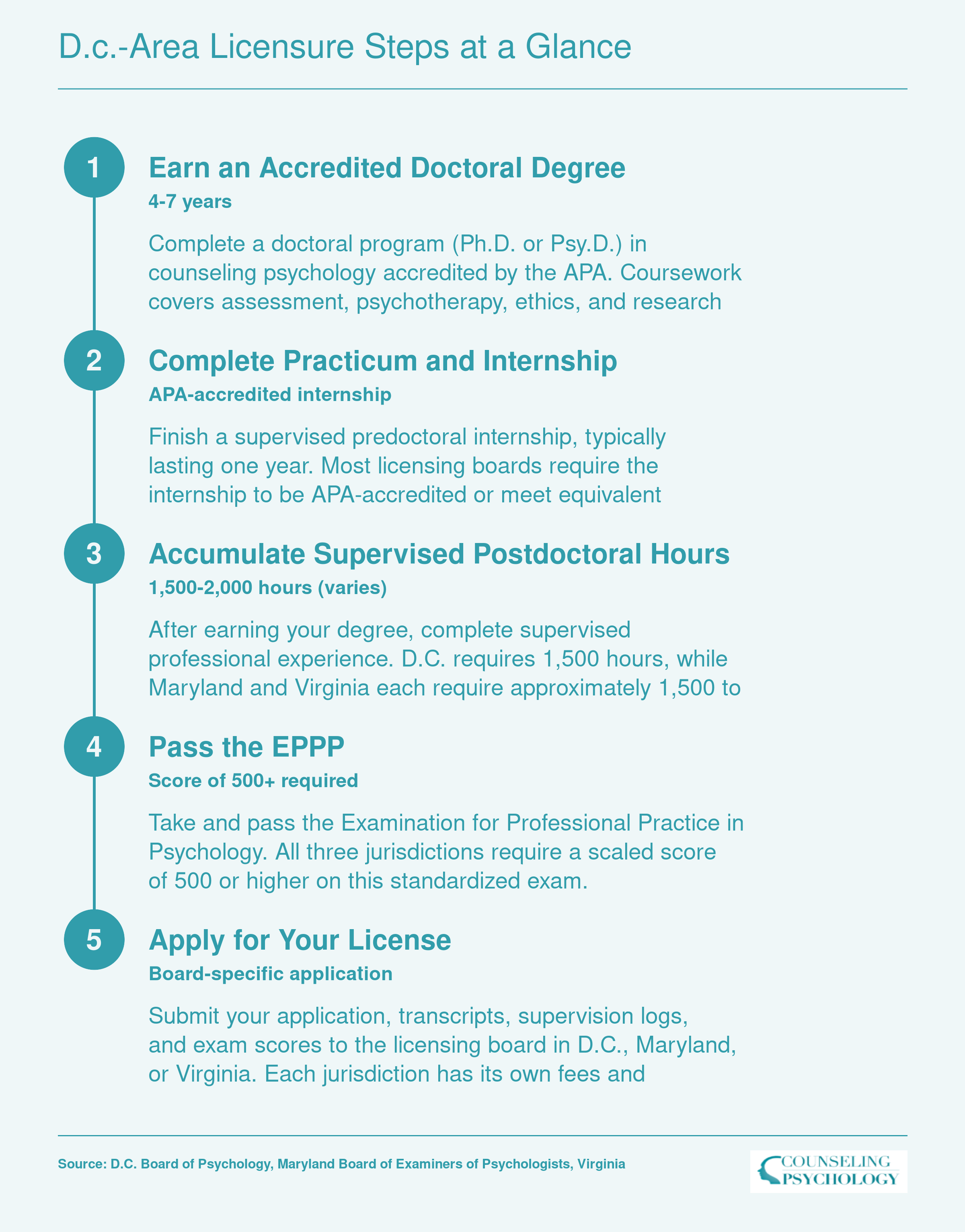
D.C.-Area Licensure Steps at a Glance
Becoming a licensed counseling psychologist in the Washington, D.C. metro area follows a structured path. While the broad sequence is consistent across the District, Maryland, and Virginia, specific hour requirements and application procedures differ by jurisdiction. Always verify current rules with your licensing board.
Tuition, Financial Aid, and Return on Investment
A counseling psychology degree is a significant financial commitment, but when you compare what graduates owe to what they earn, the top online programs in this ranking deliver solid returns. The key is looking past sticker prices to real costs and realistic post-degree income.
Tuition Ranges and What You Actually Pay
Among the accredited online programs featured here, annual tuition runs from under $10,000 at public universities to more than $68,000 at private schools. In-state public tuition can drop as low as $8,480, while out-of-state rates at the same institutions may climb to $33,000. However, many online programs charge a single, fixed rate regardless of residency, so it is essential to confirm the exact per-credit cost before applying.
Sticker price is only part of the picture. The net price, the average cost after grants and scholarships, ranges from approximately $12,000 to $58,000 per year across these institutions, according to federal data. This figure is an institution-wide average, so your individual cost may differ significantly depending on your financial situation. Reach out directly to the program's financial aid office for a personalized estimate.
What Graduates Borrow
Median debt at completion tells you what students actually take on. Among these programs, median debt falls between $15,000 and $23,940. That is a manageable range for a field where master's-level practitioners in the D.C. metro routinely earn above the national median. Borrowing less than a year's starting salary is a practical benchmark, and these programs generally meet it.
ROI: Earnings Relative to Debt
Return on investment becomes clear when you stack debt against earnings. Institution-wide median earnings 10 years after entry range from $57,053 to $89,363 across these schools, with several surpassing $70,000. The resulting earnings-to-debt ratios range from 2.9:1 to nearly 6:1, meaning graduates earn three to six dollars for every dollar borrowed. While program-level earnings data is not yet available, these institution-wide figures suggest that graduates of top counseling psychology programs can expect to repay loans quickly and build financial stability.
Financial Aid Options for Online Students
Online learners have access to most of the same aid as on-campus students, but some options require extra effort to secure.
- Federal loans and repayment plans: Fill out the FAFSA early. Graduate students are eligible for Direct Unsubsidized Loans and Grad PLUS Loans, plus income-driven repayment and Public Service Loan Forgiveness for those working in schools or nonprofits, which are plentiful in the D.C. area.
- Graduate assistantships: These are less common in fully online programs but not impossible. Ask the program coordinator about remote research, teaching, or administrative roles that include tuition waivers or stipends.
- Employer tuition reimbursement: Federal agencies, large healthcare systems, and private practices in the D.C. region often subsidize graduate education. Check your HR benefits portal for annual caps and service commitments.
- Military and VA benefits: Given D.C.'s sizable military and veteran population, many online programs accept Post-9/11 GI Bill benefits and participate in the Yellow Ribbon program. Contact the school's veterans affairs office to verify eligibility and coverage.
Get a Program-Specific Cost Picture
Net price averages can mask wide variation. Your actual cost will depend on your income, transfer credits, state residency (if applicable), and the mix of grants and scholarships you receive. Always request a program-specific cost estimate and ask about any hidden fees, such as clinical placement or technology charges. Even a few thousand dollars difference in total cost can meaningfully shift your debt-to-earnings outlook.
Program-level debt and earnings figures are not yet published for every school in this ranking, but where data is available the spread is dramatic. Some graduates earn back every borrowed dollar within two years, while others carry debt loads that take a decade to offset. Before committing, compare each program's total cost of attendance against reported early career earnings to gauge your personal return on investment.
Career Paths and Salary Outlook in the D.C. Metro Area
Counseling psychology graduates in the Washington, D.C. region step into a labor market shaped by federal employers, world-class universities, robust community mental health infrastructure, and strong private-practice demand. The D.C. metro area offers not only diverse careers in psychology but also a substantial wage premium over most other U.S. markets.
Salary Data for the Washington-Arlington-Alexandria MSA
Clinical and counseling psychologists in the Washington-Arlington-Alexandria metropolitan statistical area earned a median annual wage of $99,820 in 2024, according to Bureau of Labor Statistics data.1 The middle half of the profession earned between $78,900 at the 25th percentile and $125,110 at the 75th percentile. In hourly terms, that translates to a median of $48.00, with quartile ranges from $37.93 to $60.15. Nationally, the median wage for clinical and counseling psychologists is lower, putting the D.C. metro premium in the 15 to 25 percent range depending on career stage and setting. That geographic advantage reflects the high cost of living but also the concentration of well-funded federal agencies, research hospitals, and large employer-sponsored health plans that reimburse mental health services at higher rates. For a broader look at pay benchmarks across the profession, see our counselor salary breakdown.
Common Career Paths in the D.C. Region
Four career tracks draw most counseling psychology graduates in the area:
- University counseling centers: Every major university in the region employs licensed psychologists to provide short-term therapy, crisis intervention, and outreach programming. These roles often include supervision of practicum and intern trainees, making them appealing for those who enjoy teaching.
- Veterans Affairs hospitals and clinics: The VA maintains a large footprint across D.C., Maryland, and Virginia. Psychologists here treat trauma, substance use, adjustment disorders, and chronic pain in veteran populations, often in interdisciplinary teams.
- Private practice: D.C.'s educated, insured population supports a vibrant private-practice ecosystem. Many newly licensed psychologists join group practices or share office space before launching solo ventures.
- Federal agencies: The Substance Abuse and Mental Health Services Administration (SAMHSA), the Department of Defense, the National Institutes of Health, and other federal employers hire psychologists for policy analysis, program evaluation, clinical care, and research roles that rarely exist in other markets.
Job Outlook and Demand Drivers
Nationally, the Bureau of Labor Statistics projects 6 percent employment growth for psychologists between 2024 and 2034, with roughly 12,900 annual openings across all specialties.2 In the D.C. metro area, demand appears even stronger. Federal hiring cycles, ongoing veteran care needs, university enrollment stability, and a population with relatively high health insurance coverage under the Affordable Care Act all contribute to steady employer demand. Community mental health organizations in underserved neighborhoods of D.C., Prince George's County, and parts of northern Virginia continue to expand, often with federal grant support, creating additional openings for master's-prepared community mental health counselor professionals who work alongside doctoral-level psychologists.
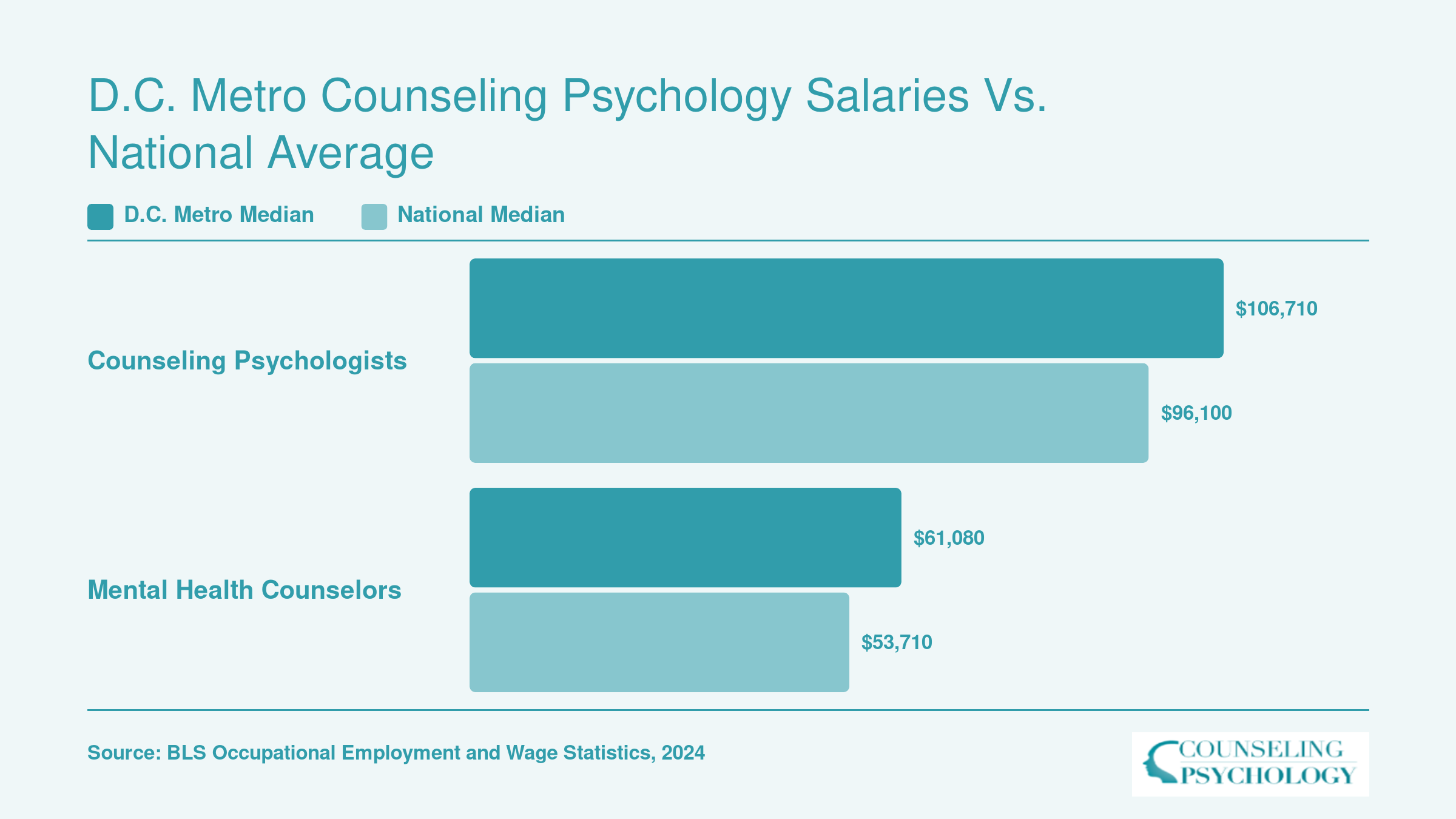
D.C. Metro Counseling Psychology Salaries vs. National Average
Salaries for counseling professionals in the Washington, D.C. metropolitan area consistently outpace national figures. The comparison below draws on BLS data for two key occupational groups, illustrating the earning premium that the D.C. metro commands.
How to Choose the Right Counseling Psychology Program
What should you actually look for when comparing counseling psychology programs near Washington, D.C.? The answer depends on where you want to land after graduation, and getting that alignment right from the start saves a lot of frustration later.
Match the Training Model to Your Goals
Every accredited program operates from a guiding philosophy about how psychologists and counselors are trained. Scientist-practitioner programs, common in doctoral-level counseling psychology, expect graduates to consume and produce research alongside clinical work. Practitioner-scholar models, more typical in professional counseling master's programs, tilt toward applied skills and reflective practice. Neither is better in the abstract, but one will fit your career direction better than the other.
When you visit a program's website, look for explicit language about its training model. If the program does not state it clearly, that itself tells you something. Academic or research faculty positions, competitive internship placements, and licensure-track clinical roles each reward different preparation. Know which path you are aiming for before you apply.
Investigate Faculty and Scholarship
Faculty research areas shape what gets taught, what supervision looks like, and what doors open through mentorship. On any program's faculty page, look beyond job titles. Check whether faculty members publish consistently in peer-reviewed journals, and whether those journals cover topics relevant to your interests, such as multicultural counseling, trauma, health psychology doctorate programs, or community mental health. Sparse or stale publication records can signal a program that is coasting rather than contributing to the field.
Evaluate Clinical Training Depth
Practicum and internship requirements vary considerably across programs. Ask programs directly: How many supervised hours are required before graduation? Where are the placement sites, and do they include settings relevant to the populations you want to serve? Who provides supervision, and how is it structured? Stronger programs have established site partnerships, diverse placement options, and licensed supervisors with meaningful clinical credentials.
Verify accreditation independently. APA-accredited programs appear on the APA's official accreditation lookup, and CACREP-accredited programs are listed on CACREP's website. Do not rely solely on what a program's own marketing materials claim.
Use Authoritative Data Sources
Salary expectations and job-market realities are best drawn from primary sources. The Bureau of Labor Statistics publishes occupational outlook data and wage figures at bls.gov, broken down by occupation and, in many cases, by state and metro area. If you are still weighing different credential paths, exploring the different types of psychology degrees can help you understand which level of training matches your goals. Professional associations such as APA and ACA publish guidelines that also serve as a useful checklist when evaluating program strengths and gaps. Cross-reference what programs promise with what independent data actually shows about the field.
Frequently Asked Questions About Counseling Psychology in D.C.
Prospective students exploring counseling psychology in the D.C. metro area tend to share a common set of questions about admissions, licensure, and program format. The answers below draw on current requirements in the District, Maryland, and Virginia to help you plan with confidence.
More Counseling Psychology Programs to Explore
Beyond the top-ranked programs, here are additional accredited counseling psychology programs available online. Each entry includes key details to help you compare options.
- Master of Education in Counseling and Development (School Counseling)
- Master of Education in Counseling and Development (Clinical Mental Health)
- Master of Science (MS) in Clinical Psychology
- Counseling
- Master of Science in Addiction Counseling
- Master of Education in Clinical Mental Health Counseling
- Counselor Education (PK-12 Professional School Counseling)
- Counselor Education (Clinical/Community Counseling)
- School Counseling
- Counseling Psychology (M.A.)
- MA in Clinical Psychology with an Emphasis in Marriage and Family Therapy
- Master of Education in Clinical Mental Health Counseling
- Clinical Mental Health
- Master of Science in Clinical Mental Health Counseling
- Master of Science in Clinical Mental Health Counseling (Addictions and Substance Abuse)
- Master of Science in Clinical Mental Health Counseling (Couples and Family Counseling)
- M.A./Ed.S., Professional Counseling (Online)
- Master of Arts in Clinical Mental Health Counseling
- Master of Arts in Clinical Mental Health Counseling (Marriage and Family Therapy)
- Master of Arts in Clinical Mental Health Counseling (Substance Use Disorders)
- M.A.-C.P. in Community Mental Health